WARNING: This story contains details of child pornography and sexual violence.
###
The question of whether sexually violent predator Richard Stobaugh should be released back into the community remains open tonight following an all-day hearing that explored the implications of his reported possession of child pornography while confined to a state mental hospital.
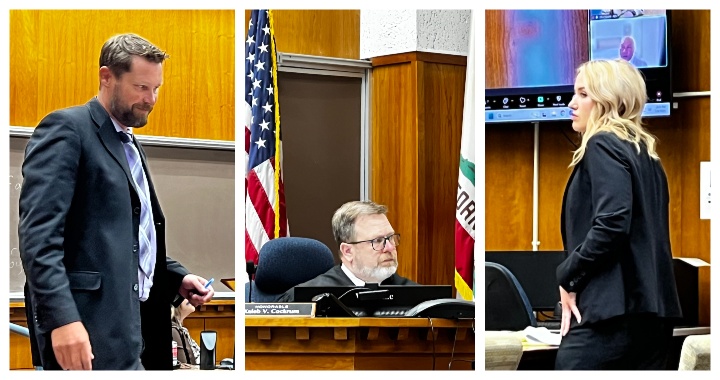
Appearing before Humboldt County Superior Court Judge Kaleb Cockrum, Senior Deputy District Attorney Whitney Timm called a series of witnesses who testified that Stobaugh was found in possession of a contraband hard drive in 2018 and that the device contained folders with pornographic photos and videos of underaged girls. Timm argued that by failing to disclose this information to his treatment team at Coalinga State Hospital, Stobaugh revealed himself to be “deceptive by nature,” a man who remains a predator who’s unsafe to be released.
Meanwhile, Humboldt County Public Defender Luke Brownfield, who is charged with defending Stobaugh, questioned whether the hard drive belonged to Stobaugh or to another inmate altogether. And a pair of mental health professionals testified that, even with the evidence of child porn possession, they stand by their professional assessments that Stobaugh is appropriate for conditional, supervised release.
Stobaugh was sentenced to prison in 1988 for a series of violent sexual assaults, and in 2012, after being designated a sexually violent predator, he was transferred to the locked facilities of Coalinga State Hospital. His treatment team there says that in recent years, Stobaugh has willingly submitted to treatment and, having served his full prison sentence, he is now appropriate for highly supervised released.
But there has been significant public outrage — along with official statements of opposition from Sheriff William Honsal and the Humboldt County Board of Supervisors — to a proposal that would place Stobaugh in a house on the outskirts of Manila.
Stobaugh, now a senior citizen, appeared today via Zoom on a wall-mounted TV in the courtroom wearing a long-sleeved, collared tan shirt with matching pants. During the proceedings he occasionally wrote down notes, but mostly he was attentive to the witnesses, who testified remotely via Zoom.
At the end of today’s evidentiary hearing, Timm urged Judge Cockrum to deny Stobaugh’s release while Brownfield argued that the defendant has changed and should be granted released per the recommendations of his treatment team.
Cockrum took the matter under submission and said he’ll likely issue a ruling on the matter tomorrow (Wednesday) morning.
Stobaugh appearing via Zoom on the courtroom TV screen. | Photo by Ryan Hutson.
###
At the outset of today’s hearing, Cockrum explained that since Stobaugh has served the entirety of his prison sentence and been recommended for release, the burden lies on prosecutors to show by “a preponderance of the evidence” that his release would be inappropriate.
Timm’s first witness, sworn peace officer Gerardo Paredes, testified that as part of a special search team at Coalinga, he helped conduct a search of Stobaugh’s four-man dorm room on April 6, 2018. The search uncovered three portable DVD players, a projector and a hard drive. The serial numbers on the DVD players had been scratched off, which is against the law, Paredes said.
The People’s second witness, Sandy Herr, is a special agent with the California Department of Justice but was employed as a detective at Coalinga in 2018. Two weeks after the contraband was recovered from Stobaugh’s dorm, Herr helped conduct an interview of Stobaugh at his request, she said.
During that interview, Stobaugh was “nervous, shaky and sweaty” as he tried to attribute everything on the confiscated hard drive to another inmate, Robert Abelman, whom he considered his best friend. According to Herr, Stobaugh told the investigators that he expected child pornography to be found on the drive — photos of 16- to 17-year-old girls in a file folder named “J.B.” for “jail bait.” He said Abelman had shown him one of these photos and he offered to provide information about Abelman smuggling methamphetamine into Coalinga.
Herr said Stobaugh’s story changed under questioning that he misrepresented his own criminal history, claiming his youngest victim was 20 years old when in fact she was only 18. As the interview progressed, Stobaugh appeared “nervous, sweating and stuttering,” his face red and twitching, which led Herr to conclude that he wasn’t being forthcoming.
In the interview, Stobaugh said he’d obtained his friend’s hard drive so he could watch movies, but he couldn’t give any examples of movies that would be found on the device, Herr testified. Under further questioning, Stobaugh said the girl in the photo was actually only 14 or 15, not 16 or 17, and that she was nude. Herr said his demeanor changed while describing the photo: He was smiling as if pleased, with a smirk on his face.
On cross-examination, Brownfield asked Herr why she’d never asked Abelman if the hard drive was, in fact, his. She said it was because the item had been found in Stobaugh’s dorm, not in Abelman’s, and because Stobaugh clearly knew what was on it and tried to “manipulate the situation.”
On redirect from Timm, Herr testified that during the investigation with Stobaugh, she offered to go ask Abelman directly if the hard drive was his, which caused Stobaugh to get nervous and say something like, “I just killed myself.” In her estimation, Stobaugh really didn’t want investigators revealing to Abelman what Stobaugh had been telling them.
The People’s third witness was Coalinga peace officer and certified cybercrime examiner Hill Magpayo. He testified about what investigators found on the hard drive through a forensic analysis. There was a folder named “ZZZ Rick’s folder,” and Magpayo said “Rick” was Stobaugh’s nickname.
In a folder named “Personal Stuff,” investigators found a sub-folder named “My Movies” that contained a 12-minute video showing a Caucasian girl, roughly 10-14 years old sitting on a patio. The video starts out with her fully clothed but proceeds to depict her orally copulating with an adult man who then engages in vaginal sex with her, Magpayo said.
Another sub-folder, labeled “Pictures,” held photos of an Asian girl, age 12-14, laying on a bed masturbating. Forensic search tools eventually discovered “several thousand” photos of various children, some engaging in sex acts while others were merely “erotic” images of naked or partially naked kids, Magpayo testified.
He also said that Abelman was willing to testify that the hard drive was his but that he (Abelman) didn’t believe there was any child pornography on it.
Both Magpayo and Herr had trouble remembering many of the details of these incidents, some of which occurred more than seven years ago, and Timm often had to prompt them to refer to their reports or to other documents, which resulted in drawn-out and stilted testimony. In one such exchange, Timm asked Magpayo to find a spot in an interview transcript where Stobaugh said Abelman was running a business in the hospital, operating a drug trade and selling other contraband to fellow confined patients.
Later, Magpayo testified that, according to Stobaugh, Abelman had an electronic tablet that he’d “jailbroken” to gain access to the internet via WiFi. Stobaugh admitted to showing photos on the tablet to other patients and Coalinga, who said that the images didn’t look legal, according to Magpayo.
The dorm room search in 2018 also turned up handwritten papers that looked like “payo” sheets — a ledger of debts for contraband, complete with emails and bank account numbers. Timm displayed a copy of the document on Zoom via a courtroom camera.
Magpayo said that Abelman had the nickname “Mickey” in the hospital, and there was a notation on this paperwork saying “Mick-Rick 2018.” Notes of apparent transactions referenced photo trades, and one mentioned “bisexual trades.”
Other notes contained technical details about computer programs and operating systems, including Linux and Android. Magpayo said Linux is sometimes used in criminal activity, but he had difficulty explaining specifics. (At one point, Judge Cockrum sustained an objection from Brownfield about this testimony, noting that Magpayo apparently “doesn’t understand the difference between an operating system and a program.”)
Recovered photos of child pornography were sent to the National Center for Missing and Exploited Children (NCMEC), where the images were matched to two known victims.
Public Defender Luke Brownfield (left), Judge Kaleb Cockrum and Senior Deputy District Attorney Whitney Timm. | Photos by Ryan Hutson.
###
At several points during today’s hearing, Timm and Brownfield both asked witnesses about the apparent communication breakdown between law enforcement investigators and the medical treatment team at Coalinga State Hospital, as well as the Humboldt County District Attorney’s Office, which didn’t learn of Stobaugh’s possession of child pornography until fairly recently.
On cross-examination of Magpayo, Brownfield asked whether the handwritten transaction log could have documented bartering of legal items such as food, and Magpayo admitted that it could. He also admitted that he never interviewed Abelman, saying there was no reason to since the contraband had been found in Stobaugh’s room, though the hard drive contained some of Abelman’s documents, including legal materials and personal correspondence.
Stobaugh told investigators that he never personally accessed files containing child pornography, and the investigators found no child porn in the folder labeled “Rick’s stuff.”
Brownfield suggested that some of the images that were supposedly of an Asian minor may in fact have been photos of Abelman’s girlfriend at the time, who was a college-aged Asian woman.
After a lunch break, the court heard testimony from clinical psychologist Dr. Paul Murdock, who conducted annual evaluations of Stobaugh for many years, and Dr. Robert Cureton, clinical director of the conditional release program (CONREP) for sexually violent predators at Liberty Healthcare, the agency that will be charged with monitoring Stobaugh should he be granted release.
Timm pressured both doctors on whether the testimony they’d heard today, or any of the facts regarding Stobaugh’s possession of child pornography and his failure to disclose it, gave them pause or made them reconsider their recommendation to release him to the community under supervision.
Dr. Murdock said he has consistently diagnosed Stobaugh with an other specified paraphilic disorder (a type of recurring, intense and atypical sexual arousal), substance use disorder and antisocial personality disorder, and he said Stobaugh remains a sexually violent predator.
But he said Stobaugh’s possession of child pornography in 2018 doesn’t change his risk assessment, which is based on something called a Static-99R, a widely used risk prediction instrument that estimates the probability of reoffending among adult males with a history of sexual crimes.
Murdock said Stobaugh’s Static-99R score is a 1, but even if it was upgraded to a 2, that’s the level given to common sex offenders who are routinely granted release after serving their sentences. Murdock also said there’s no evidence that Stobaugh is sexually attracted to children, though he may have used child porn as a commodity in the hospital.
Timm pushed back on this, noting incidents from Stobaugh’s criminal past in which he sexually assaulted women with children nearby, seemingly using the kids as a means of control. And she asked Murdock whether he considers children depicted in child porn victims, to which he said yes.
But Murdock stood by his professional opinion, saying Stobaugh has willingly engaged in treatment for years now and evidence shows that there’s a steep drop in rates of reoffending once men become elderly.
Dr. Cureton likewise stood by his opinion that Stobaugh can be safely released under strict supervision, which includes monitoring through a GPS-enabled ankle bracelet, random drug testing, regular polygraph testing, computer monitoring, intensive psychotherapy and direct supervision — tools that “are designed to keep the community safe and to make sure that the person is progressing successfully.”
Today’s hearing occurred because the prosecution asked the court to reconsider its order granting Stobaugh’s conditional release, and Cockrum explained that due to the “liberty interest” that has already been granted to Stobaugh, the D.A.’s office bore the burden of proof.
Timm proceeded to argue that she had met that burden by showing that Stobaugh still displays risky, manipulative and deceitful behaviors, and that, through his possession of child porn, he was still victimizing people. She said that there’s no sign that his “selfishness and criminality” will change if he’s released.
“He is deceptive by nature,” Timm said. “He is a predator, and that’s exactly what Dr Murdock said that he is. But they’re not doing anything to adequately supervise him.”
Brownfield countered that the experts are considered experts for a reason, and they’ve given their opinions that he’s now appropriate for release, having passed every polygraph and done everything required of him since 2019. Brownfield said the allegation of child porn possession hasn’t been definitively proven, and even if it had, that was seven years ago and his doctors testified that he has changed.
Cockrum took the matter under submission and said he expects to announce his decision in the morning. Check back tomorrow for more coverage of this case.
The Wiyot Tribe’s Dishgamu Community Land Trust has partnered with Redwood Capital Bank to receive from FHLBank San Francisco $2 million that will help create 52 senior apartment affordable housing units to be located at Laquilh Hou Daqh “Where the Elders Are” housing development on 6th and L Streets in Eureka and $2 million dollars towards 41 affordable housing units for lower-income families and individuals at the Gou’wik Hou Daqh “Where the Families Are” Housing development on 5th and D street in Eureka.
“The Tribe has prioritized affordable housing because our tribal citizens are struggling to find affordable housing, our people are being displaced in their own ancestral lands due to ever increasing housing costs in our region. Bringing 93 affordable housing units to our area will help address that,” said Wiyot Tribal Chair Brian Mead
AHP grants contribute to the development or preservation of single-family and multifamily housing that serves people in need, including lower-income families, the chronically unhoused, families, seniors, veterans, at-risk youth, people living with disabilities and mental health challenges or overcoming substance abuse, many others.
“Funding for these two developments represents wins for our entire community, new affordable housing units for people struggling to find housing in our community; 93 units towards Humboldt County’s state-mandated Regional Housing Need for 3390 new units by 2027; and another successful partnership and land back opportunity between the City of Eureka and the Wiyot Tribe that satisfies affordable housing needs of both the City and the Tribe,” Michelle Vassel, Wiyot Tribal Administrator
The Bank’s member financial institutions work in partnership with community-based housing developers or providers to compete for AHP General Fund or Nevada Targeted Fund grants by submitting applications for specific projects in an annual funding competition. In total for the 2025 program cycle, the Bank’s AHP awarded funding for 31 affordable housing projects, including 22 in California, four in Arizona, and five in Nevada.
“In a critical time when more solutions to address the growing housing affordability crisis are desperately needed throughout our high-cost region of Arizona, California, and Nevada, we are pleased to deliver on our mission of partnering with our member financial institutions to support affordable housing and economic development,” said Joe Amato, interim president and chief executive officer of FHLBank San Francisco. “We are proud to work with our members and their partners, including Redwood Capital Bank and the Wiyot Tribe’s Dishgamu Humboldt Community Land Trust, to help make a positive impact by creating and preserving access to more high-quality, units of affordable housing that individuals and families a place to call home.”
Since the inception of its Affordable Housing Program in 1990, FHLBank San Francisco has partnered with its members to award $1.41 billion in AHP grants to help fund the development of preservation of nearly 155,000 units of affordable housing, helping hundreds of thousands of people throughout California, Arizona, Nevada, and other regions served by FHLBank San Francisco members, have an affordable place to call home.
For more information about the 2025 AHP General Fund and AHP Nevada Targeted Fund winning projects, visit FHLBank San Francisco’s website at fhlbsf.com.
Dishgamu Community Land Trust
Since time immemorial, the Wiyot people have lived along Shou’r (the Pacific Ocean) and around Wigi (Humboldt Bay). Until the onset of settler-colonialism in the 1850s they have lived in reciprocal relationship with over 40 miles of coastline, extending inland about 10 miles, living in balance with the plants, animals, earth, water, and air across multiple ecosystems and watersheds. Today, this unceded ancestral territory is marked by the negative effects of decades of extractive practices around fur, minerals, timber, fishing, water diversion, and more recently, real estate speculation. This has left the region to face increasing economic inequality alongside environmental degradation and destabilization.
Dishgamu Community Land Trust was created to address these challenges and help restore balance to Wiyot ancestral territory - now a collection of highly interdependent yet disparately governed cities and towns, as well as the population center of Humboldt County and the northern California coast. Our deeply rooted environmental knowledge and territorial-scale perspective make us uniquely equipped to address the scale and complexity of the challenges before us.
A key symptom of this imbalance is the lack of access to affordable, safe, and healthy housing. This not only impacts on the ability of Wiyot people to remain in their homeland but threatens the ability of the entire community to thrive in relationship to the land. Short-sighted or profit-driven responses to current housing market pressures threaten to destroy natural resources, put communities in the path of environmental hazards, and ignore the needs of historically underserved communities. The current market creates many contradictions: over a thousand houseless people living alongside vacant buildings; residents in subsidized housing choosing between economic advancement and housing security; and supposed solutions only adding fuel to the current crisis. Dishgamu Humboldt seeks to establish radically alternative forms of housing development that remove the profit-motive and empower communities. Understanding the scale of our region’s housing needs and the communities most impacted helps us set priorities for new housing construction and affordable housing preservation.
FHLBank San Francisco
The Federal Home Loan Bank of San Francisco is a member-driven cooperative helping local lenders in Arizona, California, and Nevada build strong communities, create opportunity, and change lives for the better. The tools and resources we provide to our member financial institutions — commercial banks, credit unions, industrial loan companies, savings institutions, insurance companies, and community development financial institutions — propel homeownership, finance quality affordable housing, drive economic vitality, and revitalize whole neighborhoods. Together with our members and other partners, we are making the communities we serve more vibrant and resilient.
Press release from the Humboldt County Sheriff’s Office:
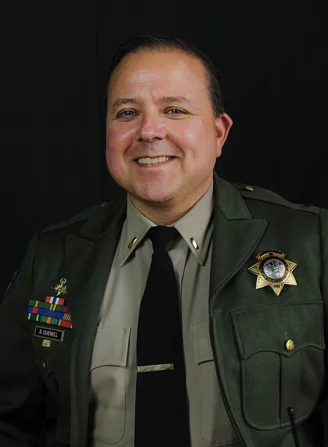
Quenell.
The Humboldt County Sheriff’s Office (HSCO) is proud to recognize Captain Bryan Quenell, who is retiring after 31 years of dedicated service to our community.
Born and raised in Humboldt, Quenell is a third-generation law enforcement officer. Following in the footsteps of his grandfather and father—who served with the Eureka Police Department, the District Attorney’s Office, and the Sheriff’s Office—he joined the police academy in 1994. By day, he trained with the new recruits. By night, he worked as a records clerk in the courthouse, often answering phones and filing records until 2:00 in the morning.
Since graduating from the police academy in 1995, Quenell has served important roles in nearly every arm of the Sheriff’s Office. His roles have included Correctional Officer, Resident Deputy in Hoopa, Field Training Officer, and a Team Leader for both the Marijuana Enforcement and Special Services teams, the unit that handles boating, off-highway vehicles (OHV), and search and rescue. He later served as Sergeant, Lieutenant, and Commander of the Drug Task Force and SWAT teams. Known for stepping into any role that was needed, he led special projects like integrating the Sheriff’s Office with the Coroner and forming the Community Response Unit, a problem-oriented policing team with a tip line for anonymous citizen complaints.
After two decades of steadfast service, Quenell was promoted to Captain in 2018. In this role, he oversaw Patrol, Special Services, Major Crimes, the Coroner’s Office, Animal Control, Neighborhood Watch, and Emergency Communications Center—all simultaneously. Despite his many accomplishments, he remains humble about his time with HSCO and hopes his colleagues will remember him as “firm but fair.”
“I did what I could while I was here and did my best to make it better every step of the way, no matter what role I was in, whether I was a clerk or a correctional officer or a deputy. It was just about trying to make it better for the people who will come behind me. It’s nice to give back to the community that helped raise me,” said Quenell.
As for what’s next on the horizon, right now he has no formal plans. “My wife’s convinced that I won’t be able to sit still and that I’ll probably want to get back involved at some point. Maybe a couple of years down the road, we’ll see. You never know what the future holds.”
Sheriff William Honsal praised Quenell’s impact on the agency. “We were privileged to have him as part of the HCSO family for so many years. Though he never sought recognition or accolades, his impact on this office is undeniable. He leaves behind a legacy of service and dedication, and he will be deeply missed.”
If you’re inspired by Captain Quenell’s story of commitment and service, you too can join the HSCO family. Visit humboldtsheriff.org/join for current job opportunities.
Baduwa’t estuary? More like GOODuwa’t estuary, if you’re a fish! Photo: Colton Dixon.
Press release from Caltrout:
California
Trout (CalTrout) announced today that the Baduwa’t (Mad River)
estuary restoration project has been successful in providing natural
habitat to numerous threatened species, according to new monitoring
data. The 9.3-acre project, designed by Northern Hydrology and
Engineering, and completed in partnership with McKinleyville
Community Services District in late 2022, transformed former
wastewater percolation ponds into floodplain habitat that is now
successfully supporting a thriving ecosystem.
“These
monitoring results prove that strategic habitat restoration works,”
said Mary Burke, CalTrout’s North Coast Regional Manager. “The
Baduwa’t restoration project site is providing some of the only
refugia habitat for fish to escape from high winter flows in the
estuary. We were especially excited to learn that coho salmon have
utilized the site every winter since construction.”
Post-restoration
monitoring conducted by Dr. Darren Ward at California State
Polytechnic University Humboldt reveals the site is functioning
exactly as scientists hoped. CalTrout hired Ward’s crew for
post-project monitoring, building on a long-term partnership through
which Ward brought students to sample the site regularly since before
construction, allowing researchers to document the ecosystem change
before and after restoration.
The
monitoring shows Chinook and coho salmon have occupied the restored
area every year since construction, with young salmon following their
natural life cycle and pausing their journey to the ocean to eat and
grow rapidly in the protected waters. Fish occupying the site have
growth rates as fast or faster than similar restoration projects and
significantly faster than fish remaining in their birth streams.
Notably, coho fry younger than one year are about 20% longer than the
ones outside the pond. The site supports juvenile salmonids with
winter habitat and a critical stopover in their migration corridor,
with increased numbers of smolts using the area during their spring
ocean migration.
Throughout
25 sampling events from January 2023 to May 2025, researchers
documented more than 15,500 individual fish representing 17 different
species at the restoration site. The vast diversity of species
included threatened Chinook and coho salmon, threatened steelhead
trout, state species of special concern coastal cutthroat trout, and
endangered tidewater goby.
“It
has been an amazing opportunity to follow along with the CalTrou
project from the initial planning stages to follow-up monitoring
after implementation,” said Dr. Darren Ward, Department of
Fisheries Biology Professor at Cal Poly Humboldt. “CalTrout’s
funding for monitoring allowed me to hire a crew of students for
field work, providing critical work experience as they start their
careers.”
The
success demonstrates that reconnecting rivers to their floodplains
can rapidly restore ecosystem function, creating habitat that
supports salmon, marine species like bay pipefish and starry
flounder, and also serves as an introduction for the next generation
of restorationists. For more information about the Baduwa’t estuary
restoration project and more of CalTrout’s restoration work on the
North Coast, click HERE.
About
California Trout
California
Trout is a nonprofit conservation organization dedicated to
revitalizing waters for resilient wild fish and a better California.
Through science-based advocacy, restoration and community engagement,
CalTrout protects and restores the state’s freshwater ecosystems
for fish and people alike.
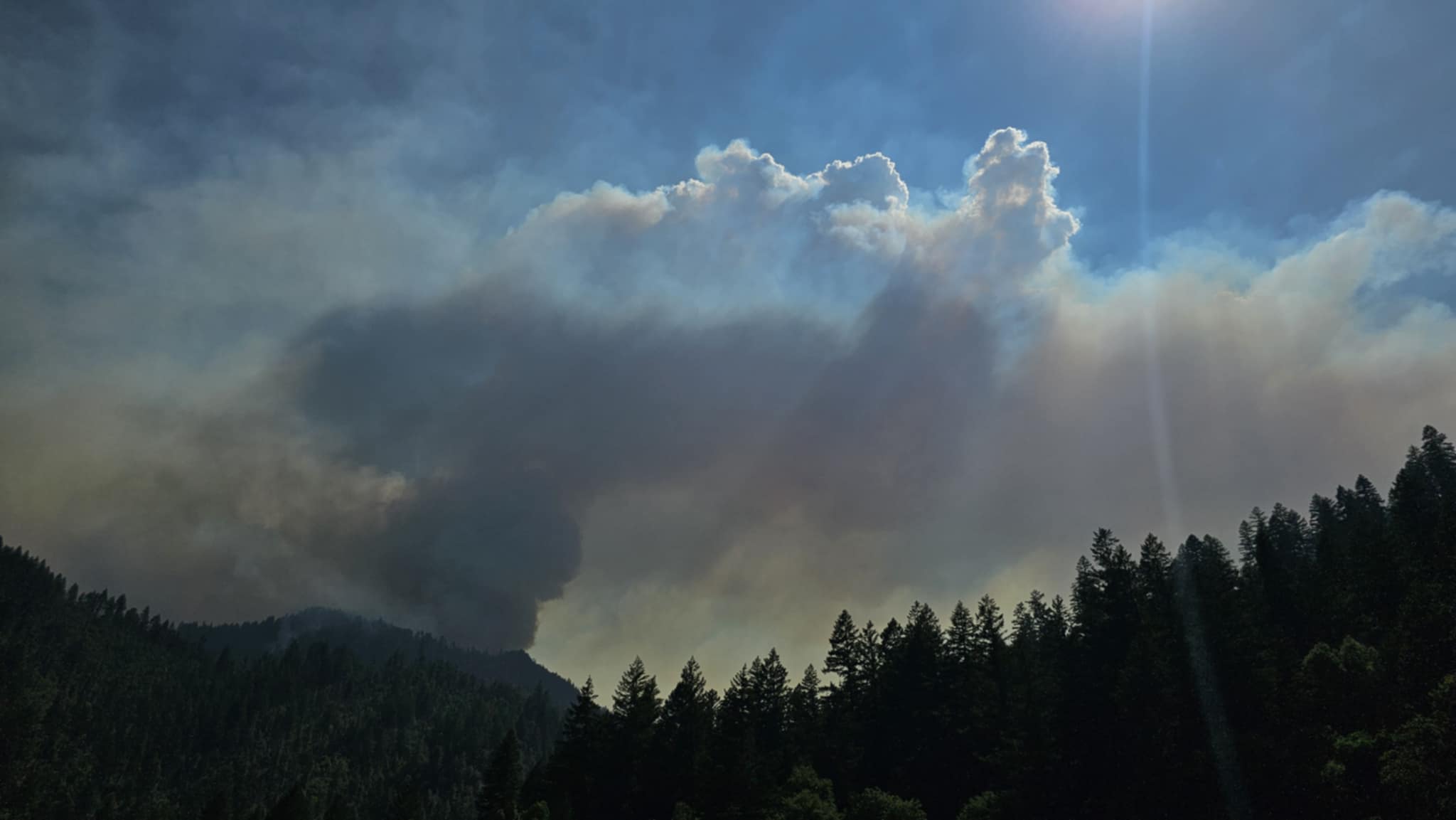
Morning view of the Butler Fire burning at the Humboldt-Siskiyou county line. | Photo: Abel Mattson - Orleans Patrol 25.
Butler Fire — Siskiyou County
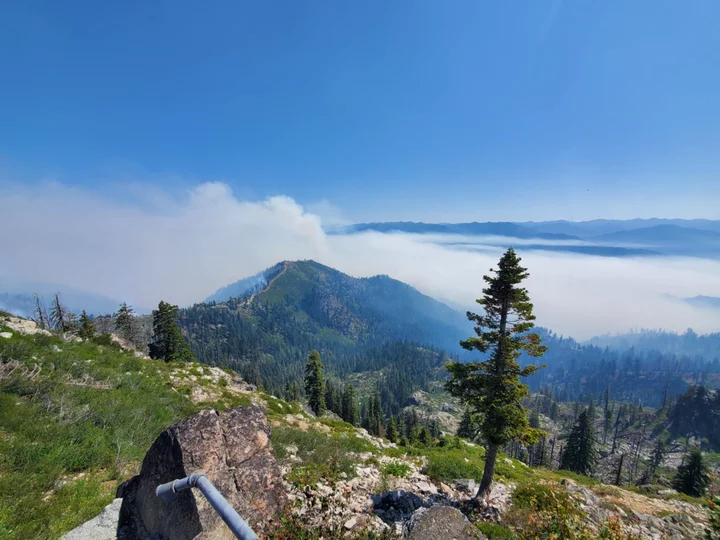
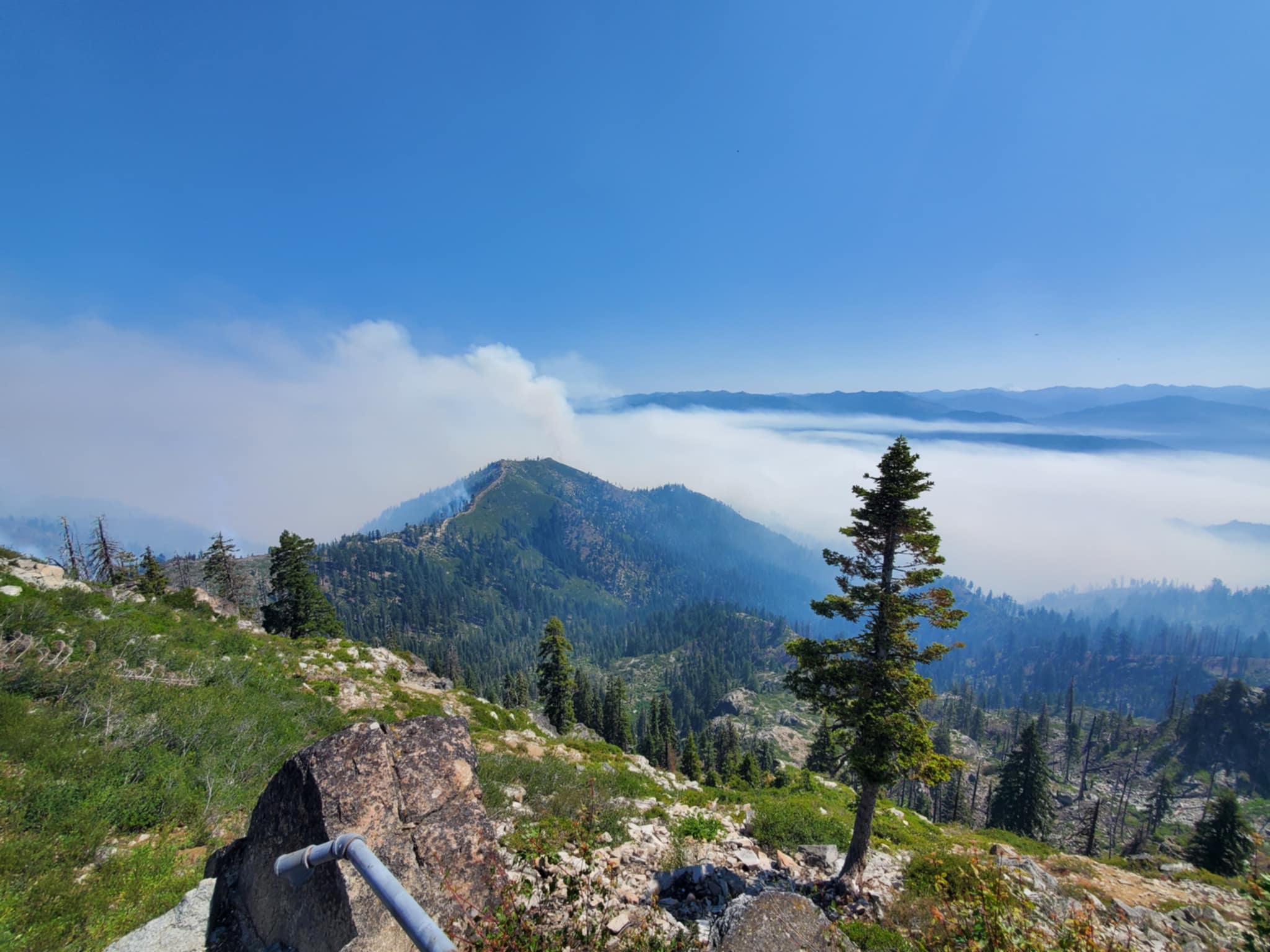
The Butler Fire has quadrupled in size in the last 24 hours, growing from 233 acres to 966 acres with no containment. The fire is burning approximately 10 miles northeast of Orleans, near Butler Mountain above Salmon River Road.
There is a mandatory evacuation order in place for zones SIS-1703 and SIS-1708 in Siskiyou County. There are evacuation warnings in place for zones SIS-1704 (Butler Creek, Lewis Creek and Bloomer Mine), SIS-1707, SIS-1710 and SIS-1803-A. Nordheimer and Oak Bottom campgrounds are currently closed for fire suppression activities. Click here for an interactive map of current evacuation orders.
A map of evacuation orders and warnings for the Butler Fire. | Screenshot
The following additional information comes from the Six Rivers National Forest:
Leader’s Intent: The Butler Fire is being managed with a full suppression strategy emphasizing
firefighter and public safety while protecting critical values at risk.
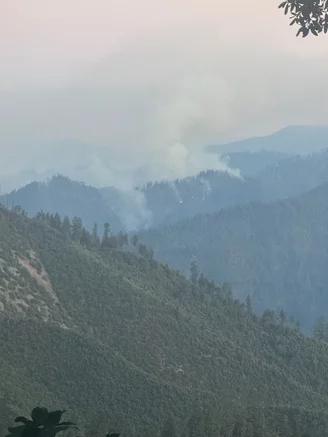
Photo: Kyle Fears - Engine Captain 322
Operational Update: Today the Butler and Nordheimer Structure Groups will continue to focus on
implementing their structure protection plans, with a strong focus by Butler Structure Group on the Butler
Flat Community’s water system infrastructure. Along Salmon River Road, crews will begin to complete
roadside brushing activities as well as continue to prepare the lower section of the Boundary/Orleans Trail
to connect to the work done by crews along the ridgeline.
Crews have been working tirelessly to contain this fire. IR flight data reports that yesterday the fire doubled
in size, making today’s response efforts critical to minimize continued growth. Crews on the ground and
aircraft will begin the day by assessing how the line held overnight and engage quickly where it is safe to
do so. Helicopters will be dropping water on critical locations as conditions allow. Crews will also engage
on the spot fires near the boundary ridgeline in the headwaters of Hammel Creek. Since the fires began on the
ridgetop, the ideal situation is to back the fire down with low intensity from the ridge down towards the
Lewis Creek drainage. The goal is to continue to fully suppress the fire with all means possible, going
direct on the Boundary/Orleans Mountain Trail and utilize air resources to tame critical hotspots.
The Incident Command Post will remain at the Orleans District Office with base camp located at the Oak
Bottom Campground.
One prescribed burn and one cultural burn are planned to occur today. Both of these actions are separate
from the Butler Fire incident management. The Mid Klamath Watershed Council (MKWC) and partners
plan to move forward with the All Hands All Lands Butler Rx plan to burn 6 acres at Butler Flat Meadow
at approximately 4 p.m. This is independent from the Butler Fire, and they provide all their own resources
and plans. If there are questions or concerns, please contact MKWC Fire and Forestry Program at 530-
627-3202. A Cultural burn may also occur directly across the creek from the All Hands All Lands
prescribed fire.
View from Orleans Mountain lookout. | Photo: James McLaughlin - Orleans Crew 20
Community Meeting: There will be a community meeting about the Butler and Red Fires Wednesday,
July 9 at 5 p.m. at the Karuk Department of Natural Resources located at 39051 Highway 96 in Orleans.
For those unable to attend in person, a recording will be available on Facebook after the meeting.
Closures & Evacuations: Siskiyou County Sherriff have evacuations warnings and orders in place for
the Butler Fire. As Evacuation Order has been issued for SIS-1703 (no residents). Warnings apply to
zone SIS-1704 (Butler Creek, Lewis Creek, Bloomer Mine residents and Nordheimer Campground),
SIS-1707, and SIS-1803-A (no residents). There are no planned road closures along Salmon River Road.
However, the public may experience minor delays as crews work on roadside brushing over the next few
days. Nordheimer and Oak Bottom Campgrounds are closed due to wildfire and fire suppression activities.
Weather & Fire Behavior: Local weather will be warm (high 80s) and slightly breezy today (southwest
winds 5-8 mph). Relative humidity remains around 50% to 60%, which may help moderate fire behavior
despite warm, breezy conditions.
Fire Safety & Prevention: The local area is likely to have both wildfire suppression operations and
external prescribed and potentially cultural burning today. These operations are being done with care
and consideration for firefighter and public safety. Area residents and visitors should be aware of their
surroundings, watch for increased traffic in the area and try to avoid being in the fire area. With this
activity and the issuance of evacuation warnings, residents and visitors should review resources at
www.siskiyoucounty.gov/ReadySiskiyou.
Fire Information: For additional fire information and resources, please visit www.linktr.ee/srffirepio.
The Marble Complex and Jacket fires continue to burn further east. As of this writing, the Marble Complex Fire is at 445 acres and five percent containment, and the Jacket Fire is holding at 50 acres with five percent containment.
###
A map of evacuation warnings for the Bridge Fire. | Screenshot.
Bridge Fire — Humboldt County
Fire crews have made significant progress on the Bridge Fire, which ignited near Alderpoint on Sunday evening. The fire, burning on either side of the Eel River, has grown by about 55 acres in the last 24 hours, to 403 acres with 30 percent containment.
There are 300 fire personnel currently assigned to the fire, along with 45 engines, one dozer, nine crews and seven water tenders.
“Firefighters continue to strengthen the perimeter on two vegetation fires burning on opposite sides of the Eel River, in grass, brush, and timber,” according to CalFire.
An evacuation warning is still in effect for residents in zones HUM-E204-A and HUM-E204-B. A previous notification on Watch Duty, a volunteer-contributed fire information resource, indicated that the evacuation warning was lifted on Monday, but that does not appear to be the case. An interactive map of current evacuation notices can be found here.
###
Aerial view of the Red Fire via Six Rivers National Forest.
Red Fire — Del Norte County
The Red Fire, which ignited on Sunday, has burned 28 acres east of Klamath Glen with no containment. There are no evacuations in place at this time. The following additional information comes from the Six Rivers National Forest:
Firefighters are continuing to respond to the Red Fire burning in the Siskiyou Wilderness on the Six Rivers National Forest Orleans Ranger District.
The fire is approximately 28 acres and is located about 1.5 miles north of Nickowitz Peak near Blue Creek. Cause is under investigation and there is no containment. There are no structures or communities threatened.
The Red Fire is burning in heavy fuels and dense vegetation with moderate fire behavior. The fire growth from 3 acres to approximately 28 acres today was driven by steep terrain and winds.
Smokejumpers and rappelers were fighting the fire today after arriving on scene this morning. Aviation resources have been working on suppressing the fire throughout the day.
While firefighters are working on fighting the Red and Butler Fires on the Six Rivers National Forest, as well as supporting incidents throughout Northern California, the public is asked to use caution with anything that can spark a fire.
This story was originally published by CalMatters. Sign up for their newsletters.
###
Amid calls for police reform in the aftermath of George Floyd’s murder in 2020, California lawmakers set out to raise education standards for incoming law enforcement officers. Five years later — as California faces a widespread shortage of police officers — those reforms are being debated once again.
In 2020, former Assemblymember Reggie Jones-Sawyer introduced a bill that would have required prospective police officers 18 to 25 years old to earn a bachelor’s degree before entering the police force. A growing body of research shows that college-educated law enforcement officers tend to use less force and exercise better decision making.
The bill was ultimately revised after it was criticized as too restrictive by law enforcement and labor leaders. In an updated version, which was signed into law the following year, lawmakers agreed to raise the minimum age of a police officer to 21 years old, and they asked local police and school officials to create recommendations for new higher education requirements.
This year, Assemblymember Jacqui Irwin, a Democrat from Thousand Oaks, is proposing a new bill to establish education standards based on those recommendations, but some law enforcement and criminal justice reform advocates are skeptical — albeit for different reasons.
Starting in 2031, Irwin’s new law would require incoming officers to get a policing certificate, associate degree or bachelor’s degree, although there are some exceptions within 36 months of graduating from a police academy. It also creates a law enforcement recruitment task force to identify and recruit candidates for law enforcement agencies throughout the state.
In an interview with CalMatters, Jones-Sawyer said the current bill by Irwin undermines the original intent behind his 2021 law by allowing a loophole for incoming officers to satisfy the education requirement through a certificate, prior military experience or out-of-state law enforcement experience.
Some policing experts, such as former justice department official Arif Alikhan, echoed those concerns and said the exceptions swallow the whole. “It completely obviates the need to have any educational background,” said Alikhan. “Officers who have a college education tend to perform better.”
Representatives from some law enforcement unions, by contrast, think the bill still goes too far. Dustin Smith, president of the Sacramento Police Officers Association, said the new requirements “would be catastrophic to staffing statewide,” limiting the supply of incoming officers.
Those concerns haven’t stopped the bill from sailing through the Legislature, where it has received widespread support from many law enforcement agencies. It’s supported by all of California’s statewide law enforcement advocacy groups, including the California Police Chiefs Association, the California State Sheriff’s Association, the California Association of Highway Patrolmen and the umbrella labor organization that lobbies on behalf of police unions, the Peace Officers Research Association of California. It has received no formal opposition.
Democratic lawmakers at odds with one another over new standards
In introducing his bill, Jones-Sawyer viewed a college education as paramount to law enforcement training because it would expose incoming officers to new perspectives, healthy debate and critical thinking skills.
“We keep looking at law enforcement as if anybody can do it,” said Jones-Sawyer. “No. You need a certain type of person to have the skills and ability to deal with modern-day policing.”
Instead of requiring an associate degree in modern policing, as Jones-Sawyer said he intended, the new bill allows incoming police officers to meet the education standards with four years of military or out-of-state law enforcement experience. While Jones-Sawyer intended to carve out certain exceptions for people with prior specialized military or law enforcement experience, they would have only been given some credit – not all.
New officers also have the option of attaining a “professional policing certificate” from an accredited college or university, although that curriculum has not yet been developed.
The new bill “does not make policing better, it makes it devolve back into what it used to be,” said Jones-Sawyer. Irwin maintained that the bill advances his efforts and will help police officers improve themselves as they rise through the ranks.
Many police chiefs and sheriffs view the bill as a meaningful way to raise education standards while affording incoming officers the flexibility to meet them.
In May, Los Angeles Sheriff Robert Luna wrote a letter to Sen. Jesse Arreguín, an Oakland Democrat and chair of the Senate’s public safety committee, arguing in favor of Irwin’s bill. The sheriff’s office once required all applicants to have a bachelor’s degree, wrote Luna, but the requirement was “short-lived” because the office saw “an immediate decline in applicants by about 50 percent.”
Luna said Irwin’s bill is a “more workable, more inclusive path forward” because it includes exceptions for those with non-academic experience.
Although the vast majority of local law enforcement agencies nationwide only require a high school diploma, having a college degree can often create more opportunities for better pay and promotions.
Police officer shortage: truth or myth?
All across the state, law enforcement officials say staffing is an ongoing problem, which more education requirements might exacerbate. The Los Angeles County Sheriff’s Office is short roughly 1,500 officers as of June 1, according to spokesperson Miesha McClendon. The office was able to respond to recent protests through the support of staff from other areas of law enforcement, including its jails and detective division, McClendon said.
In rural areas, such as Plumas County in the northeast corner of the state, Undersheriff Chad Hermann said a single officer is sometimes responsible for covering communities that are as far as 70 miles apart. If that officer needs to make an arrest and drive a suspect to jail, a town could spend hours without any nearby police on duty, he said.
Sheriffs and police officers say the shortage is due to several factors, including low wages in some communities, an aging workforce and negative perceptions of police following high-profile instances of misconduct. Departments are offering starting bonuses and other incentives, such as better benefits, as a way to recruit new officers.
Some agencies gave record-breaking raises to officers coming out of the COVID-19 pandemic. In some places, including the California Highway Patrol, entry-level officers can expect six-figure salaries and top notch benefits.
But not all agencies can offer those perks.
“We’re not a rich county — we can’t offer the big hiring stipends,” said Hermann. “By adding a requirement like an associate degree, it’s going to make it harder to get people from our hiring pool.” He said even exceptions for those with military service may not help the recruiting problem since the hiring pool is so small in a county with just under 19,000 residents.
While the new law enforcement recruitment task force in Irwin’s bill is designed to ease some of those staffing challenges, Christy Lopez, a law professor at Georgetown University said it’s troubling to see that it would only comprise people from law enforcement.
“We need to be moving towards a recruiting approach that seeks to screen in the right people, not just screen out the worst people,” she said. “And to make sure that we develop that sort of approach to recruiting, you need perspectives broader than just law enforcement.”
She said the police recruiting crisis is a myth. “The idea that there’s a crisis in recruiting presupposes that we know what the right number of police officers is and that we’re not there,” she said. “And we don’t know that.”
What it takes to become a police officer
Devin Nisbet grew up in Calaveras County and as a kid, he had a positive experience with one of the officers when he prank-called 9-1-1. Instead of just disciplining Nisbet, who was around 6 years old, the officer gave him a tour of the police cruiser and handed him a patch with the sheriff’s office logo. “It made me want to be part of it,” said Nisbet in an interview with CalMatters.
After dropping out of college, Nisbet was working for a grocery store in Calaveras County when that same sheriff’s office held a recruiting event in a nearby parking lot. The agency promises a $10,000 bonus, spread out over three years, for new recruits. At the time, he said he thought to himself, “Why not try to do this?”
It took Nisbet roughly seven months to pass the county’s background checks and exams, which include a written test, a psychological exam and a medical exam. He then received a tentative job offer from the Calaveras County Sheriff’s Office, contingent on completing a police academy.
In January, he enrolled in the police academy at San Joaquin Delta College in Stockton. Police academy training in California typically takes a minimum of six months, but some police departments require far more training. Nisbet is paid by the Calaveras County Sheriff’s Office for the entirety of this training, just under $34 an hour.
The college program requires students to learn CPR, first aid, and various laws about use of force, search and seizure and firearms. They’re tested in scenarios that can include chases or combat. In one timed exam, they must pull a 165 lb dummy, cross a 25 yard obstacle course, run 500 yards and scale a 6-foot fence.
Some students fail to pass the academy’s courses. Others never get hired because they fail the police department’s background checks or have low scores.
Nisbet is set to graduate on July 2, at which point he’ll begin working, but his training won’t be over. New officers must complete weeks of field training and a year of probation.
“I believe that people, if they want to do this job, they need to get evaluated first,” said Nisbet, though he said an associate degree shouldn’t be required. He said many of his classmates don’t have a college degree.
Lauren Jill Miner Eureka,
Calif. February
4, 1963 – June 7, 2025
Lauren
Jill Miner, 62, of Eureka, passed away in her home on June 7, 2025
after a long battle with
chronic illness.
Lauren
was born at General Hospital in Eureka on February 4,
1963 to Richard “Bruce”
and Shirley J. Miner. Lauren attended primary and secondary schools
in Eureka, graduating
from Eureka High School in 1981, and eventually earning a Bachelor of
Arts in English
from California State University Humboldt. During her school years
Lauren developed a love
of music and theater, performing on woodwinds in various ensembles
during the 1980s and
1990s.
Since
her teen years, Lauren was an active member of the First Presbyterian
Church of Eureka. She
found a love for singing and became a regular member of her church
choir, adding her robust
voice to the tenor section. This experience led to her association
with the California Redwoods
Chorale, a community mixed chorus that made several concert tours
abroad. Like her
mother Shirley she was an active member of community service organizations, including PEO
(Philanthropic Educational Organization), which provides scholarship
opportunities for women
entering college or continuing their education later in life.
Lauren’s
professional life varied over the years: she sold residential
flooring in Sacramento, and seafood
at WinCo in Eureka, but was most fulfilled later in life after going
back to Cal Poly Humboldt
and earning a teaching credential. She spent the latter years of her
working life as a substitute
teacher and Speech Therapy facilitator for Eureka City Schools.
Lauren
is preceded in death by her mother, Shirley Jean Miner of Eureka, and her longtime partner
and love of her life, Tony Smith of Ashland, Oregon. She is survived by
her father, Richard Bruce
Miner, her brother, Douglas (Rhonda) of Bremerton, WA; nephews,
Andrew and Ryan Miner
of Bremerton, Wash.; niece Jessica Lynn Nourouzee (Easa) and
grand-nephews Simon and Elton
Nourouzee of Lisbon, Portugal. She is also survived by cousin Lynn
(Ernie, deceased) Schorno
of Carmichael, Calif.
The
family sends heartfelt thanks and appreciation to all the wonderful
friends, neighbors and fellow
members of her church family who helped Lauren over the past several
years. A celebration of Lauren’s life will be held at First
Presbyterian Church 819 15th St. Eureka, on August 23 at 1 p.m.
###
The obituary above was submitted on behalf of Lauren Miner’s loved ones. The Lost Coast Outpost runs obituaries of Humboldt County residents at no charge. See guidelines here.