Through an extensive investigation, Agustin Vazquez-Castillo, 26, of Fortuna, was identified as the suspect in
this case. On July 15, 2026, a felony warrant was issued for his arrest on charges of arranging to meet with a
minor for the purpose of committing a sexual offense and annoying or molesting a child under the age of 18.
On July 23, 2026, at approximately 12:20 a.m., a Eureka Police Department officer conducted a traffic stop in
the area of Broadway and West Clark Street on a vehicle registered to Vazquez-Castillo. Officers confirmed
Vazquez-Castillo was the driver of the vehicle and took him into custody on the outstanding warrant without
incident. He was subsequently booked into the Humboldt County Correctional Facility.
Anyone with information related to this investigation is encouraged to contact the Eureka Police Department’s
Criminal Investigations Unit at (707) 441-4300.
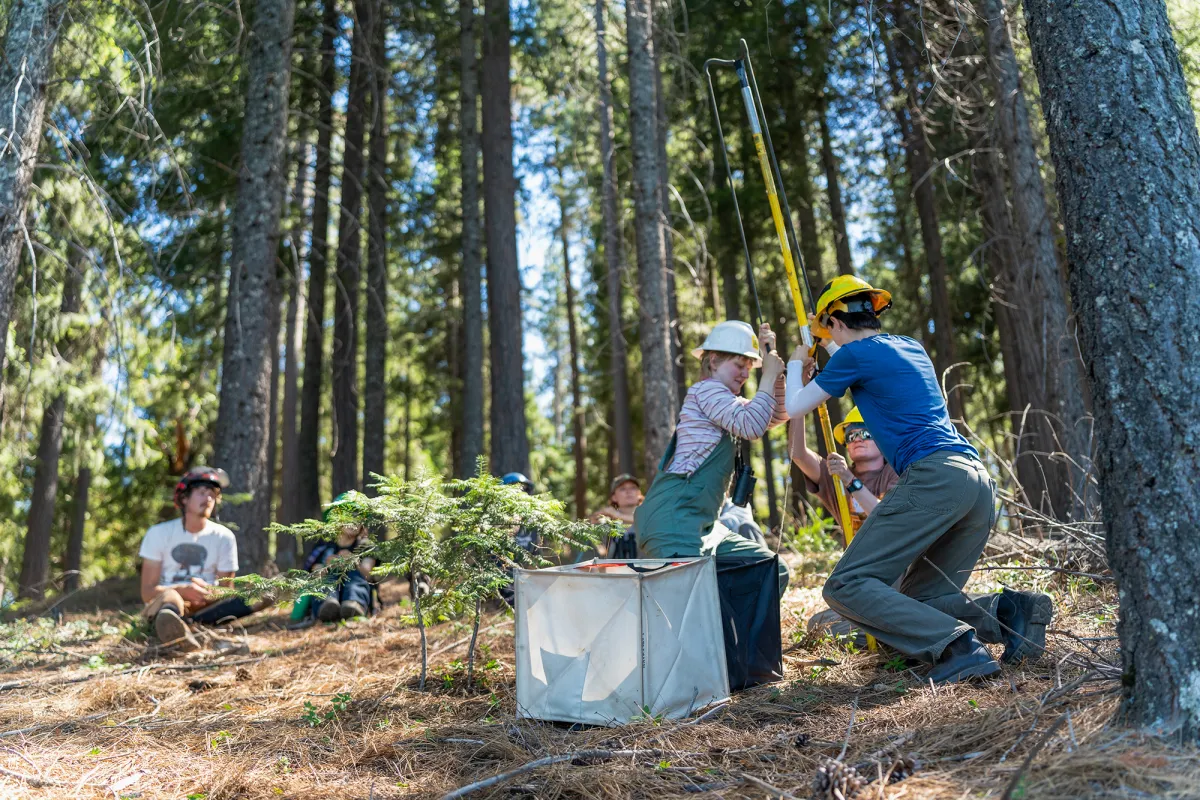
Cone Camp participants prepare to launch a weighted line into a sugar pine tree in Pollock Pines on July 15, 2026. Photo by Anna Hoch-Kenney, CalMatters
###
This story was originally published by CalMatters. Sign up for their newsletters.
###
A windowless warehouse on the outskirts of Davis shelters pieces of California’s forests.
Icy air swirls and fogs around 42,000 pounds of seeds — the past and the future of these trees, frozen in cardboard boxes. It smells like the woods on a snowy day.
“This is like the mothership of forestry in California right here,” said Stewart McMorrow, staff chief for wildfire resilience at Cal Fire, standing outside the heavy metal door of the state seed bank at Cal Fire’s Lewis A. Moran Reforestation Center in Davis.
Private landowners especially rely on these seeds — some now more than a half-century old — to reforest property destroyed by wildfire.
Climate change and more than a century of overzealous fire suppression are now fueling wildfires so severe that they’re wiping out the very forests that need fire to thrive — leaving iconic landscapes at risk of turning into brush and scrub, permanently.
Over the past quarter century, high-severity wildfires have burned 2.3 million acres of California’s forestland so completely that the trees are unlikely to return on their own — according to a working draft of the state’s new reforestation strategy obtained by CalMatters.
California is counting on these forests to store carbon, protect water supplies, clean the air, and shelter wildlife. By 2071, one recent analysis reports, half of California’s forest area could be gone.
“Reforestation,” said Malcolm North, a scientist with the U.S. Forest Service Pacific Southwest Research Station, “is pretty damn important.”
Yet to replant even a quarter of the privately owned forestlands in the state, California would need to increase seed bank capacity by roughly 300%, according to Cal Fire — which means more seeds, more people, more space. And that wouldn’t solve the problem on federal land, which accounts for more than half the forests in the state and most of the lands that need replanting.
A sheet of Douglas fir seeds are scanned by x-ray for insect larvae by Lily Hessl, a Cal Fire forestry aide, at the Lewis A. Moran Reforestation Center in Davis on July 15, 2026. Photos by Anna Hoch-Kenney, CalMatters
Stewart McMorrow, staff chief of wildfire resilience for Cal Fire, opens a box of seeds in the seed bank at the Lewis A. Moran Reforestation Center in Davis on July 15, 2026. Photo by Anna Hoch-Kenney, CalMatters
CalMatters reviewed a working draft of California’s reforestation strategy; the USDA California Climate Hub is developing it with state and federal agencies, the conservation non-profit American Forests, and the Governor’s Wildfire and Forest Resilience Task Force.
But both Sacramento and Washington have spent decades letting the money and staff needed to grow back California’s forests wither.
“We need to focus on reforestation as an emergency, as a state,” McMorrow said.“We are slowly losing our forestland, and we’re not catching up.”
Bleeding the federal workforce
Timber harvests once paid for much of the U.S. Forest Service’s efforts to replant trees.
With ever-increasing demands, a 2022 Forest Service document warned, there is a “critical need” to increase the number of staff “substantially dedicated” to reforestation.
Congress and the Biden Administration unstoppered additional money for a reforestation trust fund in 2021, a move championed by the conservation non-profit American Forests. Just a few years later, the Forest Service reported that it had replanted roughly 285,000 acres nationwide — the highest yearly total in more than a quarter century.
But the need still dwarfs action, and federally-directed work is lengthy and intense. Crews must clear dead and dying trees quickly to reduce the danger to people and the chance of reburns, a Forest Service spokesperson said. Finding seeds and growing seedlings can take a year or two, even before planting.
First: Burned and fallen trees leave a section of hillside bare near Pollock Pines on July 15, 2026. Last: Assistant Nursery Manager Maya Hotz examines white fir seedlings in a greenhouse at the Lewis A. Moran Reforestation Center in Davis on July 15, 2026. Photos by Anna Hoch-Kenney, CalMatters
Leilani Villeda prepares to fire a weighted line into the high branches of a pine tree using an air-powered launcher during Cone Camp, an annual training session where participants learn how to survey and collect pine cones, in Pollock Pines on July 15, 2026. Photo by Anna Hoch-Kenney, CalMatters
The federal government’s capacity to replant forests eroded away over time, and it will take time to rebuild it, said Solomon Dobrowski, a professor of landscape ecology at the University of Montana. Dobrowski’s research found that the reforestation gap spans millions of acres across the West and is likely to double or even triple in the coming decades.
“You don’t turn that ship around on a dime,” Dobrowski said.
Instead, the Trump administration cut the Forest Service significantly. The agency lost 20% of its staff last year.
“It just makes me cry at night … it’s basically a child swinging a wrecking ball,” said Hugh Safford, a forest and fire ecologist with the UC Davis Environmental Science and Policy Department and a former regional ecologist for the Forest Service. “Morale is down, capacity already was really minimal.”
And California keeps burning.
A widening gap
The loss of forests “is one of the least-known impacts of climate change and megafires,” said wildfire task force director Patrick Wright.
The draft strategy for California obtained by CalMatters comes with no dedicated funding. The goal, Wright said, is to put every agency and organization trying to replant California’s scorched forests on the same page.
The strategy calls for streamlining planning, prioritizing projects tackling critical human safety concerns and ecosystem issues like water supply, and increasing the supply of seeds, seedlings and workers.
Assistant Nursery Manager Maya Hotz checks on a batch of Douglas fir seedlings in a nursery at the Lewis A. Moran Reforestation Center in Davis on July 15, 2026. Photo by Anna Hoch-Kenney, CalMatters
It urges land managers to avoid adding more fuel to the fires, and recommends replanting at lower densities and with more natural spacing instead of the classic, closely-packed “pines in lines” grid. Scientists have linked high-density plantings to high-severity fires.
The most startling pieces, though, come from the draft strategy’s look at the current landscape. California would need to scale up reforestation by 35% annually to meet the state’s existing post-fire replanting goals, which start at 280,000 acres per year in 2030. The increase would take “significant funds,” the report said, because reforestation can cost up to $6,400 an acre.
But the current pace is lagging. Statewide, land managers have replanted roughly 254,000 acres of severely burned forest since 2020 — or around 16% of the area stripped of forest cover by high severity fires between 2020 and 2024 alone. The number is just 8% on federal lands, outside of wilderness areas.
Safford said the numbers are actually even more dire: Factoring in both wilderness areas and excluding forests likely to regrow on their own, his recent study reports that the U.S. Forest Service replanted just 1.2% of the agency’s California lands that wildfire denuded between 2016 and 2023.
It wasn’t always like this, said Safford. The Forest Service’s replanting efforts mostly kept pace with wildfires until around 2006.
“And then,” Safford said, “it just falls to shit.”
‘Nowhere near prepared’
For all the vitriol between Gov. Gavin Newsom and President Donald Trump over the care and raking of California’s forests, state and federal money — and people — often intersect on the landscape.
On California’s end, Cal Fire funds and conducts research, and provides grants for forest restoration on private, state and even federal land. Cal Fire also runs thereforestation center in Davis, where flats of glossy young conifers are gently misted with water in the summer heat.
McMorrow — tall and crisp in his navy Cal Fire uniform — can’t help but dig his hands into the dirt to pull out weeds tangling with the seedlings.
Cal Fire staff chief of wildfire resilience Stewart McMorrow, left, and Assistant Nursery Manager Maya Hotz, right, check on seedlings in a nursery at the Lewis A. Moran Reforestation Center in Davis on July 15, 2026. Photos by Anna Hoch-Kenney, CalMatters
One of the most challenging chokepoints, McMorrow said, is finding the right seeds to grow these seedlings — getting climbers to the right spot, at the right time, to pluck ripe cones from the treetops.
“Believe me, I do it,” said McMorrow, who created a tree-climbing program at Cal Fire. “We are trying to meet the demand that’s in front of us, and it’s crushing.”
The nursery in Davis shut down in the early 2000s, a casualty of across-the-board state budget cuts. Though the seed bank freezer stayed on, the reforestation center didn’t fully reopen until after the Legislature in 2017 tapped a 2012 fee on wood products to bring it back online.
Scaling up and upgrading the facility now carries an estimated $26.2 million price tag; this year’s state budget included about $1.2 million to fund preliminary planning.
Meanwhile, other funding is on the line. California’s climate regulators — chaired by Newsom appointee Lauren Sanchez — voted in May to overhaul a key climate program in ways that could substantially reduce, or even eliminate, up to $200 million a year for wildfire resilience. Grants for reforestation are among the many competing priorities for this funding.
“The truth of the matter is that California is probably, infrastructurally speaking, in a better place than any other western state,” Safford said.
“What that tells you is how piss-poor the capacity is in general in the Western U.S., because California is nowhere near prepared for the scale of this.”
Cone hunting
On the banks of Jenkinson Lake in the Sierra Nevada foothills, Stella Krone and Elyse Wohlenberg wrestled with a slingshot that towered over the two of them. It took their combined strength to slot the bungee into position, then Wohlenberg stepped back.
“All clear?” Krone asked, kneeling in a clearing and pointing the slingshot at a Douglas fir 50 yards away. “Firing!”
Krone, Wohlenberg, and dozens of other hard-hatted people were there, crunching over conifer needles, for Cone Camp — a training program led by American Forests with support from Cal Fire and the Forest Service.
Cone Camp participants search for the right pine tree to collect cones from on the shores of Jenkinson Lake in Pollock Pines on July 15, 2026. Cone collection helps contribute to Cal Fire’s seed bank and reforestation program. Photo by Anna Hoch-Kenney, CalMatters
The campers — some forestry professionals, some interested laypeople — peeled off with oversized slingshots and souped-up potato guns to learn how to knock cones loose from tree branches. That’s how they check the cones for ripeness and viability, before sending someone up the tree to collect them for a seed bank.
The problem was, there were hardly any. Last year’s dry cones rattled to the forest floor as Krone and another camper jiggled the rope they’d shot into the canopy.
“So far, not a great cone year,” said Leana Weissberg, American Forests’ California director.
In the clearing, the instructor asked whether the group was ready to try again.
“Let’s go,” Krone said. “We’re cone hunters for a reason.”
Election workers process vote-by-mail ballots at the Orange County Registrar of Voters in Santa Ana on June 2, 2026. Photo by Jules Hotz for CalMatters.
###
This story was originally published by CalMatters. Sign up for their newsletters.
###
California is taking the Trump administration to court a third time over its attempts to tie crucial emergency preparedness funding to the president’s preferences on immigration enforcement and election administration.
In a coalition with 24 Democratic-led states, Attorney General Rob Bonta announced the lawsuit over new conditions on U.S. Department of Homeland Security grants.
Most of these new rules relate to elections, including mandating states to employ a federal system to verify the citizenship of all their voters; using hand-marked paper voting ballots; and carrying out post-election audits, according to the lawsuit in Rhode Island’s federal court.
The conditions also require states to assist with federal immigration enforcement and enable federal agencies to terminate states’ funds at their discretion.
For decades the Department of Homeland Security and the Federal Emergency Management Agency have provided billions of dollars to states to prepare and respond to major disasters, including wildfires and earthquakes. One of these grants is the Homeland Security Grant Program, which Congress created in response to the Sept. 11, 2001 attacks. California alone receives $150 million each year from this program to fight terrorism, such as preventing cyberattacks.
But under the Trump administration, Bonta said the agencies are using public safety as “a bargaining chip,” and unlawfully withholding funds that Congress already appropriated.
The lawsuit alleges that if states do not comply with the new election rules, for example, they will lose at least 20%, if not all, of their Homeland Security Grant Program funds.
In the lead up to the November midterms, the Trump administration has pushed for stricter election rules, such as voter ID, to fight claims of widespread voter fraud. But Democratic lawmakers and officials have characterized these moves as Trump and the Republican party’s efforts to suppress voter turnout.
“Instead of ensuring these critical resources reach the communities that need them, Trump is attempting to use this funding as leverage to force states to adopt his preferred political agenda,” Bonta said at a press conference Thursday.
In an emailed statement FEMA said the lawsuit is “partisan pushback” from Democratic politicians who “oppose common-sense measures designed to protect election security and safeguard the integrity of American democracy.”
“Election security is national security, and protecting our critical infrastructure remains a top priority for the Trump Administration. Concerns over voting processes, data security, and registration practices have made it clear that action is required. … These new requirements will preserve election integrity.”
The Trump administration tried to deny states these same grants twice last year as it pressured states to participate in federal immigration enforcement. Both times California and other states sued and a federal court sided with them.
In her ruling rejecting the administration’s second attempt, U.S. District Court for Rhode Island Judge Mary McElroy, a Trump appointee, said holding funds hostage “based solely on what appear to be Defendants’ political whims is unconscionable and, at least here, unlawful.”
This lawsuit is California’s 79th against the second Trump administration.
Patricia
“Pat” Barnum was born in 1931 at the Norwegian Hospital in
Brooklyn, New York, to William Boyle and Gunhild Benestad. She was
always very close to her ice-skating Norwegian grandfather when she
was young, and she dreamed of becoming another Sonja Henie when she
grew up.
Although
raised primarily in New Jersey, she also spent several years in
Arizona with her family during grade school, living in a house that
still stands in Phoenix’s Willo District. She remembered rafting in
the canals, shaking out her shoes (lest a scorpion have nested in
there overnight!) before walking to school every morning, and
traveling with her family over to Venice, California, on the coast to
cool down during the summers. The family then returned to New Jersey,
where she graduated from Westfield High School with the Class of
1949. (One of her school friends - Olympic diver Bobby Clotworthy -
visited Eureka during the late fifties and amazed Pat’s children by
walking up and down the stairs on his hands.)
Pat was an
excellent student, and she was offered a full scholarship to Stanford
when she graduated. However, the summer before her senior year she
traveled out to California to visit her sister Florence, and that
trip changed the course of her life when she met Bob Barnum on the
beach at Redway. Pat and Bob’s families shared a connection via her
sister’s husband, Don Philips, the son of Dorothy Falk of Eureka.
Socially, Pat and Bob had just a week to get to know each other
before she returned home, but on her trip back to Westfield, when
asked what she thought of California and the people she’d met, she
replied: “Bob and I are going to be married!” Her high
school yearbook reported that she was “most likely” to be
heard singing “California Here I Come!” as she walked the hallways
during her senior year.
Their
chemistry and their commitment to each other was undeniable
throughout their 73 years of marriage, which ended only with Bob’s
passing in 2022. Together they raised five children, grandchildren
and great-grandchildren. Nothing brought Pat more joy than gathering
her family together to celebrate life’s special moments. She
especially enjoyed Christmas with her life-sized creche, her cookie
and “Barnum circus” trees and her Christmas teas.
A gifted
businesswoman and champion of the arts, Pat owned the Blue Sky
boutique at the Eureka Inn during the sixties and seventies and later
founded Westway Marketing, representing and promoting local artists
and artisans throughout the US. She had a keen eye for talent and
expression, and she loved helping others succeed. She was an early
member of the local Florence Crittenton circle, originally a home for
unwed mothers in San Francisco, which morphed locally circa 1970 into
Humboldt Sponsors. She was active in the Marshall School PTA when her
children were young, and she was a founding member of the St. Joseph
Hospital Foundation. She also chaired Eureka’s Bicentennial
Celebration in 1976 (one of those years when the fireworks rose
exuberantly and then disappeared into the fog!).
Pat
embraced life. Her motto was “Do it now!” During her early
married life, she was an enthusiastic skier and tennis player, and
during her middle years she took up painting. She loved fashion, and
she became close friends with Tokiko Madison with whom she enjoyed
designing dresses. And through it all she was active in politics,
advocating for classic Republican causes and supporting
representatives. She and Bob hosted Governor Ronald Reagan twice in
their home for fundraisers and attended three GOP conventions from
1976 to 1984.
She and Bob
also enjoyed “bridge club nights” during their early years,
and they were members of a gourmet cooking club. (So many interesting
cookbooks!) - A fond memory of their children is hearing the whisk,
whisk, whisk of egg whites being beaten in a copper bowl after they’d
been sent upstairs to bed, the chocolate or Grand Marnier souffles
being enjoyed during the parents’ quiet time together with Johnny
Carson late at night. Dreams not of sugarplums but of leftover
morning souffle would follow the kids into Dreamland.
Simply
stated, Pat relished life. Her moving on leaves an empty space in her
wake, one that can’t quite be filled.
She leaves behind her children, Patricia Barnum, Charles Robert Barnum, III, William F. Barnum (Bill, and spouse Monica Cruz Barnum), and Cathleen Barnum Christensen (and spouse Pattison Christensen). She was preceded in death by her daughter Janet Lea Andersen Downing in December 2013. She leaves eight grandchildren: Kelsey Barnum Bonilla, Robert Ogden Barnum, Sarah Barnum Poff, Emily Jean Christensen, Jensen Christensen, Marin Christensen Ferris, Paul W. Andersen and Bridget Andersen Lane. Fifteen great-grandchildren survive her: Kealan, Brooklyn, Leilani, Sienna, Lane, Mateo, Cody, Nolan, Greyson, Charley Ann, Carter, Joshua, Elle, Tahlia, and Cove. And one great-grandson, Weston. And Pat is survived by her best friend, confidant, and loving and supportive sister Janet Sikora.
She also leaves many
extended family members and friends — including Tokiko, Bev Morrison,
and her dear friend Kathryn DeVries, who visited with Pat during her
final weeks. Nearing the end of her life, she was cared for by a crew
of wonderful caretakers, many of whom we’ve grown to love like
family, most notably during her final months by Tracy Flanagan, Wendy
Tharp and Emily Christensen with the expert help of Karen Phillips,
Brenda Fregoso, Jessica Beck-Stasse, Emily Fryer and Brandie Burnham.
###
The obituary above was submitted on behalf of Pat Barnum’s loved ones. The Lost Coast Outpost runs obituaries of Humboldt County residents at no charge. See guidelines here. Email news@lostcoastoutpost.com.
Dorothy
“Dottie” June Nelson, age 81, of Eureka, passed away
peacefully on June 22, 2026, in Medford, Oregon surrounded by her
family.
Dottie was
born on August 1, 1944, and raised in Eureka, where she attended
Eureka High School (Class of ‘62!). She continued her education at
Humboldt State University and received her bachelor’s degree in
social work. She built a life centered around family, friendship and
creating meaningful memories with the people she loved.
Dottie was
married to Ronald Nelson for 46 years, had 3 children
together and they made their home in Kneeland, where they shared
nearly five decades of life, love and memories. Most people
know Dottie from her days at Kneeland School, being the
music teacher and playing the piano at the school plays. To then
becoming a realtor at Ming Tree Realtors for over 30 years.
Dottie loved
spending time with her family and friends. She enjoyed traveling,
watching Hallmark movies and attending every sporting event and
activity she could do for her children and grandchildren. She never
wanted to miss a game, celebration or special moment.
Known
for her warm personality and caring heart, Dottie was
incredibly social and had a special ability to strike up a
conversation with anyone. She loved making people happy and always
took the time to make others feel welcomed, valued and special. Her
kindness, laughter and genuine love for others touched the lives of
everyone who knew her.
Dottie is
survived by her children, Marlaina Steil and Monica Witte;
sons-in-law, James Steil and Daniel Witte; and grandchildren, Heidi
(20), Brody (18), and Mallory (14). She was preceded in death by her
husband, Ronald Nelson, and son Andrew Nelson.
Family
and friends are encouraged to attend Dottie’s Celebration of
Life from
1-3
p.m., on Saturday Aug 22, 2026, at the Moose Lodge in Eureka at 4329
Campton Rd. She
will be interred in Humboldt County.
She
will be deeply missed and forever remembered by her family, friends,
and all who were fortunate enough to know and love her.
###
The obituary above was submitted on behalf of Dottie Nelson’s loved ones. The Lost Coast Outpost runs obituaries of Humboldt County residents at no charge. See guidelines here. Email news@lostcoastoutpost.com.
Rio Dell, California — The City of Rio Dell is calling on residents, businesses, and animal lovers throughout Humboldt County and nationwide to help build a permanent, humane home for the animals in the Rio Dell Police Department’s care.
Right now, Rio Dell has no kennel facility of its own. When officers take in a stray, injured or abandoned pet, there is nowhere in the city to safely and humanely house it. Animals are currently transported to Fortuna PD for kenneling, a temporary measure.
The City Council has approved moving forward with a permanent solution: a secure, sanitary, climate-controlled, six-run kennel facility built specifically for municipal animal control operations. The project — recommended by a City Council ad hoc committee that spent months evaluating options — will give Rio Dell’s Police Department the tools it needs to protect animal welfare and reunite lost pets with their families faster.
The estimated cost of the project is approximately $125,000. Rio Dell is asking the community to help fund 30 percent of that total — and every dollar donated brings this project closer to reality.
“This community has a chance right now to set a new standard for how we care for animals in Rio Dell and across Humboldt County,” said Rio Dell Mayor Debra Garnes. “That next chapter should be humane, it should be trusted, and it should belong to all of us. That chapter starts with Rio Dell building a home of our own. Help us build it.”
Under the funding plan approved by the City Council, the City will move forward immediately with site preparation to stay on schedule, while staff actively pursues donations, sponsorships, and grants toward the community share of the cost. Once that community goal is reached, the City will complete the project — funding the balance and putting a permanent kennel into service.
Why this matters:
No safe place today. Rio Dell has no kennel of its own — animals are currently sent out of town for housing, adding delay and cost every time an animal is taken into custody.
Faster reunions. A local, on-site facility means lost pets can be processed and returned to their owners faster, without the extra time and paperwork of an out-of-city transfer.
Built for the job. The facility includes six individual runs, climate control, sanitary flooring and drainage, and secure fencing — designed specifically for animal control work, not adapted from something else.
A lasting asset of compassion and care. This is a one-time investment in permanent infrastructure that will serve Rio Dell’s animals in a responsible and ethical manner.
Every gift — whether from an individual, a local business, a civic group, or a foundation — moves Rio Dell closer to breaking ground on a facility our animals and our community deserve. No contribution is too small, and every donor will be helping build something we all will be proud of. Donations to the city may be tax-deductible; consult your tax advisor.
“Winter is fast approaching and we have a narrow window to make this happen before then,” concluded Rio Dell Police Chief Josh Phinney.
How to help: Residents and organizations interested in donating, sponsoring, or learning more about the Animal Kennel Project can contact Rio Dell City Hall at (707) 764-3532 or visit www.cityofriodell.ca.gov and select “Online Payments” on the home page. Choose “Donation” from the payment type menu and note “Animal Kennel Project” in the comments field. Checks can also be mailed to:
Animal Kennel Project c/o City Hall 675 Wildwood Avenue Rio Dell, CA 95562
A little street scene plays out all day next to the Los Bagels in Arcata in a mural painted on the building next door: two old men lean out of their upstairs windows, one playing an acoustic guitar, the other listening, his expression inscrutable. Below, a couple dances in the streets; beyond them, a river winds underneath sky-scraping rocks. Though it’s better known now as a sister city fundraiser, the first I Block Party was held in 1986 to raise enough money to paint the mural, and they’ve both stuck around for the last 40 years. Now, its purpose is changing course once again.
Centro del Pueblo is now the new organizer of the I Block Party, held for the rest of its life, since the mural was painted, to raise funds for Arcata’s sister city, a Nicaraguan town called Camoapa on Labor Day weekends. Money earned from the party’s silent auctions and raffles flowed to Camoapa through a committee set up to be a bridge between the two cities, but the committee no longer has the ability to host the event. It lacks the “infrastructure” to do so, Los Bagels owner and erstwhile party organizer Dennis Rael told the Outpost; Nicaragua’s politics have changed over the last 39 years since the committee first threw the party, and Nicaragua’s current administration has severely restricted how non-governmental organizations can operate and fundraise. And it was getting difficult to find enough volunteers to staff the event anyways.
But they wanted the party to live on, and Centro del Pueblo seemed like the right choice to keep it going. Its focus on Latin American immigrants would allow the party to continue benefiting similar causes, Rael reasoned. (Although the party was the committee’s biggest fundraiser, there are a few smaller ones that will continue to benefit Camoapa.) They were eager to accept the task, executive director Brenda Pérez told the Outpost. “It made every sense for him to pass the torch to Centro del Pueblo,” she said.
They’ll use every dollar raised, Pérez said. The Trump administration’s massive anti-immigrant crackdown has forced Centro del Pueblo to focus on raising money to help pay for the legal defenses that many families have to mount to prevent being deported. It’s especially expensive to do that in Humboldt, Centro’s Immigration Educator María Corral Rocha told the Outpost. Structural problems make it difficult. The closest immigration courts are in the Bay Area or Sacramento, and Humboldt residents fighting to stay in the U.S. have to travel there and pay for their lawyers, who are also based elsewhere.
Then the process to become an approved, legal immigrant drags on and on — “not because it’s inherently long,” Corral Rocha said, “because the government takes a long time. The resources allocated to processing that kind of paperwork are not there.” The lawyers they’ve hired and paid sometimes vanish, or, because bringing in a family member from some countries can take more than two decades, sometimes they die before the courts make a ruling.
But, despite the toil and the crushing expense, many immigrants are still pulled towards getting a legal immigration status.
“Without it, we’re terribly vulnerable,” Corral Rocha said. “Sometimes people say, ‘Why don’t you just come in the right way, the legal way?’ There isn’t a legal way for many immigrants, and that’s a function of the law. The law is written in such a way to exclude categories of immigrants, rendering them vulnerable to labor exploitation.”
“So immigrants come to the United States,” she continued. “To join their families. They run away from war. They run away from violence. They’re seeking new opportunities for their children. We want to work hard, and there isn’t a legal way for many of us to come in, and many of us do anyway, because we want better opportunities for our children.”
Pérez agreed. “People ask me, over and over, ‘Why you haven’t done your papers? Why?’ — The big Why? — and if they will know how much money, effort, time this will take; I think they will consider twice to ask why.”
How does that happen? It seems almost providential that a chance to throw a big party popped up. They hope it’ll help bridge the gap between Humboldt’s mainstream white community and its Latino community, who often feel “invisible,” Corral Rocha said, particularly those who immigrated. It bothers her that ICE only started making nationwide headlines and inspiring huge protests once it started killing white people, like Renée Good and Alex Pretti. But the problem is an old one. Thirty-two people died in ICE detention in 2004, a record that wasn’t matched until last year, and many dozens in years past have been shot and killed by immigration enforcement agencies.
Corral Rocha spoke at last week’s Arcata City Council meeting, along with a few other colleagues. She challenged the council members to name Lorenzo Salgado Araujo, a Houston man ICE killed several weeks ago. They didn’t. (The council members don’t usually speak when members of the public are addressing them during the public comment period.) It irks her. The slain Latinos were people too, she said, parents who drove their kids to school and loved them just as much as Pretti and Good did. But when a federal agent kills a white citizen, the crowds come rushing out to take the streets.
“They only know the names that they want to see themselves in,” Corral Rocha said. “Identify, feel compassion for, because they feel very far from us. They just don’t see themselves as — or they don’t see us as part of their community, or their lives, right?”
ICE’s killing of Good and Pretti was “horrid,” Corral Rocha said, but the gap in the public’s attention is devastating nonetheless. It’s a big one. The information both groups of people have about one another is incomplete. “People who don’t know immigrants think that we’re taking away resources,” Corral Rocha said. “We’re taking jobs. We’re criminals. We’re rapists. We’re murderers. We eat dogs and cats. I mean, you name it.” When voters hear fabrications like these, they may not support policies that will help immigrant communities, she and Pérez said. Everyone ends up worse.
A big event in the center of Arcata could begin to fill that gap, they hope. She and Rael both think Centro del Pueblo will be able to attract a wider variety of people, and probably more of them. Ideally, they’ll all mingle, blend together and learn something about one another. It won’t be a completely different event than it’s been in years past, Pérez said, but attendees should expect it to be more of a rager. They’ve hired vendors to sell regional Mexican food, plus bands to play Latin American music “playing for Latin American people,” Pérez said.
They’re thrilled that the Latino community in Humboldt is large enough to successfully throw an event like this, one more tailored to them. Piecing together a big, joyful event while keeping their clients’ families together, monitoring anti-immigration activities and mourning is a tough storm to navigate.
“But we are also people of joy, and of so much resilience, and tools for resisting, and we want to present that as well,” Pérez said. “We want to be able to say, ‘Look, don’t always look at us in the fields. Don’t always look at us on the TV, at the detention centers, or at the protests. Don’t always look at us that way. Don’t always look at us suffering, crying, screaming. Also be able to imagine our lives with dignity.’ We want to be human.”
“We are also enjoying ourselves,” she continued. “We haven’t stopped doing that either, because we need to balance out, and we need to bring what we call ‘medicine,’ which is our songs, and our music, and our food. So, in order to not fall into that trap, of ‘Immigrants always have to be in the struggle’ — we want to have this one day, where everybody acknowledges that we are as human as the rest of the world.”