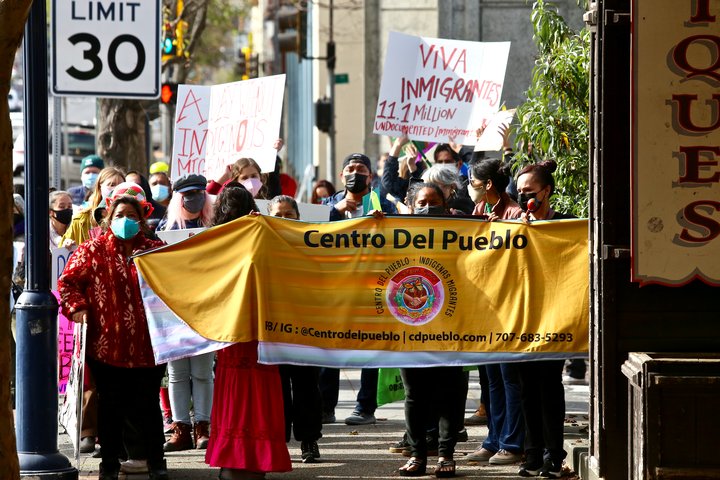
A Centro del Pueblo march in 2022. File photo.
A little street scene plays out all day next to the Los Bagels in Arcata in a mural painted on the building next door: two old men lean out of their upstairs windows, one playing an acoustic guitar, the other listening, his expression inscrutable. Below, a couple dances in the streets; beyond them, a river winds underneath sky-scraping rocks. Though it’s better known now as a sister city fundraiser, the first I Block Party was held in 1986 to raise enough money to paint the mural, and they’ve both stuck around for the last 40 years. Now, its purpose is changing course once again.
Centro del Pueblo is now the new organizer of the I Block Party, held for the rest of its life, since the mural was painted, to raise funds for Arcata’s sister city, a Nicaraguan town called Camoapa on Labor Day weekends. Money earned from the party’s silent auctions and raffles flowed to Camoapa through a committee set up to be a bridge between the two cities, but the committee no longer has the ability to host the event. It lacks the “infrastructure” to do so, Los Bagels owner and erstwhile party organizer Dennis Rael told the Outpost; Nicaragua’s politics have changed over the last 39 years since the committee first threw the party, and Nicaragua’s current administration has severely restricted how non-governmental organizations can operate and fundraise. And it was getting difficult to find enough volunteers to staff the event anyways.
But they wanted the party to live on, and Centro del Pueblo seemed like the right choice to keep it going. Its focus on Latin American immigrants would allow the party to continue benefiting similar causes, Rael reasoned. (Although the party was the committee’s biggest fundraiser, there are a few smaller ones that will continue to benefit Camoapa.) They were eager to accept the task, executive director Brenda Pérez told the Outpost. “It made every sense for him to pass the torch to Centro del Pueblo,” she said.
They’ll use every dollar raised, Pérez said. The Trump administration’s massive anti-immigrant crackdown has forced Centro del Pueblo to focus on raising money to help pay for the legal defenses that many families have to mount to prevent being deported. It’s especially expensive to do that in Humboldt, Centro’s Immigration Educator María Corral Rocha told the Outpost. Structural problems make it difficult. The closest immigration courts are in the Bay Area or Sacramento, and Humboldt residents fighting to stay in the U.S. have to travel there and pay for their lawyers, who are also based elsewhere.
Then the process to become an approved, legal immigrant drags on and on — “not because it’s inherently long,” Corral Rocha said, “because the government takes a long time. The resources allocated to processing that kind of paperwork are not there.” The lawyers they’ve hired and paid sometimes vanish, or, because bringing in a family member from some countries can take more than two decades, sometimes they die before the courts make a ruling.
But, despite the toil and the crushing expense, many immigrants are still pulled towards getting a legal immigration status.
“Without it, we’re terribly vulnerable,” Corral Rocha said. “Sometimes people say, ‘Why don’t you just come in the right way, the legal way?’ There isn’t a legal way for many immigrants, and that’s a function of the law. The law is written in such a way to exclude categories of immigrants, rendering them vulnerable to labor exploitation.”
“So immigrants come to the United States,” she continued. “To join their families. They run away from war. They run away from violence. They’re seeking new opportunities for their children. We want to work hard, and there isn’t a legal way for many of us to come in, and many of us do anyway, because we want better opportunities for our children.”
Pérez agreed. “People ask me, over and over, ‘Why you haven’t done your papers? Why?’ — The big Why? — and if they will know how much money, effort, time this will take; I think they will consider twice to ask why.”
How does that happen? It seems almost providential that a chance to throw a big party popped up. They hope it’ll help bridge the gap between Humboldt’s mainstream white community and its Latino community, who often feel “invisible,” Corral Rocha said, particularly those who immigrated. It bothers her that ICE only started making nationwide headlines and inspiring huge protests once it started killing white people, like Renée Good and Alex Pretti. But the problem is an old one. Thirty-two people died in ICE detention in 2004, a record that wasn’t matched until last year, and many dozens in years past have been shot and killed by immigration enforcement agencies.
Corral Rocha spoke at last week’s Arcata City Council meeting, along with a few other colleagues. She challenged the council members to name Lorenzo Salgado Araujo, a Houston man ICE killed several weeks ago. They didn’t. (The council members don’t usually speak when members of the public are addressing them during the public comment period.) It irks her. The slain Latinos were people too, she said, parents who drove their kids to school and loved them just as much as Pretti and Good did. But when a federal agent kills a white citizen, the crowds come rushing out to take the streets.
“They only know the names that they want to see themselves in,” Corral Rocha said. “Identify, feel compassion for, because they feel very far from us. They just don’t see themselves as — or they don’t see us as part of their community, or their lives, right?”
ICE’s killing of Good and Pretti was “horrid,” Corral Rocha said, but the gap in the public’s attention is devastating nonetheless. It’s a big one. The information both groups of people have about one another is incomplete. “People who don’t know immigrants think that we’re taking away resources,” Corral Rocha said. “We’re taking jobs. We’re criminals. We’re rapists. We’re murderers. We eat dogs and cats. I mean, you name it.” When voters hear fabrications like these, they may not support policies that will help immigrant communities, she and Pérez said. Everyone ends up worse.
A big event in the center of Arcata could begin to fill that gap, they hope. She and Rael both think Centro del Pueblo will be able to attract a wider variety of people, and probably more of them. Ideally, they’ll all mingle, blend together and learn something about one another. It won’t be a completely different event than it’s been in years past, Pérez said, but attendees should expect it to be more of a rager. They’ve hired vendors to sell regional Mexican food, plus bands to play Latin American music “playing for Latin American people,” Pérez said.
They’re thrilled that the Latino community in Humboldt is large enough to successfully throw an event like this, one more tailored to them. Piecing together a big, joyful event while keeping their clients’ families together, monitoring anti-immigration activities and mourning is a tough storm to navigate.
“But we are also people of joy, and of so much resilience, and tools for resisting, and we want to present that as well,” Pérez said. “We want to be able to say, ‘Look, don’t always look at us in the fields. Don’t always look at us on the TV, at the detention centers, or at the protests. Don’t always look at us that way. Don’t always look at us suffering, crying, screaming. Also be able to imagine our lives with dignity.’ We want to be human.”
“We are also enjoying ourselves,” she continued. “We haven’t stopped doing that either, because we need to balance out, and we need to bring what we call ‘medicine,’ which is our songs, and our music, and our food. So, in order to not fall into that trap, of ‘Immigrants always have to be in the struggle’ — we want to have this one day, where everybody acknowledges that we are as human as the rest of the world.”
CLICK TO MANAGE