

THE ECONEWS REPORT: Land Back as Conservation
The EcoNews Report / Saturday, July 25 @ 10 a.m. / Environment

The Blue Creek watershed from above. File photo: Thomas Dunklin, via the Yurok Tribe.
The effort to rematriate land, natural resources and political sovereignty back to Indigenous peoples offers an important opportunity for restorative justice. It also offers an opportunity for better land conservation too, moving from extractive colonial models of land management to more holistic management. Yet, land back has been met with caution from conservatives and even some environmental advocates.
Guests Molli Myers of the Klamath Indigenous Land Trust and Alex Leumer of Leumer Consulting join the program to discuss the marriage of restorative justice and conservation and efforts in Sacramento to promote Indigenous management opportunities.
BOOKED
Today: 10 felonies, 12 misdemeanors, 0 infractions
JUDGED
Humboldt County Superior Court Calendar: Today
CHP REPORTS
1656 Union St (HM office): Missing Indigenous
ELSEWHERE
County of Humboldt Meetings: Behavioral Health Board - SUD/Dual Recovery Committee - Sept. 10, 2026
County of Humboldt Meetings: Behavioral Health Board Executive Committee Meeting - July 1, 2026
RHBB: Judge Overturns Search Warrant in Student Activist Case: Devices Ordered Returned
RHBB: Multi-Vehicle Crash Closes South Fortuna Boulevard Near Strongs Creek Plaza
HUMBOLDT HISTORY: Local Photography Pioneer Emma Belle Freeman Was Celebrated Across the Nation, But Her Portraits of Local Native American People Were Somewhat Complicated
Augustus Clark / Saturday, July 25 @ 7:30 a.m. / History
Emma Belle Freeman, the mother of stylized Native American photography, was born on a small farm on the flat plains of Nebraska. There is not much known about her young life, except that she took to drawing with crayons at a very young age, worked diligently on the farm with her parents, and was often spanked for drawing silly pictures of her teacher on the school blackboard. Her parents were William K. Richart and Belle Zoover Richart, originally from Ohio and of German stock.

Emma Freeman self-portrait. Public domain.
When Emma grew to womanhood, she decided to travel to San Francisco to become an artist, but her savings only got her as far as Denver, Colo. Here she worked behind a ribbon counter of a department store and met the man who became her husband of 13 years, Edwin Ruthven Freeman. Edwin was a salesman and, together, they made a handsome couple.
Eventually, the two made their way to San Francisco where the first Freeman Art Company was opened. After the earthquake destroyed their business, the couple borrowed money to move to Humboldt County and open a new Freeman Art Company. Here Emma began her now-famous work with the local Native Americans. She also found notoriety when the submarine H3 went aground on the Samoa Beach, and the heavy cruiser USS Milwaukee went trying to save the sub. Emma photographed these events in full detail and called herself the “Official Government Photographer.”
During this period, Emma surprised the local population by traveling to San Francisco with a visiting ex-governor of Illinois. The matter led to divorce proceedings with Emma being sued for adultery by Edwin. Following her divorce, she continued her work and sought friends among her Native American subjects. Her best friend, Bertha Stevens, met Emma’s photographer Fred Chamley, fell in love with the handsome half-Cherokee Indian, and married him soon after. When Emma decided to return to San Francisco, Fred stayed on in the Eureka store under new ownership. The second Freeman Art, located in the Bay Area, was quite impressive. The entire second floor, called the Humboldt County Room, featured Indian baskets, artifacts and paintings of the North Coast.
All went well for a time thanks in part to prestigious customers such as the I. Magnin Company. But by 1923, only four years after her move to San Francisco, Emma went bankrupt. The competition was steep and, in addition, Freeman Art Company in San Francisco was linked to a scam involving the theft of artifacts from Islamic temples in Constantinople (Istanbul). The stolen objects were earmarked for the Freeman Art Company.
Emma lived on in San Francisco though she was somewhat lost without her shop. She remarried in 1925 at age 45, and lived quietly for two more years. In 1927 she suffered a severe stroke and died.
Peter Palmquist, Society board member and photo-historian, said of Emma, “Her artistic output, like the Northern California Indians, was largely ignored until recent years. Now both remain basis for legend.”
Her art
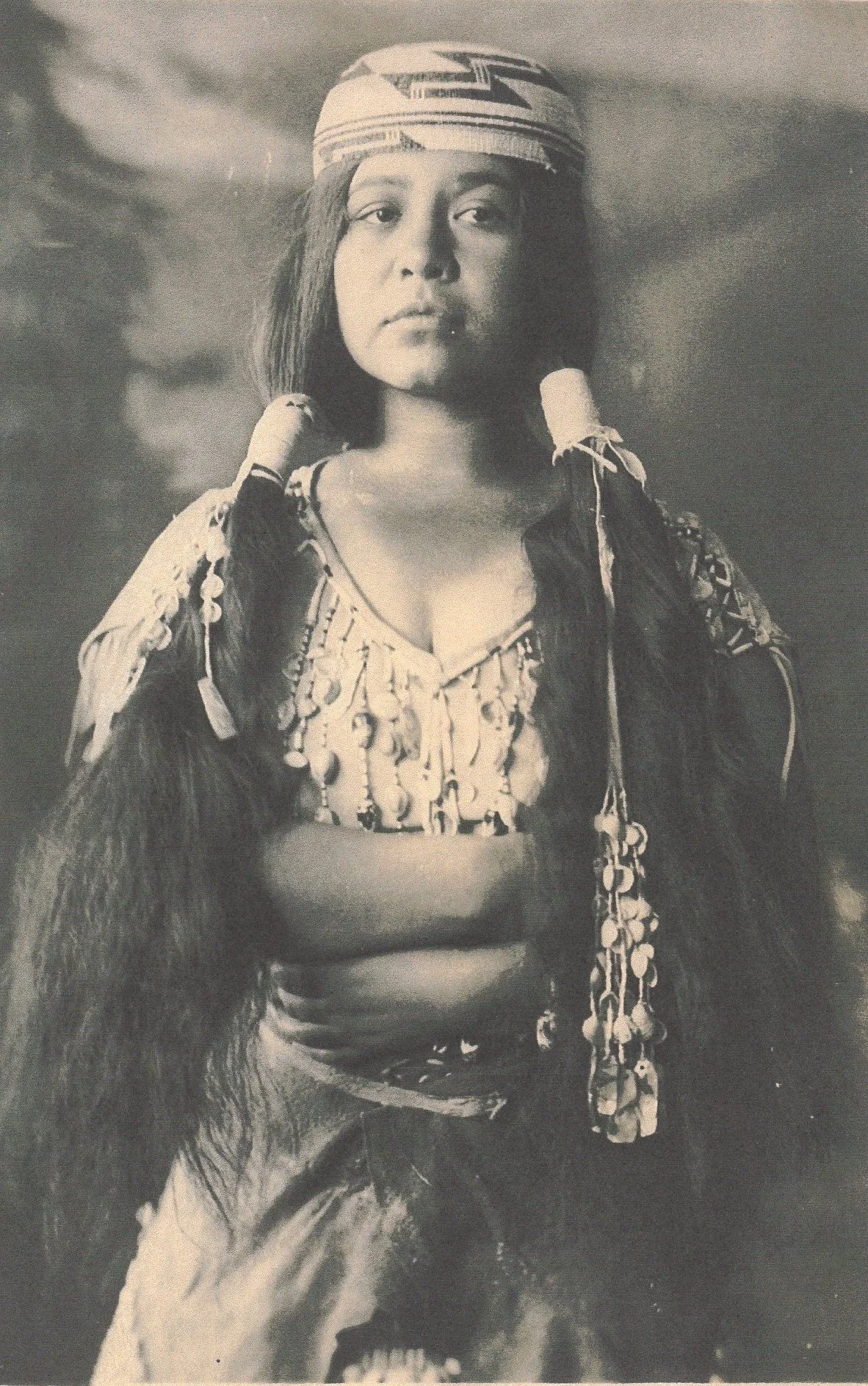
A Freeman portrait of Bertha Thompson. Photo via the Humboldt County Historical Society.
If not for her early “Bohemianism” or for the sometimes interesting way in which she dressed around town, Emma B. Freeman would probably be remembered for her original and, up until then, unique artistic style. It should be stated that she started using crayons as a little girl, spending what little free time she had on the farm out in the countryside, drawing colorful birds and flowers that the caught her eye.
This was, of course, the beginning of her career. She went on to make handcrafted souvenir curios after her marriage while she and Edwin lived in San Francisco. A short list of the kinds of curios include: leather novelties, burnt wood gee-gaws, painted Easter and Christmas items, hand-colored photographs, and sketches in both pastels and watercolors.
But it was not until after she and her husband opened their tiny shop on the corner of Union and Octavia streets that she finally began to fulfill her childhood wish to become a serious artist. Acting on the advice of other artists and students, she enrolled in a San Francisco art school where she attended classes religiously and honed her skills at drawing and painting.
It was not until Emma and Edwin moved to Eureka and officially opened the Freeman Art Studio and Supply Shop that she began to incorporate photography into her work. Emma was an apparently self-taught photographer, making full use of a previously-owned camera and equipment. She began to experiment at once, exploring the possibilities of artistic portraiture. She also painted her own backgrounds, often custom-made for each picture. Her romantic, artistically conceived portraits became very popular with the locals, attracting those interested in obtaining fashionable images of themselves. She was renowned for her tableaux settings of women; the three-quarter length pose was the one she used most and featured backgrounds and props to approximate a homelike environment.
Emma even did some early nude photography, but examples have not been preserved. She must have been accepted in the community because a man who attempted to do nudes in this area at that same time was sentenced to a prison term. She was also one of the first to photograph Humboldt County landscapes. However, few original examples of Emma’s romantic landscapes can be found.
It was not the knick-knacks, photographic portraits, experimental nude photographs or landscapes that made Emma B. Freeman a great artist. She earned her place in the legitimate art world for her portrayals of the local Native American population in and around Northern California. She created fantastic photographs of chiefs, braves and young men, elderly women and younger women, even some children in the surrounding forests or streams. Sometimes she brought them into her studio and took pictures there.

Miss Redwood Empire 1927, Little Fawn of Klamath River. Little Fawn was a stereotypical “Indian Princess” of the 1920s, complete with flapper-inspired costume and hair. Photo and description via the Humboldt County Historical Society.
One criticism could be made of Emma: She did not pay much attention to the closer details of her subjects. Sometimes she used a blanket from the faraway Navajo tribe in the background of a local Yurok woman. One time she angered Native Americans when she took a picture of a woman holding a bow and arrow. Sooner or later, Emma did start paying more attention to authenticity. Her later photos are now not only viewed as beautiful pictures, but also as serious, realistic documents of Northern California’s Native American population.
Emma once commented on her taking photographs of the local Native Americans in an issue of Pacific Outdoors:
The average Indian is extremely opposed to facing the camera. This is because of a tribal tradition which forbids handling the dead or preserving anything ever owned or worn by the departed: only their memory is left and that an unspoken thought. …As a basis of legend and literature for future generations I have endeavored to preserve in picture what scholars and literature have preserved in story, viz., the very best in the life history of the American Indian.
It was extremely difficult for Emma to find willing Native American models. She often used models of mixed ancestry and other people who were not very well placed in the community, although there were exceptions.
One final, interesting aspect of the art work of Emma B. Freeman was that she often added pencil work and pastels to her finished photographs. There were other photo-colorists, but with Emma it was different. Somehow her additions added to her artistic vision and were not simply an attempt at realism. It should also be noted that one of her most famous works, a photograph of the Humboldt County redwoods, is still on display in the White House.
Emma B. Freeman, with every picture she took, offered us a new and romantic view of the ancient woodlands. She also gave us an idyllic, Utopian view of the Native American that the local whites surely had never seen before.

The Freeman Art Company, at Fifth and H Streets in Eureka. Photo: Emma B. Freeman - Beinecke Rare Book and Manuscript Library, Public Domain, Link
A personal perspective
My great-grandfather came to know Emma B. Freeman when he bought the Freeman Art Company from her before she moved back to San Francisco. His name was Niel Nielsen, an officer of the Danish Royal Guard, who immigrated to San Francisco one year after she left the city for the first time in 1906. Niel came to manage his uncle’s Nickelodeon in Chinatown. He sent for his bride-to-be Helena Anne Sorensen the next year. My grandmother, Anna Nielsen Carlson, and her brother, Frances Nielsen, were born in the city. They often played hopscotch and jump rope with the Chinese children in front of the theatre. One of my mother’s favorite possessions is a small, fire-opal ring that her mother found in the Nickelodeon.
In 1918 when my grandmother was nine years old, the Nielsen family moved to Eureka. My great-grandfather bought the Colonial, one of the earliest movie theatres on the coast. Later, he sold the Colonial in favor of the more “stable” lifestyle as owner of the Freeman Art Company. Niel inherited the services of Emma’s studio photographer Fred Chamley, a gentleman who stayed with the business until Niel’s death in 1953. Fred and his wife Bertha became a part of the Nielsen circle of friends, and could be found picnicking together on Sundays at Dyerville Bridge or Trinidad.
Niel also inherited Emma’s “colorization” techniques, and continued to use oils on portraits photographed by Fred. Niel liked the artwork and the business end as well. He added a china section and moved the Freeman Art to Fifth Street, next to the old Rialto Theatre. He began to add oils to black and white photos of the redwoods, mostly taken on those Sunday picnics at Dyerville. The tinted and enlarged redwood scenes, often framed in gold, are now in many homes in Humboldt County, and in many lumber company offices both in Eureka and as faraway as Tokyo.
It is interesting to me, as a senior at Fortuna High, to know that the Freeman Art Company took all senior pictures at my school for many years, stopping only after my great-grandfather’s death. As a small child my mother helped glue folders and wrap packages of senior pictures for Fortuna High students long before I was ever thought of. She also remembers accompanying her grandfather to San Francisco on buying trips where they had tea with Chinese merchants.
The Freeman Art went on for a few years with my grandfather Allan Carlson doing mostly photo-engraving and wedding pictures. However, color photography was now popular and the large Fairchild machines did the engraving faster and cheaper. In 1963, the Freeman Art Company closed it doors. What remains of Emma B. Freeman for my family, including myself, are many of her original pictures and four of her tinted portraits of Native Americans … and lots of good stories.
###
The piece above — written by then-Fortuna High Student, now celebrated local artist Gus Clark — was printed in the September-October 1991 issue of the Humboldt Historian, a journal of the Humboldt County Historical Society. It is reprinted here with permission. The Humboldt County Historical Society is a nonprofit organization devoted to archiving, preserving and sharing Humboldt County’s rich history. You can become a member and receive a year’s worth of new issues of The Humboldt Historian at this link.
OBITUARY: April Posey, 1982-2026
LoCO Staff / Saturday, July 25 @ 6:56 a.m. / Obits

It is with a heavy heart that I have to tell everyone we lost April Lorraine Posey (Steiner) on Sunday morning, July 19, 2026, while she was sleeping.
April Posey was a true friend to many. She was my Little Teapot. She was a mother, my wife, a daughter, an auntie, a great-auntie, a cousin and a godmother. April was a rare soul who made an impact on so many lives. She was loving, strong, faithful, kind, funny, determined, adamant, beautiful, confident, brave, bold and loved by everyone she met.
I met April when she was three and I was five. We grew close over the next four years before she went on vacation and ended up staying in Oklahoma, where she lived for 14 years. However, April and her family would still visit throughout those years. We finally reconnected when April was 24 years old. Her dad told her not to make it so obvious when she squealed with joy upon seeing me again after three years. It was then, at that very moment, I knew she still loved me as much as I still loved her. We moved quickly. She moved into a tent with me up on Hayfork Summit off the grid, and she never left my side.
She was such an amazing woman who stood on her values. April was born April 20, 1982 in Porterville, Calif., and has lived in Humboldt/Trinity County with me for the last 20 years.
She is preceded by her grandparents, Ronald Steiner & Nancy Edwards, and Richard Moore & Patty Andrews.
April is survived by her parents, Mike and Renee Steiner; her husband, Larry James Posey; her children; Nikki Renee Steiner, William James Posey, Clara Rose Posey, and Willow Patricia Posey; her siblings and their spouses, Amber and Cliff Morgan, Amy and Jerry Jolly, Andy and Christine Steiner; her nieces, nephews, and their spouses, AJ Morgan, Christopher Shelman, Michael Morgan & Anna Goldman, Matthew Morgan, Mariah Morgan, Conrad Steiner, Grace Steiner, Betty Steiner, Jacob and Rocky Jolley; and her great-nieces; Alice Steiner, Amber Steiner and Avery Brubaker.
As a family, my son has set up a GoFundMe page for anyone who would like to contribute to help with expenses. Here is the link.
We will be announcing the time and date of services on social media.
###
The obituary above was submitted on behalf of April Posey’s loved ones. The Lost Coast Outpost runs obituaries of Humboldt County residents at no charge. See guidelines here. Email news@lostcoastoutpost.com.
Eureka Landlord Anil Dwivedi, Still Embroiled in Class Action Lawsuit Over Illegal Rent Hikes, Launches Campaign for Mayor
Ryan Burns / Friday, July 24 @ 3:46 p.m. / Elections
PREVIOUSLY
- Eureka Apartment Tenants Say They Were Manipulated Into Big Rent Hikes; Landlord Says They Freely Chose to Help Him Make Ends Meet
- Tenants at Eureka’s Hillsdale Apartments Successfully Fight Back Against Illegal Rent Hikes
- Tenants of Hillsdale Apartments File Class Action Lawsuit to Stop Landlord’s ‘Unlawful Rent Increases’
- Judge Grants Restraining Order Against Hillsdale Apartments Owner, Preventing Illegal Rent Increases
- Dwivedi Accuses His Tenants and Their Attorneys of Presenting False and Misleading Information to the Court, But Judge Keeps Restraining Order in Place
###

Dwivedi. | Submitted
Anil Dwivedi, the 36-year-old owner of two low-income Eureka apartment buildings, is running for mayor.
The local landlord, who remains embroiled in four lawsuits over illegal rent increases at the Hillsdale Apartments on E Street, filed his initial candidate intention statement at City Hall on Thursday.
Reached by phone this afternoon, Dwivedi said he first considered running for office a few months back but just decided a couple of weeks ago to try bringing his experience as a business owner to City Hall.
“I love Eureka, and I believe Eureka has tremendous potential,” he said. “And over the past several years, I have invested heavily in [the] Eureka community. I created local jobs, helped provide housing to approximately 40 extremely low-income families, many of whom had experienced homelessness or housing instabilities. So I believe I have spent years solving problems on the ground, and I want to bring that some practical, result-oriented approach to City Hall.”
Asked what he thinks about the job being done by the current city council and incumbent Mayor Kim Bergel, Dwivedi admitted that he’s at a loss.
“I actually personally don’t know much about current mayor and council members,” he said. “I met personally Kim here and there [at] events a couple of times, but I don’t know enough to make any comments regarding their work.”
After a beat he added, “I think there is always room to do better.”
What would his priorities be if he wins election? He offered a list of five items.
“I would like to clean up the streets, especially the Old Town and downtown areas, because I was told by many business owners and some locals that these streets are filthy,” he said. Later, he specified that he was referring to garbage and potholes.
“Second, I want to offer more things to do for both children and adults,” he said. “And third, I would say I want to revive downtown and make it more inviting for the locals and tourists who visit, because Eureka is beautiful and it just requires a little bit more care and attention.”
The fourth item on his to-do list was bringing life back to the Bayshore Mall. Dwivedi showed up to the beleaguered mall’s foreclosure auction on the courthouse steps back in April, but the $12 million starting bid “turned me off tremendously,” Dwivedi said. He didn’t offer details on his mall revitalization plan.
“And another most important thing that I’m already working on that I would like to find a solution for [is] the homelessness and the people who are on the streets,” Dwivedi said. “So that would be one of my biggest priorities.”
Asked about the city’s existing programs for addressing homelessness and mental health issues — including the Community Safety Engagement Team (CSET), Crisis Alternative Response Eureka (CARE) and Uplift — Dwivedi said they’re “amazing,” noting that a few of his tenants were referred to him through Uplift.
He also noted that CSET was among the agencies that responded to the emergency situation in Old Town on Sunday, when a tenant of Eureka Central Resident (another building he owns), spent nearly five hours at the edge of the roof, apparently experiencing a mental health crisis.
“So I’m so proud of these agencies and how hard they work, and I want to make sure they are empowered and they have all the tools in their hand to do their job better,” he said.
As for his ongoing legal battles, Dwivedi said he doesn’t want to comment on the details while the case is ongoing.
“I respect the legal process,” he said. “I let the attorneys do their work, and I would rather focus on my vision for the future of Eureka.”
Patrik Griego, a senior partner at Janssen Malloy, represents the tenants suing Dwivedi in a class action suit. Reached by phone this afternoon, Griego said the case is very close to a settlement, though, once reached, it will still have to be approved by the court and presented to each member of the class, who can choose to opt in or out of the deal.
In broad terms, Griego said, the deal will require Dwivedi to refund tenants for the rent amounts he charged above what’s legally allowed per California’s Tenant Protection Act — roughly $10,000 — plus about $90,000 in attorneys’ fees to Janssen Malloy. That amount doesn’t include the costs of his own legal counsel.
“And he got caught again just recently,” Griego said. “He asked for too much rent again.”
According to Griego, Dwivedi asked an employee in the City of Eureka’s housing department whether he was legally allowed to raise his tenants’ rent by 8.8 percent. The employee cautioned that they were not an attorney but said that “sounds right,” according to Griego. In reality, the legal limit for an annual rent increase was less than that. “So he racked up another $8,000” in damages, Griego said.
Dwivedi, whose candidacy was first reported by John Chiv, said Eureka didn’t make a good first impression when he first moved here about four years ago.
“When I was living down south, we just wanted to come to somewhere place that is cooler, and we ended up in Eureka,” he said. “And initially, I would say, as a tourist, I did not like it much in the beginning. But then slowly, slowly, when we stayed about a week, we started liking it.”
“I think Eureka has that, that … in order to like it, you have to live in it,” he continued. “You have to feel the city, and you needed to start talking to people, and then that’s how it happened with me personally. I fell in love, and then I decided I would like to come here more and move in here.”
Asked if he had anything he’d like to add, Dwivedi said, “I just want to make sure that voters see my problem-solving skills instead of reading the past headlines about the existing lawsuit, because I deal on a daily basis with hard decisions that I have to make dealing with local agencies, state agencies, federal agencies. So I want to make sure that people can see that, and I’m not just a talker. I work. I produce results, and I’m not just talking.”
He added that he’s literally providing housing for homeless folks, explaining that many of his current tenants either had no house or were facing housing instability.
“So, for me, my only goal is to bring my experience to the City Hall and make sure that I can produce results,” he said. “I am not the person who just talks. So that’s I would like to add.”
He also sent the following statement (along with the photo above) via email:
Thank you for reaching out.
I appreciate your interest in my campaign. I decided to run for Mayor because I care deeply about Eureka and believe our city has tremendous potential. Over the past several years, I’ve invested heavily in our community, created local jobs, and provided housing to more than 40 extremely low-income families, many of whom had experienced homelessness or housing instability. Through this work, I’ve seen firsthand both the opportunities and the challenges our city faces.
As a business owner and problem-solver, I’ve gained practical experience managing budgets, improving properties, working with government agencies, and finding solutions to complex challenges. I want to bring that same results-oriented, accountable approach to City Hall.
If elected, my priorities will include revitalizing downtown and Old Town, supporting local businesses, improving public safety, addressing homelessness with practical and compassionate solutions, keeping our streets cleaner, encouraging economic growth, creating more opportunities for families and visitors to enjoy our city, and working toward lowering the tax burden whenever it is fiscally responsible to do so.
I truly believe Eureka’s best days are ahead of us. My goal is to bring people together, focus on practical solutions, and help make our city an even better place to live, work, and raise a family.
###
Dwivedi is running against incumbent Mayor Kim Bergel. Resident Casey Dresser has also filed a candidate intention statement for the race, earning a Facebook endorsement from Cornelius Loewenstein, a cantankerous critic of the current council whose steady haranguing of Bergel prompted her to seek a restraining order in 2020. Her request was denied.
We’ve arranged to speak with Dresser next week.
Considering a run for local public office? Click here for details on how to do it.
Death of Retired Dr. James Jaworski Ruled Accidental Following Coroner’s Investigation
LoCO Staff / Friday, July 24 @ 2:40 p.m. / News
PREVIOUSLY
- 77-Year-Old McKinleyville Man Missing, Sheriff’s Office Wants to Know if You’ve Seen Him
- Missing 77-Year-Old Man Found Deceased Near McKinleyville Neighborhood, Sheriff’s Office Says
###
Press release from the Humboldt County Sheriff’s Office:

Jaworski. | DMV photo
The Humboldt County Coroner’s Office has completed the death investigation into the death of 77-year-old retired physician James Jaworski.
Mr. Jaworski was reported missing by his wife on the morning of July 8, 2026. Following an extensive search effort, the Humboldt County Sheriff’s Office Special Services Division and Humboldt County Search and Rescue (SAR) Team located Mr. Jaworski approximately one day later in a brush-covered area outside near his residence.
The autopsy findings determined the cause of death to be blunt force trauma, with underlying medical conditions identified as contributing factors. The manner of death has been determined to be accidental.
The Humboldt County Sheriff’s Office extends its deepest condolences to Mr. Jaworski’s family, friends, and loved ones as they continue to grieve this loss.

It Felt Like a Salmon: Last Weekend’s Unscathed Shark Incident Survivor Says It Was Actually Kinda Cool
Dezmond Remington / Friday, July 24 @ 2:36 p.m. / Ocean

Eric Gurney with his board. Photos by Dezmond Remington.
PREVIOUSLY
###
A little less than three years after Eric Gurney was born, Jaws came out. It’s still a special effects masterpiece, even if the prop shark looks a little cheesy now. It often malfunctioned, and Spielberg didn’t end up giving it all that much screen time. He created the film’s atmosphere by using cinematic tricks that forced viewers to assume the shark was nearby: a dorsal fin gliding uninhibited through glassy ocean water, buoyant yellow barrels dragged over the surface — a swimmer, one second there, the next, gone. The duh-duns. Less is more. The movie was better for it. Spielberg ended up being grateful for the shark’s wonky idiosyncrasies.
The film grossed $475 million and Universal greenlit another, Jaws 2, which wasn’t nearly as good. Didn’t matter. Eric can’t remember how he wound up in the theater watching it, sometime around when he turned six years old, and it terrified him. He quit swimming, even in pools. Soon after, the nightmares started. Eric would see he and his brother sleeping in their beds, and the viewpoint would pan around the room. Water would start gushing out of a pool drain in between their beds and the room would fill up. Cue the duh-duns — and WHAM the shark crashes through the door, and Eric is forced to swim for safety, to the basement, to a closet, maybe to a cupboard.
The shark was always a metaphor for something scaring him, Eric had long ago decided. It often changed forms: sometimes the shark had two dorsal fins, or no head. Trauma became a shark. Loved ones dying became a shark. After escaping so many sharks in dreamland, Eric began to think he’d someday have to deal with a real one. A surfer for decades, all the time he spent in the water didn’t dissolve that impression.
Probably millions of people watched Jaws and lost the ability to swim without thinking about killers underneath them, convinced that if they went into the ocean a shark would nab them, and pretty much all of them have been wrong. Eric wasn’t.
###
Eric hadn’t eaten breakfast yet when he and a friend paddled out last Sunday morning. They were out a little later than they’d planned to be; finding a beach with the right surf had taken about an hour or so, and they wound up at Moonstone Beach at around 8:30. The waves weren’t huge, but the lineup was full. Eric recognized several of the other surfers out there, some by name, some just by their face.
He’s been surfing for around four decades, but he’s now in his 50s, and if he’s out longer than an hour or so it starts to hurt. He wears a watch to keep track of time, and he saw it’d been close to an hour and a half. All right, he thought, one more and I’m going in. Eric waited for another set to roll in, sitting on his bodyboard, a surfboard about the length of his torso. It doesn’t have any fins on the bottom; for extra propulsion, he wore a pair of flippers on his feet. He didn’t have much on his mind.
Fifteen minutes before, he and his friend, Tony, had noticed a few seals hanging out further asea. They liked seeing seals when they surf, Eric told the Outpost during an interview earlier this week. The seals make them feel comfortable, “because they’re lovely,” he said, “and because that’s what sharks like to eat. They’re not gonna go for me.”
The seals disappeared, and Tony said he saw a strange splash. It didn’t look like a seal’s; it was larger than the kind of splashes seals make, and besides, seals are so graceful they hardly splash at all.
“I said, ‘Dude, it’s July. Don’t worry about sharks,’” Eric said. They’re usually more of a threat during colder months, when they migrate back towards the coast from the open ocean. “‘They never — that’s not ‘til the fall.’”
They got back to it. Eric waited. The water was placid and dark, the sky grey and the sun hidden. The board started to vibrate, rock back and forth — Eric was confused. Am I sitting on a rock? he wondered. It stopped, abruptly, and Eric pushed himself up to see what was happening. His legs dangled in the ocean, his head careened over it. He saw a silhouette. All black. It came into view, and he could see the whole body, top-down, swimming six feet beneath him, tail fin, dorsal, snout, turning in a long arc back towards him — a shark, 10 feet long. The upper half of its tail fin was folded over, and Eric watched it snap to attention, like a sail unfurling in the wind, and begin to ascend.
It’s coming up around my right, he thought, and he moved as far left as he could, the left half of his body hanging off of the board in the sea. Eric had only his right hand keeping hold of the board as the shark rose, cutting a sharp angle perpendicular to his board, just underneath it, and it breached the surface. He saw its back to the left of his board; he didn’t look at the head on his right. Something told him not to. Eric shifted. The shark curled upwards and bit — Eric put his free hand on its back, balancing, the follow in a dance no human has ever led. It jerked the board, got a mouthful of foam with a dash of wetsuit polypropylene, released the board, thrashed away from him, and disappeared.
It felt like a salmon, Eric said. He knew that texture. It calmed him. He was calm for no time at all before he completely understood what had happened in the last 10 seconds, and he started swimming for shore, overwhelmed with panic, arms and legs churning the water, still still. If it comes back, he thought, I have no more leverage. I’m totally in the water. If it comes back to bite, I’m going to get bit. He made it to the beach, and the other freaked-out half-dozen surfers who had seen the incident came in too. They hit the beach almost simultaneously.

Triangular bite marks in the board.
He was fine. The board had a perfect negative of a shark’s mouth in it, about 10 inches in diameter; his wetsuit, a small tear. None of its teeth broke his skin. Eric and Tony hung out for another half-hour or so on the beach. People wanted to tell him they were glad he was OK. And they wanted photos of the board. He met a guy who claimed he was with the Coast Guard, who took a few and said he’d report the incident. (Eric later contacted the California Department of Fish and Wildlife, who sent him a lengthy incident report to fill out.)
They left and went to eat breakfast in McKinleyville, but before that they stood in the parking lot for a minute.
“Yeah,” Tony said. “July, huh?”
###
Eric made his peace with the incident quickly. He and Tony talked it out over breakfast, and then he saw his girlfriend and hashed it out some more. He went back home, to Eureka, later.
So far as almost getting mauled goes, it was a pretty great experience, he said. He’s glad he didn’t look at its face when it made its move on his board. He has several friends who have had similar experiences; one of them described what he saw as a trash barrel full of teeth with water pouring into it right next to him. “I mean, if I saw that next to me,” he said, “how would you — how would you go to sleep then?!”
Eric is proud of how he reacted, staying calm, moving to the right place out of harm’s way without hesitation. Decades of surfing made moving around the board a simple instinct. A newbie maybe would have frozen, he said, put their weight in the wrong place and fallen off. He said he’s heard some people have survived their shark encounters by fighting, jabbing their fingers in its eyeballs, punching its sensitive snout. He’s just glad he avoided being injured. His friend who saw the toothy trash can didn’t get bit, but another acquaintance of his, Scott Stephens, survived a serious one in 2012. The shark raked its teeth along his torso, but it avoided his arteries. He still surfs. If Eric had had an experience more like Scott’s, he said, he would be in the hospital rueing his response. Only a tiny handful of people to ever live have gone through what Eric did, and he’s grateful to experience the privilege, but only because he was uninjured. He doesn’t want to experience that again.
He harbors no ill will towards that shark nor its cousins at-large. It was just doing what it was designed to do, he said, exploring for a potential meal with its mouth. It didn’t make him feel like a prey animal, he said.
“It’s a situation where you are reminded of what we don’t want to be reminded of,” Eric said. “In that moment, you don’t have an ego, you don’t have a name, you don’t have a number. You’re not really a member of civilization. You’re just a biological organism. You’re just a creature in the wild, with other creatures who are a lot bigger and stronger than you are, and that’s our situation on Earth. It’s just that we cover it up with civilization.”
He’s always wanted to touch a shark — preferably from a boat while it feeds on a whale carcass or something, but this will do. It was “spiritual,” he said, and he was surprised by its similarity to a fish. A friend told him if he’d stroked it the other way, it would have felt rough. But he got the smooth side and it kept him calm. He doesn’t fish much anymore, but he used to frequently. “I have nothing but positive associations with fish,” Eric said. “…And that touch, what was being communicated through that touch, was really powerful too. At the time, I wouldn’t — I didn’t have any words, right? But just the thought, of fish, and all of the positive associations with that, and it just gave this current, of ‘Ah, it’s okay to be calm.’ Like, ‘This is a fish. It’s a really, really big fish, but it’s not going to hurt you. You’re going to be okay.’”
All of that, of course, he came up with later. The feeling was there; the words were not. Eric is a writer, and clarifying an experience by assigning words to it is a process he’s carried out many times. “When I’m telling, like, describing it all, it’s a little bit, um, it’s a little bit false,” Eric said, “because I’m putting all these words to this after the fact, and in the moment, it was just, like — it was just something that happened so immediately. And there’s no words.”
“But that’s what we do,” he continued. “We’re human beings. We tell stories to ourselves and to each other. That’s who we are. So that’s my story right now. It could change, but it feels right.”
The shark had done him a favor. Eric had been certain for so long that he’d one day have to deal with a real shark, in a real ocean, not a psychological monster lurking as a metaphor. Now, he said, the loop had been closed. He didn’t have a shark dream all week.
Dog Dies After Swimming in Eel River; Health Officials Warn of Harmful Algal Blooms
LoCO Staff / Friday, July 24 @ 12:10 p.m. / Health

Algal blooms on the lower Eel in years past. | File photo: Eric Stockwell.
###
Press release from the Humboldt County Department of Health and Human Services:
Environmental health officials are warning community residents to be on the lookout for harmful algal blooms after a dog died on Thursday, July 23, a short time after swimming in a slow, stagnant pool of water off the Eel River near Scotia.
Typically, warnings about cyanobacteria and harmful algal blooms (HABs) come out between late July and early August, coinciding with low flows and sustained high temperatures in the inland areas which may contribute to cyanobacteria growth in local rivers and lagoons.
While most cyanobacteria do not affect animals or people, some are capable of producing toxins that can be harmful. Dogs and children are most likely to be affected because of their smaller body size and tendency to stay in the water for longer periods of time.
Freshwater HABs can appear as dark green, blue-green, black, orange or brown water or can occur as mats and sometimes create scum or foam on the riverbed or on the water. However, toxins produced by HABs may be present without visual indicators.
Officials recommend the following guidelines for recreational users of fresh water areas:
• Keep children, pets and livestock from swimming in or drinking water containing algal scums or mats.
• Adults should also avoid wading and swimming in water containing algal blooms. Try not to swallow or inhale water spray in an algal bloom area.
• If no algal scums or mats are visible, you should still carefully watch young children and warn them not to swallow any water.
• Fish should be consumed only after removing the guts and liver and rinsing fillets in tap water.
• Never drink, cook with or wash dishes with water from rivers, streams or lakes.
• Get medical attention immediately if you think that you, your pet or livestock might have been poisoned by cyanobacteria toxins. Be sure to tell the doctor or veterinarian about possible contact with cyanobacteria or algal blooms.
• Join or support one of the many watershed and river organizations.
Since 2001, there have been 14 documented dog deaths locally where the dogs died shortly after swimming in Big Lagoon, the South Fork Eel River or the Van Duzen River. In each instance, water samples confirmed the presence of cyanobacteria in the water. In July 2021, the confirmed presence of cyanobacteria in the Trinity River east of Willow Creek is believed to have contributed to a dog’s death that had occurred weeks before. The most recent documented event was in 2024 when two dogs died a short time after swimming in a small pool off the Eel River near Fernbridge in early September.
To learn more about cyanobacteria and harmful algal blooms, visit the state of California’s website at mywaterquality.ca.gov/habs/index.html.
To report a bloom, e-mail CyanoHAB.Reports@waterboards.ca.gov or call 844-729-6466 (toll free). Blooms can also be reported via the “bloomWatch” app which is available for free download on iTunes or Google play.
For information on conditions in Humboldt County, contact the Humboldt County Department of Health & Human Services Division of Environmental Health at 707-445-6215 or 800-963-9241. Photos of suspected blooms can also be emailed to envhealth@co.humboldt.ca.us.


