

OBITUARY: Deborah Flo Freeman, 1951-2025
LoCO Staff / Thursday, April 17, 2025 @ 6:56 a.m. / Obits

Deborah Flo Freeman passed away peacefully on March 11, 2025, in Eureka, succumbing to Progressive Supranuclear Palsy.
Flo was born Deborah Lee Speake at Methodist Hospital in Indianapolis, Indiana. She grew up the eldest of five on the Northside of Indianapolis, where she attended School 70 and graduated from North Central High. After graduation, she hitchhiked to California with her dog Gracie, having many adventures along the way. There, she fell in love with the Pacific Northwest and came to call it home. She was part of the D Street commune in San Francisco and then moved to Humboldt County. She also fell in love and married Michael Freeman, giving birth to daughter Amanda two years later while they lived on Elk River.
Flo built a reputation as a hard-working and talented chef at several successful venues in California and Indiana, including Bergie’s in the Jacoby Storehouse in Arcata, and The Provincial Kitchen, Café Patachou, and Cath, Inc., in Indianapolis. She was the Executive Chef at Deer Creek Music Center for several years, where she loved cooking for the hundreds of music stars and their crews brought to town by Sunshine Promotions.
She returned to Humboldt County in 2005 and again in 2019 for the last time. It was her heart’s home and walking with her friends and dogs in its beautiful places filled many a happy day. As her abilities lessened these past few years she enjoyed time on the Madaket cruising Humboldt Bay and heading to Trinidad Pier to relish the ocean.
Laughter flowed freely when talking with Flo. Cooking delicious meals for those she gathered was her natural state. Music around a campfire was another favorite, during which she would sing harmonies with her pretty voice. She remembered what made people happy and was always giving little gifts to those in her orbit. She loved the earth and continued to study it her whole life, completing the Master Gardener program in 2017, and serving as a docent for Friends of the Dunes and the River Center on the San Joaquin River beginning in her 60s.
Flo was a creative and positive force in the lives of all who knew her. Flo is still, and will always be, a beloved Mother, Sister, and Friend to those who survive her. She counted herself lucky to have friendships spanning six decades and close siblings. She is survived by daughter Amanda, as well as siblings Vicky Miller, Farroll “Chip” Speake, and Matthew Speake, and several nieces and nephew. She is preceded in death by her parents Farroll “Bud” Speake and Velma Lee Luse (Moon), and her brother Mark Speake.
A memorial party will be held at the River Lodge at 5pm on June 14. Contact Amanda if you would like to make one of Flo’s recipes to bring to the feast. Donations to Hospice of Humboldt and CurePSP.org are welcome in lieu of flowers. The family sends heartfelt thanks to her caregivers and friends for their invaluable assistance over the years.
###
The obituary above was submitted on behalf of Deborah Freeman’s loved ones. The Lost Coast Outpost runs obituaries of Humboldt County residents at no charge. See guidelines here. Email news@lostcoastoutpost.com.
BOOKED
Today: 10 felonies, 12 misdemeanors, 0 infractions
JUDGED
Humboldt County Superior Court Calendar: Today
CHP REPORTS
No current incidents
ELSEWHERE
County of Humboldt Meetings: Behavioral Health Board - SUD/Dual Recovery Committee - Sept. 10, 2026
County of Humboldt Meetings: Behavioral Health Board Executive Committee Meeting - July 1, 2026
RHBB: Judge Overturns Search Warrant in Student Activist Case: Devices Ordered Returned
RHBB: Multi-Vehicle Crash Closes South Fortuna Boulevard Near Strongs Creek Plaza
After Another Tense Meeting, Eureka City Council Decides to Revisit Controversial Homeless Camping Ordinance Next Month
Isabella Vanderheiden / Wednesday, April 16, 2025 @ 4:26 p.m. / Homelessness , Local Government
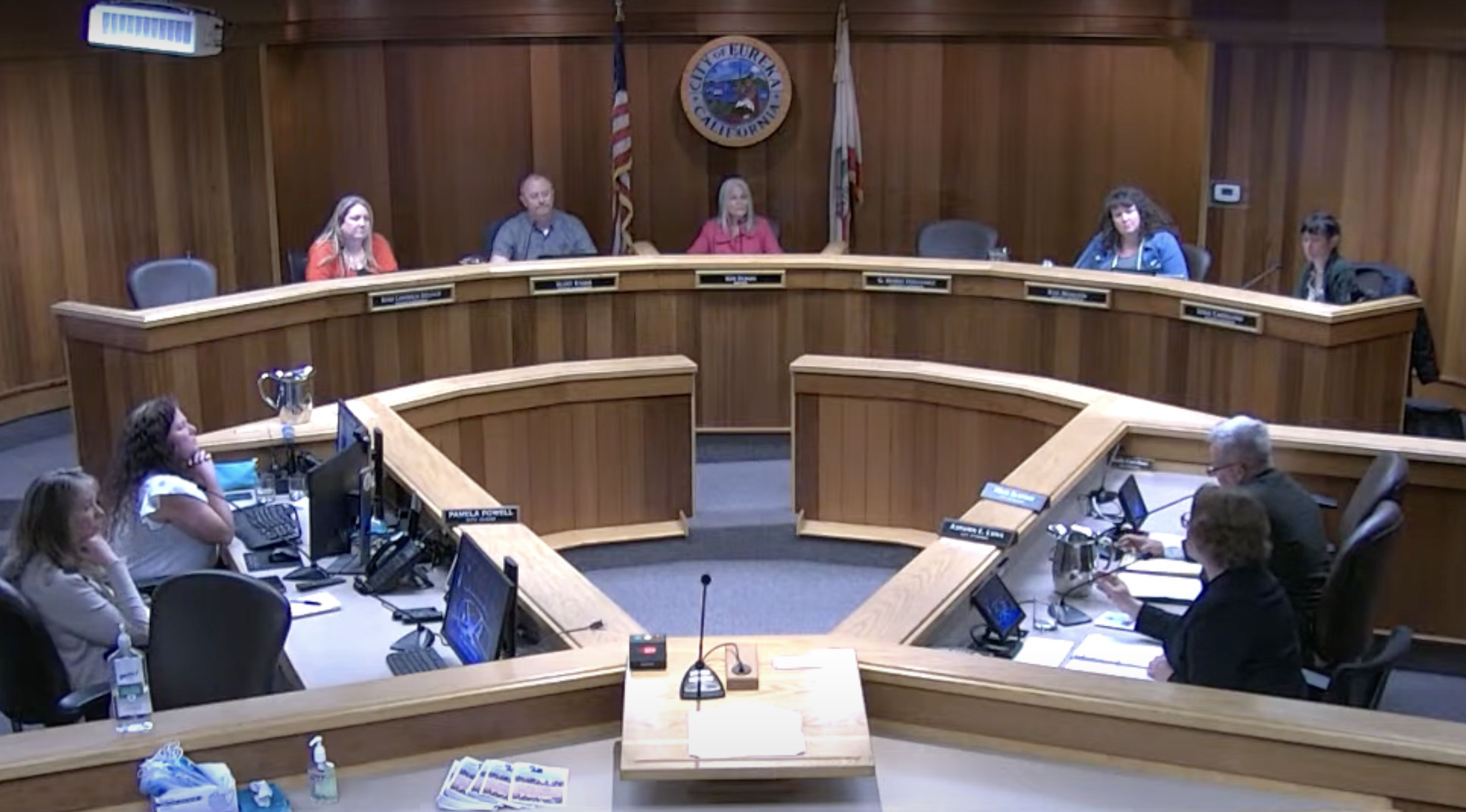
Screenshot of Tuesday’s Eureka Council meeting.
###
###
Weeks after the Eureka City Council’s grueling seven-and-a-half-hour discussion over a proposed ordinance to increase penalties for people living in unauthorized homeless encampments, tensions remain high.
While discussing future agenda items near the end of last night’s city council meeting, Councilmember Scott Bauer said he has experienced “many restless nights thinking about what transpired” at the Mar. 28 meeting and apologized for not doing more to stand up for staff who were subjected to “acrimonious testimony” and “tremendous disrespect” from members of the public.

Scott Bauer.
“I can’t let it go,” Bauer said. “Frankly, I thought our community was better than that. I sincerely apologize to all staff involved in [the] meeting, [who] dedicated so much time to crafting this ordinance. You simply followed a council request to develop this law and present it to us, and you should not have been treated so poorly. … What I do find completely baffling is the lack of trust expressed during public comment in our staff [who] have dedicated [their] heart and soul to working with our homeless population.”
Many of the speakers who spoke during the three-and-a-half-hour public comment period at last month’s meeting opposed the ordinance and criticized the city for “criminalizing people simply for existing.”
The draft ordinance — linked here — would increase penalties for “unlawful camping, sitting, and lying in public spaces” from an infraction to a misdemeanor, and would allow the city to redirect offenders to community-based rehabilitative services instead of jail through a municipal program called Law Enforcement Alternative Diversion (LEAD).
Bauer acknowledged concerns about the criminalization of homelessness but emphasized that the proposed ordinance would “be used as a tool, not a bludgeon” to help law enforcement get people off the street and into housing.
“I, for one, believe EPD is a wholly necessary part of the social fabric of our city and sleep better knowing our women and men in blue are out there doing their best to care for and protect our citizens,” he continued. “This council has been nothing but supportive of CSET [Community Safety Engagement Team], Uplift, CARE [Crisis Alternative Response Eureka] and a myriad of programs that have the sole mission of getting community members off the streets. … I believe Eureka and its public servants are doing more for its homeless population than most — if not all — cities in this great state.”
At the end of his five-minute statement, which you can watch in the video below, Bauer urged his fellow council members to avoid “kick[ing] the can, once again, down a long and apparently endless road,” and asked that the council revisit the ordinance next month.
“If we do not take action, we are sentencing our most vulnerable to a life in the willows, wetlands and green spaces of our community,” he said. “Do we really think this is in the best interest of our city and [our] citizens?”
Councilmember Kati Moulton defended the council’s decision to table the item, noting that it was 1:30 a.m. and “emotions were running really high” after the lengthy public comment period.
“I thought it would be more useful for us to have a delicate and nuanced conversation with a fresh head at the next meeting,” Moulton said. “But at this point, I would say that the ordinance is either useful and we should … adjust it and pass it, or we should take an entirely different path, but having this kind of hanging out there, I agree, is not helping anything.”
Mayor Kim Bergel asked if the rest of the council was in favor of the proposal, and was met with two thumbs up from Bauer and Moulton, and two thumbs down from Councilmembers Leslie Castellano and Renee Contreras-DeLoach. (Councilmember G. Mario Fernandez was absent.)
Castellano acknowledged Bauer’s frustration with the way that staff were treated, but felt it would be “disingenuous to the community” to bring the ordinance back prematurely.
“I do feel like we set upon some things that we told the community we’re going to be working on,” she said. “I do think distrust of government in general is, from my experience, at an all-time high, and I don’t think that trust is going to be built by bringing [the ordinance] back so soon.”
Tasked with breaking the tie, Mayor Bergel took a few moments to collect her thoughts before explaining her stance. She described how EPD has changed its policing tactics over the years, adopting a more compassionate approach.

Mayor Kim Bergel.
“I’ve watched staff go from slashing tents, stealing people’s property, talking smack about people, all those things. I’ve watched our [police] department change over the last 10 years, and I’ve watched our city grow in compassion over the last 10 years,” she said. “I was very disappointed about the meeting … and I had people call me on the phone, very upset that … it would be put off to some [date] far, far away.
Bergel agreed that the ordinance should be brought back to the council sooner rather than later. “I would like to see some resolution with it,” she said. “If it fails, it fails, but I think that the discussion … needs to happen.”
With three thumbs up secured, staff agreed to add the ordinance discussion to the council’s May 20 agenda.
###
Other notable bits from last night’s meeting:
- The council received an update from Uplift Eureka on staff’s efforts to increase homeless outreach and services. Special Programs Manager Jeff Davis said the Uplift Eureka Community Resource Center, located in the Municipal Auditorium at 1111 E Street, has had nearly 400 people visit the resource center since it opened to the public in January. Uplift continues to house people through its Homeless, Housing, Assistance and Prevention (HHAP) programs, Davis said, adding that the city has housed over 200 people through its Rapid Rehousing Program. “Every day we’re working towards better outcomes and better goals,” he said.
- The council also received an annual report from the Humboldt Waste Management Authority (HWMA). This summer, the authority is going to launch a study to assess the feasibility of creating a local organic waste collection site. City Manager Miles Slattery noted that the city’s compostable materials are sent down to Mendocino County, which kind of defeats the purpose of collecting organic waste to reduce greenhouse gas emissions.
- Staff also revealed the city’s new poet laureates: Sarai Bordeaux and Oivia Jaqueline Gibson. Both poets read a poem to the council, one of which moved Mayor Bergel to tears.
(PHOTOS AND VIDEO) PG&E Does Not Want You To Worry About Seeing Drones Near Power Lines, So They Staged a Flight For Us
Dezmond Remington / Wednesday, April 16, 2025 @ 3:22 p.m. / Flying

Drone operator Vinh Nguyen pilots a DJI Mavic 3E. Photos by Dezmond Remington.
PG&E, our overlords underground, have apparently taken to the skies as well — but don’t fret, they’re not interested in what the top of your house looks like.
PG&E have expanded their use of photo-taking drones to inspect power poles all over the state. In 2024 they conducted over 5,000 flights in Humboldt County alone. Naturally, a lot of people called them with privacy concerns, so to clear the air PG&E staged a demo flight for local media today.
“We don’t take photos of your kids,” PG&E spokesperson Megan McFarland said. “We’re not looking at your home or your backyard. We’re just looking at our assets [mostly poles, wires, and transformers].”
There are about 100 drone crews made up of one or two people around California. The operators take anywhere from 20-60 photos quality enough to see the threads on the wires and send them to a desk crew. They inspect the “assets” for wear and tear and decide if the equipment needs any work. Lower-risk areas are surveyed no less than every five years, higher-risk areas every year.
PG&E are switching to using more drones because they’re cheaper and quicker than sending people up the poles to check out the lines.
Spring is PG&E’s busy season for inspections because it’s right before wildfires start, so expect to see quite a few drones hovering around. Drone pilot Vinh Nguyen said there should always be a pilot watching the drone.
“It’s OK to ask questions,” said PG&E employee Billy Brown. “Just make sure you wait until the drone is on the ground.”




GAME ON: New Arcade to Bring Black Light Mini Golf and Laser Tag to Old Town Eureka
Isabella Vanderheiden / Wednesday, April 16, 2025 @ 7:34 a.m. / Community , Family

Game On will host Eureka’s first black light mini golf course. | Photos: Andrew Goff
Some kids want to be astronauts when they grow up. Others picture themselves as doctors or lawyers. Jacob Day, on the other hand, has always wanted to own an arcade, and, after more than 20 years of dreaming, his vision is finally becoming a reality.
Day, a long-time construction worker and skilled tradesman, has spent months transforming the cavernous space at 411 First Street in Eureka, formerly home to HealthSPORT By The Bay, into Game On — a family fun center featuring black light laser tag, mini golf and, of course, classic arcade games. Game On will open to the public on May 1.

Jacob Day
“This is something I’ve always wanted to do. I feel like this idea has been in the works for about 20 years now,” Day told the Outpost in a recent interview. “People my age, we pretty much grew up in arcades. You know the story: Our parents kicked us out at daylight and told us to come home when the street lights came on. A lot of our time was spent in [places] just like this … and we don’t have anything like that here in Eureka. I’ve always wanted to do something like this, but I had to wait for the opportunity to arise.”
Day spotted his opportunity while driving around Old Town Eureka with his wife Traci Day, a local insurance agent, earlier this year. “I saw the ‘For Lease’ sign on the front of the building, and I just had a feeling it was the right spot,” he said. As they peered through the windows, the building’s owner, Robert Maxon, pulled into the parking lot and asked if they wanted to see the building.
“He ran into his office next door to grab his keys and gave us a tour. We knew almost instantly that this was the building because we spent so much time in here when it was Globe Imports,” Day said. “I’m a woodworker, and I love the wood walls in here. There’s something really special about this building. I reached out to Robert about a week later and told him I was interested.”


Day has spent countless hours prepping Game On for its big debut next month, transforming the former gym into a glow-in-the-dark haven for game enthusiasts. Rendezvous Music & Vending has supplied about a dozen arcade games for the new space, including Mortal Kombat, Big Buck Hunter, a few racing games, several pinball machines and an air hockey table.
(Note to Skee-Ball fanatics: As it turns out, there aren’t any Skee-Ball machines available for rent locally, but Day said it’ll be “one of the first purchases we make once we bring in a little more revenue.”)

The nine-hole mini golf course and laser tag arena, located in a pair of backrooms on the West side of the building, were built almost entirely by hand.
“I didn’t really have a plan; I just put my head down and started building what came to mind,” Day said, gesturing to the ocean-themed mini golf course and “Rum Barrel Ralph,” a grinning pirate’s skeleton. “The wife and kids have done most of the painting for me so that I can keep moving building anything that needed to be built. … I decided to keep it at nine holes because anything more than that has a tendency to get kind of boring, you know?”


The laser tag arena is still a work in progress, Day said. The equipment — infrared-emitting phasers (guns), packs, targets and battle bases — is expected to arrive sometime this week. The neon alien-themed artwork should be wrapped up soon thereafter.
In addition to the laser tag arena and the mini golf course, Game On will host an “adults only” area on the second floor of the building to give parents a space to “withdraw from the controlled chaos” of the arcade and gaze out at Humboldt Bay. There’s also a private room for birthday parties and events on the first floor.
“Our goal is to create the most fun, family-friendly environment that you could possibly have in Humboldt County,” Day said. “We recognize that people are coming here to spend money, so we want to give them a little something back and provide some free stuff and games — like this huge Connect 4 game — for them to fill their time if they’re waiting and we’re lucky enough to be booked out.”
Game On will host a ribbon-cutting ceremony at 12:30 p.m. on May 1. Keep an eye on their Facebook page — linked here — for updates.
###

RIP HealthSPORT By the Bay.
How Labor Killed a Bill to Let California Wildfire Victims Sue Big Oil for Climate Change
Ryan Sabalow / Wednesday, April 16, 2025 @ 7:31 a.m. / Sacramento

A home burns during the Palisades Fire near Pacific Coast Highway in Los Angeles, on Jan. 7, 2025. Photo by Ted Soqui for CalMatters
###
This story was originally published by CalMatters. Sign up for their newsletters.
###
Oil companies had their hackles up this year after Sen. Scott Wiener introduced a controversial bill that would allow victims of wildfires and other climate disasters to sue them for causing climate change.
Facing potentially billions of dollars in losses, Big Oil had a lot to lose.
But oil companies took a back seat last week when it came time to persuade environmentally friendly lawmakers to kill the legislation.
Instead, Big Oil’s most influential allies in California’s Democratic-controlled Legislature – the unions that represent oil industry workers – led the opposition. They successfully persuaded a committee made up of pro-labor Democrats to kill the measure, which had support from nearly every California environmental organization.
Despite California’s reputation for taking the lead on climate change, the death of Senate Bill 222 is the latest example of how environmentalists’ most aggressive policies regularly fizzle out when Big Labor works on behalf of Big Oil.
“That’s how the oil companies breach the machine in Sacramento,” said Jamie Court, president of Consumer Watchdog, one of the groups that supported the legislation.
A spokesperson for the Western States Petroleum Association, which typically represents oil company interests in Sacramento, declined to comment on why the State Building and Construction Trades Council of California took the lead in killing the legislation.
Chris Hannan, the trades council’s president, said union members feared SB 222 would have a “chilling effect on our economy, setting gas prices through the roof, with absolutely no environmental benefits.”
“This bill’s terrible, terrible policy,” he said. “And it puts our jobs in jeopardy and puts our state in jeopardy.”
Big money turns out to oppose climate bill
At last week’s Senate Judiciary Committee hearing, Wiener, a Democrat from San Francisco, argued his proposal was urgent after January’s massive wildfires tore through Los Angeles County, destroying thousands of homes and exacerbating the state’s housing and insurance crises.
“We’re not supposed to have destructive wildfires in the middle of winter,” he told the committee. “And yet that is the new normal in California. And right now, who is paying for these climate disasters? Who’s paying for them? We’re paying for them.”
Wiener’s measure would have allowed victims to sue oil companies for damages, but they would have to prove in court that climate change was specifically to blame for their losses, which is not easy. While scientists have documented the connection between climate change and fossil fuels, the evidence is less definitive linking fossil fuels to specific extreme weather events such as floods, droughts or wildfires.

State Sen. Scott Wiener on the Senate floor at the state Capitol in Sacramento on April 29, 2024. Photo by Miguel Gutierrez Jr., CalMatters
Two witnesses Wiener brought to testify in support of SB 222 had lost their homes to wildfires. They argued that it’s time for the fossil fuel companies to pay their fair share.
“Disasters like this are going to keep happening, but you can make the financial burden less awful for all of us,” Moira Morel, whose home burned in the Eaton Fire, told the committee.
After they spoke, representatives of more than 20 environmental and consumer attorney groups walked up the microphone urging the committee to pass the measure.
The California Federation of Teachers, which has given at least $2.5 million to legislators since 2015, was the only major political donor supporting it, according to the Digital Democracy database.
But that paled in comparison to what its opponents have spent on politics: at least $22.7 million to members of the Legislature since 2015, according to Digital Democracy.
They included major business groups such as the California Chamber of Commerce and the Civil Justice Association of California, whose board of directors includes representatives from major corporations including Amazon, Pfizer, Apple and Meta, which didn’t didn’t directly take positions on the bill. Those two advocacy groups alone have given nearly $2 million to legislators since 2015.
Michael McDonough, a lawyer who spoke on behalf of the business groups, told the committee the bill was likely unconstitutional and “retroactively punishes the legal production of fuel for this state, which has been critical for California’s growth since its founding, and which this Legislature has supported for nearly 150 years.”
Organizations representing fossil fuel companies that opposed the bill but gave no testimony during last week’s hearing also have donated at least $1.7 million to legislators since 2015.
Democrats find union argument persuasive
But the Legislature’s biggest donors that opposed SB 222 are the trade unions. The State Building and Construction Trades Council, the California State Association Of Electrical Workers and the California State Pipe Trades Council and their affiliate unions have given at least $12 million since 2015, according to Digital Democracy.
“SB 222 unfairly targets one industry, while ignoring the broader systematic factors that contribute to climate change,” the trade unions’ lobbyist, Keith Dunn, told the committee.
Dozens of rank-and-file union members – pipefitters, boiler makers, painters, iron workers and others – took the mic after Dunn to urge lawmakers to spike SB 222. Many of them looked fresh off the jobsite, wearing safety glasses and T-shirts emblazoned with their union logos. It was a striking contrast in the Capitol, where business wear tends to be the standard attire.
The measure needed seven votes to advance out of the Senate Judiciary Committee; it failed with just five votes in favor and eight recorded votes opposed. Yet only one Democrat on the committee actually voted “no.” The rest didn’t vote at all, which counts the same as a no vote. As CalMatters has reported, the widespread practice of dodging tough votes allows legislators to avoid accountability.
There are few groups more influential in state politics than unions in California, despite only representing one-sixth of the state’s workforce.
As CalMatters reported, labor groups regularly get their way on bills at higher rates than other prolific lobbying groups, due in part to their massive political donations. Around a quarter of the members of the current Legislature are current or former union members.
One of them is Sen. María Elena Durazo, a Democrat from Los Angeles and a member of the committee who didn’t vote on the measure. The long-time former labor activist told the committee that companies that cause climate change should be held accountable, but not at the expense of workers.
“I don’t want to let anyone off the hook, but I don’t want to let working people be on the hook for everything that happens,” Durazo told the committee.
Her office didn’t respond to an interview request to ask why, if she opposed the measure, she didn’t cast a firm “no” vote. The four other Democrats on the committee who also didn’t vote for SB 222 – Aisha Wahab, Angelique Ashby, Tom Umberg and Jesse Arreguín – declined CalMatters requests to explain in an interview why they didn’t vote.
Sen. Anna Caballero, who represents Merced, was the one Democrat who voted “no.” Like Durazo, she found the union members’ arguments persuasive. She said the costs of the measure would be too high. She urged the Legislature to focus on promoting climate-friendly technologies such as “hydrogen, carbon capture, biogas, biomass.”
“Those are the kinds of jobs that will create a livable wage and also give us the opportunity to meet our climate goals,” Caballero told the committee. “And I think we’re all interested in the same goal … but we’re not going to get that through this litigation.”
Sen. Henry Stern, a Democrat who lost his home in the 2018 Woolsey Fire, addressed the union workers directly before he voted to support the legislation.He said the bill was about making multinational corporations accountable. He said the oil companies had been threatening “their workers that they’re going to fire them” if the Legislature passed SB 222.
“This is targeting those shareholders and those boardroom folks who are making the big decisions back at some corporate headquarters out in Houston or somewhere else, but not you,” he told the committee.
Wiener said in an interview that he wasn’t surprised the trades unions “are fighting to keep those jobs.”
“But it continues to surprise me that the California Legislature doesn’t pass the oil accountability bills, with only a few exceptions,” he said. “I hope that the Legislature will start taking a much more proactive stance to hold the oil companies accountable for the huge harm that they have done and are doing to California and to the planet.”
More High Schoolers Are Taking College Classes — but No Surprise Which Students Benefit Most
Delilah Brumer / Wednesday, April 16, 2025 @ 7:17 a.m. / Sacramento

The Campus Center of Bakersfield College on June 14, 2023. Photo by Larry Valenzuela, CalMatters/CatchLight Local
###
This story was originally published by CalMatters. Sign up for their newsletters.
###
Students tap on their keyboards as a professor lectures at the front of the room. It looks like any other college course, except that it’s taking place at a high school. This year, more than 150,000 California teens are earning college credit in dual enrollment courses.
Dual enrollment offers high schoolers the chance to attend community college, typically for free, often without having to leave their campuses. By helping students tackle the college academic experience, the programs increase the likelihood that students attend college after graduating high school.
About 80% of California’s dual enrolled high school students go on to a community college or university, compared to 66% of California 12th grade students in general, the Public Policy Institute of California found. More than a third of California’s dual enrolled students go on to attend the same community college they attended while in high school after they graduate, according to the Community College Research Center.
Many college and high school administrators have pushed to increase students’ college attainment rates, and the state has invested more than $700 million in dual enrollment, leading to a significant expansion. The number of students in these courses tripled between spring 2015 and spring 2024, according to state data. The Public Policy Institute of California found that about 30% of California’s high school graduating class of 2024 took at least one dual enrollment course.
The growth of high schoolers is a bright spot in overall student totals at the state’s community colleges, which have struggled to fully rebound after enrollment tanked during the pandemic. However, some community college faculty have pushed back against widespread dual enrollment due to concerns about academic rigor and working conditions for educators.

Furthermore, data shows that some of California’s rural students, as well as males and students of color, don’t enroll in and complete these courses at the same rate as others. Some experts and administrators say they’re not just missing out on a couple of college credits, they’re not getting the same opportunities to envision themselves as future college students.
“When high schoolers complete these courses, they are able to fulfill requirements that help them access associate degrees and bachelor’s degrees,” said Daniel Payares-Montoya, a PPIC research associate. “The students benefit, but so do the community colleges, because it helps them enroll more students.”
Rural schools and colleges face dual enrollment hurdles
In Siskiyou County, at the northern tip of California, the only community college serves a sprawling region that covers mountains, forests and rural towns. Although the county has a population of just 43,000, it is the fifth largest county in California by area, meaning that often the hardest part of supporting dual enrolled students isn’t the actual teaching — it’s having the right technology and transportation to reach them in the first place.
“The personal interaction is a challenge, because we have high schools that are two hours away,” said Kim Peacemaker, a counselor and dual enrollment coordinator at College of the Siskiyous. The college currently has about 230 dual enrolled high school students and about 2,390 students total, based on state data.
Peacemaker said the college has worked to make dual enrollment accessible by allowing professors to meet virtually with students in their high school classrooms. However, she added that some students don’t have reliable internet access at home for homework or tutoring. In Siskiyou County, 13.7% of households don’t have broadband internet.

Students walk through one of the main walkways onto Bakersfield College on June 14, 2023. Photo by Larry Valenzuela, CalMatters/CatchLight Local
California’s rural colleges generally lag behind urban colleges in dual enrollment. Kern Community College District in the southern Central Valley and the Compton Community College District near Los Angeles had the two highest percentages of high school students in 2024, at 41% and 36% respectively, based on state data. In comparison, 9.7% of students at College of the Siskiyous are dual enrolled high schoolers, and this drops to about 5% in some other parts of the state.
Sonya Christian, the chancellor of the California Community College system, previously led the Kern Community College District, spearheading its expansion of dual enrollment. Now, dual enrollment in the district is “one of the most successful models in the state,” Christian said in an emailed statement to CalMatters.
“I prioritized dual enrollment because I saw it as a potential pathway to increase college-going rates, accelerate degree completion and provide students — especially those in rural and low-income communities — with early exposure to college-level coursework,” Christian said in the statement.
“Everyone should do dual enrollment. It saved me time, it saved me money and it made me feel more prepared for college.”
— Manuel Milke, San Diego State student
For many high school students in the small city of Blythe, which sits along California’s border with Arizona, the only people they know with bachelor’s degrees are their teachers. That’s why Clint Cowden, the vice president of instruction and student services at Palo Verde College, said the exposure to college that dual enrollment provides these students can be transformative.
“It’s really a win-win for the community,” Cowden said.
A recent alumnus of Palo Verde College’s dual enrollment program, Manuel Milke earned his high school diploma and his associate degree simultaneously, while juggling varsity soccer and football. Now Milke, who is 19, is set to graduate in the fall from San Diego State with a bachelor’s degree in kinesiology. Milke said he chose to attend San Diego State to stay close to his family in Blythe, and aspires to work as a physical therapist somewhere nearby.
“Everyone should do dual enrollment,” said Milke. “It saved me time, it saved me money and it made me feel more prepared for college.”
Student gaps remain in dual enrollment
As a Latino male, Milke is in the minority for dual enrollment. Based on state data, Black and Latino students are both underrepresented in dual enrollment courses. In the spring 2024 semester, 41% of dual enrollment students were male, while 56% were female. According to Payares-Montoya, these gaps in access to dual enrollment can make it so Black, Latino and male students are less likely to see higher education as an option, compared to their dual enrolled peers.

For Jesse Medrano, an 18-year-old senior at Daniel Pearl Magnet High School in the Los Angeles Unified School District, dual enrollment has provided “a good outline of what college is like.” His high school first placed him in dual enrollment in ninth grade, and since then he has taken five classes, covering topics including economics and political science.
“I didn’t have the drive to seek these courses out, so the fact that they put me in them set this standard for me, and now I’m meeting it,” said Medrano, who is Latino and plans to study accounting at Cal State Northridge. “I didn’t have the motivation, but now I do, and I’m able to succeed.”
At Compton College more than a third of the current students are still in high school, according to state data. Latino and Black students comprise 75% and 9% of dual enrollees, respectively, which are significantly higher than state averages. Keith Curry, the college’s president, said that when students of color complete dual enrollment courses, this gets them comfortable with college academics and leads to better representation at colleges and universities.
Some faculty push back against expansion
Some community college faculty have raised concerns about the process by which dual enrollment partnerships are established, the level of readiness of high school students for college courses, and who teaches these classes. In many districts across the state, some dual enrollment courses are not taught by community college faculty, but by existing high school teachers who hold the credentials required to teach at a college level. In the Kern Community College District, about 60% of dual enrollment courses held on high school campuses are taught by high school teachers who meet the college qualifications, according to district spokesperson Norma Rojas.
“Completion is important, but our primary responsibility is for students to learn something along the way.”
— Tim Maxwell, College of San Mateo English professor
Tim Maxwell, an English professor at College of San Mateo, is a “conscientious objector” to California’s expansion of dual enrollment. Maxwell said he is concerned about what he sees as a focus to get as many students to graduate and earn college credits as quickly as possible, sacrificing college-level rigor and evaluation.
“Completion is important, but our primary responsibility is for students to learn something along the way,” said Maxwell, who has taught community college courses for about 30 years.
Maxwell has taught creative writing courses on his college campus with several dual enrolled students, one as young as 15 years old, and he said these students are “phenomenal.” But, he added, there’s a difference between a handful of proactive high schoolers going to a community college campus and a high school classroom that “switches to a college class during fifth period.” He said he is concerned about poor working conditions for professors, primarily adjunct faculty, who have to travel to high schools and teach without the proper background or support.
“We need to resist this, and we need lawmakers who understand something about education and not just spreadsheets,” Maxwell said.
Wendy Brill-Wynkoop, the president of the Faculty Association of California Community Colleges, said dual enrollment is beneficial for students, but that she has “heard grumblings” about a need for faculty to have a more active role in setting standards and policies for dual enrollment.

Students walk near Hepner Hall at San Diego State University in San Diego on Oct. 10, 2024. Photo by Adriana Heldiz, CalMatters
While in high school in Blythe, Milke said his dual enrollment courses were generally easier than the courses he takes at San Diego State. But they still challenged him and prepared him for a college-level workload, he said.
Lawmakers work to continue growth
Several state laws have been enacted in the past decade to expand dual enrollment in California. In 2015, Assembly Bill 288 established the College and Career Access Pathways program, allowing community colleges and high schools to enter into dual enrollment partnerships. These institutions bring the courses to students, as opposed to those students having to seek them out. The state streamlined the pathways program with the passage of Assembly Bill 30 in 2019, allowing students to submit fewer forms to enroll. Assembly Bill 731, which is currently in committee, would, among other changes, increase the number of units that students in the program can take.
Based on PPIC research, students in the College and Career Access Pathways program now account for about 37% of dual enrollees. This program has a higher percentage of underrepresented students compared to other dual enrollment programs, in part because it eliminates some of the restrictions that can make it hard for schools to offer broad and barrier-free dual enrollment.
As dual enrollment continues to expand, it increases costs to California beyond the more than $700 million that the state has already invested. That’s because both community colleges and high school districts are typically both able to receive state funding for dual enrolled students, according to the Legislative Analyst’s Office.
According to the statement from Christian, state leaders are working to increase dual enrollment access by expanding partnerships between high schools and colleges.
“My vision is to make dual enrollment a standard opportunity for all California students, not just an option for a select few, increasing equitable access to higher education and workforce-aligned learning,” Christian said in the statement.
Alana Althaus-Cressman, who runs the dual enrollment program at Golden Eagle Charter School, a K-12 school in Siskiyou County, markets the program to all students, not just those who already have a record of high achievement. She studied dual enrollment access for rural students for her graduate school dissertation at Sacramento State University, and started the early college high school program at Golden Eagle Charter in 2024. Students in the program take dual enrollment courses for part of the school day, and high school courses for the rest.
“We don’t want students to think that they aren’t the type of student for this program. It’s for everybody.”
— Alana Althaus-Cressman, Golden Eagle Charter School
Althaus-Cressman said that because dual enrollment offers students a glimpse of college, it’s important that the classes aren’t only filled with students who already plan to attend college. Some high schools require minimum grade point averages or have other barriers to entry for dual enrollment, which Althaus-Cressman said can perpetuate inequalities.
The early college high school program enrolls about a third of Golden Eagle Charter’s ninth graders. Althaus-Cressman attributes this level of participation to extensive outreach, which included working with school staff to call the families of every incoming high school student to invite them to a dual enrollment orientation.
“We don’t want students to think that they aren’t the type of student for this program,” Althaus-Cressman said. “It’s for everybody.”
###
Delilah Brumer is a fellow with the College Journalism Network, a collaboration between CalMatters and student journalists from across California. CalMatters higher education coverage is supported by a grant from the College Futures Foundation.
Kernen Construction Mostly Carries Its Case at Today’s Board of Supervisors Meeting; Company May Continue to Operate Without Explicit Hour or Noise Restrictions
Hank Sims / Tuesday, April 15, 2025 @ 2:46 p.m. / Local Government

Kernen cofounder Scott Farley addresses the board. Screenshot.
###
PREVIOUSLY:
###
The latest skirmish over rock and gravel operations at Kernen Construction’s Glendale yard ended with a win for the construction company this afternoon.
After a three-hour hearing this morning – and several delays from previous meetings over the last few months — the Humboldt County Board of Supervisors voted 4-1 in favor of a stripped-down motion that required the company to remediate some unpermitted berm construction at the site, which had encroached on the coho-bearing Noisy Creek.
But in the end the board majority seemed to side with representatives of the company, who argued that the board had no standing to revoke or amend a decades-old conditional use permit, which contained no language limiting the company’s hours of operation or the noise generated by it.
Supervisor Steve Madrone, who represents the area on the board, was the sole “no” vote on the the board’s compromise, and issued a strong verbal dissent right before the vote was taken. The terms being approved by the board would continue to allow 24/7 work at the Glendale site, and with no mechanism for limiting noise pollution.
“I just want to be really clear,” Madrone said. “I will be voting no, and I don’t believe that this motion in front of us deals with the number one reason why we’re even here today. And I find that to be just outrageous, frankly, that we’re not dealing with this. We’re not trying to find a way to really find a compromise for this neighborhood, you know, to bring some peace to them, to allow them to have their sleep and things like that.”
As was illustrated during public testimony, the dispute between Kernen and some of its nearest neighbors is a classic zoning case: How to balance the needs of the industrial company with the rights of the people who live nearby?
The original resolution brought by staff came in pretty hard in favor of a revised conditional use permit that would limit operations at the yard, which most people seem to agree leaped up abruptly in the last couple of years. Among other things, staff’s proposed “Revised Conditions of Approval” would have mandated that all operations cease nights and on Sundays. (The loudest part of the Kernen operation — rock crushing — is already so limited.)
Planning Director John Ford said that this proposed condition was prompted by the fact that Kernen had failed to negotiate with the department or neighbors on those terms.
“I don’t think staff wants to see them have to shut down at night completely but we’d ask for them to give us a proposal,” Ford said. “How can we balance this a little bit and address some of the neighbors’ concerns? We haven’t gotten a proposal, so this is our effort to come out and and have a dialogue about what can be done to realistically try to address some of the noise concerns that exist out there.”
Caltrans and other road contractors are often limited to working at night, so trips to Kernen’s materials yard will have to take place during those hours. In addition, sometimes emergency work will require that Kernen open its stockpiles of asphalt, gravel and the like during off hours.
Kernen attorney Brad Johnson, who led the case before the board, came out very strong, arguing that the board had no legal right to modify aspects of the permit issued to the company at the turn of the century. He explicitly mentioned legal action if it were to attempt to do so, and even hinted at political consequences to board members in a PowerPoint slide:

Slide from Johnson’s PowerPoint presentation.
Public testimony was mixed, with many people arguing that when you by a house in an industrial area you shouldn’t complain about the consequences.
“I live in a flight path for the airport in McKinleyville,” said John Nicholls of Nicholls Trucking, also located in Glendale. “I knew when I moved there that it was going to be noisy. Planes come over all the time. I hear them. It is what it is. That’s where I chose to live. You know, I can’t do anything about it. Ninety percent, probably 99 percent of the people who have complaints about the noise coming up from there have moved in since this operation was in place. They have no business complaining about the noise that they chose to move next to.”
But neighbors who have been lobbying the county about increased activity in recent years took exception to such sentiments, among them Cindy Trobitz-Thomas.
“The Trobitz family, contrary to what people think, that we’re all new there, has lived in Glendale for nearly 70 years, for the most part in harmony with adjacent industrial uses until the last two years,” she said. “Kernen Construction has expanded their operations without regard to the current situation for residents, the environment and laws.”
When it came time to take action, Supervisor Steve Madrone offered a resolution that asked for everything the Planning Department had proposed, in terms of hours of operation, noise and environment remediation, and added a few other items of concern — dust management, for example.
“I’m trying to find a way forward where we can continue to have this business operate, but also make it a little less impactful on the neighborhood,” Madrone said.
But this motion died for lack of a second, apparently because other supervisors took the point that amending the conditions of Kernen’s original conditional use permit — at least regarding noise impacts to the neighborhood — would not pass legal scrutiny, at this point.
Supervisor Natalie Arroyo asked the Kernen team which items from the county’s proposed list would they be comfortable with, and after a short break Johnson answered that question. The biggest concession was on the unpermitted berm the company had constructed, in an attempt to keep out flood waters. The company would agree to move that berm back 25 feet, away from Noisy Creek, and to revegetate that area. But it was a firm “no” on most items relating to sound or hours of operation.
One concession Kernen did make on the noise front: It agreed to replace the backup alarms on all its yard equipment with new, more mellow “white noise” alarms, or “quackers,” as Madrone called them. The compromise resolution passed by the board gave the company a year to do so.
The company also agreed that if it conducts vehicle maintenence at night, as it tends to do, it will do so indoors and with the doors closed.
So Ford quickly drafted a revised version of the resolution with those changes reflected, and it quickly passed with all but Madrone voting in favor.
The board is in closed session at the time of this writing. When it comes back, it will talk about the future of Project Trellis, the county-funded and -led marketing program meant to support the cannabis industry. It’ll also pass a resolution confirming that members of the board will receive no pay raises this year, in light of the budget crunch.


