

OBITUARY: Joseph Ryan Peters, 1977-2024
LoCO Staff / Thursday, Jan. 9, 2025 @ 6:56 a.m. / Obits

On October 9, 2024, Humboldt County lost an extraordinary friend, IT
guy, shark-and-snark-loving, snuggable bear of a man. Joseph Ryan
Peters, known as Ryan, was born May 10, 1977 in Mountain View to
Martha S. Peters and John R. Peters, and grew up in the Bay Area. He
graduated from Cupertino High School, Cupertino, in 1995.
An ex-girlfriend and life circumstances brought Ryan first to Garberville, where he honed his IT skills and earned four Associates of the Arts degrees from College of the Redwoods:
- College of the Redwoods, Eureka. Received an Associate in Arts in Transfer Studies, 12/15/2000
- College of the Redwoods, Eureka. Received an Associate in Arts in Natural Science/Mathematics 12/15/2000
- College of the Redwoods, Eureka. Received an Associate in Arts in Humanities 12/15/2000
- College of the Redwoods, Eureka. Received an Associate in Arts in Social Science 12/15/2000
He eventually made his way north to Eureka, where he made his mark on the community around him.
He worked as the entire IT department of RCAA since 2009, shouldering the responsibility of keeping this non-profit’s tech and internet access running smoothly with his remarkable skills in computer sciences. He was a dependable and tireless volunteer for the local community, pouring countless hours into Kinetics, the IMPropriety Society and fetish nights. Ryan took on jobs others didn’t want to do and managed them with his stubborn, and some(often)times snarky persistence.
While these above details matter, none of them matter as much as the kind of friend that Ryan was. He was the friend who could be counted on to show up in a moment of crisis. He was the ultimate problem-solver and shared this skill with those he loved. He was immensely huggable, and had a contagious giggle (Whiskey Shits! IYKYK). He was one of the best shit-talkers known to man, and loved nothing more than a good gossip session. His loyalty was unreserved — if he loved you, it was for life.
Of course, no one is perfect, and Ryan was no exception. He could offer the sassiest advice and commentary on your life; it sometimes stung but you always knew he was right. His beautiful tenacity could turn into stubborn resistance — he dug his heels in like nobody’s business! He was filled with contradictions: a gun-loving, motorcycle-riding, nerdy leftist.
With his death we strive to remember those aspects of him that brought the most joy and will be the most missed: an insatiable curiosity about the sciences, art, music, and people; a deep love for animals, particularly birds and sharks; immense knowledge and wisdom; a sassy, quick-wit; loyalty and trustworthiness; insane creativity; the best giggle in town; and a hug that could comfort the most anxious among us.
Joseph Ryan Peters is survived by his mother, Martha S. Peters, San Jose, father, John R. Peters, Gresham, Oregon, brothers, John and James of San Jose, the late Mr. & Mrs. H. F. Strickland of Gainesville, Florida and the late Mr. & Mrs. John Peters of Snellville, Georgia.
His large circle of friends who became family include: Kati, Nawdy, Q and Yvonne, Diamond and Griff, Laura and Ryan, Maxwell and Teresa, SuperK8 and Silas, Gin, Cas, Julia, Tina, Natalie and too many more to list. Please join this motley crew in a remembrance of Ry’s life on Sunday, January 19, 11 a.m. at Synapsis, 1675 Union St, Eureka.
###
The obituary above was submitted on behalf of Ryan Peters’ loved ones. The Lost Coast Outpost runs obituaries of Humboldt County residents at no charge. See guidelines here. Email news@lostcoastoutpost.com.
BOOKED
Yesterday: 6 felonies, 4 misdemeanors, 0 infractions
JUDGED
Humboldt County Superior Court Calendar: Today
CHP REPORTS
0 Sr299 (RD office): Assist CT with Maintenance
ELSEWHERE
RHBB: Cement Truck Driver Seriously Injured in Highway 3 Crash Near Hayfork Yesterday
RHBB: ‘Roads 202 and 250 Closed for Restoration Work’: CAL FIRE
RHBB: Fire Burns Outbuilding Near Mendocino County Animal Shelter
Design Review Committee Narrowly Approves New Plans for Eureka’s EaRTH Center
Isabella Vanderheiden / Wednesday, Jan. 8, 2025 @ 4:43 p.m. / Housing , Local Government

The Eureka Design Review Committee. From left to right: Gailey Browning, Kassidy Banducci, Chuck Ellsworth and Ryan Cameron. | Image: Screenshot
###
At a public hearing this morning, Eureka’s Design Review Committee narrowly approved new design plans for the long-awaited EaRTH Center, a four-story housing and transit development slated for two city-owned parking lots on Third Street between G and H streets, behind Lost Coast Brewery.
The EaRTH Center — shorthand for the Eureka Regional Transit & Housing Center — will host the Humboldt Transit Authority’s regional transportation hub on its ground floor, plus five commercial spaces for businesses. The upper floors will feature 46 residential units designated for low- and very-low-income households, including three studios, 18 one-bedroom, 13 two-bedroom and 12 three-bedroom apartments. Residents will have access to communal amenities on the second floor, including a community room with a kitchen, a fitness room, and a large outdoor terrace with a playground.

The northeast corner (Third and G streets) of the EaRTH Center depicted in the Servitas proposal (left) and Danco (right). | Images via City of Eureka
The project has changed quite a bit since it was approved in February 2022 by the Eureka City Council, as seen in the renderings above. When plans for the EaRTH Center were drawn up a few years ago, the development was billed as a 30-unit housing project for students and traveling medical staff. At that time, the city was working with Cal Poly Humboldt and Servitas, a student housing management company, to create much-needed housing for incoming students. However, the university and Servitas later left the project due to expenses.
The city briefly considered a partnership with College of the Redwoods, but the slow approval process for obtaining the necessary grant funding led the city to look elsewhere. Eager to get the project back on track, city staff asked if Danco would be interested in taking over the project, and in June 2024, the city council unanimously approved a resolution that authorized the City Manager to enter negotiations with Danco Communities for a Disposition and Development Agreement (DDA).
The redesign includes significant changes to the building’s façade and exterior, with a concrete base and green metal siding on the upper floors. Senior Planner Lisa Savage said the modified plans include new bus shelters along H Street, expanded sidewalks and electric vehicle charging stations.
“There also be a major [re]configuration of H Street between Third and Fourth streets,” Savage told the committee. “The west lane – where the bus shelter currently is located – will become a bus-only lane, and a new bike lane will run on the eastern side of the street. The current street parking configuration on the east side of H Street between Third and the alley [behind Lost Coast Brewery] will change from angled to parallel, which will cause the street to be reduced to one lane [for regular traffic] in this section.”
The reconfiguration will further reduce parking near the EaRTH Center, an issue many downtown and Old Town business owners have expressed concern about since it was first proposed.
Committee Vice-Chair Gailey Browning asked how many additional parking spots would be removed from Third Street under the current plan. Savage said the reconfiguration would eliminate parking on the south and east sides of the project, but she could not provide an exact number.
Committee member Chuck Ellsworth asked why Danco had decided to change the design, noting that the original rendering was “much more compatible with the community.”
Caitlin Castellano, the city’s deputy director of development services, noted that the previous rendering had been created by the former developer, Servitas, and that Danco decided to adopt a different, more cost-effective design. “There was no requirement by the city council or the Humboldt Transit Authority to retain the original design,” she added.
Browning felt the modified design was “inharmonious” with the rest of Old Town. “I think this is such an important project that there’s room for improvement on it,” she said. “I think the roof pitches could be more dramatic, I think they could add more window trim, I think the horizontal [and vertical] banding could be more pronounced. … I think the deck is a lovely edition, but I’d love to see some iron railing to pronounce that there’s a deck because you really can’t tell that it is from afar.”
Ellsworth seemed to agree, referring to the current rendering as a “cookie-cutter design.” He emphasized his support for the EaRTH Center but said, “It’s [in the] wrong place and it’s the wrong design for the community in that area.”
Committee member Ryan Cameron said he liked the building “overall” but asked if the developer would be willing to incorporate brick into the design to match some of the buildings nearby.
Garrett McSorley, the project’s current architect, pushed back on the committee’s assertion that his design is a “cookie-cutter” project. “From my perspective, this is a very high-quality project,” he said.
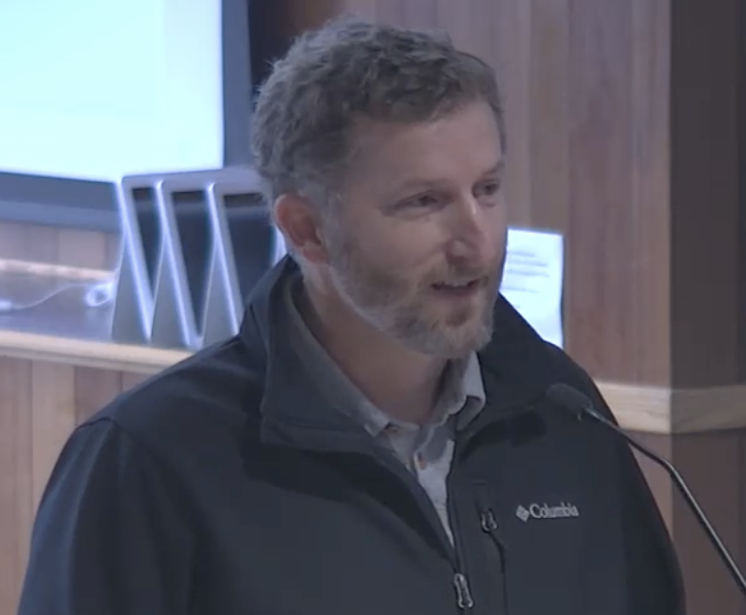
McSorley | Screenshot
“We can incorporate different materials,” McSorely continued. “You know, brick is definitely one of the things that we talked about early on in the process but we found that brick is a budget-buster. It’s very, very expensive and it doesn’t provide the [degree] of long-term maintenance that the materials we have shown are. … Repeating and using the same materials that are already there in Old Town doesn’t necessarily respect Old Town. … We’re just a block down from the Carson Block Building – a gem of a building – and trying to repeat and copy that building would be a mistake, in my opinion.”
McSorely acknowledged that the metal siding may look “flat” in the digital renderings, but said it will look “more interesting” in real life. He also expressed interest in incorporating a pattern or design into the concrete base on the ground floor of the building.
Browning asked McSorley if he would be willing to increase the pitch of the roof to provide a more dynamic design. Again, he acknowledged that the digital rendering “looks boring” but advised against upping the pitch because it would increase shading. Increasing the pitch could also interfere with the solar panels that will be installed on the roof of the building, he said.
“These projects are net zero energy,” he continued. “The families who [will] live [t]here [will] have utility bills of, like, $10 a month and the way that’s done is through the roof design. If we wanted to create a full new roof with, you know, spires and different gables, those all drastically reduced the amount of solar panels we could fit in the project and it has a dramatic impact on the residents in the future.”
During the public comment period, nearly all of the speakers spoke in favor of the project, underscoring the need for more affordable housing in Eureka. One speaker called the modified project design a “bait and switch,” comparing the new rendering to the veteran’s resource center on Fourth Street, across the street from the North Coast Co-op. “That’s probably one of the least attractive buildings in Eureka, in my opinion,” he said.
After a bit of discussion among committee members, Chair Kassidy Banducci made a motion to approve the modified design, which was seconded by Cameron. The motion failed in a 2-2 vote, with Browning and Ellsworth dissenting.
Development Services Director Cristin Kenyon advised the committee to come up with a new motion, otherwise, its decision to deny the project design would almost certainly be appealed to the Eureka Planning Commission.
The committee rehashed some of the design elements with the architect and came up with a short list of modifications to the project, including wood paneling at the building’s main entrance and thicker horizontal banding between floors on the façade.
Before the committee could take a second vote, Browning left for an appointment. After a bit of additional discussion, Banducci came up with a motion that passed 2-1, with Ellsworth dissenting.
###
Humboldt Bay Fire Engine Dispatched to Help Battle SoCal Wildfires
LoCO Staff / Wednesday, Jan. 8, 2025 @ 2:05 p.m. / Fire

Humboldt Bay Fire release:
This morning Humboldt Bay Fire was requested to assist with an available engine to respond to the Palisades Fire in Los Angeles County. Our Type 3 Engine as well as an Engine from Fortuna Fire are leaving Humboldt County to meet with a group of three Sonoma County fire engines in Petaluma. From there all five engines and a strike team leader will be driving through the night to LA.
Once at the Palisades Fire, our crew and the rest of the strike team will likely go directly to work. Humboldt Bay Fire is happy to provide apparatus and personnel to any agency in need, and we know that would be reciprocated. Working under unified command, all crews will be hard at work to prevent any further devastation to the Los Angeles County affected area. HBF hopes all personnel involved remain safe and return home.


(PREVIEW) The Makers of the New Baduwa’t Documentary Want People to Get Mad About the River
Dezmond Remington / Wednesday, Jan. 8, 2025 @ 10:56 a.m. / Activism , Film

The Mad River/Baduwa’t at sunset. By Dave Feral.
It’s December 1849, and explorer and naturalist Josiah Gregg is alone. He is furious. He is hungry. His buddies absconded to get a meal at a nearby Wiyot village, leaving him stranded at a river they were resting at while he drew up a map of the area they explored. He crossed the river and found his crew.
“His cup of wrath was now filled to the brim,” a later recount of the expedition would put it, “but he remained silent until the opposite shore was gained, when he opened upon us a perfect batter of the most withering and violent abuse.”
After a minute everyone relaxed, but the incident remained fresh in Gregg’s mind. He christened the river he crossed in pursuit of bread and revenge the “Mad River” on his map. The U.S. government bought the map, and over the following decade, settlers colonized the area Gregg charted. 175 years after Josiah Gregg had a fit on the banks of a river nameless to him and his party, people still call it the Mad.
But there were people living near that river thousands of years before Gregg’s tantrum, and they called it a different name: Baduwa’t, “free-flowing river.” Almost two centuries after the river was given the Mad moniker, people are trying to change it back.
Dave Feral talks slowly, but he makes up for it by way of persistence. Every answer to every question ricochets around the point for a while before hitting a glancing blow.
Feral is the founder and executive director of the Baduwa’t Watershed Council (BWC), an organization dedicated to preserving the health of the river. He’s also a driving force behind the recently released Baduwa’t, a documentary about the river’s health, its turbulent history with outsiders and the Wiyot effort to both formally and colloquially change the name.
“I’m way too verbose, so you gotta cut me down,” Feral said in an interview with the Outpost. “There’s piles of my stuff on the floor.”
Mostly composed of gorgeous river b-roll and interviews with everyone from Wiyot tribal members and scientists to county supervisor Steve Madrone to Feral himself, the work on the film started in 2021 and wrapped last year. It had a private premiere at the Arcata Theatre Lounge last month. Feral and the film’s co-director, Michelle Hernandez, a member of the Wiyot Tribe, hope to secure a public release in February at the Eureka Theater.
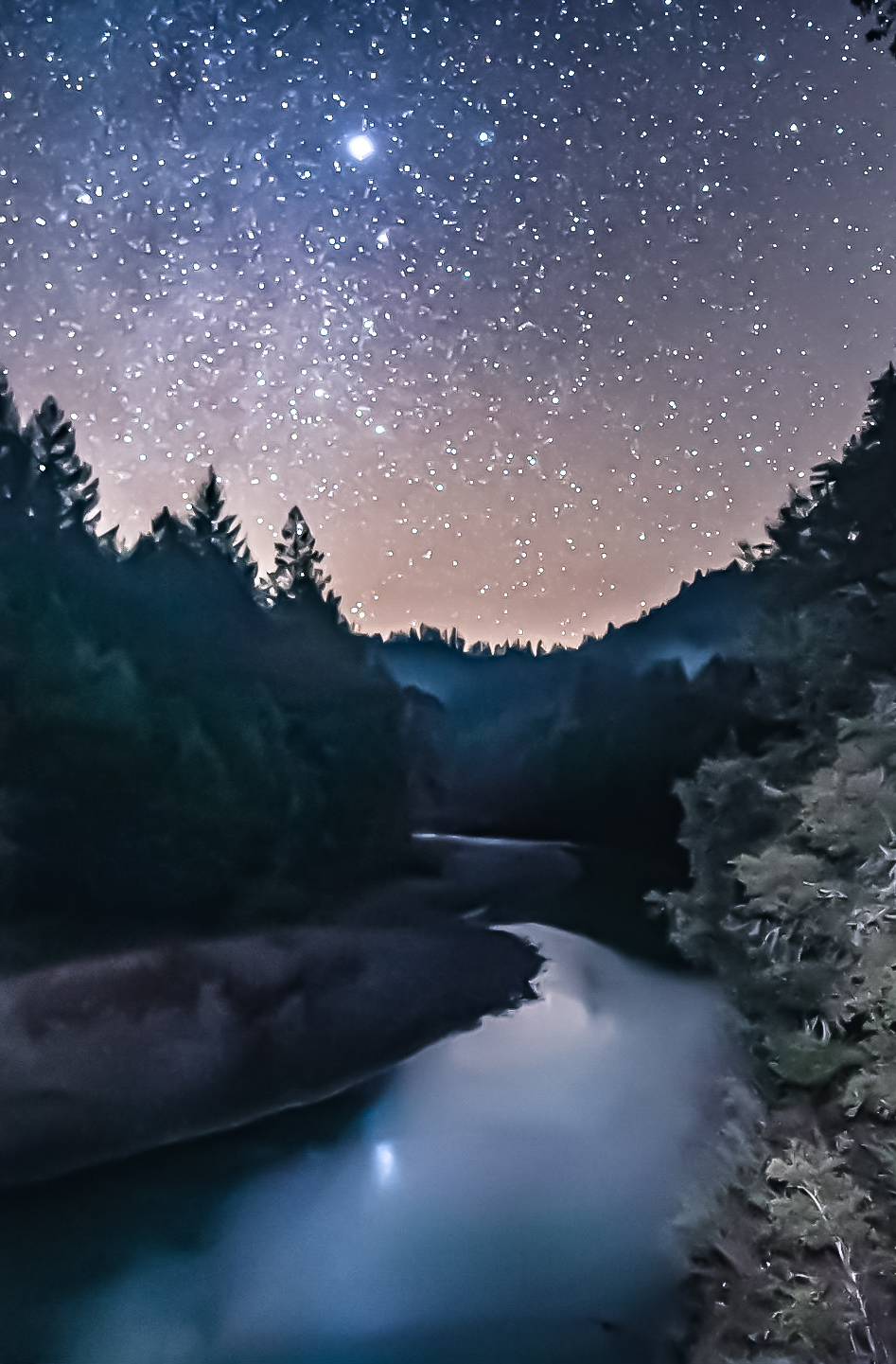
The river at night. By Dave Feral.
It’s a trim film that touches on a lot in its 41-minute runtime. Feral and Hernandez both summed it up as a story about the river as a whole and the people that use it.
“It’s about hope and changing a name,” Hernandez said. “It’s also about how we got to where we are currently with the river’s health. Basically, ‘What can a community do before it’s too late, before it gets sick?’”
The BWC hopes they can convince their audience of the importance of changing the name of the river back to Baduwa’t. Hernandez and Feral argue that beginning a public discussion about changing the name will draw more eyes to the ecological health of the river.
“I thought for many years about the Baduwa’t before this transpired into the story it is now,” Feral said. “At a certain point, I went ‘You know what? If we begin to share the story of Baduwa’t, more people will become aware of the river…’ I think that’s the impetus, to say ‘What would it be like if we just started the process of getting people to recognize the name Baduwa’t instead of Mad?’”
This renaming effort is part of a larger narrative, in Humboldt and around the U.S. and worldwide, of indigenous-led efforts to rename places in the original native tongue. In Humboldt, Patrick’s Point State Park became Sue-Meg in 2021. There’s even a program the Wiyot tribe runs to find Soulatluk place names for agencies that want one.
Feral says there has been a backlash about the proposed shift to Baduwa’t, a kind of entrenched nostalgia from people whose ancestors lived in Humboldt for a while and always called it the Mad and see no reason to change it back.
“There have been a couple people on projects I’ve worked on … they’re complaining on public forums on Facebook,” Feral said. “I’m like, ‘Hey, you know what? To be accurate, this name existed way before anyone you’re related to got here and pushed some other people off of their land.’”

A salmon in the river. By Dave Feral.
Feral knows firsthand that the process of changing names isn’t simple. Several years ago, he changed the name of the BWC from its previous name, the Mad River Alliance. Board members questioned the move. State grant checks made out to Mad River Alliance had to be fixed. People still complain about the adjustment.
Hernandez and Feral also believe that the original renaming of the river was symbolic of greater injustices, both to the Wiyot people and the ecosystem as a whole. Reclaiming Baduwa’t would be beneficial for both the community at large and the river itself.
“The renaming of Baduwa’t to ‘Mad River’ marked the beginning of a series of destructive events, including the gold, timber, and green rushes, that have severely impacted the watershed,” the BWC website reads.
“The Wiyot never changed the name,” Feral said. “They never gave up sovereignty of their land, their tribe, or any of the names they used before colonization occurred. I think that opening up the dialog and helping us understand how we see things from a colonial perspective versus [how] the Wiyot tribes or indigenous people see things is very important, because it begins the healing process that’s not just looking at the landscape and the damage that was occurred when the gold rush, the timber rush, and the fish rush occurred, and all the other atrocities that occurred with the capitalist colonization 175 years ago, but also recognizing how things had been managed before.”
Feral thinks Baduwa’t is an essentially hopeful film, and he claims many people that have seen it agree with him — but it can be hard to be optimistic during this film, when much of it focuses on how poorly the river is doing. The steelhead salmon population of the river is the smallest it’s ever been. Illegal water diversions for illicit cannabis grows are making it hotter. Clearcuts and logging roads dump tons of debris into the river. But Feral and Hernandez believe that a re-branding of the river back to Baduwa’t could help ameliorate those conditions by drawing more public attention to its problems.
“I’m hoping when I go home [to Humboldt] I hear more people referring to it as Baduwa’t and not the Mad River,” Hernandez said. “I hope [the film] helps cause a movement not just here, but throughout the United States. We’re seeing what happened, and we’re hoping that other people decide to reclaim other names that have been changed throughout the U.S. I hope this causes a movement so that we have more say in how we take care of this land, so we can prevent climate change from causing more damage than it’s already causing.”
Too Wet and Too Dry: The Crazy North-South Gap in California’s Rain
Alastair Bland / Wednesday, Jan. 8, 2025 @ 8:02 a.m. / Sacramento
A remarkably wet kickoff to Northern California’s rainy season has coincided with a desperately dry fall in Southern California — a huge disparity, perhaps unprecedented, between the haves and have-nots of rainfall.
Los Angeles usually gets several inches of rain by now, halfway into the rainy season, but it’s only recorded a fifth of an inch downtown since July, its second driest period in almost 150 years of record-keeping. The rest of Southern California is just as bone-dry.
At the same time, much of the northern third of the state has weathered nearly two months of storms, flooding and even tornadoes. Santa Rosa, north of San Francisco, has received more rain than nearly any other city in California — nearly two times its average rainfall to date. At the city’s airport, almost 7 inches fell on Nov. 20 alone, an all-time daily record.
Northern California is always wetter than the semi-arid southern half. But the scale of the north-south gap that has persisted for several months has stunned experts.
“There have been few if any years since 1895 … that have been so much above-normal in the northern part of the state while simultaneously so dry in the south,” Daniel Swain, a UCLA climate scientist, wrote in his blog Weather West. He added, in an email exchange with CalMatters, that “it is likely that the current north-south disparity is record-breaking in magnitude by at least some metrics.”
This season’s stark imbalance isn’t bad in terms of water supply. That’s because Northern California’s rain and snow feed major reservoirs, which provide much of the water used by Californians. If this occurred in reverse — a wet south and a dry north — most of the water would remain uncaptured, providing little benefit for supplies.
Snowfall to date has followed a similar pattern, with relatively heavy snowpack accumulating in the northern Sierra Nevada and substantially below-average levels in the southern Sierra.

All of Southern California, between Kern County and the borders with Arizona and Mexico, is experiencing moderate to extreme drought so far this season. The dryness, along with fierce Santa Ana winds, ignited two major fast-moving wildfires in Los Angeles County on Tuesday.
But while the latest forecasts predict dry weather for at least the next 12 days, water suppliers aren’t panicking. They say thanks to ample precipitation two years in a row, their reservoirs and groundwater basins are brimming with water to supply Southern Californians.
“In terms of water reliability and water supply at this moment in Southern California, things are looking pretty solid,” said Mike McNutt of the Las Virgenes Municipal Water District, which serves 75,000 people in northwest Los Angeles County.
In addition, demand in the district has declined since the 2020 drought year by 23%, McNutt said.
Statewide, average per capita water use has declined sharply since the 1990s, in spite of a growing population. Last July, state officials approved controversial and costly mandatory conservation rules that force 405 cities and other urban suppliers serving about 95% of Californians to meet individualized water budgets that decline over time.
Orange County Water District Chief Hydrogeologist Roy Herndon said his agency, which supplies groundwater to the north half of the county, has enough supply to carry its 2.5 million customers through the worst of any potential droughts — multiple years in a row with minimal rainfall. “Three years, no problem. I’d say even five years,” Herndon said.
The Metropolitan Water District of Southern California — which serves 19 million people mostly with imported water — also has an abundance, “with a record 3.8 million acre-feet of water in storage,” according to Interim General Manager Deven Upadhyay, who issued a statement last week. That’s enough water to supply 40 million people for a year.
Last year was the eighth wettest year statewide in a century, and 2024 was about average. Now, the state’s largest reservoirs are well above their average levels for this time of year. Lake Oroville, the State Water Project’s largest, contained 128% of its average to-date storage as of Jan. 6. Lake Shasta was at 130%. Casitas and Diamond Valley reservoirs, key holding facilities for Southern California’s supply, are both almost full.
Moreover, snowpack conditions in the Sierra Nevada are promising.
As of Monday, the Sierra Nevada contained a snow water equivalent of 103% of average. The northern end of the mountain range is at 150% — a reassuring status since it’s the source of the bulk of the reservoirs. The southern end, however, now holds just two-thirds of its average for early January.

At right, California Department of Water Resources staff member Andy Reising conducts the first snow survey of the 2025 season at Phillips Station in the Sierra Nevada., on Jan. 2, 2025. Photo by Nick Shockey, California Department of Water Resources
“Off to a better start this water year than we were last year, but much remains to be seen in terms of how this water year actually ends up,” said David Rizzardo, hydrology section manager of the California Department of Water Resources.
The agency announced in early December that its State Water Project — which serves 750,000 acres of farmland and 27 million people — would be delivering 5% of requested water supplies to local agencies. Later in the month, after November’s atmospheric rivers pummeled Northern California, the department boosted the initial allocation to 15%. The allocation will likely jump again before the rainy season peters out — usually in April or May.
What’s in store for the next three months?
In California climatology, only one prediction is downright easy to make: Summers will be dry across most of the state. But California’s winters are extremely variable, and how the next three months — historically the wettest of most years — will unwind is anyone’s guess.
Michael Anderson, a climatologist with the California Department of Water Resources, said a single large storm could change the outlook for Southern California’s water year. But he also observed that most years that have started out so exceptionally dry have stayed dry.
“That is certainly the California story — bouts of very wet to bouts of very dry, flipping within a single season, flipping year to year, hoping that it evens out in the end.”
— John Abatzoglou, UC Merced climatologist
Of the ten times on record when Southern California’s coastal region had received less than an inch of rain by New Year’s Day, only once did the water year’s precipitation tally come out above normal, he said. Three of those times, precipitation levels reached almost average.
John Abatzoglou, a climatologist at UC Merced, said an abrupt shift in precipitation patterns into a full-on drought statewide, though not necessarily probable, would not be surprising, either.
“That is certainly the California story — bouts of very wet to bouts of very dry, flipping within a single season, flipping year to year, hoping that it evens out in the end,” he said.
Though it’s essentially a tossup how the rest of the year shapes up, there is a caveat: the onset of La Niña. The counterpart to the more prestigious El Niño, La Niña often features dry conditions in Southern California and wetter conditions farther north.
Alexander Gershunov, a research meteorologist at UC San Diego’s Scripps Institution of Oceanography, said the precipitation patterns seen so far this year, while somewhat consistent with La Niña, are more the “outcome of natural variability.”
“La Niña signals typically don’t kick in until January,” he said.
A classic La Niña could draw out current patterns through the remainder of the winter, though Gershunov also leaned toward the possibility that the year would finish up a wet one. Citing 2011, 2017 and 2023, he said “three of the wettest years this century were La Niña years.”
Southern California’s dry conditions primed the region to burn. The largest wildfire, the Palisades Fire, in Los Angeles County’s Pacific Palisades, grew to more than 3,000 acres within hours, forcing evacuation of tens of thousands of residences and destroying homes. The Eaton Fire ignited in Altadena, near the San Gabriel Mountains, on Tuesday night.
Wetter wets and drier dries
Increasingly pronounced weather extremes have been a growing area of interest among scientists and state officials, who frequently cite “weather whiplash” — “wetter wets” and “drier dries” — as one of the most pressing climate-related challenges facing California.
Mid-winter wildfires are just one potential outcome of this climate pattern. Increasingly erratic and unpredictable water cycles are another. California’s intricate system of reservoirs, canals and pumping stations was built to accommodate winter rainfall followed by a steady flow of snowmelt in the summer.
“Our reservoir system was predicated on the notion that much of our water would stay frozen in the mountains for months,” said Jeffrey Mount, a senior fellow and water supply expert at the Public Policy Institute of California.
But the climate that has historically supported this pattern is changing.
“Hots are getting hotter, dries are getting drier, the wets are getting a lot wetter,” said Gov. Gavin Newsom in a recent press briefing. “You have simultaneous droughts and simultaneous rain bombs.”
“We’re facing a future without snowpack, and we’re not ready for that.”
— Jeffrey Mount, Public Policy Institute of California
One trend frequently described is that of warmer and shorter winters, compressed from both ends. This causes more precipitation to fall in a shorter period of time, more of it to fall as rain, and more of the snow that does fall to melt earlier in the season.
Climate models suggest that the state’s snowpack — a resource that on average has provided 15 million acre-feet of water annually, or nearly four times the capacity of the state’s largest reservoir — could mostly disappear by the end of the century, when winters may be too warm to support long-lasting snow on all but the highest peaks and ridges in the state.
“The outlooks for California are a warmer future, where we see that snow line … moving up the hill, towards the end of the century, really leaving that seasonal snowpack to the higher elevations,” Anderson, at the Department of Water Resources, said.
Mount said the decline of snowpack is happening slowly on average, but with extreme snow drought periods increasingly falling into the bar charts of California history. Notable gaps are seen from 2012 to 2015 and 2020 to 2023 — low-snow periods that could reflect future norms.
“We’re facing a future without snowpack, and we’re not ready for that,” Mount said.
This shifting hydrology has prompted calls from many water supply advocates for more reservoirs and enlargement of existing ones, to capture more water at once. The long-delayed proposed Sites Reservoir — one of Newsom’s frequent rallying points — is well into planning stages, and other reservoirs are being enlarged.
Mount said relying on such concrete infrastructure enhancements will eventually prove much too costly. The solution, he says, lies underground.
“Our best hope is to aggressively start using groundwater for our main storage for the future,” he said.
Underground solutions
That’s not so easy in agricultural areas. Farms use such great volumes of water that it’s impossible to recharge many groundwater basins faster than growers pump it out, especially in the San Joaquin Valley. Water agencies and state officials are seeking ways to channel floodwaters into gravelly basins where water can rapidly sink in but logistical and regulatory barriers continue to stifle progress.
Because urban areas use relatively little water compared to farmland, local stormwater capture has made more of a splash. The Los Angeles Department of Water and Power captured more than 108,000 acre-feet of local stormwater in 2023 — about 20% of its annual demands — and diverted it into groundwater basins. Last year, the agency captured 41,000 acre-feet of stormwater in February alone.
Delon Kwan, the department’s assistant director of water resources, said city plans are afoot to increase stormwater capture to 150,000 acre-feet per year by 2035, in part by using urban parks as infiltration grounds.
Water recycling systems are another way to help drought-proof California communities. In his 2022 water supply strategy, Newsom set a target of 800,000 acre-feet of recycled water by 2030 and 1.8 million acre-feet by 2040. Some cities already reuse wastewater for irrigation or treat it after storing it in aquifers. Now direct potable reuse — sometimes erroneously called toilet-to-tap — has been approved in California.
Mount said Southern California has made great steps toward improving local water supplies, but climate change could limit the region’s potential for self-sufficiency.
“As you see increasing aridity in Southern California, with a climate more and more like the Southwest, you’re going to see increasing reliance on water from other areas,” he said. “If you haven’t got water to recycle, it becomes a real problem. If you haven’t got stormwater to capture, it’s a problem.”
###
CalMatters.org is a nonprofit, nonpartisan media venture explaining California policies and politics.
OBITUARY: Charles L. Bussman, 1949-2024
LoCO Staff / Wednesday, Jan. 8, 2025 @ 6:56 a.m. / Obits

Charles L. Bussman — beloved husband, father, brother, uncle and friend — passed away unexpectedly on December 7, 2024.
Charlie was born to Lawton (Bushy) and Marjorie Bussman on April 6, 1949. He was the youngest child born in the family following his half brother Albert Francis (Sonny) Jensen, Peter & Maryellen Bussman.
During Charlie’s youth he spent his summers at his grandmother “Nonny” Anderson’s property in Blue Lake. Here Charlie’s love for the outdoors, cooking, hunting, ranching was forged. He learned about long days and hard work.
Charlie was not known for his wonderful academic performances. He was a rather mischievous student sneaking into junior high school dances, being brought home by the police. Or having his mother called by the Eureka police department asking if she owned a 1968 Ford Fairlane, because it was driving up H street with a bare ass hanging out the window. He did have one talent at school, and that was the boys’ golf team. Golf was a lifelong hobby.
Charlie graduated from Eureka High School in 1968, He was not drafted to go to Vietnam, due to a diagnosis of asthma. He instead attended Humboldt State University, and after only six years he graduated. During his time in college Charlie worked in local mills, and could be found anywhere in Humboldt, Trinity or Mendocino counties, hunting or fishing. It is hard to find a photograph of Charlie without a dead animal or a golf club in his hands.
After his graduation from Humboldt State, Charlie’s father, who owned the Guthrie Georgeson agency at the time, got him a job selling insurance for Myron Abrahamsen at George Petersen Insurance. In 1981, Myron sold George Petersen Insurance to Charlie and his two sons. Jeff and Tom Abrahamsen. Charlie continued working in the Eureka office, and Jeff moved to Santa Rosa to open an office in Sonoma County. Jeff and Charlie worked together buying multiple insurance agencies across Northern California. In 1994, after the passing of his business partner Charlie became President of George Petersen Insurance.
Over the past 51 years working at George Petersen Insurance, Charlie made many great personal and business friendships. Charlie was always proud of his customers’ accomplishments, and he never backed away from a challenge that was presented to him. He enjoyed mentoring new, younger insurance agents to teach them about the business and the way you should help and take care of your client’s livelihoods and prosperity. Charlie led the way to grow George Petersen into one of the largest independent insurance agencies in Northern California, employing over 200 people, and spanning over 12 locations. Charlie was incredibly proud of what the Agency had become and all the work that staff had done over the years to achieve that growth.
Charlie was incredibly generous, helping others in financial need or personal guidance. He was a fierce friend, always taking care of those around him. He supported many nonprofit organizations such as Humboldt County Historical Society, Humboldt Botanical Gardens, Rotary Club of Eureka, Humboldt County Fair and Junior Livestock Auction, Boys and Girls Club of the Redwoods, The Buckeye Conservancy, Humboldt Crabs, Eureka Rescue Mission, Rocky Mountain Elk Foundation, and Boy Scouts of America.
Charlie had many hobbies and interests. Besides hunting, fishing, golfing at Baywood, or at the Palms or Hideaway in La Quinta. Charlie loved to bake pie, cook and BBQ. He loved to entertain people with a gathering, pizza party, 4th of July, Thanksgiving, Christmas Eve, Super Bowl, The Sea Grill, Roy’s Club, whatever the event, Charlie enjoyed a good time!
Charlie’s favorite place to be was his ranch in Maple Creek. Feeding cattle, cutting firewood, gathering slash for burn piles, having a Fourth of July party, riding rigs with his grandchildren on the annual Christmas tree hunt. He always wanted to be at the ranch. His energy for life was superhuman, he was a hard charger, always with a project to be accomplished.
Charlie enjoyed traveling, whether via motorhome, airplane, truck, river boat. Most recently he traveled to Scotland, Hungary and Austria. He loved to travel but his most beloved place was the Big Island of Hawaii. He had gone there as a young man and went almost annually since then.
Charlie’s love of family ran deep in our lives. We are all incredibly saddened by his sudden passing. There has not been a day gone by that he is not thought of or wished to be here.
Charlie is preceded in death by his father, mother, and half-brother. He is survived by his wife Deborah Bussman, his brother Peter Bussman and Sister Maryellen Horn. His Children Megan Bussman (Armin Halston), Mindy Sehon (Cory), Nicholas Abrahamsen (Amber), Kathleen Matson (Erik). His grandchildren Marina Sehon, Maren Bussman-Halston, Jeffrey, Virginia, Henry Abrahamsen, Cooper and Charlee Matson.
A memorial service is planned for a future date. Please reach out to the family for details.
###
The obituary above was submitted on behalf of Charlie Bussman’s loved ones. The Lost Coast Outpost runs obituaries of Humboldt County residents at no charge. See guidelines here. Email news@lostcoastoutpost.com.
OBITUARY: Betty Bliss, 1931-2024
LoCO Staff / Wednesday, Jan. 8, 2025 @ 6:56 a.m. / Obits

My mother, Betty Bliss, passed away peacefully in her home on December 3, 2024, just 10 days
before her 93rd birthday. She was born Betty Alice Basom on December 13, 1931 in Thermopolis, Wyoming to John Emerson Basom and Susanne Floryne Basom. Mom had two siblings, her brother
Dhane and her sister Wyoma.
Betty is preceded in death by her parents, John Basom and Susanne Basom; her brother Dhane Basom; her sister Wyoma Snyder; ex-husband and friend Larry Bliss; her oldest and very good friend Mish; and many, many four-legged friends.
Betty is survived by me, Sarah Finley, her only child; her son-in-law Bill Finley; granddaughters Nicole and Jasmine Finley; grandsons Gavin Finley and Forrest Borzini; brother-in-law Scott Bliss, who never forgot to call her every day; sister-in-law Claire Piccinelli; her friend Mish’s daughters Julie and Caitlin, who were like daughters to her and sisters to me, and many much loved extended family and friends.
The Basom family lived in Thermopolis, Wyoming until they moved to Amarillo, Texas when Mom was around five years old. All three of the Basom children were very musically talented. Mom started playing music at a very young age. Her life’s passion was the violin, but I cannot think of any instrument that she could not play. She would say that there were some that she didn’t play well, but she could still play them.
She studied music at Southwestern at Memphis Tennessee (now Rhodes College) and UC Berkeley, where she met my dad, Lawrence Hugh Bliss. They married in 1958 and I was born in March of 1968. We moved from the Bay Area to Southern Humboldt as part of the back-to-the-land movement in July of 1969, where they ran the Briceland Store (a little hippie convenience store and gathering place) until 1973.
Mom’s musical career was long and varied. She was music teacher to many children and adults. In addition to private lessons, she taught music at Skyfish School (when I was a kid), Briceland High and College of the Redwoods SoHum branch, where she taught and conducted the choir, and taught music history.
She played in and was concert master of the Eureka Symphony Orchestra, was first chair violin of the Meadowood String Quartet. She played in the Ukiah Symphony Orchestra, played at the Mendocino Music Festival, played in the Lake County Orchestra, and so many other music groups. One of her greatest joys was attending the Humboldt State Music Workshop. She said it was like music camp for adults. In 2018 she was honored by the Chamber Players of the Redwoods with the Floyd A. Glende award for her outstanding achievements and contributions to music on the North Coast.
Mom loved her family, friends and community very much, but was the most happiest about the little family that I stepped into when I married. She loved her grandkids with all of her heart! Over the last five years there were many amazing and wonderful people that came into our lives as helpers and caregivers, but in the end there was a core group of loving giving people that made it possible for mom to stay in her home. Laurie, who lived with her the last two years of her life. Laurie has been our rock and has become family. Alice, Joe and Vicky, who were amazing on a daily basis.
Heart of the Redwoods Community Hospice, and several wonderful neighbors and friends. Thank you all so much for helping me. All she wanted and asked for was to stay in her home and I could not have done that without all of you.
A celebration of life will be held on Saturday April 5. from noon until 5 p.m. at the Beginnings Octagon in Briceland. Please bring a pot luck side dish, Salad or dessert. In lieu of flowers, donations can be made to Heart of the Redwoods Community Hospice at 464 Maple Lane in Garberville.
###
The obituary above was submitted on behalf of Betty Bliss’s loved ones. The Lost Coast Outpost runs obituaries of Humboldt County residents at no charge. See guidelines here. Email news@lostcoastoutpost.com.


