
(VIDEO) Everyone in Humboldt County is Required to Watch This Music Video Now
Andrew Goff / Monday, Oct. 21, 2024 @ 10 a.m. / Our Culture
Does Humboldt County need an anthem? Local farmer/songwriter Brett McFarland certainly seems to be staking claim to the honor of penning it with the release, today, of his music video for “Humboldt” off the album Humboldt.
The five-and-a-half-minute song touches on a number of facets of local life and history — from the back-to-the-land movement, to the massacres of Native Americans, and, of course, weed — and the accompanying video features cameos from a handful of folks deemed sufficiently Humboldt. McFarland cites the musical outing as being one of the most significant accomplishments of his life.
“I’m a farmer. I feed people and regard that as highly important and valuable work,” McFarland states in a press release distributed to herald the release of his new music video. “But working on this project with the community here on the North Coast has been as meaningful as anything I’ve ever done in my life.”
That’s how Brett does it in Humboldt! Tune in and sing along to “Humboldt” in the clip above and read McFarland’s full release below:
Humboldt County farmer, Brett McFarland, has released the official music video for his song Humboldt on YouTube today. A social impact project off his album Humboldt, McFarland aims to celebrate unity and inspire environmental change through these uplifting short films.
From loggers and ranchers to Wiyot, Hoopa, Karuk and Yurok Tribal members, the video highlights the resilience of this diverse Northern California community. Notable cameo appearances include:
TV Star and renowned craftsman Eric HollenbeckLocal celebrities and regenerative farmers, The Foggy Bottom Boys
Hoopa Tribal Member Inker McCovey who serves as Director of Parks and Recreation and a cultural ambassador for the Hoopa Valley Tribe
Huckleberry Hill Farms’ Johnny Casali, who was sentenced to 10-years in prison before founding the first fully-licensed CA cannabis farm to grow for Willie Nelson’s brand Willie’s Reserve
Owners of the only oxen farm west of the Mississippi, ShakeFork Farm’s Cunningham duo
“I’m a farmer. I feed people and regard that as highly important and valuable work. But working on this project with the community here on the North Coast has been as meaningful as anything I’ve ever done in my life,” said McFarland.
This video release is on the heels of his successful kickstarter campaign. The next video, Klamath, is already in the works and will tell the powerful story of the river’s demise, tribal-led undamming and restoration. The release for Klamath is slated for late November.
The Official Music Video for Humboldt is now live on Youtube. To listen to the full album or learn more about the music visit www.brettmcfarlandmusic.com.
BOOKED
Yesterday: 10 felonies, 12 misdemeanors, 0 infractions
JUDGED
Humboldt County Superior Court Calendar: Today
CHP REPORTS
Church Ave / Sutter Rd (HM office): Trfc Collision-Unkn Inj
Summer Ln / E Washington Blvd (HM office): Defective Traffic Signals
Poppy Dr / Sherwood Rd (HM office): Closure of a Road
ELSEWHERE
RHBB: Ousted ER Doctor Runs for the Hospital Board That Pushed Him Out
RHBB: Eureka Public Outreach Shows ‘Tension’ Between Owning and Renting
RHBB: Ukiah Drops Annexation Push After Public Pushback
County of Humboldt Meetings: Behavioral Health Board - SUD/Dual Recovery Committee - Sept. 10, 2026
Why California Democrats Believe Abortion Issue Can Win Them Back the U.S. House
Jeanne Kuang and Jenna Peterson / Monday, Oct. 21, 2024 @ 7 a.m. / Sacramento

Tory Trowbridge, an organizer for the Knock for Democracy canvassing event in support of congressional candidate Derek Tran, addresses supporters in Placentia on Oct. 12, 2024. Photo by Carlin Stiehl for CalMatters
Three years ago, it wasn’t such a potential liability for a California Republican in Congress to be anti-abortion. Now, several of them are in competitive races to keep their seats.
Four signed a brief in 2021 urging the U.S. Supreme Court to overturn the federal constitutional right to the procedure. Three of them co-sponsored a bill aiming to give equal protection under the Constitution to “preborn” life, which it stated started at fertilization. The legislation, which was backed by 166 House GOP members but never made it out of a committee, was essentially an attempted national abortion ban with no exceptions.
By this spring, those California incumbents had all walked away from the bill. Several of those in tight races say that they don’t support a federal ban, but that each state should decide abortion policy.
Democrats say it’s flip-flopping. Republicans say it’s a political overreach. They’re both calling the other side liars.
Buoyed by strong support for a state constitutional amendment guaranteeing abortion rights in 2022 and polls showing Republicans nationally losing ground on the issue, Democrats are banking on abortion as they seek to flip or hold onto several California districts in their bid to win back the U.S. House majority.
They have help from abortion rights activists. Planned Parenthood Affiliates of California spent nearly $1.5 million this month on digital and mail ads targeting three of the state’s toss-up districts, attacking the incumbents as anti-abortion.
“A lot of these candidates … really all of them, have tried rewriting their records or reframing it, but their votes, previous comments and statements speak for themselves,” said Jennifer Wonnacott, the group’s spokesperson.
It’s a revival of Democrats’ play in the November 2022 elections, after the U.S. Supreme Court overturned Roe v. Wade that June: Democrats called out Republican incumbents for dodging the issue or amending their anti-abortion stances.
In the tight California races, the Democrats lost, but say there’s good reason to try again. If Vice President Kamala Harris wins the presidential election, having a Democratic Congress is key for her pledge to write Roe v. Wade into federal law. If former President Donald Trump wins, or if Republicans retain their House majority, activists say they fear Congress will attempt to restrict abortion in federal law, potentially upending California’s state constitutional right to the procedure.
They say the numbers are on their side. Across six toss-up U.S. House districts in November 2022, the state constitutional amendment on abortion got larger shares of the vote than the incumbent. Democrats have focused on the incumbents’ votes on a funding bill that would have limited access to the abortion pill and a bill to require doctors to rescue infants born alive during an attempted abortion — a rare occurrence — that critics called a way to intimidate abortion providers.
Republicans say Democrats are unlikely to get much traction on the broader abortion issue. California already allows it until the fetus can survive outside the womb, generally considered 24 weeks, and the GOP says voters are more interested in the economy.
Republicans also accused Democrats of mischaracterizing or exaggerating their positions. One ad for Democrat Rudy Salas suggests Rep. David Valadao opposes abortion even in cases of rape or incest. The Republican was a co-sponsor of the “life at conception” bill in 2022. This year at a debate, he said he supports exceptions for rape or incest.
Representatives for Valadao and other Republican incumbents did not respond to CalMatters inquiries about their views. Neither did Salas’ campaign.
“Democrats are lying about California House Republicans’ positions on abortion because they cannot win on their disastrous handling of inflation and crime,” Ben Petersen, a spokesperson for the National Republican Congressional Committee, said in a statement. The committee is among outside groups that have spent heavily in key California races.

Derek Tran, a Democrat running in California’s 45th Congressional District addresses canvassers at a Knock for Democracy event in Fullerton on Oct. 12, 2024. Photo by Carlin Stiehl for CalMatters
The districts — spanning the Central Valley, Orange County, the Inland Empire and outskirts of Los Angeles — are among the most competitive races in the country. According to a September poll, the candidates are separated by 5 percentage points or less, with one district virtually tied.
In the survey, researchers asked voters the first word that came to mind when they heard a candidate’s name. In the 13th, 45th and 47th districts, “pro-life” and “pro-choice” made the list.
“The fact that abortion is coming up unprompted at a relatively high rate in half these districts shows that it could potentially drive voters to the polls, and it’s certainly framing the way voters are thinking about these competitive congressional races,” said Christian Grose, a political science professor at the University of Southern California who is part of the polling team.
Still, it’s not certain that the abortion issue will tip the scales toward Democrats.
Republican incumbents in several of the districts won or held onto their seats two years ago despite a Democratic edge among registered voters. Since then, the GOP has picked up thousands of new voters in those districts.
And not all purple districts are the same.
In the 47th District in Orange County, where he’s running to succeed fellow Democrat Katie Porter, state Sen. Dave Min said he’s “running hard on abortion as one of our baseline issues” against Republican Scott Baugh.
In the neighboring 45th District, reproductive rights activists this month are knocking doors for Democrat Derek Tran, who is trying to unseat Republican Rep. Michelle Steel. Tran told CalMatters abortion is a “number one” issue in the district.
Some 300 miles to the north in the 13th District in the heart of the Central Valley, some Democratic voters and volunteers said abortion is a touchier subject. While the issue has galvanized young women, misinformation and rhetoric has pulled some “religious voters that would vote Democratic, to the right,” said Jared McCreary, a volunteer for Adam Gray’s congressional campaign.
At the edge of an event focused on Latino voters at a Merced park, two middle-aged women said their Catholic faith gave them mixed views about Democrats’ platform on abortion, but they remained loyal to the party over economic policy.
A relative, Geovanni Vera, joined them. The 21-year-old UC Merced student, who called himself pro-choice, chalked up the difference in opinion to generational divides, and said abortion rights would drive young voters like his classmates to the polls.
Angela Romero-Waterman, 59, said when she knocks on doors for Democrats, she discusses the separation of church and state with neighbors who are on the fence about abortion. A social worker, she and her partner said they were concerned not just about abortion rights, but an erosion of women’s rights overall.

U.S. Rep. John Duarte speaks during a Republican rally for the midterm election in Madera on Oct. 8, 2022. Photo by Rahul Lal, CalMatters
The incumbent, Republican John Duarte, has said he’s a moderate on abortion, and said in a debate in 2022 that he supports the right to an abortion up to three months, or 12 weeks. This year, he told reporters that he and Trump — whose public statements on abortion have varied widely — are both “pro-choice,” and that states should get to decide abortion regulations.
Gray, who lost to Duarte by fewer than 600 votes in 2022, said he would vote to pass a federal law guaranteeing abortion rights.
“All this other nonsense about, ‘Well, I’m pro-choice, because states get to have a choice, that’s just lying to people,” Gray said in an interview.
A spokesperson for Duarte’s campaign did not respond to multiple interview requests.
CalMatters surveyed candidates in six swing districts about federal abortion laws. Two Republicans — Rep. Ken Calvert and Baugh — said they believe abortion should be left up to the states. The Democrats who responded — George Whitesides, Will Rollins, Tran and Min — said they would vote to codify a federal right to abortion if elected.

Two years ago, seven GOP House members from California co-sponsored the life-at-conception bill. This year, only three did; Steel was the only one in a tough race to do so, signing on nearly a year after it was introduced, during the March primary campaign. Two days after she won, she withdrew that support, saying that she backs in vitro fertilization. Now, her campaign ads highlight IVF and other women’s issues.
Tran called it an attempt to “erase the history that she signed on and co-authored” the bill. Steel did not respond to multiple requests for an interview or the survey.
At a canvassing event with Knock for Democracy in Placentia, Tran emphasized Steel’s record to canvassers — many of whom traveled from neighboring Los Angeles and Ventura counties.
“It’s definitely important to me,” said canvasser Jamie Hellebuick, a 26-year-old graduate student at UCLA, “because it’s people trying to control my body because of their own worldview.”
###
CalMatters.org is a nonprofit, nonpartisan media venture explaining California policies and politics.
PASTOR BETHANY: Jonah, Part III — Or, Look Toward the Temple
Bethany Cseh / Sunday, Oct. 20, 2024 @ 7 a.m. / Faith-y
PREVIOUSLY:
- PASTOR BETHANY: Jonah Escaped the Whale, But the Point of the Story is What He Escaped After That
- PASTOR BETHANY: Jonah, Part II — Or, Denial is the Reason We Sink to the Bottom
Biblical characters are often seen as two-dimensional, lacking background or nuance. But Jonah had a story. Knowing a person’s history and hardship has the potential to soften our own hearts and relate to that person differently, bringing empathy.
We don’t know much about Jonah, about his life circumstances or upbringing. We don’t know what kind of loss or joy he experienced. Based on the culture and history, with the Assyrians’ bloodthirsty oppressive violence over Israel, we can assume his life wasn’t easy. Human psychology tells us Jonah’s upbringing came with intergenerational trauma and difficulty where surviving is carried within a person’s DNA. When you aren’t sure how to make ends meet or how to feed your kids, when you’re called off to war, or when you hear that the next city over has been burned to the ground, there are certain traumas that become foundational to how a person navigates through their life. (The comparison of this ancient story with Israel and Gaza today is not lost on me. Violence begets violence as we watch our paradoxical bloodsoaked tax dollars protect and kill and aid all at once.) These ancient stories have much to teach us if we’re willing to allow them. For Jonah, his upbringing was rooted in generational traumas and daily uncertainties, and I’m sure this shaped how he saw the world. Same for us, right? Our own difficult and traumatic life experiences shape the way we view the world and can make us question God. It’s really hard to respond to life with joy when loss and uncertainty has paved the way into today. And if that’s the case for you and me, I can’t begin to imagine how it was for Jonah.
But whenever Jonah needed grounding, he could find it in the Temple.
The Jerusalem Temple was thought to house the presence of God. Everything a Jewish person did was rooted in the admiration of and distinctness of Temple life. So, whenever Israel was subjected to foreign oppressive powers they would turn their focus towards the Temple, which reoriented their perspective in whatever storm they faced.
The Temple was also a constant, physical reminder of God’s unbreakable covenantal relationship. Covenants weren’t something God made up. It was an ancient practice tribes and peoples used to signify a mutually beneficial promise made between them. For example, the son and daughter from two different families of similar wealth and power would marry to benefit both. Or two tribes would make a promise to have each other’s backs, or not go to war against each other.
To make this promise the leaders would cut a covenant. They would take an animal, kill it, cut it in two, place each half just a part from the other, and then walk through the two halves signifying the promise made to each other was for life. If either party broke the covenant they were essentially saying, “May it be to me as it was to this animal …Till death do us part.”
If I break this promise, you can walk through my blood.
In Genesis 15, God used this ancient, barbaric human-made and understood promise and pledged Godself to a people, cutting a covenant with Abraham, knowing full well that human beings could never uphold the promise of relational fidelity.
Jonah’s prophetic role was to remind Israel they were to be faithful to following the ways of God no matter their circumstances, and I’m sure Jonah took his role very seriously.
So when the word of the Lord came to Jonah to declare second chances over Israel’s sworn enemy, over the people who may have murdered and mutilated Jonah’s own family members and demolished his countrymen over the past hundred or more years, of course Jonah wasn’t super-stoked. This wasn’t just the graciousness of God. This seemed like a breach in covenantal fidelity and promise.
It would have felt like betrayal, abandonment, treason.
I bet everything Jonah thought he knew about God, everything he’d worked for and preached about began to unravel. His faith, his theology, his religion fell apart like a house of cards, so what was the point of living when everything you’ve ever known now seemed like a lie? Of course you would run away and get as far as you could from where your life began to crumble.
He boarded a ship for the farthest place he could think of and while on this ship, a fierce storm kicked up and began tearing the ship apart, threatening to sink it. While the sailors did their best to survive by throwing their livelihood overboard and crying out to their gods — screamed prayers carried away by the wind and rain — Jonah headed down below deck to sleep it off.
When grief hits you hard because everything you thought you knew about your own life expectations or how your life was supposed to turn out falls apart like a house of cards, it’s really hard to function.
Jonah avoided reality, numbed the present, and sunk below the ship, because grief will do that to you.
Once the sailors discovered that the storm was from Jonah’s making and after deliberation, they woefully decided to throw him overboard.
And this is where the big fish comes into the story. Throughout chapter two of Jonah, we don’t read about the details of his experience in the belly of this big fish. We read about his prayer life.
Jonah had no idea how long he would be in this situation or if he would survive it. We know it would be three days but all he could probably see was a slow death and the torturous existence of a claustrophobic grave. But in the middle of despair, he fixed his perspective on what he knew to be true. “I remembered you,” Jonah said about God. I remembered your faithfulness. I remembered your love.
Jonah prayed, I remembered you. He didn’t know what the next moment would bring him but he did know that when he walked through the valley of the shadow of death, God wasn’t waiting for him on the other side, beckoning him closer. God was with him in the valley, in the grave, in the depths of such unknown and impossible places.
Jonah remembered and fixed his attention on the holy Temple, knowing he wasn’t alone.
I know many of us are walking through a valley of the shadow of death and it feels like we’re alone. This valley might be of your own making, like it was for Jonah. It might be from someone else’s making. It might be from nothing you can actually point towards and blame — it’s just hard right now. Some of you might feel like Jonah, totally irritated and frustrated that life isn’t turning out the way you had imagined it because you thought you’d be married by now, or that your marriage would be healthy by now, or your kids would be kinder by now, or you would have the right career by now. And to walk forward when things are such a mess feels like an impossible task, like maybe you’ve been abandoned.
Some of you might feel like you’re in the belly of the grave, barely surviving or holding on, feeling forgotten by God. There is a level of loss and grief that has buried you and it’s been way longer than three days. You’ve lost the ability to sing, pray, or trust anything or anyone.
So, look towards the Temple.
Take a deep breath and focus your attention inside. You are created in the image of God and you have everything you need inside you. You can feel it in your gut. You were designed to access the goodness and love of God, and you keep looking everywhere else, hoping some wisdom is going to fall from the sky when you were already created with everything you need. You are loved. You are whole and complete. Scripture says your body is the temple of the Holy Spirit. What a holy invitation of spiritual depth and wonder! God is with you in this hardship!
These ancient stories eventually tell how Jesus Christ brought forth a new covenant through his death because blood was required. The original covenant was broken again and again, so God slipped into skin to show a powerful way of sacrificial love (Google Girard’s “Scapegoat Theory.”) Humans became the Temple that houses God’s presence, which bears witness to such love and grace to every person, especially our enemies. So when life feels impossible, when you feel like you’re drowning in a watery grave without any knowledge of how long you might be buried in the deep, know you are not alone. Look towards the Temple, towards Love, within you.
And I believe the power that raised Christ from the dead can raise you from your watery grave as well.
So may we know we are loved and may this Love empower us to bravely love any bloodthirsty enemy around us. And may we listen to each other’s stories, building empathy as we see the image of God within each other.
###
Bethany Cseh is a pastor at Arcata United Methodist Church and Catalyst Church. Follow her on Instagram.
(UPDATE: OPEN) Highway 101 Closed to Northbound Traffic at Eel River Bridge Near Rio Dell Due to Accident
Isabella Vanderheiden / Saturday, Oct. 19, 2024 @ 2:09 p.m. / Traffic
###
UPDATE 2:35 p.m.: Both lanes are now open, according to Caltrans.
###
Original post: A traffic accident has shut down northbound traffic on Highway 101 at the Eel River Bridge just north of Rio Dell. The California Highway Patrol dispatch notes a four-vehicle traffic accident at that location just after 1:10 p.m.
Caltrans District 1 says the road should be cleared by 5 p.m. If you don’t see a big “STOP” sign at the center of the map above, traffic is likely flowing again. We’ll update this post when we know more.
GOOD FIRE: CalFire Is Gonna Torch 300 Acres Near Ettersburg Over the Next Few Days to Restore Oak Woodland Habitat
LoCO Staff / Saturday, Oct. 19, 2024 @ 11:10 a.m. / Fire , Non-Emergencies

File photo via CalFire.
###
TUESDAY UPDATE: CalFire has extended the controlled burn to Wednesday, Oct. 23 “due to weather and fuel conditions” in the area.
###
Original post:
Press release from the CalFire Humboldt-Del Norte Unit:
What: Professionally controlled prescribed burn planned for the restoration of oak woodland habitat and reducing wildfire hazardous fuels. The burn is planned for approximately 300 acres, as conditions allow.
When: The prescribed burn is planned for 3 consecutive days, October 20-21-22, 2024.
Where: Ettersburg Ranch Rd and Wilder Ridge Road in Ettersburg.
Why: This burn is part of a long-term habitat management plan and is also intended to reduce hazardous wildland fuel loading. The treatment will help to enhance the health of the native plant communities, aid in the control of non-native plant species, and protect and enhance habitat for animal species dependent on the oak woodland ecosystem.
Who: CAL FIRE. During these prescribed fire operations, residents may see an increase in fire suppression resource traffic, smoke will be visible and traffic control may be in place. Please be cautious for your safety as well as those working on prescribed burns.
Learn more how you can prepare for wildfire by visiting: www.ReadyForWildfire.org. For more information, please contact the CAL FIRE Humboldt – Del Norte Unit Public Information Officer line at: (707) 726-1285.
THE ECONEWS REPORT: Pre-Election Jitters, With Rep. Jared Huffman
The EcoNews Report / Saturday, Oct. 19, 2024 @ 10 a.m. / Environment

Congressman Huffman is back on the show. With a major election in just a few days, what is the Congressman up to? When he isn’t calling voters in swing states — has anyone in Nevada received a call from a “Jared from California”? — he is sponsoring new legislation to protect birds and whales.
The Congressman also has new bipartisan fire resiliency legislation that seeks to make our state safer without sacrificing environmental protections along the way.
HUMBOLDT HISTORY: ‘Too Bad White Man Find This Place.’ Or, Requa at the Beginning of the Last Century
Ruth Kellett Roberts / Saturday, Oct. 19, 2024 @ 7:30 a.m. / History

During the years that Roberts spent in Requa, a brush dance was held each year after the commercial fishing season closed. All photos by Ruth K. Roberts, via the Humboldt Historian.
###
FROM THE EDITOR OF THE HUMBOLDT HISTORIAN: This essay was given to the Historian by Peter Palmquist. It represents the fourth selection from his unpublished manuscript White On Red: Fifty Writings about Native Americans from the White Popular Press, 1850-1950 to appear in the Humboldt Historian.
Palmquist states:
Ruth Kellett Roberts was a society woman from Piedmont, California, who took a special interest in the Indians of the Klamath River area. She regularly arranged for young Yurok girls to live with white families in the San Francisco Bay region and was a strong advocate for Native American voting rights. Beginning about 1915, Roberts spent a total of seventeen summers at Requa, Del Norte County. She was an avid amateur photographer, and many of her photographs are among the best taken of Sa-atch culture. In this essay, which is reprinted from the March 1934 issue of Pacific Sportsman, Roberts talks about the history of Requa and its Native people.
###
Seventeen years ago I stood one day with an old Yurok Indian woman in the Indian village of “Rekwoi” at the mouth of the Klamath River. The name Yurok has been incorrectly applied to the branch of Algonquin Indians living from Weitchpec to Requa. “Sa-atch” is the Indian’s own name for this group. “Yurok” is the Karok (Orleans Indians) name for this group.
The glorious stream, the Klamath River, has its source in Klamath Lakes, Southern Oregon, and flows for approximately two hundred miles through a narrow gorge to the Pacific Ocean, and empties at a point in Del Norte County, California, twenty-two miles south of Crescent City, and seventy miles north of Eureka. The Indians themselves called it “O-meg-waw,” meaning Big River.
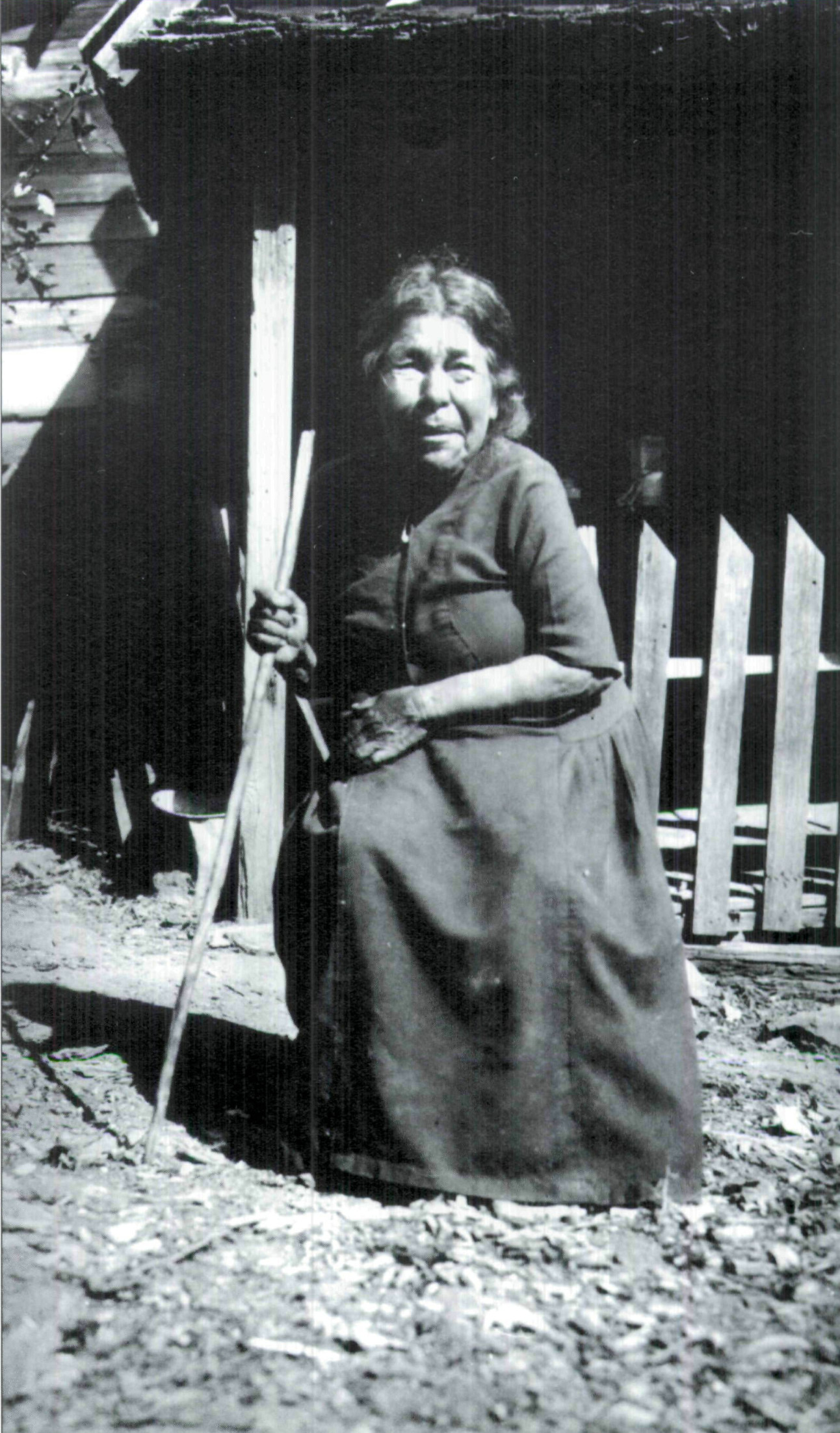
A Yurok woman in front of a house.
The steep slope where we stood above the river had once been a populous Indian community. All that now remained was one old family house, several caved-in sweat-houses, an equally caved-in ceremonial house, graves, and scattered pits overgrown with nettles where houses had once stood. Four Indian families, living in weather-beaten frame houses, were all that remained of the numerous inhabitants of the once thriving village.
We stood for several minutes without speaking, looking across the tidewater lagoon toward the extinct Indian settlement on the opposite hill slope, the site of which was marked only by graves. Above the graves a conical hill, the “Mount Ararat” of Indian legend, stood guard. Suddenly my companion clutched my hand. Quick tears blinded her dim eyes as she exclaimed; “Too bad white man find this place! He never would, if old woman who lived right there hadn’t let fire go out. She made a fog over fire. Hide this place! For long time no one found us! Oh too bad!”
Again there was silence. In my heart I, too, felt it was “Too bad.”

Roberts wrote, “The old town of Requa, clinging to the hillside, with its comfortable inn, church, quaint cabins, and cottages surrounded by gorgeously hued dahlias and sweet peas, seems more like a fishing hamlet in Europe than a California town.”
The first white man to look out across the river and ocean from this same hillside slopes was “Big John” Turner of the Jedediah S. Smith overland exploration party.
The Smith party, the first white “tourists” to invade this now popular fisherman’s paradise, descended the Trinity and lower Klamath River canyons in 1828 and encamped on a flat on Hunter Creek, at a point somewhere near the junction of the Redwood Highway and the county road into Requa. This junction is one and one-half miles in from the mouth of the river.
In Smith’s diary he states that during the short encampment of his party here, he saw no Indians. An Indian informant, however, related to me the fact that many Indians were hiding in the bushes near Smith’s camp and observed, both day and night, every move made by the explorers.
“Big John” Turner, a man of enormous stature, was evidently the only member of the Smith party to go to the actual mouth of the Klamath River. Smith’s diary does not recount this fact, but the Indians do. They have given me a complete description of Turner and the effect upon the Indians of the sudden appearance of this huge bewhiskered white man, who came alone into the Indian village at Rekwoi and stood quietly looking out across the Klamath River mouth and the Pacific Ocean.
The first impulse of the Indians, I am told, was to kill this intruder.
His huge size and calm fearlessness, however, were so disconcerting to the Indians, that they concluded this stranger must have a “medicine” or “power,” and that it might not be safe to kill him. And so, the first white tourist, who came “just to look around,” “looked,” and returned to camp, quite unconscious of his imminent danger.
The next arrivals at Rekwoi came by boat. In 1850 a small bark, the Laura Virginia, anchored just outside the mouth of the Klamath River. This boat was one of several boats outfitted in San Francisco, carrying miners seeking a water route to the Trinity goldfields.
Maps in use at the time indicated a large navigable stream, identified as Trinity River, emptying into Trinidad Bay. It was believed that this river was a direct water route to the Trinity gold fields.
The Laura Virginia, failing to find this river at Trinidad Bay, sailed on up the coast, and discovering the Klamath River, concluded it must be the sought-after water route. Therefore, some of the miners and their supplies were put on shore at the mouth of the Klamath, where a temporary camp was set up on the north beach.

Yurok woman in front of a traditional plank house, which has been propped up and is probably in disuse.
The dismayed Indians watched the Laura Virginia sail off up the coast and viewed with apprehension the camp preparations of the miners. The intent of these white trespassers was unknown to the Indians, but after observing the unwelcome immigrants for a time, decided they were not hostile, and so indicated the desired trails in order to rid the community of an undesirable foreign element.
The Indians called these new people the “Wa-gay,” because they had sprung up from nowhere, and were “smart.” The Wa-gay, a prehistoric people, were, according to an old Indian legend, the first people to inhabit this region, and “knew everything.”
One inquisitive small boy, “Billie” Brooks, and his sister, bolder than the rest, went down to the camp fires of the miners and were treated to baked potatoes. “God, but they tasted good,” Billie, the oldest surviving Indian living at Rekwoi, said, in recounting the story to me eighty-one years after the incident had transpired.
It was these miners from the Laura Virginia who first followed the course of the Klamath River for about one hundred and fifty miles to the Shasta River and made known the fact that the Klamath did not empty into the ocean at the mouth of the Rogue as all maps up to that time had represented its course, but was a continuation of the stream that was known as the “Klamet” above the Shasta River, and had been frequently visited by trappers and settlers who journeyed between Oregon and the bay region of California.
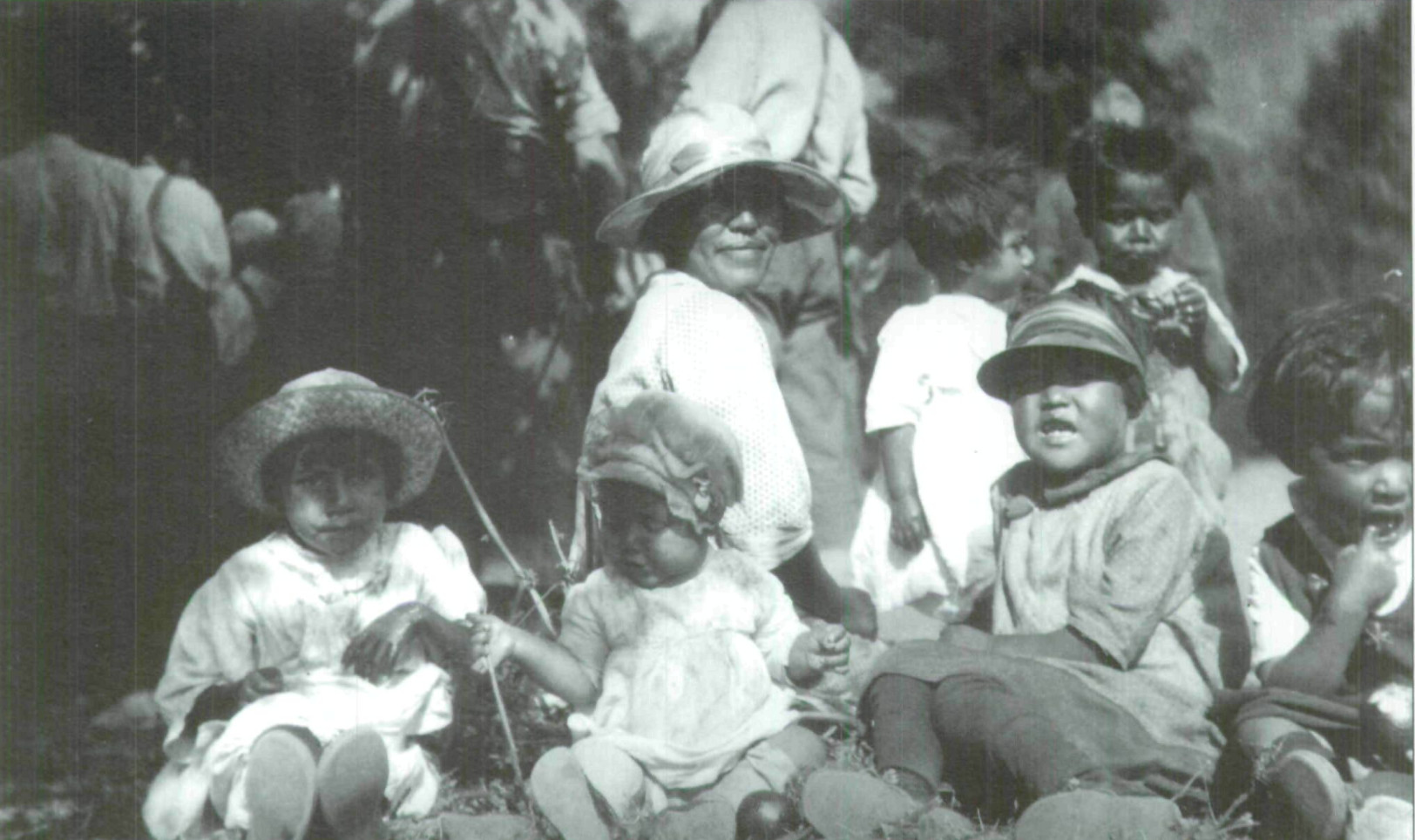
A Yurok woman smiles while several children enjoy the food at a community celebration.
For a period of years, miners and a few prospective settlers struggled through the lower Klamath River region, but made no settlement near the mouth of the river. The first and only building erected in the Indian village of Rekwoi by a white man was a store built and conducted by a man by the name of Weigle. The building housed the trader’s family, a post office, a general merchandise store, a saloon and a community dance hall. Another man named Tucker succeeded the first occupant and the house, and it became known as “Tucker House.”
The woman-shaped rock at the river mouth became known as “Tucker Rock.”
Several years ago an enterprising young Indian, Hathaway Stevens, acquired the property on which the old house stood, razed it and established himself and family in a modern bungalow. He put in a garden, leveled off a parking place for automobiles and prepared to harvest his share of profit from the ever-increasing tourist crop.
The town of Requa, the Mecca for salmon trollers from July until November, snuggling on the hillside about a mile in from the ocean, had a saloon as a nucleus of settlement, and from all reports outrivaled the frontier towns of the movies in local color. The name Requa is the white man’s attempt at the use of the unfamiliar Indian name “Rekwoi,” which in Indian means “river mouth.”
Requa nourished as a prosperous center of business activity and boasted several saloons, two dance halls, two general merchandise stores, a post office, livery stable, cannery and shake mill, until a few years ago when most of the business activity, the fights and the dust of the tourist moved three miles out to the new town of Klamath, near the Douglas Memorial Bridge on the Redwood Highway. The old town of Requa, clinging to the hillside, with its comfortable inn, church, quaint cabins, and cottages surrounded by gorgeously hued dahlias and sweet peas, seems more like a fishing hamlet in Europe than a California town.

Sandy Bar Bob, a Karuk man, plays a square drum typical of the area.
Fishing has always been the consuming occupation of this community, from the days of the unmolested aborigines who fished with every manner of net, spear, bone hook, and trap, to the familiar commercial net fisherman, and the tourist sportsman with troll and casting rod.
Commercial fishing was introduced on the Klamath River by Mr. A. Bomhoff in 1887, who by agreement with the soldiers in charge of Indian affairs for this district, built a salmon cannery at the present site of the Klamath River Pacers’ Association plant, with the understanding that only Indians be employed as fishermen and for unskilled labor. It was because of this agreement that the Indians and the Hoopa Indian agent permitted the cannery to be built on Indian land. Some of the Indians who started work in the cannery in 1887 were in 1933 employed there, and opening day each season found them knife in hand in their accustomed places ready for work. Commercial fishing was made illegal by action of the state legislature of 1933 and the law became effective January 1, 1934.
During its six weeks of operation the commercial cannery was the center of community activity. Indian families came down from “up river” in dugout-canoes, skiffs, and motor boats and established themselves for the fishing season in the cannery cabins near the plant. With their arrival the sleeping hillside slope became alive with babies, dogs, white washings and men busy at their net racks putting their nets in order.

A woman paddles herself and the photographer across the river.
Young and old Indians of both sexes fished and worked in the cannery. Gossiping old women, too old to work, took care of the babies and busied themselves gathering and smoking salmon heads and tails, salvaged from the cannery, for winter food.
In the evening, Indians, local whites and tourists gathered on the cannery platform or perched on points of vantage above the river, from which a good view could be had, and watched the fishermen “lay out.”
At the signal whistle from the cannery the fishing boats pulled out from both shores of the lagoon, the gill-nets stretching out behind with the “corks” bobbing on the surface as the boats raced toward the center of the stream. It was a thrilling sight.
Gill-net fishing on the Klamath River in recent years was legally confined to the two-mile stretch between the mouth and Douglas Memorial Bridge, and was done only at night, six nights a week, over an actual period of about six weeks.
At the end of the commercial season, September 6th, the Indians had a grand finale in the way of a “brush dance,” a “white man’s dance,” and a general holiday from all restraint. They “settled up,” bought their winter food supplies and clothing, and returned to their homes up the river. Here they harvested their beans, potatoes and corn, gathered acorns, went hunting, and dried salmon.
To the tourist salmon means sport fishing, to the Indian his staff of life …

Wildflowers bloom along a path that winds across the gentle hillside.
###
The story above is from the Summer 1999 issue of the Humboldt Historian, a journal of the Humboldt County Historical Society. It is reprinted here with permission. The Humboldt County Historical Society is a nonprofit organization devoted to archiving, preserving and sharing Humboldt County’s rich history. You can become a member and receive a year’s worth of new issues of The Humboldt Historian at this link.


