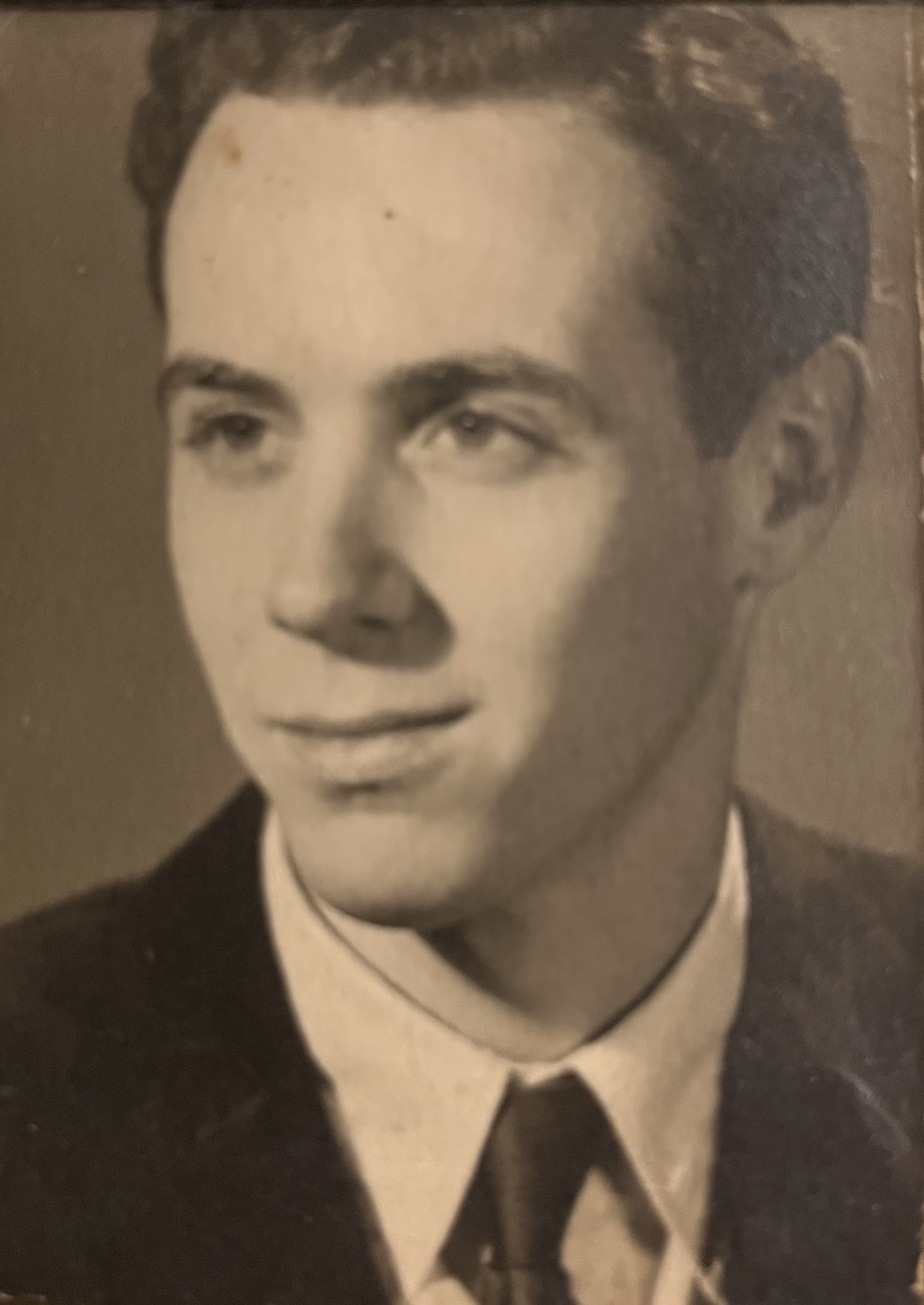
James
Darrell Bilderback passed peacefully from this world the afternoon of
March 20, 2024. He was born in Eureka, the son of Dora Mozettti
Bilderback and William James Bilderback. He lived 93 (almost 94)
years filled with love, purpose, travel, and service to his community
as a teacher.
He
was known as Jim, Dad, Grandpa, Uncle Sam, Uncle Donny and Mr.
Bilderback. He was a favorite uncle who, in his younger years, took
his nephews on trips to discover different places throughout the
country. He loved to travel internationally. He met his wife Marilyn
when a local couple invited them both to view travel slides, hoping
they would hit it off. Apparently he squirted her in the face with
whipped cream while serving her dessert that evening, a memory which
was often repeated. They were married in 1968, and rumor has it they
traveled to over 100 countries (on every continent.) His favorite was
Bhutan, whose people he described as incredibly peaceful and content,
but he had good things to say about each place and people everywhere,
including Kenya, where he met a hippopotamus face to face.
He
spent most of his life in Eureka, with the exception of a year in San
Francisco working in a Christian book store and his time in the air
force. He was stationed at Travis Air Force Base in California, and
then in Okinawa during the Korean War. He was impressed by the
resourcefulness of people he met there, and he always maintained a
perspective of gratitude for his blessings. He served the end of his
enlistment at the Pentagon, and was grateful for the educational and
home ownership benefits provided by his country in exchange for his
service.
An
alumnus of Humboldt State University, he was a true bibliophile with
a library of books on world cultures, natural wonders and the
pursuit of truth. He genuinely loved talking about the weather and
held a soft spot in his heart for all creatures great and small,
especially dogs. He would get seemingly perturbed at the family dog
for messing up the house and garden, but end up spoiling him with a
towel on the couch and football throws. He got a tremendous kick out
of training him to sit for his dinner and treats, and always made
sure that the home was well stocked for his visits. He took pride and
joy in making sure that everyone and everything was attended to.
He
taught social studies at three junior high schools in Eureka: Jacobs,
Zane and Winship. He was known for sharing his travel slides with his
students, and being a strict but good teacher that really wanted his
students to learn and become caring and engaged citizens of the
world. He was a devoted husband to the love of his life, and a loving
father and grandfather, celebrated for his pillow fighting and waffle
making skills. He kept his yard looking spectacular and was dedicated
to using gardening methods that caused minimal harm to all its
inhabitants. He maintained beautiful rose bushes and a wide variety
of ornamentals,
working outdoors regularly until a year before his passing.
He
was preceded in death by his mother and father, his sister Helen
Lampella, and brothers Vernon and Eugene (Mick) Bilderback. He is
survived by his wife Marilyn, daughter Marcia, grandson Kaiteo, niece
Jo, nephews Jim, Gene, David, Michael, Rick, and Gary, as well as
many of their children and grandchildren. He will be deeply missed,
but will live on in the lives of those he touched and in the wonders
of the world which he held in such reverence.
An
intimate celebration of his life was held with family following his
passing. Donations are welcome and can be made in his name to the
Humboldt Library Foundation or the American Cancer Society.
###
The obituary above was submitted on behalf of James Bilderback’s loved ones. The Lost Coast Outpost runs obituaries of Humboldt County residents at no charge. See guidelines here.
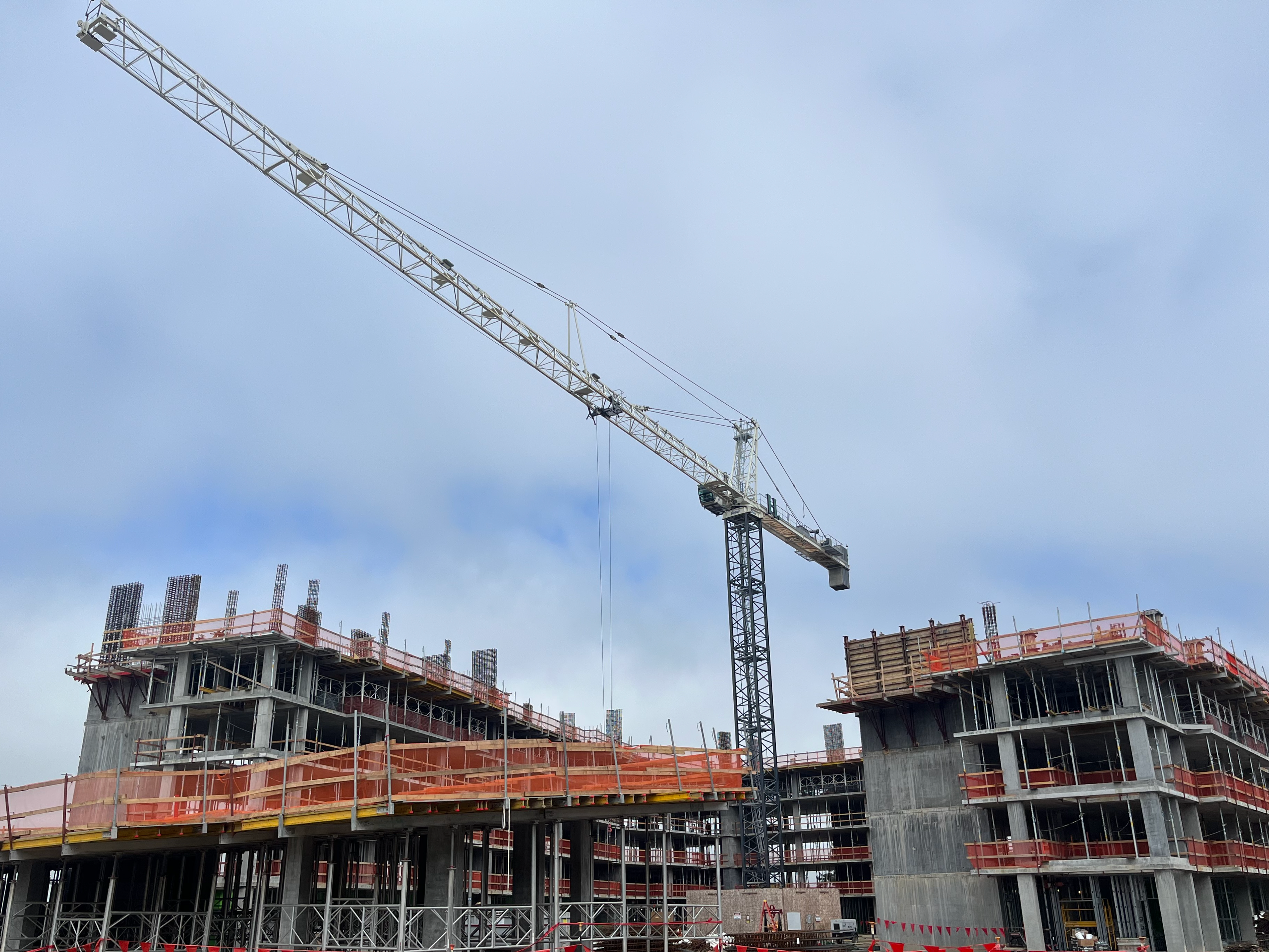
One of the housing buildings under construction on the east side of the Craftman’s Mall site, and the familiar giant crane overhead. | Photos: Stephanie McGeary
###
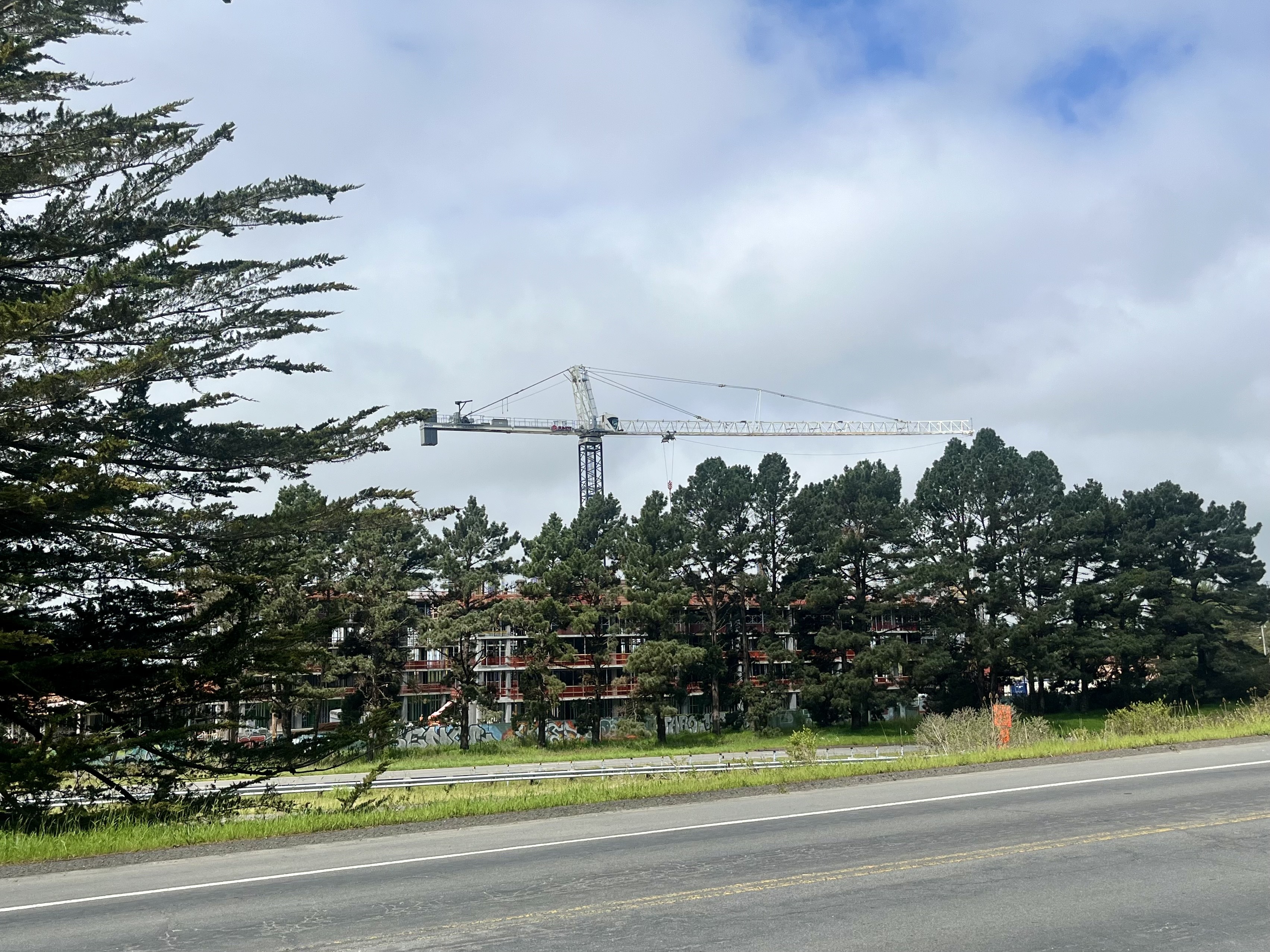
It’s been nearly a year since Cal Poly Humboldt broke ground on the new student housing project at Arcata’s old Craftsman Mall sitee. Many of you have likely seen the giant tower crane or the top of the in-progress building poking above nearby trees.
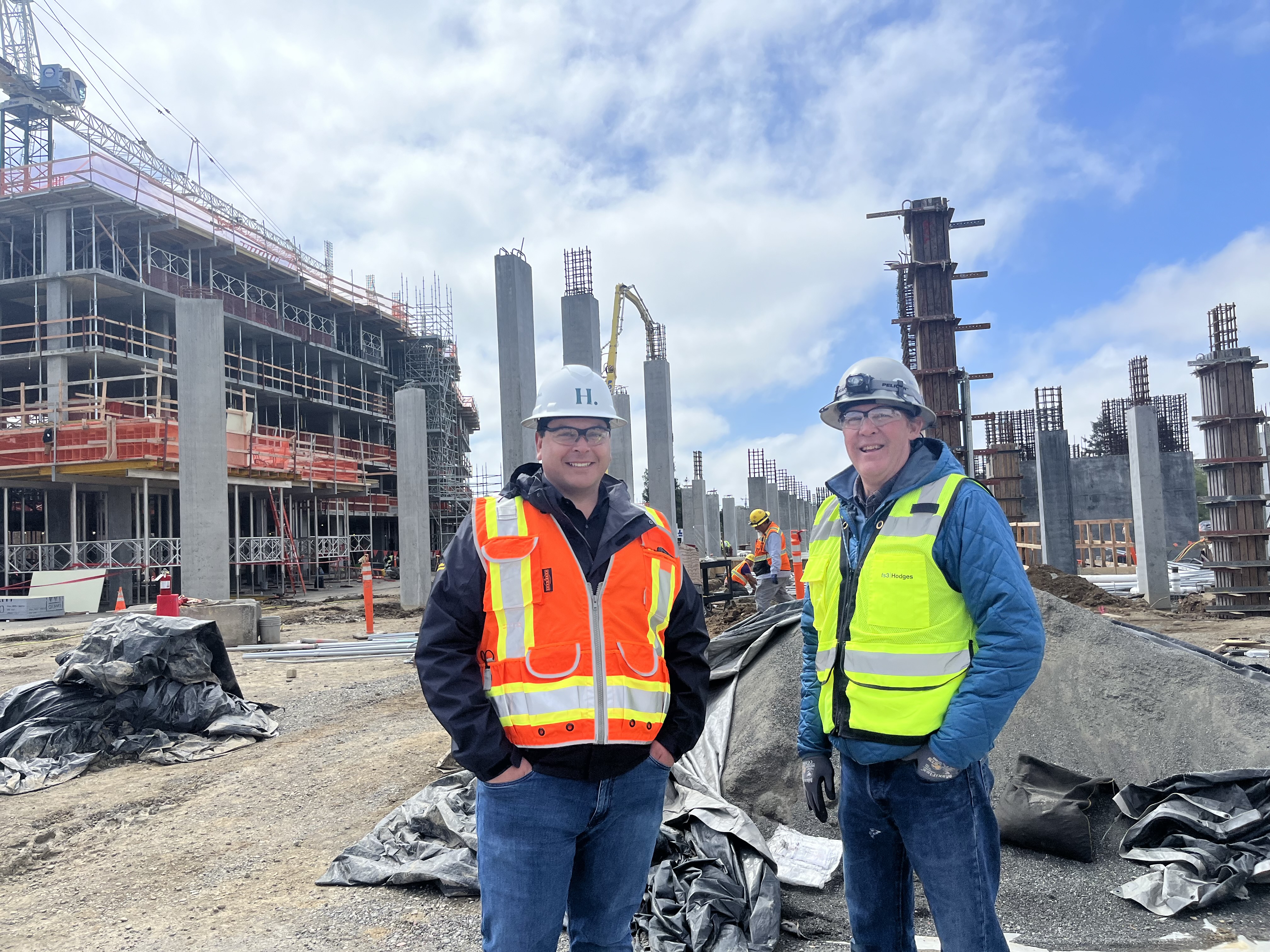
The Outpost wanted to take a closer look, so last week we joined Mike Fisher, associate vice president of facilities management at CPH, and Fred Saldana, construction manager for FS3, for a tour to learn more about the largest development Arcata has seen in a long time. Once finished, the project will house up to 964 students at a time.
With construction still underway, it’s difficult to imagine the completed project, but Fisher and Saldana did their best to paint a picture as we toured the site.
The development includes two large buildings at staggered heights. The larger one, on the east side, will reach seven stories while the smaller will reach six. The taller building should be completed by the end of summer 2025, followed a few months later by the smaller one. Together they’ll hold 241 housing units, including two-, three- and four-bedroom apartments, each with its own kitchen and common room.
Fisher (left) and Saldana in front of the construction site.
In addition to housing, the project will include a gym, lounge areas, conference rooms and private study rooms. Between the two buildings will be an open walkway, which Saldana said will have the feel of a European “mews” – small, alley-like streets that aren’t open to vehicular traffic.
The site will have 320 parking spaces in multiple lots — not enough for every student to have their own space, but Fisher said alternative forms of transportation will be encouraged, and a shuttle service will run between the housing site and campus.
As part of the project, the university agreed to provide funding for the City of Arcata to complete a segment of the Annie and Mary Trail along the east side of the complex, and provide a shortcut for biking or walking to campus. Fisher said Arcata is trying to open the trail around the same time as the housing development.
The project will include covered bike storage in a one-story building just south of the main buildings. This building will also have a café, which will be open to the public, as will the project’s outdoor areas, though dorm rooms and certain other facilities will be accessible only to students.
Since many construction projects have been delayed due to the wet winter and supply chain issues compounded by COVID, we were pretty surprised when Saldana said the housing project is on schedule. He said the team planned for contingencies and while certain tasks, like pouring concrete, can’t be done in the rain, other work can be done in inclement weather, and planners obtained materials far in advance.
Still, the project had its unique challenges. Saldana and Shawn Marty, the project manager for Sundt Construction who joined the tour for a bit, explained that the long-unused property needed a lot of work before construction could begin. Temporary asphalt roads were added for trucks and machines access.
Above: what it looks like now. Below: what it is going to look like (rendering from CPH website)
“The key was getting the roads in so we wouldn’t be destroying the grounds,” Marty said. “And we got in the big stuff before the rains started.”
While laying down those roads, the team was surprised to unearth about 300 feet of buried railroad. Apparently, back when the site housed a sawmill, an industrial railroad spur was built to help load and unload materials from railcars.
The other big pre-construction step was getting the giant tower crane in place. Saldana said the crane was delivered in sections on 18 different trucks and assembled onsite.
With the development happening in quiet li’l Arcata, noise has been a public concern. However, the giant crane is not the culprit; it’s actually incredibly quiet when in use. But trucks’ backup beepers and other construction noise have led to complaints, Fisher said.
Project managers set a noise threshold with the City, Fisher said, and someone conducts “noise sampling” every two weeks to ensure the noise output is below that threshold. Of course, this doesn’t completely stop the complaints.
“It gives us a reference point, but people’s perception and experience is not just about numbers,” Fisher said. “If someone complains, we try to position [machines] in a different way or ask workers to limit use of their backup beepers or something like that. We try to be as flexible as we possibly can while still delivering the building on time.”
A pair of electricians map out their plans.
What about noise from partying students? Fisher said that, like the dorms on campus, each floor will have two to three resident advisors (RAs) in charge of monitoring and reporting issues to management, and the property will be patrolled by the University Police Department.
And for any neighbors worried about parties and general dorm-room debauchery, it might ease your concerns to know that the new buildings will be reserved for upperclassmen, while freshmen and sophomores will mostly be housed on campus.
With the project on schedule, Fisher said the housing should be ready for occupancy by fall 2025. The university will start marketing it this summer and assigning students to it next summer.
But with Cal Poly Humboldt’s enrollment numbers not nearly as high as expected after the transformation to a polytechnic, is this nearly 1,000-bed facility necessary?
Fisher believes it is, and he stressed that, although the growth has not been as rapid as the university anticipated, enrollment will continue to grow, even with total college enrollment decreasing over the past decade.
“Last year was about a 2.5 percent enrollment increase from the previous year,” Fisher said. “But we had lofty expectations, so the difference between those expectations versus what we’re experiencing is significant. But the story is we’re still growing amidst a higher education non-growth or even contraction.”
Fisher added that the new facility should help increase enrollment because once potential students see this impressive new development, they’ll really want to live there and will simply be unable to resist attending Cal Poly Humboldt.
“The better amenities we put out there, the more attractive we’ll be,” Fisher said. “And higher education is not just about the quality of the educational program; it’s also the quality of where you live.”
View of the construction from LK Wood Boulevard.
Another rendering of the plans, looking from the south.
Arcata resident Cora Lee sends along this video she recently captured of a great blue heron stalking and killing an unsuspecting little rodent (a mole?) from a lawn in Arcata.
We may tend to think of these elegant birds more as fish eaters, but they’re not picky. A great blue heron will eat pretty much any species big enough for a meal, including amphibians, reptiles, invertebrates, small mammals and even other birds.
Hunting Great Blue Herons wade slowly or stand statue-like, stalking fish and other prey in shallow water or open fields. Watch for the lightning-fast thrust of the neck and head as they stab with their strong bills.
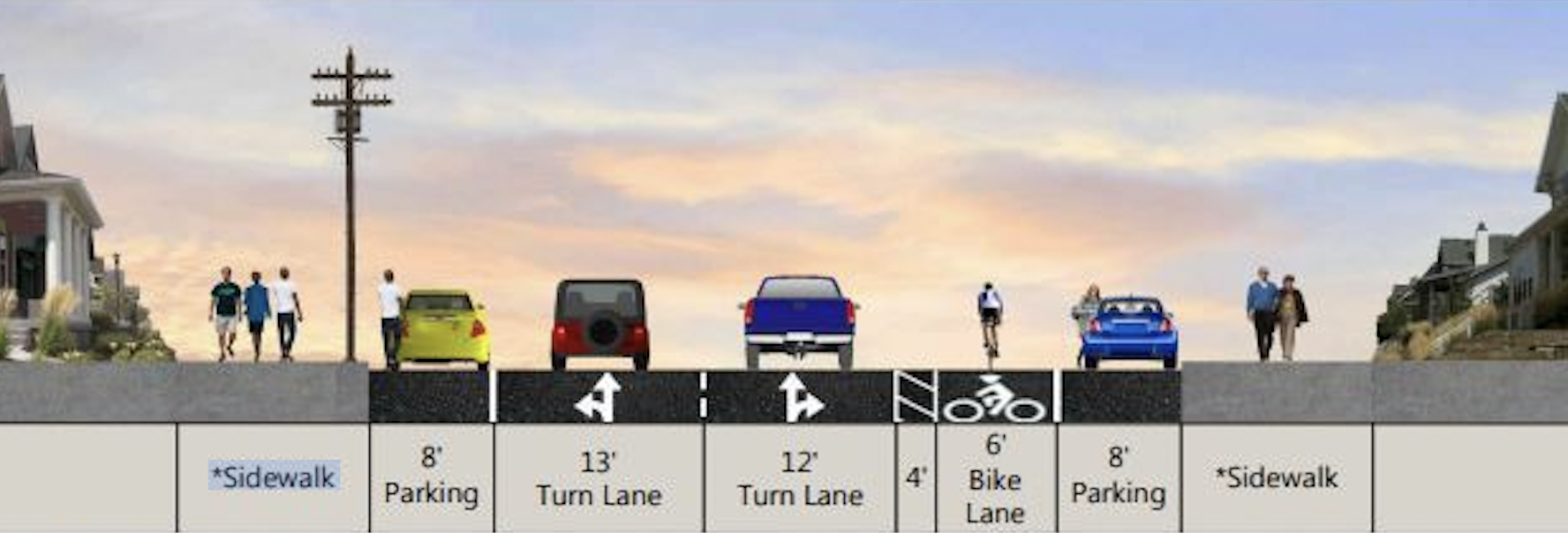
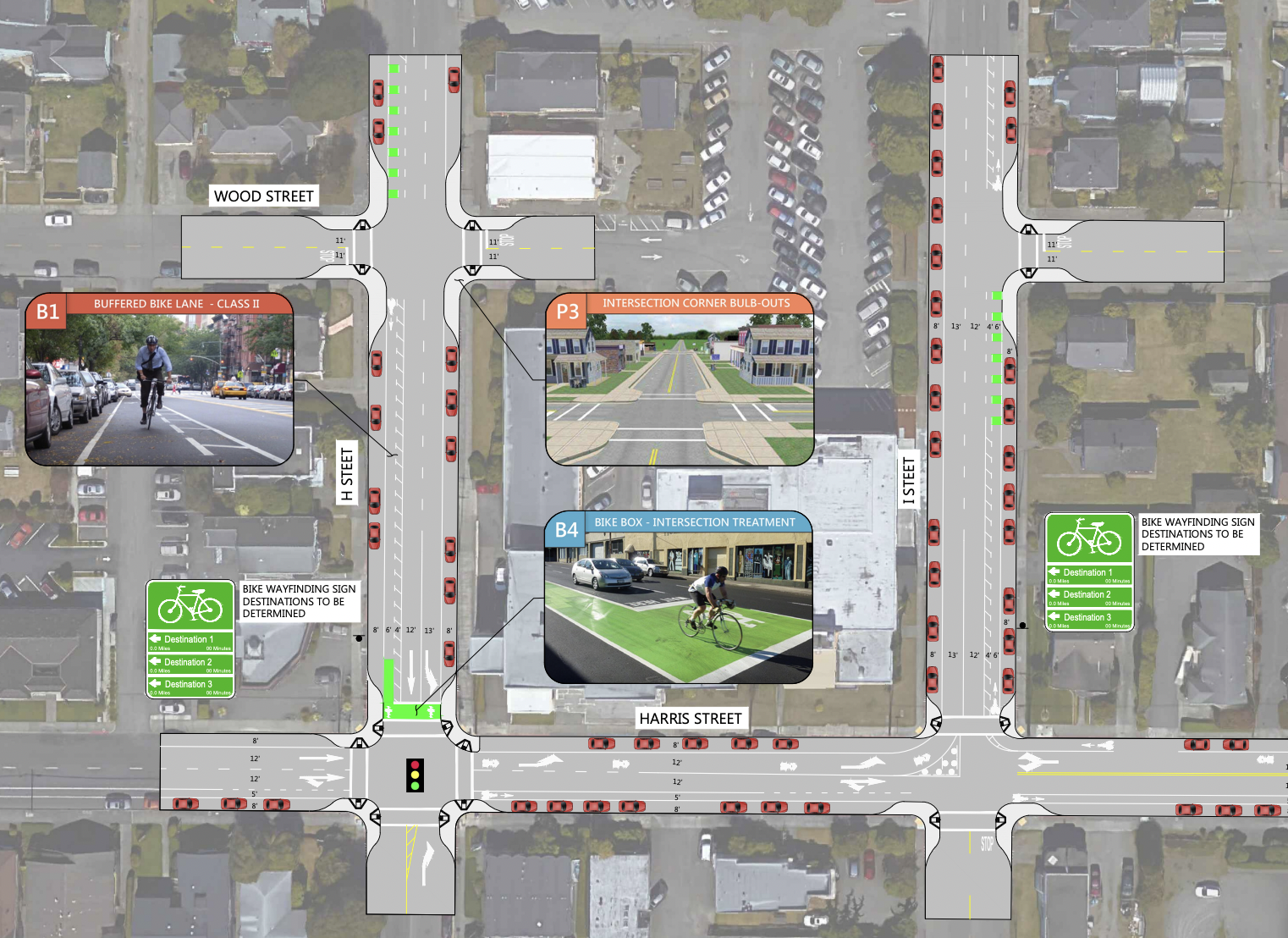
Beginning this month, contractors will be striping the new lane configuration on “H” and “I” Streets from Harris to 6th Streets. The new setup will include two through lanes for motorized vehicles, with a buffered bike lane for safer and more comfortable non-motorized use of the roadway.
The City of Eureka has received a Caltrans Sustainable Communities Grant (SCG) for multimodal transportation design, planning, and technical assistance for the completion of a multimodal plan. The project area is located between J and E Streets from 6th Street to Harris Street with a focus on H and I Streets. The multimodal plan will look at these north-south transportation corridors within the City for enhancing safety and mobility for all modes of transportation.
The City of Eureka Development Services and Public Works Departments are collaborating with Redwood Community Action Agency to engage residents, youth, and local businesses in re-envisioning H and I Streets and potentially adjacent north-south routes to improve safety for all users and foster vibrant neighborhoods and business districts.
Resident, youth, and local business participation will be integral to the success of this project. The City and Redwood Community Action Agency (RCAA) will conduct public outreach efforts to engage the community, and receive input to understand the diverse needs of the community, and also to solicit input on the development of the alternatives. Click here to provide feedback in our online survey.
Included in the objectives and goals for the project is the identification of at least three conceptual design alternatives for improved mobility, safety, and user experience for all modes within the project area with the focus on H and I Streets in the City of Eureka. In addition will be the completion of a Multimodal Plan for the project area with the focus on H and I Streets and the north-south transportation corridors within the city for enhanced safety and mobility for walking, biking, accessing transit, and motor vehicles.
One of many images included in the City of Eureka’s North-South Multimodal Corridor Plan. Find the whole plan here.
The City of Eureka Mayor’s Initiative in partnership with the National Alliance on Mental Illness and
the Department of Health & Human Services invite the community to “Embracing Humanity” a town
hall event to kick-off and celebrate Mental Health Awareness Month on Saturday, May 4, 2024 from
10AM-4PM at City Hall in Eureka.
The morning will include two panels comprised of local professionals and individuals with lived
experience in the mental health realm. The afternoon will include an inspiring keynote speech by Joe
Roberts aka the “Skidrow CEO” who will share his personal story of perseverance: Roberts overcame
homelessness and eventually succeeded in business before devoting his life to advocacy.
This event is a continuation of the City of Eureka Town Hall events held throughout 2023 focused on
mental health, homelessness, and substance use related issues in our community. The aim of the day is
to encourage community members to reflect on mental health, highlight key leaders in the community,
discuss local resources and needs, and to brainstorm connections and solutions going forward.
Community based problems require community based solutions. We look forward to you joining us!
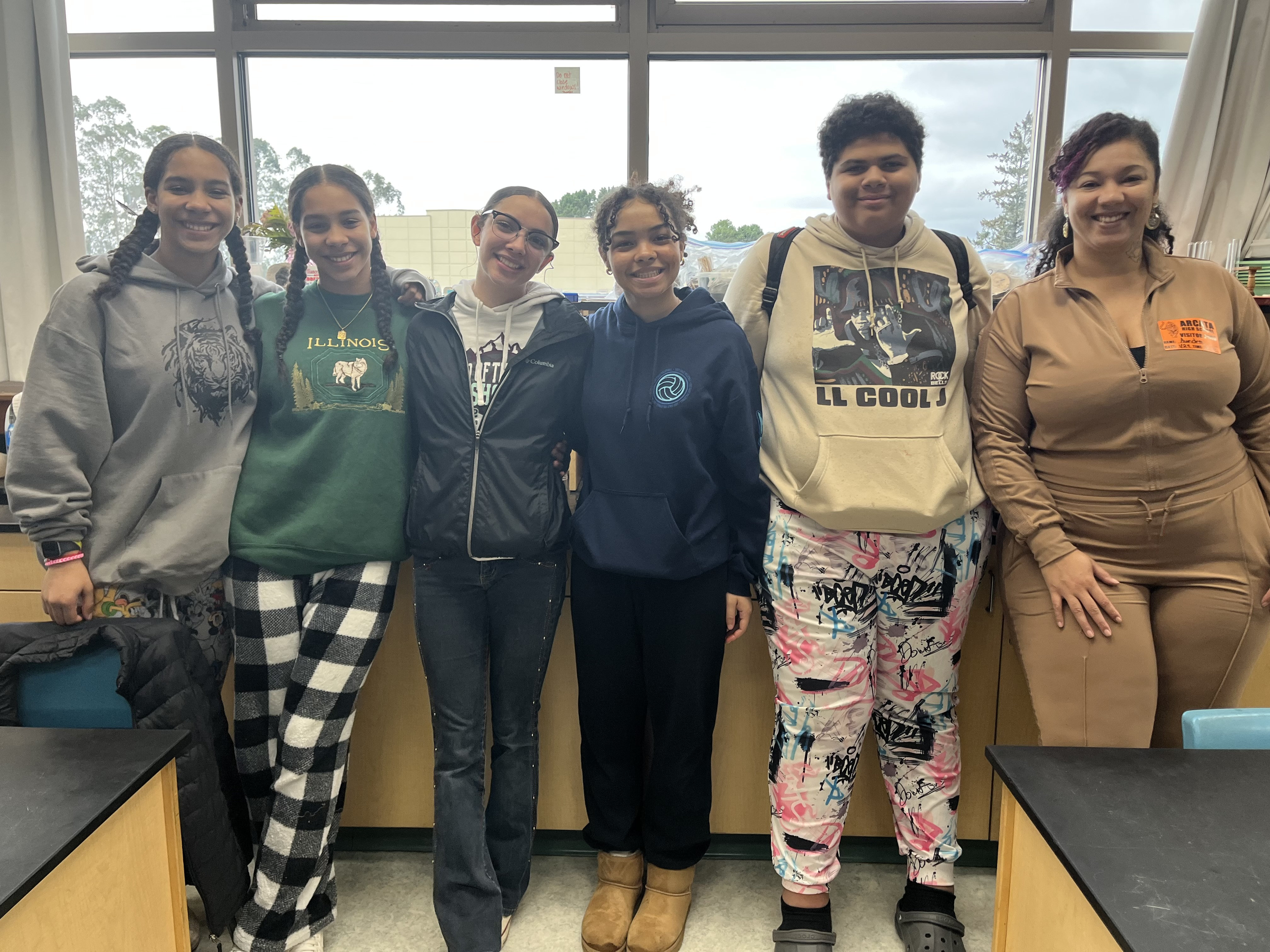
Members of Arcata High School’s Black Student Union. From left to right: Tae Wolford, Mae Wolford, Mayleah Jackson, Aliyah Aaron, Donald McKnight and Aundrea Stuckey from Youth Art Will Succeed. Photo courtesy of Shannon Kresge.
###
After more than two years of planning, Arcata High’s Black Student Union (BSU) is ready to unveil the club’s new mural in honor of David Josiah Lawson. The big reveal will take place on Wednesday at 6 p.m.
“To me the mural represents power. It shows that we’re here,” sophomore Aliyah Aaron told the Outpost. “The powerful fists, bright colors, and portrait all symbolize power. We’ve all taken so much time and energy into this project, and this reveal really feels like the ending reward. We couldn’t have pulled this off without our amazing community at [Arcata High School] and throughout Humboldt.”
The mural, designed and painted by Cal Poly Humboldt alum Malachi Arthur, was funded by Art Representation Culture (ARC), a Dream Maker project of the Ink People Center for the Arts that promotes diverse cultural representation and community through murals in local public schools. Naomi Doherty, a project facilitator with ARC, worked with the students and local non-profit Youth Art Will Succeed (YAWS) to bring their vision to life.
“The students already knew that they wanted a mural, and in choosing to honor Josiah Lawson, the themes of social justice, Black Joy and Love came to fruition through this mural,” Doherty said. “We think it is important for the students to have a space and to be able to talk about issues that directly impact them. Mural projects such as these center the voices of the youth and through this empowerment they make the changes they wish to see.”
BSU Advisor Shannon Kresge underscored the importance of students feeling represented in their communities, especially at school. “[T]hey need to feel seen, heard and a part of the larger community,” she said. “Artistic expression is important because it allows individuals to express themselves creatively and it promotes self-discovery and empathy. … Spreading a message of love and community were important to the students.”
Sophomores Mae and Tae Wolford are hoping the mural will convey that “the Black community is evolving” in Humboldt County.
“What encouraged me to get involved was seeing the impact this mural could [have] on people,” Tae said. “The message it gives is to show love [and] give justice to the people who deserve it.”
The mural reveal will take place at the Fine Arts Building on the Arcata High School campus at 6 p.m. on Wednesday, April 10. The celebration will feature performances by All Love Aundrea, Ra and Bamidele Hotep. The event is sponsored by the Ink People Center for the Arts, Humboldt Area Foundation, Eureka NAACP, Black Humboldt, Building Black Community, HC Black Music & Arts Association, and Queer Humboldt.
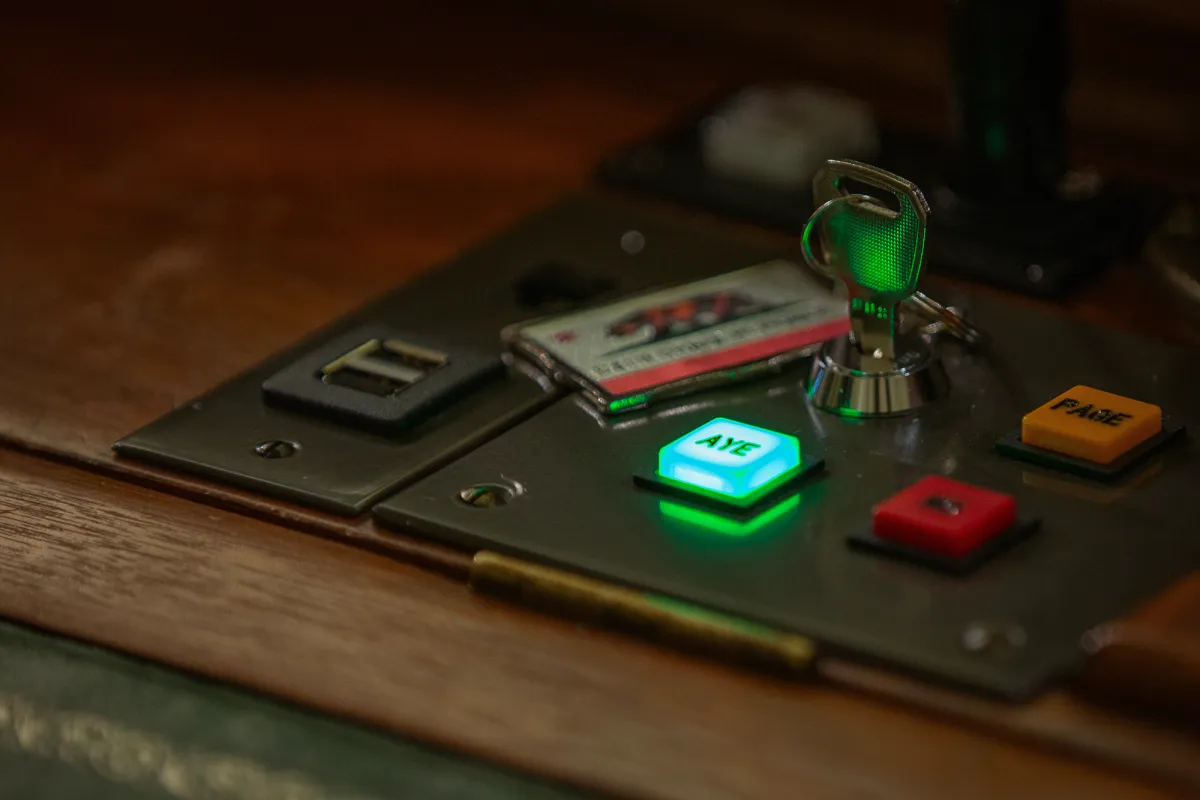
An “Aye” vote on a legislator’s desk on the Assembly floor at the State Capitol in Sacramento on Aug. 17, 2023. Photo by Semantha Norris, CalMatters
Mike Fong has cast more than 6,000 votes since he joined the state Assembly in 2022 and never once voted “no.” Pilar Schiavo is newer to the Assembly, but she has yet to vote “no” after more than 2,000 opportunities.
Remarkably, their Democratic colleagues in the Legislature are not much different. Using our new Digital Democracy database, CalMatters examined more than 1 million votes cast by current legislators since 2017 and found Democrats vote “no” on average less than 1% of the time.
Why? It’s not something they want to talk about. Democrats have had super-majorities in both legislative chambers since 2019, so most votes involve bills from their political colleagues. But the legislative leaders and lawmakers contacted by CalMatters declined repeated requests to explain a pattern that might appear like a rubber stamp for deals made out of public view. And it seems to be sanctioned by leaders.
“There’s only two fucking buttons on your desk: There’s a green button, and there’s a red button,” then-Assembly Speaker Anthony Rendon told the California Labor Federation last year in remarks reported by Politico. “Ninety-nine percent of the time, the green button is the labor button. Ninety-nine percent of the time, the green button means you’re doing the right thing, and the red button means that you’re an asshole.”
Rendon’s office declined to comment or make him available for an interview.
Instead of voting “no,” the data, video and transcripts in CalMatters’ Digital Democracy project reveals that legislators will often decline to cast a vote. Lawmakers widely use the tactic as a courtesy to avoid irking fellow legislators who’d get upset if they vote “no” on their bills, but it’s a controversial practice that critics say allows them to avoid accountability.
“There are a lot of people who abstain and who years later will claim, ‘Oh, I was in the bathroom,’ or ‘I was gone,’ or ‘I was in a meeting,’” said Mike Gatto, a former Democratic Assemblymember from Los Angeles. “It provides them an excuse after the fact to claim that they were not there. I always thought that was cowardly, the opposite of courageous.”
Last year, at least 15 bills died due to lack of votes instead of lawmakers actually voting “no” to kill them.The most notorious example was when a bill to increase penalties for child sex trafficking died in the Assembly Public Safety Committee because Democrats did not vote. After widespread condemnation, Gov. Gavin Newsom got involved, prompting some committee Democrats to apologize and re-vote on the measure that Newsom later signed.
At least three fentanyl-related bills also died last year due to Democrats refusing to vote on them, infuriating Regina Chavez, who advocated for the legislation. Her 15-year-old daughter, Jewels Marie Wolf, died from the drug in 2022.
“I personally am insulted, because I think everything should be on the record when you hold a state title,” she said. “That is what they signed up for to represent us.”
Chavez along with a group of mothers of youth who died from fentanyl learned about the prevalence of non-votes by exploring the Digital Democracy database.
In a glaring example they found, a bill had 22 bipartisan cosponsors and would likely pass if it reached the Senate floor, but it died in the Senate Public Safety Committee when the four Democrats — Nancy Skinner, Steven Bradford, Aisha Wahab and Scott Wiener — declined to vote by staying silent during the roll call. None of them responded to interview requests.
The bill, called “Alexandra’s Law” for a young woman who died from the drug, would have required judges to read a warning to defendants who’d been convicted of dealing fentanyl that if they dealt the drugs again, they could be charged with murder if someone died after taking their fentanyl.
More than 100 people testified in the hearing, almost all in support of the bill and many sharing their own experiences with fentanyl deaths. Some of the Democrats who did not vote had a lengthy discussion with the bill’s author, Sen. Tom Umberg, a Democrat and former federal prosecutor. (This link to Digital Democracy includes information about the bill, SB 44, as well as video and transcripts of the hearing).
“It’s beyond frustrating,” said Laura Didier, who has testified several times in Sacramento about fentanyl legislation and whose 17-year-old son, Zach, died from the drug in 2020 (See video and transcripts of all Laura Didier’s testimony).
Didier said it took an enormous amount of work to assemble the bipartisan group of bill sponsors and the supporters who testified. “To me, it just makes no sense that … people, by withholding their vote, can kill that momentum. You know, it’s very, very frustrating.”
In another example last year, the former chairperson of the Assembly Public Safety Committee cast a “no” vote to kill a bill, AB 367, that would have led to longer prison sentences for fentanyl dealers. Seconds later, he withdrew his vote after all five of his fellow Democrats on the committee killed the bill by not voting.
The then-chairperson, Reggie Jones-Sawyer, a Los Angeles Democrat who is running for Los Angeles City Council when his term expires this year, didn’t return a message from CalMatters.He told the committee last spring that he was a mortician during the crack cocaine epidemic, so he empathized with families who lost loved ones to fentanyl, but he sided with activists who testified that people of color have unfairly and disproportionately borne the brunt of harsh sentences for drug crimes.“Our communities were decimated by the War on Drugs,” he said.
Digital Democracy’s analysis
The CalMatters data analysis included more than 1 million votes currently sitting lawmakers have taken since 2017 in committees and on the Senate or Assembly floors. The analysis only included votes on actual bills. Routine resolutions were not included. The data was collected by Digital Democracy from the Legislature’s official bill-tracking website.The site records each lawmaker’s “aye,” and “no” votes. If a lawmaker does not vote on a bill, it’s listed as “NVR,” short for “No Vote Recorded.” The online system does not distinguish between a vote to abstain, an absence or when the legislator is present but no vote is cast.
Assemblymember Evan Low speaks with fellow lawmaker Phillip Chen at the Capitol on March 27, 2023. Photo by Miguel Gutierrez Jr., CalMatters
The CalMatters analysis reveals that 38 of the 94 members of the Democratic caucus have voted “no” 20 or fewer times since 2017. This, despite each senator and Assemblymember having thousands of opportunities to vote. Some of those lawmakers have served since 2017.
While all Democrats rarely vote “no,” some members stand out in the analysis.
They include Assemblymember Jesse Gabriel of Encino. He’s been in office since 2018 and has cast more than 12,000 “aye” votes. He’s voted “no” just nine times. Lisa Calderon of City of Industry has served in the Assembly since 2020 and cast nearly 9,000 “aye” votes. She’s voted “no” once.
Assemblymember Eduardo Garcia of Coachella has cast more than 15,000 “aye” votes since 2017. He’s only voted “no” eight times. Assemblymembers Schiavo of Santa Clarita Valley and Fong of Los Angeles are the two current members who have never voted “no.”
None of those lawmakers responded to CalMatters’ interview requests
Meanwhile, the Digital Democracy analysis showed wide discrepancies in not voting. Garcia, the Assemblymember from Coachella, had more than 2,000 NVRs, the most of any of his Democratic colleagues since 2017.
Fong, who serves on the powerful Appropriations Committee, stood out for another reason other than never voting “no.” As of last week, he only had 25 NVRs, the lowest abstention or absence rate of any lawmaker.Robert Rivas, who became speaker of the Assembly last year, has only voted “no” nine out of 12,308 times since he joined the Assembly in 2018. He abstained or was absent from voting 673 times during that period.
From left, Assemblymember Mike Fong and Speaker of the Assembly Robert Rivas. Photos by Richard Pedroncelli, AP Photo and Miguel Gutierrez Jr., CalMatters
“The Speaker will not be available for your story,” his press secretary, Cynthia Moreno, said in an emailed response to CalMatters’ request to discuss his voting record and the records of his fellow Democratic lawmakers.
Republicans and the red button
It’s no surprise that vastly outnumbered Republicans in the Legislature regularly vote “no” on Democratic bills. They do so on average 21% of the time. But CalMatters’ analysis shows they tend not to vote on bills at higher rates than Democrats.
The average Republican “No Vote Recorded” rate is around 12%. The average rate for Democrats is 4.5%.
James Gallagher, the Assembly’s minority leader, said it’s due to Democrats largely cutting the Republicans out of bill discussions, leading to situations where Republicans might not oppose a bill’s intent, but they don’t feel comfortable voting for language they can’t change.
“That (bill) might be at a place where you sort of agree with where they’re trying to go with it,” said Gallagher, a Republican from Chico. “But you’re just not really sure that the policy is really right and it’s taking into account all the different unintended consequences.”Gallagher has voted “no” 3,236 times since 2017, and he’s been listed as a “No Vote Recorded” 1,708 times.
Gallagher said he’d support making the process more transparent by requiring lawmakers to officially declare an abstention instead of the way it’s reported now, where the public has no easy way of knowing whether a member was actually absent or just declined to vote on a bill.
Bill Essayli, a Corona Republican who’s served in the Assembly since 2022, has the highest percentage of NVRs in the Legislature. Twenty-three percent of his votes are NVRs.
Essayli said he learned it’s better to abstain on some bills instead of voting “no” to avoid retaliation from Democrats. He said Democrats are “very sensitive” and punish legislators of both parties when they vote “no.”
He noted that last year, Democrats briefly stripped Bakersfield Democratic Assemblymember Jasmeet Bains of a committee assignment after she sided with Republicans and cast the lone Democratic “no” vote against Gov. Newsom’s gas-price windfall tax bill.
Essayli said he’s taken to abstaining from votes on bills he doesn’t support when he’s not trying to make a strong political statement. “Not voting is a polite ‘no,’” he said. “And then hitting the red button is like an ‘F no.’”
Essayli said Democrats have targeted him after voting “no.” The California Democratic Party put up a billboard in his district, accusing him of voting against fentanyl victims. He said it was retaliation for him voting “no” on legislation that contained a fentanyl provision that he supported buried in a large budget bill that he did not.
Former Assemblymember Gatto has heard all of the excuses about why lawmakers choose not to vote. Sometimes, lawmakers abstain to avoid an activist group or political opponent using their vote against them. Other times, they don’t want to irk a colleague who might feel passionately about a bill that a lawmaker doesn’t particularly care for. Other times, Gatto said, a non-vote is a lawmaker’s way of saying, “Court me. I want you to gather around my desk and promise me something I want.
”He said it’s better to just cast a “no” vote, when a lawmaker doesn’t support legislation.
“When people talk about how a very strange or poorly conceived proposal made it all the way through the Legislature, the answer is because very few people stood up and said, ‘This is bunk.’” he said. “When people do, and they do it with something as clear and unambiguous as a ‘no’ vote, it encourages other people to have the same courage to tell a lawmaker, politely, that this idea might not be the best one.”
###
The team that performed the data analysis for this story included Foaad Khosmood, Forbes professor of computer engineering at Cal Poly San Luis Obispo; Thomas Gerrity, data scientist and product manager for Digital Democracy; and Zhi He, a Cal Poly student research fellow.
CalMatters.org is a nonprofit, nonpartisan media venture explaining California policies and politics.