
BOOKED
Today: 12 felonies, 20 misdemeanors, 0 infractions
JUDGED
Humboldt County Superior Court Calendar: Yesterday
CHP REPORTS
MM101 N HUM 2.10 (HM office): Traffic Hazard
Humboldt Rd / Maher Ave (HM office): Trfc Collision-Unkn Inj
ELSEWHERE
RHBB: 30 Acre Wildfire Burns East of Leggett, Draws Air Tankers and Additional Water Tenders
RHBB: Sixty-Seven-Year-Old Woman Dies After Collision With Vehicle in Fort Bragg
RHBB: Evacuation Warning Issued as Structure Fire Sends Black Smoke Over Covelo
RHBB: Traffic Control At Seventh And F Streets For Vital Arcata Waterline Improvements
25 Years of Headwaters Forest!
LoCO Staff / Friday, March 1, 2024 @ 8:34 a.m. / Nature

Photo: BLM, public domain.
Press release from the Bureau of Land Management:
The Bureau of Land Management and its partners are celebrating 25 years since the establishment of the Headwaters Forest Reserve on California’s North Coast and are planning public events and announcements celebrating the conservation achievements since the 7,400-acre Reserve came into public ownership on March 1, 1999.
“We have been posting regular features on our social media platforms to share interesting facts about the reserve and its importance,” said Collin Ewing, manager of the BLM Arcata Field Office, which oversees the reserve. “We are producing commemorative posters to be released at the Arcata Field Office beginning March 1, and planning guided hikes and presentations. There will be excellent opportunities to get out and enjoy the reserve and learn why it is so important to North Coast natural resource conservation efforts.”
The BLM will announce hikes, speaker panels and availability of commemorative items in the coming weeks. The reserve contains some of the last unharvested groves of redwoods on the West Coast with ancient trees more than 1,000 years old. It provides forest habitat for northern spotted owls and marbled murrelets (Pacific seabirds), and stream habitat for coho and Chinook salmon and steelhead trout, all threatened species. Headwaters is the ancestral home of the Wiyot people, who lived in the forest for thousands of years, and remains an important part of their culture.
In the years since acquisition by the federal government and state of California, the BLM has completed projects to accelerate the pace of recovery from historic logging and to improve habitat for wildlife. Miles of former logging roads have been replanted, sediment-producing stream crossings have been removed and tree thinning in formerly logged areas is improving health of the forest. The BLM collaborates with the California Department of Fish and Wildlife on these efforts.
With partners, the BLM has brought Headwaters history to life, completing an interpretive trail segment, restoring a logging era locomotive barn for use as an education center, and winning placement of the Falk town site on the National Register of Historic Places. Public visitors experience the forest and discover its importance on the Elk River, South Side and Salmon Pass recreation trails and thorough presentations and hikes led by Friends of Headwaters, a volunteer support group.
The Headwaters Forest Reserve came into public ownership after a decade of activism that called attention to the importance of conserving these forest resources, including some the last remaining ancient redwoods in the world.More information on the Reserve is available online here.
Housing Authority Looks to Upgrade Public Housing Facilities in Eureka
Isabella Vanderheiden / Friday, March 1, 2024 @ 7:55 a.m. / Housing

An aerial view of the “25-1” public housing project on Burrill Street, near the Eureka Winco. Image via Housing Authority of the City of Eureka (HACE)
###
The Housing Authority of the City of Eureka (HACE) is seeking public input on its ambitious plans to redevelop and expand access to affordable housing in Eureka. The housing authority will host a virtual community meeting next week to discuss its plans to add over 150 new public housing units to the local housing stock and redevelop nearly 200 more over the next decade.
HACE, a public housing agency that operates under the authority of the U.S. Department of Housing and Urban Development, owns nearly 200 public housing units across its 12 properties in Eureka. Many of those units were built way back in the early 1950s and require substantial capital investment and repair.
HACE is in the first stages of “repositioning” its Eureka properties to convert them to a Section 8 platform. (Section 8 refers to a federal government assistance program that subsidizes rent for very low-income individuals and families.) Doing so would “bring more stable and increased revenue to properties” and allow the housing authority to upgrade and expand existing sites, according to HACE’s Repositioning Plan.
“The repositioning plan create[s] a roadmap for how to tackle a significant issue – addressing aging housing stock that is underfunded but is also on underutilized land,” HACE Executive Director Cheryl Churchill told the Outpost. “[O]ur goal is to rehabilitate units that are newer and closer to full density at their individual sites, considering what local zoning will allow, and redevelop sites that are underutilized, bringing more and newer affordable housing to Eureka. … We know our community needs more housing at all income levels, so we’re continuing to do what we do best, and filling our role of serving the low-income households here.”
HACE plans to redevelop or rehabilitate almost all of its public housing units over the next decade but for now, the housing authority is focused on the “25-1 Site” on Burill Street, near the Eureka Winco.
“We are working on preliminary plans to do a first phase on Hiler Street, between Everding and Burrill Streets,” Churchill explained. “Currently, there is a park and eight units adjacent to that site. We’re starting here because it would allow us to bring 44 new units of housing while displacing only eight households, which builds in capacity to transfer tenants when we redevelop subsequent sites. We’ll be assisting tenants with relocation, whether they transfer between our units or find private rentals with voucher assistance.”
HACE staff are looking for feedback from the public on design options, including specific features or amenities that people might want to see in the upgraded facilities. From there, the housing authority will go through design review and entitlements with the City of Eureka and work with HUD to get the financing in order.
“The requirements to bring affordable housing from concept to reality are numerous, but I look forward to bringing greater affordable housing options to our community,” she said. “Many of these households are made up of seniors, or working families with children – people like you and me who are just trying to live their lives in our little slice of Humboldt heaven, which also happens to be in one of the most expensive states to live in, in our country.”
The virtual meeting will be held via Zoom on Wednesday, March 6 at 6 p.m. More information can be found in the flyer below.
###

Getting Paid to Go to School? California’s Community Colleges Try It Out
Adam Echelman / Friday, March 1, 2024 @ 7:49 a.m. / Sacramento
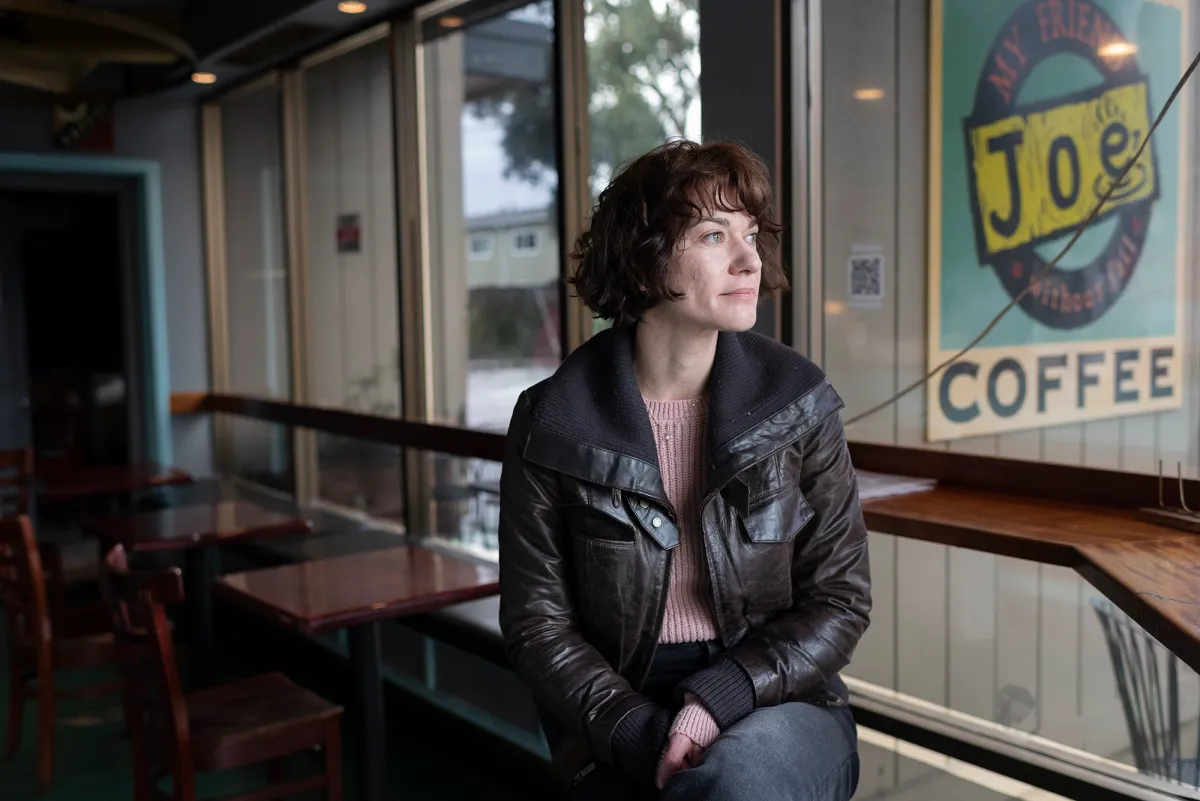
Student Leah Richardson, 37, at a coffee shop near Santa Rosa Junior College on Feb. 20, 2024. Photo by Laure Andrillon for CalMatters.
Leah Richardson is juggling community college and work, but her job doesn’t pay enough to cover the cost of living in Sonoma County. Often, she relies on a food pantry, despite receiving thousands of dollars in financial aid from her school, Santa Rosa Junior College.
Now a new program will pay her for every hour she spends in class and on homework. The $30 million state program, called Hire UP, is an experiment modeled on the state’s many guaranteed income programs. It focuses on students who are formerly incarcerated, like Richardson, as well as former or current foster youth, and those receiving CalWorks benefits, the state’s cash aid program for low-income adults with children. Ten community college districts received the money and some schools, including Santa Rosa Junior College, are beginning to distribute it now. Others have yet to set a timeline.
Richardson, 37, is one of the first recipients. On a recent morning, she sat at a cafe next to campus, where students hurried by, but she didn’t notice them as she stared at her financial aid statement on her iPhone.
“I’m a little in shock,” she said as she used her fingers to zoom in on the web page that showed her current grants.
She’ll receive monthly payments of nearly $2,000, starting today. Those payments are calculated based on the state’s minimum wage, $16 an hour, for each of the 30 hours she spends every week on school.

Leah Richardson looks up the updated amount of the financial aid she will receive near Santa Rosa Junior College on Feb. 20, 2024. Photo by Laure Andrillon for CalMatters.
When she enrolled at Santa Rosa Junior College in 2021, she couldn’t afford to attend full time. She was still adjusting to a new routine, after spending time in and out of jail and substance use treatment centers. She decided to take classes in the afternoon and work from 4:30 a.m. until about 1:30 p.m. at a Safeway store most days of the week. When she wasn’t working at Safeway, she took shifts at bakeries.
“I was exhausted — a lot,” she said. Since then, she’s tried to work less and study more. “Now that I have this money, I don’t have the weight of having to go back to a job that’s going to drain me.”
Gina Browne, an assistant vice chancellor with the California Community Colleges Chancellor’s Office, said the office is monitoring how well colleges administer the program and how the money affects students’ outcomes.
“Some students who are working now may be able to stop working or reduce their hours,” she said. “We want students to focus on taking those units so they can get through (college).”
Student aid offers ‘a glimmer of hope’
Every Tuesday, formerly incarcerated students at Santa Rosa Junior College gather in a multi-purpose conference room on campus, part of a state-funded support program known locally as Second Chance. Men with scraggly beards or neck tattoos wave to younger men and women as they walk in. Some students wear T-shirts while others are in button-downs or blouses. It’s a cross-section of the college and the city at large. Modeled like a 12-step recovery meeting, students speak up, one by one, sharing their stories about navigating work, school and life after prison.

The room for the Second Chance program at Santa Rosa Junior College on Feb. 20, 2024. Photo by Laure Andrillon for CalMatters Credit: Laure Andrillon
Matthew Domingos, 42, helps moderate. He works part time for the college as he finishes an associate degree and prepares to transfer next semester to Cal Poly Humboldt. As a full-time student, his financial aid package totals around $10,000 a semester but it doesn’t leave any wiggle room, he said. “I feel like I’m one trip to the emergency room away from homelessness.” He was selected for Hire UP, but he doesn’t yet know how much money he’ll receive.
Richardson can’t always attend the weekly meetings because of her work and school schedule, though she wishes she could. She pays about $1,100 a month toward rent and hundreds more on utilities, food, and transportation. “I don’t spend money,” she said. “There isn’t any to spend.”
There are roughly 160 formerly incarcerated students who enroll each year at Santa Rosa Junior College, all of whom may apply for Hire UP, said Jessy Paisley, a counselor for the Second Chance program on campus.
That money is a “glimmer of hope,” she said. “How do you focus on turning in your Canvas assignment if you don’t even know where you’re going to charge your computer tonight, or sleep, or get your next meal?”

Leah Richardson at her home in Santa Rosa on Feb. 20, 2024. Photo by Laure Andrillon for CalMatters.
What happens when the money runs out
The average cost of attending Santa Rosa Junior College, including living expenses, is about $20,000 to $30,000 a year, depending on whether students pay rent, said Rachael Cutcher, the college’s director of financial aid. For in-state students, tuition is less than 7% of their total annual expenses. The rest is rent, transportation, food and books.
Many students at the community college qualify for financial aid. However, the amount of aid typically depends on the number of classes that students take, and at Santa Rosa Junior College, most students are part time. Cutcher said the average financial aid package is around $10,000 a year.
The Sonoma County Junior College District, which oversees Santa Rosa Junior College, received just over $2.6 million for Hire UP, but the money can’t help all the students who qualify. The college has roughly 600 students who are formerly incarcerated, current or former foster youth, or CalWorks recipients, according to data from the chancellor’s office. If all of those students were to get a portion, the money would run out in a few months.
“We’re prioritizing our formerly incarcerated students as our first tier,” Cutcher said, later adding that the other populations are already eligible for their own special scholarships or government grants. “Then if we have enough funding, we’ll go to foster youth, then CalWorks. If it’s successful, I’d advocate for it to be renewed and offered more broadly.”
Other schools, such as those in the San Diego Community College District, expect to exhaust most of the money in the first two years, said Susan Topham, the vice chancellor of educational services for the district.
“We want them to run out of money,” said Browne. If community college districts spend it all and the benefits of the money are apparent, she said the chancellor’s office can advocate for more funding, either for this program or for similar ones.
California’s financial aid is stuck in 1969
Compared to other state and federal financial aid programs, the money from Hire UP is relatively small.
In the 2022-23 academic year, California gave community college students more than $700 million in state aid, according to data from the chancellor’s office. The same year, the federal government gave out nearly $1.7 billion in grants to community college students, including Pell grants for low-income students as well as one-time money from various COVID-19 spending bills.
But on a per-person basis, the money doesn’t always go far. For example, community college students typically receive just over $1,600 a year for non-tuition costs from the state’s cornerstone financial aid program, the Cal Grant.
That grant amount was first set in 1969, said Manny Rodriguez, the California director of policy and advocacy at The Institute for College Access and Success. “If it kept up with inflation, it should be worth between $7,000 and $8,000 today.”
“How do you focus on turning in your Canvas assignment if you don’t even know where you’re going to charge your computer tonight, or sleep, or get your next meal?”
— Jessy Paisley, a counselor at Santa Rosa Junior College
For years, advocates like Rodriguez have worked with the chancellor’s office to push the state to give students more cash. In 2022, California legislators passed a new law that would slowly increase the amount of state money provided through the Cal Grant program.
However, the increases to Cal Grant will only go into effect if Gov. Gavin Newsom and the Legislature agree to put the money into this year’s budget. Newsom has until May to release a revised state budget proposal, which includes the financial aid program. But with a multi-billion dollar projected deficit looming, advocates are worried that reforms may have to wait.
The federal and state financial aid programs also come with requirements many students fail to meet. The state’s largest financial aid program for community college students, the Student Success Completion Grant, requires students to take a full course load, typically at least four classes each semester.
Hire UP is structured differently. Part-time students can qualify, as long as they take at least two classes. The money is disbursed and recalculated every month, depending on how many classes the student took.

Student and Second Chance staff member Matthew Domingos, 42, at Santa Rosa Junior College on Feb. 20th, 2024. Photo by Laure Andrillon for CalMatters Credit: Laure Andrillon
Domingos is a full-time student, so he qualifies for the Completion Grant. It’s one reason why he receives more financial aid than the average student. However, Richardson has never been able to receive the Completion Grant because her work schedule prevents her from taking more than three classes. While Domingos receives federal aid, Richardson’s income is too high to qualify.
Richardson will receive over $8,000 in Hire UP payments during the spring semester. That will be in addition to the $4,000 in financial aid she was already getting for the same time period.
Santa Rosa Junior College may run out of money for Hire UP, but Cutcher said the financial aid department has budgeted the program so that students who receive initial payments are guaranteed money until they graduate. That means Richardson could receive more than $20,000 from Hire UP before she graduates next year.
“No matter what,” she said. “I’m going to be ecstatic with whatever the state can offer me.”
###
Adam Echelman covers California’s community colleges in partnership with Open Campus, a nonprofit newsroom focused on higher education.
CalMatters.org is a nonprofit, nonpartisan media venture explaining California policies and politics.
Newsom Hits the Road for Mental Health Measure as Poll Shows Declining Enthusiasm for Prop. 1
Kristen Hwang and Nigel Duara / Friday, March 1, 2024 @ 7:31 a.m. / Sacramento

Gov. Gavin Newsom speaks in support of Prop. 1 during a press conference at the United Domestic Workers of America building in San Diego on Feb. 29, 2024. Photo by Kristian Carreon for CalMatters
Two months ago polls suggested Gov. Gavin Newsom wouldn’t have to do much to persuade voters to pass his marquee mental health measure. His plan, a $6.4 billion bond that would pay for the construction of new treatment beds and housing, had support from about two-thirds of voters.
But now, with voters casting ballots and a more recent poll showing declining enthusiasm for his proposal, Newsom is barnstorming the state to talk up Proposition 1.
“Polling on this has been overwhelmingly positive, but polls don’t vote, people vote,” Newsom said Thursday during a get-out-the-vote rally in San Diego. “We’re here to get people to the polls.”
The rally with the union United Domestic Workers, Attorney General Rob Bonta and other elected Democrats was the first of four planned campaign events by Newsom leading up to Election Day on March 5. Other stops include Palm Springs, Los Angeles and San Francisco.
Statewide, about 10% of all ballots have been returned by mail just four days ahead of the election. Analysts say the trend indicates Tuesday will see the lowest voter turnout for a presidential primary election in recent state history.
Support for Prop. 1 dropped from 68% to 59% between December and February among likely voters, a nine-point difference, according to two polls published by the Public Policy Institute of California. Democrats and Independent voters were overwhelmingly supportive of the measure while most Republican voters indicated they would vote against it.
The measure needs 51% of the vote to pass.
Prop. 1 is a two-part ballot initiative to restructure California’s mental health and substance abuse treatment system. It includes the bond to build treatment facilities and permanent supportive housing for people with mental health and addiction challenges. It also would change a special wealth tax known as the Mental Health Services Act by requiring counties to spend 30% of that revenue on housing instead of on other services.
Gov. Gavin Newsom’s mental health policies
Newsom has pitched Prop. 1 to voters as a way to address the state’s entrenched homelessness crisis and vastly increase capacity for acute mental health and drug treatment. His Yes on Prop. 1 campaign amassed a war chest of $14.4 million, gaining support from law enforcement unions, large health care organizations, big city mayors and the mental health advocacy organization NAMI California.
California has failed for decades to make good on its promise of expanding community-based mental health treatment after closing nearly all state psychiatric hospitals in the 1960s. Prop. 1 is an opportunity for voters to rectify that failure, Newsom said.
Newsom has signed several laws during his tenure meant to address the mental health crisis playing out on California streets, including one last year loosening restrictions on involuntary treatment.
“People get it, and they want to get something done,” Newsom said to a gathering of about 100 union workers and first responders. “They don’t want to talk about this problem anymore. They want to see progress.”
The Yes on Prop. 1 campaign estimates that 6,800 treatment slots and 4,350 housing units could be constructed with the money raised by the bond.
Prop. 1 opponents point to deficit
Opponents represent smaller mental health groups, disability advocates and current users of county mental health programs who fear budget cuts if the measure passes. They attribute the proposition’s decreased support in part to concerns over the state’s soaring deficit.
The nonpartisan Legislative Analyst’s Office projected in early February that the state deficit would grow to $73 billion, $15 billion higher than last month’s projection.
A bond allows the state to borrow money and repay it over time. The Legislative Analyst’s Office estimates that Prop. 1 would cost the state $310 million annually over the next three decades, totalling $9.4 billion.
“Informed voters know that means now is a terrible time for Prop. 1,” Paul Simmons, executive director of Californians Against Prop. 1, said in a recent campaign statement.
Newsom has previously disputed how severe the state’s deficit will be come June, when lawmakers are legally required to pass a budget. During Thursday’s rally, Newsom hinted his updated budget proposal would draw from the state’s reserves. In January, his administration estimated the state held about $38 billion in reserves.
“We’ve never had more reserves in our state’s history, so that issue will be resolved in a matter of months,” Newsom said.
###
CalMatters.org is a nonprofit, nonpartisan media venture explaining California policies and politics.
OBITUARY: Calvin Harold Kernen, 1925-2024
LoCO Staff / Friday, March 1, 2024 @ 6:56 a.m. / Obits

The family of Calvin Harold Kernen is sad to announce his passing on
February 11, 2024, in Arcata. Cal was born August 5, 1925, in Del
Norte, Colorado to Swiss immigrants Friederick Alfred and Mary
Albertina (nee: Gerber) Kernen and was proud to have turned 98 ½
years old just days before his passing. He grew up on Pinos Creek
near Del Norte as the youngest of seven children and loved life in
the great outdoors. Cal grew up farming organically, eating farm to
table, composting and living off the grid. He remembered the big
changes electricity made to their home in 1937. The family raised
their own crops and livestock, and Cal began helping at age 7. He
loved tending to cattle in the hills, hunting and fishing. A
highlight of growing up was being chosen to drive the school bus. Any
17-year-old in high school got to drive the school bus if they were
the farthest one out on the route. That way the person driving had
the bus in the morning to pick up the children for school. He drove a
Ford V8 bus and was paid $12.50 a month. Cal was equally as proud to
have passed the CA DMV written and road test on his last birthday.
When WW II began, he, his older brother, John, and several older friends were drafted. Local farmers told the draft board they needed Cal to tend to their cattle, so his enlistment was postponed a year. He fondly remembered this time spent on the cattle range as the best time of his life because it was so peaceful away from other things taking place in the world. Cal was a proud WWII army veteran and was grateful to have been on one of the Honor Flights to Washington DC. Following his military service, Cal returned home. In June 1950 he met Virginia Mae Dickson, who had recently taken a job as a nurse in Del Norte, on a blind date. They were married in December and spent over 73 years together. They lived briefly in Southern California near Cal’s sister, but the country life called, and they moved to Humboldt County where they purchased rural property and a home where he lived the remainder of his life. Cal worked in sawmills, owned a gas station with good friend, Bill Kenyon, and finished his working career as a carpenter. He was very proud of being on the crew who built the Brookwood covered bridge in Jacoby Creek and that his son and grandson later worked the bridge’s maintenance.
Cal and Virginia raised their three children among the redwoods and shared the land with deer, bear, coyotes, ducks and geese on the pond, as well as other “critters.” They also raised animals, grew fruits and vegetables, and preserved their own food. Cal grew a garden and raised chickens until recently and regularly shared the bounty from his garden and fruit trees. They were the parents who always helped out with their children’s activities, especially 4-H and FFA. Cal and Virginia were devoted supporters of the Junior Livestock Auction. Cal was very social and enjoyed visits with neighbors and a group of retirees who gathered at Toni’s weekly for coffee. Cal and Virginia were proud members of the Swiss Club, and spent years serving as officers, preparing and serving food for the events, and cleaning and fixing items at the Swiss Hall. They cherished these friendships, and Cal especially loved hearing stories about Switzerland and being immersed in the Swiss culture, including Hans Giovanoli’s yodeling.
After retiring, Cal and Virginia enjoyed trips to Alaska, the east coast to see the fall colors, and to Switzerland. They made great memories on their last trip to Kansas to visit Virginia’s family, made possible with their son’s help. They cherished the last visit to Cal’s birthplace, a celebration for his 90th birthday. Family and childhood friends gathered at the homestead for a weekend of sharing stories and laughing.
Cal was a man of integrity. His word was his bond, a handshake was a contract, and honesty guided his affairs. He was capable, hardworking, independent, kind and caring. He could fix anything and was quick to lend a helping hand to anyone needing it. He always had a part somewhere that would give life to any broken item. He had a dry sense of humor and smile that let you know he was joking. And he lovingly took the best care of Virginia these past few years as they aged together. Anyone who knew Cal, was better for it.
Cal was an exemplary husband, father, and grandfather. He was a role model and hero to his nieces and nephews. He is survived by his wife, Virginia, his daughters, Karla (Steve) Darnall and Kay (Don) Becker, his son, Kurt (Sandra) Kernen, grandchildren: Matthew Darnall (Kathleen Kiernan), Kathryn (Oliver) Helms, Reuben (Nickie) Rail, Diego Rail, Jeffrey (Ivy) Holmes, Christopher (Lauren) Holmes, Terris Becker, Kelsey Becker, Jess (Olivia) Kernen and Reid Kernen. His great-grandchildren include Hozana, Miranda, Rowan, Aurora, Hailey, Henri, Dylan and Hazel. He is also survived by his sister-in-law, Joyce Bender, and numerous nieces and nephews and their families throughout the mid-west. He felt particularly close to Ken Kernen, Jay Kernen, Jan Voth, and Jon Mitchell.
Cal was predeceased by his parents, his siblings, Lloyd, Hilda, Irene, Bertha, Madeline, and John and their spouses, and his nephews Jim, Fred and Bob. Also, by Virginia’s parents, Herbert Paul and Marjorie Fay (nee: Osburn) Dickson and siblings, Archie, Lloyd, Grace, Beulah, Gilbert and their spouses, brother-in-law, Dale, and niece, Rhonda.
The family would like to thank the staff at Mad River Healthcare, Suite 3, and Mad River Hospital for their attentiveness, kindness and compassion to Cal in his final days. Arrangements are under the direction of Ayres Family Cremation, and the family plans a celebration of life at a later date.
The photo is of Cal in front of his childhood home in Colorado on his 90th birthday.
###
The obituary above was submitted on behalf of Cal Kernen’s loved ones. The Lost Coast Outpost runs obituaries of Humboldt County residents at no charge. See guidelines here.
A Black Business Owner’s Work Truck Was Firebombed and Spray-Painted With the N-Word in Eureka, Owner Says
Ryan Burns / Thursday, Feb. 29, 2024 @ 5:10 p.m. / Crime

Archie Claybon’s Ford F-350 was allegedly fire-bombed and spray-painted with racist language. | Photo courtesy Archie Claybon.
UPDATE, 3/1: EPD Now Investigating Recent Vehicle Arson as a Hate Crime
###
Archie Claybon was awoken around 1:45 a.m. on Tuesday, Feb. 20, by a call from the Eureka Police Department saying he and his fiancée needed to come outside and meet them at the end of the block because his truck was on fire, he told the Outpost on Thursday.
When they got there, he said, they saw that his highly customized 2004 Ford F-350, which he’d paid $10,000 to have wrapped with advertisements for his tile business, Claybon’s Custom Tile and Design, was fully engulfed in flames – and after closer inspection he found that the n-word had been spray painted above the back passenger-side tire.
“It’s Black History Month, and they put the n-word on my truck … ,” Claybon said. “I just feel like whoever did this, they’ve got some stuff wrong in their head, a whole other level of racism. I feel like it’s 2024’s equivalent to having a cross burned on my front porch.”
Laura Montagna, a spokesperson for the Eureka Police Department, could only say that the incident is still under investigation.
Claybon, meanwhile, said he’s been racking his brain trying to figure out who would do this and why. He doesn’t know if it was motivated by a personal grudge or by anger over the fact that he’s been parking his truck along this stretch of Harris Street, between Williams and D, for weeks to take advantage of the high traffic volume and visibility.
Claybon said he has been in contact with the city’s code enforcement unit over anonymous complaints about his truck being parked in one place for more than 72 hours, but he doesn’t think that would explain the violence of this action or the hateful language he found.
“A lot of people have asked me, ‘How would [the alleged perpetrator] know I’m black?’ Well, my last name says it all,” Claybon said, adding that his family has lived in Humboldt County since the 1970s and he’s been here for roughly 13 years.
Claybon said that over the last two years he has spent roughly $50,000 on his work truck – “engine, transmission, four-wheel-drive, turbo, wrap, paint, rims, a full makeover,” he said. “It was basically brand new. The only thing that was original was the leather seats.”
He’s doubtful that his insurance will cover the full value of his truck and the damages to his business, and he said people have suggested that he start a GoFundMe campaign to recoup some of his losses. But that’s not his style.
“If anybody wants to help, tell your friends [about my business],” he said, adding the motto, “I tile, you smile.”
“I’ve had so many bumps in the road; this is nothing a little blood, sweat and tears can’t fix,” Claybon said.
Below is video footage he took of the truck after the fire had been extinguished.


