Eureka Police Department Statement on Yesterday’s Crash Confirms That a 66-Year-Old Pedestrian Was Killed; Witnesses Asked to Come Forward to Assist Investigation
LoCO Staff / Thursday, May 23, 2024 @ 3:17 p.m. / Crime

Photo: Andrew Goff.
PREVIOUSLY:
###
Press release from the Eureka Police Department:
On Wednesday, May 22 at approximately 1:45 pm, Eureka Police Department (EPD) and Humboldt Bay Fire (HBF) responded to a vehicle versus pedestrian collision on the 900 block of I Street. While responding, additional reporting parties called advising multiple vehicles had also collided on I Street near 7th Street, and one of the involved vehicles collided into a building. Extrication was needed for occupant of one of the vehicles.
Upon arrival, EPD and HBF personnel took over lifesaving efforts from bystanders. However, the 66-year-old male pedestrian succumbed to his injuries. Several occupants from the involved vehicles were transported to the hospital for injuries.
A member of EPD’s Major Injury/Fatal Traffic Investigation Team responded to the scene to conduct the investigation. Additionally, EPD Detectives and Evidence Technicians responded to assist with collecting witness statements and evidence.
Based on preliminary findings, it appeared a vehicle was traveling north on I Street, collided with the pedestrian in the roadway near 9th Street, continued traveling north, collided with additional vehicle(s) near 7th Street, and then collided into a building. The decedent has been identified and the Humboldt County Coroner’s office is working to notify next of kin.
This is an active investigation and EPD is asking if anyone witnessed the collision to please contact the Criminal Investigations Unit (CIU) at 707-441-4300.
BOOKED
Yesterday: 6 felonies, 12 misdemeanors, 0 infractions
JUDGED
Humboldt County Superior Court Calendar: Friday, Oct. 9
CHP REPORTS
No current incidents
ELSEWHERE
RHBB: REMINDER: Southbound 101 Closure Starting Tomorrow at the Eureka Slough Bridge
RHBB: Del Norte County Recreational Razor Clam Fishery Closes Due to Public Health Hazard
RHBB: Man Missing in Eureka
RHBB: Artists Wanted: Sooty Grouse to Star on California’s Next Upland Game Bird Stamp
Cal Poly Humboldt Rolls Out New ‘Locking Plan’ to Address Alleged Safety Concerns on Campus; Staff, Students Call the Restrictive Policy a ‘Logistical Nightmare’
Isabella Vanderheiden / Thursday, May 23, 2024 @ 3:05 p.m. / Cal Poly Humboldt

Photo courtesy of Cal Poly Humboldt.
###
Starting next Tuesday, Cal Poly Humboldt will roll out its “Campus Locking Plan,” a new policy that limits access to academic buildings to address alleged safety concerns on campus. The restrictive policy has drawn criticism from university staff and faculty who worry that it creates unnecessary barriers for students.
Under the new policy most buildings on campus “will remain locked at all times” with exceptions for “open buildings,” including the library, Gutswurrack Student Activities Center, Student Health & Wellbeing Services, Student and Business Services, Student Recreations Center, College Creek Marketplace, the J and the Depot, which will remain open during normal business hours. All other buildings will require a key card or a PIN code for entrance.
Staff and faculty will have 24/7 access to their own offices, according to a notice posted to the university’s website on May 21. Staff’s access to all other academic buildings will be limited to business hours: Monday-Friday from 7:30 a.m. to 10:30 p.m. and 7:30 a.m. to 5:30 p.m. on weekends.
According to the notice, “Students will have key access to buildings where their classes are held.” Some staff and students interviewed by the Outpost took that to mean that students will only have access to specific buildings. However, University spokesperson Aileen Yoo clarified: “Students will be given access to all buildings during open building hours and they are not restricted to the buildings that their classes are being held in.”
Academic buildings will remain unlocked during public conferences and campus events “as long as entrances are staffed or monitored by event personnel,” according to the announcement. “Primary key holders” will be responsible for letting event participants into campus buildings and ensuring doors are not propped open and remain fully locked. The notice does not specify who is considered a “primary key holder.”
The university says the new policy is “a significant step toward improving safety for the campus community and addresses concerns raised by faculty and staff in recent years.” However, some university faculty interviewed by the Outpost contend that the alleged safety concerns are unfounded.
“We have never heard of this,” said Aaron Donaldson, a lecturer with the Department of Communications and secretary of the Humboldt chapter of the California Faculty Association (CFA). “If this has been something that [the administration] has been working on for several years, then it’s been years that they have neglected to tell us. What are the specific concerns? They don’t have to put names to it, but they should be able to say, ‘These are the specific requests.’”
The timing of the new policy is difficult to ignore, Donaldson said. Just a few weeks ago, Cal Poly Humboldt made national international headlines after pro-Palestine protestors took over Siemens Hall, one of the university’s administrative buildings. The weeklong occupation prompted administrators to impose a “hard closure” of campus and, eventually, call in law enforcement from all across Northern California, culminating in over 30 arrests on April 30.
Yoo said the plan was initiated four years ago in response to “concerns related to incidents such as vandalism, theft, harassment of faculty, destruction of our gender-inclusive restrooms and individuals attempting to live in our buildings.”
“Given those factors and the University’s commitment to bolster campus safety, we began the process of updating building access protocols and evolved systems to better manage facility access in 2020, which enhanced our ability to secure facilities,” Yoo wrote in an emailed response to the Outpost’s request for additional information. “There’s a misconception the plan stems from the protest. The protests are one of several factors behind the timing of the locking plan, but … this plan has been in the works for some time.”
Administrators thought it made sense to move forward with the pilot plan this summer since there are fewer people on campus, she added.
“I don’t doubt that this has been in the works for years – I don’t doubt that at all – but I do think it’s dodgy, and I think it would have seemed fairly extreme and unnecessary if it were done before the protest,” Donaldson said.
Erin Kelly, chair of the Department of Forestry, Fire and Rangeland Management, didn’t give administrators that much credit, noting that the policy seemed “half-baked.”
“I am concerned that it was communicated poorly and dishonestly, and that leaves a bad taste in my mouth after the events of the last month,” Kelly told the Outpost. “This policy just reflects a general disregard for the day-to-day functioning of our university. … This is not clearly increasing anyone’s security, it is creating work for people who do not have time to do the work. I do not see safety benefits, only a kind of paranoia. … This kind of overreaction is typical of what we have seen recently.”
Cindy Moyer, chair of the Department of Dance, Music and Theatre, had a similar perspective, noting, “If [this policy] truly was in the works for years and no one thought to consult stakeholders, the university leadership is even more dysfunctional than I had realized.”
All of the faculty members interviewed by the Outpost said the unprecedented announcement failed to provide much-needed information about the policy’s rollout, leaving staff with more questions than answers.
What happens if students lose their key cards? Will staff and faculty have to pause their lecture to let a student into the building? If that’s the case, Kelly said staff will be “constantly running around” to help their students, and will likely find themselves in difficult situations – “sometimes with ADA implications, like people need an elevator in a specific building to access another part of campus” – in that process.
On top of that, key cards will inevitably be lost and misplaced, Moyer said. “If we have 6,000-plus keycards issued to students and faculty, it will probably take about a week before a good number of them are lost and picked up by people that we would prefer not to have in the buildings,” she said. “At that point, all the value of the external locking system is lost.”
Yoo said the university will issue PIN codes to students to provide “greater flexibility for those who prefer to use a code or forget their key card.” Both the PIN code and the key card will be connected to the student’s name and ID number, she said.
Kelly also expressed concern about public access to the university. “We are a public institution, and we just created a massive barrier for public entry and participation on our campus,” she said.
“Every thesis presentation for graduate students is public. Do we have people stationed by the doors for every event?” Kelly continued. “We have frequent visitors, including alumni, who come to discuss career opportunities with students or who are on advisory committees or other on-campus groups and now we need to arrange for every single member of the public to get into buildings. Who is going to do this work?”
The notice sent to staff also notes that the new policy will “increase energy efficiency on campus going forward.” Kelly and Moyer were both puzzled by the claim.
“It is obviously not going to be energy efficient because locks don’t provide energy efficiency,” Kelly said. “People will likely start propping doors open.”
Moyer added that keeping external doors open is essential for some buildings, including Music B, where temperatures can spike up to 100 degrees in the summer months due to the big glass windows on the west side of the building.
“As a result, the air conditioning works very hard, and all the classrooms get very cold,” she said. “The best solution is to prop open as many doors as possible, which can lower the lobby temperature by 10 or 15 degrees, and thus save considerable energy. The restriction against propping open doors will both make the building uninhabitable and cost us more energy.”
Students interviewed by the Outpost raised similar concerns. Rae McGrath, an ecological restoration major, said the locking system poses “another inconvenience to students” who are just trying to get through school.
“It seems to me that the university is sending out a lot of mixed messages [about] whether or not it’s a community space,” he said. “There are a number of community resources on campus, like the Campus Center for Appropriate Technology (CCAT) and the Women’s Resource Center [in Nelson Hall] that I was under the impression was, like, open to the community. Under this new policy, the buildings there would be closed unless you have a key card.”
Art Education major Janie Mendosa said the new policy “seems like a logistical nightmare” for staff and faculty who will be tasked with enforcing the rules.
“We pay so much in tuition, so that’s a concern as well,” she said. “It seems like [the university] is not giving what they promise.”
All of the people interviewed for this story said they had never heard of a university imposing such restrictive security measures on a university campus. Donaldson noted that some high schools keep their exterior doors locked during school hours but said those security measures didn’t come about “until the shootings started.”
“I think there are very vague ways that [administrators] contextualize threat and risk, and this was incredibly true during the protest in very counterproductive ways,” he said. “[T]here’s no direct proof of these conversations around safety concerns. And if they are happening, they’re not happening with the union.”
Asked if similar security procedures have been implemented at other California State University campuses, Yoo said such policies “are not uncommon.”
“[CSU] Dominguez Hills, CSU East Bay, and San Jose State have locking guidelines like ours, and several other CSU campuses are moving in this direction as well,” she said.
Moyer said some staff in the Music Department have had safety concerns with homeless people sleeping in the music buildings, but said that issue was “mostly” addressed by giving students keycards to classrooms and practice rooms. When Moyer initially raised the issue to university higher ups, she asked if music students could have key card access to exterior doors to accommodate people practicing late at night.
“We were told that we couldn’t have that because the exterior door cards cost $5 each,” she said. “Perhaps that cost has been reduced? If not, this locking plan is going to be very expensive.”
Yoo did not directly respond to the Outpost’s question about the cost of the new infrastructure, though she did say “most campus buildings are already equipped with card readers.”
“While all classrooms have a locking system, the University secured in March a contractor who will be installing new locks that give people the ability to secure doors from inside classrooms,” she added. “We anticipate that work will be completed sometime this summer.”
The “Campus Locking Plan” will take effect at the start of the summer term on Tuesday, May 28. More information can be found at this link.
Sheriff’s Office Seeks Public’s Help in Locating Missing Hydesville Woman
LoCO Staff / Thursday, May 23, 2024 @ 1:35 p.m. / Crime
Press release from the Humboldt County Sheriff’s Office:
Carol (Shelly) Mills, age 58, of Hydesville, CA, was reported missing on May 22, 2024. She was last seen May 22 at 9:30 a.m. on a camera leaving her home in Hydesville. She is believed to be driving her 2004 gold Chevy Silverado, CA license plate number 7G85920.
If you have any information regarding the whereabouts of Carol (Shelly) Mills, please contact the Humboldt County Sheriff’s Office at (707) 445- 7251.
DATE LAST SEEN: 5/22/2024
LOCATION LAST SEEN: Hydesville, CA
DESCRIPTION: White female, approximately 5 feet 3 inches, 130 pounds, with long brown hair. She was last seen wearing grey sweatpants, a grey hoodie with pink and teal, pink shoes and a pink ball cap.

BREAKING: Sun Valley Floral Farms Issues Layoff Notices to Entire Workforce in Arcata and Oxnard
Ryan Burns / Thursday, May 23, 2024 @ 11:50 a.m. / Business

Greenhouses at Sun Valley Floral Farms in Arcata. | File photo by Andrew Goff.
###
Sun Valley Floral Farms, one of the nation’s largest producers of tulips, lilies, irises and other bulb flowers, has issued layoff notices to all of its employees in both Arcata and Oxnard.
Citing “a significant downturn in business,” the notice says Sun Valley Group expects layoffs to begin on July 23, which gives employees the minimum 60 days’ notice required under the federal Worker Adjustment and Retraining Notification (WARN) Act.
The notice tells employees that they should consider their layoffs to be permanent, though closure of the company’s Arcata and Oxnard facilities may not be a foregone conclusion, according to a statement provided to the Outpost by Sun Valley’s director of sales and marketing, Bill Prescott. [Disclosure: Prescott was formerly the general manager of Lost Coast Communications, Inc., the Outpost’s parent company.]
The statement says team members were recently notified about a potential mass layoff, though the text of the actual notice does not include such provisional language.
“This action was taken to comply with government laws while the Company continues to evaluate its strategic options,” reads the statement provided by Prescott. “We regret the uncertainty and confusion these notices will undoubtedly cause to our team members, vendors and customers and we will be privately communicating to all affected groups. We will provide further public comment as circumstances warrant. Please direct all questions to Bill Prescott 707-630-2994 or bprescott@tsvg.com.”
Scott Adair, the county’s director of economic development, said Sun Valley reached out months ago saying management was concerned about the prospect of mass layoffs.
“They mentioned that energy expenses, particularly electricity costs, were one of the main pressure points on their business,” Adair said.
The county reached out to PG&E on the company’s behalf in hopes of negotiating a special discounted rate that’s available to businesses that meet certain criteria under the North American Industry Classification System (NAICS). But representatives from PG&E told the county that Sun Valley didn’t qualify.
“PG&E said they were only targeting industries that fell within the manufacturing category — agriculture did not qualify,” Adair said. County staff tried to convince the utility provider that Sun Valley Floral Farms is different than typical agricultural businesses, with elevated planter beds and more technically complex operations involving machinery.
“It’s not like an artichoke farm with acres and acres of crops,” Adair said.
The county’s economic development team connected Sun Valley with the nonprofit California Manufacturing Technology Consulting (CMTC) in hopes that they could help the company change its NAICS designation to manufacturing in order to qualify for PG&E’s discounted rates, but that effort failed.
“It’s too bad,” Adair said. “We did try to provide them some support.”
The company told county economic development staff that it employs up to 700 workers during its peak season, often filling hotels off Arcata’s Giuntoli Lane. Adair said the company is known for employing people who are otherwise disenfranchised, without much training or technical expertise.
“It’s somewhat of a stepping stone,” he said, “a gateway professional opportunity for less skilled people.”
Sun Valley has shown signs of economic struggle for years now as wholesale cut flower producers in other countries flood the market with cheaper supplies. In 2021, Sun Valley applied for permits to convert up to 23 acres of its greenhouses to cannabis production. Amid pushback from neighboring property owners, the Board of Supervisors wound up approving a much smaller operation of just 5.7 acres. Of course, that industry has also gone south, and the conversion to weed hoop houses greenhouses never took place.
The layoff notice tells Sun Valley employees that they will not be provided with any severance benefits, and any workers who have health or dental insurance through the company will lose their coverage after July 23.
Reached via phone, Prescott said he could not provide any further information at this time.
###
UPDATE, 2:15 p.m.:
Humboldt County Economic Development Director Scott Adair sent along the following message to employees impacted by these layoffs:
Affected workers can contact the Humboldt County job market at 707-441-5627 or email us at workforce@co.humboldt.ca.us. We have career advisors and vocational counselors who can assist laid off workers at no cost. We want to help.
###
DOCUMENT: Sun Valley Group Notice of Layoff to Affected Employees
California Climate Programs Would Lose Billions in Newsom’s Budget
Alejandro Lazo / Thursday, May 23, 2024 @ 7:43 a.m. / Sacramento
Democratic lawmakers and environmental advocates are urging Gov. Gavin Newsom to support a bond measure to help pay for billions of dollars in climate programs endangered by the state’s record deficit and deepening budget cuts.
The lobbying comes as an array of key climate programs — including efforts to combat rising seas and help low-income Californians buy electric cars — face significant cuts and delays as California seeks to close a $56 billion deficit over the next two fiscal years.
The governor and the Legislature two years ago approved a $54.3 billion spending package for what he called his “California Climate Commitment.” After a round of trims last year, Newsom in January proposed an additional $2.8 billion in cuts, or 7%, this year. Then, earlier this month, he proposed more than doubling that amount by adding another $3.3 billion in funding cuts. In all, that is a 17% reduction, or $9.4 billion, from the 2022 peak.
The governor also has proposed delaying the funding of some of the state’s programs.
For instance, the Clean Cars for All program, which helps lower-income Californians replace their older gas-powered cars, was slated to get $45 million next year, but Newsom has suggested delaying that money until the 2027-28 fiscal year. He will be termed out of office by then. The program received $611 million in one-time funding in the 2021 through 2023 budgets but it has not all been allocated yet.
Climate and public health advocates say cutting or delaying spending on programs that reduce greenhouse gases or help California adapt to climate change will exacerbate natural disasters and weather emergencies and allow air pollution to continue for years to come.
California’s climate spending includes programs to enhance coastal resilience as sea levels rise, prepare for wildfires, ensure water security and develop solar and wind energy projects.
Advocates are raising the alarm about reductions in “resiliency” programs meant to help California adapt to climate change, particularly sea-level rise and extreme heat. The Coastal Commission, for instance, is facing $392 million in cuts for various coastal programs, according to a state Assembly committee summary.
“The climate crisis doesn’t take a break for tough budget years,” said David Weiskopf, senior policy advisor for NextGen California, which advocates for environmental and social issues. “Anything we put off for later will only cost us more and run up the bill we will have to pay as the climate crisis worsens.”
“The climate crisis doesn’t take a break for tough budget years. Anything we put off for later will only cost us more … as the climate crisis worsens.”
— David Weiskopf, NextGen California
The Senate and the Assembly have passed competing measures that would seek voter approval in November for a bond to pay for climate programs. Newsom has not endorsed either of them.
The tough budget choices come after the state budget ballooned with record surpluses after the COVID-19 pandemic, buoyed by an influx of federal spending, a soaring stock market and higher earnings, particularly for high-income Californians.
Newsom saw that windfall as an opportunity to shore up a state reeling from calamitous wildfires, droughts and floods. In 2021 he began setting aside two consecutive years of surplus to combat climate change, but then began cutting back last year.
Now, facing the large deficit, Newsom said he would rather not eliminate or scale back climate programs that he supported. Earlier this month, Newsom said the 83% of the climate funding that he is proposing keeping intact is significant.
“There (are) no material cuts to the climate agenda,” Newsom said during a May 10 press conference. “There was a lot of creativity.”
But environmental advocates disagree, saying that the cuts will affect California’s efforts to fight the effects of a warming planet.
“There (are) no material cuts to the climate agenda…There was a lot of creativity.”
— Gov. Gavin Newsom
California is already in danger of failing to meet its ambitious goals unless it almost triples its rate of reducing greenhouse gases through 2030, according to recent analysis. If the state has to scale back programs aimed at reducing emission, those goals may become harder to meet.
“It’s very fair to say we’re slowing down California’s transition to its climate goals and its clean energy goals,” said Barry Vesser, chief operating officer of The Climate Center, an advocacy group. “Unfortunately, as you and I know, physics and chemistry and climate change do not really care about the state’s fiscal condition.”
Facing a June 15 deadline to pass a revised budget, legislators are pressing for a bond measure that would fund some of those programs.
Assemblymember Eduardo Garcia, a Democrat from Coachella and author of the Assembly’s bond bill, AB 1567, said “advancing a climate bond offers a can’t-miss opportunity to alleviate funding disparities while making the investments we need to protect” Californians from climate change. Sen. Ben Allen, a Democrat from El Segundo, author of the Senate’s bond proposal, SB 867, said in a statement that California “urgently needs to invest in solutions to mitigate the worst impacts of climate change.”
At the press conference, Newsom would only say that “we’re maintaining a posture of engagement” on a climate bond.
He said he is wary of another bond measure after suffering a ballot box setback in March, when voters approved his $6.4 billion mental health bond by the slimmest of margins, 50.2% to 49.8%. That experience, Newsom said during his press conference, “sobered, I think, a lot of the conversation up here.”
“The public wants to see results,” the governor told reporters. “They are not interested in inputs, they are not interested to talk about how much money we’re spending.”
Jon Coupal, president of the Howard Jarvis Taxpayers Association, said he was wary of bonds that might pay for climate programs, especially if those programs don’t pan out.
“Are they really going to create those kinds of projects with a long-term benefit?” he asked.
On Wednesday, the state budget committee overseeing climate programs delved into the governor’s proposal in detail. Assemblymember Steve Bennett, a Democrat from Oxford and chair of the committee, said he hopes to avoid some of the reductions.
“I will continue to fight for maintaining and restoring funding for wildfire preservation, water resilience, sustainable agriculture and environmental justice within the bounds of the budget constraints that we have,” Bennett said. “Given this budget shortfall, and our current fiscal reality, for every dollar we try to restore, we have to cut somewhere else.”
Newsom is increasingly relying on the state’s cap-and-trade program — the market for companies buying and selling greenhouse gas credits — to make good on his previous spending commitments. He is proposing funding $5.2 billion of his climate agenda from cap and trade’s Greenhouse Gas Reduction Fund.
Environmental justice advocates oppose the cap and trade program because it allows pollution from some facilities to continue, largely in the state’s poorest communities.
The Lung Association recently identified California as home to six of the 10 smoggiest cities in the country. Vehicles are the primary source of the state’s smog, and delays in the funding of low-emission programs such as the clean car rebates will undermine the state’s efforts to clean the air, said Will Barrett, a senior director with the American Lung Association.
“These are programs intended to reduce harmful pollution,” Barrett said. “To the extent that these resources are taken away from those purposes, that’s obviously concerning.”
###
The CalMatters Ideas Festival takes place June 5-6! Find out more and get your tickets at this link.
CalMatters.org is a nonprofit, nonpartisan media venture explaining California policies and politics.
The Single Largest Cut in Gavin Newsom’s New Budget Hits California Health Care Providers
Kristen Hwang / Thursday, May 23, 2024 @ 7:31 a.m. / Sacramento
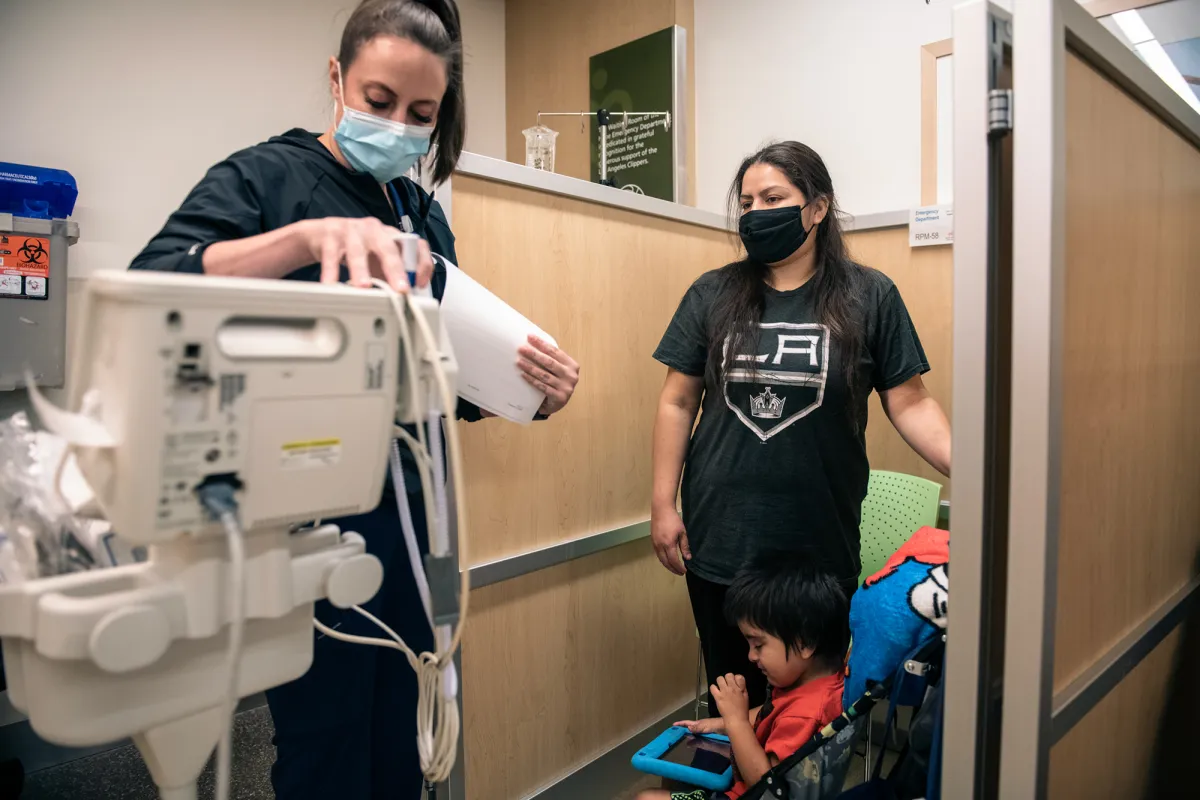
Gov. Gavin Newsom’s plan to close the state deficit includes a significant cut to Medi-Cal and a repurposing of money from the so-called MCO tax that had been intended to increase payments to California health care providers. Here, patients visit Martin Luther King Jr. Community Hospital in Los Angeles on July 26, 2022. Photo by Pablo Unzueta for CalMatters
The single largest cut in Gov. Gavin Newsom’s latest budget proposal threatens to undo a multi-billion dollar deal he made with health care industry leaders last year to shore up the state’s expansive public insurance program with a new tax.
Newsom wants to take $6.7 billion that had been earmarked for increased Medi-Cal payments to health care providers and instead use it to help plug the ballooning state deficit. Providers last year agreed to be taxed to generate that money with the stipulation that it be invested in Medi-Cal, the state’s insurance program for lower-income households.
Newsom said his budget proposal preserves core services for programs like Medi-Cal and emphasized that his administration has expanded services “like no other state in U.S. history has ever expanded.”
“We are maintaining that,” Newsom said during a recent budget presentation.
Groups representing doctors, hospitals and patients warn the cut would weaken an already overburdened health care system that serves one-third of the state’s population. Industry groups have gathered signatures to place a measure on the November ballot that would overrule any cuts made in the state budget and to prevent Newsom and future governors from repurposing Medi-Cal funds.
“We are deeply disappointed that the governor’s proposal jeopardizes access to health care for millions of Californians,” the Coalition to Protect Access to Care, the group supporting the ballot measure, said in a statement.
The coalition is the same group that brokered last year’s deal — known as the Managed Care Organization, or MCO, tax — and is primarily supported by the California Medical Association, California Hospital Association, ambulance operators, Planned Parenthood Affiliates of California and health insurers.
Under the original deal, the health insurance plans serving Medi-Cal patients would get taxed in order for the state to claim a dollar-for-dollar matching amount of money from the federal government. The promise was that the money generated — upwards of $35 billion for the state over four years — would be invested in the Medi-Cal system to increase reimbursement rates and attract doctors and other providers who otherwise say they don’t get paid enough.
Instead, Newsom’s new proposal increases the tax on health plans, uses the new money to alleviate the deficit, and cancels planned Medi-Cal rate increases for emergency room doctors, specialists and certain other providers. Increased payments that started in January for primary care, obstetrics and mental health would not be touched.
“This is mind-boggling for the public, but really the story is about equality,” said John Baackes, chief executive of L.A. Care Health Plan, the largest publicly operated health plan in the country.
For the past decade, California lawmakers have steadily restored Medi-Cal services cut during the Great Recession, added new ones, and expanded eligibility to include all low-income Californians regardless of citizenship. Today Medi-Cal covers things like dental exams, hearing aids, doula services and acupuncture. It is one of the most comprehensive public insurance plans in the country.
Expanding Medi-Cal access
L.A. Care serves more than 3 million Medi-Cal members in Southern California. Between January and March, more than 164,000 new members were enrolled when California granted Medi-Cal to working-age, undocumented immigrants. But increasing enrollment and benefits without providing more incentives to providers has strained the health system to a breaking point, Baackes said.
“Nobody is saying that the state doesn’t have a (budget) problem. We know they have a problem, but the cost that’s going to be paid by the people who benefit from the Medi-Cal program is very difficult for the providers to accept,” Baackes said.

Gov. Gavin Newsom addresses the media during a press conference unveiling his revised 2024-25 budget proposal at the Capitol Annex Swing Space in Sacramento on May 10, 2024. His proposal includes a change to the so-called MCO tax on California health care services. Photo by Fred Greaves for CalMatters
In recent budget hearings, representatives from the Newsom administration said they were trying to protect Medi-Cal’s core services while balancing a $27.6 billion deficit.
“These decisions and proposals are difficult and not put forward lightly,” said Michelle Baass, director of the Department of Health Care Services, which oversees Medi-Cal, during a recent Assembly budget hearing.
At that hearing, lawmakers who approved the tax deal last year accused the administration of not being honest about how the money would be used.
“I’m just wondering if any of the discussions we’ve had about the shortages, the closures, the issues that we have on the ground, the workforce shortages, if any of those things came into thought as you were trying to preserve core services, which is important, but if you don’t have providers to go to, what have we done?” said Assemblymember Akilah Weber, a Democrat and obstetrician from La Mesa, in the hearing.
Looking to California’s November election
Jarrod DePriest, president of Maxim Healthcare Services, said he was shocked to learn the “dollars meant to protect Medi-Cal” could be diverted. DePriest’s company provides home health services, such as nurses for people who would otherwise be confined in a hospital. A majority of its clients are children with complex health needs like cerebral palsy or severe respiratory problems, DePriest said.
Between 2018 and 2024, the number of nurses his company employs dropped by half because Medi-Cal reimbursement rates haven’t kept up with salaries and inflation, DePriest said. Consequently his company serves nearly 10,000 fewer patients.
“Down the road things will get worse and worse,” DePriest said.
His group and others, like air ambulance operators, were not included in the original Medi-Cal rate deal and are fighting for some of the tax revenue — but it’s unlikely with the current deficit. The proposed cuts signal to them that the state is unwilling to invest in Medi-Cal, which is exactly what ballot measure proponents hoped to avoid.
Dustin Corcoran, president of the California Medical Association and leader of the ballot coalition, said providers will only accept more Medi-Cal patients if they are confident the state will fund the program permanently.
“Medi-Cal has been underfunded for so long, one of the things we were trying to accomplish was the predictability and stability of rates,” Corcoran said. “You can’t have providers in situations where they don’t believe in consistency in the rates, and they have to choose between bankruptcy and patient abandonment. That shouldn’t be a choice that a provider ever has to make.”
Supported by the California Health Care Foundation (CHCF), which works to ensure that people have access to the care they need, when they need it, at a price they can afford. Visit www.chcf.org to learn more.
###
The Calmatters Ideas Festival takes place June 5-6! Find out more and get your tickets at this link.
CalMatters.org is a nonprofit, nonpartisan media venture explaining California policies and politics.
I Street Closed in Downtown Eureka Following Huge, Multivehicle Crash; Pedestrian Struck
Hank Sims / Wednesday, May 22, 2024 @ 2:28 p.m. / Traffic

Photos: Andrew Goff.
###
UPDATE, 3:24 p.m.: Laura Montagna, public information officer with the Eureka Police Department, tells the Outpost via phone, “This is an incredibly complex situation. We are continuing to investigate.”
###
UPDATE, 2:50 p.m.: A coroner’s vehicle has arrived at the scene.
###
UPDATE, 2:41 p.m.: The pedestrian who was struck has not been removed from the scene. Police have set up privacy barriers to block public view of him or her.

###
ORIGINAL POST: Eureka’s I Street is closed between Sixth and Ninth at the moment, following a huge multivehicle collision a few moments ago that resulted in at least two people injured, one of them a pedestrian.
Commander Lenny LaFrance of the Eureka Police Department told the Outpost that the closed area is being treated as a crime scene. Numerous police officers have been called to the area to close off the streets and, presumably, to investigate, all while other emergency personnel attempt to assist people involved.
The Outpost‘s Andrew Goff, at the scene, counts at least five vehicles with damages along that stretch of I Street.
Needless to say: Avoid the area. We’ll update when we know more.