

When Is a California College Degree Worth the Cost? A New Study Has Answers
Mikhail Zinshteyn / Thursday, May 9, 2024 @ 7 a.m. / Sacramento

The CSU San Bernardino campus on April 22, 2024. Photo by Jules Hotz for CalMatters
Nathan Reyes lives with his family five minutes from Cal State Los Angeles, where he’s paying close to nothing to earn a bachelor’s degree that typically lands graduates a salary of $62,000 within five years of completing college.
He’s one of hundreds of thousands of California low-income students who attend colleges that, because they’re affordable enough, cost the equivalent of a few months of a typical salary that students earn within a few years of graduation.
A new report compares California’s colleges by analyzing how long it would take low- and moderate-income students to recoup the money they spent to earn a college credential. It shows that many community colleges, Cal States and University of California campuses — all public campuses — have better returns on investment than most nonprofit private colleges and for-profit institutions.
Reyes’ only expenses are car upkeep, gas, a few books and helping his family with some housing costs. The third-year student didn’t need to take out loans.
“I feel very lucky,” Reyes, a communications major, said. “In high school, I was always stressing about, ‘Oh, man, I’m gonna have a whole bunch of debt racked up after college’. And now that I’m in my third year, I don’t have to worry about any of that.”
Reyes, who’s 20 years old, receives state grants to cover all his tuition and federal aid for other academic and living expenses. He also works for a state volunteer program that pays students a stipend.
Report calculates time it takes to recoup cost of degree
The report was commissioned by College Futures Foundation, a nonprofit that promotes college completion. The report merges several concepts into one number:
- The net price of a college degree after all financial aid is calculated
- The typical earnings 10 years after a student first enrolls in a school
- How much higher those wages are compared to what young adults earn with just a high school diploma.
It defines low- and moderate-income households as those earning below $75,000 annually.
The data, all from the federal government, show that the time it takes to recoup the net costs of earning a degree at Cal State San Bernardino is less than three months. That’s because low-income students there incur about $5,000 in out-of-pocket expenses if they finish in four years. Within a few years they earn about $53,000 a year — double what young adults with only a high school diploma make.
At Cal State Los Angeles, the time to recoup the net costs of earning a bachelor’s is also less than three months of a typical post-college annual salary.
“This is really a first-of-its kind look,” said the report’s author, Michael Itzkowitz, who headed the federal government’s first consumer tool for comparing college costs under the Obama administration. The approach is a mathematical way of demonstrating which colleges confer economic value to students beyond what a high school diploma would.
“I feel very lucky. In high school, I was always stressing about, ‘Oh, man, I’m gonna have a whole bunch of debt racked up after college.’”
— Nathan Reyes, undergraduate student at Cal State LA
A CalMatters analysis of Iztkowitz’s data found that the average time needed for a student to recoup their net costs is about two years at public institutions and a little over three years at nonprofit private colleges in California.
Some of those private campuses are as affordable as a Cal State, UC or community college after factoring in financial aid. Stanford University costs low-income students nothing. However, only 4% of students who apply are admitted, while all but three Cal States admit more than 70% of the students who apply. Most undergraduates in California attend a public institution.
Pitzer, Pomona and the University of Southern California and several other highly selective nonprofit private colleges cost students less than a year’s worth of the typical salary they’ll earn within a few years of completing their degree.
Return on investment varies by college
While some for-profit colleges have strong returns on investment, most do not.
It takes nearly 13 years for students attending this often-scrutinized segment of higher education to recoup their costs, Itzkowitz’s calculations show. California’s Department of Justice has sued several for-profit colleges, accusing them of deceitful practices, and won large financial judgments and settlements.
And that doesn’t even account for the 22 for-profit institutions that show no return on investment, meaning students from those schools earned no more than what a young adult with just a high school diploma makes. In the report, 24 campuses in total, or 8% of all California colleges, showed no return on investment, including two small nonprofit private colleges.
“There are for-profit institutions that can offer an affordable education and good employment outcomes and they’re recognized within the data,” Itzkowitz said. “But what we also see is that there are a disproportionate amount that show more worrisome outcomes for students in comparison to other sectors.”
Most California for-profit colleges, however, predominantly issue certificates, which are shorter-term credentials that don’t regularly lead to the economic gains associated with bachelor’s degrees.
At 79% of California institutions in the report, low and moderate-income students typically recoup their costs in five years or less. For nearly a third of campuses, it was less than a year.

Sample colleges in the report. Cal Poly Humboldt doesn’t do as well as many other public universities, ranking 175th out of 293 — the lowest of any school in the CSU or UC systems. Get the full data at this link.
For many students, the ultimate costs of a degree will be higher than the data published today. That’s because they need more than two years to earn an associate degree or beyond four years to earn a bachelor’s, assuming they graduate at all. The longer they chase a degree, the less time they spend in the workforce earning the higher salaries that come with a college credential. Also, the federal net price data has limits: It only calculates what full-time freshmen pay. Students attending part time will experience different annual costs.
But the basic trend remains the same: State and federal financial aid at public campuses plus typical salaries that far exceed the wages for those with a high school diploma make college worth the investment.
Itzkowitz plans to produce a follow-up report that measures the return on investment by major. His organization, the HEA Group, produced an analysis of typical wages by major last year. Some majors lead to higher wages than others, which can skew school-wide results.
The data in today’s report show variation within public universities, too, even in the same city. UCLA’s net price-to-earnings ratio is about seven months and its students tend to earn more than those from Cal State LA after graduating. But the typical cost of a degree after four years for low-income students is roughly $31,000 — far higher than the $5,500 at Cal State LA, which is 20 miles away.
“I wanted to go to UCLA, but it was too expensive for me,” Reyes said. “I did get accepted.”
Like he did at Cal State LA, he would have probably qualified for the Cal Grant, which waives tuition at public universities. But the distance from home would have forced him to either live in a UCLA dorm or commute about two hours daily between home and the crosstown campus. Housing, not tuition, is usually the largest expense for students at public universities. Borrowing money was out of the question for him.
So was a long drive to UCLA. “If I ended up missing a class or something, I’d beat myself up over it,” he said.
###
For the record: College Futures is a funder of CalMatters. Our news judgments are made independently and not on the basis of donor support.
The CalMatters Ideas Festival takes place June 5-6! Find out more and get your tickets at this link.
CalMatters.org is a nonprofit, nonpartisan media venture explaining California policies and politics.
BOOKED
Yesterday: 4 felonies, 7 misdemeanors, 0 infractions
JUDGED
Humboldt County Superior Court Calendar: Today
CHP REPORTS
No current incidents
ELSEWHERE
RHBB: Nov. 3, 2026 General Election Vote Center and Ballot Drop Box Locations
RHBB: Mendocino Railway President And Ceo Robert Jason Pinoli Elected To Aslrra Board Of Directors
RHBB: Wildfire Burning Near Highway 101 South of Laytonville
OBITUARY: Petey Brucker, 1952-2024
LoCO Staff / Thursday, May 9, 2024 @ 6:56 a.m. / Obits
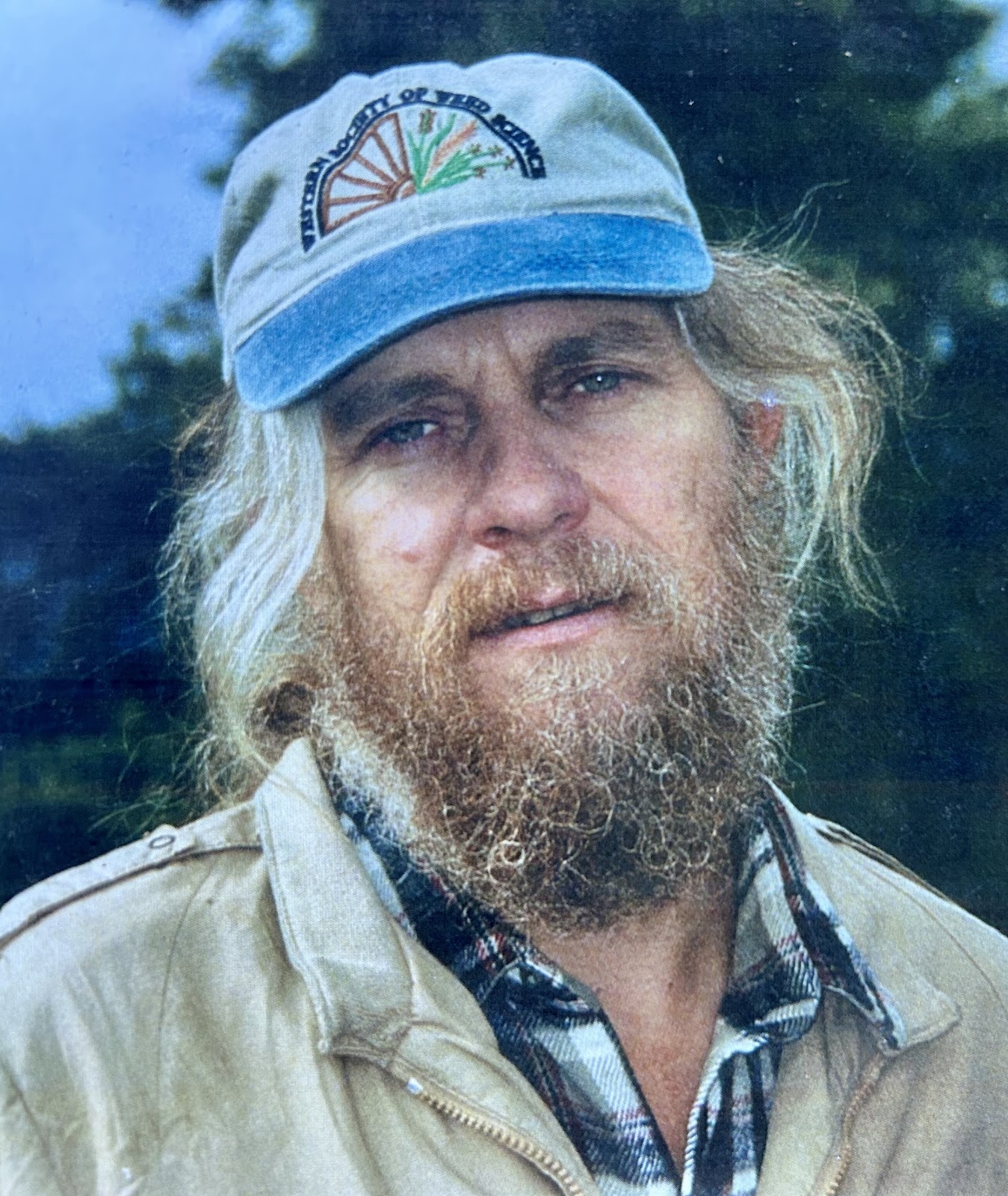
Petey
Brucker: The River Runs Through Him
October
15,1952 - April 22, 2024
Peter (Petey) Daniel Brucker passed away peacefully, in the arms of his loved ones. As the sun rose at 6:37 a.m. on Earth Day, April 22, 2024, he took his last breath at his home on the Salmon River in Northern California.
Petey and Geba Greenberg, his partner of 47 years, spent his last two years in Arcata due to his disabling neurological disease, Progressive Supranuclear Palsy. As Petey felt his life ending, he asked to return to his high mountain home at Godfrey Ranch. He had five final wondrous days with his family by his side, and friends visiting who shared the vista, a toke and music-making. Among those singing were his two daughters, Karuna Greenberg and Allegra Brucker, and his lifelong friend and music partner, Rex Richardson.
Born in Nyack, New York, on October 15,1952, the son of Mildred and Daniel Brucker, Petey was known as a loving and wily child who would do whatever he could to stay out of school. He always had a sense of connection to the earth that was nurtured by summers spent with his family at Camp Kanawauke in Bear Mountain State Park, New York. There he swam, canoed, and romped in the woods and brooks with his pals. He was a long-distance swimmer who could hold his breath for three minutes underwater, disappearing into the dark and popping up on the far side of the lake, or way upstream.
In the spring of 1975, just before turning 23, Petey followed his older brother Phil to the Salmon River. His sister Donna soon joined them. He met Geba Greenberg on the Winter Solstice in 1977 at Black Bear Ranch and spent the rest of his life with her. As a husband, father, friend, mountain man, musician and activist, Petey showed love in everything he did. He loved his community and watershed, expressing his spirituality through music and caring for the earth.
Petey was generous, eager to give someone in need the shirt off his back, or the dollars in his pocket. He was famous for stopping to talk to those he passed on the Salmon River Road, saying this was how a community stays connected. He was known for spending hours in the evening at the Beer Tree in Forks of Salmon with the likes of Hoss Bennett and Jim Hensher. If there was anyone at the tree, he said it was disrespectful to pass by without stopping. He made friends with everyone, no matter where they lived or what they believed. Petey broke down fences and barriers. The name Brucker means bridge-keeper, and Petey built bridges.
Petey loved babies and engaged children in theater projects at local schools. He was an adept musician with an impeccable ear, a singer, songwriter, a master of the guitar and mandolin who also played piano and bass. Over the years he was in many bands on the river including Loose Gravel, Quick Cabbage, The Super Fines, The Salmon River Snipers, and often in a duo with Rex Richardson. His sister Donna accompanied him in many musical endeavors. His music was a soundtrack of the Salmon River.
While on tour in 1990 with a giant old growth Douglas Fir Log to raise awareness about logging practices in the West, he opened for Pete Seeger in Washington D.C. on Earth Day. He attended Woodstock in 1969, Bob Marley in 1979, and later, many Humboldt ‘Reggae on the River’ festivals. Whenever asked, Petey played weddings, funerals, graduations, and holidays. He wrote songs as tributes to friends and family who had passed. He rarely listened to recorded music, and if he did, it was Stevie Wonder, Jimi Hendrix, Bob Marley, or his own tunes. You can listen to his music on SoundCloud: Petey’s Songs
Petey was a hard worker and especially loved digging in the earth. He could out-dig three people in the garden and was an early creative in guerrilla cultivation technologies. He would say that his favorite job was ditch-digging and spoke highly of having been a grave digger for a short time as a teenager.
Petey was an instrumental character through the decade he lived at Black Bear Ranch. After Geba, their daughters and he moved to Godfrey, they continued to steward Black Bear until his body no longer allowed it.
The only novel Petey read as an adult was “The Mists of Avalon,” but he read thousands of pages of environmental government documents. He was self-educated, saying he attended the U of Me. His infectious sense of humor remained until the day he died. Though he could barely speak the last few years of his life, he never lost his capacity to laugh. Petey’s relationship with marijuana as good medicine ran deep. His condition caused him to give up smoking, but when he resumed in the last months of his life, it made it easier for him to swallow and sleep.
Living in the remote wilderness community of Forks of Salmon, Petey dedicated his life to protecting this extraordinary watershed. He inventoried and measured the damage done by the extractive mining and logging industries, then devised strategies for repair.
As fish populations plummeted, and fires ravaged the landscape, Petey was determined to restore healthy forests and rivers. Agent Orange was repurposed after the Vietnam War as an aerial herbicide. After clearcutting, It was sprayed on tree plantations to ensure profitable timber sales, but it damaged human health, wildlife, and the forest itself. In response, Petey banded together with others to found ‘Salmon River Concerned Citizens’ to raise awareness and organize to stop aerial herbicide spraying.
Petey studied the ecological impacts of forest practices, thinking hard about the consequences of logging and fire suppression. As the watershed was shaped by wildfires, so was Petey. He lost his home twice to catastrophic fire, in 1977 and 1987, and volunteered as a renegade fire fighter in both fires. He participated in developing fuels management and fire protection strategies, and Indigenous-led controlled and prescribed burn practices. He became the first Community Fire Liaison, an official role he conceived to link the government fire command group with local community members by establishing clear communication between them.
In the late 1980s, when the Forest Service was kicking people out of mining claims, then burning their homes, Petey helped start ‘Siskiyou Citizens For Housing Reform’ and the ‘Salmon River Mining Council’ to protect residents of the Salmon River. After his brother Phil was killed on his motorcycle by a logging truck, Petey helped found the Salmon River Volunteer Fire and Rescue so that life-saving emergency medical care was available.
In 1989, Petey, with Felice Pace and a handful of others, founded the Klamath Forest Alliance (KFA) to mitigate harm from forest management practices like clear-cut logging and old growth liquidation. Petey led with science-based forestry analysis, reworking proposed timber sales through dialogue, litigation, and appeals. Klamath Forest Alliance
Petey saw possibilities for more than harm reduction, devising creative restoration solutions, and in 1992 co-founded the Salmon River Restoration Council (SRRC) with Jim Villeponteaux. SRRC programs included fisheries and water quality monitoring; instream habitat restoration; noxious weed removal; fire and fuels management, including prescribed burning; watershed education; and river cleanup. His daughter Karuna Greenberg is now Co-Director of the Salmon River Restoration Council, ensuring that this work continues to grow and thrive. https://srrc.org
After the noxious Spotted Knapweed was discovered on Salmon River bars, the Forest Service proposed spraying Round-Up to control it. Petey initiated the bold plan of manual removal of noxious invasive plants as an alternative toxic herbicide, persuading land management agencies that removal could be managed by SRRC by recruiting volunteers and employees to pull noxious species and plant natives in their stead. This project had record breaking volunteer hours, including thousands by Petey himself; and over time proved to be incredibly effective.
Petey felt a responsibility to the Indigenous people of this place. He knew our future depended on reckoning with our past by honoring native people not only in our thoughts, but also in words and actions. When it seemed like an unfathomable feat, Petey put his shoulder to the wheel to support Karuk, Yurok and Hoopa tribal members in kicking off the movement to remove Klamath River Dams and revive the salmon.
That meant tireless lobbying over two decades, driving long distances to meetings, organizing rallies and protests. During high stakes meetings, when tensions ran high, Petey brought out his guitar. Representatives from both congress and the tribes asked Petey to open meetings with a song. With good humor, Petey could cajole negotiators back to the table after they’d walked away. It was a gift for Petey to know that the salmon could now return.
Petey, Geba and Allegra were able to join Leaf Hillman, Ron Reed, Molli White, Frankie Myers, Sammy Gensaw, Mike Belchik, Craig Tucker, and others in witnessing the final draw down of the Copco Dam on January 23, 2024. He shed tears of joy as he watched the river run free for the first time in nearly a century. Here is a link to Petey’s song “Tear Down the Iron Gate Dam” with photos of the many years of protests. Iron Gate Dam Song - Petey Brucker & Arcata Interfaith Gospel Choir
Petey acted from his belief that stewardship is our responsibility and that working together is the path to achieve lasting change. His organizing style was to listen so that each voice is heard, and lift people up. With kindness, joy, persuasion, and litigation, he held agencies accountable for best forest practices.
Petey was awarded the Unsung Hero Award by the California Governor’s Office of Emergency Services in 2017 for his work in environmental conservation and disaster response. In 2023, he was honored by EPIC with a wonderful event and the Sempervirens Lifetime Achievement Award. Here is his dear friend and brother Ron Reed speaking about Petey at that event.
- Ron Reed honoring Petey Brucker 7/15/2023
- EPICH honors Petey Brucker 2023 Sempervirens Lifetime Achievement Award
Petey’s imagination, perseverance, and collaborative skills as well as his passion for ecological activism have inspired the next generation to protect forests, rivers, and wildlife along the Klamath and Salmon Rivers. Petey showed by example how one changemaker can cause a cascade of good downstream.
The remarkable love Petey and Geba shared with each other was an honor to witness. The commitment, sacrifices, and tenderness with which Geba cared for Petey in this last decade should not go unmentioned. Over the years, their sweetness for each other held.
Petey was a father and mentor to many, one of whom is his nephew, Waylen Brucker. They shared a special closeness after both losing Phil Brucker. Waylen is a skillful nurse who was an indispensable part of Petey’s care team. Brian Sharkey was Petey’s mobility angel, providing wheelchairs, lifts, ramps, walkers, and grab bars. At every step of his decline, Brian’s innovation and generosity delivered the next piece of equipment needed.
The family thanks Hospice of Humboldt County, UCSF David Soleimani-Meigooni, Life on Wheels, and Erin Fowler for their part on Team Petey, and kind-hearted caregivers Jan Pfaff, Dennis Meade, Amanda Howard, Omar Green, Phillip Meshekey, Betty Ann and Creek Hanauer, and Jessie Peck, who guided Petey and family toward a beautiful final chapter.
Petey is survived by partner Geba Greenberg, daughters Karuna Greenberg and Allegra Brucker, sister Donna Brucker, and cherished grandsons Phoenix and Zephyr O’Hare. Petey joins his parents Millie and Dan Brucker, beloved brother Phil Brucker, and many dear friends, including Melvin Berry, Jim Hensher and Jim Jennings, as well as fellow Earth Warriors Jim Villeponteaux, Les Harling, Freeman House, Florence Conrad, Brian D. Tripp, Ronnie Pierce, Troy Fletcher, Tim McKay, and Judy Bari.
If so moved, donations in memory of Petey Brucker to the Salmon River Restoration Council https://srrc.org/give/
Celebration of Life
Saturday June 22, 2024 @ 2 PM
Forks of Salmon Community Club
Info or RSVP: celebratepetey@gmail.com
Share stories, photos, videos and recordings of Petey to the Google Drive Petey Brucker Memories or email celebratepetey@gmail.com Email us if you’d like to learn one of Petey’s original songs to play at the celebration, or play one of your own celebratepetey@gmail.com
###
(Listen to his song The River here)
The
River
By Petey Brucker
The
river is running through
It’s
flowing through me and you
We
find it in everything we do
The
river is running through
It’s
what delivers and takes us away
It’s
working in each and every day
With
a love that’s new
A
love that’s true
It’s
a love that’s you
The
path is waiting to be walked
The
thought is thinking to be talked
I
think of you and I start to cry
But
now you shine so bright up in the sky
It’s
what delivers and takes us away
It’s
working in each and every day
With
a love that’s new
A
love that’s true
It’s
a love that’s you
The
light will always be aglow
If
you look deep deep down in your soul
You’ll
find a love waiting for you there
Sometimes
it tires but it always cares
It’s
what delivers and takes us away
And
it’s working in each and every day
With
a love that’s new
A
love that’s true
It’s
a love that’s you
It’s
a love that
It’s
a love that’s you
Sometimes
this life it seems too short
Much
too soon our ship came into port
But
like a boat that’s tossed upon the sea
We
are born, live life, and then we’re free
It’s
what delivers and takes us away
And
it’s working in each and every day
With
a love that’s new
A
love that’s true
It’s
a love that’s you
It’s
a love that, it’s a love that,
It’s
a love that’s you
The
river is running through
It’s
flowing through me and you
We
find it in everything we do
The
river is running through
The
river is running through
The
river is running
The
river is running
The
river
The
river
###
The obituary above was submitted on behalf of Petey Brucker’s loved ones. The Lost Coast Outpost runs obituaries of Humboldt County residents at no charge. See guidelines here.
YESTERDAY IN SUPES: Board Punts Decision on TOT Funding for the Arts, Approves $4 Million for Measure Z-Funded Projects, and More
Isabella Vanderheiden / Wednesday, May 8, 2024 @ 3:49 p.m. / Local Government

Screenshot of Tuesday’s Humboldt County Board of Supervisors meeting.
###
Over a dozen representatives of the local arts sector filled the Humboldt County Board of Supervisors chambers on Tuesday to urge the board to maintain critical funding for art and theater programs made possible by the county’s transient occupancy tax (TOT).
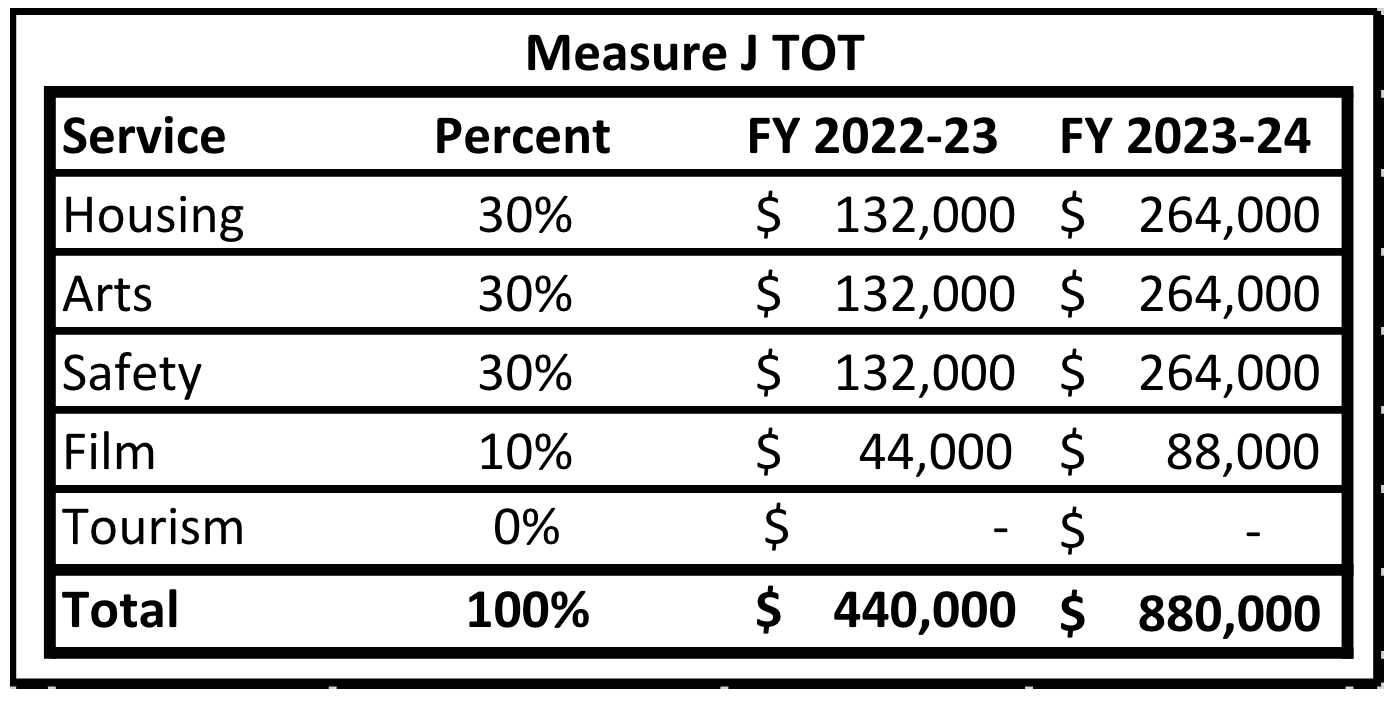
The emotional testimony came in response to a proposal from staff that sought to keep $880,000 in funding generated by Measure J, a TOT hike approved by voters in 2022, in the county’s General Fund to help stabilize the county budget, rather than allocating the funds to outside organizations for various arts- and film-related projects.
During a presentation to the board, Deputy County Administrative Officer Jessica Maciel reiterated that the county is facing a $12.4 million budget shortfall for the current fiscal year. The extra $880,000 would “ensure that resources would be available, should more emergent needs arise in future fiscal years, providing protections for critical essential services,” according to the staff report. The TOT funding allocations are detailed in the chart below.
Screenshot
Speaking during public comment, Leslie Castellano, executive director of the Ink People Center for the Arts, said the funding provided by Measure J helped the Ink People establish the Underserved Communities Fund, which offers support to BIPOC (Black, Indigenous, People of Color), LGBTQ+ and other underserved people looking to create art projects that benefit the greater community. She urged the board to keep the funding in place.
“I want to thank you for your bold decision last year to invest – really for the first time – in the arts and culture sector as a way of, you know, really seeing what kind of good work could be done through arts and culture in terms of addressing economic development, addressing public safety [and] addressing public health,” she said. “I think your investment is yielding results. … You can see it as an investment in the people who are in your community and their well-being.”
Cassandra Hesseltine, executive director of the Humboldt-Del Norte Film Commission, also encouraged the board to look at the funding allocation as an investment in the community’s future. She noted that the Star Wars-themed festival Forest Moon Days, which received funding from Measure J, brought in “over 6,500 attendees [to] the region.”
“We would like to have an increase in our funding actually, believe it or not, because we think we can help bring in more money,” she said. “Our return on investment for your regular funding that you guys give us is 500 percent.”
Johnson | Screenshot
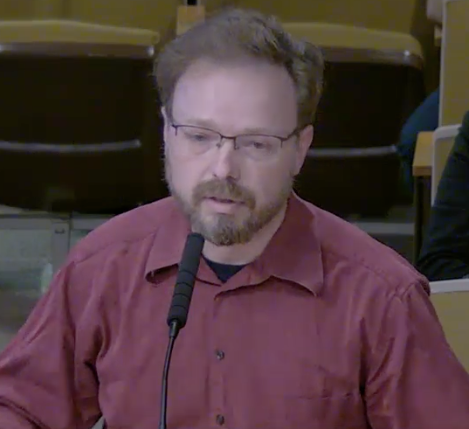
Similarly, Calder Johnson, managing artistic director for the North Coast Repertory Theatre, asked the board to think of the arts as service and a source of enrichment to the community. “When we start talking about arts, culture, events [and] gatherings … we’ve seen the data showing how much of an effect this has on mental health, physical health, social health, community well-being [and] suicide prevention. … This is a service.”
Humboldt County Sheriff William Honsal expressed his own appreciation for the arts sector, noting that he is “a huge fan of Star Wars” (First District Supervisor Rex Bohn, earlier, claimed never to have seen a Star Wars movie), but ultimately urged the board to direct the funding back to the General Fund to prevent layoffs.
“We are looking at cuts across the county,” Honsal said. “I know we need to work on generating more revenue – I’m all about that – but right now, we may have to lay off people this year.”
Following public comment, Third District Supervisor Mike Wilson suggested the board keep half the $880,000 in the General Fund and allocate the other half to the programs, as previously planned.
“I think these budgets are moral decisions in a lot of ways about what’s important,” Wilson continued. “They are investments, and I do believe that the arts … it’s just that we’re coming into some pretty tight times.”
Second District Supervisor Michelle Bushnell offered her gratitude to the people who spoke in public comment but said she was leaning toward staff’s recommendation to keep the funding in the General Plan.
“[Fourth District Supervisor] Natalie [Arroyo] and I went through the budget ad hoc process and it was very painful,” Bushnell said. “We had to tell each department that we’re looking at layoffs and we’re looking at cuts and we won’t be able to fund essential services,” Bushnell said. “While I do think – and know – that the arts are so important to our community … I just can’t right now knowing that we have a budget talks in less than a month and we’re going to tell people that they can’t fund their departments.”
Arroyo also acknowledged the importance of being “really strategic about the investments we’re making” and suggested that the board create an ad hoc committee to look into the issue further.
“I kind of hate to say ‘Let’s do another ad hoc!’ but perhaps that’s one approach we can take [to provide] a little more evaluation of this funding stream for the purpose of generating revenue,” she said. “We’ve reined back a lot of other expenses around tourism … but we also need to look at ways to make revenue and catch up.”
Arroyo made a motion to create an ad hoc and volunteered to serve. The action was seconded by Wilson.
Bushnell asked if Wilson if he would be willing to sit on the ad hoc committee but quickly volunteered to do it herself, joking that he and Arroyo “think too much alike.”
The motion passed 5-0.
Measure Z Funding Recommendations
The board also approved a list of funding allocations for projects funded by Measure Z, the county’s half-percent sales tax intended to maintain public safety and essential services, totaling $4.08 million.
Along with the rest of the county’s budget, Measure Z funds have dried up in recent years due to a reduction in economic activity across the county, which has cut millions of dollars from the county’s projected income. At the end of last year, the board made the difficult decision to cut funding for the county’s Mobile Intervention Services Team (MIST), which serves homeless people experiencing mental health crises, to maintain essential county services.
This round of funding allocations was no different. The Measure Z Citizen Advisory Committee went through an extensive ranking process to develop the following list of recommendations:
- $500,000 for Public Works to prep chip and seal two miles of Mattole Road.
- $1,100,000 for Public Works to replace three pieces of heavy equipment.
- $197,901 for the City of Fortuna to reinstate its school resource office.
- $188,324 for the Sheriff’s Office to continue using the evacuation software platform Genasys.
- $2,100,000 to the Humboldt County Fire Chiefs’ Association for equipment, training, dispatch fees and planning.
Bohn said he was happy to see a chunk of funding going to his district because it usually “doesn’t get anything.”
“We’re in a tough time,” he said. “We’re lucky we got what we got. If it’s creative bookkeeping, we’re lucky with what we got.”
Quincey | Screenshot
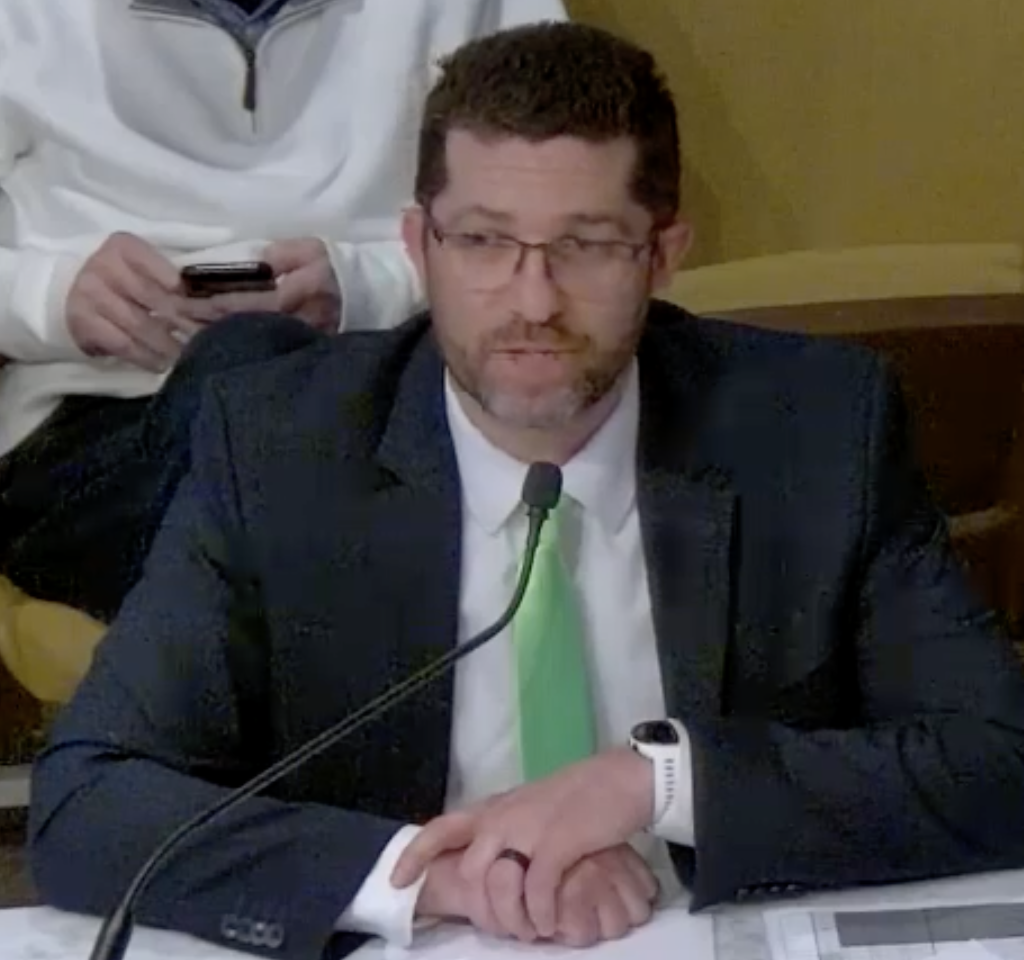
Deputy County Administrative Officer Sean Quincey warned that next year’s funding allocations will be even more sparse than this year. “We’ve had a lot more difficult conversations in terms of how the pie is getting split,” Quincey said. “Next year, we don’t expect to have nearly as much funding available for Measure Z. And if there’s no change in our process … there’ll be another difficult year full of difficult discussions and conversations.”
However, Quincey noted that there was $45,665 left in the current round of funding. The board was divided on whether the money should be given to Public Works for additional road repair work or to the City of Arcata to help fund a juvenile diversion program.
Bushnell made a motion to approve the list of funding recommendations and allocate the $45,665 to Public Works, which was seconded by Bohn.
Wilson made a case for Arcata’s juvenile diversion program, suggesting that the board give the remaining funds to the city and, if it can’t come up with the matching funds needed for the program, the $45,665 will go to Public Works. Bushnell and Bohn agreed and the amended motion passed in a unanimous 5-0 vote.
Issues at the Trinidad Rock Quarry
At the beginning of Tuesday’s meeting, the board presented certificates of appreciation to representatives of Mercer Fraser Company, Granite Construction and Operating Engineers Local 3, all of whom donated supplies and services to help Public Works staff and the Westhaven Community Services District with the installation of road humps on Sixth Avenue in Westhaven.
The item appeared on the board’s consent calendar, which is typically approved in a single motion along with the rest of the calendar without much discussion. However, the item drew an unexpected amount of attention from the public as several community members seized the opportunity to call out Mercer Fraser for creating an alleged “environmental disaster” at the rock quarry near Trinidad.
Numerous speakers, including residents of the communal living village “Yee Haw,” claimed Mercer Fraser has not had a permit to operate the quarry in nearly two decades, while others alleged that environmental degradation at the quarry is threatening air quality and nearby watersheds.
“We’re not okay over there on Quarry Road – the situation is not okay,” said one speaker, who only identified herself as Claire. “The plants, the animals and the people are all being impacted. I look forward to this being on the agenda at another moment where we can go further into the paperwork documenting the disregard, documenting the unpermitted status [and] documenting the impact on the waterways and on air quality. It’s all there.”
Fifth District Supervisor Steve Madrone acknowledged that there are “lots of issues going on in the quarry area,” but did not speak directly to the commenters’ concerns.
“I know sometimes it’s hard to separate things, but when somebody does a good action, I believe they deserve recognition for that,” he said. “[This project] was a very important thing for the community. That doesn’t mean there aren’t issues at the quarry, I think we all know that there are. … [T]he county is going to be engaging with Mercer Fraser in regards to things that need to be taken care of.”
The consent calendar was ultimately approved 5-0.
###
Other notable bits from today’s meeting:
- The board approved a request from the Fish and Game Advisory Committee to look into the possibility of installing a fish cleaning station at the “Jimmy Smith” boat launch property in Fields Landing.
- The board also approved a proclamation recognizing Missing and Murdered Indigenous Persons (MMIP) week in Humboldt County. According to the FBI’s National Crime Information Center, an estimated 5,203 indigenous girls and women were reported missing in 2021, “disappearing at a rate equal to more than two and a half times their estimated share of the U.S. population.” Julia Oliviera, an MMIP investigator with the Yurok Tribe, thanked the board for the proclamation, noting that she is the only dedicated MMIP investigator in the state. “I hope soon there will be more of me out there,” she said.
- The board approved a resolution in support of the Rumble of the Redwoods airshow, which will take place at the Humboldt County Airport on Aug. 10 and 11.
Will California Voters Decide Tax Limits in November? It’s Up to the Supreme Court
Alexei Koseff / Wednesday, May 8, 2024 @ 12:41 p.m. / Sacramento

Photo: OmiB91, via Flickr. Creative Commons license.
The California Supreme Court will decide in the coming weeks whether to remove a sweeping anti-tax measure from the November ballot, blocking an effort to increase the requirements for implementing taxes, fees and other government charges in the state before voters have a chance to weigh in.
Gov. Gavin Newsom, the Legislature and others sued last fall to stop the business community-sponsored initiative, arguing that it amounts to an illegal attempt to revise the California Constitution and would impair essential government functions.
With a June 27 deadline to set the ballot for the November election, the court must rule soon about whether to allow the proposed measure, formally known as the Taxpayer Protection and Government Accountability Act, to proceed.
At an hour-long hearing this morning in San Francisco, the justices grappled extensively with a provision that would require the Legislature to seek approval from the voters for any new or higher state tax. Currently, lawmakers can raise taxes by a two-thirds vote of both chambers.
“From the founding of the state, the Legislature has had the supreme power of taxation,” Margaret Prinzing, an attorney representing the state, told the court. “This measure would revoke that power for the first time in the history of California and instead put it in the hands of the voters.”
Prinzing argued that, rather than simply amending tax law in the state constitution, this would fundamentally restructure how government operates — a more substantial change that can only be proposed by a two-thirds vote of the Legislature or through a constitutional convention.
Justice Goodwin Liu pressed the lawyer for the initiative’s proponent, the California Business Roundtable, about that idea repeatedly during the hour-long hearing. He asked at one point whether giving voters authority over state taxes would create a fourth branch of government.
“Doesn’t this measure essentially shift us from a republican form of government far more strongly towards a direct democracy, given how fundamental the taxing power is?” Liu said.
Thomas Hiltachk, the lawyer representing the business group, asserted that the power of the legislative branch is shared with the public and thus the Legislature has no unilateral power to impose taxes.
“Our constitution, since its inception, has stated that all political power is inherent in the people. It has stated that the people have the power to reform and alter their government whenever they decide it needs reform,” Hiltachk said, adding later, “The people have the last word.”
The proposed initiative would broadly make it more challenging to raise taxes in California, including by also increasing the margin to pass a voter-initiated special tax at the local level, to two-thirds from a simple majority.
Other consequential provisions — which could upend the operation of California government at every level — would restrict how officials can calculate the cost of fees that fund public services and programs and reclassify some of those charges as taxes. That would prohibit administrative agencies from setting these levies, requiring the Legislature or local governments to turn to the voters to adjust them.
Proponents say their initiative is a necessary crackdown on loopholes created by legislators and court rulings that weakened previous voter-approved tax accountability measures and allowed an unelected administrative bureaucracy to flourish. It has been heavily supported by the real estate industry and a private ambulance company, which frequently battle local governments over taxes, fees and assessments to fund public services.
But since it secured its eligibility more than a year ago, Democratic politicians, organized labor and other opponents have worked feverishly to undermine the initiative and toss it from the ballot.
In addition to the lawsuit, legislators voted in the final weeks of session last summer to put a competing measure on the ballot that would flip the California Business Roundtable initiative’s own higher standards against it, requiring that changes to the threshold for approving state and local taxes pass by that same margin. That would mean it needed to secure two-thirds support from the electorate, rather than a simple majority, a high hurdle for a statewide measure.
At this morning’s hearing, attorney Prinzing argued that the proposed overhaul to how governments can raise revenue would hinder their ability to respond quickly to fiscal emergencies and might change the nature of what taxes are even possible in California, by transferring those decisions away from experts who can consider them within the full context of budgets and spending priorities.
“The voters simply don’t have the capacity to do that,” she said.
Hiltachk responded that the state has faced emergencies in the past and recovered from most of them without ever choosing to raise taxes.
“If the Legislature believes it needs a more long-term solution, it can certainly ask the voters,” he said.
The justices appeared sympathetic to the state’s arguments about the practicality of the initiative. Liu in particular noted how “vast” its impact would be, potentially affecting everything from traffic tickets to library fines.
“If you wanted a measure that spoke to the concerns that you raised, that would be a different measure,” Liu told Hiltachk.
But several justices expressed uncertainty about the appropriateness of deciding the legality of the initiative prior to the election, as well the state’s request to strike down the entire measure rather than considering each provision on its own merits.
Hiltachk urged the court not to thrust itself into a political judgment and allow the voters to have their say.
“This tug-of-war over taxation has been going on for over 100 years,” he said.
###
The CalMatters Ideas Festival takes place June 5-6! Find out more and get your tickets at this link.
CalMatters.org is a nonprofit, nonpartisan media venture explaining California policies and politics.
First They Closed College, Now They Close College COVE?!? Yes, But Only For Two Weeks and to Perform Much-Needed Repairs, State Parks Says
LoCO Staff / Wednesday, May 8, 2024 @ 10:07 a.m. / News
Press release from California State Parks:
In the interest of public safety and resource protection, College Cove in Trinidad State Beach will be closed to access and use on May 15th-22nd and May 29th-June 5th. This closure is necessary for public safety while crews work on trail restoration. The temporary closure order will apply to the parking area and trail within the unit. Other popular trails within Trinidad State Beach will remain open during this closure.
With the exception of park employees and approved contractors, no person shall be in the above-mentioned closure area for any reason, day or night during the times listed. Authorized emergency vehicles, Department of Parks and Recreation personnel, vehicles, and equipment required to perform the restoration work are exempt from this Order.

Will Californians Get Any Relief on Gas Prices?
Lynn La / Wednesday, May 8, 2024 @ 7:25 a.m. / Sacramento

Adrian De La Cruz fills his work truck with diesel gas at a station in west Fresno on May 7, 2024. Photo by Larry Valenzuela, CalMatters/CatchLight Local
Californians pay more at the pump than residents of any other state — an average of $5.34 a gallon for regular unleaded, compared to the national average of $3.64, according to AAA. And in some counties, the sticker shock is even worse — $6.80 in Alpine, $6.29 in Mono and $5.85 in Humboldt, for example.
Statewide, gas prices have jumped 55 cents a gallon from this time a year ago.
It’s also a little more than a year ago when Gov. Gavin Newsom’s plan to crack down on windfall oil profits became law. So what’s up?
On Tuesday, the Senate energy committee asked California Energy Commission officials that very question. Citing the “crippling” effect high gas prices have on low-income Californians and commuters, legislators wanted to know if the law’s increased reporting requirements on oil companies have helped the commission determine whether to recommend capping oil profits and penalizing oil companies that exceed the cap. Any recommendation isn’t expected until later this year.
“We want to have the confidence that the solutions will bring relief to Californians at the pump are real and not just aspirational,” said Sen. Steven Bradford, an Inglewood Democrat and chairperson of the committee. “Far too often, we shoot first and ask questions later.”
Though the commission is still gathering data, what it and its new watchdog division found so far was that the three times gas prices notably spiked in the last five years (in October 2019, October 2022 and September 2023), oil company profits rose. Environmental fees and state and federal taxes, however, remained relatively flat during that periods.
“Price spikes are profit spikes for the oil industry,” said Tai Milder, director of the Division of Petroleum Market Oversight.
What causes gas prices to be so volatile? One reason is the price of crude oil, which can be swung by global events such as the wars in Ukraine and Gaza. These wholesales prices, in turn, impact retail prices. But while both typically rise in tandem, they do not fall together — when wholesale prices drop, pump prices are often slow to follow.
Siva Gunda, vice chairperson of the energy commission, describes the pattern as “up like a rocket but down like a feather.”
Still, Gunda said that there is no clear evidence that oil companies are engaging in price gouging, but that there is also no industry incentive to ease price spikes.
“None of the industry in our good-faith discussions disputes that profits go up a lot. So who’s to decide how high you can go during those times?” said Gunda. “That’s what we’re trying to think through. Given that this is such an important public benefit, how do we ensure that there’s a cutoff?”
At today’s hearing of the Senate energy committee, Catherine Reheis-Boyd, president and chief executive officer of Western States Petroleum Association, pushed back against caps and penalties. She told CalMatters that they wouldn’t reduce prices, but have “the absolute opposite effect.” To avoid incurring penalties on profits, companies will restrict supply, which will drive up costs.
“It’s two to three times more expensive to run a refinery in California than anywhere else in the world. It comes to a point where it becomes uneconomic,” Reheis-Boyd said. In 2023, California had 14 refineries compared to 43 in 1982.
Instead, Reheis-Boyd argues that legislators should look into investing more into the oil supply chain to increase supply, such as lifting restrictions on the production of crude oil in California.
Some reasons for higher prices are built into the calendar.
Service stations in California have already switched to the more expensive summer fuel blend, formulated to reduce ozone emissions — in Southern California on Feb. 1, and in Northern California on March 1, according to the energy commission. Last year, Newsom pushed to go back to winter fuel sooner than the usual Oct. 31 to help bring down prices.
And on July 1, the state’s excise gas tax will increase by 1.9 cents to 59.6 cents a gallon to keep up with inflation. The tax on diesel fuel will rise by 1.3 cents to 45.4 cents a gallon.
###
The CalMatters Ideas Festival takes place June 5-6! Find out more and get your tickets at this link.
CalMatters.org is a nonprofit, nonpartisan media venture explaining California policies and politics.
[UPDATED] Coastal Commission Approves Humboldt Bay Seawater Intake System Upgrades Needed for Nordic Aquafarms Project
Ryan Burns / Tuesday, May 7, 2024 @ 3:24 p.m. / Environment , Government
UPDATE, May 8, 4:13 p.m.:
After more than an hour of discussion, which included the addition of some new conditions of approval by staff as well as public comments both in opposition and support, the California Coastal Commission unanimously approved the project.
In granting the Harbor District’s permit application, the commission cleared away one of the last remaining administrative hurdles for Nordic Aquafarms’ proposed fish-production factory on the Samoa Peninsula.
The coastal development permit will allow the Harbor District to upgrade its seawater intake infrastructure in Humboldt Bay, install new underground water pipelines along the bay, perform a variety of environmental mitigation activities and, eventually, withdraw up to 11.8 million gallons of water per day for tenants in the future National Marine Research and Innovation Park.
Appearing remotely, Harbor District Director of Development Rob Holmlund explained that while nearly 12 million gallons per day may sound like a lot of water, it represents just a tiny fraction — roughly 1/6,000th — of the 20 billion gallons exchanged in Humboldt Bay during each and every six-hour tidal cycle.
In presenting the project to the commission, staff acknowledged that the water intake system will have a substantial adverse impact to marine life in the bay, sucking in tiny fish eggs, larvae and other planktonic organisms, mitigation measures can fully offset the resulting loss in productivity.
The prescribed mitigation measures include:
- the removal of nearly 1,000 derelict, creosote-treated piles and crossbeams from an old dock in Fields Landing,
- the eradication of an invasive species (particularly Spartina densiflora, aka European beachgrass) from salt marsh habitats around Humboldt Bay, and
- tidal marsh restoration on district-owned property at the foot of Bay Street, on Eureka Slough.
Commissioner Mike Wilson recounted his long journey with the Harbor District’s Redwood Marine Terminal II property, including his tenure as a chair of the Harbor District’s board of commissioners, during which it was discovered that roughly 4 million gallons of toxic pulping liquor were being stored in deteriorated storage tanks at the former pulp mill site.
Wilson said that while this project will have negative impacts, that’s true of all forms of food productions and he believes that, with the mitigation measures, the benefits will ultimately outweigh the costs.
###
Original post:

Computer rendering of Nordic Aquafarms’ proposed recirculating aquaculture system (RAS) facility slated for development on the Samoa Peninsula. | File image.
###
PREVIOUSLY:
- Lawsuit Challenges Humboldt County’s Environmental Impact Report for Nordic Aquafarms Project; Five Appeals Filed With Coastal Commission
- Water Quality Board Awards Wastewater Discharge Permit for Nordic Aquafarms’ Planned Peninsula Facility
- Coastal Commission OKs Wastewater Discharge Permit for Nordic Aquafarms’ Onshore Fish Farm
- Nordic Aquafarms Celebrates Coastal Commission Denial of Five Appeals to Samoa Fish Farm
###
The California Coastal Commission will hold its monthly three-day meeting up in Crescent City this week, and on Wednesday commissioners are set to consider permitting some major upgrades to old seawater intake systems located in Humboldt Bay.
The permit is being sought by the Humboldt Bay Harbor, Recreation and Conservation District, but expect some Norwegians to tune in to the livestream feed. That’s because the infrastructure upgrades are necessary for the operation of Nordic Aquafarms’ planned onshore fish farm, which is slated for development on the Harbor District-owned Redwood Marine Terminal II property.
That property formerly hosted the Samoa pulp mill, which used the two seawater intake systems (called “sea chests”) to support mill operations. In order to meet the needs of future tenants, including Nordic’s $650 million recirculating aquaculture system (RAS) facility, the Harbor District seeks permission to eventually withdraw up to 11.8 million gallons of water per day, or 8.25 8,250 gallons per minute.
The District’s proposal also calls for refurbishing the intake structures, adding mesh screens, installing water delivery pipelines on upland portions of the project site and building supporting infrastructure needed to convey seawater to other future tenants of the property. The District’s long-term plans for the site call for development of a National Marine Research and Innovation Park.
Coastal Commission staff is recommending approval of the project, but only with a dozen special conditions, including mitigation measures to protect marine life and approval from both the California Department of Fish and Wildlife (CDFW) and the North Coast Regional Water Quality Control Board (NCRWQCB).
A staff report notes that the project would impact marine life in Humboldt Bay, which is home to a wide variety of plants and critters, including several special-status species such as longfin smelt and several types of salmon. The Harbor District’s proposed screening systems “are designed to avoid or substantially reduce impacts to these listed species,” staff says, “as the screen mesh size and the intake water velocities are expected to essentially eliminate impingement, which occurs when larger marine organisms are trapped or injured on the screens due to the velocity of the water intake.”
But the intake system would still suck in smaller organisms, including the larvae of longfin smelt, which are listed as threatened under the state Endangered Species Act. The CDFW has investigated this issue and recommends requiring the Harbor District to restore 5.89 acres of “highly productive habitat” in the Bay.
The Coastal Commission received 19 letters on the matter — some in favor of the project, some opposed. In the latter category, environmental nonprofit Humboldt Waterkeeper (formerly called Humboldt Baykeeper) raises concerns about leftover industrial contamination along the shoreline, where the Harbor District plans to construct a 4,650-foot-long pipeline trench.
Frank Egger, president of the North Coast Rivers Alliance, argues that with the billion-dollar Pacific Coast fishing industry “collapsing,” the potential for fish entrainment alone should make the project a “non-starter.” Other letters contend that Nordic’s plans and the associated environmental review have been “piecemealed” and are thus insufficient.
Several emails in support of the project highlight the value of redeveloping a brownfield site into a fish farm and aquaculture innovation center.
The Coastal Commission is scheduled to consider two other Humboldt-specific items on Wednesday. Local attorney Russell Clanton and his wife want to tear down an existing home on Stagecoach Road in Trinidad and build a larger one. And PG&E wants to inspect and repair an underground gas transmission pipeline located in the Arcata Marsh and Wildlife Sanctuary. Staff recommend the commission approve both, with conditions.
Meetings of the Coastal Commission can be live-streamed on cal-span.org, and anyone wishing to comment can submit a speaker request on the commission’s website.


