Humboldt County Office of the District Attorney press release:
Today, Honorable Judge Steven M. Steward sentenced 43-year-old Ryan M. Doucet to serve 14 years in state prison. Doucet was convicted at jury trial in November 2023 of multiple crimes including child endangerment, possession of fentanyl with intent to sell, being a felon in possession of firearms, selling assault style weapons, and possession of destructive devices.
District Attorney Stacey Eads commends the Humboldt County Sheriff’s Office Neighborhood Watch Program and Bayside residents directly impacted by Doucet’s crimes for working together to help make our community a safer place.
Humboldt County, the latest war-torn video game hellscape | Activision
Just existing in Humboldt County can, at times, feel like you’re living in a video game. Well, now it’s official.
Earlier this month, Activision released a series of new multiplayer maps as downloadable content (DLC) for its latest release in the Call of Duty franchise, Call of Duty: Modern Warfare III. Essentially, these maps are virtual arenas where you can challenge your gamer friends to an all-out war. In their wisdom, Activision decided that a marijuana grow operation — specifically one in Humboldt — would be a suitable setting for spraying bullets at your fellow man.
Inside “the growroom.”
“Prepare for a strong aroma when descending upon the Growhouse facility in Humboldt County, California,” reads a page on the Call of Duty website, which goes on to list various obstacles players can use as cover from their enemies — an RV, a pickup truck, a water tank, an outhouse, a burnt car, a scissor lift, etc. The site also speaks of the degradation and disrepair of the “backwoods narcotics den nestled in remote foothills,” noting that “the roof of the main barn seems to have been struck by missile fire, and the rafters are still smoldering.” Fun!
Honestly, LoCO thinks the craggy granite hills that surround Activision’s “Growhouse” makes it look less like Humboldt County and more like eastern California but, if you’d like to judge for yourself, allow YouTuber “StoneyDogTv” to take you on a little video tour, above.
Having not spent any time in the Call of Duty universe, we can’t gauge whether or not “Growhouse” is any fun to play or not, so we will defer to the following review from a random Twitter gamer.
Hopefully this attention does not negatively impact our local industry.
No telling whether this operation has an active permit, but there does seem to be significant environmental degradation and illegal grading. Not setting a great example.
Press release from the Humboldt County Sheriff’s Office:
On 04/09/2024 at about 4:40 p.m., Humboldt County Sheriff’s deputies were dispatched to a residence on Berry Road in Trinidad regarding a report of threats against another individual.
Black
Upon arrival, the suspect Michael Matthew Black had left the scene. During the investigation, it was discovered that Black had threatened another individual with a hatchet. Deputies then searched the greater Trinidad area for his truck that he was reported to be associated with and located it at his residence.
There had been other reported incidents where Black had threatened other individuals with weapons within the last few weeks and had displayed aggressive behavior.
Deputies developed the probable cause to arrest Black for Criminal Threats and other criminal charges. Black was believed to be armed and dangerous. Deputies attempted contact with Black at his residence, however, he fled into the wooded area behind his home on a tractor. Black was acting erratically, refusing surrender commands. Black made suicidal statements and threatened to shoot law enforcement if they did not leave his property. Black went back into his residence and barricaded himself inside. Deputies on scene attempted to deescalate the situation, and after several minutes Black exited the front door and deputies were able to approach Black and he subsequently surrendered without further incident.
Black was arrested and booked into the Humboldt County Correctional Facility on charges of Threaten Crime with Intent to Terrorize (PC 422(A)), Brandishing a Deadly Weapon (PC417 (A)(1)), Elder Abuse (PC 368(B)(1)), Felon in Possession of a Firearm (PC29800(A)(1)), Felon in Possession of Ammunition (PC30305(A)(1)), Obstruct/Resist a Police Officer (PC69(A)), & Probation Violation (PC 1203.2(A)(1)).
Anyone with information about this case or related criminal activity is encouraged to call the Humboldt County Sheriff’s Office at (707) 445-7251 or the Sheriff’s Office Crime Tip line at (707) 268-2539.
The decision is designed to protect California’s dwindling salmon populations after drought and water diversions left river flows too warm and sluggish for the state’s iconic Chinook salmon to thrive.
Salmon abundance forecasts for the year “are just too low,” Marci Yaremko, the California Department of Fish and Wildlife’s appointee to the Pacific Fishery Management Council, said last week. “While the rainfall and the snowpacks have improved, the stocks and their habitats just need another year to recover.”
State and federal agencies are now expected to implement the closures for ocean fishing. Had the season not been in question again this year, recreational boats would likelyalready be fishing off the coast of California, while the commercial season typically runs from May through October.
In addition, the California Fish and Game Commission will decide next month whether to cancel inland salmon fishing in California rivers this summer and fall.
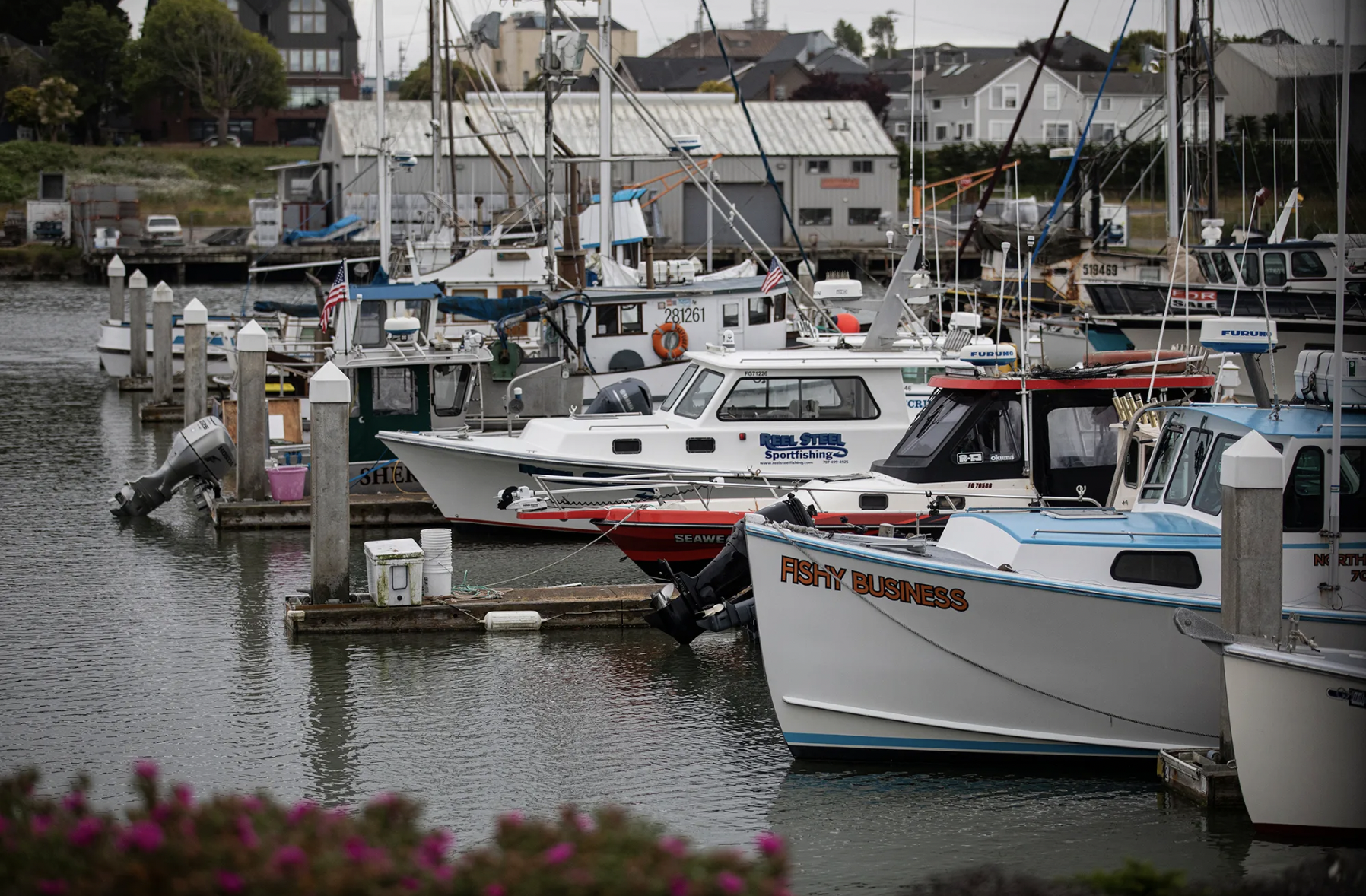
The closure means that California restaurants and consumers will have to look elsewhere for salmon, in a major blow to an industry estimated in previous years to be worth roughly half a billion dollars.
“It’s catastrophic,” said Tommy “TF” Graham, a commercial fisherman based in Bodega Bay who now drives a truck delivering frozen and farmed salmon and other fish. “It means another summer of being forced to do something you don’t want to do, instead of doing something you love.”
About 213,600 Sacramento River fall-run salmon — a mainstay of the fishery — are estimated to be swimming off the coast. Though that’s an improvement over last year, the forecast remains the second-lowest on record since the fishery was closed in 2008 and 2009, Yaremko told the Pacific fishery council.
The numbers this year, plus the fact that the forecasts for salmon returning to spawn are routinely overestimated, “add concern,” Yaremko said.
Many in the fishing industry say they support the closure, but urged state and federal officials to do more to improve conditions in the rivers salmon rely on. Fishing advocates and environmentalists have lambasted Gov. Gavin Newsom’s administration for failing to prioritize water quality and flows to protect salmon in the vital Bay-Delta watershed.
“Our fishing fleets and coastal communities can not be the only ones making sacrifices to save these fish,” said Sarah Bates, who owns a commercial fishing boat called the Bounty, berthed at Fisherman’s Wharf in San Francisco. “Water policy needs to take the health of our river ecosystems seriously.”
The closure comes as the fishing industry still awaits disaster aid promised from last year’s salmon fishery closures, which state officials estimated to have cost about $45 million. The fishing industry says that’s a vast underestimate.
“Some fishermen have already lost their businesses and many will in the coming months,” said RJ Waldron, who runs a charter fishing business out of the East Bay. Last year’s closure dried up his customers, and he put his sportfishing boat up for sale months ago.
“My dream of being a charter boat owner is very much a nightmare now.”
###
CalMatters.org is a nonprofit, nonpartisan media venture explaining California policies and politics.
Wes was born to George Wesley and Edna Mae (Bell) Ludwig on Dec. 21,
1929 in Grand Junction, Colorado. He moved to Redding with his family
while in high school.
He served in the US 5th
Army Armed Division Op Korean War in 1951 with honorable discharge
from the army reserves in 1953. Entered as private, exited as
Sergeant. He received the Combat Infantry Badge, Korean Service
Medal, 2 Battalion Service Stars, and United Nations Ribbon.
He married Nancy
Jane Hickok in July 1960 and divorced in November 1972. They had two
daughters, Valerie Lynn (Robert) Slaughter of
Lafayette, Oregon; Jenelle Sue (Benson) with her children Carly and
Matthew of Australia and Chris Bryan of Texas with three
great-grandchildren.
He married Nona Winkle Kitchen on
June 21, 1973 bringing stepchildren Nola (Dennis) Lionberger of
Grants Pass, Oregon; Jonnie (Rita) Reames of Panama, Oklahoma; Kathi
(Dennis) Hendricks and Jeffrey (Kay) Kitchen of Eureka. He also left
eight step-grandchildren.
He was predeceased by his wife Nona
Ludwig, stepson Larry Kitchen, by both parents George Wesley and Edna
Mae (Bell) Ludwig, and sisters Beryl Ludwig and Ramel Leach.
He spent most
of his career as an optical technician and dispenser. He was the
manager of Bay Optical Labs in Eureka, making glasses for most of the
local optometrists for many years. He retired from Bay Optical in
1990.
He was interested in wood working,
and remodeled his and Nona’s home after retiring. They shared a
love of cooking and walking. He said that he and Nona walked at least
50,000 miles in their retirement, before her death three years ago. In
the last few years he had started creating intarsia artwork from
wood. His last piece was entered into the Humboldt County Fair in
2023, and won 1st Place, Best of Show and 1st
Place in Category. His most consuming interest was in investment
strategies and he was quite successful in his own portfolio. He
wanted to educate all his children on the importance of investing
early to provide for retirement years.
He will be missed by his many
friends and neighbors in McKinleyville. They watched out for him in
his last years. He baked muffins and sourdough bread and shared his
goods with many. Even strangers walking the route that he walked
daily were treated to fresh baked goods.
Special thanks to his neighbors
Jennifer, Patrick, Mike and others for their support and friendship,
and to Dr. Tong at Mad River Hospital for the care he gave Wes in his
hospital stay.
###
The obituary above was submitted on behalf of Wes Ludwig’s loved ones. The Lost Coast Outpost runs obituaries of Humboldt County residents at no charge. See guidelines here.
Screenshot of Tuesday’s Humboldt County Board of Supervisors meeting. | Screenshot.
###
After nearly three hours of extensive deliberation, the Humboldt County Board of Supervisors on Tuesday voted to approve new rules for signs and billboards located in unincorporated areas of the county. The two ordinances – one for inland and one for coastal regions – were approved in a 3-2 vote, with Supervisors Rex Bohn and Michelle Bushnell dissenting.
The county’s existing sign regulations “are brief and not well-defined,” according to the staff report. The new rules set standards (size, height, design, location, etc.) for various types of on- and off-premise signs and billboards to “protect aesthetic values along scenic highways [and] coastal areas,” preserve environmentally sensitive habitat areas and ensure compatibility with the county’s General Plan and the Caltrans Outdoor Advertising Act.
Humboldt County Planner Jacob Dunn gave some examples of existing signs that would and would not be acceptable under the new rules. For example, the freestanding sign in front of the Eureka Stars Hamburgers on Harrison Avenue would pass muster, but the Murphy’s Market sign at the corner of Fern and Walnut Streets in Cutten would not. “That one would be too tall for the proposed regulations,” he said.
The Stars Hamburgers sign is OK under the new ordinance. The other two are too tall, according to staff. | Screenshot.
Dunn added that staff had added multiple sections to the ordinance “to create allowances for specified sign types that may not be as impactful.” The ordinance also “provides pathways for those seeking exceptions to the set performance standards with discretionary review,” he said.
The sign ordinance imposes new rules for off-premise billboards “to balance the direction of the General Plan, which intends to limit the duration of new and existing billboards while protecting sensitive environments,” the staff report states. The ordinance creates a permitting pathway for damaged billboards to be re-stabilized as long as they’re in locations where sensitive environments won’t be harmed.
During the public comment portion of the meeting, Eureka-based Allpoints Signs owner Geoff Wills claimed the proposed ordinance is “not consistent” with the county’s General Plan, adding that it infringes on the livelihood of business owners without just compensation.
“In 2017, I purchased Allpoints [Signs] for $1,650,000,” he said. “I made this investment knowing my business and private property would be protected via eminent domain law because that’s what the General Plan outlined it would do. If [this ordinance] is not amended, my company … will instantly be stripped of around $2 million in value … .”
Wills added that he is “one rainstorm away from being out of business,” implying that if one of his billboards were to blow over it could not be replaced and he would not be able to recoup the financial losses.
Local business owner Jeannie Fulton echoed some of Wills’ concerns, adding that small business owners are still struggling with the effects of the COVID-19 pandemic and the downturn in the economy. Having to retrofit and resize signage would be yet another “big expense,” she said. “I’m really hopeful that this ordinance will not pass.”
Following public comment, Bohn asked if the county would have to deploy “sign policeman” to enforce the new rules or if it would be a complaint-driven process.
“State law requires that we do one of two things,” Planning and Building Director John Ford explained. “We either … [take] an inventory of all signs and identity whether or not they’re legal or illegal and then those signs can have an enforcement process. Or you can find that all signs are legal non-conforming and basically at that point, all signs that exist, exist. That is what we’ve written into the resolution.”
Ford emphasized that on-premise signs that are already permitted can remain standing, and signs classified as “legal non-conforming” can be repaired or even replaced if damaged.
“That’s for all the other signs, other than billboards,” Ford continued. “We’re not in any way requiring existing signage to be redone or taking away entitlements from people who have existing signs. We want to be really clear on that.”
Bushnell asked what would happen if an un-permitted sign were to fall over during a storm. “They would, of course, need to come in and get their permit, but then would it be allowed to be reconstructed [as] the original [sign]?”
“That is what we are proposing, yes,” Ford said.
At one point in the discussion, Bohn said he was “probably going to vote against this whole thing” due to the potential impacts to local business owners. “I think in this day and age, everybody is just hanging on for business,” he said. “I know people hate billboards … but I haven’t had any[one from] the business community come out and tell me they hate [billboards].”
Wilson. | Screenshot.
The board embarked on a long discussion, initiated by Supervisor Mike Wilson, about some of the rules surrounding illuminated and digital signs in unincorporated areas and whether there should be additional constraints on the brightness of certain signs.
Under the proposed ordinance, illuminated signs located in residential areas must be externally illuminated and located at least 50 feet away from any residence. Illuminated signs in non-residential areas can be internally or externally illuminated, though all signs “must be steady, stationary and static in color” to avoid safety hazards for motorists and pedestrians.
Digital and animated signs that “appear to rotate, flash, blink, move, change color, emit sound, or change intensity” are prohibited under the proposed rules, excluding “approved fuel price signs, standard barber poles, time and temperature signs that are located in commercial and industrial zones.” Electronic message boards and “large television or projector screens” are also prohibited, “except when placed on such property by the public agency having jurisdiction or expressly authorized by such public agency.”
Supervisor Natalie Arroyo talked a bit about her experience working on the City of Eureka’s sign ordinance during her time on the city council, saying it was “emerging as an issue and the community was clamoring for us to do something about it.” She noted that Eureka’s ordinance isn’t necessarily “a representation of what an ideal lighting situation would look like according to DarkSky standards.”
Supervisor Steve Madrone, who was silent for much of the discussion, generally spoke in favor of fewer billboards and illuminated signs across the county. “I can remember a time in the ‘70s and ‘80s, maybe even into the ‘90s when there were another 20 or more billboards along Humboldt Bay … and I have to say I really like where we’re at now compared to then,” he said. “It’s a major improvement.”
After about two and a half hours of discussion, Wilson made a motion to approve the ordinance with a few small modifications, including the following:
Between sunset and sunrise, luminance is limited to 100 candelas per square meter. Each sign must either be designed to achieve this standard or have a light-sensing device that will automatically adjust the brightness of the display as the natural ambient light conditions change.
Exposed bulbs are only allowed under a Creative Sign Permit.
Signs must be maintained using the materials and dimensions found on the existing sign.
The stated objective of the ordinance is to implement General Plan provisions to regulate billboards in accordance with the Outdoor Advertising Act.
After a bit of additional discussion, the motion was approved in a 3-2 vote, with Bohn and Bushnell dissenting. The ordinance can be viewed at this link.
###
Sheriff William Honsal and Undersheriff Justin Braud. | Screenshot.
License Plate Reader Technology for Law Enforcement
The board also received a report on the county’s new Automated License Plate Reader (ALPR) program from Undersheriff Justin Braud and Sheriff William Honsal.
The ALPR system, which is still being implemented, consists of cameras mounted to street poles or other fixed positions along a roadway that automatically take pictures of vehicle license plates, which are then translated into letters and numbers. The technology, provided by Flock Safety, can be used to find stolen vehicles and/or vehicles associated with missing individuals. ALPR does not use facial recognition technology and the data is deleted after 30 days.
“I believe that this technology is the industry standard – I believe this is the future,” Braud said. “It’s a force multiplier in a time of budgets that are [being] restrained and constrained, and this type of technology is going to do nothing but improve our ability to serve the constituents of this county and also do it in a way that respects their privacy and their rights.”
Sheriff Honsal noted that the system will become more effective if and when other municipalities sign up. Fortuna Police Chief Casey Day spoke in favor of the program, noting that it will improve law enforcement’s ability to “solve crime” and “serve the residents and the businesses within our region.”
The Board of Supervisors asked for a few particulars about the program but largely spoke in favor of its implementation. The board didn’t take any action on the item but agreed to accept the report.
The sheriff’s office policy can be read in full here.
###
Other notable bits from Tuesday’s meeting:
The board invited representatives of Pacific Gas & Electric Co. and the Redwood Coast Energy Authority to talk about some of the rate-payer assistance programs available to local residents. Many income-eligible customers can receive financial assistance through PG&E through its California Alternate Rates for Energy (CARE) program, which provides a monthly discount of 20 percent or more on gas and electricity. A list of PG&E’s financial aid programs can be found here. A list of RCEA’s services can be found here.
The board also declared April Child Abuse Prevention Month and received an annual report from the Child Abuse Prevention Coordinating Council.
Children on the playground at Winzler Children’s Center in Eureka. | Screenshot from a Eureka City Schools video.
###
Elizabeth Rice. | ECS.
Elizabeth Rice, the director of Winzler Children’s Center in Eureka, has been placed on administrative leave pending the effective date of her resignation, which she submitted two weeks after an incident in which an employee was arrested for allegedly slamming a child into a wall at the preschool.
According to an investigation report from the Community Care Licensing Division of the California Department of Social Services, Rice failed to immediately report the incident to the state, to law enforcement and to the child’s parents, and she also allowed the employee to return to work the day after the alleged abuse took place.
On Monday, during an unannounced inspection of the preschool, state investigators obtained a copy of the police report for the incident and interviewed a facility representative.
Here’s what happened, according to the investigation report and law enforcement records.
Alice Hellen Abler. | Booking photo.
On the morning of Thursday, Feb. 29, a former Winzler aide named Alice Hellen Abler was arrested on school grounds on charges of child endangerment and corporal injury on a child for allegedly slamming a preschooler into a wall.
[UPDATE: According to two parents, who spoke to the Outpost on condition of anonymity, the violent incident had occurred the day before, on Feb. 28.]
Abler was booked into the Humboldt County Correctional Facility later that morning. She is no longer employed by Eureka City Schools.
After Monday’s inspection of the facility, the state’s Community Care Licensing Division issued a pair of citations against Winzler Children’s Center: First, it found that the preschool failed to ensure that each child is free from “corporal or unusual punishment, infliction of pain, humiliation, intimidation, ridicule, coercion, threat, mental abuse or other actions of a punitive nature.”
And second, the agency found that Rice engaged in conduct that was harmful to the health, morals, welfare or safety of a child in her care.
Reached via email, Eureka City Schools Director of Student Services Lisa Claussen said this incident “has shaken our Center to the core.”
“Student safety is our main priority here at Eureka City Schools, especially with our youngest learners,” wrote Claussen, who is acting as the facility’s representative. “We are fully cooperating with all investigative agencies and are following all necessary plans of correction.”
The state required Claussen to provide all parents or guardians of currently enrolled kids with a copy of the licensing report documenting the citations.
One such parent, who asked to remain anonymous, told the Outpost that he received a copy of the report when dropping off his kid this morning. He doesn’t think children at the facility are at risk going forward (he called the teachers there “professional” and “well-rounded”) but said he did have concerns about Abler and complained about her to administrators earlier this year.
“After I complained about her being a dick, I never saw her again,” the parent said. He added that many kids at Winzler are autistic and can be challenging to manage, which makes it all the more important for aides to have sufficient training and background knowledge.
Claussen told the Outpost that the Eureka City Schools Board of Directors did not re-elect Rice as director during its March meeting. Rice submitted her resignation on March 15, though it won’t take effect until June 30. In the meantime, she remains on administrative leave.
“She will not be returning to an ECS campus,” Claussen said via email.
The state’s plan of correction requires Winzler staff to take a series of care and supervision trainings, including mandated reporter training, and submit proof of completion to the agency.
CLARIFICATION: The headline of this post has been changed to attribute the allegation to a state investigation.