On April 9, 2024, at approximately 9:05 pm., Eureka Police Department (EPD) officers
responded to the 3200 block of Glen Street on a report of a dog bite. The victim of the dog
bite, who was also the dog’s owner, stated they were injured and also requested medical
assistance.
Upon officer arrival, they were able to communicate through the window with the victim, who
was afraid to try and navigate out of the residence in fear of the dog attacking them again. The
victim gave permission for the officers to use Pepper Spray to disperse the dogs from their
location. An officer deployed his Pepper Spray and it was effective in coaxing the dogs into leaving the area in which the victim was located and allowed them time to exit the residence.
A juvenile who was on scene was located safe in their bedroom and officers were able to
remove them from the residence through the bedroom window.
The victim explained that they own all three dogs that were in the residence. One female dog
is currently in heat and when the victim tried to stop one of the male dogs from mating with
the female dog it attacked the victim, causing their injuries. The dog that attacked the victim
was described as a gray pit bull. The victim stated the other two dogs, while barking
aggressively, had not actually attacked her.
The victim was transported to a local medical facility for their injuries which were described as
severe and serious in nature. Due to the aggressive nature of the two male dogs in the
residence, the officers secured the residence and left to continue their investigation, as there
was no danger to the public with the dogs inside the residence.
Officers were able to contact another family member who was familiar with the dogs and
returned to the residence a little after midnight. Officers, with the assistance of the family
member, were able to secure the dog that attacked the victim. The dog was later transported
to the Humboldt County Animal Shelter.
EPD’s Animal Control Officer has taken over this investigation which is ongoing.
Press release from the Humboldt County Sheriff’s Office:
On 4/8/2024 at about 9:00 a.m., Humboldt County Sheriff’s deputies were dispatched to Clam Beach Road in McKinleyville for a report of a domestic violence incident.
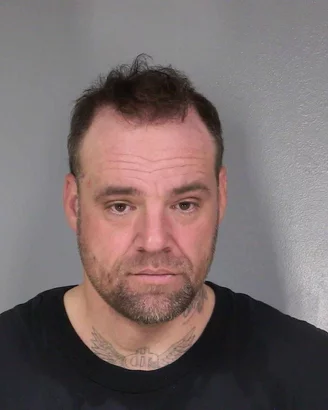
Deputies contacted the female victim, whom had visible injuries to her face. The victim told deputies she was in a dating relationship with suspect Bobby Lee Ganfield. She explained that the assault took place at a residence in the 1100 block of Driver Road in Westhaven. After the assault, the female victim fled the residence and drove to Clam Beach Road, where she met with deputies. One deputy stayed with the victim and waited for medical personnel to arrive to treat the victim for her visible injuries.
Sheriff’s deputies responded to the 1100 block of Driver Road to search for the suspect. While searching the perimeter of a residence, Ganfield emerged from the rear of the residence and ran into the wooded area. Deputies pursued and located Ganfield hiding off of a neighboring street. Ganfield was subsequently arrested without further incident.
Bobby Lee Ganfield was booked into the Humboldt County Correctional Facility on charges of 273.5(a) P.C.; Inflict Corporal Injury on Spouse, 245(a)(4) P.C.; Assault with a Deadly Weapon, 422(a) P.C.; Threaten Crime with intent to Terrorize, 417(a)(1) P.C. Exhibit Deadly Weapon other than Firearm, 148(a)(1) P.C.; Obstruct/Resist/etc. Public/Peace Officer/Emergency Personnel, and 978.5 P.C. Bench Warrant/Failure to Appear on Felony Charges.
Anyone with information about this case or related criminal activity is encouraged to call the Humboldt County Sheriff’s Office at (707) 445-7251 or the Sheriff’s Office Crime Tip Line at (707) 268-2539.
The 11th Annual Cal Poly Humboldt Hip Hop Conference: Power to the People will feature a keynote address from Chuck D, and three days of presentations, performances, food, and celebrations of hip-hop culture from April 23-25.
“To talk about hip hop is to talk about lived experiences of African Americans in particular and other oppressed people,” says Dr. Ramona Bell, chair of the Department of Critical Race, Gender & Sexuality Studies.
Dr. Bell started the Hip Hop Conference in 2013, one year after teaching a course called “Hip Hop and the Black Experience.” CRGS is an interdisciplinary field, Dr. Bell says, which brings together ethnic studies, history, sociology, psychology, life and social sciences, literature, and other fields of study. She adds that, “A hip hop course is a great opportunity for interdisciplinary study and hands-on learning.”
“Students get excited when they realize they can study hip hop culture and rap music in a university classroom,” Bell says. “People who love the music and the culture want to talk about it.”
This year’s Hip Hop Conference features a keynote address from Chuck D, leader and co-founder of legendary group Public Enemy and part of the supergroup Prophets of Rage, social activist, author, film producer, and digital music pioneer, on Tuesday, April 23, from 5-7 p.m in the Van Duzer Theatre.
“Public Enemy and Chuck D have been and are one of my favorite groups,” says Jeff Crane, Dean of the College of Arts, Humanities & Social Sciences. “It was from their lyrics that I developed an interest in and began learning more about critical issues in American history related to the Black experience and began studying people like W.E.B. Dubois, Marcus Garvey, and the Black Panthers.”
Community members, faculty, staff, and students are also encouraged to submit presentation proposals. On April 24, students in the Hip Hop and the Black Experience class will present scholarly research on hip hop culture. On April 25, regional musical artists will perform followed by a consciousness hip hop concert. The last day will feature elements of hip hop culture: DJ Chuck Angeles, Emcee NacOne, and b-boy/b-girl dance. All events are free.
CRGS also offers a one-unit Hip Hop Organizing course and Hip Hop Conference Attendance courses, which give students the opportunity to help plan and develop the conference. Students organize the events, create publicity, promote the event, and carry out the days’ activities.
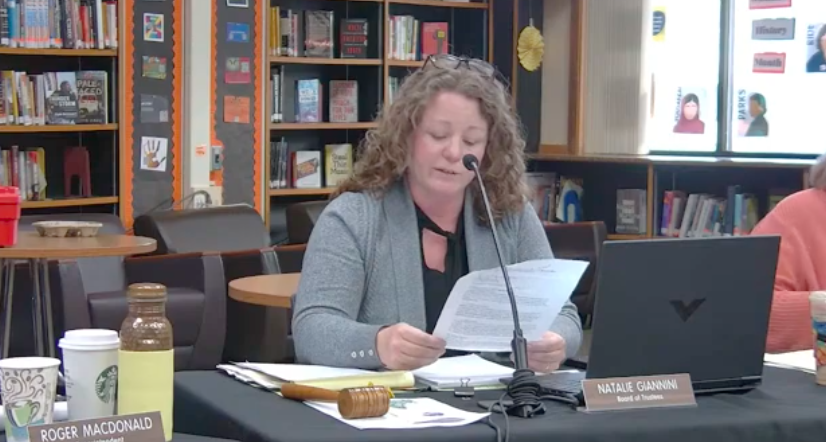
Natalie Giannini, board president, reads from a prepared statement about Perry’s reassignment | Images screenshot from Norhtern Humboldt UHSD meeting video
It’s been nearly a month since the Northern Humboldt Union School District Board voted (4-0) to remove Ron Perry from his position as Arcata High School Principal and reassign him to a teaching role in the district, a decision that shocked and angered many Arcata High staff, teachers and parents.
During last night’s meeting the board finally decided to issue a statement about the decision, which (not too surprisingly) contained essentially no new information, and even the board admitted that the statement was ‘deeply unsatisfying’ for those concerned about Perry’s reassignment.
“So the board has received concerns from the community and staff members regarding the decision made at our Tuesday, March 12th board meeting to reassign Arcata High School principal Ron Perry to a teaching position next year,” Natalie Giannini, board president, read from a prepared statement during the meeting.
“The board and the district have been questioned as to why we have not released any details about the reasoning behind this decision … ,” she continued. “We are legally prohibited from discussing the details of any and all personnel matters. The fact that we may not discuss or provide details regarding a personnel matter should not be interpreted as the board not caring – we do. This should also not be interpreted as the board not doing our due diligence.”
Giannini went on to say that personnel matters are confidential and that the board cannot share information on decisions concerning employees.
“While we understand that this answer is deeply unsatisfying, we’re nonetheless legally required to maintain employee confidentiality,” Giannini continued. “Please consider that if the district or board were to share confidential personnel information, we could open ourselves up to expensive lawsuits and we would deter prospective employees who want to work for an organization that values employee privacy.”
The audience was completely packed during the meeting, and because of the large turnout, Giannini said the board would go over the usual 20 minute allotment for public comment, providing 20 minutes for staff to comment and then opening it up to the rest of the public.
Dozens of district staff members, teachers and community members took turns at the lectern, voicing their support for Perry and their ire at the board’s decision.
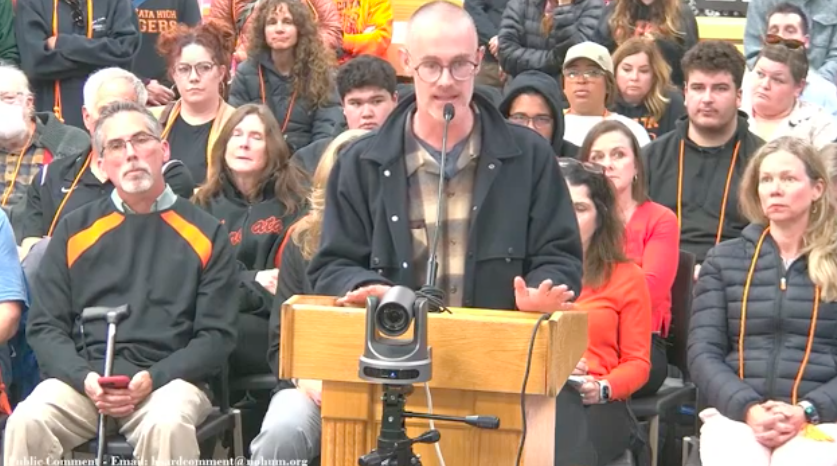
“I’ve been working here for almost 15 years and Ron Perry is one of the most caring, dedicated, engaged, present people I have ever seen in this position,” Alexander Kantner, an English teacher at Arcata High, said during public comment. “It has been deeply and profoundly disillusioning to feel that our elected representatives are unable to communicate and have the kind of transparency that I assume we all value as citizens of this society.”
AHS English teacher Alexander Kantner addresses the board
Many Arcata High students also came to support their principal and express their concerns about the board’s decision to reassign him.
“As elected officials on the school board, ‘for the people, by the people’ should be something that should be vehemently prioritized,” Melanie Luh, associate student body president at Arcata High said to the board. “Instead, the voices of teachers who haven’t had a consistent bell schedule since COVID, and students who haven’t had a consistent principle since the pandemic, have had no say or influence in this matter.”
Luh was referring to the fact that Arcata High School has already been through three principals in the past six years. Perry has served as principal for about two years and will be finishing off this semester in the position before being reassigned to a teaching position at the start of the 2024-25 school year.
The board ended public comment after roughly 30 minutes, cutting off one final commenter, Pam Cavanagh, who attempted to address the board.
“Actually, the public comment is over,” Giannini said. “We have no more time for public speakers. I’m sorry. We gave 20 minutes and we just went overtime.”
This was met with some uproar from the crowd, who encouraged Cavanagh to speak anyway. As she began, the board announced that it would be adjourning to a 10-minute break and the commenter was cut off.
It remains unclear as to why the board decided to remove Perry as Arcata High principal and it appears that it will likely stay that way.
You can view the full meeting video here. The discussions related to Perry take place between roughly 17 and 55 minutes in.
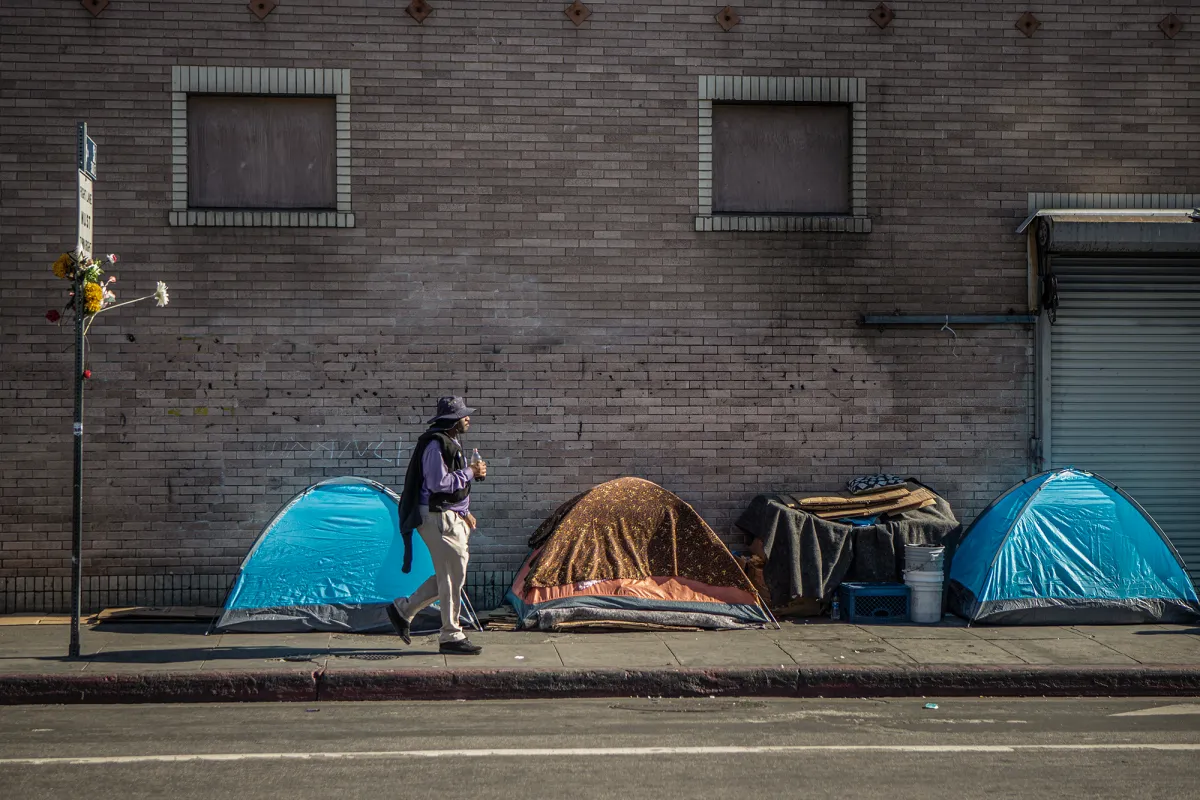
A person walks by a homeless encampment in downtown Los Angeles on Nov. 18, 2022. Photo by Larry Valenzuela for CalMatters/CatchLight Local
Exactly how much is California spending to combat homelessness — and is it working?
It turns out, no one knows. That’s the result of a much-anticipated statewide audit released Tuesday, which calls into question the state’s ability to track and analyze its spending on homelessness services.
The state doesn’t have current information on the ongoing costs and results of its homelessness programs because the agency tasked with gathering that data — the California Interagency Council on Homelessness — has analyzed no spending past 2021, according to the report by State Auditor Grant Parks. Three of the five state programs the audit analyzed — including the state’s main homelessness funding source — didn’t even produce enough data for Parks to determine whether they were effective or not.
The audit also analyzed homelessness services in San Jose and San Diego, finding both cities failed to thoroughly account for their spending or measure the success of many of their programs.
“The lack of transparency in our current approach to homelessness is pretty frightening,” said Assemblymember Josh Hoover, a Republican from Folsom who co-authored the request for the audit.
That means state policymakers have little data to go on when they make funding decisions related to what has become one of California’s most dire challenges.
“The State Auditor’s findings highlight the significant progress made in recent years to address homelessness at the state level, including the completion of a statewide assessment of homelessness programs,” the Interagency Council on Homelessness wrote in an emailed statement. “But it also underscores a need to continue to hold local governments accountable, who are primarily responsible for implementing these programs and collecting data on outcomes that the state can use to evaluate program effectiveness.”
Tens of billions of dollars, nine agencies and more than 30 programs
As the homelessness crisis has intensified, California under Gov. Gavin Newsom’s leadership allocated an unprecedented $24 billion to address homelessness and housing during the last five fiscal years, according to the Legislative Analyst’s Office.
Nine state agencies administered more than 30 programs aimed at preventing or reducing homelessness. Some of those programs did such a poor job tracking their outcomes that it’s impossible to tell if they’ve been successful, according to the audit, which marks the first such large-scale accounting of the state’s homelessness spending.
The report evaluated five state homelessness programs and found two “likely” are cost-effective. Newsom’s signature Homekey program helps cities and counties turn hotels and other buildings into homeless housing at an average cost of $144,000 per unit (in the program’s first round), compared to the $380,000-$570,000 it would cost for new construction. The CalWORKS Housing Support Program, which gives financial help to families who are homeless or at risk of becoming homeless, also saves the state money because it’s much cheaper to help someone stay housed than it is to help them find housing once they become homeless.
The auditor found the CalWORKS program spent an average of $12,000-$22,000 per household, while a single chronically homeless person can cost taxpayers as much as $50,000 per year.
But for three other programs, the state hasn’t collected enough data for the auditor to make an assessment: the State Rental Assistance Program (which helped people pay rent and other expenses during the COVID-19 pandemic), the Encampment Resolution Fund (a program Newsom launched to help cities clean up specific encampments) and the Homeless Housing, Assistance and Prevention program (the state’s main source of general homeless funding, also known as HHAP).
“Fundamentally, the audit depicts a bit of a data desert,” Sen. Dave Cortese, a Democrat from Santa Clara County who joined Hoover in asking for the audit, said during a media call.
For example, nearly one-third of people who left placements funded by the Homeless Housing, Assistance and Prevention program left for “unknown” destinations, according to the auditor’s analysis of round-one funding in Los Angeles, San Diego, Santa Clara and San Francisco counties. That ambiguous data makes it impossible to tell if the program has been successful, the auditor wrote. Even so, the state authorized billions of dollars for four additional rounds of funding.
“The lack of transparency in our current approach to homelessness is pretty frightening.” — Assemblymember Josh Hoover, Republican, Folsom
The auditor laid some of the blame on the Interagency Council on Homelessness. Legislators instructed the council in 2021 to collect funding data on all state homelessness programs. The council did so once, reviewing data from 2018 through 2021, but has taken no action since, according to the report.
In a written response to the audit, the council said it doesn’t have the funds to continue collecting that data.
There also were a number of errors in the statewide system that collects data on homeless individuals and shelter capacity in each county. More than 100 records had clients with names such as Mickey Mouse, Super Woman or even Test Participant. One shelter reported nearly 1,100 people enrolled in a facility with fewer than 300 beds.
Should California pause its spending on homelessness?
Hoover hopes he and his colleagues in the Legislature will draft several bills this year aimed at improving transparency in state homelessness spending.
“We should freeze any new investments and additional investments until we can figure that out,” he said.
Cortese disagrees.
“I don’t think it’s a time to stop,” he said during the media briefing. “I would be disappointed personally, professionally as a state senator, if the governor or Legislature negotiated away this year’s investment in homelessness.”
In the midst of a major deficit, Newsom’s proposed budget for the upcoming fiscal year didn’t cut funding already allocated to the homelessness crisis, but it didn’t propose any new funds, either. For three years in a row, Newsom had granted $1 billion for local homelessness programs — but now the future of that funding remains up in the air. A group of supporters gathered at the state capitol earlier this month to urge the governor and legislators to authorize ongoing funding. Activists have been pushing for years for a permanent source of funding to fight homelessness, but so far Newsom’s administration has resisted, instead parceling out one-time grants each year.
The estimated number of unhoused Californians has increased from about 151,000 in 2019 to more than 181,000 last year. More than two-thirds of those people are living on the street or in places unfit for human habitation — not in shelters.
Cortese began pushing for the audit after visiting a massive homeless encampment on vacant land near San Jose’s airport, where hundreds of people lived among rodents, massive piles of trash and broken-down cars and RVs. When he started asking whether state funding was going to that encampment, he couldn’t get a clear answer.
And despite the Newsom administration pouring billions into the homelessness crisis and launching several new programs aimed at moving people indoors, encampments still are rampant up and down California. The perceived lack of progress led lawmakers to ask: Where is all that money going?
San Jose and San Diego fail to track homelessness spending
San Jose and San Diego each have spent hundreds of millions of dollars on homelessness in recent years. But neither could provide an exact accounting of how much was spent and where it went, according to the audit.
And both cities failed to consistently evaluate whether the homeless services nonprofits they contract with are effectively spending city funds. In San Diego, for example, a $1.6 million shelter contract didn’t specify how many people should be served, making it impossible to tell if that program has been successful. Even when the cities required performance metrics from their contractors, they sometimes failed to collect them.
Other times, the cities failed to act upon the data collected. A shelter provider San Diego contracted with had a goal of getting 26% of the people who left the shelter into permanent housing. Instead, about 6% went into permanent housing. Even though the provider fell far short of its goal, the auditor found no evidence the city took steps to analyze the contract’s effectiveness.
“Fundamentally, the audit depicts a bit of a data desert.” — State Sen. Dave Cortese, Democrat, Santa Clara
In San Jose, the city extended an $8 million homelessness prevention contract based on vastly inflated performance data, according to the audit.
“I completely agree with the notion in the audit that we need to set goals, measure performance and improve transparency and accountability,” San Jose Mayor Matt Mahan said in an interview. He recently helped launch a public dashboard that tracks his city’s homelessness spending and outcomes.
But the state needs to help, he said. The city gets funding from several different state programs, and it’s often not clear across each program what types of performance metrics they should be using, Mahan said.
San Jose and San Diego have similar estimated homeless populations — 6,340 and 6,500 respectively. But San Diego has 4,000 emergency shelter and temporary housing beds, while San Jose has just 2,500, according to the report.
And both cities lack enough permanent housing for their homeless residents — as well as any comprehensive plan to fund and build the housing they need. San Jose hasn’t even calculated how many new homes it needs, according to the audit.
In San Jose and San Diego, more than 85% of the placements made for homeless residents are into temporary — not permanent — housing. As a result, around 40% of the people who leave those placements return to the street.
Both cities are taking steps to reduce the health and safety risks associated with homeless encampments by providing trash pickup, toilets, showers, medicine and other services. In San Jose, the budget for those services increased from $12.7 million in the 2020-21 fiscal year to $19 million last year. In San Diego, it grew from $32 million to $43 million. But neither city is doing a good job of evaluating the outcomes of those efforts, according to the audit.
San Diego Mayor Todd Gloria defended his city’s approach to homelessness in an emailed statement. The city served more than 11,400 people last year, he said.
“All of us can use this audit as a tool to understand how much more needs to be done in order to continue meaningfully addressing homelessness,” he said, “and we hope to impress on state leaders the need for adequate and ongoing funding for California’s biggest crisis.”
The auditor recommended San Jose and San Diego should, by September, report all of their homelessness-related spending in one central location and improve the way they evaluate the effectiveness of their homelessness programs.
In a written response to the audit, San Jose said it already is taking steps to better document its homeless services budget and more thoroughly assess the effectiveness of its programs. San Diego said it recently hired new staff dedicated to performance monitoring.
Todd Langton does outreach in homeless encampments throughout Silicon Valley in his role as founder of the Coalition for the Unhoused of Silicon Valley and executive director of homeless services nonprofit Agape Silicon Valley. Based on what he’s seen on the ground, he’s “not surprised at all” by the results of the audit.
Langton said he often finds small nonprofits, such as his own, are more successful at getting people housed than the larger nonprofits that eat up state and city funding.
“As advocates,” he said, “we just shake our heads and say, ‘They’re spending so much money on this. What’s going on?’”
###
CalMatters.org is a nonprofit, nonpartisan media venture explaining California policies and politics.
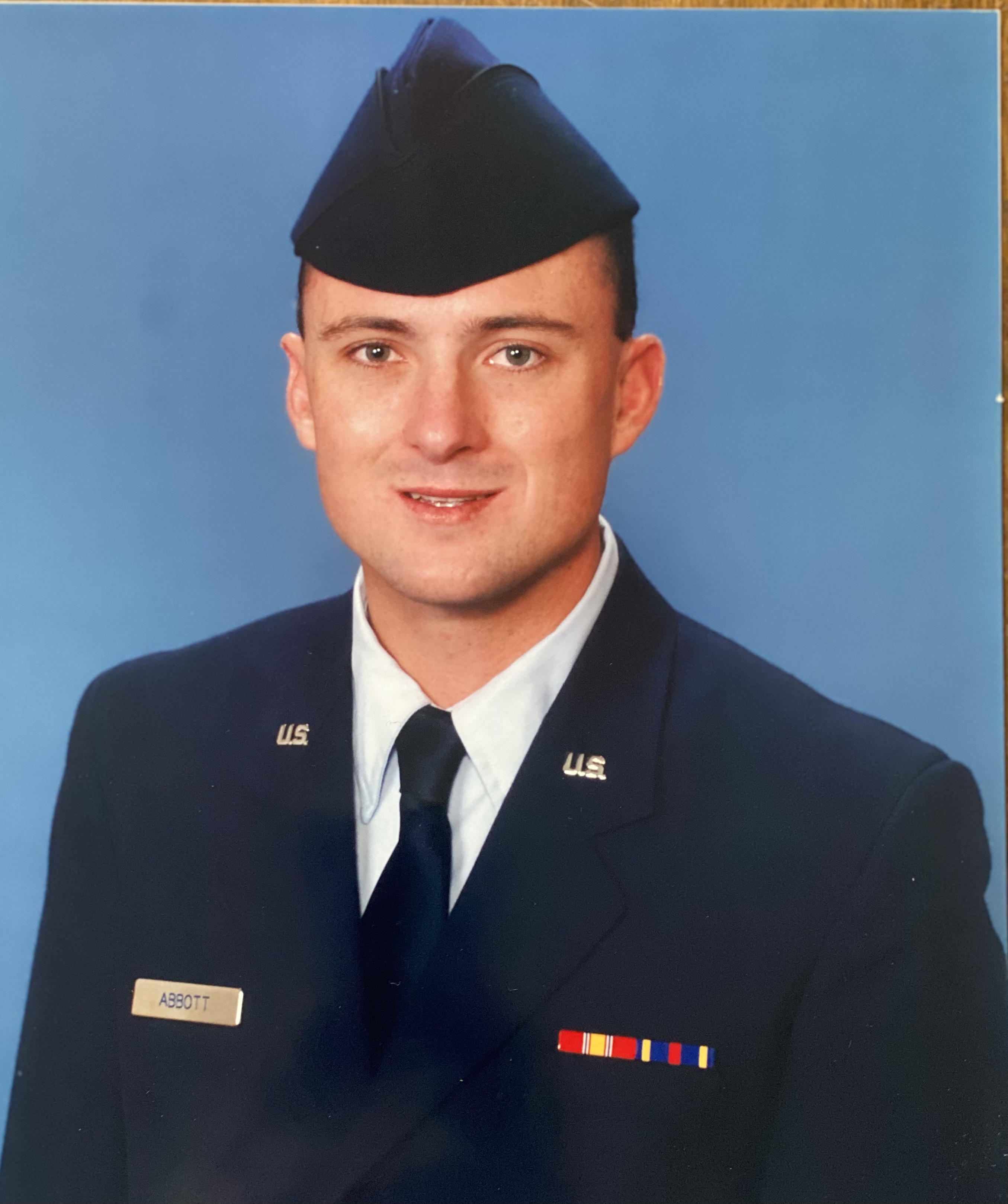
Ryan Phillip Abbot October
21, 1982 - February 28, 2024
Ryan
Phillip Abbott was born in San Diego. He enjoyed a happy
and active Southern California childhood, bodyboarding in the Ocean
Beach surf with his brother, and playing baseball and soccer. He
graduated from Point Loma High School.
He
relocated to Northern California, living and working in Eureka until
he joined the United States Air Force in 2006 and trained as a Civil
Engineer.
Ryan’s
first station was Malstrom Air Force Base in Montana. He was later
deployed to both Iraq and Afghanistan. His last base was Ramstein Air
Force Base in Germany, from where his team was also assigned duty at
Aviano Air Force Base in Italy.
His
military honors include, among several others, the Air Force
Achievement Medal, medals with stars for both the Iraq and
Afghanistan Campaigns, medals for National Defense Service, Global
War on Terrorism Service, and a NATO medal. Among his awards are also
ribbons for Air Force Longevity Service, Air Force Expeditionary
Service, and Overseas Service. Ryan was honorably discharged as a
Senior Airman after serving seven years.
Ryan
continued his education while working first in San Diego and later in
Eureka before making Elko, Nevada his home for several years. He
returned to Eureka in 2023.
After
months of failing health, Ryan passed away at home in Eureka, in his
mother’s loving care.
He
is survived by his mother Pamela Longacre, his father Jeffrey Abbott
(Heidi), brothers Clark (Amanda), and Kent. He was predeceased by his
stepfather, Donald Longacre.
Ryan’s
ashes will be interred at Miramar National Cemetery in San Diego on
April 16, 2024 at 12:30 p.m.
The obituary above was submitted on behalf of Ryan Abbott’s loved ones. The Lost Coast Outpost runs obituaries of Humboldt County residents at no charge. See guidelines here.
James
Darrell Bilderback passed peacefully from this world the afternoon of
March 20, 2024. He was born in Eureka, the son of Dora Mozettti
Bilderback and William James Bilderback. He lived 93 (almost 94)
years filled with love, purpose, travel, and service to his community
as a teacher.
He
was known as Jim, Dad, Grandpa, Uncle Sam, Uncle Donny and Mr.
Bilderback. He was a favorite uncle who, in his younger years, took
his nephews on trips to discover different places throughout the
country. He loved to travel internationally. He met his wife Marilyn
when a local couple invited them both to view travel slides, hoping
they would hit it off. Apparently he squirted her in the face with
whipped cream while serving her dessert that evening, a memory which
was often repeated. They were married in 1968, and rumor has it they
traveled to over 100 countries (on every continent.) His favorite was
Bhutan, whose people he described as incredibly peaceful and content,
but he had good things to say about each place and people everywhere,
including Kenya, where he met a hippopotamus face to face.
He
spent most of his life in Eureka, with the exception of a year in San
Francisco working in a Christian book store and his time in the air
force. He was stationed at Travis Air Force Base in California, and
then in Okinawa during the Korean War. He was impressed by the
resourcefulness of people he met there, and he always maintained a
perspective of gratitude for his blessings. He served the end of his
enlistment at the Pentagon, and was grateful for the educational and
home ownership benefits provided by his country in exchange for his
service.
An
alumnus of Humboldt State University, he was a true bibliophile with
a library of books on world cultures, natural wonders and the
pursuit of truth. He genuinely loved talking about the weather and
held a soft spot in his heart for all creatures great and small,
especially dogs. He would get seemingly perturbed at the family dog
for messing up the house and garden, but end up spoiling him with a
towel on the couch and football throws. He got a tremendous kick out
of training him to sit for his dinner and treats, and always made
sure that the home was well stocked for his visits. He took pride and
joy in making sure that everyone and everything was attended to.
He
taught social studies at three junior high schools in Eureka: Jacobs,
Zane and Winship. He was known for sharing his travel slides with his
students, and being a strict but good teacher that really wanted his
students to learn and become caring and engaged citizens of the
world. He was a devoted husband to the love of his life, and a loving
father and grandfather, celebrated for his pillow fighting and waffle
making skills. He kept his yard looking spectacular and was dedicated
to using gardening methods that caused minimal harm to all its
inhabitants. He maintained beautiful rose bushes and a wide variety
of ornamentals,
working outdoors regularly until a year before his passing.
He
was preceded in death by his mother and father, his sister Helen
Lampella, and brothers Vernon and Eugene (Mick) Bilderback. He is
survived by his wife Marilyn, daughter Marcia, grandson Kaiteo, niece
Jo, nephews Jim, Gene, David, Michael, Rick, and Gary, as well as
many of their children and grandchildren. He will be deeply missed,
but will live on in the lives of those he touched and in the wonders
of the world which he held in such reverence.
An
intimate celebration of his life was held with family following his
passing. Donations are welcome and can be made in his name to the
Humboldt Library Foundation or the American Cancer Society.
###
The obituary above was submitted on behalf of James Bilderback’s loved ones. The Lost Coast Outpost runs obituaries of Humboldt County residents at no charge. See guidelines here.