Caroline Griffith of the Northcoast Environmental Center and Colin
Fiske of the Coalition for Responsible Transportation Priorities join
host Tom Wheeler of EPIC to discuss what modifications and delay mean
for meaningful efforts to address the climate crisis.
Logging scenes like this throughout the redwood area became a familiar scene as more Dolbeer engines were put to work. More men made up the crews and oxen became a thing of the past. This view is from the southern part of Humboldt County. Photos via The Humboldt Historian.
The donkey that finally ousted oxen
from the skidroads of the West was not a
beast but a small steam engine. It was
called a “donkey,” after a ship’s auxiliary engine, because the man who
invented it in 1881, a mechanical genius
named John Dolbeer, had been a naval
engineer before turning to logging. The
loggers agreed with the name “donkey engine” because early models, though
mighty, looked too puny to the loggers
to be dignified with a rating in horsepower.
John Dolbeer, inventor of the donkey engine which revolutionized logging.
One day in August 1881, a mechanical
monster smaller than any locomotive
but bulkier than a yoke of oxen
appeared in the redwoods near Eureka.
It sat on heavy wooden skids and consisted of an upright wood-burning
boiler with a stovepipe on top, and a
one-cylinder engine that drove a revolving horizontal drive-shaft with a
capstan-like spool at each end for winding rope. The power of this first steam
donkey was small, so several blocks had
to be employed to increase the pull;
moreover, the hemp rope used was not
overly strong and tended to stretch,
especially when wet. These factors kept
down the distances logs could be pulled.
In addition, the design of this first model
was such that the directions from which
logs could be pulled were limited.
Nevertheless, Dolbeer considered the
tests a success and patented his invention soon after.
On Dolbeer’s maiden model, patented
in April 1882, a manila rope 150 feet
long and four-and-a-half inches in
diameter was wrapped several times
around a gypsy head: a revolving metal
spool mounted on a horizontal shaft. The
loose end was carried out to a log and
attached to it. Then, with a head of
steam built up in the high-pressure
boiler, the spool revolved and the incoming rope hauled the log toward the
donkey.
The Dolbeer Steam Logging Machine
would be recorded as the greatest labor
saver in the industry’s history and
changed logging for all time. In a high
lead setup with its steel cable running
through a pulley near the top of a towering spar tree a huffing donkey could
yank the mightiest log out of the woods
in minutes, and a sharp crew could
handle 5,000 tons of logs in eight hours.
ThÍs is the patent drawing for Dolbeer’s steam-powered engine.
Operating an early Dolbeer donkey
required the services of three men, a boy
and a horse. The “choke setter” attached
the line to a log; an engineer or “donkey
puncher”, tended the steam engine; and
a “spool tender” guided the whirring
line over the spool with a short stick. The
boy, called a “whistle punk”, manned a
communicating wire running from the
choker setter’s position out among the
logs to a steam whistle on the donkey
engine. When the choker setter had
secured the log to the line running from
the spool, the whistle punk tugged his
whistle wire as a signal to the engineer
that the log was ready to be hauled in. As
soon as one log was in, or “yarded” it was
detached from the line; then the horse
hauled the line back from the donkey
engine to the waiting choker setter and
the next log.
The horse was replaced by a simple
improvement called a “haulback line”.
The haulback line was joined to the
main line, and the two were converted
into a long loop, the far end of which
traveled through a pulley block
anchored in a tree stump. Out among
the felled trees the choker setter fastened a noose of cable around a log and
attached it to the main line; the noose
“choked” the log securely when the line
from the donkey engine grew taut and
began to pull. When the log reached the
yard and was released the haulback line
pulled the main line over the spool and
drug it back into the timber.
With at least two Dolbeer engines in action, scenes at landing became familiar, as logs were loaded aboard the short cars, foreground. This is in a Vance Redwood operation. Area not identified.
It is apparent that John Dolbeer gave
the donkey engine its first real tryout in
the Humboldt County woods. This item
about “Steam Power” appeared in
Andrew Genzoli’s “Lines From the
Times,” a recopy from The Humboldt
Times, dated July 31, 1881.
The report said:
Steam Power—It’s application to logging business: To those whoare familiar
with the logging woods, or who have
been accustomed all their lives to see the
unwieldy ox-team tugging at the great
logs, the announcement that steam
power is to supersede this antiquated
method will be received with no little
surprise and incredulity.
But improvement is the order of the
day and there is no reason why the ox
team should not make the way for the
steam engine as the stage coach has the
engine.
George D. Gray of the Milford Land
and Lumber Company has brought up
from San Francisco and set to work on
the company’s logging claims at Salmon
Creek, a steam logging engine that bids
fair to change very considerably our system of logging. The idea of such a contrivance was laughed at by practical men
and when the machine was set down
among the crew at Salmon Creek, it was
pronounced utterly impracticable.
But the inventor had faith in the new
machine and put it in motion last week.
It has performed its work to perfection
from the first and is now a regular hand
in the Salmon Creek woods. The
machine is designed to be used in blocking out roads, hauling out of the way all
waste material and hauling logs into the
roads and coupling them together ready
for the ox team to take away. It consists
of an upright boiler and engine. The
crank shaft of the engine is geared into a
“gypsy head.” The whole set on a heavy
wooden frame, is twelve feet long by six
feet wide.
The gypsy projects over one side of the
frame. The weight of the whole machine
with water and fuel is about four tons,
and it has sufficient power to break a
four-and-half-inch manila rope.
The operation of the machine is very
simple. After running the rigging the
same as for an ox team, a few turns of the
line are thrown over the gypsy and the
engines started. Besides being more
powerful than the ox team, the power
can be used or halted instantly. A log
can be rolled up on its side and held
there by the brake, to be peeled or
“sniped”, or for any other work that may
be necessary.
The machine is the invention of John
Dolbeer.
Over the next decades donkey engines
evolved far beyond the stage of Dolbeer’s initial fragile invention. Donkeys
were mounted on barges to herd rafts of
logs, “road donkeys” pulled logs along
skidroads, and “bull donkeys” lowered
entire trains of log cars down steep
inclines. All of these descendants took
advantage of another sophisticated
invention: the wire cable, metal cable
had been available since the Civil War,
but Dolbeer did not use it with his early
donkey engines because it kinked and
often snapped. But manila ropes, especially when wet stretched and were too
hard to handle for hauls of more than
200 feet. By the 1890’s strong steel cable,
winding and unwinding on rapidly
turning drums, gave the donkey engine
a pulling range of 1,500 feet, along with
the strength to do just about anything
that needed doing in the woods. Loggers
learned to “road” the logs hundreds
upon hundreds of yards from one donkey to another along the entire length of
the skidroad.
Donkey engines kept getting bigger
and more versatile. There were two-drum and three-drum donkeys able to
haul logs from the woods over high
wires, donkeys that loaded logs on railroad cars, and landing donkeys that
pulled logs to river or lake landings. In
1902 the donkey even became a steamboat. On Mendocino’s Big River, one
lumber company launched a converted
lighter with a donkey çngine that
turned a stern wheel; christened S.S.
Maru, it was used to herd large “rafts” of
logs downriver.
Not all donkey engines were destined to be powerful midgets, born to turn the woods upside down — not when giants like these came onto the scene. Many of these great engines were built in Eureka foundries. Unless some reader with proof says differently, we are informed that the setting is southern Humboldt.
At first only the larger, more adequately financed logging operations
used steam donkeys and similar power
equipment but by the late nineties even
the operators of small shows were coming over.
Considering costs, one logging operator commented about the donkey
engine: “It don’t cost anything to keep it
and you don’t have to feed it when it is
not earning anything.” Steam donkeys
not only got logs out of the woods more
cheaply, they also made it possible to log
when it was too muddy for bull teams to
work. By the turn of the century, there
were 293 donkey engines in use in
Washington, 35 in Oregon and 61 in
California. Thirty-five of the latter were
in Humboldt and Mendocino counties.
Though in time the donkey eliminated
most of the horses and bulls, it gave jobs
to many men. Before the coming of John
Dolbeer’s spark-spewing marvel, a
score or so of men might make up a logging crew; afterward, with production
highballing along, a camp of 200 men or
more was not unusual.
The donkey remained the power of the
forests until the internal combustion
engine arrived.
###
The story above was originally printed in the March-April 1982 issue of the Humboldt Historian, a journal of the Humboldt County Historical Society. It is reprinted here with permission. The Humboldt County Historical Society is a nonprofit organization devoted to archiving, preserving and sharing Humboldt County’s rich history. You can become a member and receive a year’s worth of new issues of The Humboldt Historianat this link.
Tuesday,
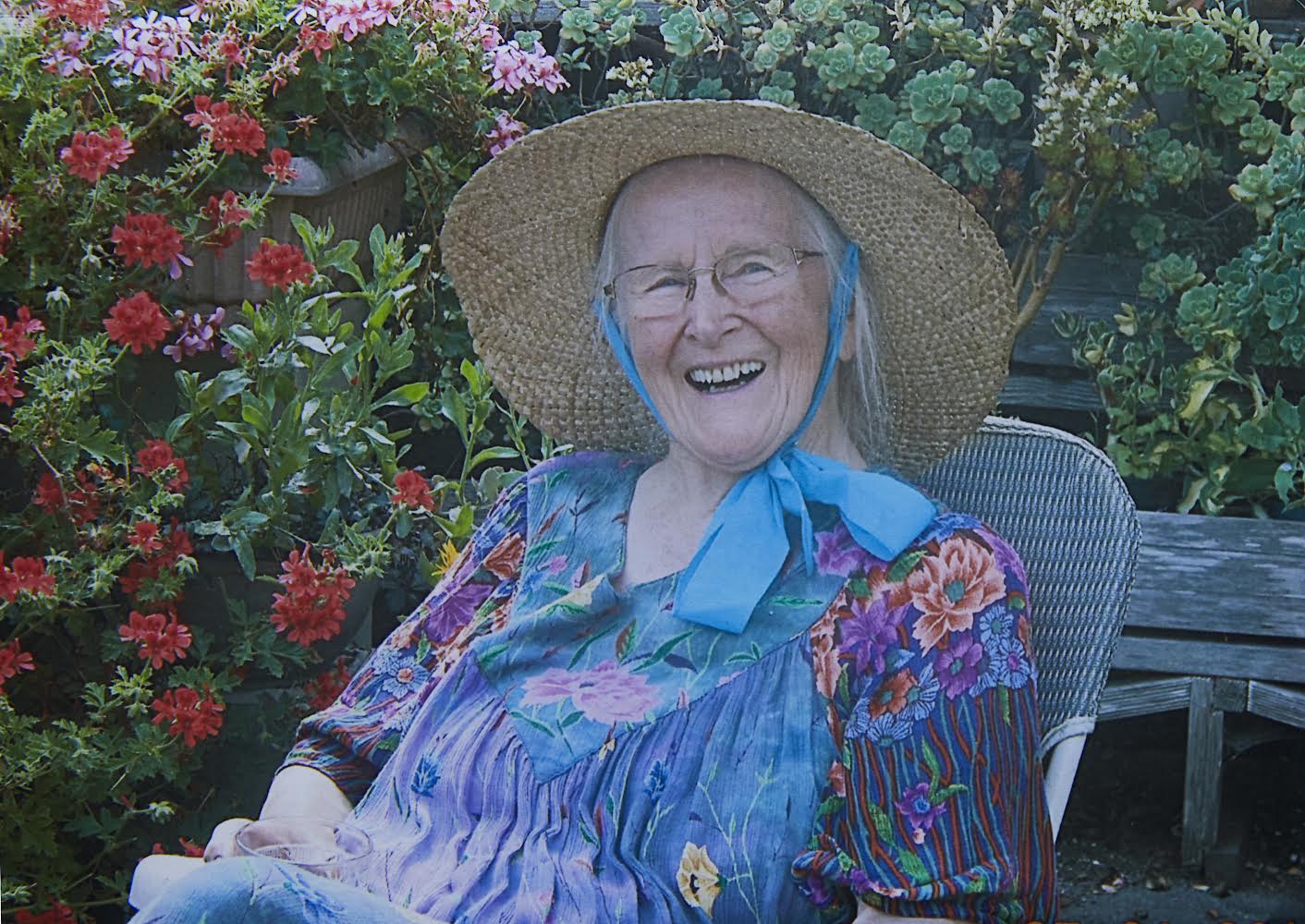
October 24, 2023, at the age of 95, the magical, hilarious,
spectacular Hazel Juell passed away.
She
was born the third of seven children and raised on her family’s
farm in Coudersport, Penn. After skipping two grades she
graduated high school at 16 and took off solo to California to join
her sister and uncle.
She
acquired work and enrolled in Humboldt College. She found college
didn’t captivate her; higher education would have to wait. She had
met Leonard Juell and he captured her heart. Together they created an
amazing life for the next 62 years.
She
would tell you that she was a life-long learner. I would add that she
was an entrepreneur, the center and matriarch of our family, and in
all areas of her life she built community. Her answer to loneliness
or a need in a new community was to create a social group. In Korbel
it was a beer brewing group in her basement (probably illegal then).
In Leggett she started a sewing group and a Sunday school. Then she
saw the need for a church and organized the locals to build the First
Presbyterian Church of Leggett.
With
an infant, a toddler, and a young child, she packed up the family and
moved to Leggett from Korbel to open and run The Famous One Log
House, a gift shop along the Redwood Highway. Leonard had always
wanted to be a business owner but he was still teaching school so in
her competent manner, she orchestrated the move herself. For years
she ran her successful business, raised her three children, and was
supportive and active in her church and community. At 35, she
surprised Leonard with their forth and last child.
As
her children aged and became more independent her quest for higher
education became a priority again. She went back to Humboldt State
University and graduated with her Bachelor of Science degree side by
side with her oldest daughter, Jeanette. Then it was on to her
Master’s in psychology so she could pursue her career as a
marriage, family and child Counselor. So many people have benefited
from her sage advice, 50 minutes per session.
Ever-present,
the drive for knowledge energized her to pursue her Doctorate at
University of San Francisco. To whooping cheers from her family, she
walked across the stage and accepted the award for Dissertation of
the Year for her doctoral thesis.
Now
with her career in full swing, she looked for a community amongst her
peers. She leased a large victorian in Eureka and started Bayview
Institute, a group practice of therapists and a place of healing and
camaraderie. At the age of 86 she finally retired her practice and
settled into a life of gardening, bridge, writings groups, church
choir, deep conversations with many friends accompanied by her famous
Manhattans.
She
loved to share ideas, cherished her many “talking companions,”
and loved everything that grows, from personal growth, emotional
growth, friendships, and babies, to her vast variety of succulents
and begonias.
She
was preceded in death by her husband Leonard Juell, her parents, and
five siblings. She is survived by: her sister Mary Gage, her four
children Stacey Juell (Sue), Jeanette Addis (Mike), Greg Juell
(Barb), and Kristine Juell, her five grandchildren Tara Juell, Addie
Juell, Ericskon Juell (Shaena), Sara Felsenthal (Noah), and Ben Trump, and two great grandchildren Alder and Coen Felsenthal.
Public
viewing will be November 1, 2023 from 4 to 7 p.m. at Paul’s
Mortuary in Arcata. A funeral service will be held at her church, the
Arcata Presbyterian Church on November 2, 2023, at 12:30 p.m. with
internment immediately following at Greenview Cemetery in Arcata. All
her beloved friends and family are welcome to attend.
###
The obituary above was submitted on behalf of Hazel Juell’s loved ones. The Lost Coast Outpost runs obituaries of Humboldt County residents at no charge. See guidelines here.
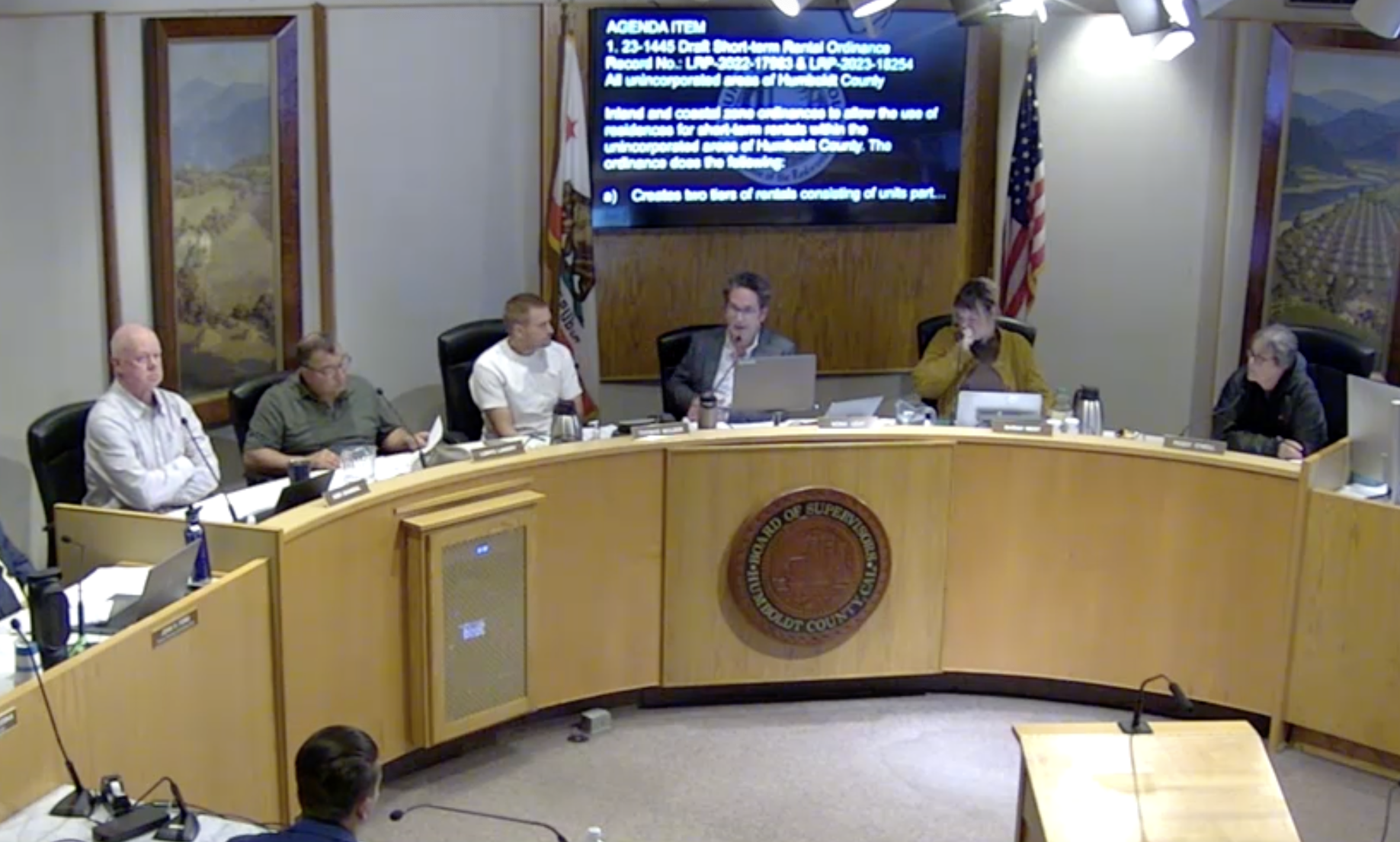
It looks like it’s going to be another few weeks before the Humboldt County Planning Commission makes a final decision on proposed regulations for short-term vacation rentals.
Commissioners had hoped to come to a consensus by the end of Thursday’s meeting, but, alas, after more than three and a half hours of going through the draft ordinance section by section, the commission unanimously voted to continue its discussion at its next meeting on Nov. 2.
The proposed rules would provide a regulatory framework for the permitting and operation of short-term rentals – defined as the rental of a dwelling for 30 consecutive days or less through services such as Airbnb or Vrbo – in unincorporated areas of Humboldt County. The regulations seek to protect neighborhood integrity and prevent the loss of available housing, while also providing tourists with more accommodation options and economic opportunities for property owners who aren’t interested in renting to long-term tenants.
Of the 34,093 residential units in unincorporated Humboldt County, approximately 567, or 1.66 percent, are being used as short-term rentals. To ensure short-term rentals don’t overwhelm the Humboldt Bay region, where housing availability is already impacted, the total number of permits would be capped at two percent of the total housing stock.
The draft ordinance would also establish standards for the operation of short-term rentals to mitigate neighborhood impacts, such as noise and parking issues.
Operators with proof of pre-existing operations would be given priority under the proposed rules.
“No permits for whole dwelling unit Short-term Rentals shall be issued during the first two months following the effective date of this section but applications from individuals operating existing short-term rentals will be received,” according to the text of the ordinance. “Two Three months after the effective date of this ordinance the department will issue permits for qualifying locations with existing Short-term Rentals. … If the number of permits issued for existing Short-term Rentals exceeds the cap … then no permits will be issued for new Short-term Rentals until the number of permitted Short-term Rentals in the County falls below the cap.”
During a recent public hearing on the matter, the commission asked staff to include a provision in the ordinance that would prevent operators with unresolved violations on the property from being permitted. “Violations which have been remedied will be allowed the same pathway forward as other operators,” the ordinance states. “Properties where violations exist will not be considered for [rentals].”
The Planning Commission agreed to hear public comment before deliberating on any of the proposed changes. Overall, public opinion of the draft document was fairly mixed.
Layal Bata, a policy and research analyst with the Los Angeles-based housing advocacy group Better Neighbors, asked the Planning Commission to reduce the suggested two percent cap on short-term rentals to one percent of the total housing stock and to prohibit short-term rentals from operating within a multi-family structure.
“Like many counties throughout California, Humboldt is facing a housing affordability crisis,” she said. “In the City of Los Angeles, we’ve seen firsthand how short-term rentals have contributed to rising housing costs. According to a McGill University report published last year, short-term rentals have contributed to an increase in rents by $810 and have taken 2,500 homes off the long-term market since 2015. Meanwhile, in Humboldt County, rents have increased $250 since 2015, with the number of unhosted short-term rentals [in the coastal zone] increasing to 25 percent since 2022.”
Arcata resident Raelina Krikston asked commissioners to eliminate short-term rentals without a caretaker resident, meaning someone who lives on the property they are renting out.
“In doing so this would open up hundreds if not thousands of homes up to first-time homebuyers and long-term renters in our community who currently need homes and are seeking upward home mobility,” she said. “[T]he number of short-term rentals in our county represents a significant portion of our housing stock that is being lost to commercial ventures. Based on our current [Regional Housing Needs Allocation] RHNA, 3,390 new homes are needed and the current number of [short-term rentals] in our county [is] equivalent to 26 percent of our RHNA needs.”
Krikston also spoke in favor of limiting short-term rentals to one per individual or business as opposed to five. She also expressed support for an overall cap of one percent.
Speaking to the other side of the issue, Southern Humboldt resident Chip Titman said short-term rentals offer “a lifeline” to rural communities where housing availability isn’t a pressing issue.
“They are an economic engine for tourism and a pathway beyond the dying cannabis economy,” he said. “Please don’t over-regulate the rural short-term rental operators, forcing them out of business and increasing the economic slide in rural and Southern Humboldt.”
McKinleyville resident and short-term rental operator Seth Naman said short-term rentals offer a cheaper option for folks visiting the area.
“If you want to stay at the Holiday Inn [by the airport] on a weekend in August [of 2024], that’s going to cost you $304 for one night [and] one room,” he said. “Like it or not, we are a tourist area. … People want to come here and they don’t want to stay in a hotel room, they want to have a more organic experience at a short-term stay. … A lot of us short-term rental operators, we live here, we’re in the community, we spend our money here, raise our kids here and the income that’s generated from the short-term rentals really is a part of how we get by.”
Several other commenters spoke, touching on many of the same issues.
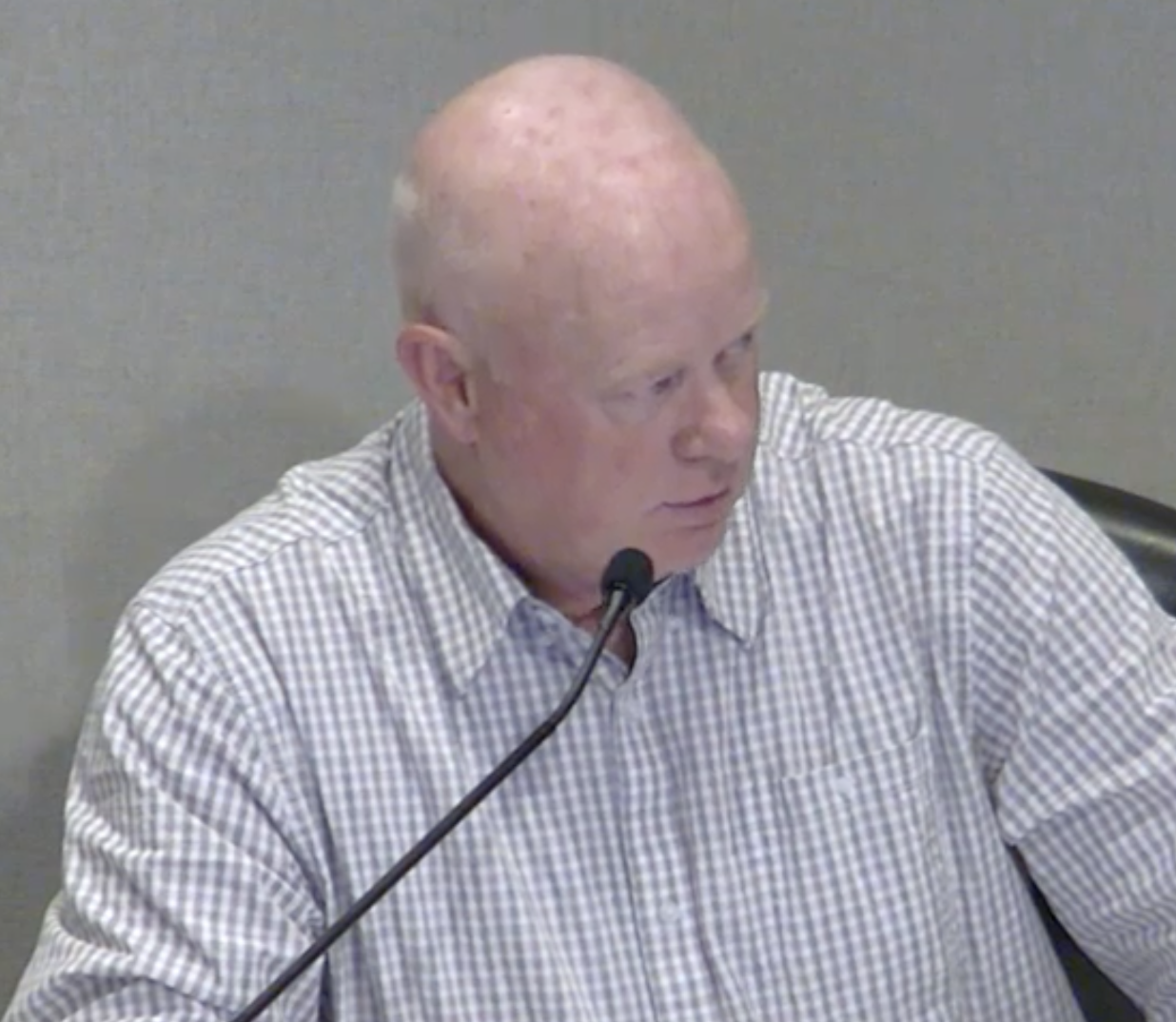
Before delving into the document, Commissioner Iver Skavdal acknowledged the “overall lack of housing” in Humboldt County. “[There is] a lot of concern which I also share.”
Skavdal
“We don’t have many tools in our toolkit, so it seems like people are grabbing on to this short-term rental regulation as perhaps one opportunity to solve that problem. Personally, I think it’s not,” Skavdal said. “Frankly, we’re not building houses in Humboldt County right now, which is the problem. … The last 10-year average, we’ve built about 115 single-family dwellings a year – about .33 percent of the housing stock. … I think we need to turn our attention to what’s causing what’s the difficulty. Why are we not building new homes in Humboldt County?”
Commissioner Sarah West said she felt short-term rental regulations could serve as a “tool in the toolbox when it comes to housing,” but agreed that the construction of more housing should be a priority. “While I don’t think it’s a solution to our housing struggles, it does impact our housing availability and we ought [to] have some sideboards on converting housing into businesses.”
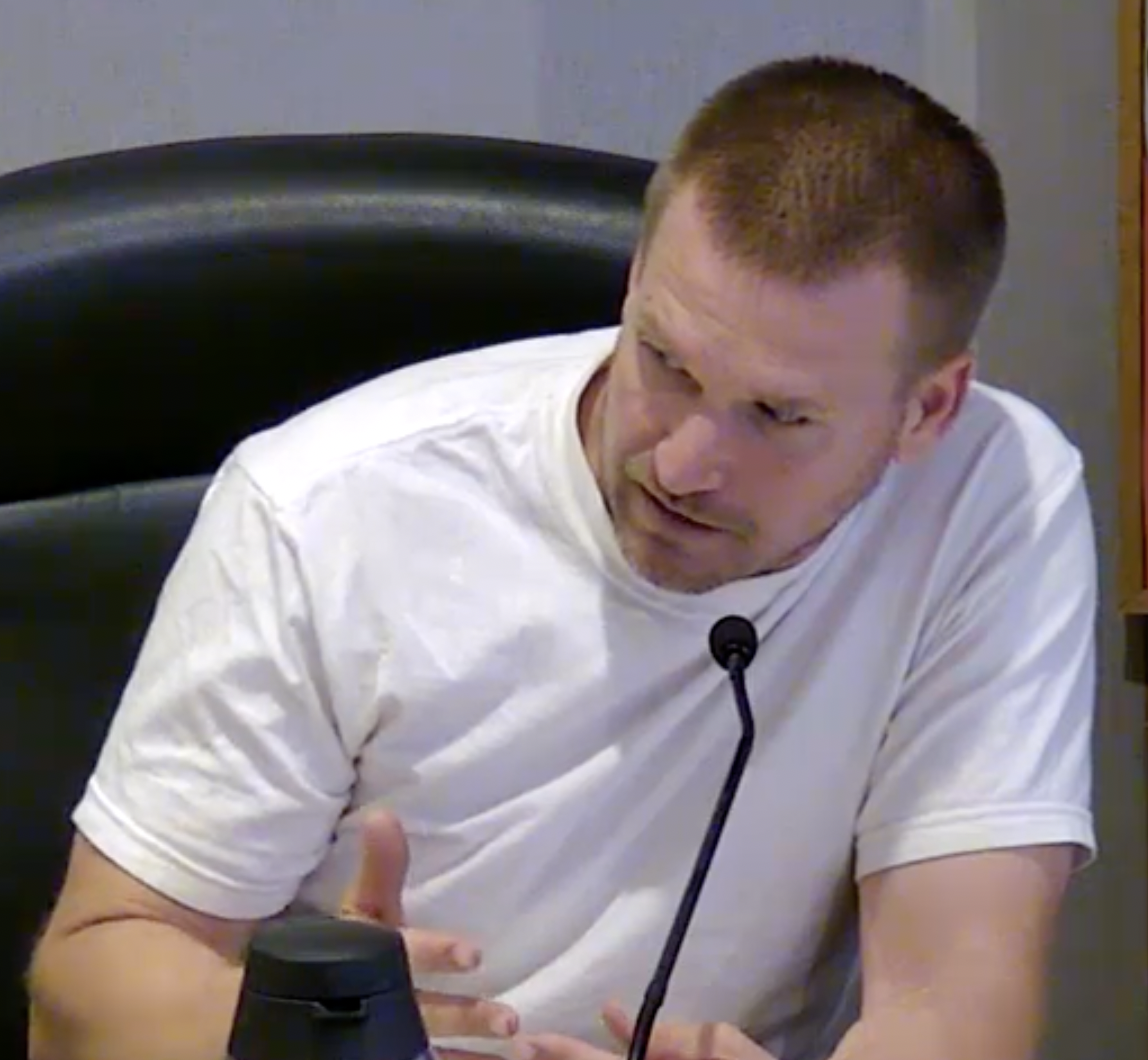
Commissioner Thomas Mulder asked fellow commissioners to avoid putting unnecessary or unfair restrictions on short-term rental operators that wouldn’t apply to long-term renters.
Mulder
“If we heavily regulate one end, that doesn’t mean another end that’s already regulated isn’t providing the needs through the appropriate regulations as it is,” he said, seemingly referring to rules already implemented through Airbnb or VRBO.
Commissioner Peggy O’Neil expressed sympathy for both sides of the issue, noting that she’s “all for supporting people who want to live in our community to have a source of income on their property,” but said she didn’t want to see outside investors buying up properties to turn into short-term rentals that will price out local folks.
“Or even expensive long-term rentals that are pricing people out of living in Humboldt County or having to radically change their lifestyle so that they can’t have a single-family home,” she said. “They have to rent a bedroom or they’re facing homelessness because they can’t afford rent anymore. It’s ridiculous. If you don’t already have a home, good luck getting one. Even if you’re a school teacher or work for a service district, you can’t even afford a house anymore.”
Commissioner Lonyx Landry said it took him three months to find a rental that he was “overqualified for” when moving back to Humboldt County in recent years.
From there, the commission spent two-and-a-half hours going through the ordinance section by section. They approved a few sections of the ordinance but got caught up talking about who and what would qualify as a home share rental.
As the meeting hit the three-and-a-half-hour mark, commissioners agreed to wrap up the discussion. Ford suggested the commission continue the discussion and finish its review of the draft ordinance at its next meeting on Nov. 2. Staff will come back with the final revisions on Nov. 16.
Landry made a motion to that effect, which was seconded by Mulder. The motion passed in a unanimous 6-0 vote, with Commissioner Brian Mitchell absent.
Press release from the Humboldt County Sheriff’s Office:
On 10/26/2023, at about 8:45 pm, Humboldt County Sheriff’s Deputies were on patrol in the area
of the US Highway 101 and Highway 36 interchange. A Toyota truck, known to the Deputies to
have been used in the commission of a recent burglary and vehicle theft, was observed traveling
northbound on Sandy Prairie Road, Alton. The Deputies attempted a traffic enforcement stop and
the truck fled, prompting a short pursuit.
Previousl Miller booking photo:
The pursuit was discontinued when the truck began traveling on US Hwy 101, southbound in the
northbound travel lanes. The truck proceeded at a slow rate of speed to the area of US Hwy 101
and Metropolitan Road when the truck experienced mechanical failure and came to a stop.
HCSO Deputies, assisted by Fortuna Police and Rio Dell Police Officers, established a traffic
closure on the highway and deployed spike strips to further contain the truck. The driver of the
truck, identified as 34-year-old Clayton Miller of Fortuna, was uncooperative with Deputies/
Officers and a K9 unit was deployed during his apprehension.
Miller was medically cleared at Redwood Memorial Hospital prior to being booked at the
Humboldt County Correctional Facility for the following violations:
VC 2800.4 – Fleeing/ Evading
a Peace Officer; Against Traffic
PC 22810 – Illegal Possession of Tear Gas
PC 148(a)(1) –
Obstruct Resist a Public Officer, HS 11377(a) – Possession of a Controlled Substance
Press release from the Fortuna Union High School District:
The Fortuna Union High School Music Program is thrilled to announce a generous donation of $1.2 million from the
Alice Gunnerson Trust. This monumental contribution, aimed at securing the future of music education at Fortuna
Union High School, will establish a fund to support the program in perpetuity.
Alice Gunnerson, a lifelong advocate for the arts and a dedicated supporter of Fortuna Union High School, has left an
indelible mark on the community with this extraordinary gift. Her commitment to the enrichment of students’ lives
through music education will continue to resonate through generations of budding musicians and artists.
The funds from the Alice Gunnerson Trust will be used to enhance the music program’s offerings, including the
purchase of new instruments, upgrading facilities, supporting Fortuna High’s talented music instructor. In perpetuity,
these resources will ensure that the Fortuna Union High School Music Program remains a vibrant and vital part of the
educational experience for students.
Mrs. Gunnerson’s extraordinary generosity is not only an investment in music education but also a testament to the
positive impact it can have on students’ lives. The school is deeply grateful for her dedication to fostering the arts in the
community and for her enduring legacy.
To honor and thank Mrs. Gunnerson for her incredible generosity, Fortuna Union High School is in the process of
planning a special dedication ceremony and other expressions of gratitude. The Fortuna Union High School Music
Program recognizes that this significant donation will enable them to provide an exceptional music education
experience for students now and into the future. It reaffirms the program’s commitment to nurturing the talents and
passions of the next generation of musicians.
For more information about the Alice Gunnerson Trust donation and the Fortuna Union High School Music Program,
please contact Clint Duey at 707-725-4462 or cduey@fuhsdistrict.net
About Fortuna Union High School: Fortuna Union High School, located in Fortuna, California, is a leading institution
committed to providing comprehensive educational opportunities to students. The Fortuna Union High School Music
Program plays a pivotal role in the cultural and artistic development of its students, and this generous donation from the
Alice Gunnerson Trust will help secure its future for generations to come.
Students walk on campus at the University of California, Davis on Oct. 3, 2023. Photo by Miguel Gutierrez Jr., CalMatters
Last year California lawmakers agreed to expand the Cal Grant, financial aid for low-income students next spring, but only if there’s enough money in the state budget.
If dollars are scarce, some advocates say the state should pull money from a new scholarship partly for middle class students to pay for more aid to students of lesser means. But key figures in the Legislature and Newsom’s administration disagree with that approach.
“I would not pull and redirect funds that are currently serving 300,000 students,” said Marlene Garcia, executive director of the California Student Aid Commission, the state agency that handles college financial aid.
“Let me just be really clear: No,” added Chris Woods, budget director for the Senate’s top lawmaker, Sen. Toni Atkins, a Democrat from San Diego.
Both made those comments at a Tuesday forum hosted by CalMatters about the state’s efforts to provide debt-free college to public college and university students. Among the forum’s themes was whether California lawmakers should prioritize fully funding the Cal Grant, which benefits low-income students, while pulling some funding from the Middle Class Scholarship.
“I would not pull and redirect funds that are currently serving 300,000 students.” Marlene Garcia, executive director of the California Student Aid Commission
Such a decision would have to be approved through the state’s annual budget process that requires agreement between the Legislature and the governor. The debate over what to fund and by how much will be key financial aid sticking points during budget negotiations next spring.
Gov. Gavin Newsom’s top education advisor, Ben Chida, was also skeptical of shifting money from one program to another, but didn’t fully rule it out. “Probably not,” he said Tuesday. He cautioned that the answer ultimately depends on addressing the “myopic interests” of advocates, lawmakers and administrators and then “when it’s time, make sure the governor makes the decision that is maximizing the good for people who are hurting.”
How we got here
The middle class award debuted last year for roughly 300,000 University of California and California State University students. It provided nearly $3,000 to students with family incomes above $100,000, while students with household incomes below $50,000 got about $1,500 each on average.
But the scholarship excludes all community college students. Meanwhile, at least 100,0000 low-income California college students aren’t eligible for the Cal Grant, which waives tuition to the University of California and California State University while also providing about $1,650 in cash to community college students. A Cal Grant expansion would apply to community college students who don’t currently meet minimum GPAs and to university students who took more than a year between graduating high school and pursuing higher education. It would also waive age restrictions for university students. However, under the proposed expansion, some middle class students would no longer be eligible because of lower income ceilings.
A budget deal reached between the Legislature and Newsom last year said the state would put up the cash to expand the Cal Grant program if budget forecasts show the money is there. This was after lawmakers expanded the grant in 2021 to include more community college students. The student aid commission last April calculated that expanding the grant to include all those people excluded would cost about $370 million a year.
“I believe that the state made a promise and the state needs to follow up on that promise and fund Cal Grant reform.” Jessica Thompson, vice president of The Institute for College Access and Success
This year lawmakers increased the Middle Class Scholarship from $630 million to about $850 million. The Cal Grant is expected to cost $2.2 billion in 2023-24. Overall, California commits far more college grant aid than any other state in the nation, according to 2020-21 data.
Where the money would come from to expand the Cal Grant in 2024 is a big unknown. The Legislature’s nonpartisan budget scorekeeper, the Legislative Analyst’s Office, wrote in February that because of the state’s shaky fiscal outlook, “Cal Grant reform is very unlikely to be triggered in 2024‑25.”
One leading advocate who supports Cal Grant expansion said if funding is tight, the state should pull money from the middle class award to fully fund Cal Grant. “I believe that the state made a promise and the state needs to follow up on that promise and fund Cal Grant reform,” said Jessica Thompson, vice president of The Institute for College Access and Success, at Tuesday’s forum. She also pressed the state to increase the amount of cash support students get from Cal Grant.
Program trade-offs
Complicating the idea of pulling money from the Middle Class Scholarship to fully expand Cal Grant is the fact that many lower-income students who got the grant also received the middle class award — about 157,000 out of nearly 300,000, according to 2022-23 data that the student aid commission provided CalMatters.
Nor does the student aid commission want to tell students that the middle class award they expected would decrease.
”You face the student and tell them you’re now going to get less,” Garcia said at the Tuesday forum.
There are also key differences between how Cal Grant and Middle Class Scholarship funds reach students. The grant is a fixed, upfront amount. Students who are promised an award know exactly how much they’ll get. The middle class program is based on a complicated formula that first takes the total amount a student needs to pay for college — including tuition, housing and other costs — and subtracts all the grant aid and scholarships the student will get. The middle class award also assumes students will work enough to earn about $8,000 a year that they can use to pay for college costs. Families with incomes above $100,000 also pitch in more as part of the state’s debt-free promise.
Federal data that CalMatters analyzed show that while California public university students with low and moderate incomes pay among the lowest amounts for the total cost of college, families with incomes above $110,000 pay above the national average.