Earl was born on November 24, 1959, to Roger and Ada McAllister in
Sacramento. He grew up in Humboldt County. His early years were spent
in Trinidad, later in Eureka and Cutten’s Northridge area. His
father, being a commercial fisherman and owner of the F/V Irish Rose,
F/V Ruby, and F/V Miss Joanne, Earl learned the trade of fisherman
very early in his life and became a very skilled and well-known
commercial fisherman and captain.
Earl graduated from Eureka High School in 1977 and immediately
began his lifelong career as a fisherman. He fished all up and down
the California coast and even passed through the Panama Canal and
continued to fish the Gulf of Mexico for a while before returning to
the Eureka area. He became captain of the F/V Alex for years in his
20s. In 1987 he fished his first time in the Bering Sea off Alaska.
He continued fishing the Bering Sea as first mate and engineer on the
F/V Silver Ice for 10 years until 1997, when he met the love he would
spend the rest of his life with, Mary Waite, in Sacramento,
California. Together they moved to Humboldt County in December 1999.
Earl had a job fishing with Hunter’s Offshore Enterprises, Inc. the
same day he moved back to the Eureka area. He worked for the Hunters
on several different fishing boats. He eventually became captain of
the F/V Fishwish, an achievement he was proud of.
In January 2021 Earl became very ill with congestive heart failure
and pulmonary hypertension. He continued as captain of the F/V
Fishwish until September 2023, when his illness made it impossible to
continue. His final years were spent at home with Mary caring for him
as he progressively got worse. Earl was released from his pain and
earthly body on March 30, 2026.
Earl was preceded in death by his father, Roger “Butch”
McAllister; his brother, Keith McAllister; his niece, Brianna
McAllister; stepson Randy Waite II; brother-in-law Kelly Permenter;
and nephew Richard Nelson.
He is survived by his wife, Mary Waite; his mother, Ada
McAllister; his sister, JoAnne Permenter; stepdaughter Lisa Waite of
Elk Grove; step-granddaughters Mia, Lyla, and Autumn; nieces Daniele
Vincente and Chandel Nelson; many great-nieces and great-nephews; his
foster brother, Robert Stockoff; and his brother-in-law, Eric
“Richard” Nelson.
###
The obituary above was submitted on behalf of Earl McCallister’s family. The Lost Coast Outpost runs obituaries of Humboldt County residents at no charge. See guidelines here. Email news@lostcoastoutpost.com.
On May 28, 2026, Officers with the Eureka Police Department (EPD)
conducted a Shoulder Tap operation focused on the illegal purchase of
flavored tobacco products for individuals under the age of 21.
Throughout the operation, two minors
contacted a total of 12 individuals. Of those contacted, six
individuals agreed to purchase flavored tobacco products for the
minors. After the purchases were completed, officers contacted the
individuals and issued citations for furnishing tobacco products to a
person under the age of 21.
The Eureka Police Department remains
committed to protecting the health and safety of youth in the
community by addressing illegal access to tobacco and nicotine
products. Flavored tobacco products continue to be a concern due to
their appeal to younger individuals and their role in contributing to
nicotine addiction among teens and young adults.
EPD would like to remind the public
that California law prohibits the sale or furnishing of tobacco and
nicotine products to anyone under the age of 21. Violations may
result in criminal citations and fines.
Drive north along Highway 101 anytime between 5 and 6:30 p.m. the last few years, and, when you near the Bayside Cutoff, you get the thrill of wondering if the car in front of the line 10 cars long spilling up the road is going to pull out in front of you while you’re doing 50-something down the freeway — or watch them do it, and participate in a split-second negotiation between the side of your brain that wants to pound the brakes, and the side that thinks they’ll make it to the other side. Fun!
Today, the Indianola Undercrossing officially opened, hopefully making it less likely people heading east have to play Frogger IRL. (And people going north don’t have to worry about squishing them.) Several dozen people attended the official ribbon cutting hosted by Caltrans, many of them nearby residents excited about the convenience the underpass opening offers them. One of them, Nancy, told the Outpost that she’d lived in Indianola since 1976 and was glad that she could go straight from her house to the highway and head south. Another said she was “ecstatic.”
The route across the highway to Indianola has been closed since 2024, when Caltrans started work on the underpass. Last year, Caltrans opened the segment over the highway. Now, drivers can safely go underneath the road; it also connects with the Humboldt Bay Trail so cyclists and pedestrians can use the undercrossing as well. The underside is bedecked with bas-relief etchings of marsh grasses and egrets, as well as some abstract swirls.
The underpassing’s official name is the Brad Mettam Memorial Interchange, after a retired Caltrans employee who died unexpectedly in 2024. Brad’s widow, Diane, spoke at the ceremony and cut the ribbon. She, and the Caltrans employees who spoke at the opening, said Mettam was an enthusiastic man, dedicated to his family, his work, and the Rotary Club.
Caltrans designated the six-mile stretch from Arcata to Eureka a safety corridor in 2002, after years of drivers speeding across the perpendicular intersections resulted in dozens of fatal accidents. Accidents at the old Indianola Cutoff and Mid-City Motor World intersections were more than twice as likely to result in death or serious injury than the average intersection. Caltrans called the new underpass a “major” safety upgrade, and said they expected it to save lives and prevent collisions. California Highway Patrol Captain Samuel Griffith said at the event that it was a “tremendous” step forward for safety along the corridor. Griffith said there had been over 100 crashes during the last five years, 12 of them seriously injuring the victims. Two were fatal.
At least one person isn’t happy about the project’s completion. “What a waste of 50 million dollars!” yelled one cyclist, whipping by on the Bay Trail, clearly oblivious: it only cost $46 million.
The free-flying condors over Yurok ancestral territory all appeared healthy in their annual spring health checkups.
With all exams complete, none of the birds have tested high enough in circulating blood lead to require treatment. Only one bird had a slightly elevated blood level, indicating exposure.
Condors A1 (studbook 969), and A0 (studbook 973) were the first of the flock to nest this spring, but it was determined last month that the egg was not viable. Based on a small chance that they might try to re-nest this season, Northern California Condor Restoration Program (NCCRP) staff decided not to trap A0, the female of the pair, to save her undue stress should she be carrying an egg.
Exams are stressful for condors and other wildlife, explained NCCRP Manager Chris West, and it wasn’t worth the risk of complications to a potentially developing egg. A0’s transmitters are currently working properly, and NCCRP was also heartened by the low lead in the rest of the flock.
Examinations also include testing for Highly Pathogenic Avian Influenza (known as bird flu or HPAI) exposure and feather sampling to determine historical lead exposure. Staff and veterinarians gave the birds head to toe physical exams and checked vital signs, weight, and feather growth.
NCCRP staff also replaced six failed radio transmitters and two failed GPS units on the birds, to ensure ongoing monitoring of the flock. Staff use these transmitters to track the birds, giving valuable insights into their movements and behavior. It was this monitoring that helped the team determine A1 and A0 were nesting in first place, as their nest was in too remote a region to visit physically. The monitors can also alert staff to possible illness or injury to a bird, allowing for possible response to render aid.
Throughout the duration of the project, the crew wore N95 respirators per the California Condor Recovery Program Health Team’s protocols to protect staff and birds from the potential of exposure to zoonotic diseases, (infectious diseases which can be spread between non-human animals and humans) especially HPAI.
The next cohort of condors will be transferred to the NCCRP field site in July. They will spend time in the NCCRP flight pen, acclimating to local conditions and getting familiar with each other and the local condors before their release into the wild throughout the fall.
Lead is the single biggest threat to condors in the wild and is responsible for nearly half of released condor mortalities where the cause of death is determined. A tiny lead bullet fragment the size of the head of a pin is enough to kill not only a condor but also vultures and eagles, should they ingest it while scavenging on remains of an animal killed with lead ammunition. These important scavengers remove carcasses from the landscape and are critical in reducing the spread of disease in many game species.
Recent research indicates that big game hunting is unlikely to raise the likelihood of lead ingestion by condors. The responsible switch to lead-free ammunition by big game hunters has made high-use hunting areas safe places for condors to forage. It is likely that individuals who manage the landscape using firearms and who are unfamiliar with more recent laws banning the use of lead ammunition for dispatching wild and domestic animals, coupled with illegal poaching, are the primary source of lead in recently poisoned condors. This makes empowering land managers with information on current laws and assisting them in accessing lead-free ammunition major priorities.
The California Condor Recovery Program is a multi-entity effort, led by the U.S. Fish and Wildlife Service working to establish self-sustaining condor populations within the historical range. The program includes addressing threats to the species in the wild; captive breeding; and reintroduction at field sites, like the Northern California Condor Restoration Program. In addition, the program raises awareness about condors and how the public can help support them through individual actions, like making the switch to lead-free ammunition.
Photos below all via the Yurok Tribe:
Yurok Wildlife Department Technician Madeleine Hellier
Chris West, NCCRP Manager and Yurok Wildlife Department Senior Biologist
Screenshot of Tuesday’s special budget study session with the Eureka Council and Finance Advisory Board.
###
The Eureka City Council on Tuesday unanimously voted to advance a proposal that, if approved by voters, would double the council and mayor’s monthly stipend — the elected officials’ first wage increase in nearly 40 years. The proposed pay hike is slated for the November ballot.
Since 1988, the council’s monthly stipend has been fixed at $500, with the mayor earning slightly more at $625 per month. (To put those numbers into perspective, the American Institute for Economic Research’s Cost of Living Calculator estimates that $500 in 1988 is equal to roughly $1,370.70 in today’s money, adjusted for inflation.) Given that Eureka is a charter city, any pay increases for elected officials require an amendment to the city’s charter, and any changes to the charter must be approved by voters.
At a meeting last month, the council directed staff to draft a ballot measure to increase the council and mayor’s monthly stipends to $1,000 and $1,250, respectively, with annual increases to be determined by the city’s Finance Advisory Board and capped at 5%. Some council members felt the pay hike would encourage more working class people to run for local office.
Speaking during public comment at Tuesday’s hearing, Eureka resident Patrick Cloney asserted that the council and mayor are earning more than they’re letting on through “other pay” and benefits.
Cloney | Screenshot.
“I feel like Ricky Ricardo because you all in city hall have some explaining to do,” he said. “The arithmetic from transparentcalifornia.com informs us that, in addition to this regular pay, Mayor Kim [Bergel] and Council[member] Renee [Contreras-DeLoach] saw their other pay increase from $3,325 in 2023 to $4,750 in 2024 along with increases to their significant benefits. Councilmembers Scott [Bauer], Leslie [Castellano] and G. Mario [Fernandez] saw their other pay increase from just over $6,000 in 2023 to $8,350 in 2024, along with increases to their more modest benefits. … Total pay and benefits increased [from] $128,700 to $157,950.”
Following public comment, Councilmember Moulton made a motion to advance the proposed pay hike but asked staff to speak to Cloney’s concerns and clarify the council’s full package of benefits.
“I think it’s absolutely a legitimate concern,” Moulton noted.
City Manager Miles Slattery said he didn’t have a breakdown of the numbers on hand, but explained that the “majority is related to health insurance.” There are also regular increases associated with CalPERS, the state’s public pension fund.
“I think from 2023 to 2024 [there] have been increases related to health insurance, and that’s why you see some of our council members have health insurance through the city, [while] others have it with their spouse,” Slattery said. “There’s different options for council [members] to either take on the city’s health insurance and be a part of that, or to have their insurance covered in a different way. Some of you have the option of being contributors to CalPERS, which is our retirement system, and others choose not to, so that will vary the compensation for each council member.”
City Clerk Pam Powell said another factor could be the $350 per month car allowance that is available to council members, though she did not indicate who actually uses it.
After some additional discussion, the council voted 4-0, with Councilmember Bauer absent, to advance the proposal. The council will revisit the topic at its June 16 regular meeting.
###
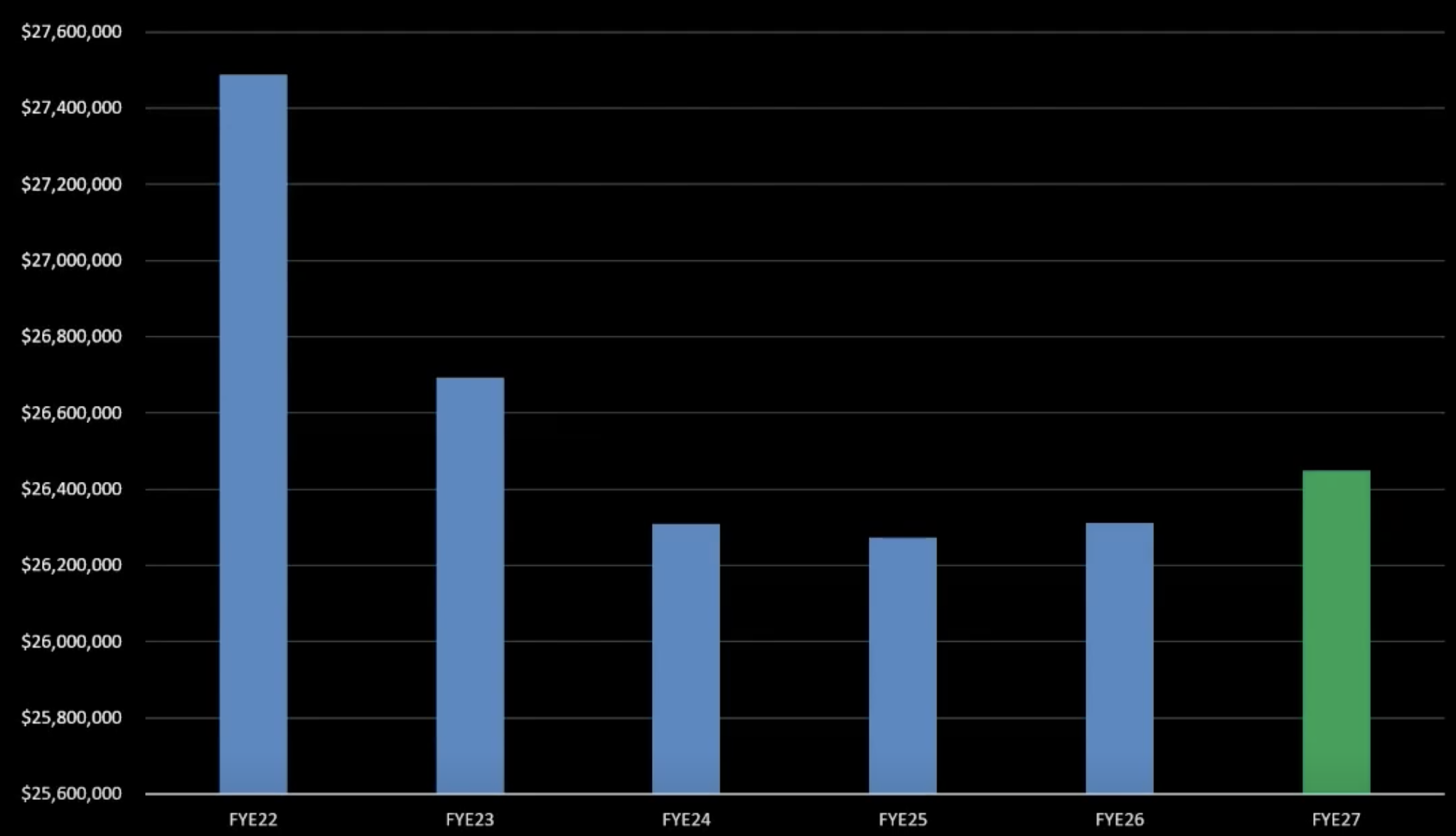
Eureka’s General Fund revenues and expenditures from 2022 to present. The green bar at the right is a projection for Fiscal Year 2026-27. | Screenshot.
A little later in the evening, the Eureka City Council took its first look at the budget forecast for the 2026-27 fiscal year during a joint study session with the city’s Finance Advisory Board. The city’s finance staff are anticipating a $800,000 structural deficit in the General Fund in the coming year, which is about the same as where the city started the current fiscal year.
“We started Fiscal Year 2025-26 with a deficit, and we expect about the same level of deficit next fiscal year,” said Finance Director Lane Millar. “The 25-26 adopted budget showed a deficit of about $800,000. Through cutting materials and supplies, outside services and capital outlay, we made up for those increases in salaries and health insurance, and we were able to actually reduce the size of that budget deficit, but we still have more to go.”
Screenshot.
Those increases in health insurance and salaries account for “93% of all increases citywide,” Millar said. Between fiscal years 2024-25 and 2025-26, the city saw a $417,000 increase health insurance costs. Staff are anticipating a $900,000 increase in the next fiscal year. Liability insurance is also on track to go up by another $400,000, as are unfunded liability payments to CalPERS.
City salaries went up by about 5% in Fiscal Year 2045-25, which cost the city roughly $2 million. Salaries are projected to tick up another 3% in the upcoming year.
“That will cost us roughly a million dollars,” Millar said. “From Fiscal Year 25-26 to Fiscal Year 26-27 these four categories add up to about $2.9 million in increased expenses.”
All told, the city is expecting a 2% increase in General Fund revenues and expenditures.
In response to Councilmember Contreras-DeLoach’s question about where that estimate came from, Millar said the city contracts with a third party that specializes in budget forecasting. However, Contreras-DeLoach pointed out that the forecast is often wrong.
Contreras-DeLoach | Screenshot
“I feel like I’ve spent three and a half years arguing with these numbers, and we have declined and declined and declined and declined,” she said, referring to the city’s annual revenue. “I totally understand the logic behind [forecasting]; it does make sense, right? You know, ‘Let’s listen to the professionals’ — they’re wrong. They’ve been wrong. … I don’t want to count on an increase. If anything, I would like us to come up with a plan for how we’re going to deal with the decrease, and I don’t want to just pull the money or pull the number out of the air.”
Millar acknowledged that there is a “balancing act” in projecting what may happen with the city’s budget. “I’ve accepted their projections, and I tend to be a little more conservative than they are in general,” he said, referring to the third-party forecaster. “I usually point myself towards the expense side of the income statement to kind of build a buffer for that reality.”
James Kloor, a member of the finance board, asked Millar about the $800,000 deficit and how it was projected to impact the city’s reserves.
“Last year, I believe we ended the year with about $12 million reserves, and that represents about three months of operating capital at the end of this fiscal year,” Millar said. “Due to some unexpected expenses that happened mid-year, our reserve levels will be more like two months or 60 days of reserve. That’s about $9 million instead of that $12 million. Since [it is] below our budget policy of three months [of reserves], I actually have to come up with a financial plan to help guide us to get back to three months, and that will come in at a future meeting.”
Staff will provide a more thorough preview of the budget for the upcoming fiscal year at next week’s city council meeting on Tuesday, June 2. The council is expected to adopt the budget at its June 16 meeting.
Yes, but it’s not because the thing is caving in, or anything like that. Hank Seemann, the county’s deputy director of Public Works and the point person for all things trails, tells the Outpost that the work — which will take place on Thursday and Friday next week, between Brainard and Bracut — is to make sure the trail meets exacting ADA compliance standards.
The Americans with Disabilities Act says that a trail should have no more than a two percent grade, side to side, which is pretty difficult to achieve when you’re just laying down asphalt with a spreader, Seemann said.
So next week’s work comes after a series of minute measurements along the county’s segment of the trail, and will involve flattening those bits that need flattening.
Press release from the Humboldt County Department of Public Works:
The
Humboldt County Department of Public Works is in the process of
preparing to conduct repair work on the Humboldt Bay Trail on
Thursday, June 4 and Friday, June 5.
The
portion of the Humboldt Bay Trail between the Brainard
Mill Site and the Bracut Industrial Park will be closed from 7:00
a.m. on June 4 through 5:00 p.m. on June 5 while these repairs are
being completed.
Repair
work will involve removing and replacing asphalt surfacing to comply
with the Americans with Disabilities Act (ADA). Localized areas of
asphalt will be repaired to ensure compliance with ADA slope
requirements.
Trail users
are asked to follow all traffic control devices and trail closure
signs in the construction area. Thank you for your patience while
repair work is in progress.
If
you have any concerns or questions regarding this project, please,
call 707-445-7448.
Voters cast ballots at a polling site at Modoc Hall at the Sacramento State campus on March 5, 2024. Photo by Miguel Gutierrez Jr., CalMatters
###
This story was originally published by CalMatters. Sign up for their newsletters.
###
Despite making up one-fifth of the state’s voting population, most Gen Z Californians won’t vote in the June 2 primary, which is stacked with several gubernatorial candidates.
The primary election tees up the ballot in November, which will also host other high-profile races and issues, such as the rest of the executive candidates, as well as propositions like the billionaire’s tax.
Generation Z, or those aged 14 to 29, makes up nearly 21% of eligible California voters, but their historical turnout is disproportionately low compared to the general voting population.
Young voters aren’t necessarily checked out. Rinu Nair, the president of the History and Civic Engagement Club at De Anza College in Cupertino, said that the student club’s meeting on the gubernatorial race drew the most participants of any meeting this year: 20. But students were often disillusioned by each candidate having a history of controversial actions.
“There’s an interest, but also that feeling of, ‘Am I doing what I want to do? Can my vote even make a change?’” Nair said. “(Young people) don’t feel represented in politics but they feel like it’s a duty they have to do.”
In a statewide survey published by the UC Berkeley Institute of Governmental Studies in May, voters aged 18 to 29 polled similarly to all voters on reasons why they may not vote in the primary election. But a few reasons jumped out in particular.
Of young voters who said they were unlikely to vote, 47% said they are not well-informed enough on the issues and candidates, compared to 38% of total unlikely voters. Another difference was that 31% of young voters said they were too busy, compared to 19% of all unlikely voters.
Cost of living and inflation, healthcare and housing costs are the top three issues Gen Z voters are tracking leading up to the 2026 midterms, according to 2026 survey data from the Center for Information and Research on Civic Learning and Engagement, a nonpartisan research organization based at Tufts University in Boston. Jobs and unemployment and immigration ranked fourth and fifth among survey respondents respectively.
How candidates are – or aren’t – addressing the youth vote
CalMatters reached out to gubernatorial candidate front-runners to learn more about their methods for engaging youth voters. Steve Hilton, Chad Bianco, Tony Thurmond and Matt Mahan’s teams did not respond.
Antonio Villaraigosa said in an interview that he hired a diverse staff of people primarily aged 22 to 26 to help him connect better with youth voters. Katie Porter and Tom Steyer said they have visited many college campuses across the state in an effort to connect with young voters.
Maiya De La Rosa, the president of California Young Democrats, a youth organizing group affiliated with the state Democratic Party, said that Xavier Becerra has visited and formed relationships with more Young Democrats chapters across the state than any other candidate, having visited 30 chapters since July 2025. She said that the organization endorsed him because of that strong relationship as well as his policies.
The California College Democrats, an organization of students that mobilizes around Democratic candidates and advocates progressive policies, similarly endorsed Becerra in March.
“He’s made a really big effort to put college students at the front of his campaign,” said Daniel Guerrero, the organization’s president and incoming senior at UC San Diego. “We believed in his message, and it’s been really rewarding to see everyone else see what we saw in him, especially in the young community.”
Steyer and Becerra have both been using short videos and partnerships with content creators to reach young audiences. Both are caught up in a controversy over content creators allegedly failing to disclose that campaigns had paid for their endorsements. The influencers often posted endorsements without disclaimers that they had been paid.
According to each candidate’s endorsement pages (except Hilton, who does not have one), Becerra has the most endorsements from youth groups – 15 total, mostly consisting of Young Democrats and College Democrats chapters.
Steyer has three youth group endorsements and Thurmond has one. Peter Opitz, a representative for Porter, said she is endorsed by UAW and Teamsters, which contain unions that represent workers and educators in higher education.
A strong social media presence has been integral to reaching young voters – and any voter – in a race where it’s difficult to stand out.
Even so, California Assemblymember Alex Lee, who has endorsed Steyer, said in an interview that he believes social media strategy comes second to good policy, and that Democrats often get criticized for being boring online.
“Zohran Mamdani’s popular not because he’s good at Instagram alone, but because he campaigned on free childcare, housing and a rent freeze,” Lee said, who was 25 years old when he was elected. “You can pump so much money into viral cringe, but it will not resonate with people.”
Seated next to Steve Hilton and Xavier Becerra, Tom Steyer speaks during a gubernatorial forum hosted by the California Hispanic Chamber of Commerce at the Sheraton Grand Sacramento Hotel in Sacramento on April 14, 2026. Photo by Miguel Gutierrez Jr., CalMatters
At a televised debate held at Pomona College in April, as candidates squabbled for speaking time, hundreds of students tuned in from a nearby dining hall where the debate was being livestreamed. They giggled at Steve Hilton’s British accent, hollered over the shade thrown on stage and kept a close eye on the crowded field for standouts.
Throughout the debate, as candidates like Villaraigosa directed their responses to “the young students at Pomona,” groans erupted from students watching the livestream. Rising junior at Pomona College Sarah Russo said the candidates’ comments felt overly performative.
“It belittled us and infantilized us,” Russo said in a talkback session with other students after the debate.
Incoming Pomona College junior Alex Benach said no one candidate really stood out. “The whole field of candidates trying to have that viral moment watered [the debate] down,” they said.
Despite the debate being held at a college campus, students attending said that the candidates failed to address key priorities for youth in college, including the job market, AI and federal crackdowns on campuses for alleged anti-semitism and equity issues.
Youth turnout is low, but young voters are hardly apathetic
No matter the kind of election – gubernatorial or general – youth turnout is historically lower than other age groups, said Mindy Romero, director of the Center for Inclusive Democracy at the University of Southern California, a hub for civic and electoral engagement research. In the 2024 general election, 42.5% of eligible voters aged 18 to 24 cast a ballot, compared to 62% of all eligible voters in California, according to a July 2025 report from the center.
While young people do not show up to vote as much as older voters, it’s “not because they’re apathetic,” emphasized Romero. Rather, it is because youth feel disconnected from the political process.
From the 2010 to 2018 primary elections in California, eligible youth voter turnout ranged from as low as 3.6% in 2014 to 17.1% in 2016, according to California Civic Engagement Project data. In comparison, total eligible voter turnout ranged from 18.4% in 2014 and 33.5% in 2016.
Likely voter modeling often shows campaigns that youth voters aren’t worth investing in due to historically low turnout. However, that same lack of investment is what can lead to low youth turnout itself – and create what Romero calls a “vicious cycle” of campaigns failing to engage youth voters because they believe it’s not worth it.
From left, candidates Tony Thurmond, Chad Bianco, Tom Steyer, Steve Hilton, Xavier Becerra, Katie Porter, Matt Mahan and Antonio Villaraigosa stand on stage for the CBS California Gubernatorial Debate at Bridges Auditorium on the campus of Pomona College in Claremont on April 28, 2026. Photo by Jules Hotz for CalMatters
When they do focus on young voters, candidates primarily target college campuses, usually skewing towards four-year university students, which means non-college goers, low-income voters and people of color are less likely to receive their outreach, according to Romero.
“The political and social context in which young people have come of age has made them not see government as a helpful thing that they have a say in, but rather a government that is not as responsive, gridlocked, and about spewing hate and not serving,” Romero said. “Generally speaking, young people don’t have a lot of positive to look to. They’ve seen only negative.”
Young people also may be more skeptical after seeing such negativity, whereas older generations have memories of a more civil past, giving them the perspective of a government that could function in a non-partisan way.
“Young people are tapped in politically, that’s undeniable,” said Christopher Smith, a student at Evergreen Valley College who attended a Steyer event. “Anybody who claims that is not true is not listening to young people enough.”
Romero suggested that the competitiveness of the race could push more young people to vote, but the turnout would still be unrepresentative of the actual youth population. In the UC Berkeley IGS Poll, 56% of respondents across all age, race and party demographics said that a low youth turnout was a “major concern” for a representative democracy in California.
The UC Berkeley IGS poll also showed that 48% of young voters who said they were unlikely to vote said access to an “unbiased and trusted source of election news” would increase their chances of voting. A quarter of them said more convenient voting would also increase that likelihood.
Andrew Luong, a De Anza College student at the Steyer rally, said he feels that it’s partially on young people to educate themselves and vote. “In the governor’s race, I know young people care about it, but don’t care to learn more about it,” he said.
Among young Democrats, De La Rosa said she has seen youth voter engagement increase “significantly.” She recalled how when she was president of California College Democrats in 2020, phone banking events would turn out about 20 people. Now, in a phone banking event for Becerra, 60 people came.
First: Students fill out ballots at a vote center at Fresno City College on March 5, 2024. Last: Students drop off their ballots at the Price Center at UC San Diego on Nov. 4, 2025. Photos by Larry Valenzuela, CalMatters/CatchLight Local, and Ariana Drehsler for CalMatters
Young progressive leaders say some youth are looking for a candidate to stand up to Trump.
“In a time where young people have been at the forefront of the attacks from the Trump administration, having someone who’s been there and has already gone up to bat to fight the Trump administration is really, really important,” Guerrero said.
Where candidates stand on Gaza, affordability
In April, Steyer made his first stop of “A California You Can Afford” bus tour a few blocks away from San Jose State University, where he made his progressive bid to a majority middle-aged crowd.
A handful of people who appeared below 30 years old were present. That’s not to say young people don’t support him – a Democratic Party poll conducted May 14 through 16 shows he and Becerra both garnered the support of 23% of respondents aged 18 to 34. Meanwhile, 17% of respondents aged 18 to 34 said they still were undecided.
CalMatters spoke to college students at the bus tour, many of whom said that the genocide in Gaza was a moral touchpoint for them.
Nair attended the event to learn more about Steyer. She said that she’s still unsure of who to vote for.
“The fact that he wasn’t willing to take a solid stance on the Gaza question, that was more than enough for me,” Nair said. “I do hold my politicians to a higher standard than some do, and that was enough for me to not feel convinced.”
Smith said that young voters especially care whether a candidate believes Israel has committed genocide.
In exclusive video interviews with CalMatters, eight candidates currently in the race were asked whether they considered Israel’s actions in the war in Gaza a genocide. None of the candidates went that far. Porter and Becerra criticized Netanyahu’s actions, while Hilton simply responded “no.”
In these interviews, CalMatters also asked candidates what is the single biggest thing they would do to make life more affordable in California. Five of the eight candidates said they would focus on combatting high housing costs, primarily with plans to make it easier to build. Hilton and Villaraigosa said they would first bring down the price of gas, while Bianco said overregulation was California’s primary affordability issue.
When asked about their greatest hope for youth in particular, the most common answer among candidates was making sure California remains a state where people want to settle permanently.
###
Kahani Malhotra and Chrissa Olson are contributors with the College Journalism Network, a collaboration between CalMatters and student journalists from across California. CalMatters higher education coverage is supported by a grant from the College Futures Foundation.