
Screenshot of Tuesday’s special budget study session with the Eureka Council and Finance Advisory Board.
###
The Eureka City Council on Tuesday unanimously voted to advance a proposal that, if approved by voters, would double the council and mayor’s monthly stipend — the elected officials’ first wage increase in nearly 40 years. The proposed pay hike is slated for the November ballot.
Since 1988, the council’s monthly stipend has been fixed at $500, with the mayor earning slightly more at $625 per month. (To put those numbers into perspective, the American Institute for Economic Research’s Cost of Living Calculator estimates that $500 in 1988 is equal to roughly $1,370.70 in today’s money, adjusted for inflation.) Given that Eureka is a charter city, any pay increases for elected officials require an amendment to the city’s charter, and any changes to the charter must be approved by voters.
At a meeting last month, the council directed staff to draft a ballot measure to increase the council and mayor’s monthly stipends to $1,000 and $1,250, respectively, with annual increases to be determined by the city’s Finance Advisory Board and capped at 5%. Some council members felt the pay hike would encourage more working class people to run for local office.
Speaking during public comment at Tuesday’s hearing, Eureka resident Patrick Cloney asserted that the council and mayor are earning more than they’re letting on through “other pay” and benefits.

Cloney | Screenshot.
“I feel like Ricky Ricardo because you all in city hall have some explaining to do,” he said. “The arithmetic from transparentcalifornia.com informs us that, in addition to this regular pay, Mayor Kim [Bergel] and Council[member] Renee [Contreras-DeLoach] saw their other pay increase from $3,325 in 2023 to $4,750 in 2024 along with increases to their significant benefits. Councilmembers Scott [Bauer], Leslie [Castellano] and G. Mario [Fernandez] saw their other pay increase from just over $6,000 in 2023 to $8,350 in 2024, along with increases to their more modest benefits. … Total pay and benefits increased [from] $128,700 to $157,950.”
Following public comment, Councilmember Moulton made a motion to advance the proposed pay hike but asked staff to speak to Cloney’s concerns and clarify the council’s full package of benefits.
“I think it’s absolutely a legitimate concern,” Moulton noted.
City Manager Miles Slattery said he didn’t have a breakdown of the numbers on hand, but explained that the “majority is related to health insurance.” There are also regular increases associated with CalPERS, the state’s public pension fund.
“I think from 2023 to 2024 [there] have been increases related to health insurance, and that’s why you see some of our council members have health insurance through the city, [while] others have it with their spouse,” Slattery said. “There’s different options for council [members] to either take on the city’s health insurance and be a part of that, or to have their insurance covered in a different way. Some of you have the option of being contributors to CalPERS, which is our retirement system, and others choose not to, so that will vary the compensation for each council member.”
City Clerk Pam Powell said another factor could be the $350 per month car allowance that is available to council members, though she did not indicate who actually uses it.
After some additional discussion, the council voted 4-0, with Councilmember Bauer absent, to advance the proposal. The council will revisit the topic at its June 16 regular meeting.
###
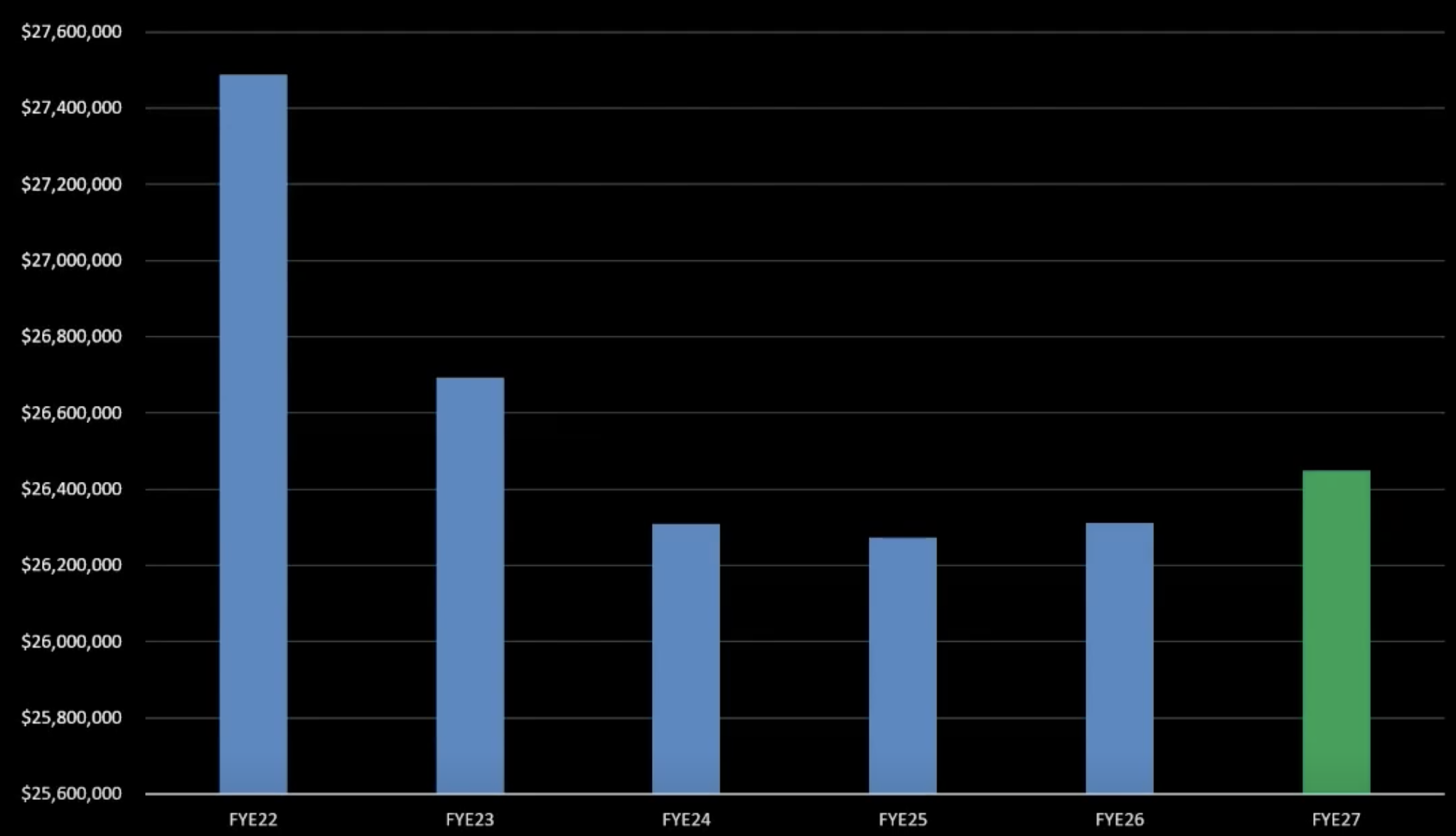
Eureka’s General Fund revenues and expenditures from 2022 to present. The green bar at the right is a projection for Fiscal Year 2026-27. | Screenshot.
A little later in the evening, the Eureka City Council took its first look at the budget forecast for the 2026-27 fiscal year during a joint study session with the city’s Finance Advisory Board. The city’s finance staff are anticipating a $800,000 structural deficit in the General Fund in the coming year, which is about the same as where the city started the current fiscal year.
“We started Fiscal Year 2025-26 with a deficit, and we expect about the same level of deficit next fiscal year,” said Finance Director Lane Millar. “The 25-26 adopted budget showed a deficit of about $800,000. Through cutting materials and supplies, outside services and capital outlay, we made up for those increases in salaries and health insurance, and we were able to actually reduce the size of that budget deficit, but we still have more to go.”

Screenshot.
Those increases in health insurance and salaries account for “93% of all increases citywide,” Millar said. Between fiscal years 2024-25 and 2025-26, the city saw a $417,000 increase health insurance costs. Staff are anticipating a $900,000 increase in the next fiscal year. Liability insurance is also on track to go up by another $400,000, as are unfunded liability payments to CalPERS.
City salaries went up by about 5% in Fiscal Year 2045-25, which cost the city roughly $2 million. Salaries are projected to tick up another 3% in the upcoming year.
“That will cost us roughly a million dollars,” Millar said. “From Fiscal Year 25-26 to Fiscal Year 26-27 these four categories add up to about $2.9 million in increased expenses.”
All told, the city is expecting a 2% increase in General Fund revenues and expenditures.
In response to Councilmember Contreras-DeLoach’s question about where that estimate came from, Millar said the city contracts with a third party that specializes in budget forecasting. However, Contreras-DeLoach pointed out that the forecast is often wrong.

Contreras-DeLoach | Screenshot
“I feel like I’ve spent three and a half years arguing with these numbers, and we have declined and declined and declined and declined,” she said, referring to the city’s annual revenue. “I totally understand the logic behind [forecasting]; it does make sense, right? You know, ‘Let’s listen to the professionals’ — they’re wrong. They’ve been wrong. … I don’t want to count on an increase. If anything, I would like us to come up with a plan for how we’re going to deal with the decrease, and I don’t want to just pull the money or pull the number out of the air.”
Millar acknowledged that there is a “balancing act” in projecting what may happen with the city’s budget. “I’ve accepted their projections, and I tend to be a little more conservative than they are in general,” he said, referring to the third-party forecaster. “I usually point myself towards the expense side of the income statement to kind of build a buffer for that reality.”
James Kloor, a member of the finance board, asked Millar about the $800,000 deficit and how it was projected to impact the city’s reserves.
“Last year, I believe we ended the year with about $12 million reserves, and that represents about three months of operating capital at the end of this fiscal year,” Millar said. “Due to some unexpected expenses that happened mid-year, our reserve levels will be more like two months or 60 days of reserve. That’s about $9 million instead of that $12 million. Since [it is] below our budget policy of three months [of reserves], I actually have to come up with a financial plan to help guide us to get back to three months, and that will come in at a future meeting.”
Staff will provide a more thorough preview of the budget for the upcoming fiscal year at next week’s city council meeting on Tuesday, June 2. The council is expected to adopt the budget at its June 16 meeting.
CLICK TO MANAGE