

Why do People Keep Getting Killed on Eureka’s Streets? A Deep Dive Into the Problem and the Different Ideas That Different People Have to Solve It
Isabella Vanderheiden / Friday, Aug. 21 @ 1:42 p.m. / Traffic

A pedestrian crosses Highway 101 at B Street, a historically dangerous intersection in Eureka. | Photos/graphics by Isabella Vanderheiden unless otherwise stated.
###
Crossing the street in Eureka — especially along Highway 101 where traffic moves fast and protected crosswalks are few and far between — can be a nerve-racking experience for pedestrians and cyclists.
Just the other day, watching traffic pass through downtown from the corner of Fifth and F streets while waiting for my turn to cross the street, I saw two vehicles zoom through red lights and another come to a hard stop midway through the crosswalk. A few weeks ago at the intersection of Broadway and Wabash, I saw a vehicle come dangerously close to hitting a pedestrian traversing the same crosswalk where a man was killed earlier this year. I’ve seen countless other close calls — as well as full-on collisions — while driving and walking in Eureka, seemingly more than anywhere else in the county. Why is that?
Data compiled by the Eureka Police Department confirms that, along with Fourth and Fifth streets, Broadway is one of the most dangerous thoroughfares in the county. More traffic collisions happen on Broadway than any other street in the city. In fact, Eureka ranks among the worst in the state for serious traffic collisions across the board, according to data from the California Office of Traffic Safety (OTS).
In 2017, Eureka recorded 275 injury and fatal traffic collisions, enough to rank first among 94 similarly sized cities with an average population of 26,100 residents. That same year, the city ranked second for injury collisions involving pedestrians and third for incidents involving cyclists. Between 2017 and 2023, Eureka averaged 240 injury traffic collisions per year, as shown in the table below. (The OTS did not have data available for 2024 and 2025.)

Injury/fatal traffic collisions in Eureka between 2017 and 2023.
How does Eureka compare to the rest of the county?
Looking at that same time period, 2017 to 2023, roughly one-third of all injury traffic collisions in Humboldt happened in Eureka, though the numbers fluctuate quite a bit from year to year. Data from the EPD shows a notable uptick in collisions during the work week between noon and 8 p.m.
As show in the table below, Eureka’s collision rate is five to eight times higher than that of Arcata and Fortuna, though it isn’t exactly an apples-to-apples comparison, given the differences in population.

Countywide injury/fatal traffic collisions between 2017 and 2023.
Eureka’s high collision rate is largely attributable to Highway 101. Unlike the county’s six other incorporated cities, the 101 cuts right through downtown Eureka, carrying thousands of vehicles across multiple lanes each day and increasing the likelihood of traffic collisions.
What can be done to reduce Eureka’s collision rate? It depends who you ask.
Increasing Traffic Enforcement
The EPD has employed numerous tactics over the years to reduce collisions on the city’s main thoroughfares, with some success.
In 2025, Police Chief Brian Stephens launched a department-wide effort to boost officer-initiated enforcement, increasing traffic stops by 300%. Earlier this year, the EPD launched “Operation Gateway 101,” a collaborative initiative with the city’s public works and code enforcement departments aimed at improving traffic safety and “quality-of-life concerns” along the Highway 101 corridor. The department launched its “Slow Down Eureka!” social media campaign a few months ago to discourage speeding.
Despite this effort, injury traffic collisions are on the rise. After reporting an 18% increase in injury traffic collisions since the start of 2026, the EPD issued a press release and survey last month seeking public input on improving traffic safety in Eureka.
In a recent interview, EPD Commander Leonard La France acknowledged the uptick in incidents, but told me that traffic collisions are “technically on a downward five-year trend.” Yes, traffic collision reports are up by about 18%, he said, but “criminal” collision reports have actually gone down by 9%.
“Even though we’re on a downward trend, it’s still not good,” La France said, adding that the department’s latest push to reduce collisions is part of its effort to increase proactive policing. “I think we’ve been more vocal about collisions and why we want to stop them [because] we’re getting exhausted by going to injury collisions that are really avoidable. It’s not been happening more; it’s just now we really want to talk about it, and [figure out] how to solve this problem together.”
The vast majority of the city’s traffic collisions occur on the city’s North-South and East-West arterials: Fourth/Fifth, Sixth/Seventh, H/I and Harris/Henderson. As shown in the chart below, Broadway ranked highest for traffic collisions, with approximately 39 incidents recorded since the beginning of the year.
The nightmarish five-way stop at Broadway and West Wabash, where a pedestrian was hit and killed earlier this year, ranks among the most hazardous intersections in the city, along with Buhne and J, Seventh and I, and Harris and H.
But what’s driving these numbers? And why are collisions so bad in these areas in particular?
“I think a lot of it is distracted driving,” La France said. “That’s one common factor we’re seeing [in our data], and it’s not just people on the phone. … They’re driving a vehicle that weighs thousands of pounds without really paying attention because they’re just getting from point A to point B, and it feels to me that people aren’t taking it as seriously as they should. It’s more like a secondary thing that we do to get from here to there … and I think that’s a lack of insight that we’re seeing.”
“Even speeders,” he continued. “We find people doing 50 in a 30, and we ask why and [we often hear], ‘I just wasn’t paying attention,’ which for some people is probably true because it’s a straightaway on H or I street and they hit the gas, and they just don’t realize that all of a sudden, they’re doing 20 over.”
Intentional or not, if you’re going 20 to 30 miles over the posted speed limit, there’s a good chance you’ll end up in jail, La France said.
“That to me is beyond reasonable,” he continued. “We had a collision where some guy blew a red light or a stop sign at Fairfield and Henderson going probably at least 50 miles an hour. [He] crashed into a couple cars, injured someone really bad, [and] we charged them with felony [reckless driving]. [He’s] lucky it wasn’t manslaughter.”
EPD’s push to increase proactive policing has led to an uptick in arrests for both driving and non-driving offenses, but has it made a meaningful impact on people’s driving habits?
As La France puts it, “perception is reality,” so if drivers see an increase in police presence, most of them will alter their behavior accordingly. “Some people won’t because it doesn’t matter to them, but I think a majority of people, when they see a cop, they are reminded that driving is a major responsibility.”

EPD conducts a traffic stop in the Starbucks drive-thru. | Photo: EPD
To reach a wider audience, La France and his colleagues have taken to posting pictures from the scene of traffic collisions to social media — often accompanied by sarcastic quips and hashtags like #YouCantParkThere, #FelonyArrest, #TogetherWeDriveChange and “LowerTheCollisionRate — to show residents what EPD deals with on a daily basis.
“Like, this is why we’re telling you not to drive like this,” he said. “We’ve got to expand who we’re reaching, but how do we do that? … We have some traffic safety videos coming out, and we’ve talked about doing TikTok videos, but I don’t think we’re there yet, although I do love TikTok. … Can we do some videos that are kind of funny but also serious? And again, how do we do that?”
I asked La France about traffic-calming measures implemented in the city in recent years (bulbouts, roundabouts, speed bumps, etc.) and whether he had noticed any changes in driving habits. He acknowledged that certain tactics can have an immediate effect on behavior — “If your car bottoms out [going over a speed bump] you’ll quickly learn not to do that” — but said it’s hard to determine what will have a long-term, meaningful impact.
“I remember years ago — and I mean years — when the Bayshore Mall had some major issues with people speeding in the parking lot, one [general manager], who isn’t there anymore, just went rogue and put up some speed bumps,” he said. “It definitely changed behavior. … The question is, do you want that severe of consequences for that kind of driving behavior? … There are some good ideas, but is it truly effective? I don’t know.”

A pedestrian and her dog cross Highway 101 at G Street in Eureka.
Can Traffic-Calming Measures Solve Eureka’s ‘Traffic Safety Crisis’?
For years, the Coalition for Responsible Transportation Priorities (CRTP) has sounded the alarm over the “traffic safety crisis” plaguing Highway 101 in Eureka. The local nonprofit — which “envisions a North Coast region with vibrant local communities where walking, biking, public transit and other socially and environmentally positive modes of transportation are the norm” — believes that traffic-calming measures are the key to reducing collisions.
“We really try to advocate for the types of improvements that have evidence to support their effectiveness, and the most effective interventions in our research are these street design and traffic-calming interventions that provide protected infrastructure for people walking and biking,” CRPT Executive Director Colin Fiske said in a recent interview. “There’s just an abundance of evidence showing that they do improve safety.”
Take bulbouts, for example. These widely hated curb extensions might be inconvenient to some, especially drivers of large vehicles, but research from the Federal Highway Administration and numerous other entities shows that bulbouts improve pedestrian safety by enhancing visibility.
“I think that’s probably why a lot of people find them annoying, because you do have to slow down quite a bit to make a sharper turn,” Fiske said. “But there’s a safety reason for that, which is that there might be a pedestrian, bicyclist or even another vehicle there that, if you’re making the turn too fast, you won’t be able to see in time.”
CRTP’s 2025 report, “Dangerous Downtown Streets,” examined traffic hazards on Fourth and Fifth streets through locally-sourced data and walking audits. The report concluded that high traffic speeds, failure to yield and poor visibility are among the leading causes of collisions involving both motorized and non-motorized traffic. These factors are amplified at intersections without traffic signals or protected crosswalks.
“Participants in the October 2024 walk audits in the corridor generally found the pedestrian experience in the corridor to be unsafe, unpleasant, and stressful, with many concerns about accessibility for pedestrians with disabilities,” the report states. “Particular concerns about safety and accessibility included crossing Fourth and Fifth Streets at unsignalized intersections, crossing side streets and driveways at unsignalized intersections, various sidewalk and curb ramp accessibility hazards, high noise levels, and lack of adequate lighting.”
The report offers a laundry list of traffic-calming measures to reduce hazards along Highway 101, but few — if any — have been implemented. The city recently installed rapid-flashing beacons at several crosswalks, but it’s not clear if those were already planned or constructed in direct response to the report.
Fiske acknowledged that it takes time to source the funding and do the studies needed to address some of these issues, but in the meantime “people are still dying and getting hurt.”
“The frustrating part of doing this work, having done it for about 11 years now, is that things just tend to take so long,” Fiske said. “After we’ve identified that there’s a problem and everyone agrees that something needs to be done, it still takes a decade for there to be anything done.”

A newly installed rapid-flashing beacon at Seventh and C streets.
The City of Eureka has adopted numerous traffic-calming strategies in recent years. Back in 2018, the city council approved the “Eureka North-South Multimodal Corridor Plan,” which eventually reduced traffic on H and I streets from three to two lanes with a buffered bike lane. A few years later, in 2023, the council adopted a resolution “declaring the importance of complete streets” as part of the city’s commitment to traffic safety and reducing collisions. This led to the construction of 170 new sidewalk bulb-outs throughout the city, as well as flashing beacons at crosswalks and signal reconfigurations at several intersections.
Brittany Powell, a project manager with the city’s engineering department, reported a 20% decrease in traffic collisions on H and I streets since the project wrapped up. Similarly, Powell told the Outpost that signal reconfigurations at Myrtle/West, Harris/S and Buhne/S have “reduce[d] the number of potential conflicts at intersections.”
“The addition of bulb-outs (curb extensions) are proven to slow speeds of turning vehicles and creates shorter crossings for pedestrians,” she added.
Similarly, Caltrans has constructed numerous traffic-calming features along Highway 101 over the past decade through its South Broadway Complete Streets Project, including a pedestrian-activated crossing near Broadway Cinema, separated bike lanes, new transit stops, enhanced pedestrian and cyclist striping, lighting, sidewalk upgrades and a new traffic signal at Hilfiker.
Caltrans, too, has drawn the ire of drivers who feel the projects are unnecessary or even dangerous. Asked to respond to these concerns, Caltrans spokesman Myles Cochrane acknowledged that it can take time to adjust, but said the traffic-calming measures implemented so far have had a significant impact on collisions.
“Caltrans data shows total collisions along U.S. 101 through Eureka have gone down about 70% since 2015. Collisions involving pedestrians or cyclists have gone down about 50% during that same period,” Cochrane wrote via email. The Outpost asked where that figure was sourced, but we’ve yet to hear back. “Since 2015, the state has invested around $50 million in safety and complete streets improvements along U.S. 101 through the city. [Highway] 101 in Eureka belongs to Caltrans; it’s Humboldt’s busiest stretch of roadway, and we’re pleased with the progress.”
Still, traffic-calming measures do have limits.
“Regarding people entering traffic outside of designated crossings, including situations involving impairment or behavioral health, there’s no single easy answer,” Cochrane said. “Highway features cannot prevent every unpredictable action, and sometimes there’s more at play than how we design things. Caltrans follows the Safe System principle that people will sometimes make mistakes, and the transportation system should have multiple layers of protection, so the consequences of those mistakes can hopefully be minimized.”
“The ultimate goal is zero collisions,” he added, “and we need to keep our eyes on the prize.”
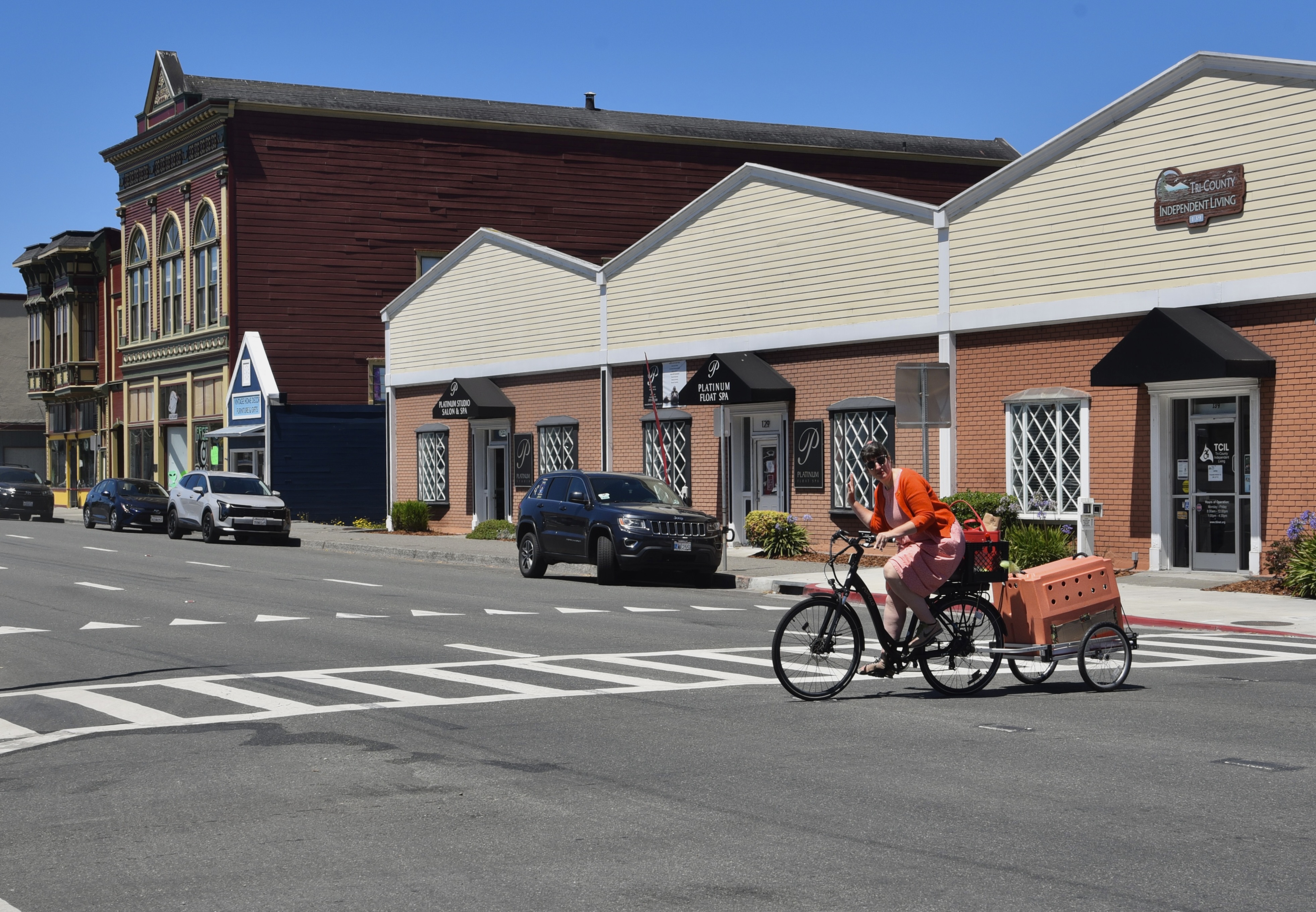
A cyclist crosses Highway 101 at C Street.
Implementing a ‘Vision Zero’ Strategy in Humboldt
While the prospect of “zero collisions” may seem like a pipe dream, the Vision Zero Network believes it’s entirely possible.
[CORRECTION: The Vision Zero Network’s goal is not zero collisions, it is zero traffic fatalities and serious injuries, as explained in more detail below. The Outpost apologizes for the error.]
The Sonoma County-based nonprofit has helped implement advance the Vision Zero Strategy, which originated in Sweden in the 1990s, in dozens of cities across the country. The strategy strives to “eliminate all traffic fatalities and severe injuries, while increasing safe, healthy, equitable mobility for all.”
The Vision Zero strategy is a departure from the “traditional” approach to traffic safety, commonly referred to as the “Three E’s” — Enforcement, Education and Engineering. Vision Zero advocates argue that the Three E’s are too focused on the individual and perfecting driving behavior. Vision Zero, on the other hand, acknowledges that people make mistakes, and to avoid collisions resulting in serious injuries or fatalities, road systems should be designed to reduce the severity of crashes.
“This isn’t a situation where you can say, ‘oh, let’s just put more dollars into traffic enforcement, and we’ll have safer roads’ because no community is going to have a police officer at every corner,” Leah Shahum, founder and executive director of the Vision Zero Network, told the Outpost. “That’s just not feasible. … And yet, there’s an overdependence or overemphasis on traffic stops being able to solve the problem. … There’s also growing recognition around the country that the idea of overemphasizing traffic stops is not only impractical and inefficient, but it can be really harmful in terms of worsening and exacerbating racial disparities.”
To make a meaningful impact on collisions, policymakers need to employ a multi-disciplinary approach that goes beyond the transportation and public safety sectors, Shahum said.
“Transportation planners, engineers, police — they should absolutely be at the table, along with public health partners and folks who work in trauma centers and the hospitals, [because] they have the bird’s-eye view of what’s happening,” she said. “[We need] folks from all these different fields … really coming together [to discuss] what works and what doesn’t in their communities. What do we need now most? What do we need more of? What do we need less of? How do we … modernize our road safety efforts to be most effective, most cost-efficient and most equitable?”
Last month, the Humboldt County Association of Governments (HCAOG) rolled out a series of temporary traffic safety demonstration projects as part of the county’s Vision Zero Action Plan, which is currently underway. Feedback from these traffic-calming projects — located in Arcata, Eureka, Ferndale and Fortuna — will be incorporated into the county’s action plan.
The plan will take some time to develop, but once it’s adopted, it will reshape the county’s approach to traffic safety and inform permanent design decisions to reduce collisions.
“Road design is a critical element for slowing speeds and saving lives, so we work to identify and fund projects across the region in line with best practices for reducing speed and conflicts between vehicles and vulnerable road users like pedestrians and bicyclists,” HCAOG senior planner Stevie Luther told the Outpost via email. “Our consultants are designing a public education campaign that when implemented will encourage safer behavior from all road users, targeted to address specific problems like distracted driving and speeding.”
The public draft is slated for release in October, and a public meeting will follow. The final plan will be reviewed by the HCAOG board in December.
Want to share your thoughts? Take the survey here.

Traffic-calming projects like this mini roundabout at Humboldt and G streets in Eureka have been installed across the county. | Photo: HCAOG
In Closing, A Plea From a Pedestrian
Getting hit by a car is a jarring and terrifying experience. If you live through it, it will change the way you interact with other vehicles, pedestrians and cyclists for the rest of your life. I would know; I was hit by a car while crossing Highway 101 at E Street on a January night in 2023.
I had met with a friend earlier in the evening, and I was standing at the corner waiting for the green light. When the signal turned in my favor, I looked both ways and stepped off the curb into the crosswalk. I had made it maybe two steps when I was suddenly pushed to the ground, hitting my head and scraping my face on the asphalt.
Before I could comprehend what had happened, a gray-haired man with thick-rimmed glasses in a silver SUV pulled up to the curb. He rolled down his window and asked if I wanted him to pull over. My immediate response, which may come as a surprise to those of you who haven’t gone through a shocking and disorienting experience, was to say, “I’m fine!” The man didn’t think twice and continued north on the 101.
As I scraped myself up from the sidewalk, I saw the countdown signal was still going and I dashed through the intersection, rubbing my throbbing cheek. I heard someone near the Starbucks shout, “Hey, are you OK?”
“I’m fine!”
I didn’t go to the ER that night because I felt fine, which was probably influenced by the concussion. My jaw hurt a little, and so did my hip, which bore most of the impact, but it was probably no more damage than an ordinary fall would do, right? And as strange as it may sound, I was actually embarrassed about what had happened to me.
I went to the ER the next day and was told that, yes, I had a concussion and deep bruising on my hip, and that I had a hairline fracture in my orbital cavity, just below my left eye. Noting too serious, but the attending physician still admonished me for waiting a full 12 hours to go to the ER, warning that I could have had a collapsed lung or internal bleeding.
Over the days and weeks that followed, I replayed the scene over and over in my head, imagining what could have happened if I had been just two or three steps further into the crosswalk. It took a couple of weeks before I worked up the courage to walk to work again, and when I finally did, I watched the cars around me with a degree of caution and paranoia I had never experienced before. Even still, if a vehicle approaches the crosswalk too quickly, I hesitate before crossing the street.
While working on this story, I spoke with a lot of people who know a lot more about the topic of traffic safety than I do, but I kept coming back to my own experience and how it has changed my walking and driving habits. Sure, EPD can increase enforcement and the city can build a new roundabout at a problematic intersection, but above all, the onus is on each and every one of us to be responsible and help keep each other safe.
BOOKED
Yesterday: 10 felonies, 14 misdemeanors, 0 infractions
JUDGED
Humboldt County Superior Court Calendar: Yesterday
CHP REPORTS
No current incidents
ELSEWHERE
RHBB: CDFW Announces Angling Closure at Mouth of the Klamath River
RHBB: Humboldt Bay Area Plan Planning Commission Workshop on Thursday, Sept. 3
A Month of Friday Night Markets in Arcata Kicks Off Tonight With Duane Flatmo’s El Pulpo Magnifico
LoCO Staff / Friday, Aug. 21 @ 10:29 a.m. / Business

El Pulpo. | Photo via Humboldt Made
###
Press release from Humboldt Made:
ARCATA, CA - August 2026 - There is something special about late summer in Arcata. The students return, the Plaza comes alive, restaurants fill up, musicians take to the streets, and the energy that makes Arcata so uniquely Arcata returns.
Following another incredible season of Eureka Friday Night Market, Humboldt Made is bringing Friday nights to Arcata. In partnership with the Arcata Chamber of Commerce and the City of Arcata, the Humboldt Made Arcata Friday Night Market will take place every Friday from August 21 through September 11.
Each week will bring live music, local food and drinks, Humboldt Made vendors, artists, nonprofits and local businesses to the Plaza, along with a different theme and a few surprises.
And opening night is going to be a big one. On Friday, August 21, Humboldt Made will welcome Cal Poly Humboldt students back to town with an extended market from 5:30 to 10:00 p.m., live music from The Undercovers and one very special guest: El Pulpo Magnifico.
If you’ve never seen a 28 foot metal octopus shoot flames into the night sky, this is your chance. Created by Eureka artist Duane Flatmo and his crew in 2011, El Pulpo Magnifico was built primarily from repurposed materials and has become one of the most recognizable art cars at Burning Man. It has traveled around the country, bringing a little bit of Humboldt’s creativity and weirdness everywhere it goes. Before heading back to the desert this year, El Pulpo is making a stop at home on the Arcata Plaza.
“It represents wonder, creativity, and the idea that art should be experienced, not just observed,” said Andrew Goff of El Pulpo Magnifico. [DISCLOSURE: Goff is our coworker here at Lost Coast Outpost.] “When we take El Pulpo around the country, we like to think that we are flying the Humboldt flag.”
For Goff and the El Pulpo crew, the best part isn’t the flames or even the size of the sculpture. It’s watching people experience it.
“It’s the smiles,” Goff said. “It’s the obvious joy you see when people realize this thing exists and was created for their enjoyment.”
That feels like a pretty perfect way to kick off Friday Night Market.“Friday Night Market is about so much more than putting on an event,” said Rosa Dixon, Executive Director of Humboldt Made. “It’s about giving people a reason to come downtown, discover a business they’ve never visited, buy something from a local maker, grab dinner, dance in the street, and remember how much fun it is to be part of this community. And honestly, I can’t think of a more Humboldt way to welcome students back than with live music, great local food, and a 28 foot fire breathing octopus.”
A Very Different View of El Pulpo
For anyone who wants to make opening night a little extra special, Humboldt Made is also opening the Plaza View Room for a one night only VIP experience. Located above the Plaza, the room will give guests a bird’s eye view of Friday Night Market and one of the best views in town when El Pulpo comes to life below.
The VIP room will have special food and libations throughout the evening, and each ticket also includes one complimentary drink ticket to use at the market bars and a Choose Humboldt tote bag.
VIP tickets are $40 and space is limited. With El Pulpo only appearing on August 21, tickets are expected to sell out. Get August 21 El Pulpo VIP tickets
Whether you’re watching the flames from above or standing right in the middle of the Plaza, opening night is meant to be an experience.
Four Fridays, Four Different Nights
The fun won’t stop after opening night. Each Friday of the Arcata season will have its own personality and another reason to come downtown.
August 21: Welcome Cal Poly Humboldt students back to Arcata with an extended market from 5:30 to 10:30 p.m., live music from The Undercovers and El Pulpo Magnifico lighting up the Plaza.
August 28: Get your Whimsygoth on at Friday Night Market, then continue the evening at the Illuminature Full Moon Light Festival at Carlson Park.
September 4: Celebrate the legacy of Sunflower with live music from Makenu.
September 11: Close out the season with DJ Rad, Bella Fire Dance and a Yacht Rock after party at The Basement.
Regular Friday Night Market hours are 5:30 to 8:30 p.m.
“Arcata is at its best when we bring people together,” said Meredith Maier of the Arcata Chamber of Commerce. “This market is a great example of what can happen when our organizations, businesses, artists, and community work together. It brings incredible energy downtown, supports our local businesses, and creates the kind of shared experience that makes Arcata such a special place to live and visit.”
The partnership behind the market is a big part of what makes it possible. Humboldt Made, the Arcata Chamber of Commerce and the City of Arcata have worked together with downtown businesses, artists, musicians, vendors and community partners to create four Friday nights that encourage people to stay downtown, explore Arcata and support local.
Visitors can grab dinner, have a local beer or cocktail, shop from Humboldt makers, listen to live music, discover a downtown business they’ve never visited, or simply meet friends and enjoy an evening on the Plaza.
The 2026 Arcata Friday Night Market season is supported by Redwood Capital Bank, Sysco, Wildberries Marketplace, Eureka Natural Foods, Cannifest, Cal Poly Humboldt, the City of Arcata and Alchemy Construction.
Bring your family, meet your friends, welcome the students back to town and help us kick off another season of Friday nights in Arcata.
The Humboldt Made Arcata Friday Night Market begins Friday, August 21, from 5:30 to 10:00 p.m. on the Arcata Plaza and continues every Friday through September 11.
VIP tickets for the August 21 El Pulpo Magnifico Plaza View experience are $40 and available through the Humboldt Made event calendar.
About Humboldt Made
Humboldt Made supports and promotes the makers, growers, producers and locally owned businesses of Humboldt County. Through marketing, community events, partnerships, advocacy and economic development initiatives, Humboldt Made works to strengthen local businesses, build connections and encourage residents and visitors to Choose Humboldt.


MILE POST FIRE UPDATE: Armed With a Variety of Drones and Favorable Weather, Firefighters Have Held it at Around 7,600 Acres, With About 75 Percent Containment
LoCO Staff / Friday, Aug. 21 @ 9:50 a.m. / Fire
The current state of the Mile Post 18 Fire. As of this writing, the most recent VIIRS satellite imagery shows only one “hot” pixel, in the center of the fire.
Press release from California Team One:
Public Information: 530-625-2124
Hours: 8 a.m.–8 p.m.
Email: 2026.mp18@firenet.gov
Incident Website: linktr.ee/MilePost18FireAcres Burned: 7,610
Containment: 74%
Start Date: 8/7/26
Personnel: 1,644Final community meeting for California Team 1 tonight
Operational Update: California Interagency Incident Management Team 1 will host its final community meeting at 6 p.m. today at the Hoopa Valley Tribal Office in Hoopa, California. Team members and community leaders will provide updates on the fire’s status and community resources, followed by questions from attendees. The meeting will also be available online on the Mile Post 18 Fire Facebook page. Attendees don’t need a Facebook account to watch the meeting. The team expresses gratitude to the local communities for their hospitality and support throughout the incident.
Firefighters increased containment line width through strategic firing operations along the eastern edge of Mill Creek. Between Oil Springs Road and 2 Mile Road. Unmanned aerial systems (drones) deployed incendiary devices deeper into the Mill Creek drainage to further reduce interior fuels which caused the growth in acreage.
Crews also used unmanned aerial systems equipped with infrared technology to identify heat sources around the entire perimeter to extinguish. Firefighters will continue seeking out any remaining heat to suppress and fortify containment lines.
Mastication work has begun along Big Hill Ridge, focusing on clearing downed and dead fuels to reinforce the containment line and clean up the road. Firefighters are also patrolling the western edge of Mill Creek, Highway 96, and Skunk Creek, searching for and extinguishing any remaining interior heat and monitoring for potential hazards.
Weather: A small chance of scattered thunderstorms is expected today, bringing increased humidity and lower temperatures. Wind gusts up to 20 miles an hour, as well as the potential for lightning, are forecast. Winds shifting out of the southwest could challenge containment lines as winds and topography align and push fire weakened trees that have been exposed to fire for the last several days. Firefighters have been assigned to any initial attack responsibilities for any new starts or spot fires.
Evacuations:
Evacuation orders are in place for HIA-E002-A and HIA-E014-D. Evacuation warnings have been issued for HIA-E002-B, HIA-E014-E, and HIA-E014-F. Closures may change rapidly, so please consult protect.genasys.com for the latest alerts.
Road Closures: Closures are in effect for Hostler Ridge Road, Mill Creek Road, and Big Hill Road due to fire activity.
Autopsy Reveals That a Previously Reported Drowning Death in the Trinity River Was Actually Caused by a Heart Attack, Sheriff’s Office Says
LoCO Staff / Friday, Aug. 21 @ 9:13 a.m. / News
PREVIOUSLY
- Sheriff’s Office Reports Third Trinity River Drowning Within a Week
- OBITUARY: Richard Scoville, 1963-2026
###
Press release from the Humboldt County Sheriff’s Office:
The Humboldt County Coroner’s Office has completed the death investigation into the death of 63-year-old Richard Scoville, who was recovered from the Trinity River near Kimtu Beach on July 22, 2026.
The autopsy determined that Mr. Scoville’s cause of death was a sudden cardiac event. The manner of death was determined to be natural. The findings confirm that Mr. Scoville did not die from drowning, as was initially reported on July 23, 2026.
The Humboldt County Sheriff’s Office extends its heartfelt condolences to Mr. Scoville’s family, friends, and loved ones during this difficult time.

Lawmakers Gut Major DUI Reform Through ‘Hostile Amendments’
Lauren Hepler and Robert Lewis / Friday, Aug. 21 @ 7:32 a.m. / Sacramento

State Sen. Sabrina Cervantes addresses the media during a press conference with fellow California Democrats at the Capitol Annex Swing Space in Sacramento on Aug. 18, 2025. Photo by Miguel Gutierrez Jr., CalMatters
###
This story was originally published by CalMatters. Sign up for their newsletters.
###
A California Senate committee just gutted one of the state’s most substantial DUI reform bills in years, despite widespread support from other lawmakers and families of drunk driving victims.
The bill would have required in-car breathalyzers for anyone convicted of a DUI, bringing California in line with most states. State law currently only requires the devices, called ignition interlock devices, after repeat offenses or injury crashes.
Sabrina Cervantes, a Democrat from the Inland Empire and chair of the Senate Appropriations Committee, provided a hint of changes last week when she said there were amendments to the bill that had been approved unanimously by the committee. This week, an updated version of the legislation emerged, and it effectively killed a key provision to start requiring the devices for thousands of first-time offenders. Such changes are commonly referred to as “hostile amendments” because they are made without the involvement or support of the bill’s author.
Cervantes was arrested for a DUI in a high-profile incident in Sacramento in May 2025. The District Attorney’s Office did not prosecute her after a blood test showed no drugs or alcohol in her system. Cervantes then sued the city of Sacramento and several of its police officers, alleging that that police fabricated evidence and falsely arrested her. Cervantes’s sister, state Assembly candidate Clarissa Cervantes, has herself been convicted of two DUIs in Southern California, according to media reports.
Sabrina Cervantes did not respond to our request for comment for this story. We will update it if she does.
As news of the bill’s gutting spread this week, Kellie Montalvo was left wondering if there’d been some sort of horrible mistake. Montalvo, whose 21-year-old son Benjamin was killed by a drunk driver in Cervantes’s district in 2020, said she was just in Sacramento two weeks ago lobbying lawmakers – including Cervantes – on a slate of dangerous driving bills. Many of those bills have already failed.
“It’s heartbreaking, and I try to tell myself not to lose hope,” Montalvo said. “I mean, California has got to do something. Our numbers are horrific.”
Alcohol-related roadway deaths in California spiked more than 50% in a decade — an increase more than twice as steep as the rest of the country, federal data shows. More than 1,300 people die each year statewide in drunken collisions.
Over the last two years, a CalMatters investigation has shown how state officials have allowed dangerous drivers to stay on the road and kill, and how elected leaders have looked away even as the death toll skyrocketed.
For years, lawmakers have tried and failed to require in-car breathalyzers for all DUI offenders. Progressive justice reform groups and the DMV have opposed similar bills in the past, citing fears about unfairly penalizing poor DUI offenders, high costs and the DMV’s aging technology. .
Montalvo and other advocates thought this year might be different. The DMV has actively participated in state hearings and, she and others said, provided technical advice to make sure the bill was realistic. Gov. Gavin Newsom also instructed lawmakers last year to continue to work on the state’s breathalyzer laws and develop a “a lasting program that strengthens public safety.”
It’s unclear why this year’s bill was gutted at the 11th hour. Public records show that Senate Appropriations committee staff recently expressed concern about costs.
The amendment process is opaque even to Sacramento insiders.
“Honestly it’s sometimes a bit of a black box even for us as legislators,” said the bill’s author, Assemblymember Cottie Petrie-Norris, an Orange County Democrat. “I am still trying myself to get to the bottom of it.”
Petrie-Norris, who has spent the past three years trying to pass a version of this bill, said she does not believe Cervantes’ personal experience played a role in the decision to amend the bill. She added that she is still working to re-amend the measure after “unintended consequences” that she says would make the policy unworkable for the DMV and hurt California’s eligibility for federal funding.
Asked for an interview to explain the changes to the bill, Senate President Pro Tem Monique Límon’s office referred questions to Cervantes. Diana Crofts-Pelayo, Newsom’s chief deputy director of communications, also declined to answer questions about the breathalyzer bill, saying the office does not typically comment on pending legislation.
While the bill heads into the final days of negotiations, Montalvo and other victims’ families are grappling with deja vu. It was just about a year ago that they were standing in the Capitol with photos of their loved ones and told the bill was doomed.
She stays busy checking in with the parole officer for the Riverside County driver who killed her son. Last she heard, the driver was trying to get her license back after being released early from prison.
Homeless Counts Dropped in These California Counties This Year
Marisa Kendall / Friday, Aug. 21 @ 7:30 a.m. / Sacramento
This story was originally published by CalMatters. Sign up for their newsletters.
###
California reduced its official homeless count in 2025 after years of increases. Now, preliminary data for 2026 shows many places in the state are continuing to make progress.
Counties up and down the state are reporting that their homeless populations dropped this year, citing early results of the point-in-time count conducted in January. Some of the drops were significant. San Joaquin County cut its total unhoused population by nearly a third compared to 2024 and nearly halved the number of people sleeping on the street without shelter. Others were more modest, such as San Francisco’s 4% drop.
Of the 28 counties or continuums of care (which group smaller counties together into single counts) that released 2026 data, more than half reported a decline in homelessness. Eight others did not conduct a point-in-time count this year, while seven had not publicly released their results.
Officials in counties where the homeless count dropped credit their progress to creating more shelter beds and low-income housing, which they say was made possible by new state funds released over the past several years.
At the same time, some activists are questioning whether the numbers really are as rosy as they seem. Cities have ramped up enforcement against unhoused people in recent years – clearing encampments and citing people for illegal camping more frequently – which causes people to scatter and become harder to count. Just because someone is missing from an official count doesn’t mean they moved off the street and into housing.
Even in counties celebrating wins this year, officials wonder whether they can maintain those gains in the face of recent federal cuts to Medi-Cal and social services.
“We’ve made progress,” said Jonathan Russell, director of Alameda County Health Housing and Homelessness Services, which reported a 13% drop in homelessness compared to 2024. “And there are real threats, real peril.”
What the 2026 point-in-time counts show
The federal government requires every county to conduct a point-in-time census of its homeless population at least every other year, though some do it every year. Typically, volunteers join city, county and nonprofit staffers on a single night in January to tally every unhoused person they see. The results are generally considered an undercount, as it’s easy to overlook people tucked away behind bushes or hunkered down in parked cars. But despite the count’s flaws, it’s the only standardized way the state (and the rest of the country) has to measure fluctuations in its homeless populations.
There were 181,934 homeless Californians counted last year – a nearly 3% drop from 2024. The U.S. Department of Housing and Urban Development, which compiles the data from each county, won’t release the official statewide or nationwide 2026 count for many months. But most counties that did a 2026 count have published the preliminary results on their own.

In some counties, the results were disappointing. Los Angeles County, after two years of declines, reported a 1% increase in homelessness this year. Homelessness increased 13% throughout Sacramento County from 2024, though it was down within the city of Sacramento.
Contra Costa County, after a significant decrease between 2024 and 2025, saw homelessness creep up 7% this year.
In addition, there were several reminders this year that the point-in-time counts are not perfect. The Los Angeles Times uncovered an accounting glitch that inflated the city’s homeless count by more than 600 people.
In Central California, Fresno and Madera counties, which combined reported a 34% drop in homelessness compared to last year, appeared to have the largest reduction in the state. But the counties changed the way they counted this year, potentially skewing the numbers. Instead of tallying everyone who was visible on the street as they did in 2025, this year, volunteers counted only people who confirmed they are homeless and agreed to participate in a survey. That change makes this year’s count difficult to compare to 2025 data, officials admitted.
Some counties touted wins in moving people off the street and into shelters – a feat that’s considered progress even though those people are still considered homeless. In Alameda County, the percentage of unhoused people living in shelters increased from 21% in 2019 to 37% this year.
Alameda County reached another significant milestone last year: for the first time since the county began tracking in 2021, slightly more people left homelessness and moved into housing than became newly homeless.
Russell credits a major influx of state homelessness dollars that appeared in the county’s coffers about four years ago, including investments in Homekey (the state program that helps cities and counties buy hotels to turn into homeless housing) and the state’s Homeless Housing, Assistance and Prevention fund. The state also awarded additional housing funds for homeless Californians with mental illness and substance use disorder in 2023 and 2024.
San Joaquin County, which boasted one of the biggest drops in overall homelessness and unsheltered homelessness in California, added 304 shelter beds and 1,078 permanent housing units between 2024 and 2026. That allowed the county to increase the number of people living in permanent housing by 86%.
“There just wasn’t money available 10 years ago like there is now,” said Dawn McLeish, deputy director of the county’s human services department. “It just took a couple years for those investments to get all the way off the ground.”

Niki Jones, executive director of the Sacramento Regional Coalition to End Homelessness, views downward-trending numbers across the state with suspicion.
“They can call it progress if they want to,” she said. “I call baloney.”
After the U.S. Supreme Court in 2024 gave cities more leeway to crack down on homeless encampments, cities have passed new ordinances banning camps, police are giving out more citations for camping-related offenses and activists are reporting more frequent encampment clearings. When people are forced to disperse from their camps, they become more difficult to spot during point-in-time counts.
“It’s a lot harder to find one person with a blanket somewhere than it is to see a camp,” Jones said.
A recent study looking at the Skid Row, Hollywood and Venice neighborhoods in Los Angeles found the overall level of unsheltered homelessness didn’t change between December 2024 and January 2026. But the number of people living in tents dropped 23%, while the number of people “sleeping rough” (without a tent, tarp or other shelter) increased 20%, according to data from the nonprofit research organization RAND.
That shift away from camps could pose a challenge in getting people into housing, as Los Angeles Mayor Karen Bass’ main intervention – the Inside Safe program – specifically targets people living in tent encampments and moves them into hotels. In addition, rough sleepers generally have a harder time holding onto their personal documents and phones, making it harder for them to navigate the process of getting into housing, according to the study.
Increased enforcement could lead to people going uncounted, but it’s hard to tell how much that is really affecting point-in-time count results, said Roxanne Wilson, homeless services director for Monterey County. She does know that she’s seeing more people in her community move into housing.
Monterey County saw a 15% decrease in overall homelessness compared to 2024, while the number of people living outdoors dropped by nearly a quarter. Wilson attributes that largely to state funds. Monterey County won three state Encampment Resolution Grants that helped it move more than 150 people out of encampments along the Pajaro River levee, in Soledad and in King City. The money went toward opening a new shelter for the Pajaro River residents in Santa Cruz County, tiny homes in Soledad and hotel rooms in King City, Wilson said. People moved from the camps into those temporary accommodations, where they could then focus on securing permanent housing.
Wilson called that a “huge accomplishment.” But state homelessness funding comes in the form of one-time grants, meaning counties never know for sure how much money they’ll get next year – or if they’ll get anything at all. That makes it hard to plan ahead and invest in long-term strategies.
“The reality is that it’s going to be hard to hold this line,” Wilson said, “if we don’t start having more stable funding sources.”
OBITUARY: Thomas Eugene Sutton, 1955-2026
LoCO Staff / Friday, Aug. 21 @ 6:56 a.m. / Obits

Thomas Eugene Sutton (Tom) passed away peacefully with his wife Sandy, children Matt and Melissa, daughter-in-law Shayna, and son-in-law Chad, together with his grandchildren Madison, Skylar and Bode, plus Reese and River, in Redding on July 23, 2026.
Born in Eureka to Martha Rose and Eugene Raymond Sutton on January 20, 1955, Tom enjoyed a childhood full of scouting (Eagle Scout, 1970), motorcycle racing, and a series of newspaper delivery jobs that introduced him to the residents of a convalescent home on Harrison Avenue in the late 1960s. This opened opportunities for Tom as he became a carpenter and handyman there, which resulted in his running construction crews for a man who became his mentor in senior care, Larry Debeni. This continued through his time at Eureka High School, followed by College of the Redwoods and Humboldt State, where he graduated in 1976 with a degree in business.
Upon finishing school, Larry hired Tom to manage Granada Hospital on Harris Street. Tom and Sandy were married in 1976 and lived in several homes in Eureka, eventually purchasing a 5-acre property with a beautiful home at the base of Campton Hill, where they resided throughout the raising of Matt and Melissa and enjoying many animals, including horses, sheep and goats, on their property.
Tom was hugely successful in Senior Care and went on to manage all of Larry’s facilities. He bought Larry’s business in 1990 in his mid-30s. Tom continued to build his business in senior care and skilled nursing and sold it at the age of 41. This was the first of several “retirements.”
Tom was just not the kind of guy who could rest on his laurels, and he shifted his activities to construction, to real estate investments, and to building what is now known as Cutten Mini Storage, which he later sold to his daughter Melissa and son-in-law Chad.
In his later years, Tom developed an interest in vintage cars, building a 1966 Shelby Cobra “kit car” from the ground up with lots of help from his friends in Eureka. More recently, he bought and fine-tuned a 1947 Hudson pickup and a 1932 Model A Roadster. He also bought a 2025 Harley Davidson Limited Edition Trike for getting around town!
Tom is survived by his sister Laura, brother Joe (Suzette), and sister Rose (Mark), and many nieces and nephews.
A private family service is planned on October 17, 2026, at Tom’s gravesite, followed by a celebration of life which starts at 5 p.m. with his many friends and associates at the Elk’s Club.
###
The obituary above was submitted on behalf of Tom Sutton’s loved ones. The Lost Coast Outpost runs obituaries of Humboldt County residents at no charge. See guidelines here. Email news@lostcoastoutpost.com.


