

California Sheriffs and DAs Are Getting a Rare Political Perk — 6-Year Terms
Nigel Duara / Wednesday, Oct. 8, 2025 @ 7 a.m. / Sacramento

###
[NOTE: Humboldt County Sheriff William Honsal and Humboldt County District Attorney Stacey Eads were both elected (or re-elected, in the former case) in 2022. That, as you’ll read below, means that neither office-holder will have to face re-election until 2028. —RB]
###
This story was originally published by CalMatters. Sign up for their newsletters.
###
A Bay Area sheriff facing imminent removal will get an extra two years in office if the move to oust her fails because of a little-noticed change in California law that moved the dates for local law enforcement elections.
San Mateo County Sheriff Christina Corpus has an unusual six-year term because state legislators in 2022 changed the law to put elections for sheriffs and district attorneys in the same years as presidential elections, which meant moving local campaigns originally slated for 2026 to 2028.
Every sheriff or district attorney who ran in 2022, including Corpus, got those two extra years, unless the official was removed from office in the meantime. That means they get two additional years for voters to forget about a scandal, or ride out other controversies.
San Mateo County moved a step closer to removing Corpus this week when retired Superior Court Judge James Emerson found cause to remove her on Monday night, more than a month after a two-week trial that included a cascade of allegations portraying a chaotic picture of her two-plus years in office.
Emerson found that Corpus had “a close personal relationship outside the boundaries of a professional working relationship” with a subordinate, unlawfully ordered the arrest of the president of the sheriff’s deputies’ union and retaliated against a captain who refused to conduct the union president’s arrest because he believed it violated state law.
“Appellant Sheriff Corpus’s purportedly non retaliatory justification for ordering an investigation against (the deputies’ union president) is, at the very least, questionable and, more likely, pretextual,” Emerson wrote in the advisory opinion.
Emerson’s recommendation will be heard in a separate hearing by the San Mateo County Board of Supervisors, which already voted 5-0 in June to proceed with the process to remove Corpus.
6-year-term once had an appeal
When former Corpus supporter Jim Lawrence first learned of the proposed change to election dates during Corpus’ 2022 campaign, he was delighted.
“We were so high on (Corpus), we campaigned for her, it was such a welcome change,” said Lawrence, board chair of the nonpartisan nonprofit Fixin’ San Mateo, which advocates for civilian oversight of the San Mateo Sheriff’s Office.
“We were gonna have someone pushing for visibility, transparency, accountability, and we didn’t have to deal with the (2026) election cycle. We could wait until 2028. There was just almost no downside.”
His feelings about the sheriff have changed.
“She had an amazing group behind her: house parties, street parties,” Lawrence said. “We got behind her and then she got in the office and made a complete about-face. It’s just, it’s really hard. How can the residents of San Mateo County live with this for another two-and-a-half years? It’s just unbelievable.”
Corpus could not be reached for comment.
The issue is of particular import to the group of San Mateo County residents who led a recall effort against Corpus this year.
After a county investigator found Corpus violated policies on nepotism and conflicting relationships, voters in April passed a measure empowering the county board of supervisors to remove her. If successful, it would be the first removal of a county sheriff in California history.
In the meantime, unions representing San Mateo County Sheriff’s Office deputies and sergeants have issued no-confidence votes in Corpus. Six cities in San Mateo County called for her ouster.
Why California moved sheriff elections
The law to change election years came about because California Democratic legislators sought to put elections for county offices on the years where voter turnout is highest, an effort that was opposed by Republicans in the Assembly and Senate.
“Overall, presidential elections attract significantly more voters than midterm elections,” the League of Women Voters of California wrote in 2022 in support of the bill. “Furthermore, midterm electorates include fewer people from underrepresented populations – including youth, Black, Latino, and Asian American people than do presidential electorates.”
The move faced opposition from the California State Sheriffs’ Association, which argued that presidential year elections are “no guarantee that voters will examine their choices more carefully.”
“A longer election ballot could result in voter fatigue and fewer votes cast in ‘down-ticket’ races,” the sheriffs’ association wrote in opposition to the bill.
Fresno County voters went as far as passing a ballot measure last year that would have forced the county to maintain off-year elections for sheriffs and district attorneys. Attorney General Rob Bonta sued, and a Fresno County Superior Court judge sided with Bonta and the state, keeping Fresno’s county elections on the presidential election calendar.
In Alameda County, the successful 2024 campaign to oust former District Attorney Pamela Price was lent heightened urgency by the prospect that she would serve until 2028 if not recalled. The Alameda County Board of Supervisors picked new District Attorney Ursula Jones Dickson as her replacement.
As for Corpus, even if the county board of supervisors votes to remove her, the Palo Alto Daily Post reports that a San Mateo Superior Court judge overseeing Corpus’ lawsuit against the county ruled that Corpus won’t be removed right away.
The judge ruled she should receive some extra time to challenge her removal: not an extra two years, but an extra two weeks.
BOOKED
Today: 3 felonies, 10 misdemeanors, 0 infractions
JUDGED
Humboldt County Superior Court Calendar: Today
CHP REPORTS
No current incidents
ELSEWHERE
RHBB: Humboldt County Roads Report
Governor’s Office: Governor Newsom names new California Public Utilities Commission President to launch new phase in effort to protect consumers from escalating utility costs
RHBB: River Runs High as Covelo Community Waits for Answers
Governor’s Office: California files lawsuit against Trump for illegally terminating $1.2 billion in energy and infrastructure programs
OBITUARY: Ricky Wright, 1939-2025
LoCO Staff / Wednesday, Oct. 8, 2025 @ 6:56 a.m. / Obits

Ricky was born in 1939 to Rae and Marge Wright and passed peacefully in her home with family at her side on September 29, 2025. She was the younger and only sibling of Marilyn Wright Forsell, who passed away in 2024. Rae and Marge were from long-time Petrolia and Ferndale families, and they raised their daughters primarily in Ferndale before later moving to the Miranda area. Ricky graduated from South Fork High School. She had many fond childhood memories of spending time with her grandparents exploring Petrolia and likely causing mischief.
All who knew Ricky knew of her lifelong love of animals. She was never without a dog and a menagerie of animals. Over the years, she assisted in the rescue of many neglected animals and wild critters.
Prior to retiring, Ricky was a medical assistant in several local doctors’ offices. After retirement, she spent numerous years providing care to elders in their homes. She took great pride in her skills and abilities tending to patients in both settings and was fondly regarded for the care she provided. One of her specialties was caregiving for “grumpy old men” with whom she would enjoy lively banter.
Ricky was very generous and helped people in need — at times to her own detriment. She was a smart, curious person who charmed people from all walks of life with her quick wit and rambunctious nature.
She lived life on her own terms and loved deeply her pets, friends, and family. She was unpretentious, and simple things in life brought her pleasure — like the smell of a pepperwood tree, laundry on the clothesline, the start of football season, and the feel of the breeze through a window.
As anyone who has enjoyed eating one of her homecooked meals or tasted one of her homemade apple pies can attest, Ricky was a fantastic cook who never skimped on butter or heavy cream in a recipe and who delighted in discussing recipes, tips, and tricks with her family and friends.
She is survived by her daughters Lynn Langdon and Jody Toste (Tim), her grandchildren, Kyle, Morgan (Gabe), and Madison, her great-grandchildren Chaz, Cade, Callee, and Kasen, and her nephews Drew and Matthew Forsell and families.
The family would like to thank her neighbors, James Baer and family, and her good friends Laurie Newman and others who supported her these last challenging years of her life. We are also very grateful for the excellent services Ricky received from the PACE program, Agape, Hospice, and for the Fortuna Fire Department, particularly the Hydesville crew, who always treated her with kindness.
At
times like this,
We may look through books for the perfect
words
To give form to our feelings,
Make the
thing complete,
Set the matter at rest.
Yet, in
hours of searching,
Each piece lies rejected – too
precise, too difficult, too sweet,
Too harsh, implying
what we do not wish to say.
But,
look into the grey wide sky,
And the thoughts will come
like this:
Remember me when I loved you most and you loved
me most.
Remember me when I was my bravest and I did you
right.
Then, let that be our secret bond
And,
let us rise in the morning and enjoy the light
And know
that the bird in the mist is returning to the sun.
— Author Unknown
As she would have preferred, no formal services are planned. Final arrangements were provided by Ayres Family Cremation.
###
The obituary above was submitted on behalf of Ricky Wright’s loved ones. The Lost Coast Outpost runs obituaries of Humboldt County residents at no charge. See guidelines here.
(PHOTOS AND VIDEO) Large Pro-Palestine March on Cal Poly Humboldt’s Campus Goes Peacefully
Dezmond Remington / Tuesday, Oct. 7, 2025 @ 4:39 p.m. / Activism

Photos by Dezmond Remington.
A vigil and march for Palestinians killed during the ongoing conflict between Israel and Hamas on Cal Poly Humboldt’s campus drew around 150 students today, who walked a peaceful half mile without incident despite taking up all of Harpst Street and the northbound lane of LK Wood for about 15 minutes.
Organized by the Humboldt chapter of Students for a Democratic Society (SDS), a few dozen students met for two hours in the Art Quad for a vigil before several speakers addressed the steadily growing crowd, which swelled to around 100 people by noon.
The speakers included SDS organizer Rick Toledo and Humboldt California Faculty Association President Ryder Dschida, who both lamented the tens of thousands of people killed since the war started two years ago today and called on the university to be transparent about any investments they might have in Israeli institutions or in weapons companies.
“America has provided over $21 billion in military aid to the Israeli government and [Israeli leader Benjamin] Netanyahu’s government’s ongoing so-called War in Gaza,” Dschida said. “Beginning on the seventh of October, 67,000 of Palestinians have been killed in this ruthless genocide…As a peace-loving person, I cannot and will not accept this. I cannot and will not support a genocide and its supporters.”
Toledo also blasted the university’s administration for denying the organizers permission to meet in the Lower Quad (the section near Library Circle downhill from the Depot), claiming it was because it was too close to a Jewish student organization’s sukkah (a temporary hut, part of celebrating the holiday Sukkot) located in the Upper Quad. Toledo said CPH officials had previously permitted them to assemble there, but later revoked their blessing. (CPH denies this.) Toledo said he felt it was “viewpoint discrimination.”
“I don’t see a conflict, and we don’t have a problem with Jewish religious events. We’re not here to disrupt a Jewish religious event,” Toledo said in an interview today with the Outpost. “We’re just remembering lives lost in Palestine. That was really offensive to us.”
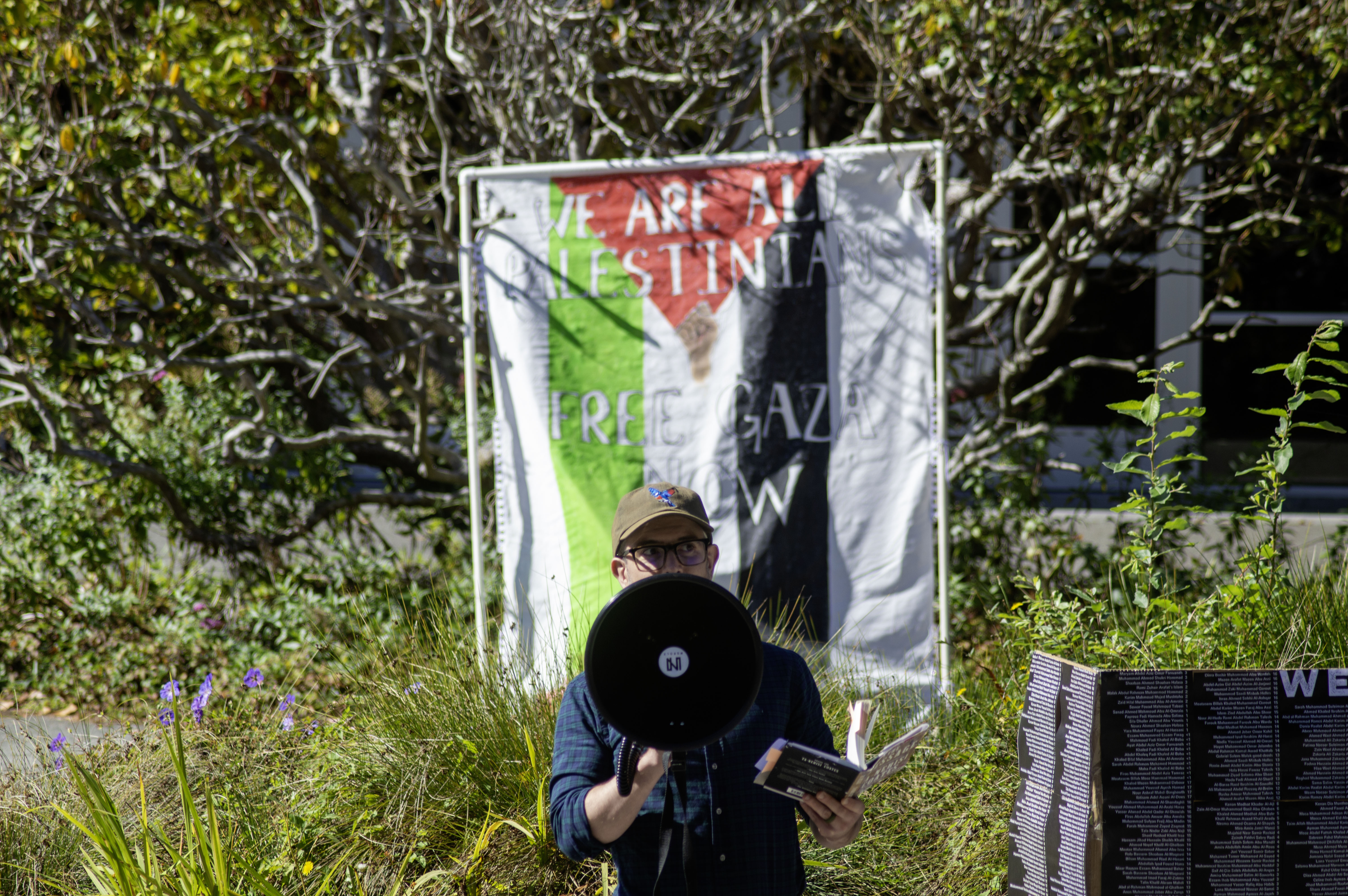
Ryder Dschida addresses the crowd.
CPH spokesperson JoAnn Yamani denied that there was any bias involved in the decision and said it was because the SDS didn’t request to use the quad two weeks out from the event, their content-neutral Time, Place, and Manner policies, and because the quad was already in use today.
“Peaceful expression has long been a part of the University’s culture, reflecting its values of open and respectful dialogue,” reads a statement from Yamani. “Cal Poly Humboldt wholeheartedly supports the constitutional rights of free expression and assembly, and encourages open and respectful discussions, inviting everyone to share their perspectives in ways that contribute positively to the University’s shared learning environment.”
Students who weren’t marching or chanting along with the cries to free Palestine were a little more lukewarm about the spectacle; one woman who had just emerged from the Depot food court with her meal when the protestors arrived at the end of their march wasn’t all that interested.
“Bruh,” she said to a friend while unwrapping her sandwich. “I just want to eat my lunch.”
This article was updated October 8. A previous version of this article quoted Dschida as saying the U.S. has provided $1 billion in aid to the Israeli government.





The sukkah on the upper quad.

They’ve Canceled That Big Prescribed Burn Near Redway For Now, But Calfire Will Go North to Burn Up Some of Cuneo Creek Instead
LoCO Staff / Tuesday, Oct. 7, 2025 @ 2:46 p.m. / Non-Emergencies

A previous controlled burn. Photo: Calfire.
PREVIOUSLY:
###
Remember that announcement yesterday? It’s off. Calfire lets us know that the “Redway Shaded Fuel Break” burn, which sounded like it was going to have an impact on 101, has been canceled “due to reasons beyond Calfire control.”
But that can’t stop the burn. The agency lets us know that they’ll be up in Humboldt Redwoods State Park at roughly the same time they were going to be in Redway, there to torch some land near Cuneo Creek and the Mattole Road.
Press release from Calfire, in its customary who-what-where-when-why format, below:
WHAT: Professionally controlled prescribed burn planned for 75 acres of prairie and timber understory.
WHEN: The prescribed burn will take place as conditions allow on Thursday, October 9th, 2025.
WHERE: Humboldt Redwoods State Park, west of Dyerville. This burn is part of a multiyear plan to enhance prairie health and reduce the threat of uncontrolled wildfire. The treatment will help to enhance the health of the native plant communities, aid in the control of non-native plant species, protect and enhance habitat for multiple animal species, and aid in the reduction of hazardous vegetative fuels.
WHO: California Department of Parks and Recreation, CAL FIRE. During these prescribed fire operations, residents may see an increase in fire suppression resource traffic. Smoke is expected to be visible from Highway 101 and from Mattole Road.
Traffic control may be in place. Please be cautious for your safety as well as those working on prescribed burns.
Learn more how you can prepare for wildfire by visiting: www.ReadyForWildfire.org.
TODAY in SUPES: Board Narrowly Approves Resolution Against Offshore Drilling and Mining
Ryan Burns / Tuesday, Oct. 7, 2025 @ 1:47 p.m. / Local Government

Humboldt County Board of Supervisors (from left): Fourth District Supervisor Natalie Arroyo, Third District Supervisor Mike Wilson, Second District Supervisor and Board Chair Michelle Bushnell, Fifth District Supervisor Steve Madrone and First District Supervisor Rex Bohn. | Screenshot.
###
The Humboldt County Board of Supervisors today took a stand against offshore oil drilling and deep sea mining, though it was hardly unanimous.
Third District Supervisor Mike Wilson brought forward a draft resolution to the board for approval. In introducing it he argued that it’s important to reiterate opposition to these disruptive and polluting industries given President Donald Trump’s recent signing of an executive order to expand offshore oil drilling.
As noted in yesterday’s meeting preview, former President Joe Biden withdrew 625 million acres of federal waters from oil development, effectively banning new drilling along U.S. coastlines. However, Trump’s order repealed that move, and U.S. District Court Judge James Cain later ruled that the Biden administration had exceeded its authority.
Wilson noted that Humboldt County has previously taken a stand against offshore oil drilling and deep sea mining. He asked his colleagues to reiterate that position and to join like-minded local governments in an endeavor called “the Local Government Outer Continental Shelf Coordination Program and Coalition,” which aims to streamline engagement with the federal government.
Wilson said the resolution “speaks for itself,” but First District Supervisor Rex Bohn questioned the need for such a measure.
“There hasn’t been anything done in over 50 years off the coast, right?” he said. (Wilson countered that there are still active derricks down south.) Bohn went on to address offshore wind development, questioning whether fastening cables to the ocean floor would be contrary to any stance against seabed mining. Wilson said they’re “pretty different technologies,” noting that mining is extractive, but Bohn remained skeptical.
Michelle Bushnell, the board chair and Second District Supervisor, then said she wasn’t comfortable approving the resolution until she did more investigating. She asked Wilson where he got all of the information included in the document. He replied that some was taken from previously passed Humboldt County resolutions, plus some elements of one from Santa Cruz County.
Fourth District Supervisor Natalie Arroyo suggested adding language to the resolution about supporting Marine Sanctuaries and Marine Protected Areas. Wilson liked that idea.
During the public comment period, two people spoke in support of the resolution, citing the potential harm to local fisheries by offshore oil drilling and deep sea mining.
Bohn remained unconvinced, saying, “I just don’t know if the threat’s there to be doing this” and again positing that offshore wind development could do “comparable damage.” He also expressed reticence about joining the proposed coalition.
Bushnell agreed. “Appointing you to something that’s not even formed yet is weird to me,” she said, adding, “I just don’t feel great about the whole thing.”
In response, Wilson said, “In order to form an organization, you have to have some people coming together to do it.”
The board wound up approving the resolution by a vote of 3-1-1, with Bohn dissenting and Bushnell abstaining.
Coastal Sign Ordinance
In another vote that revealed board members’ ideological differences, the supervisors narrowly approved three small amendments to the county’s Coastal Sign Ordinance.
The vote broke along the same divide it had a year and a half ago when this ordinance was originally adopted. In the meantime it got sent to the California Coastal Commission for certification. The commission made a few tweaks to the language, tweaks that Humboldt County Planning and Building Director John Ford described as “very minor.”
The ordinance itself sets new standards (size, height, design, location, etc.) for signs and billboards in the county’s unincorporated areas, with an eye toward protecting natural resources. The changes made by Coastal Commission staff were fairly inconsequential rewordings to make the ordinance consistent with the California Coastal Act.
Bohn, who has previously argued that the ordinance constitutes an attack on local businesses by restricting their ability to advertise, renewed his case today, saying, “We keep striking out at small businesses and local businesses everywhere we can, and it just gets to be pretty trying on the business community.”
He added, “I mean, I’m going to vote for it, because there’s no sense of not voting for it,” though he wound up taking the latter option anyway.
Wilson characterized the new version of the ordinance as “a good cleanup” of the previous one and inquired about tweaking the inland version of the county rulebook to match, though he abandoned that suggestion upon learning that this would require returning the matter to the Planning Commission.
After some discussion, Arroyo said she appreciated the feedback from the Coastal Commission and was ready to incorporate the changes.
Not Bushnell, though.
“I wasn’t supportive of this ordinance in the past; I probably am not going to be today,” she said. “It’s not reflection on staff. It’s a reflection on my district and the difficulties that are we’re already having with the sign ordinance.” This was said in the context of Southern Humboldt’s economic difficulties.
The board voted to adopt the revised ordinance by a vote of 3-2, with Bohn and Bushnell dissenting.

Screenshot of a presentation from today’s board meeting.
What else?
- Dan Phillips and John Ballard, a pair of former Silicon Valley tech execs, delivered a presentation on a fairly new economic development initiative called StartUp Humboldt. The endeavor, billed as a community entrepreneurship center and support system for small businesses, represents a collaboration between Cal Poly Humboldt, College of the Redwoods, Lost Coast Ventures, Norcal SBDC, North Coast SBDC, the Institute for Entrepreneurship Education and Cal Poly Humboldt’s Sponsored Programs Foundation. Through their nonprofit Lost Coast Ventures, Phillips and Ballard aim to create 250 “good-paying jobs” in Humboldt County over the next decade, according to Ballard.
- The board unanimously appointed Bohn to serve on the county’s Redevelopment Oversight Board, a role he’s held before. The seven-member body, which assists the state’s dissolution of local redevelopment agencies, only meets about once per year, or as needed.
- The board sang the praises of community granges ahead of the 150th annual California State Grange Convention, which will see some 200 grangers from rural communities across California descending upon the Van Duzen River Grange in Carlotta, as my colleague Isabella Vanderheiden recently previewed.
- October got itself officially declared both Breast Cancer Awareness Month and Domestic Violence Awareness Month, with the board emphasizing the importance of early detection and support services.
Trump Administration Appears to Claw Back $88 Million Grant for Local Tribal Energy Resilience Project
LoCO Staff / Tuesday, Oct. 7, 2025 @ 9:44 a.m. / Energy

The Blue Lake microgrid. Image: Blue Lake Rancheria.
###
PREVIOUSLY:
###
Press release from the Redwood Coast Energy Authority:
On October 2, the U.S. Department of Energy (DOE) announced the termination of 321 financial awards supporting 223 projects nationwide. Among the rescinded awards is the Tribal Energy Resilience and Sovereignty (TERAS) Project, a regional initiative led by the Blue Lake Rancheria Tribe, Hoopa Valley Tribe, and Yurok Tribe, in partnership with the Redwood Coast Energy Authority (applicant), the Schatz Energy Research Center (project design and development lead), and Pacific Gas and Electric Company (local utility).
In January 2025, RCEA entered into a conditional award agreement with DOE’s Grid Resilience Innovations Program for $87.6 million to support TERAS. The funding was intended to build a network of Tribally owned and operated community microgrids designed to address persistent power reliability issues across Northern California’s rural and mountainous terrain. While DOE has not directly notified RCEA of a change in award status, the TERAS project appeared on a circulated list of terminated projects.
“RCEA is very concerned with the reports that the Department of Energy has plans to terminate the TERAS project,” said Eileen Verbeck, Deputy Executive Director of RCEA. “We remain hopeful that the federal government will continue to support this project, but in the event of termination, we will pursue alternative funding to ensure the successful completion of this critical work.”
The TERAS project is designed to support more than 140 miles of power lines on the Hoopa 1101 circuit, which experiences some of the most frequent and longest-duration power outages in the state. This electricity circuit serves communities along the Trinity and Klamath Rivers — including Hoopa, Weitchpec, and Orleans — which are home to essential government services for the Hoopa Valley, Yurok, and Karuk Tribes. Already, Tribal Nations pay 56% higher electricity prices than the U.S. average and experience 6.5 times more outages. Along the Hoopa 1101 circuit, families and Tribal facilities currently experience dozens of outages each year, which take their local water, critical communication, and health systems offline, increase the risks to elders during heat waves and freezing weather, interfere with classroom education and information access, and cause a significant loss in stored food and other supplies.
The TERAS project leverages local renewable energy generation, battery storage, and advanced grid control systems to strengthen Tribes’ energy independence, providing power to critical health and public safety needs. The Blue Lake Rancheria Tribe’s nationally recognized microgrid system would serve as the pilot site for new technologies, providing a model for other rural and Tribal communities facing similar challenges nationwide.
[DISCLOSURE: The Blue Lake Rancheria is a minority owner of the Outpost’s parent company, Lost Coast Communications, Inc.]
“We are deeply disappointed by this news, as the TERAS project represents years of technical design, multi-tiered partnership, and extensive regulatory and policy review,” said Linnea Jackson, General Manager of the Hoopa Valley Public Utilities District. “Most importantly, TERAS will provide critical energy resiliency in our remote region of Northern California, where reliable power is a daily necessity for health, safety, and community well-being. The Hoopa Valley Tribe remains strong and steadfast in pursuing other solutions and pathways to ensure this project moves forward and our people have the resilient energy systems they deserve.”
Despite the federal uncertainty, the TERAS team affirmed its unified commitment to advancing the project. Philanthropic and purpose-driven partners now have a unique opportunity to help advance a first-of-its-kind, scalable model for community-owned microgrids that can be replicated in other regions facing climate and infrastructure challenges.
About the TERAS Project
The Tribal Energy Resilience and Sovereignty (TERAS) Project is a multi-Tribe, multi-partner initiative to design, build, and operate a network of community microgrids in Northern California. The project combines innovative and proven technologies to deliver clean and reliable power, strengthen Tribal sovereignty, and create a scalable model for energy resilience in rural and Indigenous communities across the country.
Regulators Know PG&E, Edison Are Slow to Hook Up Solar. Why Are There No Penalties?
Malena Carollo / Tuesday, Oct. 7, 2025 @ 7:26 a.m. / Sacramento
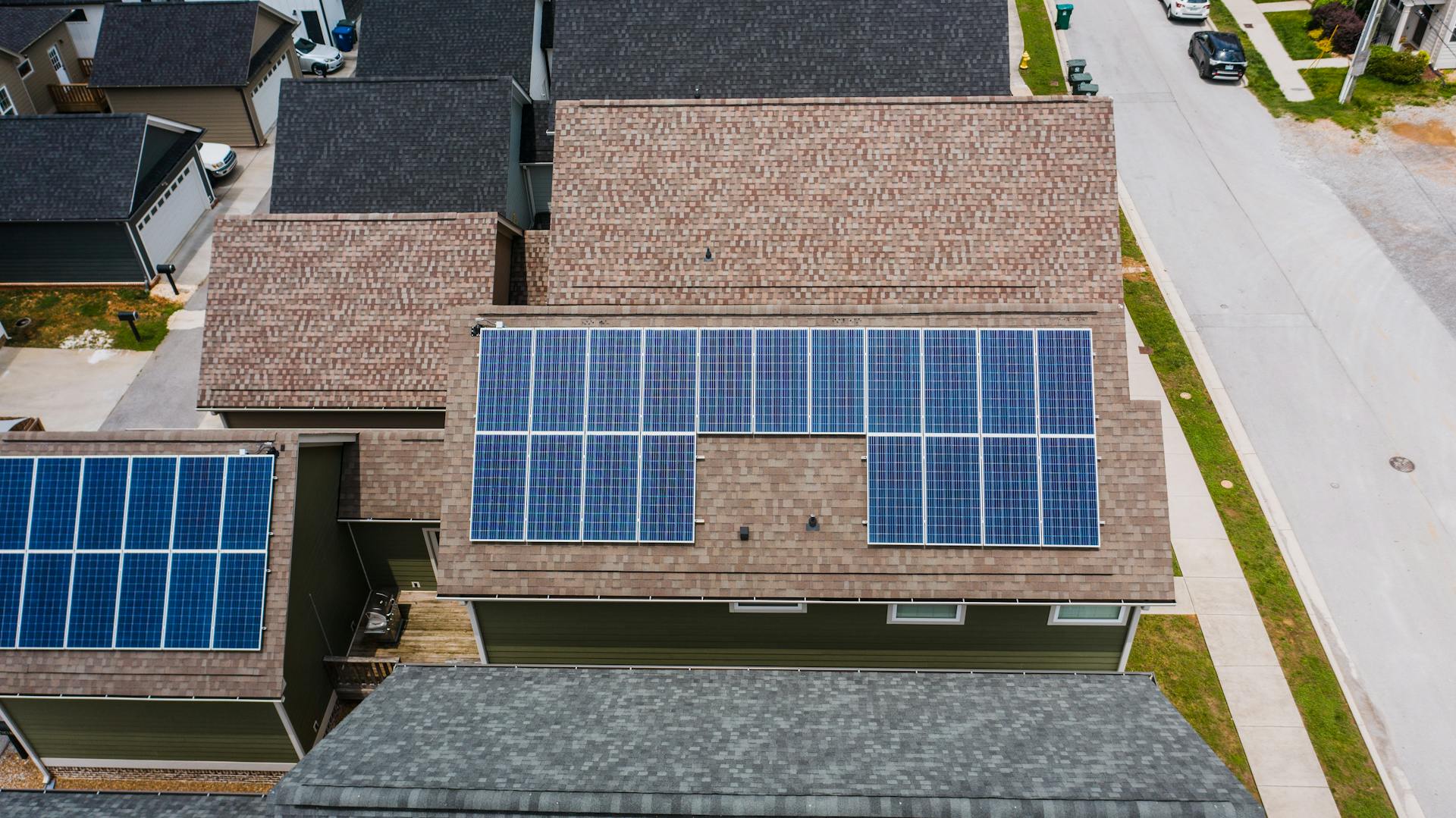
Photo by Kelly via Pexels.
###
This story was originally published by CalMatters. Sign up for their newsletters.
###
The state’s two largest utilities routinely drag their feet connecting solar panels to the electric grid, missing state-mandated deadlines as much as 73% of the time, according to a complaint filed to regulators by solar advocates.
The complaint filed by a solar energy advocacy group urges the California Public Utilities Commission to hold utilities accountable when they fail to meet such deadlines. The commission is formally reviewing it.
The advocates have complained for years that such delays hinder California’s transition to renewables. State utility regulators are separately revisiting the process for connecting rooftop solar to the grid, including examining whether and how the utility commission should require utilities to comply with the timelines it established years ago.
But the commission has yet to reprimand utilities for regularly missing these deadlines.
“The rule is there, but the commission hasn’t chosen to enforce [it],” said Kevin Luo, policy and market development manager for the California Solar & Storage Association, a group advocating for the adoption of solar energy that filed the complaint.
“The rule is there, but the commission hasn’t chosen to enforce [it].”
— Kevin Luo, California Solar & Storage Association
When Californians add solar panels to their rooftops, they begin a complex “interconnection” process led by the utilities to ensure the array is correctly installed and able to provide power for both the customer and the grid, which receives power the customer does not use. For each interconnection step, the utility is allotted a certain amount of time, ranging from five business days to 90 calendar days.
The timelines for several of the more extensive steps – including design, construction and installation – were clarified in a 2020 decision after solar panel owners complained that California’s major investor-owned utilities were blowing their deadlines.
The delays can have significant financial consequences for panel owners, widening the period after they have laid out money for solar cells but before they see a reduction in their power consumption or payments from selling excess solar power back to utilities.
Pacific Gas & Electric, Southern California Edison, and San Diego Gas & Electric all report their compliance with these timelines on a quarterly basis. The reporting is for projects over 30 kilowatts, which are often for businesses, not residential homes, and account for the majority of solar projects.
These data show that PG&E and Edison routinely exceed the allotted windows.
In the complaint, filed in late August, the California Solar & Storage Association noted the utilities take longer than permitted to connect customers between 19% and 73% of the time, depending on which stage of the process is examined.
For example, the utilities are given 10 business days to acknowledge someone’s request for interconnection – PG&E’s median time for this step was 20 days, with its longest being 245 days. One of the most crucial steps is a system impact study, which looks at how the addition of a customer’s solar array will affect the grid and identifies any potential issues with hookup. PG&E kept to its timeline 49% of the time, while Edison met its deadline 43% of the time, according to the complaint.
San Diego Gas & Electric typically meets its deadlines and wasn’t included in the solar association’s complaint about timeliness.
PG&E spokesperson Mike Gazda responded to the complaint by stating that “PG&E is a strong advocate for solar energy and has interconnected nearly 900,000 solar customers — more than any other U.S. utility — to support customers who have made the choice to go solar, strengthen California’s energy grid and reduce our state’s carbon footprint. We look forward to addressing the latest claims made by the solar gorup through the appropriate regulatory channels.”
Edison spokesperson Jeff Monford said the company takes “complaints seriously and [is] working with the California Public Utilities Commission to thoroughly address any issues related to our interconnection processes.”
Utilities have previously said that delays can be caused by permitting issues, unfamiliar new technologies, or other agencies needing to be involved.
So what happens when they break the rules?
The utilities commission declined to lay out specific penalties when it clarified the timelines in 2020. It rejected a recommendation from a working group including industry representatives and consumer advocates to “clearly indicate that financial penalties” could happen if a utility fails to meet the timelines on 95% of projects.
“The commission must first determine whether timeline certainty is improving,” the decision said. Regulators could set out penalties in the future “if it determines such a construct would support timely interconnection.”
The commission declined to comment because the case is an “ongoing adjudicatory proceeding,” Adam Cranfill, spokesperson, said.
Without some kind of punishment, advocates argue, there’s not only no incentive for utilities to follow the rules, there’s a disincentive because of how the money flows.
“From their perspective, solar and storage is competition for them,” Luo said. “Having people with their own solar and storage reduces the need to continually expand the grid and build out transmission lines.”
California’s rooftop solar industry has been mired in controversy in recent years because of the state’s “net energy metering” program, which governs how much utilities are required to pay solar customers for extra energy their panels generate. The program is meant to incentivize adopting renewable energy sources and offset the significant cost of rooftop solar, but utilities argued it creates an unfair cost burden for those without solar who pay more for costs such as grid maintenance. As a result, the current iteration of the program pays out significantly less than prior versions.
Three environmental groups sued over the change, and the California Supreme Court ruled last month that the lower courts should reexamine the case’s details instead of deferring to utility regulators.


