
Huffman Announces More Than $8M Headed to North Coast for Port Infrastructure Improvements
LoCO Staff / Friday, Oct. 28, 2022 @ 10:14 a.m. / Government
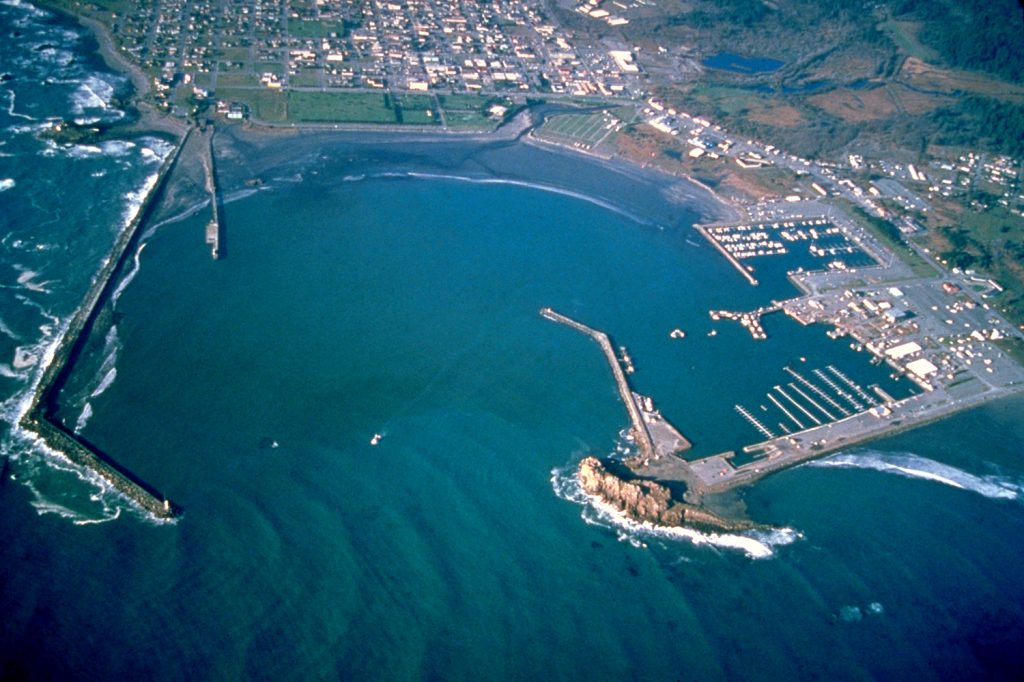
Aerial view of the breakwaters and harbor at Crescent City | Robert Campbell, licensed under CC BY-SA 3.0.
Press release from Congressman Huffman’s office:
Today, Rep. Jared Huffman (D-San Rafael) shared the news that The U.S. Department of Transportation Maritime Administration awarded $8,016,566.00 in funds to two projects off the North Coast of California through the department’s Port Infrastructure Development Program (PDIP). The awards will provide funds for port maintenance and improvements in Eureka and Crescent City. Rep. Huffman helped secure these funds for his district through the Infrastructure Investment and Jobs Act and the FY2022 Consolidated Appropriations Act.
“Communities up and down the coast of California rely on ports and harbors that fuel the economy, but crumbling infrastructure has strained operations and disrupted the global supply chain,” said Rep. Huffman. “Thanks to the investments secured by Democratic colleagues and I in the latest government funding bill, we are seeing major investments in our ports and harbors – all working to address repair and maintenance backlogs, reduce congestion and emissions near ports, and drive electrification and other low-carbon technologies. I’m glad to see our advocacy pay off and have this funding go to such important ports in my district so they can continue serving our region for years to come.”
Project Details:
- $650,000.00 for the city of Eureka’s Fishermen’s Terminal dock to replace approximately 40 failing or missing fender pilings on a quay used by commercial fishermen in Humboldt Bay. The Project includes removal of the existing pilings and the purchase and installation of replacement pilings, pile caps, and rub rails.
- $7,366,566.00 for the city of Crescent City, CA for the construction of a new seawall, the repair and renovation of a seafood packing and truck loading area, the replacement of cargo handling equipment that is currently atop the existing seawall, and the installation of EV infrastructure to power the cold storage trailers used to move seafood products to market.
“Commercial fishermen and the City of Eureka owe a huge debt of gratitude to the Maritime Administration for approving the City’s Port Infrastructure Development Program grant submittal for the repairs at Eureka Fishermen’s Terminal dock. The planning, building and funding of Fishermen’s Terminal was an eighteen-year cooperative effort between Humboldt Fishermen’s Marketing Association and the City of Eureka. Like other shoreside infrastructure, including streets, sidewalks and utilities, Eureka Fishermen’s Terminal, continues to be a vital piece of waterfront infrastructure serving the West Coast fishing fleet and the economic interests of the Eureka community. This grant allocation will allow for the Terminal to continue to serve the commercial fisherman of the North Coast and the greater Eureka community,” said Miles Slattery, Eureka City Manager.
“Commercial fishing ports in California are struggling to make ends meet. As a consequence, major infrastructure repair is often deferred indefinitely,” said Crescent City Harbor Commission President Rick Sheperd. “Fortunately, our federal partners at FEMA have recognized the dire need of the Crescent City Harbor and have funded a new sea wall to protect our harbor. The commercial fishermen of Crescent City would like to thank Congressmen Huffman for helping our harbor secure the 7.366 million dollar grant that will help the success of the commercial fishing industry in Crescent City, a fleet that is the largest shrimp producer in California, and which produces over 50% of the Dungeness crab caught in California.”
The Port Infrastructure Development Program (PIDP) is a discretionary grant program administered by the U.S. Maritime Administration. Funds for the PIDP are awarded on a competitive basis to projects that improve the safety, efficiency, or reliability of the movement of goods into, out of, around, or within a port. In FY2022, the Bipartisan Infrastructure Law (BIL) appropriated $450 million to the PIDP. An additional $234 million was made available to the program under FY2022 Consolidated Appropriations Act. Therefore, a total of $684,310,000 of funding was available to make awards under the FY 2022 PIDP grant program.
BOOKED
Yesterday: 4 felonies, 19 misdemeanors, 0 infractions
JUDGED
Humboldt County Superior Court Calendar: Yesterday
CHP REPORTS
1656 Union St (HM office): Missing Indigenous
ELSEWHERE
RHBB: Semi Driver Dies in Logging Truck Crash in Mendocino County
RHBB: Funding Shift Could Undercut Humboldt Suicide Prevention
RHBB: Airport Loop Road Repair Update
RHBB: Reported Five-Vehicle Crash Closes Northbound Broadway in Eureka, Traffic Diverted
California Cancer Care Isn’t Equitable; A New Law Might Help
Ana B. Ibarra / Friday, Oct. 28, 2022 @ 7:10 a.m. / Sacramento
Cancer is the second leading cause of death in California, behind only heart disease. This year alone, the state will tally an estimated 189,000 new cancer cases and close to 61,000 deaths.
Yet while patients often need specialists, treatments and the chance to participate in clinical trials, that access is not equitable throughout the state. It typically depends on where they live, and sometimes on their health insurance.
Lower-income cancer patients — and especially those in rural places — tend to fare worse. Studies have shown that patients with Medi-Cal, the health insurance program for low-income residents, are less likely to get the recommended treatment and have lower cancer survival rates compared to people with private insurance.
This disparity is at the crux of a California bill recently signed into law by Gov. Gavin Newsom that supporters say will make it at least a little easier for Medi-Cal patients to access cancer subspecialists, treatments and clinical trials.
The new law, which goes into effect in January, requires Medi-Cal insurance plans to “make a good faith effort” to contract with cancer centers recognized by the National Cancer Institute — which often have access to the latest treatments — or other qualifying cancer centers.
Authored by Democratic Sen. Anthony Portantino of Glendale, it was originally drafted to mandate that Medi-Cal plans add at least one of these cancer centers to their provider networks, but negotiations resulted in a scaled-back version, only requiring health plans to try to add a cancer center.
“I think making incremental change has the ability to save lives and that’s what we’re trying to do here.”
— State Sen. Anthony Portantino, Democrat from Glendale
The law also requires Medi-Cal plans to notify enrollees with complex cancers about their right to request a referral to any of these centers, even if it’s out of their plan’s network. Whether a patient can be treated at one of these centers, however, depends on whether the plan and the out-of-network provider can hash out a payment deal. This referral notification, supporters say, is critical: Patients can’t ask for something they don’t know is an option.
Supporters say that even if limited, this law will be an important step in helping low-income cancer patients get specialized care.
“I think making incremental change has the ability to save lives and that’s what we’re trying to do here,” Portantino said.
Too often patients from underserved communities arrive at these specialized cancer centers very late after their diagnosis, said Dr. Joseph Alvarnas, a hematologist-oncologist and vice president of government affairs at City of Hope, one of eight California cancer centers with a National Cancer Institute designation, and a sponsor of the law.
“The conversation begins with ‘If I could only have gotten here sooner’, or ‘My family and I fought tooth and nail to get here,’” he said.
Alvarnas said that historically, City of Hope used to see more Medi-Cal patients, but that changed as the state has largely moved its Medi-Cal program from a fee-for-service model (in which patients could see any provider who accepted Medi-Cal and the state paid providers for each service rendered) to managed care (considered a more cost-effective model in which the state pays health insurance companies a fixed amount per enrollee).
“In managed care, part of the way that model works is it includes narrower clinician networks and more limited hospital choices,” Alvarnas said. “If you have high blood pressure or you’ve got a condition that can be cared for by many types of doctors, that’s an OK model.
“But when it comes to cancer care, your network of clinicians may not have an expert in leukemia or relapsed myeloma.”
Hospitals sometimes must send some of their sickest patients to cancer centers like City of Hope – as was the case for Patrick Nandy of Whittier. In 2008, during his senior year of college, he was diagnosed with acute lymphoblastic leukemia, a cancer of the blood and bone marrow that can progress very quickly. Nandy said that when oncologists at St. Jude Medical Center could no longer treat him, he was transferred to City of Hope, where he participated in a chemotherapy clinical trial and a cord blood stem cell transplant.
“I think about how lucky I am,” Nandy said. “Doctors said two more weeks and I probably would have been gone.”
These are the types of therapies that should be available to all patients with complex or aggressive cancers, but that’s not always the case, Alvarnas said.
A 2015 analysis by the University of California, Davis, found worse outcomes for cancer patients with Medi-Cal compared to people with other types of insurance. Among some of the findings: 39% of breast cancer patients on Medi-Cal were diagnosed at an early stage compared to 61% of those who were privately insured.
The study also found Medi-Cal patients diagnosed with early stage lung cancer had a 48% five-year survival rate, lower than the 65% five-year survival rate for those with private insurance. Medi-Cal patients also were less likely to receive the necessary therapies or treatments for several cancer types.
The law will apply to people with rare or complex cancers, including advanced stage brain cancer, lung cancer, colorectal cancer, leukemia and lymphoma, among others, Alvarnas said. The sought- after treatment and research centers include City of Hope, University of California Comprehensive Cancer Centers, Stanford Cancer Institute, as well as a number of Kaiser Permanente sites and Cedars Sinai’s Cancer Institute.
While the law as passed had no registered opposition, it was watered down during negotiations involving providers, health plans and the California Department of Health Care Services, which oversees the Medi-Cal program.
Health insurance plans initially opposed Portantino’s bill because requiring plans to contract with centers, they warned, comes with new administrative hurdles that could disrupt or delay patient care.
Linda Nguy, an advocate with the Western Center on Law and Poverty, said her organization withdrew its support after the bill was narrowed. “Actually requiring plans (to contract with cancer centers) — that would have brought some meat to the table,” Nguy said. “From our understanding, plans already make efforts to contract with as many providers as possible, but it comes down to a reimbursement issue.”
Medi-Cal, which covers about a third of Californians, pays providers a lower rate than other insurance types. While lower reimbursement rates make the program more cost efficient, low payments can deter providers from participating in Medi-Cal.
“There’s a gulf between coverage and real access, because there is also a focus by the state to make sure that health care costs are somewhat controlled.”
— Dr. Joseph Alvarnas, hematologist-oncologist and vice president of government affairs at City of Hope
The debate over cancer care equity shows the complexities of achieving true access even in a state that has expanded insurance coverage to more people. California is scheduled to become the first state in the country to offer Medi-Cal coverage to all income-eligible people regardless of immigration status. Last week, Gov. Gavin Newsom’s office announced that 286,000 undocumented people aged 50 and older had started to receive comprehensive coverage in May. In 2024, California will open the Medi-Cal program to approximately 700,000 more people ages 26 to 49.
“The state has worked very hard over the last decade to improve health care coverage,” Alvarnas said. “The issue, though, is there’s a gulf between coverage and real access, because there is also a focus by the state to make sure that health care costs are somewhat controlled.”
While the bill fell short of what supporters initially aimed for, the work to make cancer care more easily accessible will continue, said Autumn Ogden-Smith, director of state legislation for the American Cancer Society Cancer Action Network, another sponsor of the bill. For instance, how to more easily get a patient into one of these cancer centers if they don’t live nearby is a priority, she said.
“If you pull up a map, you’ll see these centers tend to cover certain areas: San Diego, Los Angeles, San Francisco, Davis-Sacramento,” Ogden-Smith said. “We’re going to have to focus on how we get the people in Northern California and in the middle of the state” to cancer centers.
###
CalMatters.org is a nonprofit, nonpartisan media venture explaining California policies and politics.
OBITUARY: Tela Juanita Donahue Lake, 1959-2022
LoCO Staff / Friday, Oct. 28, 2022 @ 6:56 a.m. / Obits
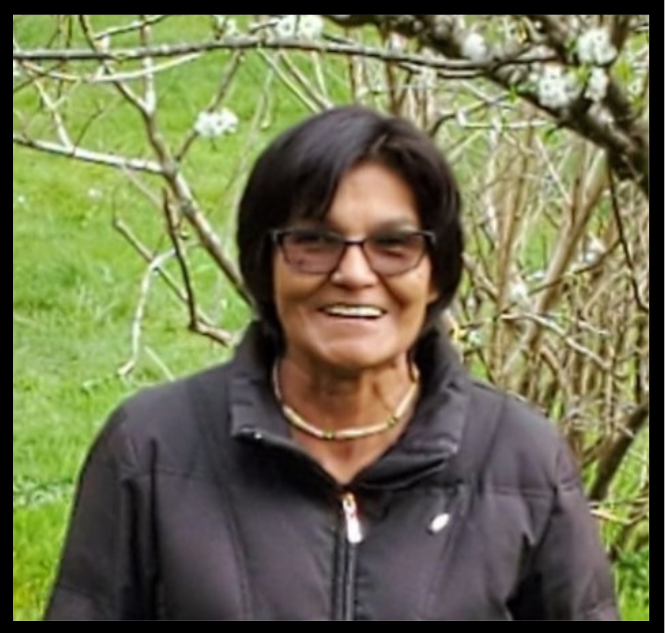
Tela Juanita Donahue Lake
May
3, 1959 to October 22, 2022
Tela “Starhawk” Juanita (Donahue) Lake, 63, of Redding, passed away peacefully on October 22, 2022. Youngest daughter and one of eight, she was a member of the Yurok Tribe and grew up in Del Norte County. Tela was a homemaker, author, medicine woman, and Sundancer. She had a love for family: spending time together camping, storytelling, gathering rocks, and at sweat lodge ceremonies. She loved to find agates, go on trips to the high country, and attend tribal events. She could find a four-leaf clover anywhere.
Tela lived her life for her children and
grandchildren. She had unmatched spunkiness and sassiness, and kept
everyone in the family connected. She was an international traveler
who could always bring the fun and unexpected. She will be missed by
all who knew her.
Tela is preceded in death by (Aawok) her parents Alveretta Spott-Green and Chuck Donahue; brothers: Baldy, Whisky, and Pergish; sister Marjorie; the father of her children Bobby Lake Thom; nieces: Lovebug, Angel; and nephews: Hoot-Se, Jessie, and Benjamin.
Tela is survived by the love of her life, Kevin Arias; stepdad, Kenny Green; sisters, Phyllis and Gladys; brother, Bobo; children: Chay-gam-em, Moon Raven, Wind Wolf (Delores), and Kanawha (Luna); grandchildren, Angelina, Sierra, Lily, Loyalty, Alexus, Aaliyah, Evalyn, Thunder, and Lance, Jason, Leland, Ada; great grandchildren: Nova and Cela; as well as many, many nieces and nephews, and people she loved.
Pallbearers: Kevin Arias,
James “Bobo” Donahue Sr., Wind-Wolf “No Name” Lake, Frank
Kanawha Lake, Brian “Eagleboy” Donahue, James “Bull Calf”
Donahue Jr., Chris Peters Sr., Delmar “Seagull” Jordan, Roger
Buckskin Jr., William Bommelyn III, William Bommelyn Jr., Santee
Martin Sr., Santee Martin Jr., and John Donahue (Little John D).
Honorary Pallbearers: Kenny Green, Ron Griffith, Frank Thom, Rick Arias, Ricky Alemania, Chaley Thom, Robert Ray Jr., Phillip Shaw Santmier, Levi Tripp, Erik Barnes, Kagett Donahue, and Chris Hawkins.
On Saturday, October 29: Viewing from 8:30 a.m. to 11 a.m. at the Elk Valley Sovereign Building; graveside services in Requa at 4 p.m. at the family’s plot; followed by a memorial dinner to be held at Yurok Tribal Community Room, Klamath, 5 p.m.
###
The obituary above was submitted on behalf of Tela Lake’s loved ones. The Lost Coast Outpost runs obituaries of Humboldt County residents at no charge. See guidelines here. Email news@lostcoastoutpost.com.
‘Together We Can Shape Offshore Wind for The West Coast’: Local Officials, Huffman and Others Join Harbor District Officials in Celebrating Partnership Agreement With Crowley Wind Services
Isabella Vanderheiden / Thursday, Oct. 27, 2022 @ 5 p.m. / Energy , Government , Offshore Wind
###
###
Just over a year ago, Rep. Jared Huffman and U.S. Secretary of the Interior Deb Haaland stood in front of Woodley Island’s iconic fisherman statue to announce the Biden-Harris Administration’s intent to bring offshore wind to Humboldt County’s shores. Today, Huffman joined local and state officials at the same spot to celebrate a partnership with Crowley Wind Services to bring offshore wind one step closer to reality.
I know, I know. We’ve been talking a lot about offshore wind energy recently but that’s because a lot has happened, especially in the last week!
Just yesterday, the Humboldt Bay Harbor, Recreation and Conservation District announced a partnership with Crowley to build a full-service terminal out on the Samoa Peninsula to support offshore wind development.
The 86-acre development, dubbed the Humboldt Bay Offshore Wind Heavy Lift Marine Terminal, would be built at the defunct Samoa Pulp Mill site. The new facility – which would become the second-largest wind terminal in the United States – will support the manufacturing, installation and operation of offshore wind floating platforms.
“I just can’t say enough about the vision and determination and competency that you have brought to this journey so far, and all of it has brought us to a really wonderful milestone today,” Huffman said. “The confluence of port development and offshore wind is here. For years, I have advocated for both of these things but it is exciting to see them finally coming together in what is likely to be a huge windfall – no pun intended.”
Greg Dale, president of the Harbor District Board of Commissioners, called the partnership a “historic and transformational moment in the history of Humboldt County and the state of California.”
“Guided by the support and expertise of Crowley, the Port of Humboldt Bay now stands to be an international leader in the transition to renewable energy,” Dale continued. “Within the next few years, this project will generate high-skilled manufacturing and technical jobs, investments and clean energy that will extend for generations into the future. This project is just the beginning for Humboldt Bay and the potential for additional complementary projects on other underutilized sites throughout the Bay.”
Dale then invited Harbor District Executive Director Larry Oetker and Crowley’s Vice President of New Energy, Jeff Andreini, to approach the podium and sign the partnership agreement.
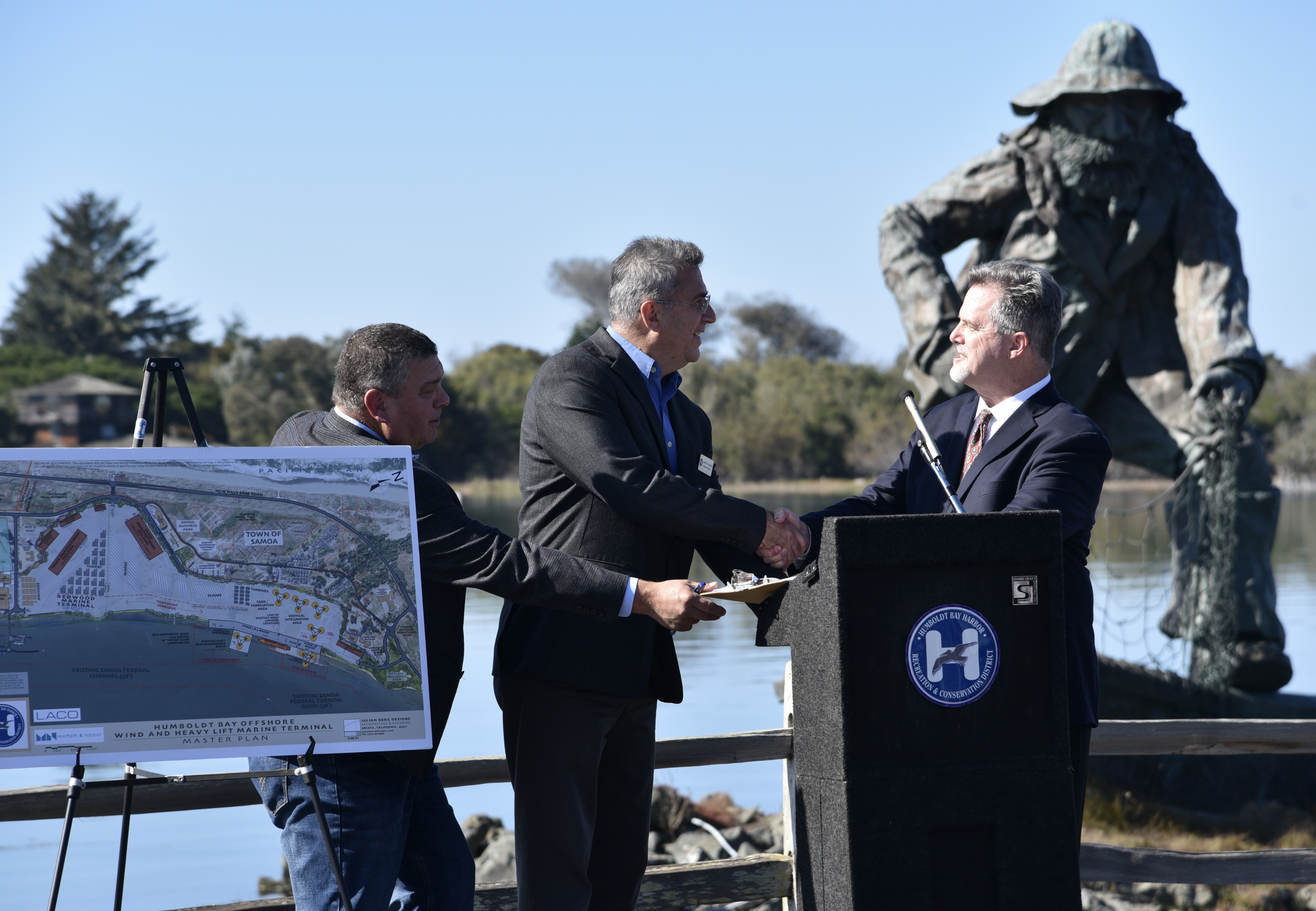
Dale, Oetker and Andreini sign the partnership agreement.
“We see this partnership as a blank canvas and opportunity to paint a beautiful picture that takes advantage of the qualities of this community, the industry and Crowley,” Andreini said. “Together, we can shape offshore wind for the West Coast of the United States that goes beyond just this terminal. … At Crowley we are proud and we are honored to be a partner with the Harbor District in a generational changing journey that will provide economic growth, jobs and a sustainable future for years to come.”
Andrew Meredith, president of the California Building and Construction Trades Council, highlighted the potential economic benefits associated with the project.
“The local dollar turns over so many times before it leaves the community when a local worker is earning dollars to construct projects like this,” he said. “This is a tremendous opportunity, not just for Humboldt County but the state of California. … Today is one of the first monumental steps in the right direction towards a renewable future.”
Fourth District Humboldt County Supervisor Virginia Bass also took to the podium to talk about growing up locally. She recalled complaining about the smell of the old pulp mill with her sister – noting “this phrase is probably not correct anymore” – her father would say, “That’s the smell of money.”
“I can speak from the experience of what it was like to have the economic activity here [in the port],” she said. “My family’s restaurant and many other local businesses thrived – survived – thrived, and unfortunately, many went down at about the same time as we lost the industry. … We’ve been hopeful for a very long time … but everything takes time. …Today’s a great day to celebrate.”
###
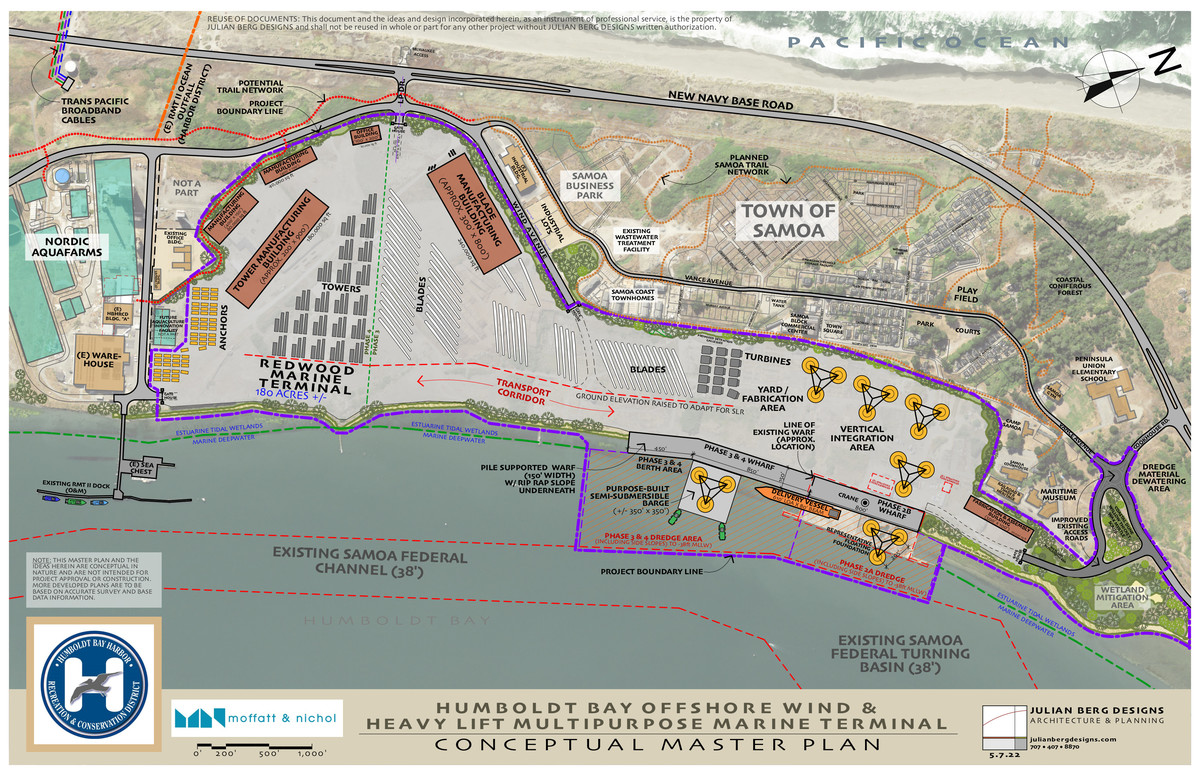
Illustrations via Harbor District. Click to enlarge.
###
Press release from Crowley Wind Services:
Crowley signed an agreement with the Port of Humboldt Bay to exclusively negotiate to be the developer and operator of a terminal to serve as California’s first hub to serve offshore wind energy installations.
Through Crowley’s Wind Services group, the company will enter into negotiations with the port to lease and serve as the port’s developer of the Humboldt Bay Offshore Wind Heavy Lift Marine Terminal. Services there will support tenants in the manufacturing, installation and operation of offshore wind floating platforms, use of large heavy cargo vessels and providing crewing and marshalling services in the Pacific waters.
“Clean, renewable energy for Californians took a step forward through our partnership with the leaders of the Port of Humboldt Bay. Crowley looks forward to working together with the Humboldt Bay Harbor Recreation and Conservation District to formalize a lease and development plan,” said Bob Karl, senior vice president and general manager, wind services. “Through our collaboration, we can reach our shared commitment for sustainable development that gives the state and the nation a new source of energy that respects the environment and reduces greenhouse gas emissions.”
This public-private partnership will support both federal and state government goals to develop more American offshore wind power and reduce greenhouse gas emissions. The U.S. Department of Interior announced on Oct. 18 that waters off the coast of Humboldt Bay areas will be part of the first-ever offshore wind lease sale on the U.S. West Coast on Dec. 6.
The State of California has set a goal to create at least 5 GW of offshore wind energy by 2030. The Humboldt offshore wind areas alone are projected to provide 1.6 GW of energy, capable of supplying power to up 1.6 million homes. The federal lease auction also will include the Morro Bay area, which offers 3 GW of projected energy.
Utilizing a grant from the Humboldt County Headwaters Fund in 2021, the Port of Humboldt Bay developed a conceptual master plan for the site. That led to a $10.45 million grant from the California Energy Commission, to conduct of technical studies, preliminary design and pre-permitting activities. The Port anticipates completing permitting and design in mid-2024. The new agreement with Crowley focuses on a 98- acre Phase I, with options to expand on adjoining land in additional phases.
“This is a historic and transformational moment in the history of Humboldt County and the State of California,” said President Greg Dale of the Board of the Port of Humboldt Bay. “Guided by the support and expertise of Crowley, the Port of Humboldt Bay now stands to be an international leader in the transition to renewable energy. The Port will play a critical role not only in the Humboldt and Morro Bay Call Areas, but in all future offshore wind areas of the U.S. West Coast.”
“Within the next few years, this project will generate high-skill manufacturing and technical jobs, investments, and clean energy that will extend for generations into the future. And this project is just the beginning for Humboldt Bay, with the potential for additional complementary projects on other underutilized sites throughout the Bay.”
Humboldt Bay will mark Crowley’s second dedicated U.S. wind service terminal project. Design and engineering are underway in Salem, Massachusetts, for the Crowley terminal as part of a public-private partnership that will support offshore wind projects in New England.
About Crowley
Crowley is a privately held, U.S.-owned and -operated maritime, energy and logistics solutions company serving commercial and government sectors with more than $2.9 billion in annual revenues, over 170 vessels mostly in the Jones Act fleet and approximately 7,000 employees around the world – employing more U.S. mariners than any other company. The Crowley enterprise has invested more than $3 billion in maritime transport, which is the backbone of global trade and the global economy. As a global ship owner-operator and services provider with more than 130 years of innovation and a commitment to sustainability, the company serves customers in 36 nations and island territories through five business units: Crowley Logistics, Crowley Shipping, Crowley Solutions, Crowley Fuels and Crowley Wind Services. Additional information about Crowley, its business units and subsidiaries can be found at www.crowley.com.
About the Port of Humboldt Bay (Humboldt Bay Harbor District)
The Port of Humboldt Bay was established by the California Harbors and Navigation Code in 1970 with the express purpose to manage Humboldt Bay for the promotion of commerce, navigation, fisheries, recreation, and the protection of natural resources, and to acquire, construct, maintain, operate, develop, and regulate harbor works. Ancestral home to the Wiyot Peoples, Humboldt Bay is the second largest Bay in California and hosts a broad array of natural ecosystems and coastal industrial uses. The Bay has predominantly serviced the fishing, timber, and wood products industries, each of which will continue to play a critical role in the port’s future. In 2021, the Port initiated a process to develop a world-class heavy-lift marine-terminal and green port development on a 170-acre site designed to serve as the West Coast’s first offshore wind manufacturing, installation, marshalling, and operations hub. The District has committed to having a project labor agreement on the construction of the new terminal. More information about the Harbor District can be found here: http://humboldtbay.org/.
SORIA TRIAL: Accused Gunman in Alleged McK Murder-For-Hire Case Suddenly Admits Owning Loaded Revolver Found at the Scene
Rhonda Parker / Thursday, Oct. 27, 2022 @ 4:37 p.m. / Courts
Testimony ended today in Isreal Soria Jr.’s jury trial, with Soria admitting an accusation he has repeatedly denied: He owned the loaded revolver found in the back yard where he was arrested after he shot McKinleyville resident Dylan Eubanks.
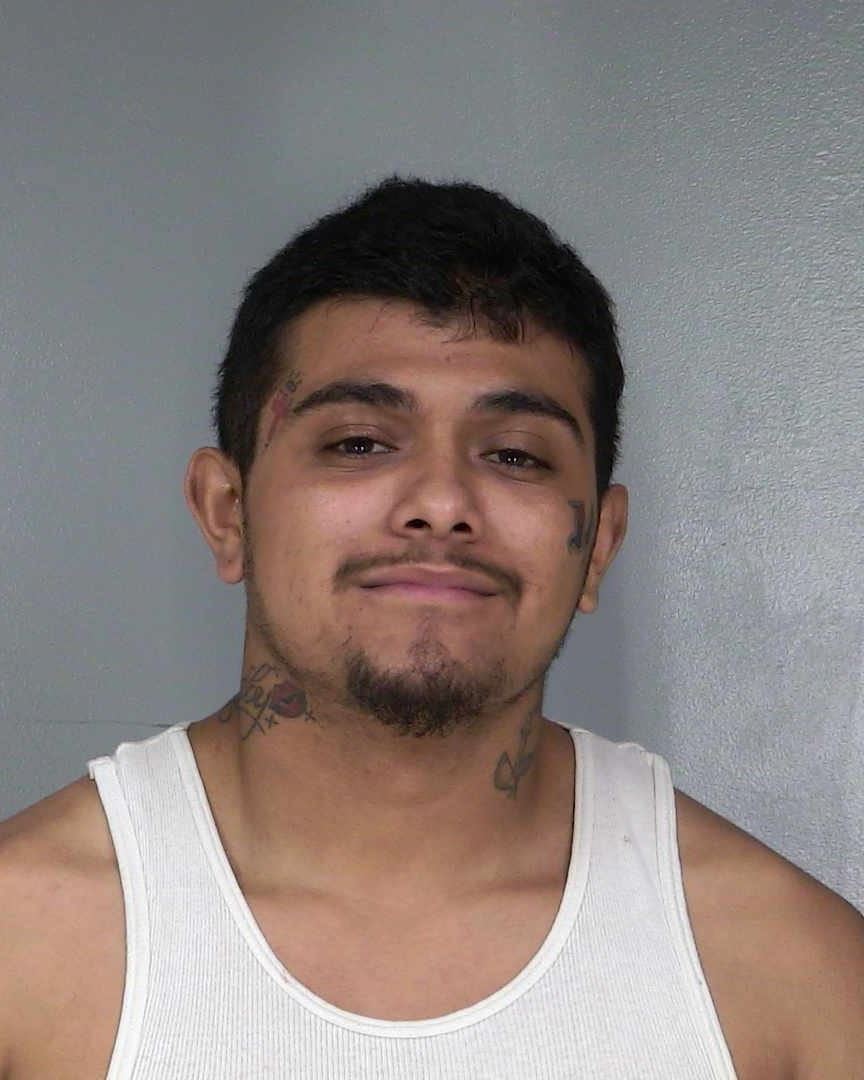
Soria.
Soria has steadfastly maintained he was armed only with a semiautomatic pistol loaded with 32 rounds. But under questioning by Deputy District Attorney Trent Timm, he finally confessed to owning the revolver containing six bullets.
“Have you ever said that until just now?” the prosecutor asked.
“No.”
Soria then proceeded to insist he can’t remember where or how he got the revolver.
Soria’s main defense is intoxication. He testified to drinking enormous amounts of alcohol the day of the shooting, along with smoking marijuana and taking up to eight Xanax pills.
Soria blames the substances on what he calls a false confession, in which he told the arresting officer the Norteño gang hired him to kill Eubanks for stealing from the gang. During the trial he testified that confession was all a drug-induced lie, and he was only at Eubanks’s house to rip him off. Soria says he learned on Snapchat that Eubanks had guns and marijuana.
Today the prosecution recalled the arresting officer as a rebuttal witness. Willits police Sgt. Jordan Walstrom, a former Humboldt sheriff’s deputy, said he saw no signs of intoxication when he interviewed Soria. No red or watery eyes, no slurred speech, no slow responses, no odor of alcohol.
In fact, Soria engaged in quite a bit of strenuous physical activity that night, including jumping over fences.
The co-prosecutor, Deputy District Attorney Luke Bernthal, asked Walstrom what condition a person would be in had he consumed the amount of drugs and alcohol Soria claimed he consumed.
“I believe that person would not be moving very much, if not overdosing,” Walstrom said.
Soria testified he fired at Eubanks after first seeing him in the house with a machete, then racking a bullet into the assault rife he was holding. Soria, standing outside a window, fired 11 rounds. Eubanks was hit once in the arm.
Officers searching Eubanks’s house found no machete or assault rifle, though one unspent bullet from an assault rifle was found on a couch.
Soria’s attorney, Christina DiEdoardo, questioned him about whether he would have behaved the way he did if he had not been under the influence. Soria said he would not have opened fire on Eubanks and would not have formulated a plan to rip him off.
Also, he wouldn’t have left his backpack and his two cellphones in the car belonging to the man who drove him to Eubanks’s neighborhood.
The trial is expected to continue tomorrow with the prosecution and defense presenting closing arguments. Judge Christopher Wilson is presiding.
###
PREVIOUSLY:
Protesters Disrupt Redwood Pride Halloween Event, Threaten and Harass Ink People Staff
Ryan Burns / Thursday, Oct. 27, 2022 @ 3:04 p.m. / Community
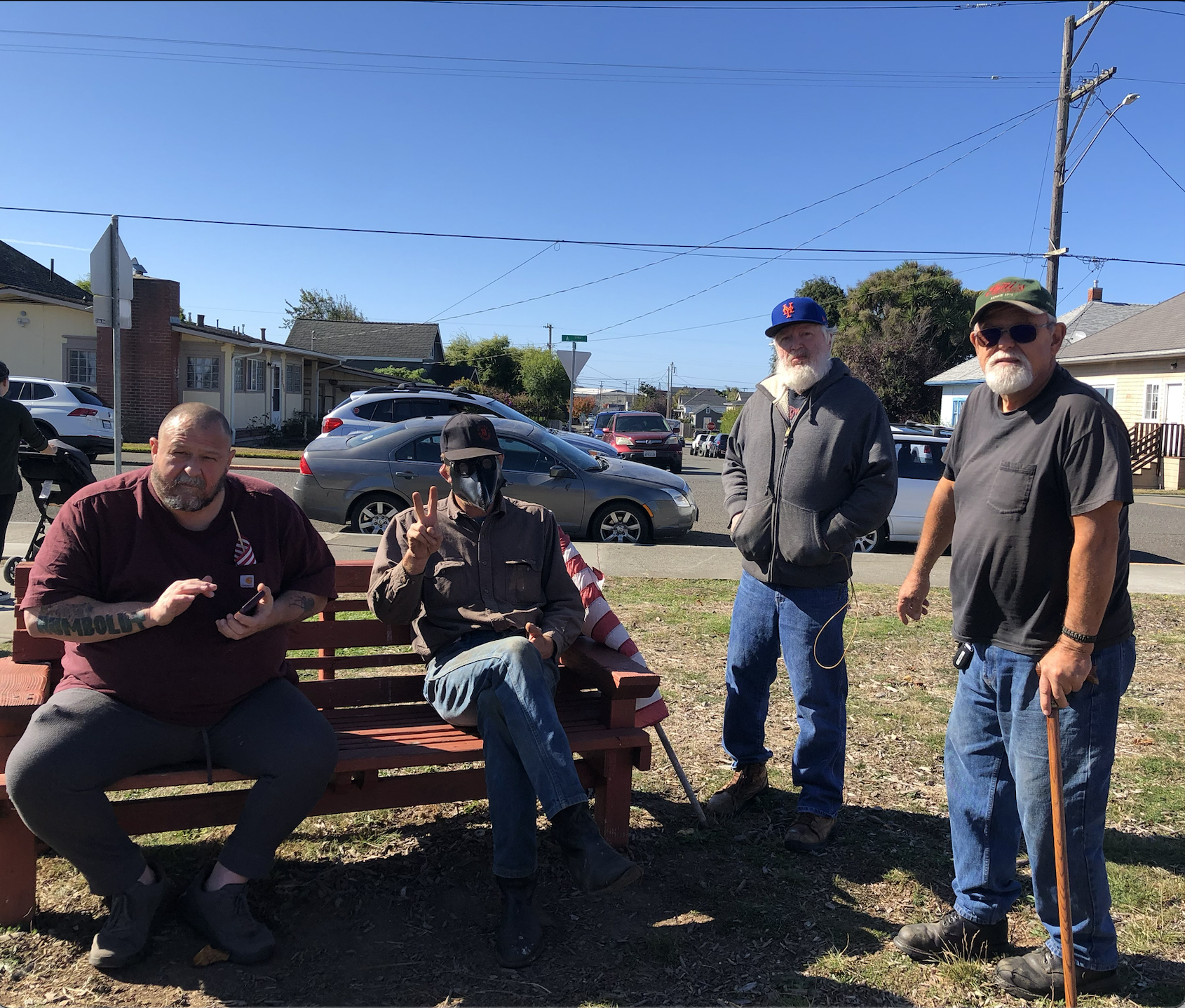
A few of the protesters who showed up at Sunday’s event. | Photo via Queer Humboldt’s Facebook page (used with permission).
###
This past Sunday, an all-ages Halloween event hosted by Redwood Pride — a DreamMaker project of the nonprofit Ink People — drew a vibrant and diverse crowd of revelers, but it also attracted a group of about a dozen protesters who confronted organizers and attendees, aggressively accusing them of “grooming children” and being pedophiles.
The event, which was held at the Jefferson Community Center in Eureka, featured a drag show, in which performers dressed-up, danced and lip-synced to pop songs. This element of the festivities has been the focal point of protesters’ outrage both at the event and in the days since.

Poster for Sunday’s event.
Angry and homophobic posts on Craigslist and social media sites have accused Ink People of being “perverts” and “sickos” who are guilty of child abuse and openly support “homosexual grooming of children.” Other posts have gone even further, listing the address and phone number for Ink People and issuing calls to “run them out of town.”
Monica Topping, administrative director at Ink People, told the Outpost that the organization’s office received roughly 40 phone calls in the first 90 minutes she was there this morning. The one caller she spoke with heard on voicemail used the same verbiage, Topping said, threatening to run the organization out of town.
Officers from the Eureka Police Department were present at Sunday’s event, and Topping said she has kept the department apprised of the intimidating comments and phone calls since.
“They’re accusing us of being pedophiles and child molesters,” said Topping, who described herself as an unapologetic supporter of LGBTQ rights.
Redwood Pride Director Æpryl Nikolai said the protesters’ rhetoric seemed to rely heavily on a set of false notions, “such as that all drag shows are hyper-sexualized, explicit and profane, that it was sexualizing children, that it was grooming or indoctrinating them into being Queer in some way, and that being Queer in general is wrong.”
The history of drag dates back to ancient Greece and includes everything from Shakespeare plays to Milton Berle, Benny Hill and, of course, RuPaul.
Nikolai said that while the protesters on Sunday were sometimes aggressively confrontational, only a couple of interactions got physical.
“One was that one woman (protester) tried to kiss an older male attendee,” they said. The other instance involved a protester lunging at an attendee with a camera, which led to a bit of back-and-forth pushing, “but the police put a quick stop to that,” Nikolai said.
In a published statement, Queer Humboldt Executive Director Lark Doolan said the protesters showed up to terrorize attendees and cause a public disturbance.
“These people came within inches of our faces, holding cameras, screaming words like ‘pedophile’ and ‘groomer,’ accusing us of mutilating the genitals of children, and claiming that they were there to protect our children from us,” Doolan wrote.
Unfortunately, this type of incident isn’t unique to Humboldt County. Across the country, right-wing provocateurs like Christopher Rufo and alt-right groups such as Proud Boys have deliberately stoked hysteria about drag shows, targeting pride gatherings, public library readings and private businesses with harassment campaigns.
A bakery owner in Illinois, for example, had her business vandalized, received threatening phone messages and was followed in her car after announcing plans for a family-friendly drag brunch, Vice reported. Up in Eugene, homophobic protesters “doxxed and attacked an 11-year-old for playing dress-up” earlier this week, according to reports from Salon and Eugene Weekly.
Nikolai told the Outpost that a number of folks representing the queer community have scheduled a meeting on Monday with members of the Eureka City Council, Eureka Police Chief Todd Jarvis and Eureka City Manager Miles Slattery.
Doolan said Queer Humboldt is hosting an all-ages “Heart Circle” tonight via Zoom. He explained that a Heart Circle is “an inclusive space where we share what is in our hearts, and are witnessed in speaking our truths.” Details for the event can be found on the community events calendar at queerhumboldt.org.
Below is Doolan’s statement about Sunday’s events (reprinted with permission).
Dear Community,
Some of you are aware that the beautiful, family-friendly Halloween festival hosted by Redwood Pride this past Sunday was interrupted by a hate group. We, at Queer Humboldt, don’t generally bring attention to this aspect of our community experience, but there are times when posts like these are necessary and now is one of those times.
In the history of LGBTQ Pride events in Humboldt County, we have had protesters before, though not so much in recent years. These people were different. They weren’t holding signs and peacefully expressing that they disagree. They were screaming hateful, bigoted, cruel things while standing next to a playground where our children, wearing their Halloween costumes, were playing.
These people came within inches of our faces, holding cameras, screaming words like “pedophile” and “groomer,” accusing us of mutilating the genitals of children, and claiming that they were there to protect our children from us. All of this, right in front of our youth.
When anyone spoke to them, they escalated matters exponentially. They were not there with love in their hearts. They were not there to peacefully protest. They were there to cause harm. They were there to terrorize us and cause a public disturbance. For approximately two hours their screams of vitriol could be heard from across the park.
One of these people, who was screaming with extra fervor, yelled that for two years, in a previous era of her life, she was partnered with a woman. Another man expressed being gay but having spent the last couple of years trying not to be.
While it is easy to meet hate with hate, especially when people are actively causing us harm, we must also remember that at least some of these haters are deeply wounded members of our own community. Let the suffering of that statement touch your heart. Hurt people hurt people. This is not a simple story of us vs. them. The enemy is not these people. The enemy is fear and ignorance.
We won’t win by fighting these people back, meeting them head on with our hurt and anger. That will only fan the flames of hate. Instead, let’s move into hope, educating ourselves and each other about how to build a world where diversity is not merely tolerated, it is valued.
In moments like this, we, as a community, have a long, rich queer history to draw from. The Two-Spirit Teachings weekend we just had included many helpful teachings. The video from Friday’s lecture will be posted in the coming weeks. Check it out. We can all learn a lot from Indigenous ways of knowing and being.
The Sisters of Perpetual Indulgence were there on Sunday, embodying the teachings of our queer ancestors (thank you, Sisters, for your magnificent service to our community on Sunday and beyond). Your fierce and playful loving support is an inspiration.
And then there is Heart Circle. Heart Circle is a core practice of the Radical Faeries, a spiritual non-movement rooted in the knowledge that we, as queer people, will never experience liberation by trying to fit into heterosexual, cisgender norms. Heart Circle is an inclusive space where we share what is in our hearts, and are witnessed in speaking our truths. This technology is similar to how Indigenous people around the world have gathered in circles in perpetuity.
In light of the events on Sunday, Queer Humboldt is hosting an all-ages Heart Circle [today] (Thursday, Oct. 27th) at 7PM via zoom. 2S/LGBTQIA+ community members and our loved ones (allies, parents, friends, partners, coworkers, etc.) are invited to participate. Given the intimate nature of this space, we ask that cameras be on. …
We know there is hate, but love is stronger. We look forward to seeing you [tonight]] in heartspace.
Just Peace,
Lark Doolan
Executive Director
Queer Humboldt
Pronouns: he/him
###
CORRECTION: This post originally stated that Humboldt County Sheriff Billy Honsal would be in attendance at Monday’s meeting with Eureka staff and council members. He will not. The Outpost regrets the error.
Friends of the Eel River Sues County for Failure to Protect Public Trust by Regulating Groundwater Extractions in Lower Eel
LoCO Staff / Thursday, Oct. 27, 2022 @ 1:35 p.m. / Environment , Local Government
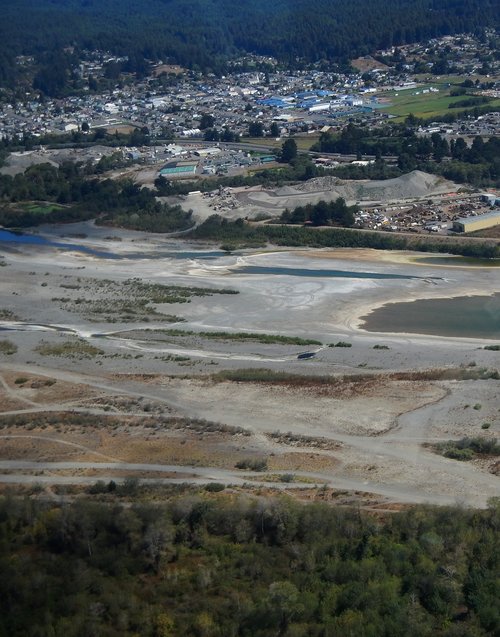
The lower mainstem Eel disconnected in August 2014. | David Sopjes
###
Press release from Friends of the Eel River:
Friends of the Eel River (FOER) has filed suit in Humboldt County Superior Court to secure protection for the public trust values at risk when groundwater pumping depletes surface flows in the Lower Eel River. First, FOER is asking the court to declare that the County has a duty to protect public trust values in the lower Eel River from the impacts of groundwater pumping. Then, FOER seeks an order requiring the County to create a program to regulate groundwater pumping in the lower Eel River as necessary to protect public trust values. Finally, FOER asks the court to require the County to stop issuing permits for new and expanded well-drilling in the lower Eel until such a program is in place.
Under California law, the Public Trust doctrine establishes that the waters and wildlife of the state belong to the people, and that the state and its subdivisions, including counties, serve as trustees of those resources for the people. Where public trust values may be affected, especially in the planning and allocation of water resources, the State and the County have an affirmative duty to consider those effects, and to avoid or minimize harm to public trust uses wherever feasible.
The Eel River provides habitat for fish and wildlife protected under the public trust, including salmon and steelhead as well as many other important species. Other values included in the public trust include recreation and cultural uses. When Humboldt County allows unlimited groundwater pumping even during extended dry times, exacerbating already low flows and leading to surface flows disconnecting, it fails in its duty to protect the Public Trust.
“As guardians of the public trust, our County leadership has the authority and the responsibility to enact an ordinance to curtail groundwater pumping in the Lower Eel when necessary,” said Alicia Hamann, Friends of the Eel River’s executive director. “Unfortunately what we’ve seen instead, under the guise of a grudging effort to comply with the state’s Sustainable Groundwater Management Act, has been continued denial by the County that groundwater use in the Lower Eel ever affects river flows, including efforts to obscure the County’s own data revealing the impacts of pumping on surface flows during dry periods.”
According to data collected for the County’s Groundwater Sustainability Plan, extraction from the lower Eel groundwater basin actually results in a loss of about 14 cfs to surface flows during late summer. This may not sound like much, but it can be nearly everything the river has during critically dry times. The Lower Eel River has repeatedly disconnected below Fortuna in late summer and early fall during the series of recent years that have been drier and hotter than historic averages. (We are avoiding using the word drought here because it implies reversion to a wetter “normal,” which seems increasingly unlikely.) Absent a program to control groundwater pumping, the County is unable to address the impacts of pumping during dry times.
###
DOCUMENT: Friends of the Eel River v. County of Humboldt, Board of Supervisors of the County of Humboldt


