
More Street Medicine Teams Tackle the Homeless Health Care Crisis
Kristen Hwang / Thursday, Dec. 8, 2022 @ 8:19 a.m. / Sacramento
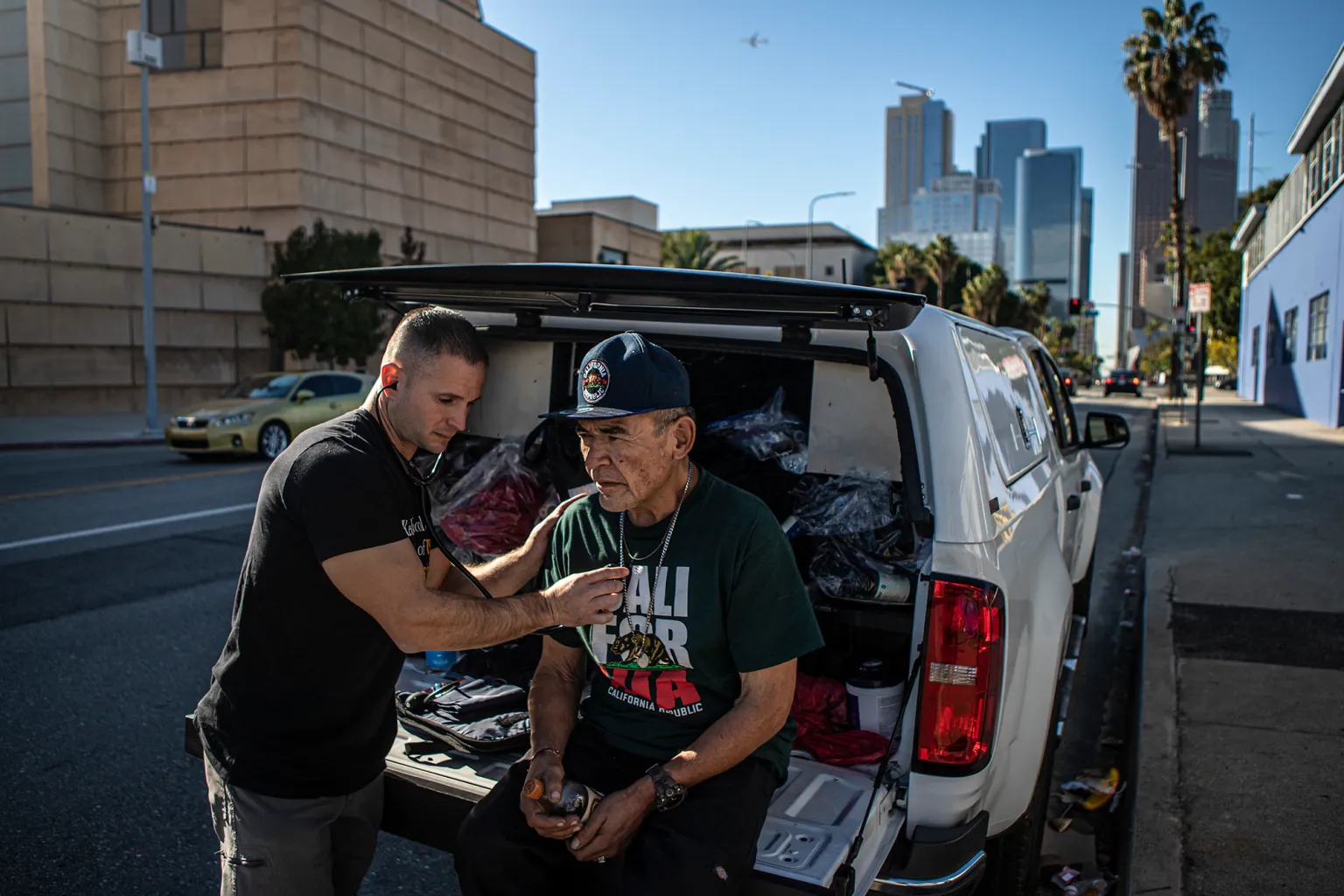
Physician’s assistant Brett Feldman does a checkup on his patient Gary Dela Cruz on the side of the road near his encampment in downtown Los Angeles on Nov. 18, 2022. Feldman is the director and co-founder of Street Medicine at the Keck School of Medicine at the University of Southern California. Photo by Larry Valenzuela for CalMatters.
Living on the streets of California is a deadly affair. The life expectancy of an unsheltered person is 50, according to national estimates, nearly 30 years less than that of the average Californian. As homelessness spirals out of control throughout the state, so too do deaths on the street, but it’s those whose lives are the most fragile who are least likely to get medical care.
Now, the state Medi-Cal agency is endeavoring to improve health care access for people experiencing homelessness. Through a series of incentives and regulatory changes, the Health Care Services Department is encouraging Medi-Cal insurers to fund and partner with organizations that bring primary care into encampments.
They’re known as street medicine teams. There are at least 25 in California.
“Oh crap. This is where she was, and they just swept that,” said Brett Feldman on a Friday morning in November, looking at a green tent, crumpled and abandoned on Skid Row in Los Angeles. Feldman, a physician assistant, is searching for a female patient in her 40s with severe and unmanaged asthma. She cycles predictably in and out of the hospital, and Feldman knows she’s due for another hospitalization soon.
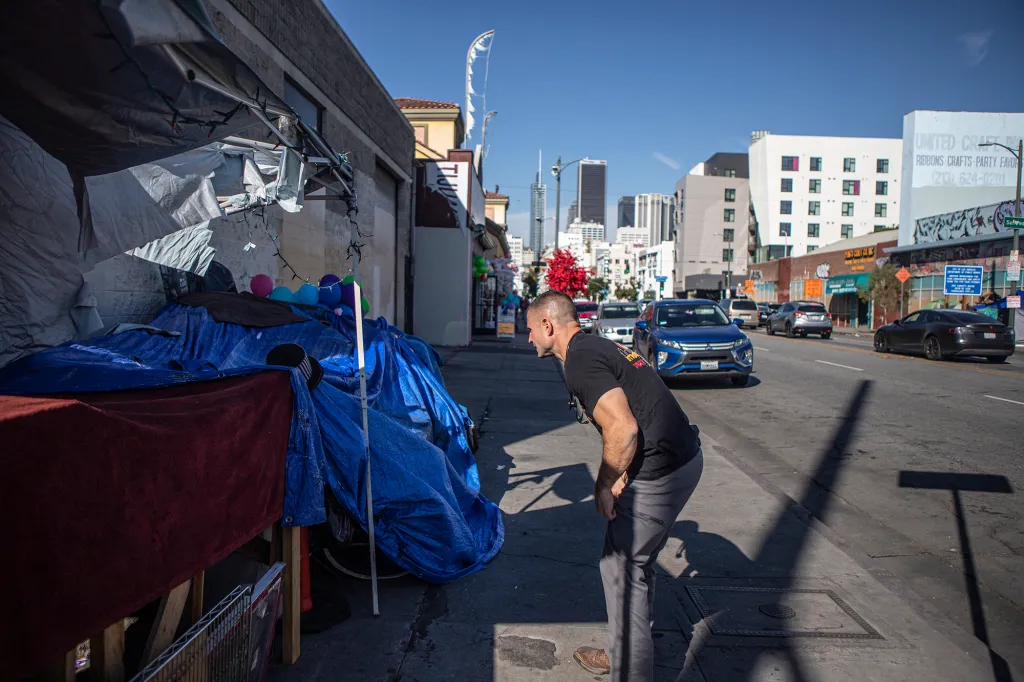
Physician’s assistant Brett Feldman asks a man in his encampment if he has seen a patient along Skid Row on Nov. 18, 2022. The patient was likely pushed out of the area as the Los Angeles sanitation department cleared the unhoused to clean the street near Skid Row. Photo by Larry Valenzuela for CalMatters.
The road is streaked with water from a cleaning truck, and sanitation workers in fluorescent vests sweep up debris. Parking enforcement and police cruisers line the section of road where a homeless encampment once stood. Nearly 5,000 people live in the half-mile block infamous for the hypervisibility it affords the state’s unrelenting homeless crisis.
Burdened by disproportionate rates of addiction, mental health disorders and chronic disease, people experiencing homelessness are some of the state’s neediest patients, but few receive anything more than emergency services. Barriers like lack of transportation and cumbersome insurance rules keep most from getting regular health care. Instead, they drift through the emergency room during a crisis, racking up high costs to the system and deteriorating physically in the interim.
Delivering health care this way is costly and not particularly effective for the patient or the system. More than half of the state’s $133-billion Medi-Cal budget is spent on the top 5% of high-needs users, according to the California Department of Health Care Services.
“Where we have been falling short, especially with this population, is their reality is so different from ours that we haven’t been building reality-based systems for them,” Feldman said. “They have Medi-Cal. They’re eligible for all these benefits, but they can’t access these benefits.”
The state’s efforts to bridge the gap between eligibility and access is supported in part through CalAIM, a multi-year plan to revamp the state’s low-income health insurance program. Grants to hire staff or invest in billing or data collection software offer some stability to teams that have historically been volunteer- or charity-operated. The department also issued a rule change in November allowing street medicine teams to tap into and manage homeless patients’ Medi-Cal benefits, meaning providers can be reimbursed for their work.
“One of our core principles of CalAIM is breaking down the walls of health care and meeting people where they are,” said Jacey Cooper, director of the state’s Medi-Cal program. “We really feel like street medicine helps us do that.”
“They have Medi-Cal. They’re eligible for all these benefits, but they can’t access these benefits.”
— Brett Feldman, physician assistant
What is street medicine
Several months ago, Feldman’s Skid Row patient suffered a brain injury from lack of oxygen during an asthma attack. She’s now confined to a wheelchair and reliant on a friend for basic needs like finding food and using the toilet.
Newer asthma medications might be able to help end her hospitalization cycle, but until recently only her assigned primary care doctor, whom she has never seen, was allowed to refer her to a specialist for assessment under Byzantine Medi-Cal rules. Feldman had been trying to get her a primary care appointment for more than a year, to no avail.
Under the new rules, however, Feldman could have referred the asthmatic patient directly to the lung specialist she needed or gotten prior authorization for the medication since it was recommended during a hospital stay. Instead, without adequate medical care to address her condition, her life has been irrevocably altered.
Statistically, she’ll be lucky to live longer than a few more years.
“She used to be a staple down here. She knew everybody,” Feldman said. “Now, she can’t walk, is confined to her tent. She’s lonely because she’s used to being part of the Skid Row community. She had a very full life despite being unhoused.”
Feldman, co-founder and director of the street medicine program at the University of Southern California’s Keck School of Medicine, said the goal of street medicine is to give some autonomy back to people who usually have very little power left in their lives.

Physician’s assistant Brett Feldman checks his patient, Carla Bolen’s, blood pressure while in her encampment at the Figueroa St. Viaduct above Highway 110 in Elysian Valley Park in Los Angeles on Nov. 18, 2022.Photo by Larry Valenzuela for CalMatters
Each day he and a team of providers scour the county streets diagnosing chronic and acute conditions, treating mental illness and substance use, delivering medicine, drawing blood for tests and following up with patients who request a visit. Community health workers hand out food and hygiene supplies and help them navigate hurdles as they try to obtain housing and social services.
“We know that people who are experiencing homelessness have higher mortality, have higher ER utilization, have higher length of stay when they get admitted,” Cooper said. “We really see this as part of a comprehensive approach to ensuring that we have a true continuum of care for people experiencing homelessness.”
The traditional health care system thrives off efficiency: The more patients move through an office, the more the provider gets paid, resulting in brief appointments and little sympathy for circumstances that make patients late. But that setup doesn’t work for unsheltered people who run the risk of getting their belongings stolen if they leave their camp — or who would rather find something to eat than take care of what may seem like a minor malady.
Less than 30% of unhoused people with Medi-Cal have ever seen their primary care provider, according to a state legislative analysis of a street medicine bill vetoed by Gov. Gavin Newsom in 2021. The measure passed the legislature with broad support but was opposed by the state Health Care Services Department for potential duplication of services. In the veto, Newsom directed the department to work with street medicine teams to fill any gaps left out by CalAIM — one such gap was adjusting billing codes that prevented street medicine reimbursement.
“When you’re focused on those very basic needs, like food, safety, shelter, how are you then able to focus on, you know, managing your diabetes or your blood pressure or some of these risk factors that can lead to more serious downstream effects?” said Dr. Kyle Patton, medical director of the street medicine program at Shasta Community Health Center in Redding.
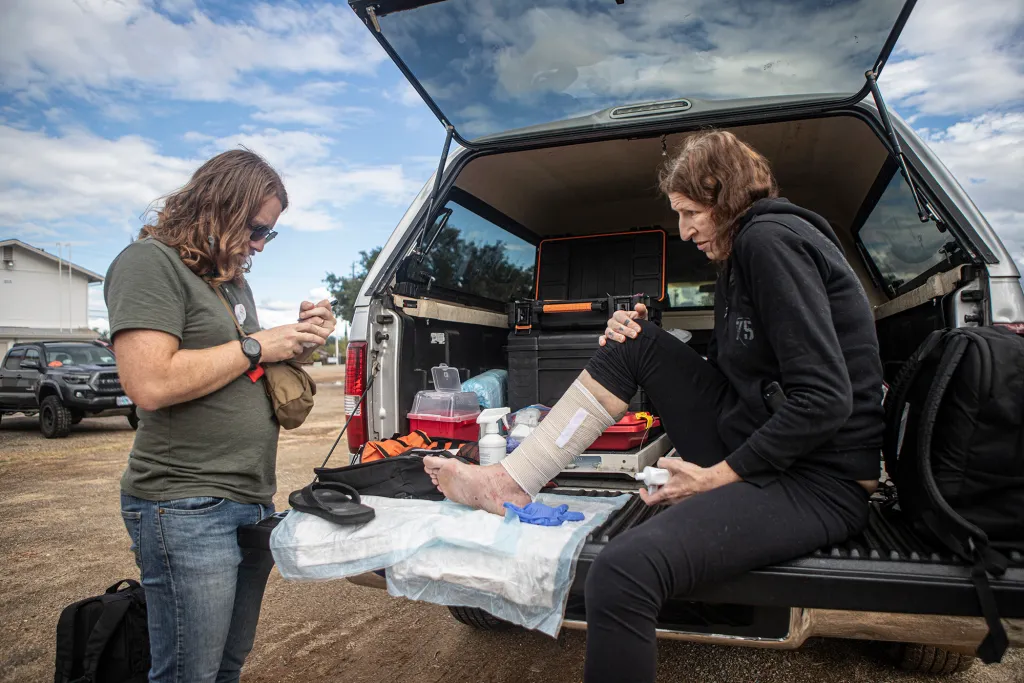
On a Monday in September, Patton and Anna Cummings, a case worker, trekked through a wooded area on the north edge of town to meet Amber Schmitt, 47, a patient with an infected leg. The ground is muddy from a storm the night before. Schmitt is paying a friend $700 a month to stay in his apartment, but hidden among the trees and rolling hills is her abandoned encampment, along with dozens of others. Schmitt gets $1,000 a month from Social Security, but it’s not enough to afford a security deposit or rent in the area, she said.
Physician’s assistant Brett Feldman checks his patient, Carla Bolen’s, blood pressure while in her encampment at the Figueroa St. Viaduct above Highway 110 in Elysian Valley Park in Los Angeles on Nov. 18, 2022.Photo by Larry Valenzuela for CalMatters
The gash on Schmitt’s right shin is mottled and inflamed. She said she scraped it on a fallen branch. Patton cleaned and dressed it for her previously, but she had no choice but to reuse bandages after running out. Now she can barely walk from the pain.
“This is a silver-based dressing, which will kill bacteria in wounds,” Patton tells Schmitt after rinsing the area with a saline wash. “We’ll get you some more dressing too. And then you’ve got some skin breakdown and maceration between your toes. I don’t like the look of that.”
He gives her a fungal cream and a bottle of antibiotics. Schmitt is a leukemia survivor and has had a hip replacement on the same injured leg. Her medical history makes her prone to infections and poor circulation in her extremities, Patton said.
“There’s people that would maybe make the argument that … they have health insurance here in California, they should just utilize the system as is. The reality is because of certain factors within the context of their homelessness, they’re not able to do that,” Patton said.
Although they qualify for comprehensive health coverage under Medi-Cal, the program wasn’t necessarily designed with homeless people in mind. For example, Medi-Cal will pay for transportation to and from a doctor’s appointment, but it requires the patient to provide a fixed address and give several week’s notice to the driver, something most people experiencing homelessness aren’t able to arrange.
Link between homelessness and health
Health data on homeless people are sparse, with no state agency and only a handful of counties tracking the information, but it’s clear that most of their deaths are preventable.
In Alameda and Marin counties, half result from acute or chronic health conditions like cardiovascular disease, cancer or respiratory failure. In Orange County, these make up a quarter of deaths among the unhoused. In Los Angeles County, heart disease is the second-leading cause of death among people experiencing homelessness, second only to overdoses.
Even overdose deaths are considered preventable — yet in San Francisco, overdoses cause 82% of deaths among the unsheltered.s.
“We commonly see conditions that you would see in a typical population, but they’re just not addressed; so out-of-control high blood pressure, uncontrolled diabetes…also substance use in terms of opioids, we see a whole lot more than in the general population,” said Dr. Absalon Galat, medical director for LA County’s Department of Health Services’ Housing for Health division.
Galat’s team started its foray into street medicine in an effort to dole out COVID-19 vaccines, but team members quickly found they needed to do more. The county used COVID-19 relief funds to purchase mobile clinics, and CalAIM funding has helped them hire 60 staff members.
In September, the county’s fleet of mobile clinics, complete with fully outfitted exam rooms, began visiting areas where services are sparse. Smaller teams of clinicians and case workers roam encampments to follow-up with patients, treat minor issues and bring patients to the mobile clinic. There’s some disagreement among street medicine providers about whether mobile clinics remove enough barriers because they still require patients to travel to a set location, but Galat said his goal is to improve access, whether it’s by wheel or foot.
“People are dying every day,” Galat said. “So we have to try with what we know best in the medical field right now to limit people who are dying.”
The connection between homelessness and health is inextricable, said Dr. Michelle Schneidermann, director of the People-Centered Care team at the California Health Care Foundation, a statewide health policy think tank.
“Either one can lead to the other. A catastrophic health incident or a series of conditions can lead to someone not being able to work, leading to poverty,” Schneidermann said. “We see this all the time, health conditions precipitating homelessness, and the other way around.”
“Until we can end our crisis of homelessness…we have to find a way to deliver care for people on the streets.”
— Dr. Michelle Schneidermann, director of the People-Centered Care team at the California Health Care Foundation
Take Danny Doran, 56, who visited LA County’s mobile clinic at Whittier Narrows Park on a recent Thursday to pick up insulin. He spent his career as a plumber and owned a home in Bishop. Three years ago he fell into a diabetic coma and was hospitalized for months. A friend Doran trusted to pay his bills while he was hospitalized emptied his bank account and disappeared — Doran has been homeless ever since. Several weeks ago he was beaten and robbed by another homeless man, who left him with a fracture in his skull and a tremor in his hands.
“I guess I’m a little bit naive,” Doran said. “We’re all humans and we’re prone to mistakes, you know? So I hate for anyone to have their money stolen like mine was and end up like me on the streets.”
At the mobile clinic, Doran said the doctor on staff agreed to be his primary care physician. His previous primary care doctor stopped accepting Medi-Cal insurance, and Doran hasn’t had regular access to insulin ever since.
“The doc here, she truly has compassion for her patients. I’m glad our paths crossed,” Doran said.
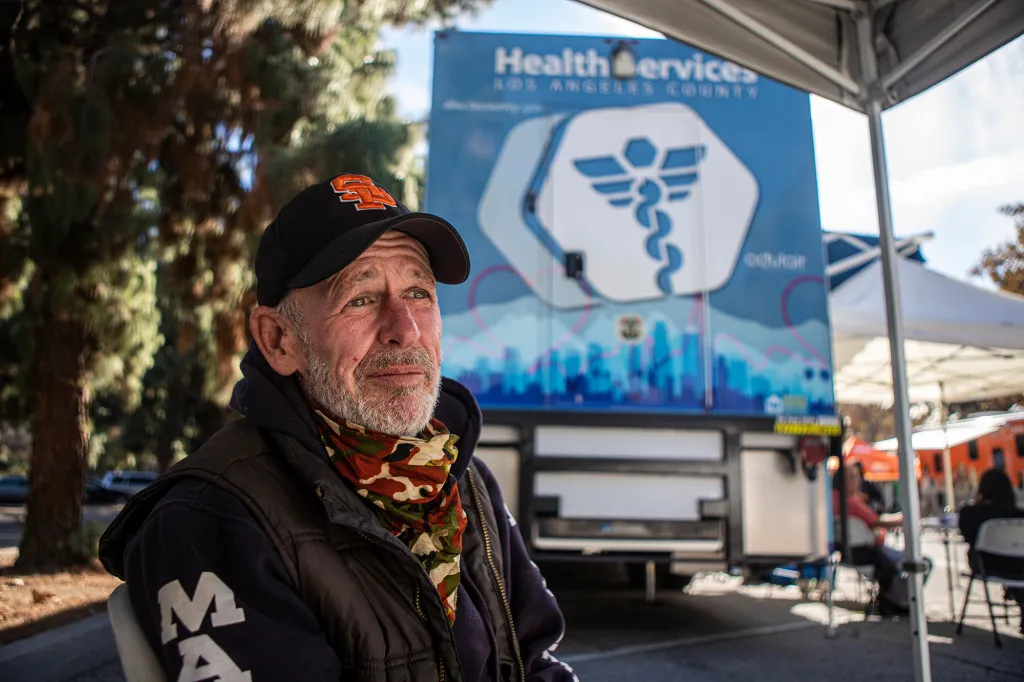
Unhoused patient Danny Doran sits in the waiting area for the mobile clinic parked in Whittier Narrows Park on Nov. 17, 2022. Doran is being checked up after being assaulted near his encampment just a few days before. Photo by Larry Valenzuela for CalMatters.
Schneidermann, who is overseeing a study on street medicine programs across California, said CalAIM, which also pays for housing services, is an opportunity for the state to address its most pernicious problem.
“Until we can end our crisis of homelessness…we have to find a way to deliver care for people on the streets,” Schneidermann said.
New programs popping up
Prior to CalAIM and the Health Care Services Department’s rule changes, street medicine programs operated outside of traditional health care, funded by philanthropies or the rare health organization willing to lose money. Now, the department’s changes offer some hope for stability, Feldman said.
Noting that these programs were birthed out of the pandemic, Feldman said they “might not exist in a few years if they’re not supported, but they have all these patients that rely on them.”
A year ago only 25 programs existed across the state, primarily concentrated in urban areas, Feldman said. But ever since CalAIM launched at the beginning of 2022, he’s run into more organizations looking to begin services. CalAIM requires Medi-Cal insurers to coordinate patients’ physical, behavioral, dental and developmental care as well as social services — something many street medicine teams already do. The goal is to make the “system hustle behind the scenes rather than making the patient hustle,” California Health Care Foundations’ Schneidermann said.
One such program is run by Anthony Menacho in Sacramento. Unlike USC, Shasta Community Health or LA County’s teams that are staffed full time, Menacho’s street medicine band is composed entirely of volunteers. They visit six camps every other weekend.
The work was funded initially by a $100,000 grant from Health Net, the largest Medi-Cal provider in the state, but Menacho, who trained as a physician assistant with Feldman at USC, wants to be able to do the work full time and hire more clinicians. He’s working to secure money through CalAIM and the Department of Health Care Services.
“We don’t have the academic resources or people behind us to be able to put in a department or infrastructure on the drop of the dime,” Menacho said. “We run on grants, but that’s not true sustainability. We can’t do it ourselves. It has to be a coordinated effort and I think that’s what CalAIM is trying to do.”
###
CalMatters.org is a nonprofit, nonpartisan media venture explaining California policies and politics.
BOOKED
Today: 8 felonies, 15 misdemeanors, 0 infractions
JUDGED
Humboldt County Superior Court Calendar: Today
CHP REPORTS
Sr162 / Fairbanks Ln (HM office): Car Fire
ELSEWHERE
RHBB: Trinity River Flows Are Predicted to Nearly Triple Tomorrow During Deadly Summer on the Water
Governor’s Office: What they are saying: Leaders from across the state celebrate transformative economic investments through California Jobs First
RHBB: Vegetation Fire Sparks Response Near Eureka’s North 40 Thursday Afternoon
RHBB: Bicyclist Suffers Major Injuries After Riding Wrong Way into Vehicle at 7th and J, EPD Says
OBITUARY: Paul Bryon Shaner, 1958-2022
LoCO Staff / Thursday, Dec. 8, 2022 @ 6:56 a.m. / Obits

Paul Bryon Shaner
Feb 3, 1958 - Sept 10, 2022
On September 10, at 3:30 p.m., with his daughters and grandson by his side, Paul Shaner passed away in the arms of his wife, Michelle.
The story of his life is filled with adventures, love and, most important to him, fun. Paul was born and raised in Arcata. He loved playing sports and was a natural athlete. He excelled in football, basketball and baseball in high school, and he is still remembered for being an exceptional baseball player. Anything he tried to do he picked up quickly and was hard to beat. While trying to help his daughter improve her hand-eye coordination for softball, he would tell her to go hit gravel in the driveway. She was not very successful. He took the bat, grabbed a small rock, and sent it humming into the woods. Not once, but every time he swung. His daughter was in awe at how good he still was. Paul was naturally talented in basketball, and he would spend many weekends showing his daughters his famous hook shot. He rarely missed a shot. The old guy still had it. Paul was a life-long San Francisco Giants, Lakers and LA Rams fan. Every sport season his daughters would hear about his “Mighty Rams, Mighty Giants or Mighty Lakers”. Win or lose, they were mighty.
Paul was an extremely hard worker and devoted family man. He spent over a decade at his first job with TP Tire in Arcata. He then went on to work at Pacific Lumber in Scotia until he became ill. He started out pulling green chain, but after several shoulder surgeries he was trained and certified to be a welder and mechanic. When is girls became old enough to drive and have cars of their own, he became their personal mechanic. Most of the time he could fix the problem, but when he couldn’t we would hear him say the dreaded “well kid, you’re screwed”. He’d say it with a laugh, and then pay to get the problem fixed.
He loved his job. Many times he’d come home and talk about his day - the good, the fun and the crazy. Paul was a prankster and loved to have fun wherever and whenever he could. Home, work or just out with friends, he always wanted to have fun. Paul loved being a father. His five daughters were the lights in his life. He enjoyed teaching them how to play their preferred sports, the card game cribbage, and about life. He could always be depended on as a thoughtful sounding board for them when they would ask him for advice. Those calls were typically met with a quick update on the weather at the house and what adventure he was up to that day.
Once his girls became older and moved away from sports, Paul picked up a new hobby, tractors. He started out small, with a modest Craftsman riding lawn mower. Not too much later he had it outfitted with mud tires and rear wheel weights. When he figured out it wasn’t powerful enough to move mountains, he bought a bigger riding lawn mower. After fabricating a hydraulic scoop for the front he was on his way to making trails around his property. After going through several of his lawn “tractors” over the years, he finally bought a real tractor. Now he was in “seventh heaven”. Many a weekend, when his daughters would come up to see him, they could quickly tell what he was up to. “Woo Hoo’s” and “Yee Haws” could be heard echoing over the property. They’d find him on his tractor, one arm in the air as if he was riding a bronco, having fun.
In early elementary school, while riding on the school bus, Paul met Michelle Hansen. While they wouldn’t meet up again for many years, their love story started with a young-fated kiss on that bus. In 2008 Paul reconnected with an old friend from childhood. It was his Michelle. The two began talking and their love story unfolded. In October, 2010, in a small ceremony, Paul and Michelle were married – a childhood crush had come full circle. Together, Paul and Michelle enjoyed many adventures – trips to Tahoe, riding their quads in the mountains and at the beach, or just around their property.
In 2015, Paul and Michelle were given the life-altering news that Paul had early onset Alzheimer’s. He soon was accepted into clinical drug trials, being conducted over a period of three years, in San Francisco. Michelle was with Paul for every round of treatment. Paul said he wanted to do the trial, as he hoped it could help others dealing with this disease. Paul faced his diagnosis with courage, never letting go of enjoying life. He even began a new hobby; picking up pretty rocks he found during the many walks he and Michelle took together. He was very proud of his rock collection, and you would find them displayed on the many windowsills of the house. Michelle’s love and dedication to Paul knew no boundaries. She was his fierce advocate and champion, making sure he received the best possible care. For this love for Paul, his daughters and family will be forever grateful to Michelle.
His wife, Michelle, survives Paul. In addition to Michelle, Paul is survived by his daughters Kellie (Amy) Shaner, Brandie Shaner, Michelle Barnes, and Brooke (Joe) Ponte, and grandchildren: Gloria, Anthony, Anika, Yazmine, Jacob, Calen, McKenzie, Emma, Lincoln, Lorenzo, Anthony, Cameron, Hunter and Patrick.
Paul is also survived by his sister, Peggy (Frank) Camilli, brother, David Shaner, parents-in-law Ted and Barbara Hansen, brother-in-law Lance (Carmen) Hansen and several good friends.
Paul was preceded in death by his parents, his brother Douglas, and, devastatingly, his youngest daughter, Heather. Also preceding Paul in death was his life-long friend, Russell Dellabalma.
Since the time of his passing in September, his ex-wife and mother to Heather, Holly Niclai Theuerkauf, has passed away (November 18th, 2022). At Paul’s request there will not be a funeral, but rather a Celebration of Life will be held in the spring of 2023 – Paul’s favorite season.
While we will miss Paul, we know that he’s reunited with his daughter Heather in heaven, where he is whole and happy again.
###
The obituary above was submitted on behalf of Paul Shaner’s loved ones. The Lost Coast Outpost runs obituaries of Humboldt County residents at no charge. See guidelines here. Email news@lostcoastoutpost.com.
OBITUARY: Ted Albert Walters, 1939-2022
LoCO Staff / Thursday, Dec. 8, 2022 @ 6:56 a.m. / Obits
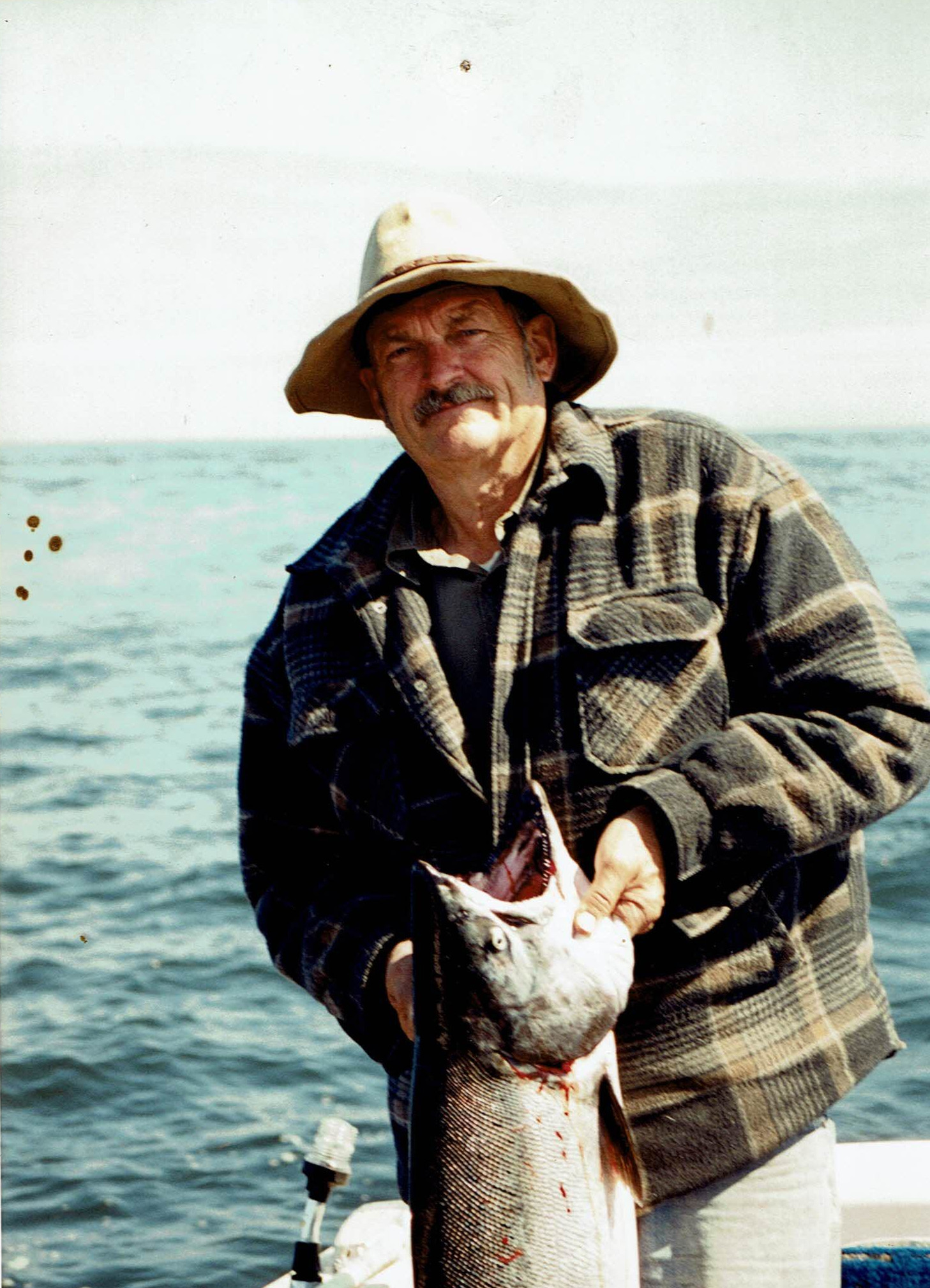
Ted
Walters went home to the Lord on November 5, 2022. He passed away at
home fighting what he would call “old age.” The last couple of
years he weakened physically but was still sharp upstairs.
Born December 20, 1939 to John and Margaret Walters in Pasadena, he was the middle child of three. Older brother Jim and younger sister Hellen. The family moved to Cutten in the mid-1940s, when there were few homes and lots of stumps to play on. His family was one of the founding families at Faith Center Church in Eureka. He grew up watching his father drive and work on logging trucks and heavy equipment. He continued that mechanical ability the rest of his life. He graduated from Eureka High School in 1958. He excelled in swimming in school and still had all his trophies on the mantel. He served in the Air Force from 1962 to 1966, stationed in Japan and March Edwards Air Force Base.
In 1966 he married Joanne Munger. They moved to Ferndale in 1969 and bought the house they still live in. In 1969 their first son, David, arrived. In 1970 their second son, Jonathan, came along. Ted taught them the love of the outdoors, going camping, hunting, fishing and cutting firewood. He had an annual Idaho hunting trip. He went to the same spot in Ore Grande, Idaho for 45 years. The stories and friends that went on that trip are too many to count.
He was active as a Cub Scout and Boy Scout leader, especially on the many camping trips, Ruth Lake summer camps, Black Lassic winter camps and many other places. He was active in Rotary Club for at least 30 years. He was one of the many cooks for the annual lobster dinner and many others.
During his Air Force service he took up photography. He built his own dark room in the back of his house. He took pictures everywhere he went. He did class reunions, weddings, birthdays and any event he could. There are thousands of pictures he has developed.
Ted worked at LP Carlotta sawmill from 1970-1977. He eventually became head sawyer and loved to tell stories about the big logs. From 1978-1979 he ran the Exxon gas station, which is now Ferndale Pizza Company. He then took a job with Francis Land and Water Company and became the manager. He worked there for 16 years until he could retire at 55 and “go play.” His so-called “playing” ended up being a job falling timber for his son, something he had always wanted to do. After a few years of that, he started running a fellerbuncher. He retired from his logging career at age 64.
He leaves behind his wife of 56 years, Joanne Walters. He is survived by his two sons David and Jonathan. Also, David’s family including wife, Megan Walters, children Mitchell, Morgan and Putter Walters and great-grandchild Bellami Washington.
Following his request there will be no services.
###
The obituary above was submitted on behalf of Ted Walters’ loved ones. The Lost Coast Outpost runs obituaries of Humboldt County residents at no charge. See guidelines here. Email news@lostcoastoutpost.com.
SOLD! BOEM Names California North Floating and RWE Offshore Wind Holdings as Provisional Winners of Two Offshore Wind Leases Off the Humboldt Coast
Isabella Vanderheiden / Wednesday, Dec. 7, 2022 @ 1:53 p.m. / Energy , Offshore Wind

A 9.5-megawatt floating wind turbine deployed at the Kincardine Offshore Wind project, located off the coast of Aberdeen, Scotland. Photo courtesy of Principle Power.
###
We have our winners!
The Bureau of Ocean Energy Management (BOEM) just announced the provisional winners of the first-ever offshore wind energy lease auction on the West Coast.
California North Floating, LLC, a subsidiary of Copenhagen Infrastructure Partners, and RWE Offshore Wind Holdings, LLC, a German multinational energy company, placed the winning bids for two lease areas in the Humboldt Wind Energy Area (WEA), which spans more than 132,000 acres approximately 20 miles west of Eureka.
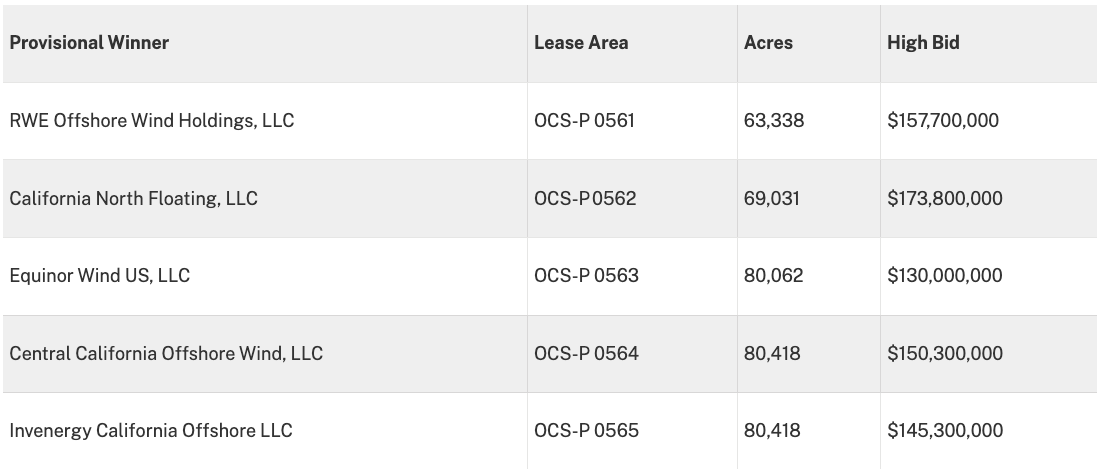
When the auction ended just before noon today, the swath of watery real estate went for more than $331.5 million, with California North Floating, LLC bidding $173.8 million for 69,031 acres and RWE Offshore Wind Holdings, LLC bidding $157.7 million for 63,338 acres.
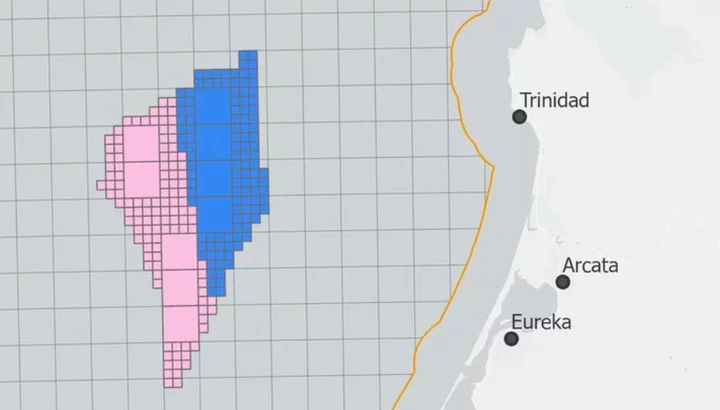
Map: Bureau of Ocean Energy Management
BOEM also auctioned off three leases further south, off Morro Bay. Those leases were awarded to Equinor Wind US, LLC, Central California Offshore Wind, LLC and Invenergy California Offshore, LLC for a total of $425 million.
“The offshore wind project for Humboldt is a game-changer for how California can shift to a more sustainable way to provide critical energy and reliability while fighting against climate change,” Assemblymember Jim Wood said in a prepared statement. “The importance of state and federal agencies investing in this region, and the community benefits that will be gained, can’t be underestimated.”
Today’s lease sale also included a 20 percent credit for bidders who committed to workforce and domestic supply chain investments, as well as a five percent credit for a Community Benefits Agreement (CBA) with “communities, stakeholder groups, or Tribal entities whose use of the lease areas or use of the resources harvested from the lease areas” and five percent credit for a General CBA with “communities, Tribes, or stakeholder groups that are expected to be affected by the potential impacts on the marine, coastal or human environment from lease development,” according to BOEM.
Now that the provisional winners have been announced, BOEM will return the non-winners’ bid deposits and the Department of Justice will initiate an antitrust review of the auction. All winners are considered provisional until they sign the lease, provide financial assurance and pay any outstanding balance of their bid.
As soon as that’s all sorted out, the lease agreement will be executed and the leaseholders will draw up a plan and begin the design phase of the project. A rigorous environmental and public review process will soon follow.
We’re certain that local folks and other governmental agencies will have lots to say about this highly anticipated announcement. We’ll add their statements below BOEM’s release, which arrived shortly after this morning’s announcement.
###
Press release from the Bureau of Ocean Energy Management:
WASHINGTON — The Department of the Interior today announced results from the Bureau of Ocean Energy Management’s wind energy auction for five leases offshore California. The lease sale represents the third major offshore wind lease sale this year and the first ever for the Pacific region. Today’s sale drew competitive high bids from 5 companies totaling $757.1 million, well exceeding the first lease sales that were held in the Atlantic.
“The Biden-Harris administration believes that to address the climate crisis head on, we must unleash a new era of clean, reliable energy that serves every household in America. Today’s lease sale is further proof that industry momentum – including for floating offshore wind development – is undeniable,” said Secretary Deb Haaland. “A sustainable, clean energy future is within our grasp and the Interior Department is doing everything we can to ensure that American communities nationwide benefit.”
The interest and success of today’s sale represents a significant milestone toward achieving President Biden’s goal of deploying 30 gigawatts of offshore wind energy capacity by 2030 and 15 gigawatts of floating offshore wind capacity by 2035.
“The innovative bidding credits in the California auction will result in tangible investments for the floating offshore wind workforce and supply chain in the United States, and benefits to Tribes, communities, and ocean users potentially affected by future offshore wind activities. This auction commits substantial investment to support economic growth from floating offshore wind energy development – including the jobs that come with it,” said BOEM Director Amanda Lefton. “These credits and additional lease stipulations demonstrate BOEM’s commitment to responsibly grow the offshore wind industry to achieve our offshore wind goals.”
BOEM’s lease sale offered five lease areas covering 373,268 total acres off central and northern California. The leased areas have the potential to produce over 4.6 gigawatts of offshore wind energy, enough to power over 1.5 million homes.
The lease sale included a 20-percent credit for bidders who committed to a monetary contribution to programs or initiatives that support workforce training programs for the floating offshore wind industry, the development of a U.S. domestic supply chain for the floating offshore wind energy industry, or both. This credit will result in over $117 million in investments for these critical programs or initiatives.
The auction also included 5% credits for bidders who committed to entering community benefit agreements (CBAs). The first type of agreement is a Lease Area Use CBA with communities, stakeholder groups, or Tribal entities whose use of the lease areas or use of the resources harvested from the lease areas is expected to be impacted by offshore wind development. The second type of agreement is a General CBA with communities, Tribes, or stakeholder groups that are expected to be affected by the potential impacts on the marine, coastal or human environment from lease development.
Under stipulations in the leases, lessees are required to engage with Tribes, ocean users, and local communities that may be affected by their lease activities. Lessee engagement must allow for early and active information sharing, focused discussion of potential issues, and collaborative identification of solutions. These communication and engagement activities must be routinely reported to BOEM. These lease stipulations are intended to promote offshore wind energy development in a way that coexists with other ocean uses, addresses potential impacts and benefits, and protects the ocean environment, while also facilitating our nation’s energy future for generations to come.
More information about today’s sale, including a map of the lease areas and requirements regarding the bidding credits, can be found on BOEM’s website.
###
Press release from the Redwood Region Climate & Community Resilience (CORE) Hub:
UNCEDED LANDS OF THE WIYOT PEOPLE — This Wednesday, California North Floating, LLC and RWE Offshore Wind Holdings, LLC won two offshore wind energy area leases, auctioned 21 miles off Humboldt Bay, totaling 132,369 acres and the potential for 140-170 megawatts (MW) of power with existing transmission infrastructure. Once fully built out, the Humboldt and Morro Bay offshore wind projects could power more than 1.5 million homes. While this makes significant progress towards state and national clean energy goals, more investments and protections for Tribes, the environment, fisheries and local communities are needed to prepare the North Coast for this new industry.
The auction was the Bureau of Ocean Energy Management’s (BOEM) first for the West Coast, and the first in the U.S. for floating offshore wind, including two leases off Humboldt Bay and three off Morro Bay. This auction is pivotal for meeting the Biden-Harris Administration’s goals of 30 gigawatts (GW) of offshore wind by 2030, and the Newsom Administration’s goals of 25 GW by 2045.These lease areas total over 373,000 acres of ocean waters and at least 4.5 GW of capacity for offshore wind.
Sufficient port infrastructure is key to the viability of this new industry on the West Coast, with the port in Humboldt Bay playing a key role. Offshore wind assembly includes turbines measuring approximately 500 feet in height, which are anticipated to grow to more than 800 feet by 2035. In October, the Humboldt Bay Harbor District announced a new partnership with Crowley Wind Services to develop the Humboldt Bay Offshore Wind and Heavy Lift Marine Terminal, which could support the offshore wind industry all along the West Coast. This impending development presents tremendous changes for this rural region, both bringing economic opportunities and requiring additional investments in local infrastructure.
Securing community benefits for the region that will host this industry remains a top concern for North Coast leaders and residents. Bryna Lipper, CEO of the Humboldt Area Foundation, explained: “Residents are excited for the new jobs and climate benefits this project may offer, however, the region currently lacks the housing, transportation, and other services to support this budding industry. Additionally, many residents have a strong connection to the natural world, and want assurances that marine mammals, fish, and birds, as well as cultural resources will be protected. Investments in local infrastructure, following the leadership of Tribes, mitigation efforts for fisheries and environmental protections are critical for the North Coast region, which struggles with a legacy of underinvestment and harms from previous boom and bust industries, like timber and gold.”
“Unfortunately, the local component of the bid credits and lease stipulations in the final sale notice and auction falls short of the investments needed for equitable wind energy development, meaning that local communities and Tribal Nations won’t have the resources needed to address the impacts of this new industry, or actually benefit from it,” cautioned Lipper. She noted that “the auction today totalled only 5 percent bid credits for a community benefits agreement with fisheries users, 5 percent for a general community benefits agreement, and 20% for workforce and domestic supply chain investments.” This is below the 50% local leaders and the state of California have advocated for in letters to BOEM. It is likely that community benefits agreements with offshore developers will not be negotiated until after leases are issued, which is expected to take place sometime after March 2023.
Over the last year the Redwood Region Climate and Community Resilience Hub (CORE Hub) convened the North Coast Community Benefits Network (‘the Network’), a group of Northern California Tribal Nations, local governments, community leaders and institutions, community-based organizations, environmental groups, and academics to advocate for local investments through BOEM’s leasing process. Unlike the timber, oil, gas, and geothermal industries, offshore wind lease revenues are not split with local governments, but rather go directly to the U.S. Treasury. The Network, along with the state of California, asked BOEM for “50% bid credits” for local workforce investments, equity and resident-focused community benefits, Tribal investments, and environmental protections.
BOEM’s lease terms and today’s auction were just two of many opportunities for local residents and leaders to shape the buildout of offshore wind. There are several steps from lease award to wind farm development, which can take up to or more than five years, and includes advancing a site assessment plan and then a construction and operations plan through the permitting process. Katerina Oskarsson, Executive in Residence with the CORE Hub added: “The Network will continue to closely watch these projects. During the leasing and permitting process, the CORE Hub will continue its engagement with BOEM to ensure the meaningful adoption and implementation of any terms and conditions that are laid out in the final sale notice. At the same time, we will continue supporting and growing the capacity of the North Coast Community Benefits Network to collectively advocate as a region.”
###
From Rep. Jared Huffman:
Congressman Jared Huffman (D-San Rafael) applauded the completion of today’s historic offshore wind auction held by the Bureau of Ocean Energy Management (BOEM), which includes two leases off the coast of Humboldt County in the second Congressional District.
“The completion of today’s auction is a tremendous step forward in the Biden administration’s offshore renewable energy goals and will bring significant economic benefits to California’s rural North Coast,” said Rep. Huffman. “Developers who have secured leases will play a critical role in our sustainable energy transition and ensuring that projects are thoughtfully constructed with mitigated impacts and strong community benefits agreements. I look forward to working with community and industry partners as these projects move forward.”
The Bureau of Ocean Energy Management’s auction included two leases off the coast of Humboldt County and three leases off the coast of Morro Bay totaling 373,268 acres. Leases off the coast of Humboldt County were secured at auction for a combined $331,500,000 and include opportunities for workforce and supply chain development and community benefits agreements. Moving forward lessees must complete state and local permitting processes, federal and state environmental reviews, and submit design reviews, construction and operations plans, and bidding credit information to BOEM in order to proceed with a planned project.
###
From a bunch of local environmental organizations:
The Environmental Protection Information Center, Humboldt Baykeeper, Northcoast Environmental Center, Coalition for Responsible Transportation Priorities, and Friends of the Eel River welcome provisional winners RWE Offshore Wind Holdings and Copenhagen Infrastructure Partners to Humboldt County.
It is imperative for our climate, wildlife, and local community that we work together to ensure that floating offshore wind energy development off our coast is successful, with the least impacts on the environment and the most benefits to our community. Floating offshore wind offers the potential for 1.6 gigawatts of clean, renewable energy generated locally, offering our contribution to the global efforts to address the climate crisis.
Moving forward, we will be working with project developers to ensure robust wildlife monitoring, transparent data sharing, and effective avoidance, minimization, and mitigation of impacts to wildlife. Success in our local communities will demand investment in local infrastructure and in historically disadvantaged communities, particularly local tribal nations.
###
PREVIOUSLY:
- Biden Administration Proposes Offshore Wind Lease Sale, Including Two Spots Off the Humboldt County Coast
- IT’S ON: Humboldt Offshore Wind Leases to Go Up For Auction on Dec. 6
- Harbor District Announces Massive Offshore Wind Partnership; Project Would Lead to an 86-Acre Redevelopment of Old Pulp Mill Site
- Offshore Wind is Coming to the North Coast. What’s in it For Humboldt?
- North Coast Fishermen Fear for the Future of Commercial Fisheries as Offshore Wind Efforts Advance
- North Coast Tribes Advocate for ‘Meaningful, Impactful Partnership’ with Potential Developers Ahead of Tomorrow’s Highly Anticipated Offshore Wind Lease Auction
Will Tonight’s Arcata City Council Meeting Happen? It Depends on Whether or Not Brett Watson Shows
Stephanie McGeary / Wednesday, Dec. 7, 2022 @ 11:44 a.m. / Local Government
Paging Brett Watson. We need you…for quorum.
This was going to be a very different article about tonight’s Arcata City Council meeting.
It was going to include an in-depth summary of an appeal hearing the council was going to hold that may reverse the Planning Commission’s approval of the Westwood Garden Apartments expansion. But alas, as this reporter was preparing the final touches on her story, LoCO got word that the appeal hearing will be continued to the council meeting on Jan. 4, 2023.
The reason for the continuation is that city staff fears the council may not have quorum (the minimum number of members that must be present for a meeting to occur, in case you are not familiar.)
For the Arcata City Council there must be at least three councilmembers present to hold a meeting, because that is how many people it takes to have a majority vote on an item. Arcata City Clerk Bridget Dory confirmed with the Outpost that two councilmembers — Councilmember Alex Stillman, who is apparently out of town on a planned trip, and Mayor Stacy Atkins-Salazar, who had a last minute emergency — will not be present tonight.
This would normally leave three councilmembers, which would be fine! But, you may have noticed that Councilmember Brett Watson has not attended any council meetings since he was not re-elected in the November election.
The city does not know for a fact that Watson will not be present tonight. He does still sit on the council until the end of the year and he might show up, in which case, the meeting will move forward and the other agenda items will still be discussed. But if he doesn’t show up, there will only be two councilmembers, Meredith Matthews and Sarah Schaefer, and the meeting will have to be canceled for a lack of quorum.
So, if you were planning to attend tonight’s meeting to comment on the appeal of the Planning Commission’s Westwood Garden Apartments project, save yourself the trouble. The appeal hearing will NOT be happening tonight.
Whether or not the meeting — scheduled for tonight (Wednesday), Dec. 7 at 6 p.m. — will happen at all, depends on whether or not Watson decides to make an appearance. Guess we’ll just have to wait and see.
BY THE NUMBERS: California’s Mild 2022 Wildfire Season
Julie Cart / Wednesday, Dec. 7, 2022 @ 9 a.m. / Sacramento

Cal Fire firefighters in Humboldt | File photo: Andrew Goff
As California emerges from its “peak” wildfire season, the state has managed to avoid its recent plague of catastrophic wildfires. So far in 2022, the fewest acres have burned since 2019.
State Emergency Services Director Mark Ghilarducci said California had “a bit of luck” with weather this summer. Although enduring yet another drought year, much of the state was spared the worst of the heat and dryness that can spark fires. And in some instances, well-timed rain came to the rescue.
Cal Fire officials also attribute some of the mild wildfire season to their emphasis on clearing away vegetation that fuels fires. Cal Fire Chief Joe Tyler said the $2.8 billion spent in the last two years on forest management made a difference, with the work “moderat(ing) fires approaching communities.”
Mindful that wildfires can spark at any time in an environment driven by climate change, California officials have their fingers crossed after Gov. Gavin Newsom pronounced “the end of peak fire season” in mid-November. While California has entered an age of year-round fire seasons, the bulk of its fires occur from April through October.
Still, Newsom knows better than to tempt fate. So while reporting that the state had a relatively moderate fire season and praising fire managers and crews, he quickly added that anything can still happen.
“We are not here with a sign, ‘Mission Accomplished,’ in any way shape or form,” Newsom said. “We will continue to maintain our vigilance.”
Here’s a look at some of the stories behind the numbers.
-362,455-
That’s how many acres burned across the state so far this year. Almost a quarter of those tore through remote El Dorado and Placer counties during the Mosquito Fire in September and October.
For perspective, last year’s acreage was about seven times larger — 2.5 million. And those years paled in comparison to record-breaking 2020, when more than 4.3 million acres were ablaze in California.
The state still threw everything at the wildfires it faced this year, hiring 1,350 additional personnel, deploying a new fleet of bespoke firefighting helicopters, and putting satellites, drones and artificial intelligence to work to attack each blaze.
-772-
Statistics about dramatically fewer structures destroyed by wildfires offer cold comfort when it’s your home that burned down. Still, there was much less damage done compared to recent years: 772 California structures were destroyed by fire this year, while 104 were damaged.
The McKinney Fire in July leveled 185 structures and the Oak Fire in Mariposa County destroyed 182, also in July.
Last year, a challenging fire season, was much worse: 3,560 buildings were destroyed — almost five times more than this year — and 286 were damaged. And during the 2020 season, the benchmark worst in nearly every statistical category, 11,116 buildings were lost.
The 2018 Camp Fire in the Butte County town of Paradise remains the most destructive fire in California history, wiping out nearly 19,000 structures — an entire community.
-9-
The ultimate cost was great, even in a quiet fire year. 2022 fires claimed the lives of nine Californians.
Four people died in August in the McKinney Fire in rural Siskiyou County, a sprawling blaze that also injured 12 firefighters. Two people were found dead in a car in their driveway. Another victim was a woman in her 70s who worked as a fire lookout for nearly five decades. She was killed in her home.
For comparison, three people died during the 2021 fire season, 33 in 2020 and three in 2019. The Camp Fire, which killed 85 people, retains the awful distinction as the state’s deadliest fire.
-256-
It’s a small victory, but fire officials will take it. Some 7,490 fires were sparked in California in 2022, which is 256 fewer than the five-year average of 7,746. In the fire world, even modest gains (about 3% below average) are welcome.
Tree removal projects — and burn scars from previous wildfires — can often slow or stop the spread of new fires. That simple calculus of creating a less-combustible landscape should equate to fewer and smaller fires, even with the dozens of variables that go into sparking wildfires.
California has a goal, in conjunction with the federal government — which owns the majority of the state’s forested land — to “treat” a million acres annually by 2025. That entails setting and monitoring low-intensity small fires, building and extending fuel breaks and clearing rights-of-way.
But it’s painstaking and slow: In the 2021-22 fiscal year, the state conducted nearly 600 fuels-reduction projects across 101,000 acres. An additional 21,000 acres have been cleared since July.
-76,788-
The state’s largest wildfire of the year, the Mosquito Fire, which burned 76,788 acres in national forests, turned out to be puny by recent standards, especially when compared to 2020’s million-acre giga fires and last year’s 963,000-acre Dixie Fire.
Size isn’t everything. Although not huge, the Mosquito Fire, which ignited in early September, was stubborn in the extreme, abetted by its location in steep canyons where fighting the flames was difficult. The fire quadrupled in size in one day. It took almost three months for firefighters to control it.
The scenario of that fire burning in a dense and dry landscape was sobering enough to prompt evacuations and weeks of defensive actions including closing parts of Tahoe and El Dorado national forests at peak camping season.
A sustained deluge of rain in October was credited with finally helping to suppress the blaze.
-3-
Along with the Mosquito Fire, two other wildfires were also, in part, extinguished by an increasing rarity in California: Rain.
Firefighters in the Rockies have an axiom: Snow puts out fires. California’s analogue occurred this summer when unexpected rainstorms doused two particularly nasty fires: the Fairview Fire in Riverside County and the deadly McKinney Fire in Siskiyou County.
Moisture from Tropical Storm Kay bailed out the Fairview Fire in September, and thunderstorms dumped three inches of rain on the McKinney Fire in August to douse some flames. But the storm also sparked lightning, which set off mud and debris flows.
It’s not just precipitation that influences the severity of the fire season. It’s also wind.
As wildfires in the northern part of the state were tamped down at the end of summer, attention turned to the south, where fires often are triggered by dry Santa Ana winds. Perhaps to remind everyone who’s in charge, winds gusted through Southern California over the Thanksgiving weekend, setting off red flag alerts for brush fires. But no large fires erupted.
-12th-
If history is any guide, the 12th month of the year can’t be counted on to be quiet.
In 2017 Southern California exploded under strong Santa Ana conditions, sparking 29 wildfires, including the Thomas Fire, which burned 281,893 acres in Santa Barbara and Ventura Counties, making it at the time the largest fire in California history.
The month-long barrage started in December, ran across 440 square miles and destroyed more than 1,000 structures. It burned into January.
In 2020 more than a half-dozen wildfires started in December, a month that is reliably cool and moist — or sometimes hot and dry.
In other words, to quote the governor, “We are not out of the woods yet.”
###
CalMatters.org is a nonprofit, nonpartisan media venture explaining California policies and politics.
TODAY in SUPES: Should Humboldt Become a Charter County? Plus, Fishermen Aim to Navigate Wind Energy Development, SoHum Looks for Financial Help
Ryan Burns / Tuesday, Dec. 6, 2022 @ 4:52 p.m. / Local Government
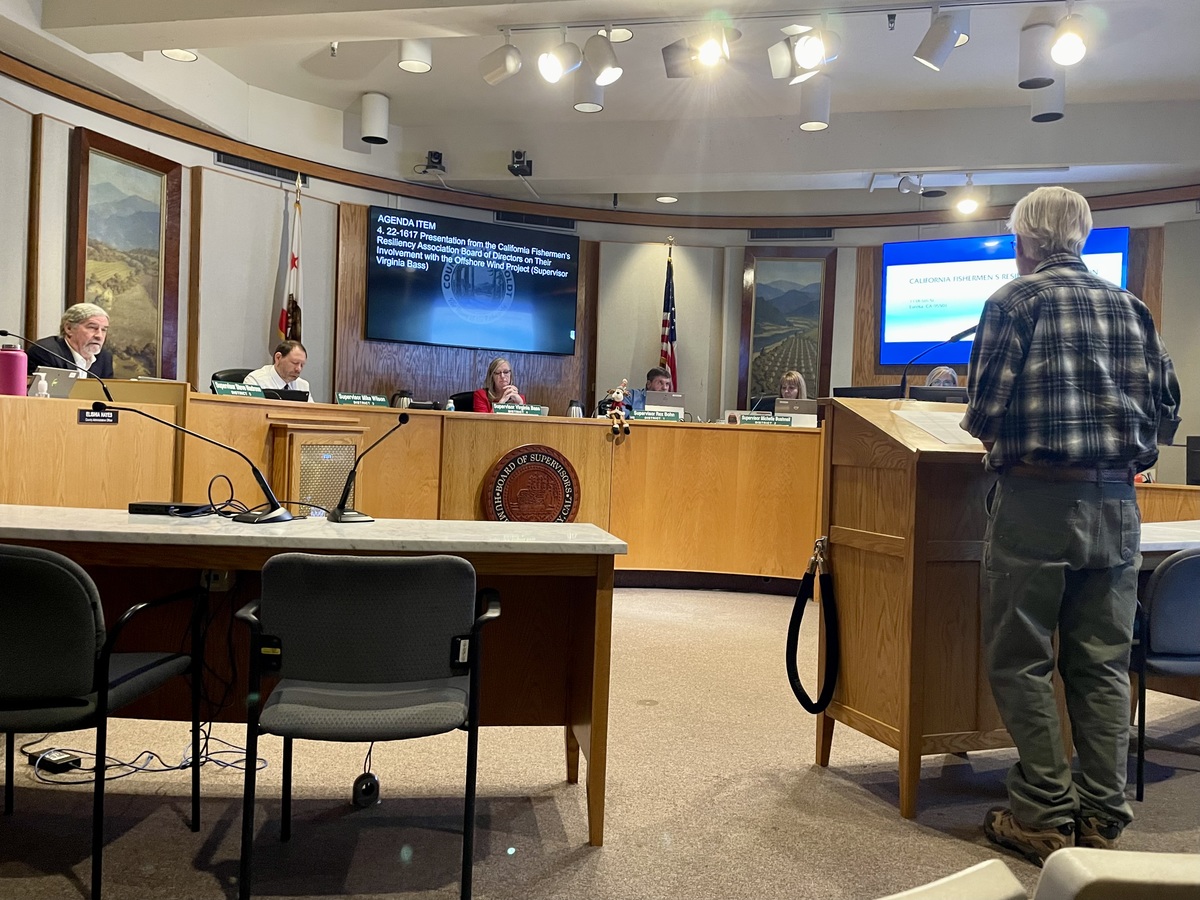
Local fisherman Ken Bates, representing the California Fishermen’s Resiliency Association, addresses the Board of Supervisors on Tuesday. | Photo by Ryan Burns.
###
We asked this yesterday, and we’ll ask it again: Should the county place a measure on 2024 ballots asking the public to create a Department of Finance? This hypothetical department would consolidate two currently separate, elected positions — treasurer-tax collector and auditor-controller — into a single Department of Finance.
A separate ballot measure would ask voters whether the head of that new department should be appointed or elected.
Why are these questions coming up now? Well, Fourth District Supervisor and Board Chair Virginia Bass is serving out her last few meetings, and before walking out the door she wanted to re-raise these two queries, to which voters narrowly responded “No, thanks” back in 2016.
Bass wagers that perspectives may have changed over the intervening years in light of the fiscal and interpersonal chaos that attended the tenure of former Auditor-Controller Karen Paz Dominguez, who resigned amid a state lawsuit and fierce internal squabbling this past June, having lost her re-election bid by a landslide.
Tabatha Miller, the assistant county administrative officer and chief financial officer, said staff has done a bit of research into this proposal, examining how things work in other California counties, and could dig even deeper, possibly by conducting some public polling, should the board so choose.
Five counties in the state have a Department of Finance and “a number” of other counties, both large and small, have combined the offices of treasurer-tax collector and auditor-controller, Miller said, adding, “Most of those are elected but there are a few that are appointed.”
Miller brought up a related but separate question: Should Humboldt County ask voters to change the county governance structure from a general law county — that is, one that strictly follows California’s Government Code — to a “charter county,” which would give it the autonomy to create and enforce local ordinances, as long as they don’t conflict with the general laws of the state.
Fourteen of California’s 58 counties are organized as charter counties, and Miller explained that becoming one would allow Humboldt to reduce the number of elected officials (though it must maintain a sheriff, district attorney and assessor).
Second District Supervisor Michelle Bushnell encouraged polling the public to get a better sense of community sentiment on both matters — the Department of Finance proposal and the charter county proposal. She also said she likes having the treasurer-tax collector operate independently from the auditor-controller.
Miller said it would be possible to have two separate divisions within the Department of Finance, which would allow for checks and balances.
Third District Supervisor Mike Wilson said becoming a charter county would allow Humboldt a lot more flexibility, allowing us to implement ranked-choice voting, for example.
As for the county’s fiscal management positions, Wilson said appointing such people has the advantage of being able to recruit candidates nationwide for such professional-class jobs.
“We don’t limit ourselves in terms of our ability to recruit for our engineers or medical professionals … to [people] just living in the county and wanting to go through an election,” Wilson said. Organizations with an annual budget of half a billion dollars don’t typically limit themselves to recruiting from a county population of under 140,000, and further limiting the candidate pool to people who are “willing to go through the yearlong interview process that we call elections,” he continued.
Fifth District Supervisor Steve Madrone said he, too, would like staff to bring back more information on becoming a charter county, noting that ranked-choice voting is “pretty exciting to a lot of people who have read about it and understand it, but we can’t do it unless we are a chartered county.”
Madrone said he also wants more information on the pros and cons of having an appointed director of finance, noting that while checks and balances are certainly important, some people say you achieve that through elections while others “argue that there would be better checks and balances to have had an appointed position [so] that you’re absolutely certain the person has the qualifications for the job.”
First District Supervisor Rex Bohn said, “We lived through the cons [of having an elected auditor-controller] for the last four years,” adding, “The one thing that shouldn’t be political is our finances.”
During the public comment period, self-styled wielder of “weaponized data” and erstwhile Paz Dominguez supporter Thomas Edrington spoke on behalf of his Transparency Humboldt Coalition, warning the board not to “appoint or in any way interfere again with the duly elected office of auditor-controller, the person who watches your money. My money. For me.”
Such power “is not to be in your hands, period,” Edrington told the board.
He blamed the county’s recent fiscal management woes on toxic work environments and the “frauds holding the reins at the CAO’s Office.”
Afterward, Wilson noted that people tend to get awfully righteous about money, “which is fine, but, I mean, we also have professionals in our community that design our bridges, our roads, our schools, our medical professionals … and we don’t subject them to political processes in these ways, necessarily.”
The board wound up passing a motion that directed staff to come back at a later date with more information on these matters, including charter counties, qualifications for county financial positions and potential public polling questions.
County Administrative Officer Elishia Hayes weighed in, saying, “Placing a ballot measure on on the ballot is a multi-step process so we’ll be talking about this many more times.”
Community grant coordinator
In light of the profound economic struggles facing Southern Humboldt businesses in particular following the collapse of the local cannabis industry, Bushnell asked her colleagues on the board to consider creating a new full-time community grant coordinator position.
Local businesses and small government bodies in the county’s unincorporated areas need help applying for grants, Bushnell said.
Economic Development Director Scott Adair said that though community events such as town hall discussions, he has learned that remote, volunteer-run organizations “may lack the skills or education or knowledge to even find grants or write grants. Some of these organizations are actually paying consultants, sometimes as much as $10,000 or more, to write grants for them,” he said.
Madrone said he supports grant writers, noting that he and Wilson supported the creation of two new grant writer/project manager positions for the Public Works Department, which has benefited from their work.
“I mean, I would support new grant positions in every department across the board every day it came before us,” Madrone said, adding that there should maybe be a grant manager or czar to oversee the rest of them.
Wilson said that while he understands the importance of grant writing, there also needs to be staff to administer the grants. He noted that there are local nonprofit organizations such as the Humboldt Area Foundation and the Redwood Community Action Agency (RCAA) that provide this type of support.
Hank Seemann, deputy director of public works, appeared via Zoom and said the county is already engaged in the seven-county North Coast Resource Partnership, which serves as a grant administrator, helping direct state-allocated funds to small districts, cities and nonprofits.
Seemann agreed with Wilson that writing a grant application is a small part of the full lifecycle of a grant, so the board should probably narrow its focus and exactly which areas of community development it would like to focus on.
“It seems like this is almost right down the alley of what the Humboldt Area Foundation was formed for,” Bohn said, adding that it might be outside of the county’s wheelhouse.
Bushnell again reiterated the dire economic situation for many local businesses, and the board wound up adopting a motion to have economic development staff analyze community needs, grant availability and potential ways to structure a grant manager position.
Fishermen and wind energy
Before the board adjourned to closed session, local fisherman Ken Bates delivered prepared remarks and a PowerPoint presentation on behalf of the recently formed California Fishermen’s Resiliency Association. The topic was local fishers’ involvement and concerns with the development of offshore wind energy.
“Fishermen are not opposed to renewable energy … ,” Bates said. “But what we are trying to do is to figure out how we can survive these projects over the long run.”
Leases to develop floating offshore wind projects within the Humboldt Wind Energy Area were being auctioned off as Bates spoke, and he said those developments will result in the loss of up to 3,000 square miles of fishing grounds, plus disruptions from increased vessel traffic and new shoreside infrastructure.
The California Fishermen’s Resiliency Association was created through a regional effort and financed via a $98,000 grant from the Ocean Protection Council.
The goal of his organization — and, by extension, of local fishermen — is to avoid impacts on fishing grounds and in harbor areas wherever possible, minimize the unavoidable impacts and mitigate the damage, possibly through fees directed to support long-term resilience in the local fishing industry.
Bates aims, through his organization, to create Fishing Community Benefit Agreements. He’s hoping his group gets the attention of the federal Bureau of Ocean and Energy Management (BOEM) and the California Energy Commission so that local fishermen can be involved in future processes, such as locating energy transmission lines.
The board accepted the report and expressed support for the local fishing industry.
Odds and ends:
- Early in the meeting, the board proclaimed this to be Human Rights Awareness Month. Reading the proclamation aloud, Bass noted the “lack of civility” and the “hate and vile speech” common here in 2022 and called for personal reflection and civil engagement in the coming year. The Human Rights Commission issued a press release after the meeting, noting the interruption of a recent Pride event by protesters as well as the dissemination of hateful stickers and antisemitic literature. Here’s a copy of the proclamation.
- The board passed a resolution recognizing former Humboldt County Public Health Officer Dr. Don Baird, who was recently honored with the Frederick K.M. Plessner Memorial Award by the California Medical Association. The award honors the California physician who best exemplifies the ethics and practice of a rural country practitioners.
- They also passed a resolution honoring Singing Trees Recovery Center, which recently closed its doors after more than three decades of helping people overcome addictions. Bushnell said her son has been sober for six years following a four-month residential program at Singing Trees.
- The board appointed David Sundberg and Callie Buck to the Weott Community Services District’s board of directors, which had hit a brick wall, procedurally, because it only had two members, making it impossible to reach the quorum necessary to pass anything. “We’re kind of seeing a trend lately where it’s getting harder and harder to find people to step up and fill these roles,” Madrone said. Bohn agreed, saying such positions are volunteer, “and you never get thanked. All you do is get doodoo heaped on you.” He called for an end of the “abuse” that comes from certain members of the public at meetings of such boards.


