

TODAY in SUPES: Should Humboldt Become a Charter County? Plus, Fishermen Aim to Navigate Wind Energy Development, SoHum Looks for Financial Help
Ryan Burns / Tuesday, Dec. 6, 2022 @ 4:52 p.m. / Local Government
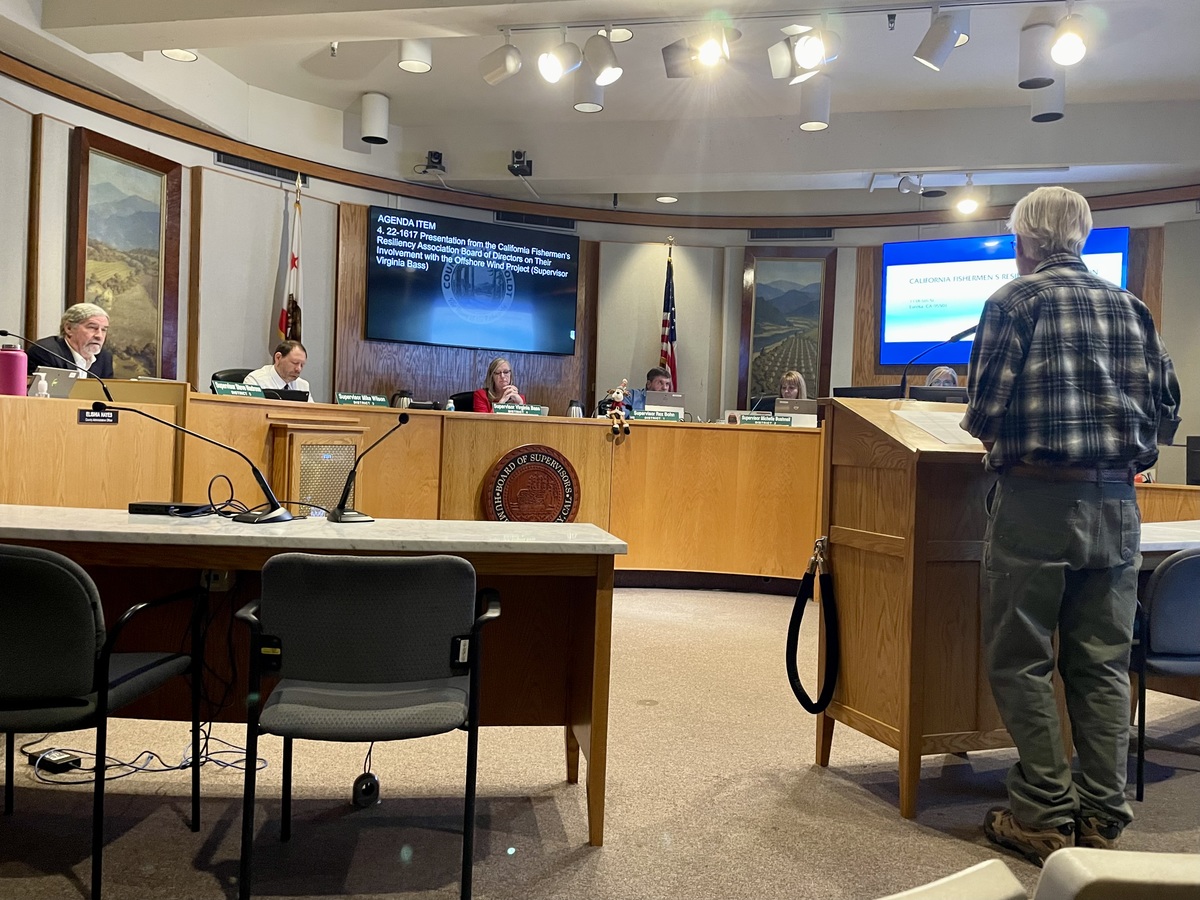
Local fisherman Ken Bates, representing the California Fishermen’s Resiliency Association, addresses the Board of Supervisors on Tuesday. | Photo by Ryan Burns.
###
We asked this yesterday, and we’ll ask it again: Should the county place a measure on 2024 ballots asking the public to create a Department of Finance? This hypothetical department would consolidate two currently separate, elected positions — treasurer-tax collector and auditor-controller — into a single Department of Finance.
A separate ballot measure would ask voters whether the head of that new department should be appointed or elected.
Why are these questions coming up now? Well, Fourth District Supervisor and Board Chair Virginia Bass is serving out her last few meetings, and before walking out the door she wanted to re-raise these two queries, to which voters narrowly responded “No, thanks” back in 2016.
Bass wagers that perspectives may have changed over the intervening years in light of the fiscal and interpersonal chaos that attended the tenure of former Auditor-Controller Karen Paz Dominguez, who resigned amid a state lawsuit and fierce internal squabbling this past June, having lost her re-election bid by a landslide.
Tabatha Miller, the assistant county administrative officer and chief financial officer, said staff has done a bit of research into this proposal, examining how things work in other California counties, and could dig even deeper, possibly by conducting some public polling, should the board so choose.
Five counties in the state have a Department of Finance and “a number” of other counties, both large and small, have combined the offices of treasurer-tax collector and auditor-controller, Miller said, adding, “Most of those are elected but there are a few that are appointed.”
Miller brought up a related but separate question: Should Humboldt County ask voters to change the county governance structure from a general law county — that is, one that strictly follows California’s Government Code — to a “charter county,” which would give it the autonomy to create and enforce local ordinances, as long as they don’t conflict with the general laws of the state.
Fourteen of California’s 58 counties are organized as charter counties, and Miller explained that becoming one would allow Humboldt to reduce the number of elected officials (though it must maintain a sheriff, district attorney and assessor).
Second District Supervisor Michelle Bushnell encouraged polling the public to get a better sense of community sentiment on both matters — the Department of Finance proposal and the charter county proposal. She also said she likes having the treasurer-tax collector operate independently from the auditor-controller.
Miller said it would be possible to have two separate divisions within the Department of Finance, which would allow for checks and balances.
Third District Supervisor Mike Wilson said becoming a charter county would allow Humboldt a lot more flexibility, allowing us to implement ranked-choice voting, for example.
As for the county’s fiscal management positions, Wilson said appointing such people has the advantage of being able to recruit candidates nationwide for such professional-class jobs.
“We don’t limit ourselves in terms of our ability to recruit for our engineers or medical professionals … to [people] just living in the county and wanting to go through an election,” Wilson said. Organizations with an annual budget of half a billion dollars don’t typically limit themselves to recruiting from a county population of under 140,000, and further limiting the candidate pool to people who are “willing to go through the yearlong interview process that we call elections,” he continued.
Fifth District Supervisor Steve Madrone said he, too, would like staff to bring back more information on becoming a charter county, noting that ranked-choice voting is “pretty exciting to a lot of people who have read about it and understand it, but we can’t do it unless we are a chartered county.”
Madrone said he also wants more information on the pros and cons of having an appointed director of finance, noting that while checks and balances are certainly important, some people say you achieve that through elections while others “argue that there would be better checks and balances to have had an appointed position [so] that you’re absolutely certain the person has the qualifications for the job.”
First District Supervisor Rex Bohn said, “We lived through the cons [of having an elected auditor-controller] for the last four years,” adding, “The one thing that shouldn’t be political is our finances.”
During the public comment period, self-styled wielder of “weaponized data” and erstwhile Paz Dominguez supporter Thomas Edrington spoke on behalf of his Transparency Humboldt Coalition, warning the board not to “appoint or in any way interfere again with the duly elected office of auditor-controller, the person who watches your money. My money. For me.”
Such power “is not to be in your hands, period,” Edrington told the board.
He blamed the county’s recent fiscal management woes on toxic work environments and the “frauds holding the reins at the CAO’s Office.”
Afterward, Wilson noted that people tend to get awfully righteous about money, “which is fine, but, I mean, we also have professionals in our community that design our bridges, our roads, our schools, our medical professionals … and we don’t subject them to political processes in these ways, necessarily.”
The board wound up passing a motion that directed staff to come back at a later date with more information on these matters, including charter counties, qualifications for county financial positions and potential public polling questions.
County Administrative Officer Elishia Hayes weighed in, saying, “Placing a ballot measure on on the ballot is a multi-step process so we’ll be talking about this many more times.”
Community grant coordinator
In light of the profound economic struggles facing Southern Humboldt businesses in particular following the collapse of the local cannabis industry, Bushnell asked her colleagues on the board to consider creating a new full-time community grant coordinator position.
Local businesses and small government bodies in the county’s unincorporated areas need help applying for grants, Bushnell said.
Economic Development Director Scott Adair said that though community events such as town hall discussions, he has learned that remote, volunteer-run organizations “may lack the skills or education or knowledge to even find grants or write grants. Some of these organizations are actually paying consultants, sometimes as much as $10,000 or more, to write grants for them,” he said.
Madrone said he supports grant writers, noting that he and Wilson supported the creation of two new grant writer/project manager positions for the Public Works Department, which has benefited from their work.
“I mean, I would support new grant positions in every department across the board every day it came before us,” Madrone said, adding that there should maybe be a grant manager or czar to oversee the rest of them.
Wilson said that while he understands the importance of grant writing, there also needs to be staff to administer the grants. He noted that there are local nonprofit organizations such as the Humboldt Area Foundation and the Redwood Community Action Agency (RCAA) that provide this type of support.
Hank Seemann, deputy director of public works, appeared via Zoom and said the county is already engaged in the seven-county North Coast Resource Partnership, which serves as a grant administrator, helping direct state-allocated funds to small districts, cities and nonprofits.
Seemann agreed with Wilson that writing a grant application is a small part of the full lifecycle of a grant, so the board should probably narrow its focus and exactly which areas of community development it would like to focus on.
“It seems like this is almost right down the alley of what the Humboldt Area Foundation was formed for,” Bohn said, adding that it might be outside of the county’s wheelhouse.
Bushnell again reiterated the dire economic situation for many local businesses, and the board wound up adopting a motion to have economic development staff analyze community needs, grant availability and potential ways to structure a grant manager position.
Fishermen and wind energy
Before the board adjourned to closed session, local fisherman Ken Bates delivered prepared remarks and a PowerPoint presentation on behalf of the recently formed California Fishermen’s Resiliency Association. The topic was local fishers’ involvement and concerns with the development of offshore wind energy.
“Fishermen are not opposed to renewable energy … ,” Bates said. “But what we are trying to do is to figure out how we can survive these projects over the long run.”
Leases to develop floating offshore wind projects within the Humboldt Wind Energy Area were being auctioned off as Bates spoke, and he said those developments will result in the loss of up to 3,000 square miles of fishing grounds, plus disruptions from increased vessel traffic and new shoreside infrastructure.
The California Fishermen’s Resiliency Association was created through a regional effort and financed via a $98,000 grant from the Ocean Protection Council.
The goal of his organization — and, by extension, of local fishermen — is to avoid impacts on fishing grounds and in harbor areas wherever possible, minimize the unavoidable impacts and mitigate the damage, possibly through fees directed to support long-term resilience in the local fishing industry.
Bates aims, through his organization, to create Fishing Community Benefit Agreements. He’s hoping his group gets the attention of the federal Bureau of Ocean and Energy Management (BOEM) and the California Energy Commission so that local fishermen can be involved in future processes, such as locating energy transmission lines.
The board accepted the report and expressed support for the local fishing industry.
Odds and ends:
- Early in the meeting, the board proclaimed this to be Human Rights Awareness Month. Reading the proclamation aloud, Bass noted the “lack of civility” and the “hate and vile speech” common here in 2022 and called for personal reflection and civil engagement in the coming year. The Human Rights Commission issued a press release after the meeting, noting the interruption of a recent Pride event by protesters as well as the dissemination of hateful stickers and antisemitic literature. Here’s a copy of the proclamation.
- The board passed a resolution recognizing former Humboldt County Public Health Officer Dr. Don Baird, who was recently honored with the Frederick K.M. Plessner Memorial Award by the California Medical Association. The award honors the California physician who best exemplifies the ethics and practice of a rural country practitioners.
- They also passed a resolution honoring Singing Trees Recovery Center, which recently closed its doors after more than three decades of helping people overcome addictions. Bushnell said her son has been sober for six years following a four-month residential program at Singing Trees.
- The board appointed David Sundberg and Callie Buck to the Weott Community Services District’s board of directors, which had hit a brick wall, procedurally, because it only had two members, making it impossible to reach the quorum necessary to pass anything. “We’re kind of seeing a trend lately where it’s getting harder and harder to find people to step up and fill these roles,” Madrone said. Bohn agreed, saying such positions are volunteer, “and you never get thanked. All you do is get doodoo heaped on you.” He called for an end of the “abuse” that comes from certain members of the public at meetings of such boards.
BOOKED
Today: 10 felonies, 12 misdemeanors, 0 infractions
JUDGED
Humboldt County Superior Court Calendar: Today
CHP REPORTS
1656 Union St (HM office): Missing Indigenous
ELSEWHERE
RHBB: Judge Overturns Search Warrant in Student Activist Case: Devices Ordered Returned
RHBB: Multi-Vehicle Crash Closes South Fortuna Boulevard Near Strongs Creek Plaza
Governor’s Office: Governor Newsom announces nearly 15,300 illegal hemp, kratom and 7-OH products removed from California store shelves
KINS’s Talk Shop: Talkshop September 2nd, 2026 – Steve Madrone
The Final Results of the November 6 Election Are In, and The Results Are What You Now Expect Them to Be
Hank Sims / Tuesday, Dec. 6, 2022 @ 4:28 p.m. / Elections
Earlier this afternoon, the Humboldt County Elections Office published its final tally of the election that took place one month ago today. And there are no surprises! Everyone who was leading two weeks ago has won.
That includes, Juan Pablo Cervantes, your incoming Clerk-Recorder/Registrar of Voters, who finished with 55.92 percent of the vote.
It includes new Eureka City Councilmembers G Mario Fernandez (53.00 percent) and Renee Contreras de Loach (53.58 percent).
It includes one returning director of the Humboldt Community Services District, Gregg Gardiner (4,421 votes, out of 7,808 ballots cast), and one insurgent candidate, Julie Ryan (3,978 votes), the latter of whom knocked out incumbent Alan Bongio.
It includes those who approved of hanging the Earth Flag at the very top of city-owned flag poles in Arcata, which turned out to be 52.31 percent of the voting populace.
View full and final Humboldt County election results at this link.
Maybe worth noting: The final turnout, in this election cycle was 57.48 percent. That’s up quite a bit from the June primary (40.8 percent), as well as a notch above the statewide turnout in this election cycle, which is currently calculated at 50.6 percent. Good job, Humboldt!
Are You DONE With That GUN? The Eureka Police Department Will Buy it From You at the Wharfinger on Dec. 18!
LoCO Staff / Tuesday, Dec. 6, 2022 @ 2:40 p.m. / Local Government

$50! Photo by Alex Andrews via Pexels.
Press release from the Eureka Police Department:
In an effort to create safer communities by taking guns that are no longer wanted off the streets, the City of Eureka is hosting a gun buyback on Sunday, December 18th from 10 a.m. to 3 p.m. at the Wharfinger Building, 1 Marina Way, Eureka.
During the gun buyback event, individuals can anonymously turn in firearms in exchange for Visa gift cards. $50 for rifles and shotguns and $100 for handguns and assault weapons. Firearms must be functional to be eligible for gift card. Limit three gift cards per individual.
Unloaded firearms should be transported in a locked container or vehicle trunk and remain in the vehicle until instructed by gun buyback staff. Identification is not required and no questions will be asked. After the event, collected guns will be checked for lost or stolen status and returned to the legal owner as appropriate. All other firearms will be destroyed.
This gun buyback event is intended to promote responsible, safe, and secure gun ownership. The goal is to remove unwanted guns that could potentially get into the hands of criminals. Free gun locks are available during business hours at the Eureka Police Department and will also be available during the buyback event.

BIG FOOD DRIVE THURSDAY! Sen. Mike McGuire, KHUM and Food for People to Gather Food for the Needy for Seventh Year Running
LoCO Staff / Tuesday, Dec. 6, 2022 @ 1 p.m. / :)
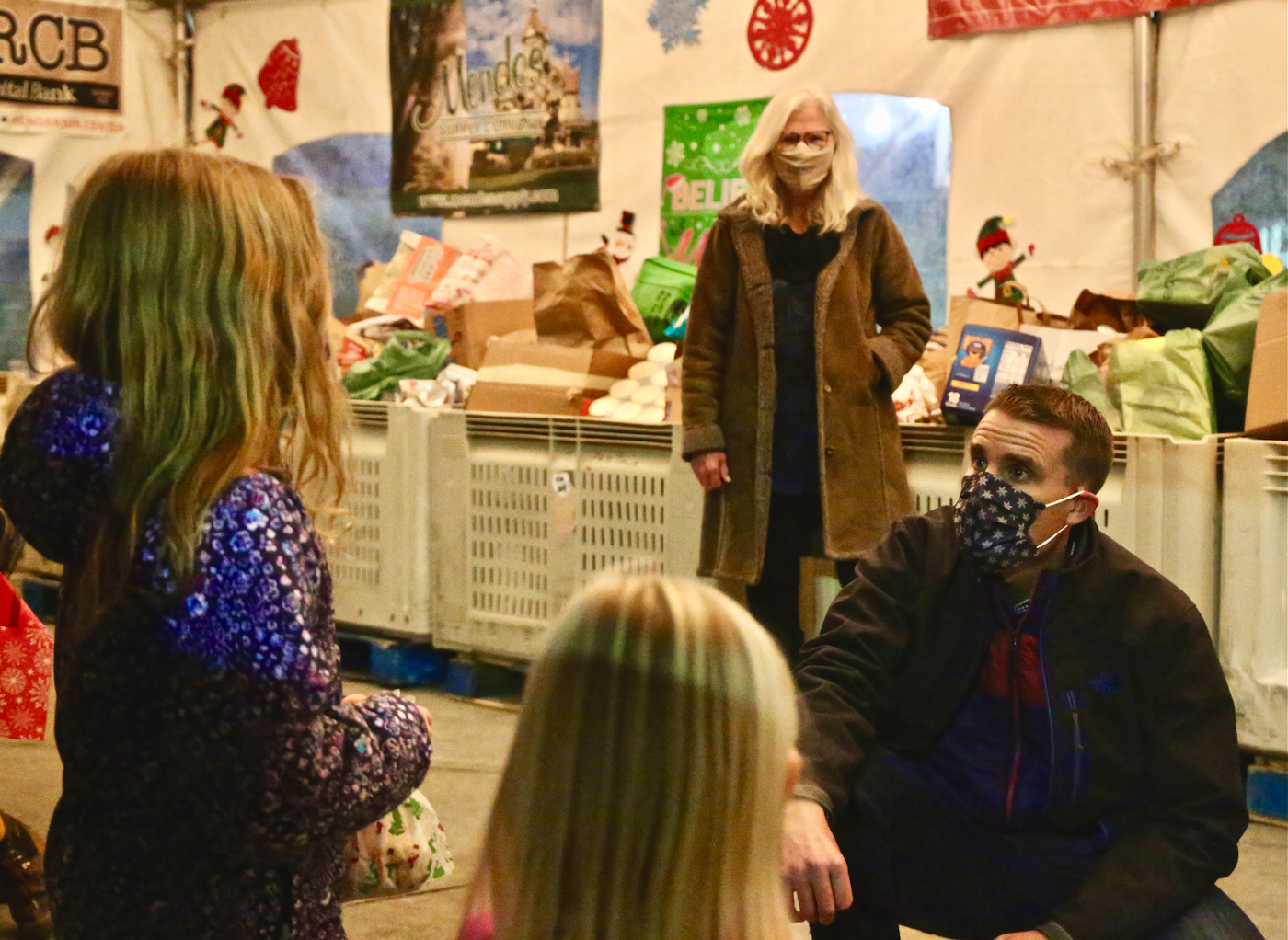
Senator Mike McGuire delights local children with his antics during the 2020 drive while Food for People Executive Director Anne Holcomb looks on. File photo: Andrew Goff.
Press release from the office of Sen. Mike McGuire:
For the seventh year running, Senator Mike McGuire is teaming up with Food for People, KHUM radio and six local high schools for the Humboldt Holiday Food Drive this Thursday. The Food Drive is now one of the largest on the North Coast.
This year the need is more critical than ever. Food For People has seen a 25% increase in those needing help to feed their families.
“Food for People is seeing record demand for food assistance this holiday season,” said Senator McGuire. “Humboldt always steps up and takes care of our neighbors when times are tough, but this year in particular, we need folks to dig deep. Join us this Thursday from 3-6pm and give the gift of generosity or donate online at FoodforPeople.org.”
Last year, Food for People distributed over 2 million pounds of food to low-income households in Humboldt. The need is especially great for thousands of kids. A quarter of those served by Food for People are children who depend on others to have enough to eat.
To gather food and monetary donations, six local high schools (Eureka, McKinleyville, Arcata, Fortuna, Ferndale and St. Bernard’s) have held various kick off events and food drop-offs, produced videos, made commercials and rallied their classmates to participate.
“We’re so incredibly grateful to the hundreds of high school students who are mobilizing to help feed our neighbors in need this holiday season. It’s so inspiring to see. We’re excited to partner with Senator McGuire this Thursday for the Humboldt Holiday Food Drive and we hope the community will turn out to support the students and the life changing work of Food for People,” said Food for People executive director Anne Holcomb.
The schools will be dropping off all of their collected food on Thursday, December 8 from 3 to 6 p.m. during the Humboldt Holiday Food Drive. The public is also encouraged to drop off their own donations of food and funds at the Eureka Safeway or donate online here.
Going, Going, Gone: Feds Hold First-Ever Auction for California Offshore Wind Leases
Nadia Lopez / Tuesday, Dec. 6, 2022 @ 7:32 a.m. / Offshore Wind , Sacramento
Federal officials today will auction off leases for 583 square miles of ocean waters off California that could lead to the nation’s first massive floating wind farms.
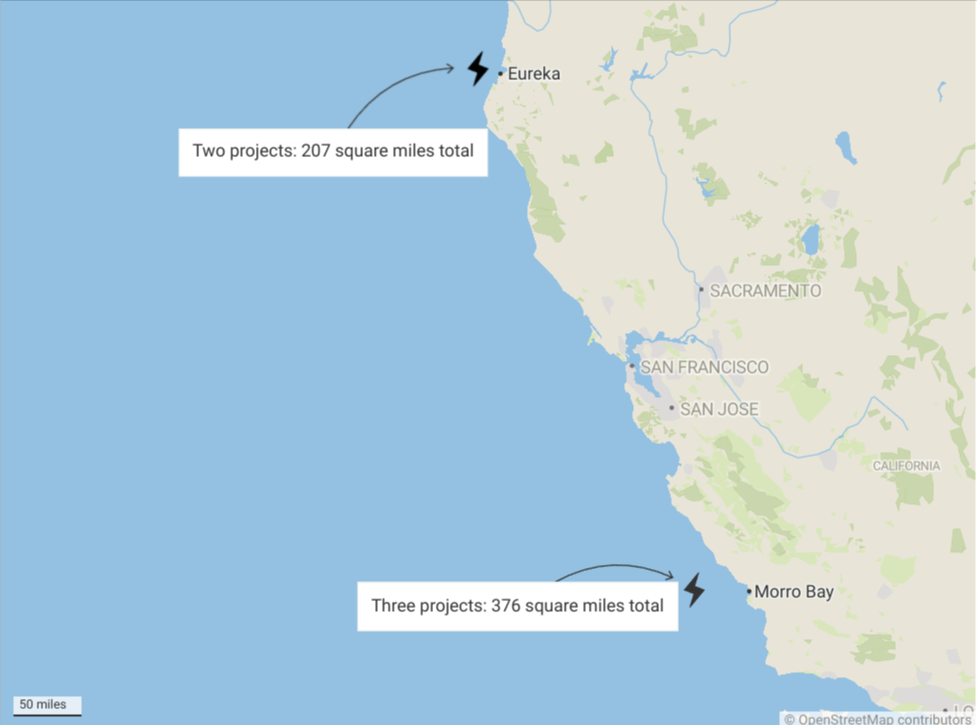
The auction — the first on the West Coast — includes five sites in deep ocean waters about 20 miles off Morro Bay and Humboldt County. The leases are the first step in a years-long regulatory process that could culminate in the first commercial-scale floating wind turbines off California’s coast.
Offshore wind projects are considered critical to meeting California’s goals to provide a new source of carbon-free electricity, end reliance on fossil fuels and battle climate change.
“Today’s auction is great news for California’s offshore wind industry, workers, and electricity ratepayers,” said Adam Stern, executive director of Offshore Wind California, a trade group for industry developers and technology companies. “It’s the most consequential milestone yet for the Golden State’s efforts to make offshore wind a key part of its diverse clean energy future.”
The results of the auction, which begins at 7 a.m., will offer the first key signs for gauging how strong the market is for producing offshore wind off California. Forty-three companies, including industry leaders like the Danish company Ørsted, are eligible to bid on the leases offered by the U.S. Bureau of Ocean Energy Management, which oversees offshore energy and mineral projects.
The waters to be auctioned off today have the potential to host several hundred turbines that produce more than 4.5 gigawatts to power about 1.5 million homes.
“There’s a lot of opportunities, but there’s also some challenges…California has deeper waters than any other areas with these floating turbines so far in the world.”
Habib Dagher, University of Maine
Experts say construction is at least five to six years away, and an array of unknowns must first be addressed by the companies: the high costs of construction, the logistics of producing the energy and bringing it to shore, and the environmental risks to marine life and commercial fisheries.
“There’s a lot of opportunities, but there’s also some challenges,” said Habib Dagher, executive director of the University of Maine’s Advanced Structures and Composites Center, who is helping develop the first offshore floating wind turbines in the U.S.
“California has deeper waters than any other areas with these floating turbines so far in the world,” he said. “How do you protect the environment, protect local stakeholders, protect the fisheries, protect indigenous communities, while also speeding up permitting so we make a difference with global climate change?”
Graphic: Calmatters.
Unlike current offshore wind turbines fixed to the ocean floor off the East Coast, California’s first-of-its-kind turbines would float on platforms anchored by cables in waters reaching about half a mile deep.
The turbines — hundreds of feet tall with blades that are bigger than a football field — would largely be out of sight from the shore, about 20 miles away. The Morro Bay lease area covers 376 square miles, while Humboldt’s is 207 square miles.
The state’s ambitious offshore wind targets build off President Joe Biden’s 2021 pledge to deploy 30 gigawatts of offshore wind nationally by 2030. Gov. Gavin Newsom hopes to add between 2 to 5 gigawatts of offshore wind off California’s coasts by 2030.
The state’s ultimate goal is to produce at least 25 gigawatts from offshore wind sources by 2045 – the boldest commitment any state has made. That could supply electricity for 25 million homes.
“Offshore wind is a critical component to achieving our world-leading clean energy goals and this sale is an historic step on California’s march toward a future free of fossil fuels,” Newsom said in a statement. “Together with leadership from the Biden-Harris Administration, we’re entering a new era of climate action and solutions that give our planet a new lease on life.”
How do offshore wind farms work?
Offshore wind turbines work similarly to land-based ones. Wind makes the turbine’s blades spin around a rotor, which then turns a generator to produce electricity. The turbines send energy through cables under the seabed to an onshore substation, where the energy is converted to a higher voltage before being fed into the grid that provides electricity.
California’s offshore wind farms would be the first in the country constructed with floating platforms at a large scale. Europe has long been a leader in developing offshore wind technologies, including a few existing floating offshore wind farms.
The U.S. hopes to soon become another world leader in developing the technology, said Dagher of the University of Maine.
“The U.S. still has an opportunity to lead in floating technologies,” he said. “But we need to move forward on the technology side and keep investing in research and development.”
The first offshore wind turbines in the U.S. are rooted to the sea floor in relatively shallow waters on fixed structures, which are unsuitable for deep waters. California’s floating turbines, however, will be located about 20 miles offshore and will need to be anchored by cables that reach to the ocean floor at depths of several thousand feet.
To date, the federal government has held ten competitive lease sales and issued 27 commercial wind leases in the Atlantic Ocean, spanning from Massachusetts to North Carolina, according to the U.S. Bureau of Ocean Energy Management.
The two offshore wind farms operating in U.S. waters are capable of generating a combined 42 megawatts of electricity. The country’s first offshore wind project, off the coast of Rhode Island, launched in 2016 with five turbines, followed by a project in Virginia with two turbines. More projects are on the way, including off the coasts of Massachussetts, New York and New Jersey.
Bigger and deeper carries more risks and higher costs
The auction is just one of many steps in the permitting and construction of commercial offshore wind development off California. Once the sites are leased, developers must submit plans detailing the cost and scale of the wind farms before going through an extensive environmental review. That process could take five to six years before construction, which could take a couple more years, begins, said Stern of Offshore Wind California.
The companies would have to seek approval or permits from several state and federal agencies, including the California Coastal Commission.
The scale and size of the technology means California would need to rapidly build specialized port facilities and servicing vessels to construct and transport the gigantic turbines. To speed up deployment, he said it’s critical that the state start now investing in transmission and port infrastructure and developing a clear roadmap on permitting and procurement.
At a climate summit hosted by the California Energy Commission on Monday, state leaders, public officials and companies gathered to discuss offshore wind deployment in California ahead of the lease sale.
San Francisco City Attorney and former Assemblymember David Chiu said the burgeoning industry could help grow the state economy by adding thousands of good-paying union jobs in multiple sectors and helping fossil fuel workers transition into renewables.
Chiu authored AB 525, passed in 2021, requiring the state Energy Commission to establish offshore wind planning goals for 2030 and 2045 and develop a five-part strategic plan by 2023. He said strong workforce training programs and community benefit agreements, especially with Native American tribes, will be crucial to implementing the law. The potential impacts on commercial fisheries also must be considered.
“We know that we have to do something different. Offshore wind is different,” he said. “But that being said, we’re also acutely aware that there are impacts on communities.”
The federal government will offer bidding credits for developers who enter into community benefit agreements and invest in workforce training or supply chain improvements in communities. Companies that develop offshore wind projects in California also will be required to enter into labor agreements and work with Native American tribes before beginning construction.
“We know that we have to do something different. Offshore wind is different. That being said, we’re also acutely aware that there are impacts on communities.”
David Chiu, former Assemblymember
Wind power tends to be stronger in the ocean than on land, making offshore wind a particularly valuable renewable energy source that could help the grid during times when other renewables like traditional wind and solar can’t produce energy.
Winds off the coast are strongest in the late afternoon and evening, which is exactly when – particularly in the summer – electricity demand surges as people go home and turn on appliances like air conditioners.
But several challenges exist with deploying the technology in deep ocean waters, including risks to marine life and concerns over natural disasters, such as earthquakes, said Dagher of the University of Maine.
The turbines off Eureka would be in waters 2,490 feet deep and for Morro Bay, 3,320 feet, he said. No project in the world exists in waters this deep. The deepest project to date is in Norway, in waters 721 feet deep, Dagher said.
“That adds costs and risk because no one’s building anything this big or this deep yet,” he said.
Studying risks to dolphins, whales, fish and birds
While offshore wind is a climate-friendly resource, many environmental groups and researchers say floating wind turbines could pose environmental risks. Sea turtles, fish and marine mammals could become entangled in the cables, while birds and bats could get caught in the turbines, said Irene Gutierrez, an environmental attorney at the Natural Resources Defense Council.
“We want to make sure it’s done right,” she said. “There’s a lot that we don’t know about offshore wind in the West and what that means for various marine and coastal ecosystems.”
To reduce harm to these animals, Gutierrez said federal and state agencies, developers and researchers must work together to conduct more research and commit to regularly monitoring the effects on natural habitats once the projects launch.
“We want to make sure it’s done right. There’s a lot that we don’t know about offshore wind in the West and what that means for various marine and coastal ecosystems.”
Irene Gutierrez, Natural Resources Defense Council
Brandon Southall, a scientist with the environmental group California Ocean Alliance and a research associate at UC Santa Cruz who studies the effects of noise on marine mammals, is performing a risk assessment on the lease areas for the federal government to assess how to avoid disruptions to endangered animals and noise-sensitive marine life.
“There’s a lot of uncertainty,” he said. “But there are a lot of tools that we have that are rapidly evolving, like listening and directional vector sensors to locate where animals are coming from, and we have some baseline data from other projects.”
He said the boats servicing and maintaining the turbines would pose some of the largest risks to dolphins and whales, which communicate over long distances and are sensitive to noise. To avoid being too disruptive to their communication patterns, Southall said the turbines should be installed with noise-reduction technology. Ship operators should also be required to follow a speed limit to avoid striking marine mammals, he added.
Despite the risks, Southall said they shouldn’t derail efforts to deploy the clean energy source given the severity of the climate crisis. He said it’s important that the federal and state governments develop a regulatory framework for companies to ensure they comply with environmental protections.
“I hope that when we’re looking at these concerns about impacts, that we, as a scientific community and as a conservation community, don’t lose sight of the fact that we need sustainable, alternative energy,” Southall said. “We need a balance of informed and conservative cautionary decision-making, but not so precautionary and so afraid of the uncertainty that we never get there.”
###
CalMatters.org is a nonprofit, nonpartisan media venture explaining California policies and politics.
OBITUARY: Chad Bernard Holub (McCay), 1974-2022
LoCO Staff / Tuesday, Dec. 6, 2022 @ 6:56 a.m. / Obits
On
Friday, December 2, at approximately 11:15 a.m., he inserted a
delicate needle between his toes to deliver the immediate ecstasy and
relief of heroin — the escape to a pleasant place, to run away from
the nothingness of life, the fulfillment of a habit. The drug coursed
through his veins, expanded a feeling of health and thoughts … then
killed him. Dead. Bits of criminal fentanyl were unknowingly mixed
in. A killer.
Chad was 48 years old, a human valuable to so many but for him a torn story.
Yet for the rest of us, beyond his lifetime of fighting addictions, Chad was charismatic, smart, a learner, a teacher, a hiker, skilled in mechanics, commercial fisherman, a builder, a cook, a farmer, an organizer, and he made other people feel welcome and whole. He was an avid reader and earth politics follower. His sense of humor was an unbounded reaction to this crazy world, telling wild stories to make you gasp or laugh. And if you were to walk with him around Humboldt you would have been introduced to his diverse friend circle of the homeless, storekeepers, his fellow NA members, fellow workers, social chums, Highway 36 friends — people of all classes, races and livelihoods.
They would all know his name. Know what a remarkable human he was in his generosity, his gentleness, his kindness, his spirit, his acceptance of others and his effort to better the world. He rests now from his fight with himself and his addictions; he is comfortable finally and not alone anymore. He leaves behind his loving mother, Kate McCay and her life partner Lyn Javier of Larabee Valley, and his aunts, uncles and cousins. A memorial will be held in the hills. TBA.
(This obituary is another of the many true stories of OD from drug/Fentanyl use happening over and over - to children, relatives and friends; in our homes, on our streets - with no end. — kmc)
###
The obituary above was submitted on behalf of Chad Holub’s loved ones. The Lost Coast Outpost runs obituaries of Humboldt County residents at no charge. See guidelines here. Email news@lostcoastoutpost.com.
OBITUARY: Patti Pearl Marie Robinson Corwin Hackenberg Mahony, 1959-2022
LoCO Staff / Tuesday, Dec. 6, 2022 @ 6:56 a.m. / Obits
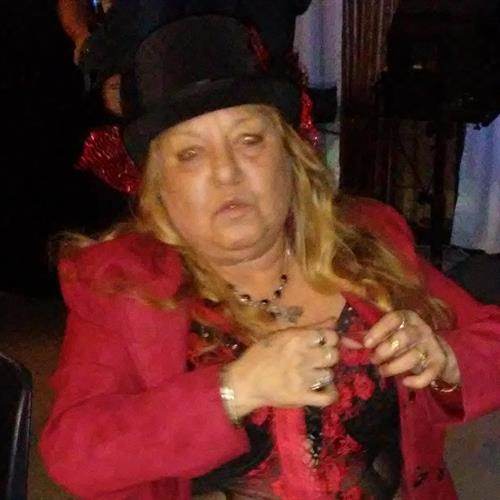
Patti passed away on November 24, 2022 at home with her family in
Eureka.
Born on January 20, 1959 to Marie Estelle Howell and Harry Robinson in Long Beach, she was the only girl stuck, in the middle with two older brothers and one younger brother. They quickly learned that she was a force to be reckoned with and she would not be bullied or pushed around by them. She held her own and soon had the respect she deserved as their sister and as a girl.
Patti called many places home throughout her life, and it all began in Long Beach. As a young child her mom would take her and the boys to the nightclubs to sing karaoke, opening with the song “We’re Not Kids Anymore.” They were the following act after the Midget Wrestlers. This did not sit well with her being the closing act. Patti was a leader, not a follower — even as a kid she knew she should be “front and center,” the “headliner,” the “star,” and it was there that her love for karaoke started.
She was young when her family moved to Guam. While living overseas her brother Gary would feed her “red hot chili peppers” and tell her it was candy, and laugh as the tears rolled down her cheeks and her mouth caught fire. After a couple years abroad the family moved back to the states, to Oklahoma City, Oklahoma. From there they moved to Glendale, Oregon and finally the family settled in Fields Landing. She grew up there and attended South Bay Elementary School, Jacobs Jr. High and graduated from Eureka High School. Patti formed and built strong friendships that have lasted and remained through the years. Patti was a friend that would be there through good and bad times and one that many friends could and would count on. She knew no strangers and always defended those that could not defend themselves. That was her nature, that was Patti Pearl.
Patti was talented and had many qualities which made her who she was, from mowing lawns for the elderly in her small community as a kid, making a very reputable name for herself, and at age 14 she began working for Eureka Fisheries and became their #1 fish flayer in the plant. But Patti was adventurous and decided at the age of 17 to “run away with the carnival” something a lot of kids talk about but never find the courage to do. Well, Patti did and found herself on the road and making a good living setting up the tents and rides and was soon running a booth and persuading the folks to play. After a few years “living the Carni life” it was time for her to make her way back home.
It was there she met and married her first husband, Evertt Corwin, while tending bar at the Buoy Club, working alongside her mom and her aunt Pat. She enjoyed the bar and the old timers and it was more than a job to her, she considered them all her family and it was bittersweet when Patti and her husband decided to move to Vermont after the birth of their daughter, Jennifer. Vermont soon proved to be different kind of lifestyle than she was used to, as her new husband’s family were Mennonites and lived as they do, from horse-drawn buggies to growing their own food and making their own clothes, and it was there that she learned how to make molasses and always sent her family freshly canned jars.
After her marriage ended she packed up her daughter and her belongings and moved to Truckee to start a new life as a single parent. She worked as a pharmacy technician while in Truckee and then met and married her second husband, Tony Hackenberg ,and had two more daughters, Felicia Rose and Toni Marie. After 14 years she found herself once again divorced and raising three girls, and she moved back home to be with her mom and care for her. During that time is when she met and fell in love with her soulmate and love of her life, Chuck Mahony. She enjoyed being strapped on the back of his Harley Davidson and just riding. When her mom passed away Patti became the matriarch of the family and was known as the “Mayor” of Fields Landing. Patti loved Christmas and always made it special for her family and those in her community that were less fortunate. She would dress Chuck up as Santa Clause and her as an elf and go around town door to door giving gifts to both young and old, making sure that no one went without. Every year she put a star on the roof of her house and from Highway 101 it could be seen.
Halloween was another of her favorites. She had more costumes than most stores and in every size, because she never knew when someone might be in need. Chuck was a member of the Clampers and every year she loved to dress up for the “Widowers Ball” and won a few contests, one for best dressed widower, and her and Chuck won best couple.
She was also a member of the Eagles Club and was captain of the Womens Pool League for a few years and enjoyed Thursday night karaoke night and always sang “Brick House” a song fitting for someone of her nature. To many of us she was our brick house and mighty, mighty. There is so much more that can be said about Patti and for those of us who knew her will agree it is endless, because she gave you all of her heart and she did it with a full heart. True to herself and to those that were lucky and fortunate enough to know her. She will be greatly missed and forever be loved by those of us she called friends. May the Angels up high give you wings to fly and give us strength to carry on without you and the void will always be big until the day we meet again, all our love amen.
But For The Grace Of God, Go…. Heaven Knows How We’ve Been Blessed With The Gift Of YOUR LOVE.
She is survived by the love of her life and soul mate of 26 years Chuck Mahony, her children Jennifer, Felicia and Toni, brother Gary, sister-in-law Connie, cousin Debbie, cousin Cindy, nephews Jack and William, niece Marie, her friends and all that knew her.
Graveside services will be held at Ocean View Cemetery 3975 Broadway, Eureka on Friday, December 9, 2022 at 10:00 a.m. Celebration of life will be held at the Eagles Club 1317 California Street, on Sunday, December 11, 2022 at 1 p.m. Please bring a dish — it is a pot luck dinner — and your most memorable story or stories.
###
The obituary above was submitted on behalf of Patti’s loved ones. The Lost Coast Outpost runs obituaries of Humboldt County residents at no charge. See guidelines here. Email news@lostcoastoutpost.com.


