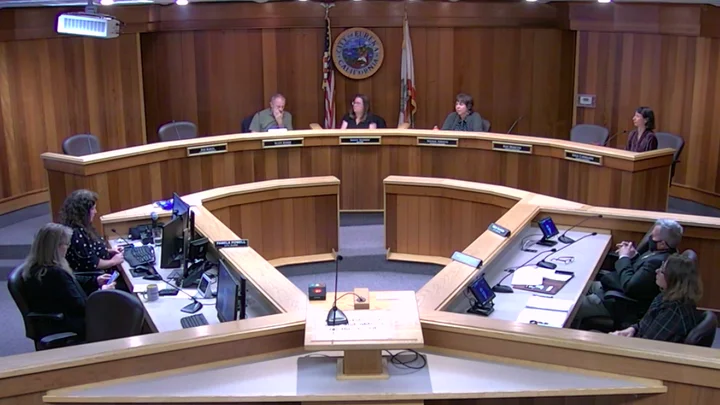
Screenshot of Tuesday’s Eureka City Council meeting.
###
Save the Broadway Dolos
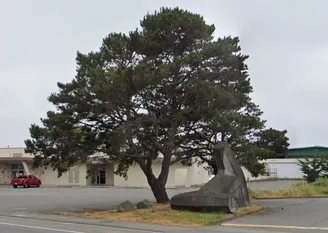
The Eureka City Council pondered the fate of the Broadway dolos during this week’s meeting. (Even though it sounds funny, “dolos” is actually singular. Dolosse are those wave-dissipating concrete structures piled out on the jetty.) The council was tasked with deciding whether the 42-ton dolos should be relocated from its existing location at the former Chamber of Commerce site to Coast Guard Park at the intersection of Broadway, Fairfield and Del Norte streets.
The council adopted a resolution to declare 2112 Broadway Street as surplus back in 2018, and gave the City Manager permission to move forward with a negotiated sale of the property. In the time since, the City has negotiated and finalized the sale with SJN Hospitality, LLC, which plans to build a hotel on the property. Unfortunately, the new owners aren’t keen on keeping the dolos.
The dolos in question. | Screenshot via Google Maps
Relocating the dolos to Coast Guard Park would set the City back $50,000 and involve large equipment and significant traffic control measures due to the size and weight of the dolos. In contrast, demolition and debris removal costs would cost about $10,000.
Mayor Susan Seaman asked how the dolos wound up in that spot in the first place. Public Works director Brian Gerving wasn’t sure, but said the accompanying Blue Star plaque indicated it had been there since 1972. City Manager Slattery guessed that the dolos was placed on the site during a repair to the jetty.
Councilmember Scott Bauer asked if any private entities were interested in helping the City cover the costs of moving the dolos. Gerving said the City had not heard from any interested parties to date, but acknowledged that “no one really knew the issue was out there.”
“We could try to get the word out about whether someone is interested in taking the dolos off the City’s hands or interested in funding the move. Either one of those could be possibilities,” Gerving said. “If the council were to direct staff to demolish on-site, up until that happens we could look at other options.”
Seaman suggested a fundraising effort to save the dolos. “There are people out there that are big dolos fans, right? Like, this is a thing people really care about?” she asked. “Is there a possibility that…we could have a month-long raffle with some prizes and all of the money can go to save the dolos?”
Unfortunately, the City is looking at a pretty tight timeframe. Gerving said the new property owners call his office several times a week to ask when the dolos will be relocated. He’s hoping to have dolos off of the property in the next three weeks.
Bauer spoke in favor of demolition, because of the price tag of relocating the dolos. He suggested the City hire a few local artists to build a replica made of fiberglass “which would cost an order of magnitude cheaper than moving [the dolos] across the street.”
Councilmember Kati Moulton pushed back against Bauer’s idea and questioned the durability of a fiberglass sculpture.
“I think that might be more expensive than you think and far less durable. It’s going to get climbed on no matter what we stick over there,” she said. “I think that having [Coast Guard Park] [serve as] a welcoming gateway is something people have talked about for years. …It’s a really big expense, but I would not be in favor of any kind of facsimile when we literally have the real thing.”
Councilmember Leslie Castellano said she was indifferent to the dolos but felt the money should be spent elsewhere. “If we’re going to invest an extra [$50,000] in something I would rather it go to something that would get a lot of public use,” she said.
Councilmember Natalie Arroyo proudly stated that she has “not one, but three pieces of dolos-related artwork” in her home and talked about the “interesting and fascinating” nature of the iconic hunks of concrete.
“I don’t think I have to explain why I think they’re cool, but I do wonder if the dolos could be moved…to the parking lot of the bowling alley [next door]?” she asked. “If we’re gonna spend $10,000 to destroy the thing, that just seems wasteful to me. I wonder if there is a less expensive alternative.”
But if the dolos is relocated to private property, the City will lose control over what happens to it in the future. And, even though Harbor Lanes’ parking lot is just next door, Gerving said the dolos would still have to be loaded onto a trailer and transported to the adjacent parcel “because it’s how the world works.”
“So, you’re saying we can’t just roll it over there?” Slattery jokingly asked.
“Maybe, instead of a fundraiser, we should crowdsource the move and have everyone go out there and push it,” Gerving said.
Castellano eventually motioned to move forward with the demolition of the dolos but encouraged staff to look into other options and seek additional funding opportunities.
Arroyo reluctantly offered her support for the motion but assured dolos-diehards that she would continue looking for creative strategies to save the dolos. “This may not be the end,” she added.
Moulton did not back down so easily.
“I think we find a way to pay for so many things, and I know $50,000 seems like a large expense, but it’s for something that is irreplaceable,” she argued. “There is no way that we will ever get another dolos and it is so iconic to the shoreline, to coastal preservation [and] to our bay entrance that I think it would be a real shame [to destroy it]. I would oppose demolition.”
The council voted 3-1, with Moulton dissenting and Councilmember Kim Bergel absent, to move forward with demolition sometime next month unless another option is brought before council.
“That was a hard one for the heart,” Seaman commented after the vote. “People are going to be getting phone calls.”
Waterfront Development
Early on in the meeting, the council received an update on the City’s waterfront development plan. The proposed “Waterfront Eureka Plan” project area spans approximately 130 acres between B and Y Streets, including Old Town, the Library District and the commercial bayfront.
City staff hosted a series of public workshops earlier this year to start the conversation and get a better feel for the community’s waterfront priorities. While there are no plans just yet, the idea is to develop the underutilized sites and buildings in the area to create a vibrant waterfront and make way for approximately 115 housing units.
“How might this look? Open space, public access and temporary uses in the commercial bayfront,” Rose Newberry, a sustainability planner for southern California-based environmental engineering firm Dudek, explained in a presentation to the council. “High-density, mixed-use buildings in Old Town. And increased housing density in the Library District.”
Newberry emphasized that the above illustrations are not proposed building plans but are meant to help visualize potential development.
Castellano asked Newberry about the public’s participation in the process. So far, Newberry said she’s received around 150 survey responses and averaged around 40 attendees during virtual public workshops.
Bauer encouraged staff to do more outreach to heighten public participation. “This is the future of Eureka,” he said. “The numbers are good, but I wish there were a thousand residents that were participating.”
Seaman suggested City staff post QR codes in storefronts throughout the waterfront plan area to enhance engagement. “People walking around will see a little sign that says, ‘What do you want to see here?’”
Castellano suggested coordinating with local artists to highlight Eureka’s cultural arts designation in potential plans. “Much of the Waterfront District also includes the Cultural Arts District, so I would love for that to be another stakeholder group if that’s at all possible,” she said. “I think they would have some great things to contribute if it’s not too late to add another stakeholder group.”
After some additional discussion, the council agreed to accept the report but did not vote on the item.
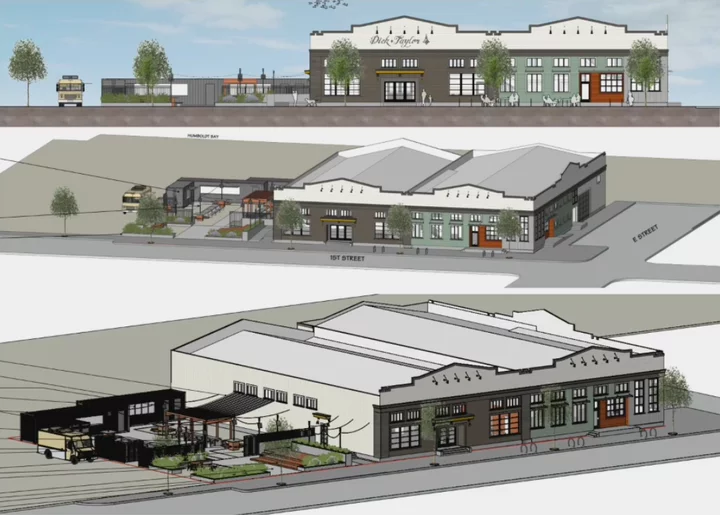
“We’re looking at what can be done in the shorter term to help revitalize that site, create more energy while we’re waiting for longer term, larger scale developments to happen,” he explained. “…Staff thought it might be good to look at how can we capitalize on new energy of the redevelopment of that First and E street building for Dick Taylor.”
Gerving presented a rendering of a partially-covered outdoor lounge that would be built next to Dick Taylor. A portion of the site, which would include seating and a raised area for a stage, would be open 24/7 while the other half would be fenced in and only be accessible during business hours or special events.
Image via the City of Eureka
“It would be sheltered from the wind coming off the bay by the shipping containers at the back,” he explained. “Those shipping containers could have a few different elements including storage, there could be another stage type of thing there, there could be restrooms that would serve that event space and potentially a kitchen, though there’s also the idea of allowing a food truck to come in and maybe serve during those events.”
He noted that many of the elements in the project’s design, such as planters and concrete benches, could be relocated and would be sturdy enough to last for many years to come.
Pending council approval, Gerving said staff will finalize the design and apply for a coastal development permit. “Then the big one is to seek funding,” he said. “There are no funds allocated to the project at this time. We’re working on refining the cost estimate.”
The council expressed enthusiasm for the project and gave staff the go-ahead to seek funding for the project. The motion passed in a 4-0 vote with Bergel absent.
‘The Sea Also Rises’
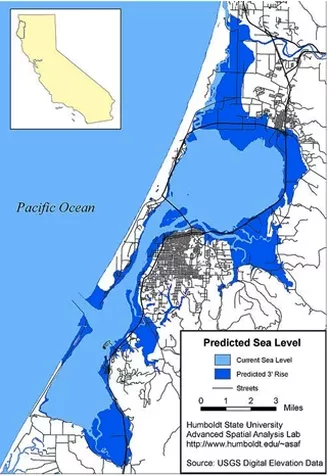
The council also discussed a recent report from the Humboldt County Civil Grand Jury regarding the local response to sea level rise. The report, “The Sea Also Rises,” describes the potential impacts of sea level rise throughout the Humboldt Bay region and calls for a coordinated regional response to address anticipated sea level rise-related flooding hazards.
Image via Humboldt County Grand Jury
The council, along with the Humboldt County Board of Supervisors, the Arcata City Council and the Humboldt Bay Harbor, Recreation and Conservation District, are required to respond to the Grand Jury’s recommendations by the end of next month.
“City staff generally recommends agreement with all the report findings with the exception of finding three,” principal planner Cristin Kenyon said. “…Finding three basically states that general collaboration will take the form of a new regional sea level rise coordination entity with new ongoing costs and salaries, benefits and overhead. …There hasn’t really been a broad discussion around forming a new sea level rise organization, so it seems premature to commit to such a group.”
Kenyon noted that the City has already initiated efforts to plan for sea level rise through its Climate Action Plan as a part of the City’s General Plan.
“The Climate Action Plan is focused on doing our part locally to reduce global greenhouse gas emissions and is focused on reducing and delaying sea level rise,” she said. “…In contrast, the Grand Jury report is focused on responding to the effects of sea level rise when it does occur, such as by elevating roadways and retreating infrastructure inland, so there’s definitely overlap between the two efforts.”
Kenyon recommended the council adopt a resolution to reaffirm the City’s commitment to addressing sea level rise (recommendation one) and to form a sea level rise steering committee with other elected officials by December 1, 2022 (recommendation two).
Arroyo was hopeful that the steering committee could elevate the community’s response to sea level rise but noted that sea level rise is just one of many impacts of climate change.
“I think it makes sense to be looking at the impacts of climate change more radically in coordination around the impacts of increased wildfire and increased variability in our weather cycle,” she said. “…I’m encouraged by the fact that there’s a [climate action plan] coordinator and hope that this regional steering committee may transform and be more comprehensive and not just focused on sea level rise.”
The council ultimately agreed to adopt staff’s resolution and send a response letter to the Grand Jury with a minor amendment to include “prevention” in addition to “mitigation” in the resolution. The council approved the motion in a 4-0 vote with Bergel absent.
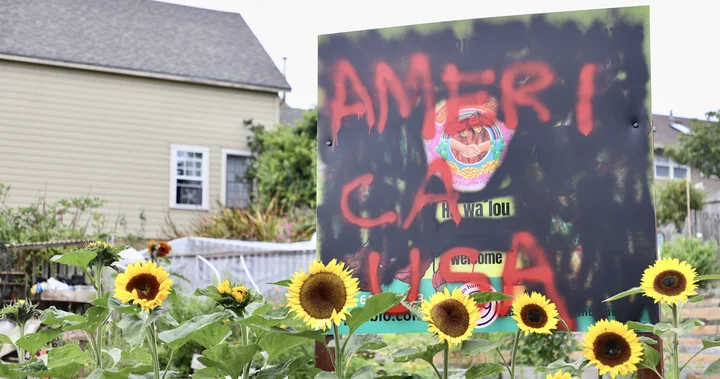
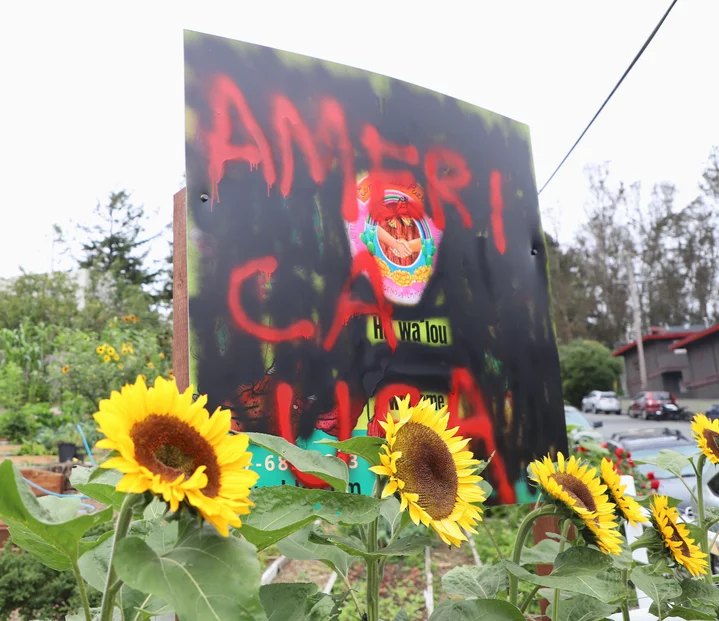
Image of the vandalized Centro Del Pueblo sign at the Jardin Santuario | Photos: Andrew Goff
Following the recent distribution of antisemitic flyers around Arcata and other parts of Humboldt, the Arcata City Council responded by reading a statement against hate speech during its Wednesday night meeting. Mere hours later, another hateful act was carried out at the Jardin Santuario (Sanctuary Garden) on the corner of 11th and F streets, just down the street from Arcata City Hall.
On Thursday morning members of Centro Del Pueblo — a community organization dedicated to the empowerment of the immigrant indigenous population in Humboldt and one of the organizations that runs the community garden — discovered that someone had spray painted over the Centro Del Pueblo sign in the garden, with the words “America USA.” The sign had also largely been covered with black spray paint, blocking out most of the imagery on the sign, leaving only the Centro Del Pueblo symbol in the center and the words “Ha´wa´lou” and “welcome” uncovered.
The sign as it appeared before it was defaced | CH
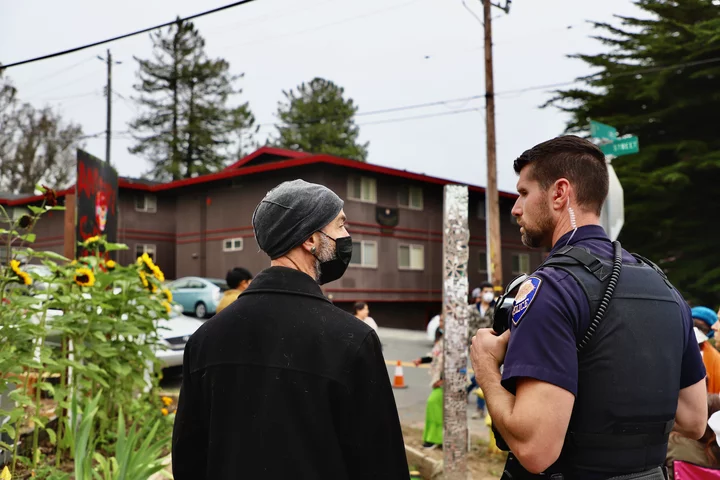
APD responded to the scene
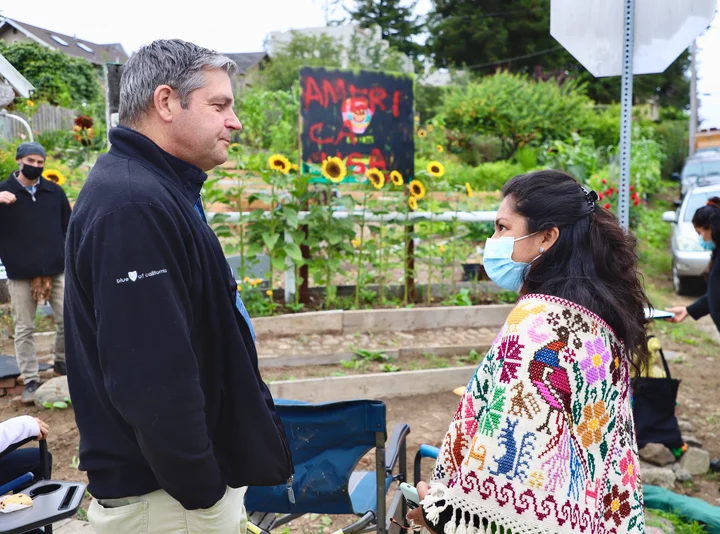
California Assembly Member Jim Wood was in town to tour local community arts projects and spoke with Centro del Pueblo’s Brenda Pérez about the vandalism
In response to the vandalism, Centro del Pueblo announced plans to host a vigil to support immigrants and oppose hate in all its forms. The vigil will begin tonight at 6 p.m. and continue through Friday, July 22.
“Community members are invited to visit the garden and bring flowers and notes of support, light a candle, and share in the peace that the garden provides,” Centro del Pueblo posted to Instagram Wednesday afternoon. “The defaced sign will be left up during this time so that all can witness this act firsthand.”
Cooperation Humboldt issued the following release about the incident:
The Jardin Santuario (Sanctuary Garden) at the corner of 11th and F Streets in Arcata is the latest target in a wave of increasing hate speech and hate crimes in our community. Sometime during the night of Wednesday, July 20th, vandals defaced the Jardin’s welcome sign, spray painting it black with the words ‘AMERICA USA’ in red.
The defacement of the Jardin’s welcome sign is not only a crime, it also sends a threatening message to valued members of our community. Centro del Pueblo, Cooperation Humboldt and the Eureka NAACP stand united in staunch defense of our Indigenous immigrant neighbors and demand that the perpetrator of this crime be brought to light to face the consequences of their actions. We urge anyone with knowledge of this crime to contact the Arcata Police Department, which is investigating this vandalism as a hate crime.
A vigil to support immigrants – and oppose hate in all its forms – will begin this evening at 6:00 and continue through tomorrow (Friday, July 22). Community members are invited to visit the garden and bring flowers and notes of support, light a candle, and share in the peace that the garden provides. The defaced sign will be left up during this time so that all can witness this act firsthand.
Those who wish to demonstrate meaningful solidarity over the longer term are invited to volunteer at the Jardin on Wednesdays from 3:00-6:00 and Saturdays from 10:00-noon. All are welcome.
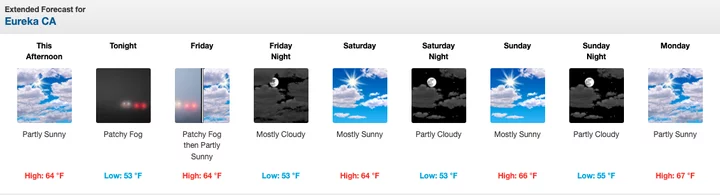
While much of the Western U.S. braces for next week’s heat wave, Humboldt will be as cool as a dip in Swimmers’ Delight, daddy-o.
“Benign summer weather continues with robust coastal stratus and slightly above normal temperatures in the interior,” Eureka’s National Weather Service Office stated today. “Slight cooling is expected this weekend, with a bit more sun along the coast.”
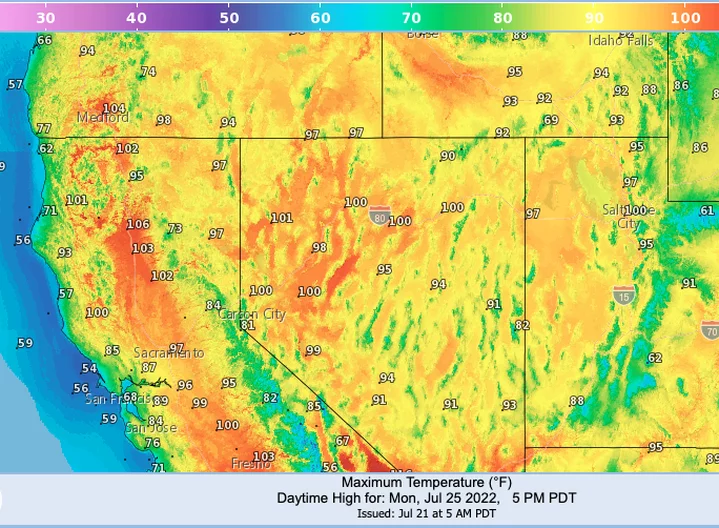
A graphic forecast for the Northwestern U.S. on Monday. | NOAA
On Monday, interior areas of Northern California are forecast to see temperatures as hot as 106 degrees. We’re talking to you Redding. Humboldt’s interior valleys could also see temperatures in the low 100s.
After a mild weekend in the mid-to-high 60s, the greater Humboldt Bay area, meanwhile, is forecast for lovely 70-degree weather next week.
Huzzah! Any good news for the NWS is good news for us all.
But what does it mean, exactly? What does KBHX — a Doppler radar station perched atop Bunker Hill, on Bear River Ridge — do for us? Meteorologist Ryan Aylward was kind enough to explain it to the Outpost this afternoon.
First of all: KBHX was only down for a short spell, to allow for maintenance and upgrades. July is the best time to do such work, Aylward told us, because it’s generally the time of year that Doppler radar is in least demand, locally. Getting new backup power to the remote location was an important part of the work, because grid power up to the top of the mountain is sketchy sometimes.
KBHX’s home.
So that work has been done, and in the future it’ll take Mother Nature much more work to knock KBHX offline.
But what does it do for us in the first place? What actually is Doppler radar?
There’s a good writeup explaining the technology at this link. You point your radar at the sky and it can do all kinds of things for you. But Aylward mentioned three things in particular that we use it for here in coastal Humboldt County: Fire detection, rainfall estimation and hazardous weather warnings.
Probably most important, in this day and age, is the Doppler’s ability to detect and measure smoke plumes sent up by wildfire. Depending on the terrain, the radar waves, pointed up into the sky, can “see” up to 150 miles away, Aylward said. It can measure how much smoke a particular fire is producing, and how high the plume rises.
How radar works. Graphic: National Weather Service.
It can also estimate how much precipitation any given storm is producing, which is especially useful when deciding whether to issue flash flood warnings for particular regions of the county.
Finally, it can also take a stab at guessing the type of precipitation a particular cloud is shedding — particularly useful, Aylward mentioned, if that cloud is packing large, dangerous hailstones.
In short: Maybe you think of radar as that green blippy thing in old movies that air traffic controllers or nuclear war soldiers use to monitor big, metal objects flying through the sky. The lesson here is that is can also be used — and, in fact, is used — to track much more nebulous material.
Which would you choose: free money you get to keep, or money you need to pay back with interest?
That was the easy decision some small businesses got to make when California rolled out two financial assistance programs around the same time in late 2020, according to a recent report from the Little Hoover Commission, an independent oversight agency.
In response to businesses struggling with the pandemic, Gov. Gavin Newsom unveiled a small business loan program called the California Rebuilding Fund in late November 2020.
“Loan funds can’t compete with free money,” said Scott Wu, executive director of California’s IBank, a financing agency within the Governor’s Office of Business and Economic Development, which provided the initial cash for the fund.
On top of grants from the state, forgivable Paycheck Protection Program loans were available from the federal government. So, the IBank and the business groups it was working with took a step back from marketing the loan program, Wu said.
Demand for the loans was “much lower” than anticipated, he said. At the outset, architects of the loan fund expected it would reach a size of between $250 million and $500 million. So far it’s raised just $114 million, said Beth Bafford, vice president at Calvert Impact Capital, which arranged the fund.
But, said Wu, there was a need for both kinds of relief. The grants ranged from $5,000-$25,000, while the loans are capped at $100,000.
The Rebuilding Fund has distributed about $71 million in loans to about 1,200 businesses in California, the vast majority of which have gone to businesses with 10 or fewer employees, according to the report.
San Francisco surpasses everyone else
Businesses across the state didn’t take advantage of the program equally. In 19 counties, nobody received a loan, according to the report. In several counties, just one or two businesses got one. All businesses that completed applications and met eligibility and credit requirements received the loan, said Bafford.
Two-hundred-two loans totaling about $15 million went to businesses in San Francisco County, according to the report. Businesses in that county received 17% of the total funds distributed so far, despite being home to 2% of Californians.
That’s because San Francisco built on top of the state’s program, investing $4 million of its own money, $2 million of which went to paying down interest. That enabled the city to offer zero interest loans to businesses, said Kate Sofis, director of the city’s Office of Economic and Workforce Development.
Without the zero interest loans, far fewer businesses would have made use of the fund, Sofis said. And, she said, the city plans to invest another $1 million of its own money into the program.
Lots of other municipalities and counties decided to run their own grant programs for small businesses instead, said Bafford.
Fresno, for example, set up its own grant program, said Tate Hill, executive director of Access Plus Capital, a small business loan fund that serves Central California. Another factor, Hill said, is that some regions of California don’t have as many financial institutions dedicated to serving low-income communities, which help run loan programs, but the Bay Area has many.
Businesses in the 13 counties that make up the Central Valley received a combined 53 loans totaling about $3 million, in comparison to San Francisco county’s 202, according to the report.
“We have some of the poorest communities in the entire state,” said Rich Mostert, the director of the Valley Community Small Business Development Center, which serves Fresno, Tulare, Madera, and Kings counties.
San Francisco’s success didn’t detract from the ability of businesses in other counties to get loans, said Bafford. The city’s program attracted additional private investment to the fund, she said, and it’s not as disproportionate as it may appear based on population, given the high density of businesses in San Francisco.
Loans from the fund will be available through November 2022, said Bafford. She’s discussing with the state “what the future holds beyond that.”
###
CalMatters.org is a nonprofit, nonpartisan media venture explaining California policies and politics.
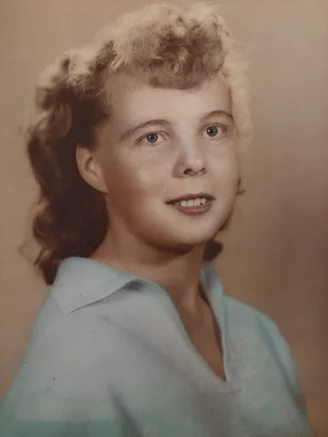
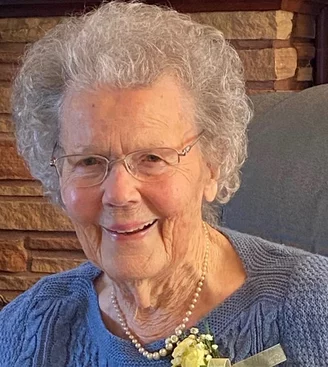
LaReida Viola Williams March
18, 1938 - July 14, 2022
LaReida
Viola Williams was born on March 18, 1938, in Arcadia, Utah, to
Maggie Viola Woodard (Mecham) and LaVon Willard Woodard. She came
into this world as a very sick baby and her parents had to rush her
in a horse-lead wagon to Salt Lake City to a doctor, only to be told
to bring her home and make her as comfortable as possible because she
was not expected to survive. But, God had other plans. She was a
fighter and a survivor and went on to live a full life of 84 years.
She lived in Provo, Utah; then, moved to Little Valley, California;
and when she was five her family decided to move to John Day, Oregon,
for work in the mills. When she was eight, her family moved to Arcata
because her Aunt Lylas told them it was t-shirt weather all year
‘round and there were mill jobs galore. At first, they lived in a
tent camp behind the mill her dad worked at; then, they moved to
Warren Creek; and finally, when Mom spotted a piece of land for sale
close to town, her dad bought it and built their home on Spear
Avenue. Little did Mom know that a boy who lived down the street
would become her husband someday. Mom met Forrest Williams when he
was on leave from the Navy and they were married on October 11, 1957.
They lived in McKinleyville for a few years, where their first child
was born, Sheila. Then, Mom and Dad moved to 29th
Street in Arcata where
Mom lived for 62 years. In 1961, exactly two years after their
firstborn child, they had a bouncing baby boy, Mike. Then, in 1967,
their third child was born — Judy.
Mom’s
main career was just that, being our Mom. Mom enjoyed having her kids
close by to her and always said that Mother’s Day was every day for
her. During high school, she worked at Bims in Arcata. Once she had
her kids, she stayed at home and was the best Mama ever. Her first
job (not paid) after having her kids was going to kindergarten and
part of first grade with Judy because Judy needed her Mama. When Judy
was eight, Mom went back to work at Bims as night manager, but that
only lasted a week because we just couldn’t handle it without Mom
at home. Then, she went to work at Holiday Gardens for Jess and Omega
Smith, who gave her a much better schedule for her to be Mom at home
and work out. She also worked for Motel 6; and then, she worked in
the cafeteria at Mad River Hospital for 15 years until her second
grandchild, Caleb, was born and she quit so her and Dad could take
care of him, which they truly enjoyed. Mom had two grandsons, Randy
and Caleb, who were 20 years apart so they both got to benefit from
Mom’s full attention.
Mom
is survived by her kids, Sheila (Kevin) Foreman, Mike (Corina)
Williams, and Judy Blanchard; her grandsons, Randy (Kerstin) Williams
and Caleb Blanchard; her great granddaughters, Nora Williams and Lea
Williams; her special little friend, Audrie; her sister-in-law,
Earlene Williams; and many nieces and nephews. She was preceded in
death by her husband, Forrest Williams; her parents, LaVon and Maggie
Woodard; her son-in-law, Art Blanchard; her brother and
sister-in-law, Melvin and Mary Woodard; her brother-in-law, Gene
Williams; her sister-in-law, Marilee Unruh; and her sister-in-law,
Evelyn Logan.
Mom
will be remembered as a very nurturing, caring person. You could
always find her in the kitchen cooking, and nobody went hungry in her
house. She loved to bake cookies and make her special fudge at
Christmastime. Mom was known as our “Pioneer Lady” - for example,
if you broke a bone and it wasn’t sticking out, just wrap it in
cardboard and you’ll be fine. She never owned a modern appliance –
no microwave, no dishwasher, no computer, no cell phone. She was
simple and true to the core. Before going to bed at night, instead of
watching TV,
she preferred reading a western book. If she didn’t have a car, no
problem, she would walk. Rain, sleet or snow, as kids we were told a
little rain won’t hurt you, go outside and play. Mom gave us kids a
lot of freedom to do what we wanted; but we knew if something didn’t
work out, we could always come back home. Mom was always home and
loved to hear from her kids. She taught us to be responsible, happy
and content.
Mom
loved animals, especially cats and dogs – her own as well as all of
her neighbors’ pets. She fed many stray animals, and I even
remember a stray cat who had kittens up in our attic. She carried
milk bones in her pocket for all her doggy friends. Mom and Dad used
to walk out at Blue Lake where they would feed the squirrels. Mom
could actually call the squirrels and they would come out from
wherever they were hiding and see her, and they knew that she would
have peanuts for them.
This
down-to-earth lady’s choice of activity was square dancing and
walking, and jump roping. She also did a “camel walk,” which she
even tried doing with her walker. She liked going to Patrick’s
Point and walking down to Agate Beach. When she was younger and had
all us kids at home, in the summertime Mom and Dad would pack up our
little green Volkswagon and drive up to Willow Creek/Hoopa (which
took much longer than it does now) to pick blackberries and play at
the river. We would even bring Grandma and our dog – it was a tight
fit, but we managed. Mom and Dad never took us to extravagant,
commercialized places, but we did go to Yellowstone in the summer of
1971 along with Grandma and our dog, Foxy; and if you have ever
watched National Lampoon’s Vacation movie, we lived it. We were
towed over the Snake River with all of us in the car, got lost in
Yellowstone with Mom reading the map, had flat tires all the way
there, lost (but found) our dog, lost Sheila while she was shopping
in Jackson Hole and found her when we took a ride on a horse drawn
wagon around town, among many other funny mishaps that happened on
that vacation; but we had one heck of a spectacular 4th
of July on our little street when we got back home with all our
fireworks.
Thank
you to all our neighbors on 29th
Street for sharing your lives with Mom and looking out for her, and
especially Willie Gallacci, who was Mom and Dad’s neighbor for 62
years and was a very dear friend of Mom’s. Thank you to all the
clerks at Westwood Market where she shopped for the past 50 years for
being so kind and friendly to Mom.
We
will be having a family graveside service. In lieu of flowers, Mom
would want you to enjoy the simple things in life, take care of
yourself and your family, be kind to others, and always give a
helping hand to those in need, humans and animals alike. Mom, we will
miss you forever and treasure all of our memories of you!!
###
The obituary above was submitted by LaReida Williams’ loved ones. The Lost Coast Outpost runs obituaries of Humboldt County residents at no charge. See guidelines here. Email news@lostcoastoutpost.com.
Mona Frances Conner, died peacefully on June 8, in her Eureka home of
over 70 years, with her niece by her side. She celebrated her 100
birthday on February 4, 2022. Mona was the daughter of Charles and
Edna Taubman of Ferndale, and the last of the four Taubman sisters;
Katherine Christensen, Clara Bender, Helene Petersen.
Mona
was raised on a ranch and learned at a young age what hard work was
all about. She attended Grizzly Bluff and Coffee Creek Elementary
Schools; graduated from Ferndale High School in 1940 and completed a
two year business course at Humboldt State College in 1942. When Mona
was a freshman at Ferndale High she met the love of her life, David
Conner. Dave was drafted into the Army on July 25, 1942. A year after
boot camp Dave and Mona were married in Spokane. In 1943 Dave was
sent overseas and Mona returned to Humboldt County. From then until
the birth of her son, Mona worked in Eureka offices. After 26 months
in the Army Dave returned to Humboldt to begin their married life and
build a home in Eureka. They were blessed with a tiny baby boy
(weighing 4 lbs.), Dwight David, in 1952.
Mona
loved being a homemaker and a mom. She always put her family’s
needs above her own; she especially enjoyed holidays, family dinners,
picnics and camping. In retirement, Dave and Mona continued to camp
and travel; with Dave she visited friends and family across the
states and even enjoyed a company sponsored trip to Spain. Her
beloved husband passed away in 2008 after 65 years of marriage; her
son, Dwight passed in 2012.
Mona was loved by all who knew her. She had a great sense of humor,
was kind and caring toward others. She always had time to listen,
offer words of encouragement, and provide home made cookies or a
slice of berry pie. She loved her church family at the United
Congregational Christian Church of Eureka and was a faithful and
active member for many years.
Mona
is survived by her immediate family: Edna Manetsch of Delavan,
Wisconsin; Marcia and Ray Daniels, Carol and Bob Giacomini of Eureka;
Kay and George Huggins of Parsonsfield, Maine. She is also survived
by her husband’s Del Norte family: Carol Lee Conner of Smith River,
Jerry and Jane Conner of Oregon, and Harold Tryon of Gasquet.
A
graveside committal service for immediate family members was held on
June 16, 2022 at Ocean View Cemetery; conducting the service was her
grand-nephew, Pastor Steve Berti and her niece, the Reverend Kay
Huggins. A memorial service for all family and friends is planned for
11 a.m. on August 13, at the Eureka Nazarene Church, 2039 E Street,
Eureka. Memorial gifts may be sent to Hospice of Humboldt, 3327
Timber Fall Court, Eureka 95503.
###
The obituary above was submitted by Mona Conner’s loved ones. The Lost Coast Outpost runs obituaries of Humboldt County residents at no charge. See guidelines here. Email news@lostcoastoutpost.com.