Press release from the Humboldt County Sheriff’s Office:
On July 14, 2022, at about 6:44 p.m., Humboldt County Sheriff’s deputies were dispatched to the Big Trees day-use Area of the Humboldt Redwoods State Park to conduct a search and rescue for two overdue hikers.
According to the reporting party, the hikers, an adult and juvenile, were part of a small group hiking in the area. The two hikers decided to stay behind for a while longer while the rest of the group returned to the trailhead. The hikers failed to return to the trailhead at the agreed upon time.
The Humboldt County Sheriff’s Special Services Division, the Sheriff’s Search and Rescue Posse and officers with the California State Parks conducted a search of the area utilizing ground teams, a search and rescue K9, an unmanned aerial vehicle and an ATV team. At about 10:47 p.m., search crews located the hikers unharmed approximately 3.5 miles from their last known location.
The found hikers told deputies that they stayed on established trails and once they realized they were lost, decided to stay put until help arrived. These wise actions were instrumental in helping search teams locate the hikers quickly, resulting in a positive resolution to this operation.
The Humboldt County Sheriff’s Office urges the community to take extra precautions when hiking or recreating outdoors. Follow these tips to stay safe:
Always hike with a group, or at least one other person, and stay together.
Check the weather forecast before heading out to hike or camp and plan your trip accordingly.
Know your skill level and physical capabilities- choose trails within your or your group’s ability.
If doing a day hike, know what time the sun begins to set. Research the trail ahead of time and anticipate how long it will take to hike. Begin hiking early so that you will have plenty of daylight to get back.
Inform someone of your travel plans- let them know where you are going, your planned route, when you plan to return and emergency numbers to call if you do not return at the scheduled time.
Bring a charged cell phone with you in case of emergencies, but do not rely on cell service in all areas. For remote hikes where cell service is not available, consider bringing a Personal Locator Beacon or GPS phone.
Bring a flashlight, warm clothes, high energy snacks and water in case your hike goes longer than expected.
If you get lost, stop where you are and assess the situation. Try to determine your location. If you are sure you can get yourself out using a map and compass, do so- otherwise stay put.
If you or a member of your hiking/recreating party becomes lost, call law enforcement for help right away (as service allows). There is no required wait time to report a missing person.
If you are interested in assisting with future search and rescue operations, consider joining the Sheriff’s Search and Rescue Volunteer Posse. Learn more and apply at: https://humboldtsar.org/
On Tuesday, July 14, 2022, at approximately 11 a.m., two juvenile females located a spy camera affixed
to the interior restroom stall door at Rohner Park. The camera was situated in a manner as to video anyone
sitting on the toilet. The two juvenile females had removed the camera and disposed of it.
At approximately 4 p.m., a Fortuna Police Detective had been patrolling the park and was flagged down
by an adult female. The adult female had advised the Detective of what the two juveniles had located and
said she had retrieved the spy camera from the trash.
The spy camera along with the SD card were retrieved by Fortuna Police Department. This is an ongoing
investigation and the Fortuna Police Department is asking anyone with information to please come forward.
Detective Brian Taylor is leading the investigation
The Fortuna Police Department remains committed to public safety and transparency. Any questions
regarding this incident can be directed to the Chief of Police, Casey J. Day at (707)-725-7550.
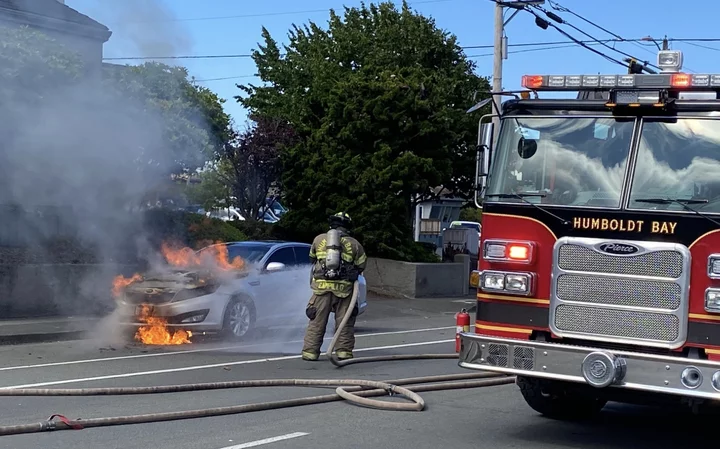
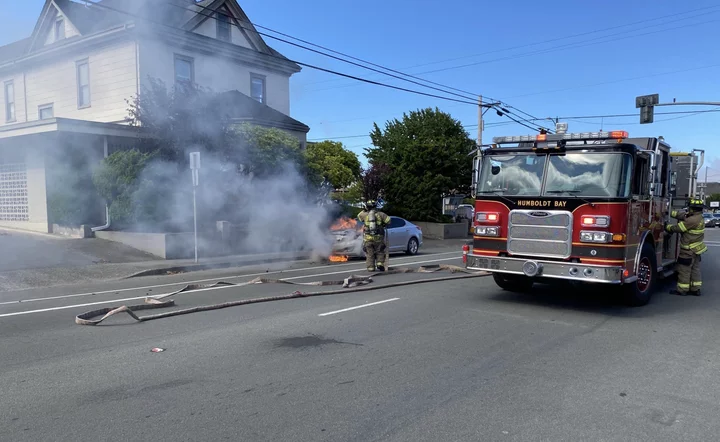
Humboldt Bay Fire is quite deft at quickly extinguishing blazing vehicles, as evidenced by today’s release:
At 10:13 a.m. Humboldt Bay Fire was dispatched to a vehicle fire at the corner of 7th and H streets. The truck arrived in less than 4 minutes from dispatch time and the fire was contained to the engine compartment and extinguished in approximately 5 minutes from arrival.
There was no one in the vehicle at the time and there were no civilian or firefighter injuries.
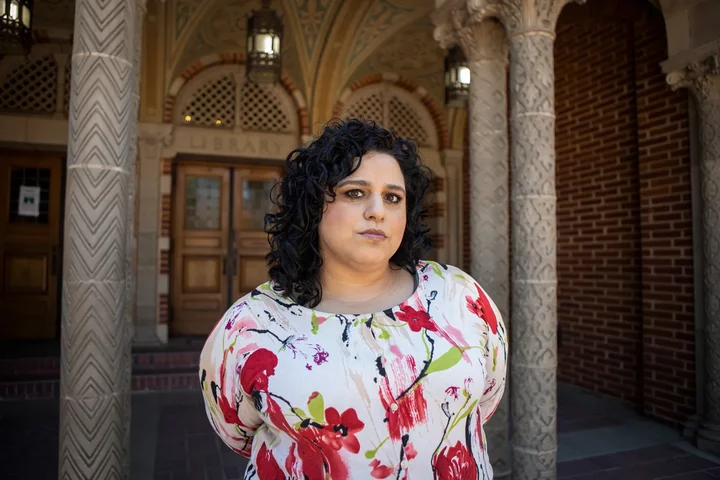
Bernadette Moordigian in front of the Fresno City College library on July 5, 2022. Photo by Larry Valenzuela, CalMatters/CatchLight Local
In 2017, a rare viral infection hospitalized Bernadette Moordigian for three weeks and paralyzed her for nearly nine months. Although she had health insurance, the hospital sent her an $80,000 bill. She appealed and got financial aid but was still on the hook for $10,000.
In 2018, Shelly Tsai, a lawyer with Neighborhood Legal Services Los Angeles, took on a client who opted to give birth at home with a midwife. Insurance wouldn’t foot the $8,000 bill despite it costing three times less than a hospital birth.
Last year, Laila Dellapasqua reduced her family’s health insurance coverage yet again as premiums increased. Collectively their yearly deductibles are more than $31,000.
Stories like these three are increasingly common. California and the country are in the midst of a health care affordability crisis. The Golden State has taken a multi-pronged approach in its effort to get a grip on skyrocketing costs — its latest effort being a new Office of Health Care Affordability whose job will be to investigate the causes behind price increases and hold health industry players accountable.
In California and nationally, the most cited reason for people being uninsured or underinsured is cost. Even those with robust insurance sometimes struggle to afford hospital bills and their medication. Some take extreme measures, such as rationing their dosages or traveling south of the border for more affordable care. Half of Californians skipped or postponed medical care in 2021 because of costs, according to a California Health Care Foundation report.
“For all the talk of inflation in the last year, if gas prices went up the same rate as health care prices over the last couple of decades, we wouldn’t be seeing $5 to $6 a gallon, we’d be seeing $30 to $40 a gallon,” said Anthony Wright, executive director of Health Access California, a consumer rights group. “What is raising people’s concerns about inflation these days has been the case for health care for decades.”
The recently approved state budget includes $30 million to create the office, whose key responsibility will be to set and enforce limits on cost growth for the industry, including hospitals, health insurers and physician groups.
The office has been years in the making, with industry representatives, legislators and Gov. Gavin Newsom haggling over specifics. In its final form, it will be seated in the Department of Health Care Access and Information and led by department director Elizabeth Landsberg.
“We absolutely will be shining a light specifically on how much of the health care dollar that’s coming out of people’s pocket — that’s putting a strain on their family budget — how much of that is going to administrative costs and profits,” Landsberg said.
However, the office’s work won’t translate into instant savings for people nor immediately eliminate stories like Moordigian’s or Dellapasqua’s. Expectations should be tempered, Landsberg said.
The office isn’t necessarily aiming to reduce costs, but rather to slow the rate of growth of those costs. “Which may not feel that great to consumers who already feel like they’re paying too much, but we have got to get the costs under control, and we think this will absolutely have a meaningful impact,” Landsberg said.
Limiting cost growth and enforcement
Household health spending has grown twice as fast as wages, and medical inflation is 1.5 times greater than general inflation, according to the Kaiser Family Foundation. State spending on Health and Human Services, which encompasses Medi-Cal, the health program for low-income people, makes up nearly one-third of the state budget. And health insurance premiums and deductibles have steadily increased for Californians in the past decade, equaling 10.5% of the median household income in 2020, according to the Commonwealth Fund, a health care think tank.
“Bottom line, health care is too expensive, its growth rate is unsustainable and we have to do something,” said Assemblymember Jim Wood, a Santa Rosa Democrat, who was involved in negotiations to establish the office.
The Office of Health Care Affordability is attempting to tackle the root of the issue: Providers can charge patients virtually any amount they want with no incentive to lower prices.
“Whenever we’ve tried to make health care more affordable, we’ve done it by increasing subsidies, but that’s not doing anything about the underlying cause,” said Gary Cohen, a former Obama Administration advisor and principal with Health Management Associates, a health care consulting group. Cohen previously led Blue Shield of California’s negotiations on the formation of the office as vice president of government affairs.
In California, the Office of Health Care Affordability will be responsible for examining the health care market as a whole. Currently, three departments and the Office of the Attorney General oversee parts of the system separately. The fragmentation often results in industry players blaming each other for rising costs. The new office plans to identify the primary drivers of cost increases, including individual facilities with above-average prices.
It will collect data on expenditures, including doctor’s visits, hospital care, medication, and medical supplies. The data is expected to help identify how much is going toward an entity’s administrative costs and profits.
“Whenever we’ve tried to make health care more affordable, we’ve done it by increasing subsidies, but that’s not doing anything about the underlying cause.” — Gary Cohen, former Obama Administration advisor and principal with Health Management Associates
An eight-member appointed advisory board will set limits on cost growth for different sectors and regions. Any entity that exceeds limits and shows no improvement may face financial penalties.
States have limited power when it comes to regulating the pharmaceutical industry, so drug companies will not be subject to the office’s cost targets. However, the office will analyze the role drug manufacturers are having on overall health care spending, Landsberg said. In one effort to cut drug costs, the Newsom administration is also working on producing its own line of generic drugs, starting with insulin.
Eight other states have created similar health care affordability offices with moderate success. Between 2017 and 2020, Massachusetts, which created the first office, saw health care costs exceed its growth limits in two of the four years. California’s office will have the toughest enforcement mechanisms, Landsberg said.
“The (enforcement) teeth are important just to convey what a critical initiative this is, and that if parties aren’t able to comply, then the state will have the ability to take action,” Landsberg said.
Landsberg will be responsible for enforcing the limits on cost growth with a variety of tools at her disposal, ranging from requiring violators to submit performance improvement plans to levying fines. Advocates and researchers are counting on the office’s ability to create price transparency and bring more competition to the health marketplace.
“If you look at other parts of our economy that are market-driven but where there is competition, consumers are the ones that determine what the prices are. They make tradeoffs for service, quality, access,” said Glenn Melnick, health economics expert from the University of Southern California’s Sol Price School of Public Policy. “The problem is, our health care system is far from that model.”
The office will also conduct reviews of mergers and acquisitions, which have remained unregulated in California.
Behind the scenes
Getting to this point was a hard-won battle, albeit a savvy political move by several players in the health care industry.
In 2014, a California ballot initiative aimed at regulating health insurance rates narrowly failed. Three years later, a state bill to establish a single-payer health system was shelved without a hearing. Earlier this year, another single-payer bill died without a vote after contentious and impassioned hearings. Although those efforts failed, the powerful California Nurses Association, which sponsored the bills, said it remains committed to pushing single-payer forward.
For health care power brokers, the message was clear: Make health care more affordable or the government would do it for them.
“If in fact this commission can get the private system to perform in a way that is consumer friendly and provides access, over the long run it may very well obviate the need for single payer,” said Blue Shield President and CEO Paul Markovich.
Newsom, who had campaigned on implementing a single-payer system, was an early supporter of the office’s more moderate mechanisms. Deputy communications director Alex Stack said making health care more affordable and accessible was a “top priority” for the administration.
Newsom first introduced the Office of Health Care Affordability in his January 2020 budget proposal but it was sidelined by the pandemic. In 2021, Assemblymember Wood drafted legislation to detail the office’s role, but after legislators and industry officials failed to reach a deal, he announced that discussions would continue into this year.
“In order for this policy to be meaningful, it must include every stakeholder in health care, and they have all had an opinion about this office,” Wood said when he pulled his bill last September. “One amendment after another has been requested in an attempt to minimize the impact on them and shift the focus to other players in the health care system.”
Initial iterations of the proposal took a hardline stance on controlling the cost of medical goods and services by capping prices even lower than current prices. Instead, in its current form, industry officials and legislators compromised by having the office only target future cost growth.
“We proposed rate regulation and got pushback from industry,” Wright, with Health Access California, said. “(The office) was an attempt to try to do this in a different way with the same goal.”
Consumer advocates and health care economists say the office has the authority to make health care more affordable, but some of its power was undercut during negotiations. Earlier versions of the proposal mandated financial penalties. The version that passed says violations “may” result in penalties.
The California Medical Association, which lobbies for doctors, successfully pushed to get doctor groups consisting of less than 25 physicians exempted from the bill.
Association spokesperson Shannan Velayas said the group “worked to ensure the Office of Health Care Affordability proposal focuses primarily on those entities with enough market power to influence health care costs.”
Another lobby, the California Hospital Association, successfully asked that the office create a public commission of industry experts to advise the office. The lobby also insisted all industry players be subject to the office’s rules, with no exemptions.
“Our point of view has always been, this is an all-in proposition,” California Hospital Association spokesperson Jan Emerson-Shea said. “This can’t just be on the backs of hospitals.”
On the insurance side, Blue Shield of California was one of the first industry players at the table. Markovich said it was “very, very difficult” to get other insurers, hospitals and doctors to come to an agreement, and that difficulty underscores the need for this office’s work.
“There’s far too much inertia, resistance and parochialism in health care today. This office has the opportunity to inject a much-needed sense of urgency and accountability,” Markovich said.
How high costs play out for Californians
Moordigian — the Fresno resident with the $80,000 hospital bill — has a doctorate in clinical psychology and teaches part time at Fresno City College. But she doesn’t get health benefits as a part-timer.
Instead, Moordigian is enrolled in a plan through Covered California, the state’s health insurance marketplace. She only pays $1 a month after federal aid. The tradeoff is her deductible and annual out-of-pocket maximum are high, at $6,300 and $8,200, respectively. It’s the lowest coverage option available, but with rent and student loans eating away most of her take-home pay, it’s the only one she can afford.
Moordigian said she frequently skips doctors’ appointments or laboratory tests because of the cost. “Every time I go to the doctor I’m asking ‘Is this free? Is this included?’ and that’s a horrible way to receive care,” she said.
Dellapasqua, another community college adjunct professor, said one of her employers offers insurance through Kaiser Permanente, but the premium is more than $2,200 per paycheck.
“I would be working for free in order to have health insurance for my family of four,” Dellapasqua said. She chose a Covered California plan instead.
“I get anxiety every time it comes to open registration. What’s the cost? You know, is this going to work?” Dellapasqua said.
But even those with employer-sponsored insurance feel the burden of rising costs.
“Every time I go to the doctor I’m asking ‘Is this free? Is this included?’ and that’s a horrible way to receive care.” — Bernadette Moordigian, Covered California client
Tsai, the attorney with Neighborhood Legal Services, said a recent client was hospitalized twice for heart problems and had a $4,000 deductible. At the same time, his wife received a $10,000 medical bill. Even though he worked full time in a factory and had employer-based insurance, his family didn’t have the cash to pay for what wasn’t covered.
“What are you going to do, squeeze water out of a stone?” Tsai said.
Last year, the national average annual premium for workers was $7,739 for an individual and $22,221 for family coverage, according to the Kaiser Family Foundation. Much of the cost for increasing premiums has been swallowed by employers, but it gets passed down to employees anyway. When health costs increase, wages stagnate, said Laurel Lucia, director of health care at the UC Berkeley Labor Center.
“Many workers probably don’t realize that family premiums have exceeded $20,000 a year. To put that in perspective, that’s equivalent to the employer and the worker getting together each year and buying a new car every year,” Lucia said.
Labor union officials signed on as staunch supporters of the Office of Health Care Affordability early in negotiations, largely to tackle wage growth.
“When we get to the bargaining table, health care costs are the number one issue,” said Steve Smith, communications director for the California Labor Federation. “It’s awfully difficult to get wage gains when health care is eating up so much of overall compensation.”
The office has the potential to benefit both employers paying high premiums and workers struggling to make ends meet, said Bill Kramer, executive director for health policy at the Purchaser Business Group on Health, which represents employers. “This is not just a health care costs bill. This is really a jobs and wages bill.”
###
CalMatters.org is a nonprofit, nonpartisan media venture explaining California policies and politics.
Starting Saturday, people experiencing mental health crises need to remember just three numbers to dial for help: 988.
The new federal number — debuting in California and across the country this weekend — is billed as an alternative to 911 for people experiencing mental health emergencies. Here, advocates say the shortcut will make it simpler for people in crisis to tap into the state’s network of 13 National Suicide Prevention Lifeline call centers.
The plan has been in the works for nearly two years.
In October 2020, then President Donald Trump signed a bipartisan bill to establish 988 as a national number. That law also gave states the option to fund call centers and mental health crisis services by attaching new fees to phone lines. So far, only four states have succeeded in doing so; California may soon be poised to be the fifth.
With the added funds from those fees, along with county, state and federal investments, the architects of 988 eventually envision it leading to an expansive, national overhaul of the mental health delivery system — one in which callers tap into a crisis response system that keeps police out of the equation.
At this point, that bigger system, first promoted by the federal government, is mostly still just a vision. But mental health leaders in California say they hope a blueprint for the project, including a means to fund it, will begin to crystallize in the coming year.
Others caution that full-scale implementation in the state’s 58 counties may prove difficult in the long run, given that the state parcels out mental health funding and services at the county level.
Compared with many other states, California appears to be in relatively good shape to receive an influx of new callers as news of 988 spreads, according to some mental health leaders.
“It’s important, it’s needed, it’s going to happen,” said Le Ondra Clark Harvey, CEO of the California Council of Community Behavioral Health Agencies, which includes the state’s 13 call centers. “When that proverbial switch is flipped, our centers are ready to go to work.”
Between 2016 and 2020, California’s National Suicide Prevention Lifeline call centers saw a 67% increase in calls, a number that’s gone up still further as the pandemic drags on. Despite this, in-state call centers have been able to answer 90% of calls, according to data from the National Suicide Prevention Lifeline.
“When that proverbial switch is flipped, our centers are ready to go to work.” — Le Ondra Clark Harvey, California Council of Community Behavioral Health Agencies
Having in-state response is important because local call centers are more familiar with available resources than national call centers that receive calls if no one is available locally.
Call centers in California say they are anticipating an influx of calls, and have been investing in infrastructure and training to prepare. To support this, the state Department of Health Care Services authorized $20 million last fall. This year’s budget includes an additional $8 million to fund the call centers.
A bill going through the Legislature would raise additional funds for the program by attaching a fee to cell phone lines. Another federal bill would also bring in additional funding for the hotline and crisis services, if passed.
Jonathan Porteus, chief executive officer of Sacramento-based WellSpace Health, which runs a suicide prevention crisis hotline that serves much of the state, estimates that calls to his center may triple in coming months. As word spreads and more people seek help, he said he feels confident in his organization’s ability to take calls and texts.
But he worries about what comes after that. What happens if a suicidal caller requires immediate in-person mental health supports in a place that has none? What if they’re in a remote, rural location? Or snowbound?
“For the most part, resources are stretched very thinly,” he said. The state’s patchwork, county-level approach to mental health care will likely mean some counties can deliver quite a bit less than what the public is anticipating, said Michelle Doty Cabrera, executive director of the California Behavioral Health Directors Association.
“The bright side is that 988 is pushing us all to dream big about what could be and the possibilities,” she said.
The challenge is especially acute in rural counties that struggle to recruit mental health workers. Cabrera notes that in Mono County, in the Eastern Sierra, even the sheriff’s department closes between midnight and 6 a.m. How will such a sparsely populated, sprawling area find both the funding and staff needed to build out a full-scale, 24-7 crisis system?
“If we want that kind of system on the mental health side, it costs a lot of money and takes a lot of bodies.” — Phebe Bell, behavioral health director of Nevada County
Some, like Porteus, suggest a regional approach may help. But that strategy has limitations, too, says Phebe Bell, behavioral health director of Nevada County, which stretches from the foothills near Sacramento to the Nevada border. If her county is lumped together with other counties and the closest mobile crisis team is based 90 miles away, it will be hard for them to respond fast enough, she said.
“If we want that kind of system on the mental health side, it costs a lot of money and takes a lot of bodies,” she said. “And if we don’t, let’s be clear it’s not going to be the same everywhere.”
By contrast, in Los Angeles County, psychiatric mobile response teams are already in place between 8 a.m. and 2 a.m., said Connie Draxler, the acting chief deputy director of the county’s department of mental health.
In coming weeks, the county plans to contract with outside providers to fill in the remaining gaps in order to have a 24/7 mobile response system in place, she said. The extent to which the rest of the system can be built out depends, in part, on what funding streams come through.
Around the state, counties are keeping an eye on pending legislation that could help.
The bill that would add the fee in California, AB 988, was originally introduced last year by Democrat Assemblymember Rebecca Bauer-Kahan, who named the bill the Miles Hall Lifeline Act to honor a young man in her East Bay district who was killed by police while in a mental health crisis.
Last year, the bill faced opposition from the telecommunications industry and was tabled. Months of negotiations between industry representatives and the author and sponsor this spring ultimately led to a significant reduction in the fee cap — reducing it from 80 cents originally to 30 cents in the current bill. The industry has now dropped its opposition.
Janus Norman, president of the California Cable and Telecommunications Association, said the companies he represents know the importance of improving mental health access.
“Honestly, again, we don’t operate in a vacuum,” he said. “My companies are made up of professionals that live in society and experience things. We deal with mental health issues amongst our employees. We see the impacts the pandemic has had in highlighting some of these concerns. If we can find a reasonable place to be part of a situation that is helpful, we want to do that.”
Bauer-Kahan says she’s been “amazed” by the unanimous bipartisan support this year for a bill she describes as a “labor of love.”
“I’m a mom,” she said. “I get the need for this and I get that we are failing families and we are failing people who are suffering.”
She emphasizes that the phone line is available for people of all ages, including children and teens in crisis.
“If we can find a reasonable place to be part of a situation that is helpful, we want to do that.” — Janus Norman, California Cable and Telecommunications Association
Other states are watching California.
Stephanie Pasternak, director of state affairs for the National Alliance on Mental Illness, says passing the bill here “would be a really big boost” to similar efforts nationally.
But even if the cell phone fee passes, many mental health leaders in the state say the effort to truly transform the system is still in its very early stages. A state working group is supposed to come back to the Legislature in the next several months with a more concrete proposal about what comes next.
“In an ideal world, when 988 launched it would be full continuum ready to go,” said Tara Gamboa-Eastman, a senior advocate with the Sacramento-based Steinberg Institute, which sponsored AB 988.
While that isn’t the case, she said, she’s still optimistic about the direction the state is heading with responding to people in crisis. She hopes all counties will have an operational crisis response system by January 2029.
“In the long term, I do think that we are starting to see the pieces coming together,” she said.
###
CalMatters.org is a nonprofit, nonpartisan media venture explaining California policies and politics.
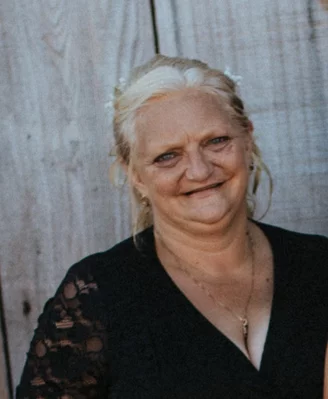
Our hearts are in mourning as Shirley Lavonne Stevens drew her last breath at 7 a.m. on June 27, 2022, after a two-year battle with bladder cancer.
On January 8th, 1968, Shirley Lavonne Stevens was born to Shirley Ann Anderson and Laverne Stevens in Eureka, at the Old General Hospital now known as Sempervirens. She came into this world fast and hard, affectionately referred to as “the caboose” because she was the last born of eight siblings. She often said, to explain her fast-paced lifestyle: “I was born in the nuthouse and raised in Rio Dell.” Growing up in her early years she was known for her beautiful blue eyes that filled her face, while later in adolescence she was known for her uncaged spirit.
In 1983 her mother bought her a three-wheeler so she could transport herself to the Rio Dell Café, where she worked as a waitress, but when not working it served as an outlet for her and her friends to “run amok.” Shirley would convince her three friends — Rita, Rosa and Lezzlee — to all pile on at the same time to ride up and down the railroad tracks of Rio Dell. As payback Rita would get Shirley to go horseback riding with her. Unfortunately, Shirley always got the horse that would buck her off when he was ready to go back to the barn
Shirley graduated from East High School in Fortuna in 1985. She said: “I got my diploma, my sucker, and I got out of there.” Shirley spent a fair amount of her free time waiting tables at Sportsman’s Cafe in Rio Dell or loitering at Bertain’s Laundry, due to her mother working there. It didn’t matter where she was, people knew her. Often she would have to chaperone her older sister Wendy’s dates as a third wheel, which at the time caused turmoil but fostered a life-long sisterly bond.
On November 25, 1992, when her son was born. She was a devoted and loving mother. She was never more proud than when he graduated from nursing school, unless you count becoming a grandmother. Unfortunately, her first grandson was born during Covid and she was not allowed in the room … but no one said she couldn’t wait outside the window! With her signature mimosas in hand, she gathered family to fellowship outside the same hospital her son was born at to welcome her grandson’s first crys! She was whooping, hollering and cheering. She was truly a proud, loving and absolutely doting grandmother!!!
She loved shooting guns, riding anything that didn’t have a mind of its own, going to the casino — or “therapy” as she would call it — bingo on occasion, painting rocks to look like “M&M” candies, and beating her oldest brother at cards. The thing that she loved the most was an adventure: whether it was an estate sale, a drive to nowhere, or a hunt for a specific item, she was up for it.
Shirley is survived by her loving life-partner of 20+ years, Wade Peters; her son, Matthew (Valerie) Stevens; her grandsons, Wyatt, Theo and Thoren Stevens; her siblings, Werner Weltsch, Bev (Louie) Gadotti, Mike (Dani) Weltsch, Gloria Dreske, Gilbert (LeAnne) Weltsch, Debi (Russ) Brandt, Wendy (Mark) Hudson, Shellie Richardson; also, Kyle (Danielle) Hudson, Ryan (Chelsea) Hudson, Laura (Derek) Ellis, Jessica Anaya, Jonathan (Sarah) Weltsch, Jennifer (Jerry) Vandercook, and many many more nieces, nephews and close friends to numerous to list. Oh! She is also survived by the many slot machines of Humboldt County.
Shirley got to spend nearly 30 years with her son here on Earth, but finally reunited with her first-born son, Scott, on the other side. Also preceded in death by her mother and father, Faye Peters, Mike Dreski, and multiple members of the Anderson family. Heaven got a bit wilder when she met up with the past members of the Overholt, Brown and Hartman families.
Throughout her time on earth, she knew so many people. It was up to you how. She was always a fighter, she was sarcastic and a force to be reckoned with. She had a beautiful and caring heart — if you needed anything, she would find it for you. If it was broken, she would fix it or rig it back together. If you just needed someone, she’d be there — unless she was sleeping (if you know, you know). She will be as greatly missed as she was loved.
The family would like to thank Resolution Care for all the love and support they have given to Shirley and her family throughout her time as a patient with them. To Amber, Nicole, & Bryan; you have some of the biggest and compassionate hearts we have had the pleasure of knowing. Thank you for being a part of Shirley’s story. Also to Gobles Mortuary for handling everything and making it easy on our family, the amount of respect felt there was unfathomable. We would also like to thank Lost Coast Outpost for their obituary services for our community. I heartfelt gesture in a capitalist world. You are very appreciated. Thank you all to no end.
The obituary above was submitted by Shirley Stevens’ loved ones. The Lost Coast Outpost runs obituaries of Humboldt County residents at no charge. See guidelines here. Email news@lostcoastoutpost.com.
Nancy Ann (Fleek) Wheeler Settles March
5, 1956-May 30, 2022
Entered into rest
after a long illness, Nancy is now pain free, united in Heaven with
many loved ones.
Born in Eureka to loving parents Jim and Darlene Fleek, Nancy was a Eureka resident
for the majority of her life. Married to Bruce Wheeler in 1979, she
reveled in the role of wife and mother to their two daughters,
Jennifer and Holly. Known for her baking skills, the girls were
always happy to come home from school to homemade cookies!
Besides being a
homemaker and mother to two busy daughters, Nancy worked for Easter
Seals as a Resource and Referral Specialist and Foster Grandparent
Program Coordinator while they lived for a short time in Ukiah.
Continuing her work helping others, Nancy was the manager at the
shelter in Arcata for a time when they moved back to Humboldt County.
For the past 15
years, Nancy has enjoyed life and many adventures with husband Rick
Settles. They enjoyed hosting family get-togethers and camping at
their favorite spot in Trinity. Nancy loved it when grandchildren
Aubree, Aiden and Charlie Jo could join them for swimming, barbecuing, and
s’mores. She loved being their “Nana” and was in her glory
when the kids were with her.
Preceded in death by
her parents and former husband, Nancy is survived by husband Rick,
daughters Jennifer and Holly, stepsons Ricky and Tim, grandchildren
Aubree, Aiden, Charlie Jo, Kaitlyn, and Kiley, and
great-grandchildren Grace, Emma, and Tobias, siblings Randy, Cindy,
Larry and Kathy, and adoring nieces and nephews Kim, Marissa,
Kelsey, Sean, Cody, and Karrie. She was dearly loved by family and
friends and will be greatly missed.
No services are
planned at this time. Please think of Nancy whenever you see a
beautiful butterfly in the sky and take time to find the joy in each
new day!
###
The obituary above was submitted by Nancy Settles’ loved ones. The Lost Coast Outpost runs obituaries of Humboldt County residents at no charge. See guidelines here. Email news@lostcoastoutpost.com.