Reader-submitted footage of Eureka’s early morning auto shop fire.
Humboldt Bay Fire press release:
At 1:29 a.m., a single Humboldt Bay Fire unit was dispatched to a reported vehicle fire
to the rear of an automotive repair shop on the 800 Block of 4th Street.
Within a
minute of the initial dispatch, Humboldt Bay Fire Dispatchers received additional
information indicating that the burning vehicle was in close proximity to the building.
The Humboldt Bay Fire Dispatchers upgraded the response to a full structure fire
response. Three additional units and a duty officer also responded.
The first arriving unit found a fully involved vehicle to the rear of the structure with fire
spreading to other nearby vehicles and the automotive repair business. Fire had broken
through the windows of the shop and was burning in the interior automotive bays of the
repair shop.
The first unit attacked the fire and slowed its progress in the structure and prevented it
from spreading to other nearby uninvolved vehicles. Additional HBF units entered the
shop and controlled the fire within 15 minutes. Personnel confirmed that nobody was
inside the business.
A second alarm was requested and the mutual aid resources responded to assist with any
additional calls within the Humboldt Bay Fire jurisdiction.
Humboldt Bay Fire officials investigated the cause of the fire. It was determined that the
fire was caused by a subject using a candle while camping in a vehicle. The subject fell
asleep and the candle ignited the interior of the car. The fire engulfed the car and spread to the other nearby vehicles and the structure. Although the subject had minor smoke
inhalation, medical treatment was declined.
Damage was estimated at $100,000. There were no injuries to fire personnel. Humboldt
Bay Fire would like to thank its allied partners for their assistance with coverage during
this incident. Arcata Fire Protection District and Samoa Fire District helped to ensure the
safety of the HBF community while our resources were committed.
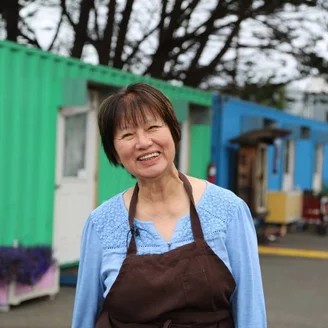
If you read the news, or just live in Humboldt, you’re surely familiar with the work of beloved local philanthropist Betty Kwan Chinn, who has spent the last four decades tirelessly serving the local homeless community.
Betty Chinn
And Chinn loves the work she does so much that after all those years, working sometimes 20-hour days, she has no plans to slow down any time soon.
“My mother lived to 104 years old, and I will work until the day I die,” Chinn told the Outpost when asked about her retirement plans. “…I don’t need anything…When you are free from power and greed, you are free yourself. I feel free everyday.”
Chinn talks about her passion for helping those in need on this 100th — and final — episode of Humboldt Holding Up, the Outpost’s long pandemic podcast experiment. Chinn also discusses the heartbreak she felt when her trailers were recently burned down, the elation she felt when receiving an honorary doctorate from Cal Poly Humboldt and some of trials of helping the homeless during COVID.
As a special treat, Chinn also entertains our “lightning round” of silly questions, sharing her love of Star Wars, her admiration of Obama and that time she met Bono, but didn’t know who he was.
So, for the final time, click the audio player above or head over to Apple Podcasts to hear Chinn’s chat with LoCO’s Stephanie McGeary and Andrew Goff.
“There were literally thousands of galaxies in an area of the sky
that up until that particular image we didn’t know anything
existed. It told us once again that we have no clue. We think we’re
smart? We have no clue.” (Charles Bolden Jr., Former NASA
Administrator)
The original Hubble Deep Field image, released in January 1996, showing thousands of galaxies in a tiny, apparently empty patch of sky. (NASA, ESA, STScI, public domain)
Bolden was referring
to the above “Hubble Deep Field” (HDF) image, distilled from over
300 separate exposures taken over a ten-day period at four different
wavelengths in December, 1995. Imagine peering at the night sky
through a drinking straw: that’s the size of the field of view seen
here. Astronomers took several months to pick a target patch of sky
to investigate, at an unprecedented level of detail. Among their
criteria: look perpendicular to the plane of our Milky Way galaxy to
avoid peering through dust; and avoid any nearby bright sources of
visible or infrared light. Basically, they wanted to investigate a
seemingly empty part of the night sky to see what lay beyond the
range of most telescopes. In the end, the field chosen (out of an
initial list of 20 potential targets) lies just “above” the
left-most star (Megrez) of the dipper of the Big Dipper.
The field of view
here is so small that, of these 3,000-odd objects, less than 20 are
foreground stars in the Milky Way. Everything else here is a
galaxy—spiral, elliptical, irregular—each comprising millions upon
millions of stars; there are an estimated 100,000 million stars in
our galaxy. (Three years later, a similar “empty” patch of sky
opposite the original HDF, yielded similar results, thus lending
credence to the “cosmological principle,” that we live in a
typical region of the universe.)
The HDF is a
remarkable image, one that inspired astronomers to push for a
successor to Hubble. This culminated (finally!) last week, with the
release of the first science images from the newly-commissioned James
Webb Space telescope, or JWST. The very first one, released last
Monday, was another “deep field” view, similar to Hubble’s but
looking even farther back in time. Whereas Hubble can see objects as
they were about 500 million years after the Big Bang, JWST can see
back to when the universe was just 200 million years old. For more on
this, check out my columns on JWST here
and here.
The first JWST image to be released centered on a galaxy cluster nearly five billion light years distant, although one of those red specks is over 13 billion light years away (almost as old as the universe). The huge mass of the cluster causes distortion of some farther galaxies by “gravitational lensing.” This image “is approximately the size of a grain of sand held at arm’s length,” according to NASA’s press release.
The next day, NASA
released five more images, including this one, the “Cosmic Cliffs
of Carina Nebula,” a young star-forming region close to us in the
Milky Way: light left there a mere 6,000 years ago.
I submit, if you’re
not totally gobsmacked by all this, you’re just not paying
attention.
Arcata has big plans to spruce up Carlson Park in Valley West | Photo: Stephanie McGeary
###
Put on those swimsuits, lather on some sunscreen and get ready to hit the river, Arcata! Because the city is working on big plans for Carlson Park in Valley West that will make it the first park to offer Mad River access right in town.
Ok, so maybe don’t get ready to jump in that river just yet. The project is likely going to take a couple of years to complete. But, thanks to a $691,000 California Wildlife Conservation Board (WCB) grant recently awarded to the City of Arcata, and more funding hopefully on the way, city staff is in the process of cleaning up Carlson Park and designing plans to expand its trails, add river access and build a parking lot and playground.
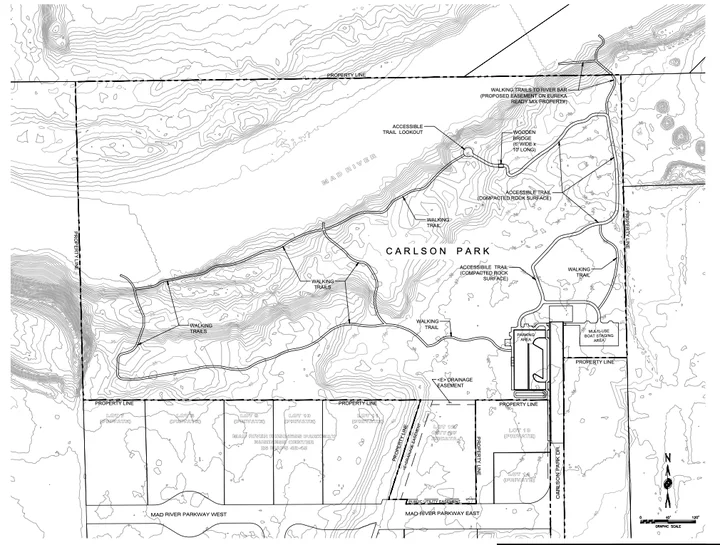
Emily Sinkhorn, environmental services director for the City of Arcata, told the Outpost that last week the city finalized its formal grant agreement with the WCB. The grant funding was awarded for river access improvements, as well as supporting wildlife restoration. The money will be used to create 3,800 feet of park trail —including an ADA compliant trail and observation deck – with two access points to the Mad River, and will go toward invasive plant removal and native species revegetation.
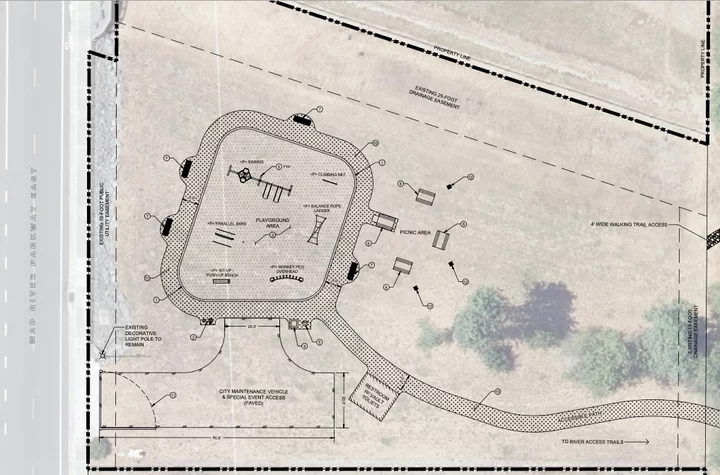
Carlson Park plans from the City of Arcata
The project is part of the City of Arcata’s vision to improve the underserved Valley West neighborhood. In recent years the city has been partnering with Comunidad Unida Del Norte de Arcata (CUNA) – a project of local nonprofit Cooperation Humboldt – to revamp Valley West (or North Arcata, as CUNA calls it), funding projects including adding fruit trees and a picnic area to Valley West Park, adding neighborhood murals, bringing free community dance and theater classes and community events.
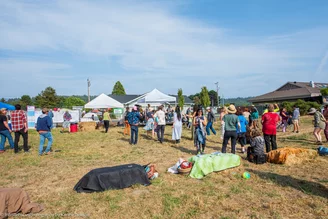
A recent Health Fair event hosted by CUNA in Carlson Park | Submitted by Emily Sinkhorn
CUNA has also been focusing a lot of efforts on Carlson Park, hosting monthly cleanups and many community events in the front lawn area of the park. Last month CUNA hosted Valley West’s first outdoor Latinx flea market, or Tianguis, which Sinkhorn said was very successful.
“CUNA has really adopted the front part of Carlson Park, which is adjacent to Mad River Parkway, as a community space,” Sinkhorn told the Outpost in a recent interview. “And it’s really being seen as a destination for events and community-oriented activities.”
The design for the trails and river access improvements is currently 75 percent complete, Sinkhorn said, and the WCB funding will go toward finishing the design over the next year. In addition to the new trails, the design plans include a multi-use court near the waterfront and a launch area for non-motorized boats. Local concrete company Eureka Ready Mix, which neighbors Carlson Park to the northeast, has dedicated a public access easement, Sinkhorn said, of about one or two acres, that will augment Carlson park at the most accessible river access location.
In addition to the trails and river access, the city also plans to construct a parking lot at the entrance. Currently, there is very limited parking available for vehicles at the end of Carlson Park Drive, on an unpaved and not exactly super-inviting-looking patch of road. The city also has long-term plans to construct a playground and special events area at the front of the park. But, Sinkhorn said, the city is awaiting approval for two additional grant applications to fund that portion of the plans.
Preliminary design for playground and events area | City of Arcata
Once the city secures that additional funding, the city will work toward finalizing the design plans and there will be opportunities for community members to provide feedback on the design – most likely sometime this fall, Sinkhorn said. Once the designs are approved, the city will put out bids for construction, which Sinkhorn hopes can begin in summer of 2023.
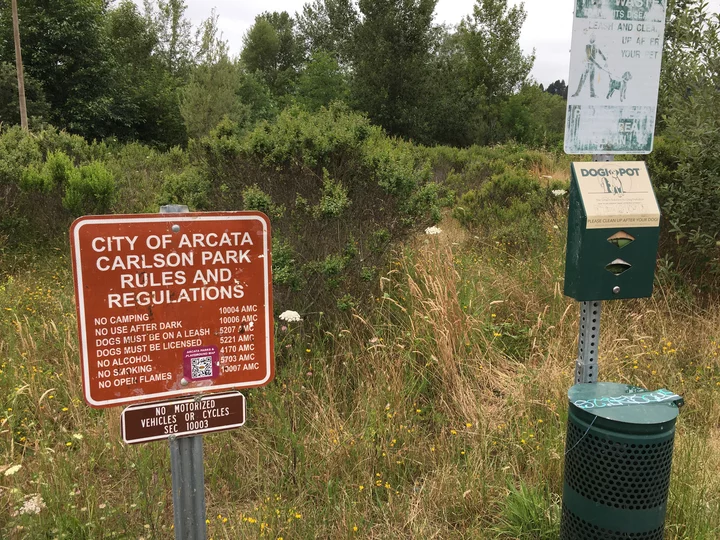
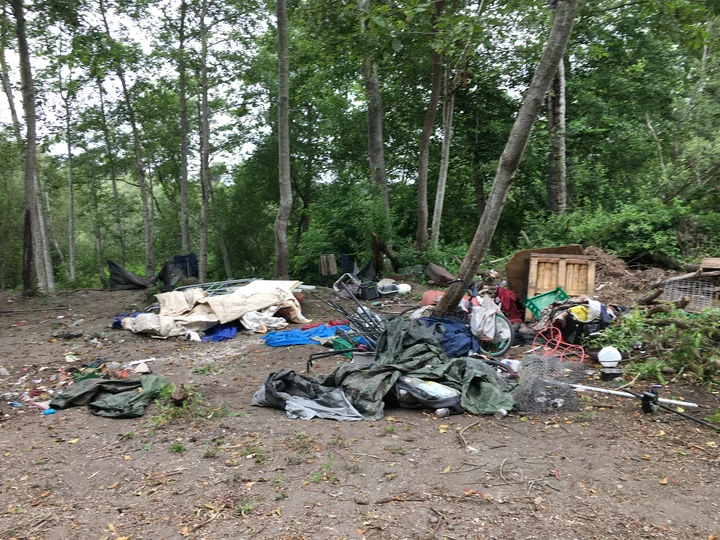
In the meantime, the city is focusing on cleaning up the park, which contains many active and abandoned homeless camps. Using grant funding for solid waste abatement from CalRecycle, the city is working with partners from Adult and Teen Challenge, DHHS and Cooperation Humboldt to identify what homeless camps are no longer occupied and clean up the trash and solid waste from those sites. As the project gets closer to expected construction, Sinkhorn said, the city will work with those social service partners and with the Arcata Police Department to relocate the people who are still actively camping in the park and connect them with other shelter opportunities.
Litter from an abandoned camp in Carlson Park | Stephanie McGeary
There is still a lot of work ahead, but Sinkhorn is very excited that the city is one step closer to turning Carlson Park into an attractive destination for visitors and the community.
“The City is really committed to improving walking and biking connectivity to Valley West…as well as improving recreational opportunities,” Sinkhorn said. “So we’re really excited that a component of the Carlson Park improvement project has been funded and we look forward to working with the community to finalize those designs.”
The marbled murrelet, the ocean-going bird that was once at the heart of
the showdown with the Pacific Lumber Company over Headwaters Forest,
is back in court in Oregon. Nick Cady of Cascadia Wildlands joins
Gang Green to discuss their recent victory protecting the large, old
trees that murrelets need to survive.
And there is a Humboldt
connection: local biologists testified on behalf of the environmental
plaintiffs, establishing that the proposed logging would violate the
federal Endangered Species Act.
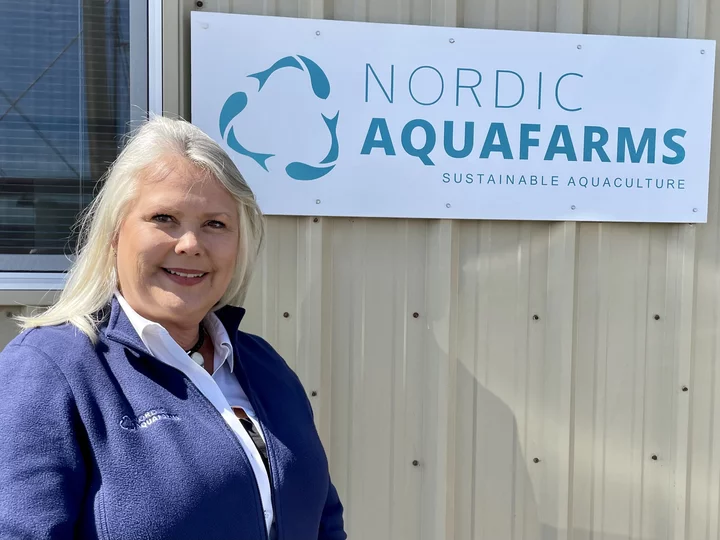
Nordic Aquafarms Interim Chief Executive Officer Brenda Chandler outside the company’s new office space on the Samoa Peninsula. | Photo by Ryan Burns
###
On Friday morning the Outpost sat down with Nordic Aquafarms’ recently appointed interim chief executive officer, Brenda Chandler, at the company’s new office space, located in the former pulp mill facility known as Redwood Marine Terminal II, on the Samoa Peninsula.
As the company gets ready to present its massive land-based fish factory project to the Humboldt County Planning Commission on July 28, executives are seeking to allay any community concerns that may have been triggered by the sudden and unexpected departure of co-founder and President Erik Heim and Executive Vice President/Commercial Director Marianne Naess.
Their unexplained split with the company coincided with the end of a lease on an office that Nordic had been renting on Third Street in Eureka. When people saw that the Nordic sign was gone it fueled yet more rumors that the Norwegian company might be in trouble, putting the project in jeopardy.
But in our interview with Chandler she said the estimated $650 million project is still full steam ahead. Joining us were Project Manager Scott Thompson and independent consultant/community liaison Lynette Mullen. The conversation has been lightly edited for length and clarity.
###
Lost Coast Outpost: You’ve been named interim CEO. Is there a search for a permanent CEO?
Brenda Chandler: No, not that I’m aware of. [Interim CEO] is the title I was given two weeks ago now.
So there may be a search for a full-time CEO?
I don’t think so. Not right now. But I think, potentially, as we move into a different stage on both of the projects [in Belfast, Maine, and Samoa, Calif.], that’s when there could probably be [a search]. And who knows? Maybe it [will be] me.
Did [getting named interim CEO] come as a surprise to you?
Yeah, it was a surprise. … The leadership in Norway approached me to say, “Can you do interim CEO?” And it’s like, sure. Sure, I can do it.
What level of involvement did you have here in California to that point?
I’ve always been part of the senior leadership as the CFO [chief financial officer], so I’d be party to discussions on updates and all of that on the California project. I worked extensively on the business case for the California project, so all of the components — everything going into the CapEx [capital expenditure] — I would be part of that discussion and those types of things.
Had you been out here before?
Yes. I was here — we were thinking about that — it must have been May 2019 or June of 2019. I was out here with Marianne. We met with a fair number of people … . So yes, I was right at the very beginning of part of those discussions.
And I take it you’ve been doing a series of meetings this trip out as well? Who all have you been meeting with?
Water District, Harbor District, some of the environmentally interested folks. We had a bit of a meet-and-greet with different different folks on Wednesday. … Some people I’d actually met with before, so this was sort of a reintroduction.
And was the timing of this trip [intended] to allay any concerns [given the recent unexpected departure Heim and Naess]?
Yeah, I thought it was important to get out here as soon as possible. I know the impact that Marianne had, being here basically for a couple of years, and all of the relationships that she had formed. And, really, that led to a great product in the FEIR [Final Environmental Impact Report].
So it was important to be here and basically say, “Hey, we have leadership in place.” But really what’s important, it’s not necessarily the leadership, either. It’s the core of the team, you know, the technical experts that we have. All of that remains the same. …
A leader is all about harnessing all of that, getting everybody going in the same direction. The technical pieces are what you really want to make sure are intact.
You mentioned at the Board of Supervisors meeting on Tuesday that Stephen Sachs is the project lead. When did he take that role with this project?
He actually has been here for over a year. He was hired in April 2021. He’s executive vice president of the projects, essentially, [on] both coasts. … Because of the timing of where we were in the projects his focus had been more on Belfast when he was first brought on. But he technically was hired to cover both coasts, especially around the construction [and] the engineering effort. He would be leading all of that — the environmental pieces, the permitting.
But the way I see it there’s sort of two sides of being here in California, and there was something similar that occurred in Maine as well, where you do have to have somebody who has the time to actually be out there and meeting with the community.
So one half of that is [what] I’m hoping to fill, and the other part is more technical, the hard numbers, the calculations, the planning — all of that is falling back on the project management side.
Basically what happened is at the beginning of this year they formed a company called NAF Europe and its concentration is going to be on the species kingfish. It also has a major expansion going on in Denmark to build out a bigger facility there for kingfish. So it’s almost concentrated on species, and the market in which it will serve.
The U.S. project is concentrating on salmon. … What they were finding was [that] investors were grappling with, “Oh, I’m interested in kingfish; I’m not interested in salmon.” Or [vice versa].
I read that there’s a Nordic facility that switched plans from [producing] salmon to kingfish because the kingfish has a higher profit margin. I guess it’s used more often in sushi. Was that the reason for investors having a different take on one fish versus the other?
Yeah, so
that’s the Fredrikstad facility [in Norway]. That facility was brought up doing Atlantic salmon on land. It’s 1,500 metric tons [in] size, so it’s a much smaller facility [than what’s planned here]. It’s designed slightly different as well.
And so … while they’ve been successful in raising salmon and putting salmon into the European market … it seemed like they would get more efficiency by doing a species that would grow faster and bigger. And so that utilization of the facility would be greater than for Atlantic salmon. But that’s undergoing permitting. That’s the plan, to actually do that conversion. It hasn’t happened yet.
Is there any chance that salmon won’t pencil out here in the states either and there may be a switch to a different kind of fish?
I don’t think so. There’s a lot of market analysis that would be required, and we’ve geared towards Atlantic salmon. Our expertise is in Atlantic salmon, and then the scale of our facilities are such that it makes more sense for it to be Atlantic salmon. The market just generally, if you think about grocery stores, restaurants, I just think there’s more of a potential growth opportunity in Atlantic salmon than kingfish in the U.S.
I saw figures cited recently that the cost estimates for both the Belfast facility and the one here went up to $600 million to $650 million. Is that accurate? And if so, what caused the increase?
Inflation.
Just that?
Predominantly inflation. The original estimates that we had were a few years old, but I will say those are still preliminary estimates. We have to keep our head around the fact that those were just the very beginning. … What really would fill that out with a more accurate number is a step that still needs to be done … detailed design, where you get a much better number because then every nut and bolt has been accounted for and it’s much deeper. You’ve got bid packages that have gone out to all of the contractors to really get more firm numbers. So that’s work that really needs to still be done — both in Belfast and in Samoa — to really understand that cost. We’re hoping that the wave of inflation actually subsides a little bit.
It’s not just inflation, right? The supply chain issues have made materials go through the roof.
Right. And it depends on the material as to whether it’s an issue or not.
I saw on an industry website that Nordic’s CEO [Bernt-Olav Rottingsnes] recently said banks are reluctant to lend to land-based fish farming projects. Given the delays that have happened in Maine, the rising cost estimates and the unproven nature of land-based RAS [recirculating aquaculture system] facilities this large — building two simultaneously — has there been any trouble attracting and maintaining investment financing?
First, I’m not sure about his quote and how it was framed. It seems like that was a bit of a soundbite that came through an article.
The direct quote was, “I think it is fair to say the banks still think it is too early to lend to land-based fish farming.”
But yet they have. … You’ve got to frame it and you’ve got to understand the framework, because we actually are able to have loans in Europe. … Now, he may have been referring to at the onset of a project, like in the U.S, but that’s not our strategy. Bank loans are later in the strategy for how do we capitalize our project. The initial phases are going to be through investors, and we have a large investor who has stayed with us the entire time and is still dedicated to us.
Who’s that?
That’s Rasmussengruppen [led by CEO Dag Rasmussen]. He’s a major investor.
I think, with the sudden departure of Marianne and Erik, some people are just wondering whether there’s really the money to do this. … Is that a concern?
You can never be 100 percent until the money’s in the bank, right? I mean, clearly it’s an effort. And clearly you have to have investors who can get their brain around it and get behind it. And that’s what we’re working on, is cultivating those kinds of relationships with investors. But we’ve done a lot.
Are you are you seeking any domestic investors? Or is the Rasmussen group financing it to this point?
They are financing it to this point. But yes, to answer your question. Yes. There’s actually U.S. investors and other potential global investors, beyond Norway.
A Lost Coast Outpost reader sent us links to [stories about] challenges that other land-based RAS facilities have had. Most of them were related to [aquaculture company] Atlantic Sapphire. In March of 2020 they experienced a mortality event in one of their grow-out systems [in a Denmark facility], losing around 227,000 fish. A few months after that the company had to initiate an emergency harvest of 200,000 salmon in its Miami facility. And the following March the company had another mass mortality event in the same facility, losing about 500 metric tons of fish — head-on, gutted salmon.
Those types of incidents seem to point to the challenges of growing Atlantic salmon at scale. And Nordic’s plans are even bigger than Atlantic Sapphire’s. How do you know if this is actually feasible at the scale that you’re talking about here?
So remember that our systems are modular, so we’ve proven it. We’ve grown fish; we’ve harvested fish at the Fredrikstad facility, so we’ve proven that we can do Atlantic salmon. So the way to think about the facility, it’s basically building out section by section by section and they’re each managed somewhat independently. So it’s not like one huge tank, right?
I can’t speak to Atlantic Sapphire, but what I will say is [that] we’re located in locations with cold water. Atlantic salmon is a cold water species. And that’s where we’re at on both coasts — seawater, a source of freshwater, and it’s all about the talent, our talent in the engineers and the biologists that we have on our staff.
And by the way, I mentioned this in the Board of Supervisors meeting [on Tuesday], the technical staff that we have in Denmark — we call them “NAF tech” — they actually had a commercial business where they were providing the infrastructure and the design to other customers before they came to work for us. So while it seems like this is big, we’ve already been doing it, actually, all over the world.
Erik Heim, before he parted ways with the company, recently told IntraFish, “As of today, there are a lack of good volume producers of eggs in the United States.” How will that challenge be met both in Maine and here?
The source of eggs that we have is from Iceland, and so it would be imported eggs at this time, which, clearly, for California is something that still needs to be vetted.
Long term are there any plans to get a domestic source?
Well, there’s always the opportunity to look strategically, should that be done? Our focus right now is on getting the permitting done on those farms. And we have a fairly long window of those before we would even get to eggs. It’s still something that’s on the horizon.
A fish biologist acquaintance of mine says that there are incidences of Atlantic salmon and brown trout hybridizing on the East Coast. Those are both in the same genus. But she has been looking through the peer-reviewed literature showing that Atlantic salmon and Pacific salmon are not capable of hybridization. They’re in different genuses. How sure are you that in the extremely unlikely event of an escape, the Atlantic salmon would not be able to reproduce with the native population?
What I’m sure
of is that they’re not going to escape. That’s what I’m sure of. There’s so many layers of of gates and — I mean, there’s physically no way for them to escape alive.
Scott Thompson: Definitely that’s true, with the redundant barriers; even with human error and natural disasters, it’s just not gonna happen.
I’m not the fish biologist, but we do have some references in the FEIR about studies where they have tried under ideal conditions to hybridize these fish and it’s just impossible. The genetic tree is way too far branched at this point that there’s no way.
Lynette Mullen: In addition to that — correct me if I’m wrong, please — but I think there have actually been efforts to intentionally introduce Atlantic salmon to the West Coast that have not been successful. So even when they’ve tried to, these fish still don’t succeed here.
Has the Wiyot Tribe taken a position on the project?
Chandler: I don’t know that we have a letter necessarily from them … but we’ve been in contact with the tribes all along.
Mullen: It’s the three tribes, when you talk about the affected tribes in this area: It’s [the] Blue Lake [Rancheria], it’s [the] Bear River [Band of the Rohnerville Rancheria] and then it’s the Wiyot Tribe on Table Bluff.
I don’t know that you saw, but the Blue Lake Rancheria actually put out a letter of support. It was kind of a big deal for a tribe to come out publicly supporting a project like this. … Really, all of the tribes, the things that they’ve been asking for is assurances regarding environmental impacts. … They want to make sure that things are done well, that there’s no negative impacts, that responsible monitoring takes place to assure them of that.
In very beginning, when Nordic was first coming in, they were very respectful of the fact that this is historic tribal land and wanted to start making those connections, understanding those concerns.
Jamie Roscoe, a well-known archeologist here, was brought on through GHD to do the cultural resources assessment, and what Marianne said at the time, she told Jamie, “Just do this. Meet with tribal leaders.” So Jamie met with the tribal historic preservation officers out here. They walked the site, talked about areas of concern. Nordic stayed out of it completely.
They did borings, they did samplings and that sort of thing. Jamie took that information, wrote up the cultural resources report and then sent it back to the tribal representatives to make sure they were comfortable with what was in that report. … The big thing — and Nordic volunteered to do this; it was kind of a no-brainer — agreed that whenever [the company] starts to go underground, Nordic’s going to supply a cultural resources monitor to be there, so if there’s anything of concern that’s unearthed there’s someone who is qualified to step right in and have that assessed and decide if it’s something significant and other action should be taken to protect those resources.
The Planning Commission hearing is around the corner. Are you aware of any organized opposition to the project?
Chandler: We’re not aware of any. We know there potentially is opposition that will be speaking. But as far as any large organization … we’re really not seeing that.
Thompson: And there are three CDPs [coastal development permits] — one through the county for the upland development but then there’s also one for the outfall [pipe] and the intake [facilities] that are through the California Coastal Commission.
So what’s the best-case-scenario timeline for starting construction?
Chandler: Well, we’re hoping [and] thinking permitting will be done in early 2023. Of course, we don’t know if there will be any appeals — that all just essentially adds time. But assuming the project is clear with all of its permits, we’d have a demolition phase, we’d have that detailed design phase. So we’re into like the 2024 to 2026 timeframe.
Thompson: A big complication to that is just, there’s a lot of birds around the site because the buildings are so porous. It’s unlikely the demolition would start during nesting season. So that kind of leaves us the winter time period. That’s probably when the big stuff will be coming down, because we can’t keep birds from nesting in the buildings that are missing so many pieces.
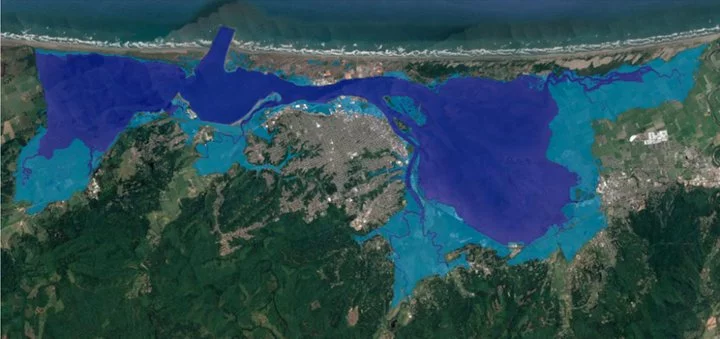
Projected Sea Level Rise Inundation Zone on Humboldt Bay for Mean Monthly Maximum Tide with 3.3 feet (1.0 meter) of Sea Level Rise. | County of Humboldt
###
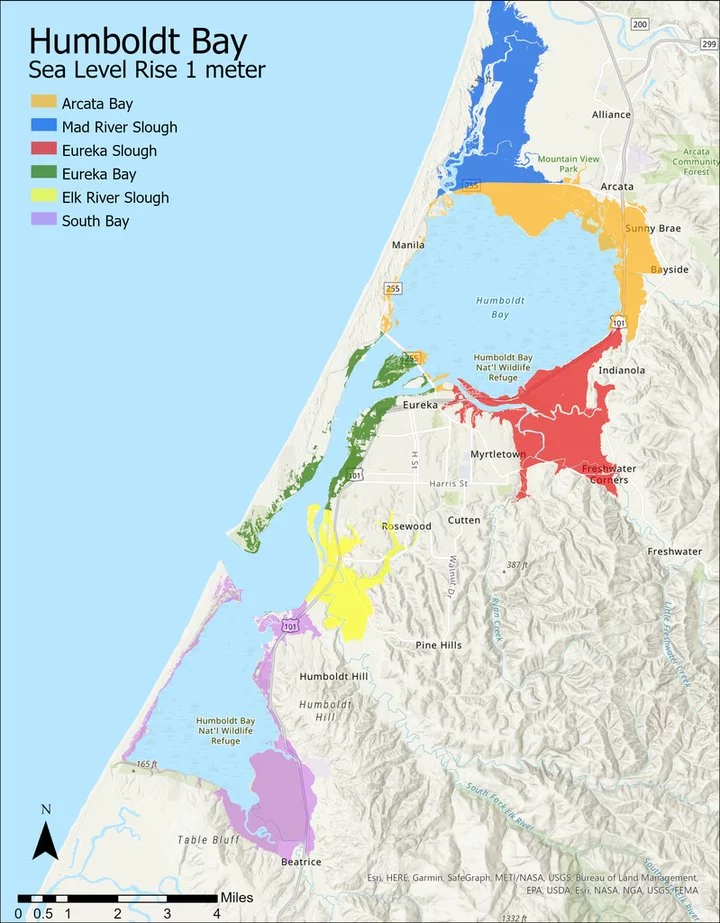
Local coastal experts expect Humboldt Bay’s shoreline to rise by as much as three feet in the next 40 years. One area of particular concern in the Humboldt Bay region is the Highway 101 corridor between Arcata and Eureka, a six-mile stretch of road that could be inundated by seawater if immediate steps are not taken to mitigate the impacts of sea level rise.
Caltrans District 1 staff are working to develop a Comprehensive Adaptation and Implementation Plan (CAIP) to protect and potentially realign the Highway 101 corridor to address anticipated sea level rise-related flooding hazards. Caltrans District 1 staff shared an update on their efforts with the California Coastal Commission this week.
“The Arcata-Eureka corridor is identified as a critical primary transportation hub because it’s one of only a few alternate routes that we have, contains essential utility lines [and] residential, business and recreational amenities that can be affected by sea level rise and flooding,” Clancy De Smet, climate change adaptation branch chief for Caltrans District 1, said during Wednesday’s meeting. “The corridor is also vulnerable given its proximity to Humboldt Bay…most sections of the shoreline along [the corridor] are of high to moderate risk.”
He added that the Humboldt County Civil Grand Jury issued a call to action for local decision-makers in one of its most recent reports, “The Sea Also Rises.” The report notes that sea level rise will likely impact the Humboldt Bay region faster than other parts of the West Coast.
“For more than a decade local coastal professionals have studied the future impact of sea level rise around Humboldt Bay,” the report states. “…For more than a decade, local coastal professionals have studied the future impact of sea level rise around Humboldt Bay. Their work, documented in several reports available since 2015, indicates that a two-foot increase in Humboldt Bay’s shoreline will be possible by 2050, and a three-foot rise may occur as early as 2070.”
Areas around Humboldt Bay that could be flooded with 3 feet of ocean water. | County of Humboldt
So far, De Smet and his team have collaborated with several local and regional groups, such as the Cal Poly Humboldt Sea Level Rise Institute, to work on data collection and develop potential strategies to address sea level rise.
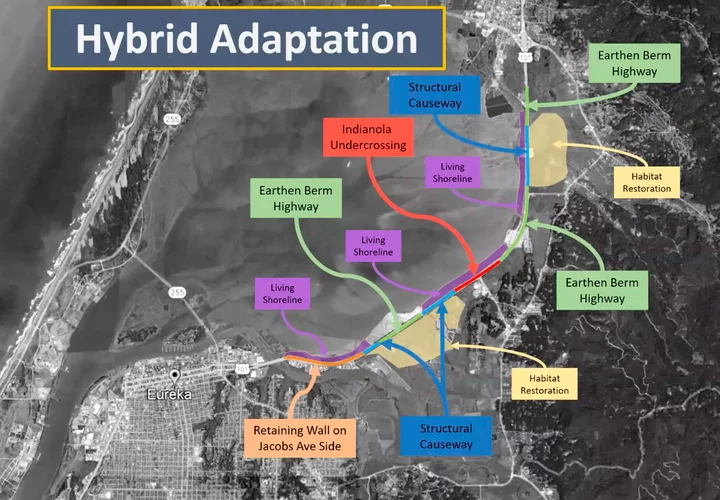
“There are several adaptation strategies that we’re exploring: protect, retreat [and] accommodate,” he said. “The most promising approach will be a hybrid strategy.”
The first strategy – protect – is a more flexible approach that would be implemented through several projects rather than all at once.
“Early investigation into this strategy has resulted in a concept that we refer to as the gradual progression of an earthen berm highway,” Harrison Rankin, transportation engineer for Caltrans District 1, explained. “…It aims to avoid the use of hard armoring by simply raising the roadway prism with fill. The first initial project is estimated to have a construction cost of approximately $100 million, with subsequent projects costing approximately $20 million every 10 years.”
Such a strategy would “result in the fastest project delivery timeline,” he added.
The second strategy – retreat – would take a more extreme approach. “This would require a major highway realignment,” Rankin said. “One such alternative that has been briefly evaluated is retreating U.S. 101 to Old Arcata Road. This alternative also has a high anticipated cost of approximately $1-3 billion, with significant community impact. The estimated number of affected parcels is likely to exceed 600 and alternative projects such as this would require very long project delivery timelines.”
The most likely strategy would be a hybrid approach in which individual segments of the highway would be subject to “micro-realignment.” Although there are an “infinite number of possibilities” with this strategy, Rankin said this approach would affect fewer residents, between 25 and 100 parcels.
Screenshot
Commissioner and Third District Humboldt County Supervisor Mike Wilson asked whether staff had considered a cost analysis regarding the potential loss of services during construction.
“When you’re saying that a couple of times a year some of the road might be closed for just a little bit here and there, is there some sort of cost analysis to [determine] how to adapt to those changes versus the assumption that we have reliability all the time?” he asked. “I think we need to think about that, in terms of what’s the cost of what we’re talking about here…and what’s the cost of our adaptation to those changes?”
De Smet said he and his team “are considering those contingencies,” noting that Caltrans has adopted similar strategies for the Garcia River in Mendocino County. “[It] periodically shuts down due to flooding,” he said. “These are things that we’re considering, and we are considering behavioral changes and ways to adapt to these things.”
Commissioner Sara Aminzadeh commended Caltrans staff on the progress they have made in the last few years, noting “a lack of coordination between various agencies, sea level rise projections and best practices” during a previous discussion in 2019.
“The presentation we just saw reflects a huge step forward,” she said. “I think, while some details are still being worked out, [it] really will hopefully result in a project that not only results in a good safe stretch of highway but can also benefit natural resilience in a way that reflects community desires around the bike path and other aspects.”
Commission Chair Donne Brownsey underscored the importance of acting quickly to address sea level rise along the 101 corridor, noting that it is “just beyond critical” to the region.
“I mean, all the highways are important, but I’ll tell you that one…I just shudder to think because it is major north-south and it’s the way to Oregon as well,” she said. “And then the local traffic because so many Arcata and Samoa and Eureka communities utilize that [roadway] every day.”
Brownesey did express concern for “spending time on temporary options,” such as the “protect” strategy Rankin had presented. “The more permanent options are going to take decades and decades. …We know that we’re already way behind.”
The commission accepted the report but did not take a vote on the item.
You find a full recording of Wednesday’s meeting here.