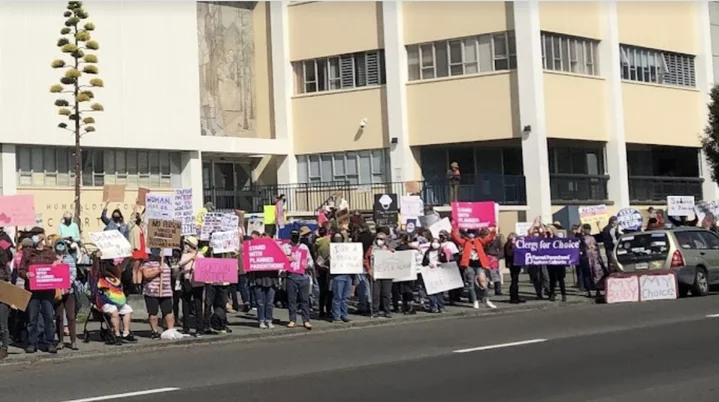
Community Protest today, Friday, June 24 at 5 pm in front of the Humboldt County Courthouse!
In a majority decision today, the U.S. Supreme Court has overturned Roe v Wade, threatening the right
to safe and accessible abortion for millions of people nationwide.
The U.S. Supreme Court’s decision will result in over half our country’s states moving to wipe out
abortion access. This would disproportionately harm people who already face systemic discrimination
and have limited health care access. With Roe v. Wade overturned, 26 states have promised to quickly
move to ban abortion. Some of these states will move to restrict, ban and/or criminalize abortion
immediately.
The U. S Supreme Court may have failed to protect our rights, but we are not without power to fight
back. We hope to see you tonight!
Press release from the Office of Gov. Gavin Newsom:
The
governors of California, Oregon and Washington today issued a
Multi-State Commitment to defend access to reproductive health care,
including abortion and contraceptives, and committed to protecting
patients and doctors against efforts by other states to export their
abortion bans to our states.
This
Multi-State Commitment affirms the governors’ commitment in
response to the U.S. Supreme Court’s unprecedented decision to
strip away a constitutional right that has been in place for half a
century, leaving abortion regulation to the states. The sweeping
decision means that for patients in more than half the country, home
to 33.6 million women, abortion care is illegal or inaccessible.
In
a video
message the
governors share a powerful message that the West Coast will remain a
place where reproductive health care will be accessible and
protected.
“The
Supreme Court has made it clear – they want to strip women of their
liberty and let Republican states replace it with mandated birth
because the right to choose an abortion is not ‘deeply rooted in
history’. They want to turn back the clock to a time when women had
no right to make decisions about their own bodies, when women had to
seek care in the shadows and at great danger, when women were not
treated as equal citizens under the law. This is another devastating
step toward erasing the rights and liberties Americans have fought
for on battlefields, in courthouses and in capitols. This is not the
America we know – and it’s not the California way,” said
Governor Gavin Newsom.
“California has banded together with Oregon and Washington to stand
up for women, and to protect access to reproductive health care. We
will not sit on the sidelines and allow patients who seek
reproductive care in our states or the doctors that provide that care
to be intimidated with criminal prosecution. We refuse to go back and
we will fight like hell to protect our rights and our values.”
“Abortion
is health care, and no matter who you are or where you come from,
Oregon doesn’t turn away anyone seeking health care. Period. Let me
be clear: You cannot ban abortion, you can only ban safe abortions —
and this disgraceful Supreme Court decision will undoubtedly put many
people’s lives at risk, in addition to stripping away a
constitutional right that disproportionately affects women and has
been settled law for most of our lifetimes,” said
Governor Kate Brown.
“For all the Americans today feeling scared, angry and disappointed
— for everyone who needs an abortion and does not know where they
can access safe reproductive health care –– please know you are
not alone, and the fight is not over.”
“The
law remains unchanged in Washington state, but the threat to patient
access and privacy has never been more dangerous. Even in Washington
state, Republicans have introduced about 40 bills in the past six
years to roll back abortion rights and access to reproductive
care,” said
Governor Jay Inslee.
“The right of choice should not depend on which party holds the
majority, but that’s where we find ourselves. More than half the
nation’s population now lacks safe access to a medical procedure
that only a patient and their doctor can and should make for
themselves. Instead, law enforcement, vigilantes and judicial systems
can force patients to bear the burdens of forced pregnancy and birth.
Washington state remains steadfast in our commitment to protecting
the ability and right of every patient who comes to our state in need
of abortion care, and we will fight like hell to restore that right
to patients all across the country.”
Over
the past several years, each state has taken action to expand access
to reproductive health care in preparation for just such a decision:
Governor
Newsom has proposed a $125 million Reproductive
Health Package to
expand access for women and help prepare for the influx of women
seeking reproductive health care from other states. The California
Legislature has introduced a constitutional
amendment to
enshrine the right to abortion in the state constitution. Governor
Newsom recently signed legislation eliminating
copays for
abortion care services and has signed into law a legislative
package to
further strengthen access and protect patients and providers.
Additional proposals are being considered with the Legislature.
Oregon
led the nation by passing the most comprehensive reproductive health
legislation at the time. Governor Brown signed Oregon’s Reproductive
Health Equity Act into
law in 2017 — a first of its kind bill that expanded access to
reproductive health services for all Oregonians and codified the
right to an abortion into state law. Adding to that work, Oregon
invested $15 million for community-based organizations to expand
access to abortion across the state and provide immediate support to
patients, health care providers, and community advocates, with a
focus on rural communities, communities of color, and low-income
communities to overcome barriers to access.
In
2018 Governor Inslee signed the Reproductive Parity Act that
requires all health plans that include maternity care services to
also cover abortion and contraception. In 2021 he signed the
Protecting Pregnancy Act that allows doctors who practice in
Catholic-run hospitals to bypass ethical-religious directives and
provide medically necessary abortion when a woman’s life is in
danger. Earlier this year Inslee signed the Affirm
Washington Abortion Access Act that
better ensures the ability of Washington abortion care providers to
serve any person who comes in Washington state seeking an abortion.
Washington law also protects patients and clinic personnel from
harassment outside of clinics. Further, when federal changes were
made to the Title X program to not allow family planning clinics to
reference abortion as an option, Washington state stepped up to fund
the Title X clinics instead of having to comply. While the federal
funding has been restored, the state will continue to provide needed
funding to support access to abortion.
From the Humboldt County Department of Health and Human Services:
After
a group of third graders at a local school inadvertently ate cannabis
gummies last month, Public Health officials are reminding adults to
help keep children safe from cannabis exposure and overdose by making
sure it is inaccessible. A lockbox is recommended and available for
free through Public Health.
Cannabis
edibles can look like candy and other foods that appeal to children,
but even a little piece of a cannabis edible can make a child very
sick. Warning signs can include trouble walking or sitting up, loss
of coordination, trouble breathing, nausea and vomiting, rapid heart
rate and difficulty staying awake.
Take
the following steps to help keep children safe:
1)
Keep cannabis edibles and all cannabis products locked up where
children and pets cannot reach them.
2)
Talk to children about cannabis edibles and that they can make them
very sick and remind your child not to share food at school.
3)
If a child has consumed cannabis edibles, call Poison Control at
1-800-222-1222. If a child is showing symptoms of having consumed
cannabis products, call 9-1-1 or contact your medical provider for
help right away.
4)
In addition to cannabis, make sure other items such as alcohol,
medications and firearms, are stored safely as well.
The
Keep It Safe Lockbox Program provides free lockboxes to community
residents who need them. The lockboxes can safely store cannabis,
medications, firearms or other items that might be used to cause
overdose, injury or suicide.
For
a free lockbox or for more information, contact the Substance Use
Prevention Program of the Humboldt County Department of Health &
Human Services Healthy Communities Division of Public Health at
707-268-2132, stop by the Community Wellness Center at 908 Seventh
St. in Eureka or email PublicHealthAOD@co.humboldt.ca.us.
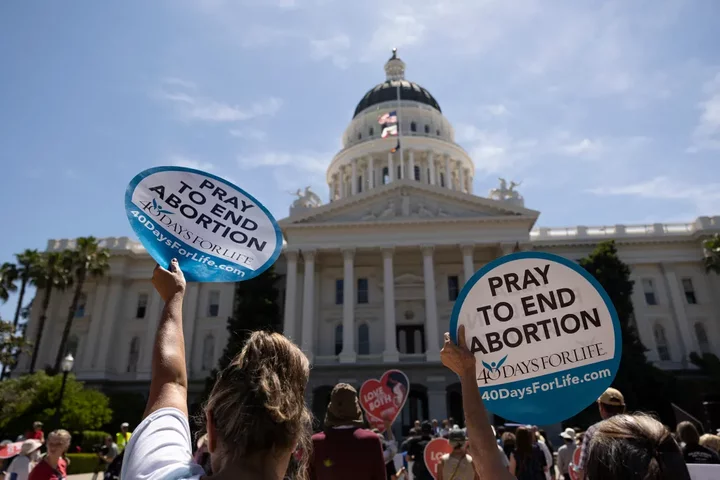
Anti-abortion protesters gathered at the state Capitol against abortion measures before the Legislature on June 22, 2022. Photo by Miguel Gutierrez Jr., CalMatters
The constitutional right to abortion in the United States is no more. Today the U.S. Supreme Court struck down its landmark Roe v. Wade precedent in a 5-4 decision, ending nearly 50 years of guaranteed abortion access for American women.
The historic ruling has been expected since early May, when a draft of the opinion was leaked, and was widely anticipated long before that as conservative justices tilted the court. The fight over abortion rights now returns to the states, where it played out five decades ago, with the procedure immediately set to become nearly or entirely illegal in almost half of them and several more bans likely to follow.
California is moving in the opposite direction, ramping up legal protections for abortion providers and pouring resources into expanding access as clinics prepare for a possible surge of patients traveling from other states to terminate their pregnancies.
Here is how the Supreme Court’s decision in Dobbs v. Jackson Women’s Health Organization will play out in California:
Abortion will be a major focus of November election
Expect to hear a lot about abortion rights in the months ahead, as candidates tout their endorsements from Planned Parenthood and flood the airwaves with advertisements warning of the bleak future for access if their opponents win.
Since the draft ruling leaked last month, Democrats in California and across the country have latched onto protecting abortion rights as a key issue for the 2022 midterm elections. With decades of public polling showing that a majority of Americans believe abortion should be legal in all or most cases, it has put the party back on the offensive as it faces mounting voter dissatisfaction with President Joe Biden and withering Republican attacks over inflation and crime.
“I hope that people are enraged,” said state Senate President Pro Tem Toni Atkins, a San Diego Democrat who ran a women’s health clinic before entering politics.
“While we feel like we have better protections here and California is different, I hope they’re enraged and they understand what’s at stake,” she told CalMatters.
A poll conducted last month by Monmouth University found that abortion was nearly tied with economic policy as the top concern for voters nationwide, a considerable increase from four years ago driven by its rising importance among Democrats. Another recent survey from UC San Diego asked Californians whether they planned to vote in November, before and after reading an article about the possibility of a national abortion ban if the Roe decision is overturned; researchers determined it had a significant mobilizing effect on independent voters.
The potential for Republicans to pursue a national abortion ban should they win back control of Congress is likely to feature prominently in a number of battleground House races across the state. Gov. Gavin Newsom and Attorney General Rob Bonta have already made abortion rights central to their re-election campaigns, and even some candidates with less of a direct connection to ensuring abortion access, including Democratic state controller hopeful Malia Cohen, have tried to raise alarms about the beliefs of their GOP opponents.
Abortion rights will also literally be on the ballot in California in November. Democratic legislators in Sacramento are rushing to qualify a measure that, if approved by voters, would enshrine “reproductive freedom” in the state Constitution.
Though California already protects abortion access through a constitutional right to privacy, Atkins, who is shepherding the amendment through the Legislature, said a more explicit guarantee is important as legal battles over the future of reproductive rights continue.
“That is my biggest fear. You find one judge somewhere in California who rules and our whole right to privacy as it currently exists in California is in question,” Atkins said, though she acknowledged there were additional political benefits: “I sure as hell hope that it’s going to drive turnout.”
More legal support for abortion providers
As dozens of conservative states laid the groundwork for the end of Roe, passing abortion bans triggered by the Supreme Court ruling, California has been scrambling to build a bulwark for reproductive rights and accommodate a potential influx of patients from beyond its borders.
Last fall, Newsom convened the Future of Abortion Council, a coalition of reproductive rights, health and justice groups, to explore how to make the state a “sanctuary” for abortion. Its recommendations, released in December, formed the basis for a sweeping package of more than a dozen bills currently moving through the Legislature.
They include Atkins’ Senate Bill 1375, which would increase the number of providers by allowing some nurse practitioners to independently perform first-trimester abortions without a doctor’s supervision, and Assembly Bill 1918 by Assemblymember Cottie Petrie-Norris, a Costa Mesa Democrat, which would create a “reproductive health service corps” for underserved parts of the state.
Several measures would protect doctors from legal and financial penalties if they travel to other states to perform abortions or treat out-of-state patients: AB 1666 by Assemblymember Rebecca Bauer-Kahan, an Orinda Democrat, won final legislative passage Thursday and would nullify civil judgments from other states. AB 2091 by Assemblymember Mia Bonta, an Alameda Democrat, would prohibit medical providers and health insurers from sharing information in cases that seek to penalize abortion. AB 2626 by Assemblymember Lisa Calderon, a Whittier Democrat, would prevent the state medical board from suspending or revoking the license of a physician who is punished in another state for performing an abortion in accordance with California law.
Abortion opponents have showed up at the state Capitol in force to protest AB 2223 by Assemblymember Buffy Wicks, an Oakland Democrat. Seeking to protect Californians from overzealous law enforcement and district attorneys who may be hostile to abortion rights, it would end a requirement that coroners investigate the cause of fetal deaths resulting from suspected self-induced abortions, clarify that women cannot be held criminally or civilly liable for pregnancy loss or abortion, and create an ability to sue prosecutors and others who violate that protection.
“We’re covering a lot of ground,” Atkins said. “As disheartening as this reality is that we have to prepare for…given all that we’re doing to shore up our protections and access to services, we will be ready.”
Newsom has expressed support for many of the proposals — and already signed legislation earlier this year to eliminate out-of-pocket costs for abortions in health insurance plans. Though some would take effect immediately if approved, including the three bills expanding legal protections for doctors, others would not become law until January.
Attorney General Rob Bonta quickly vowed today to “use the full force of the law to protect reproductive healthcare for everyone who seeks it in our state.”
Jodi Hicks, CEO of Planned Parenthood Affiliates of California, echoed that pledge. “I want to be crystal clear: abortion remains legal here in California and we are working to ensure that people — regardless of where they come from — can access abortion services with as much support and as few barriers as possible,” she said in a statement. “To people across the country living in a state hostile to abortion: California is here for you. We will not turn people away, and we will find a way to support you so that you can get the care you need.”
Out-of-state influx, but how big?
With Roe toppled, California has become the nearest state with abortion access for approximately 1.3 million out-of-state women of reproductive age, according to the Guttmacher Institute, an abortion rights think tank. That’s a nearly 3000% increase triggered by Arizona’s historical abortion ban that criminalizes the procedure and went into effect when the Supreme Court announced its decision.
Using women of reproductive age as a proxy for abortion demand is imprecise at best, and Guttmacher’s projection is based solely on driving distance. But without statewide data on abortions, it’s nearly impossible to estimate how many people may now rely on California clinics.
Even before today’s Supreme Court decision, California providers and advocates reported serving women from states farther than Arizona.
“One of the things we’ve seen is a cascading effect. The wait times for appointment availabilities increase in border states, and they travel to other states to get the care,” said Lisa Matsubara, general counsel for Planned Parenthood Affiliates of California.
In the first four months following Texas’ controversial six-week ban last year, Planned Parenthood clinics in California performed abortions for approximately 6,000 out-of-state patients, Matsubara said. Patients from out of state were three times more likely than California patients to be seeking abortions rather than other health care during the same time period.
In 2021, ACCESS Reproductive Justice, which gives grants to women to offset the cost of the procedure and remove barriers such as travel and lodging, helped people from 18 states, said Jessica Pinckney, the group’s executive director.
Pinckney, who is among the coalition of abortion advocates supporting the 13-bill package in the Legislature, said advocates have been clear with lawmakers that planning for the unknown is difficult, but providers have done their best to collectively estimate what access gaps remain in California and what they expect to see in the near future.
“There’s so much you can’t anticipate,” Pinckney said. “In a world where half of the states have banned abortion outright or nearly outright, the barriers are only going to be greater.”
Increase the number of providers?
Despite California’s reputation as a reproductive health safe haven, 40% of California counties do not have any abortion clinics. Lawmakers are pushing to increase the number of abortion providers by offering financial incentives and streamlining regulations that govern who can perform abortions.
Newsom’s proposed budget includes $20 million to give scholarships and loan repayment options to clinicians who commit to providing reproductive health care services. The Legislature’s spending plan invests an additional $21 million in existing reproductive health workforce programs and commits a one-time $20 million investment for recruiting and training clinicians that work at reproductive health centers.
Another measure aimed at allowing nurse practitioners to perform first trimester abortions without physician supervision has been billed as a way to increase the number of abortion providers, but even advocates say the impact may be limited.
In 2013, California adopted a measure allowing nurse practitioners, physician assistants and certified nurse midwives to perform first trimester abortions after receiving special training. Since then, however, training opportunities have remained limited.
“Very few nurse practitioners have been trained since the law went into effect,” said Debbie Bamberger.
Bamberger was the first nurse practitioner in the state to be trained to perform abortions and has been a nurse practioner for 28 years and works for Planned Parenthood in Oakland. Her training was conducted as part of a research study that assessed whether clinicians other than doctors could safely perform aspiration abortions — a procedure that uses suction during the first 10 weeks of pregnancy. Forty clinicians were trained during the course of that study, and Bamberger said not many more have been trained since.
Part of the problem is nursing schools and physicians assistant programs do not have abortion curriculum or training opportunities for students who want to learn the procedure. Most training is limited to medical residency programs for physicians, who don’t want to give up their limited spots to other kinds of clinicians.
Bamberger said her clinic has trained five nurse practitioners to perform abortions in the past two years and Planned Parenthood of Northern California does not offer widespread training.
“It’s mostly trying to remove barriers but it’s not necessarily going to hugely increase access if there’s still no training available,” she said.
The state is investing in abortion access
Both the Legislature’s Democratic leadership and Newsom administration have made it clear they’re willing to commit a significant amount of the state’s record surplus to abortion rights.
In his latest budget proposal, Newsom pledged $125 million to reproductive health care, including $60 million to directly subsidize the cost of providing abortions to low-income or uninsured patients. Roughly a third of that money is reserved for low- and middle-income Californians enrolled in the state’s insurance exchange, Covered California, but $40 million can be used to reimburse abortion providers for procedures conducted on anyone who can’t pay — even those from out of state.
His proposal, which is supported by the Legislature, also includes $20 million to improve physical and digital security at abortion clinics and $15 million for community-based organizations to provide sexual and reproductive health education.
The Legislature’s spending plan goes even further, earmarking an additional $156 million in reproductive health spending to train more providers, increase funding for clinics that serve Medi-Cal patients, and open an abortion “Safe Haven” pilot program in Los Angeles.
One headline-grabbing investment the Legislature and governor haven’t agreed on yet, is the creation of the California Abortion Support Fund. The fund would give grants to organizations that help defray travel, lodging, child care and other costs that advocates say prevent women from getting to an abortion clinic. While the money would go to California-based nonprofits, women seeking abortions from any state could apply for grants.
“Some of the hesitation I’ve heard from legislators and the administration is it’s not common for us to provide practical support,” said Pinckney, with ACCESS Reproductive Justice. “But there’s no other health care that is banned and is time sensitive. They can’t wait six months to save the money.”
###
CalMatters.org is a nonprofit, nonpartisan media venture explaining California policies and politics.
Edward Earl “Ned” Seely passed away peacefully in Eureka on the
morning of June 3, 2022. He has been battling Alzheimer’s for many
years and was diagnosed in late 2016. He had PCA, Posterior Cortical
Atrophy, which affected his vision and spatial abilities, but left
his humor and kindness intact.
Ned was born in
Eureka on January 31, 1949, to Elmo Keith Seely and Betty Gene Shank.
His childhood was filled with wonderful memories spent with his two
older brothers Michael and Kevin and his older sister Jenny. Growing
up his dad Elmo did not like having sugar in the house, but Ned had a
notorious sweet tooth and would sneak over to the neighbor’s house.
His mom found out many years later that the neighbor would give him
sweets and Coca-Colas. Ned would remember being the littlest in the
family and losing to his older siblings with things such as what to
watch on TV. Because of this, he would gain a love for books,
especially mysteries.
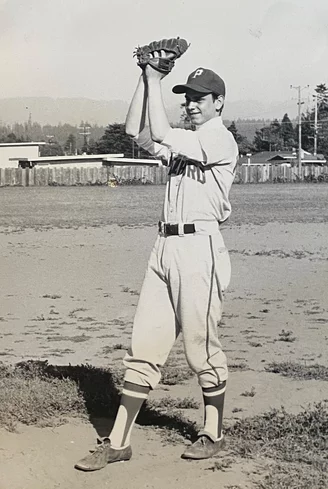
Ned attended Eureka
City Schools and graduated from EHS in 1967. Throughout school, he
played baseball and basketball. He attended College of the Redwood
and Humboldt State University, playing baseball at both. As an adult,
he would go on to play in local softball leagues and develop a love
of golf, something he would pass on to his son Nick.
In college, he met
Mary Jane Bohn and they were soon married in 1971. In 1977, they
welcomed their first child Rebecca Ann into the world and in 1981
their son Nicholas Allen was born. In their early years of marriage,
Ned and Mary worked in Juvenile Hall together and were known as Mom
and Pop. After 30 years, Ned retired as Assistant Chief of Probation.
In his retirement years, you could find him enjoying a drink at
Dave’s Place, playing pool at the Elks, or enjoying a round of
golf.
When Becca and Nick
were little, they remember that at night when their dad would watch
TV, he would roll up newspapers and pitch nerf balls to them for them
to hit. He would also play wiffle ball with them in the backyard
while he was barbecuing. This would be the start of both Nick and
Becca following in his footsteps with their lifelong love of
baseball. Ned could always be counted on to never miss any of their
many sporting events, from baseball and softball, to basketball,
volleyball, and soccer. Ned would recall his best day ever was when
Nick, at the age of 14, beat him for the first time in a round of
golf. In the summers, Ned and Mary would take the family camping up
in Grants Pass to the family’s favorite campground, Indian Mary.
Every day he would drive into town to get in a round of golf. He
loved the Grants Pass golf courses. When he wasn’t golfing, he
would be barbecuing and visiting with friends.
After living in
Sacramento for a few years, he moved back home to care for his mom
and stepdad Kenny Cringle. He loved spending time with his four
grandkids and of course never missed one of their sporting events. He
would often take his grandkids to get milkshakes at Fresh Freeze; he
would never outgrow his sweet tooth.
Ned was a lifelong
Giants fan and in his later years would take many trips down to San
Francisco with Becca and Nick, who inherited his love of the Giants,
to see a game or two. He would still travel up to Indian Mary to camp
with his kids and grandkids and of course golf everyday with Nick and
sometimes his granddaughter Shelby. He loved spending time with his
family and will be remembered with much love.
Ned was preceded in
death by his mom Betty Gene Cringle, his dad Elmo Keith Seely, his
stepdad Kenneth Cringle, his brother Michael Seely, and his cousin
Charley Shank.
Ned is survived by
his children Becca Meyer (Jeff) and Nick Seely, his sister Jenny
Lovewell, brother Kevin Seely, his four grandchildren Shelby, Kodi,
Tyson, and Jason Meyer, his ex-wife and friend Mary Seely and
numerous friends and family.
His family would
like to give special thanks to the caring staff at Timber Ridge, the
amazing Hospice team for their compassionate care during his final
days, Donnette Baarsch for entertaining him with music and art, and
George Morris for bringing him a newspaper every day while at Timber
Ridge.
A celebration of
life will be held at 1 p.m. on August 14, 2022 at the Eureka Elks
Lodge, 445 Herrick Ave., Eureka.
In lieu of flowers,
donations can be made to Alzheimer’s research or St. Bernard’s
Academy.
###
The obituary above was submitted by Ned Seely’s loved ones. The Lost Coast Outpost runs obituaries of Humboldt County residents at no charge. See guidelines here. Email news@lostcoastoutpost.com.
Tony Marvin Thomason passed away on February 5, 2022. He was born in Texarkana, Arkansas on January 17, 1947. He was predeceased by his parents Marvin and Louise Thomason and his brothers Floyd, Roy, and Jimbo. He is survived by his siblings Peggy, Carolyn, David, Marilyn, Daryl, and Earl. He is also survived by his daughter Shelly Thomason.
Tony graduated from Arcata High School and served in the U.S. Army. While he was in the Army he married Christine Basquetti. He and his former wife had a business delivering Hostess baked goods in the McKinleyville area.
Tony will be remembered for his great laugh and for his love of family. He was also a friend of all animals, especially dogs.
A Celebration of Tony’s Life will be held this Saturday June 25 at 1 p.m. at the Manila Community Center, 1611 Peninsula Drive, Arcata.
###
The obituary above was submitted by Tony Thomason’s loved ones. The Lost Coast Outpost runs obituaries of Humboldt County residents at no charge. See guidelines here. Email news@lostcoastoutpost.com.
Picture this: It’s a beautiful sunny day in Blue Lake and you’ve just reached the tippy top of the epic waterslide at the brand new waterpark. The lifeguard on duty gives you the all-knowing nod to proceed down the slide and you launch yourself forward. As you gleefully navigate each twist and turn of the slide you think to yourself, Maybe I’ll check out the splash pad after this! Life is good.
That dreamy vision could become a reality!
The Blue Lake Rancheria recently hired the Humboldt Visitor’s Bureau to look into the feasibility of a waterpark in Blue Lake. The survey is geared toward parents and asks about the use of existing water features in the county (rivers, pools, ocean, etc.) and what kind of attractions ought to be featured in a local waterpark (waterslides, splash pads, lazy rivers, etc.).
“It’s really preliminary at this point, but it seems like the community is pretty excited about it!” Andrea Marvin, communications manager for the Blue Lake Rancheria, told the Outpost this afternoon. “The Tribe will be excited to share more details as the plans become more finalized, but at this point, it’s just a feasibility study. Once the feasibility study comes out there will be more information for us to share.”
Naturally, locals are going nuts about it on Facebook. The vast majority of folks seem thrilled by the prospect, but, of course, there are a handful of naysayers who think it’s just “another stupid idea.” Several commenters have questioned whether it gets hot enough in Blue Lake to warrant a waterpark, while others have pointed out that the waterpark could be indoors like the aquatic center in Fort Bragg.
What do you think? Tell the Blue Lake Rancheria here!
(DISCLOSURE: The Blue Lake Rancheria is a minority owner of Outpost parent company Lost Coast Communications, Inc.)