

‘Flying the Earth Flag at the Top is Only Logical’: Arcata City Council To Consider Earth Flag Initiative to Either Adopt or Submit to November Ballot
Stephanie McGeary / Tuesday, June 21, 2022 @ 4:42 p.m. / Local Government
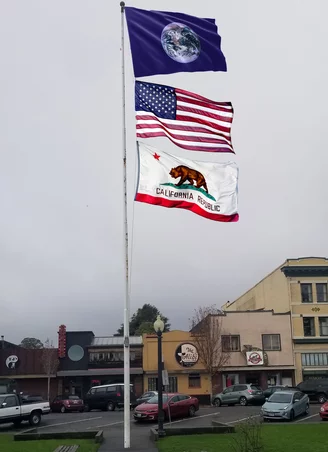
If the Earth flag initiative passes, the Earth flag would be at the top of the Arcata Plaza flagpole all the time | Submitted by Dave Meserve
Three flags wave proudly on the flagpole in the center of the Arcata Plaza – the U.S flag sits on top, California’s grizzly bear hangs in the middle, and the dark blue Earth flag is below. Now, Old Glory might get bumped to the middle, after an initiative directing the City of Arcata to fly the Earth flag on the top of all city-owned flagpoles qualified for the November ballot. The initiative will come before the Arcata City Council for discussion during its Wednesday meeting.
“Flying the Earth flag at the top is only logical,” says a press release sent out last month about the initiative, which would direct the City to fly the Earth flag above the U.S. and California flags. “The Earth includes our nation, which includes our state.”
True words. But beyond simply placing flags in a more logical order of largest to smallest place representation, proponents of the initiative feel that flying the Earth flag at the top of the flagpole would make a statement about the City of Arcata’s priorities, showing that the community values the health and well-being of the Earth above all else, something they say is particularly important while we tackle issues such as climate change and the threat of nuclear war.
With the petition for the Earth flag initiative gaining 1,318 valid signatures (significantly more than the 1,137 minimum to qualify) it will now go before the Arcata City Council, which has two options: to either adopt the ordinance without alteration, or to place the item on the November ballot and let the Arcata voters decide.
If the council opts for the first option, the ordinance could be adopted during the meeting, or the council can hold a special meeting within the following 10 days to adopt the ordinance, and that will be that. With no specified window of time included in the initiative, the Earth flag would be flown at the top of all city-owned flagpoles forever, or until somebody gathers petitions for another initiative to change the flag order back.
It seems more likely, however, that the council will opt to submit the measure to the November ballot and let the Arcata voters decide if they want the Earth flag on top. If the council goes with this option, then the council members will need to decide if they want to submit an argument against the initiative and possible rebuttal argument for the ballot. If the council does choose to submit an argument, it will need to appoint two council members to a subcommittee to draft the argument and bring it to the council’s July 20 meeting for approval. If a rebuttal argument is necessary, the council would need to draft and approve it before August 2.
Now wait just a second, you might be thinking: Isn’t it federal law that the U.S. flag be flown at the top of all flagpoles? Well, as is pointed out in the text of the measure, the United States Flag Code does state “no other flag or pennant should be placed above or, if on the same level, to the right of the flag of the United States of America.” But the flag code is written as guidelines to proper flag etiquette and is not really enforceable. In case you were wondering, the one exception written in the flag code is that Naval ships may fly a church pennant above the U.S. flag during church services held at sea for personnel of the Navy. So there ya go.
While you might wonder if worrying about rearranging the flags is a waste of time and energy that could be better spent tackling more pressing issues, Dave Meserve, former Arcata City Council member and creator of the Earth flag initiative, feels that there is time for both.
“We can address these ‘down to Earth’ issues as we also focus more on preserving the health of the Earth itself,” Meserve wrote in an Op-ed published by the North Coast Journal. “We must act soon to address climate change and the threat of nuclear war, and to do so we must increase our everyday awareness of the primacy of the Earth.”
The council will discuss the Earth flag initiative and other important issues — including initiating amendments to the city’s Short Stay Vacation Rental Ordinance and updating the City’s master fee schedule for the year — during its regular hybrid online and in-person meeting on Wednesday, June 6 at 6 p.m.
You can view the full agenda and directions on how to participate here.
BOOKED
Yesterday: 6 felonies, 12 misdemeanors, 0 infractions
JUDGED
Humboldt County Superior Court Calendar: Today
CHP REPORTS
No current incidents
ELSEWHERE
RHBB: HAF+WRCF Opens Fall Grant Round for Artists, Seniors and Holiday Programs
RHBB: State Parks Urges Safety Precautions Ahead of Labor Day Weekend
BROADWAY POP-UPS! Caltrans is Gonna Test Some Stuff to Maybe Improve the Hellscape That is Eureka’s Southern Gateway, and There’ll be a Virtual Meeting About it Next Week if You Want to Check That Out
Hank Sims / Tuesday, June 21, 2022 @ 3:35 p.m. / Infrastructure

Art for the Broadway Popups Project, which also advertises broadwaypopups.com, via Caltrans.
What on Earth are Broadway Popups, you ask? They’re stuff like temporary bike lanes and bulb-outs that Caltrans is gonna lay down on Broadway soon in order to test how they work, and whether or not to make them permanent.
Like a restaurant pop-up, but for transportation infrastructure! Descriptions below, but here’s a press release from Caltrans about the public meeting they’ll be having next week.
Press release from Caltrans:
Caltrans District 1 will host a virtual public meeting for the Broadway Pop-Up Demonstrations on Tuesday, June 28 at 6 p.m.
Staff will present information and answer questions related to the safety project located along the Broadway portion of U.S. 101 in Eureka. Coming in summer 2022, these test demonstrations will include the temporary installation of materials like vertical cone-like delineators and paint to analyze proposed improvements before possible construction.
The projects are intended to enhance safety, improve connections to local roads, improve transit access for pedestrians and cyclists, and make walking and bicycling a more enjoyable experience on Broadway. The Broadway Pop-Up Demonstrations will allow Caltrans to understand potential impacts of these improvements on all road users, receive feedback from the community, and make adjustments to project designs before permanent construction.
Information and a link to attend the virtual public meeting will be posted at: broadwaypopups.com.
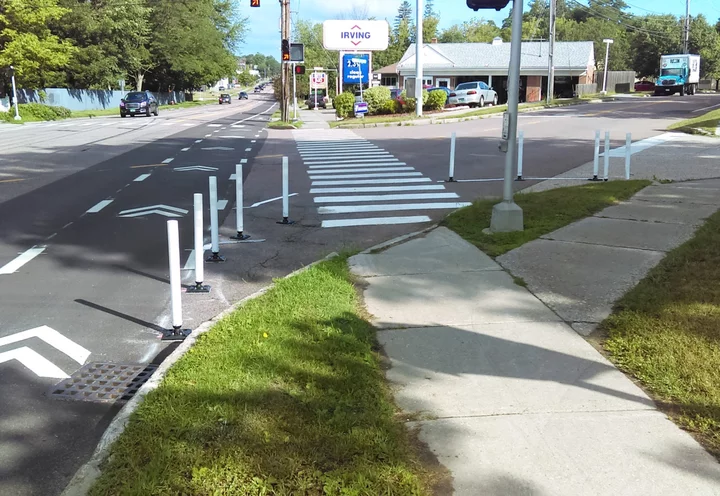
A temporary curb extension pop-up looks something like this. Photo: Caltrans.
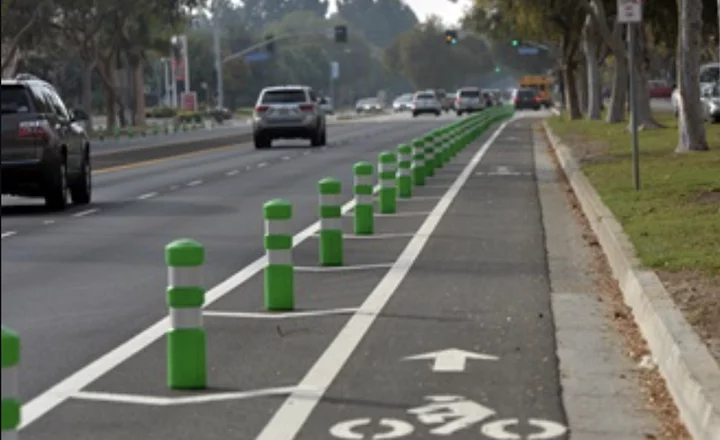
This is a temporary bike lane. Photo: Caltrans, again.
Here’s a longer description of the pop-ups they’re proposing for Broadway, which is taken from broadwaypopups.com, which is itself actually just a convenient link to a Caltrans subsite:
Broadway Pop-Up Demonstrations will include the following features:
- A temporary Class IV bikeway between Hawthorne and Wabash. Class IV bikeways have a vertical element between the vehicle lane and the bike lane. This design is intended to make bicyclists more visible and comfortable and potentially reduce collisions.
- Temporary curb extensions between Papa & Barkley and 6th Street. Curb extensions—also known as bulbouts—are extensions of the sidewalk into the parking lane or shoulder at intersections. They help make pedestrians waiting to cross the street more visible to drivers. They also slow vehicles making turns. The demonstrations will not be adjusting any curbs or sidewalks. Delineators or posts will be placed where curbs may be constructed in the future. Curb extensions are not intended to prohibit any turning movements, and drivers will be able to make their regular turns at locations with temporary curb extensions during the demonstration period. Pedestrians should still stop at the curb and wait until it is safe to cross before stepping into the test curb extension area.
- The closing of acceleration and deceleration lanes at Papa & Barkley, Pierson’s, and the Bayshore Mall intersections. Acceleration lanes provide space for turning drivers to speed up before merging into traffic, and deceleration lanes provide space for drivers to slow down without slowing through-traffic before making turns. All of these locations are signalized, which stops cross traffic and allows drivers to make turns onto Broadway without needing to merge into traffic. In the proposed permanent project, the spaces used for acceleration and deceleration lanes will be reallocated to transit stops, bicycle facilities, and/or pedestrian use. The demonstration will temporarily use delineators to close or modify these acceleration and deceleration lanes.
- The relocation of the southbound bus stop from McCullens Avenue to the Bayshore Mall entrance in front of McDonald’s. This will give transit riders and bus operators an opportunity to provide feedback on how well the new stop location works for them. Signage will be placed to alert riders of the temporary location, and riders will still be able to board or arrive at McCullens if necessary.
- Closing the median or center turn lanes near Papa & Barkley, near Hilfiker, between Highland and Truesdale, near KFC, and near Broadway Cinema. The demonstrations will temporarily use delineators to close the two-way left-turn lane at locations of proposed pedestrian crossings to understand impacts to drivers including emergency responders. The demonstrations WILL NOT include any marked crosswalks, pedestrian refuges, or other pedestrian crossing enhancements.
These features are being evaluated in a temporary condition to inform project designs and implement the vision laid out in the Broadway Multimodal Corridor Plan.
Humboldt County’s Latest Count of Homeless Residents, the First in Three Years, Shows Modest Decrease
LoCO Staff / Tuesday, June 21, 2022 @ 2:07 p.m. / Homelessness
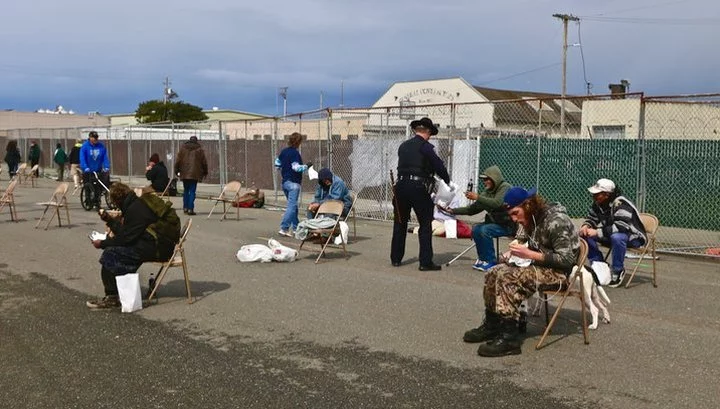
St. Vincent De Paul free meal in Eureka | File photo
###
Press release from Humboldt County:
Approximately 1,309 unsheltered people were counted in Humboldt County during the January 2022 Point-in-Time (PIT) count. This number is down from the 1,402 who were counted in 2019, the last time the count took place. An additional 347 sheltered people were also counted. [Note: 300 sheltered people were counted in the 2019 count. -RB]
Nearly 160 volunteers signed up to assist with this year’s count that showed the largest number of unsheltered people living in the greater Eureka area, followed by the greater Arcata area. The third largest count came from the southern part of the county, followed by the eastern part of the county, then the greater Fortuna area and finally the northern coastal portion of the county spanning McKinleyville to Orick.
The PIT biennial count takes place in communities across the U.S. on a single night during the last 10 days of January, as required by the U.S. Department of Housing and Urban Development (HUD). Numbers from the count are used by the state of California to allocate funding to counties to address homelessness and housing. The count was canceled in 2021 due to the COVID-19 pandemic.
Humboldt County Department of Health & Human Services Housing and Assistance Coordinator Robert Ward said, “The California legislature continues to base homelessness funding formulas on the number of people experiencing homelessness in each county as identified in the PIT data. This count is a critical source of data on the number and characteristics of people who are experiencing homelessness in Humboldt County. The data we collected will help local, state and federal policy makers understand the nature and extent of homelessness in our community.”
For the unsheltered portion of the PIT, volunteers count people who fall under the HUD definition: An individual or family with a primary nighttime residence that is a public or private place not designed for or ordinarily used as a regular sleeping accommodation for human beings, including a car, park, abandoned building, bus or train station, airport or campground. HUD defines people in the sheltered count as individuals or families living in a supervised publicly or privately operated shelter designated to provide temporary living arrangements (including congregate shelters, transitional housing and hotels and motels paid for by charitable organizations or by federal, state or local government programs for low-income individuals).
Conducted by the Humboldt Housing and Homeless Coalition (HHHC), the count documents the number of sheltered and unsheltered homeless people in the community. The draft numbers have been submitted to HUD and are expected to be finalized by the end of the year. For more information about the HHHC, visit www.humboldtgov.org/hhhc.
Eureka 498 McKinleyville/Blue Lake 32 Arcata/Samoa 356 Ferndale/Fortuna/Table Bluff 64 Garberville 52 Hoopa 76 Miranda/Myers Flat/Phillipsville 38 Orick 7 Petrolia 10 Redway 151 Rio Dell/Scotia 10 Trinidad 12 Willow Creek 3 Total 1,309 For more details about the PIT count, click on the summary here.
NPR’s ‘Planet Money’ Comes to the Redwoods, Asks, ‘What the Heck Happened to Orick?’
Ryan Burns / Tuesday, June 21, 2022 @ 12:02 p.m. / Economy , History , Media

The Orick Inn, 1914. | Public Domain.
###
Orick has seen better days. That much is obvious to anyone who’s been through the former lumber town in the past, oh, four decades or so. That includes Greg Rosalsky, a reporter with “Planet Money,” National Public Radio’s economy podcast/blog.
He and his partner recently came north to visit Redwood National and State Parks to enjoy the “stunning lagoons, rivers, and beaches, eye-popping hiking and biking trails, a rich array of wildlife, and some of the oldest and tallest trees on the planet.”
Rave reviews on that front. For example, Rosalsky correctly identified the hike through Fern Canyon to Gold Bluffs Beach as “one of the best hikes on the West Coast.” He also recalls coming “face to face with a gang of Roosevelt elk.” (I think they prefer “herd.”)
As for the little unincorporated community at the gateway to the gorgeous park system? Well, here’s his take:
It’s a town called Orick. Driving through the town on Highway 101 to get to the park, you pass boarded-up motels, ramshackle houses, rusted-out cars, and properties that look like junkyards. Parts of Orick look like the setting for a zombie movie.
Brutal but true. The post goes on to recount the rise-and-long-fall history of the town, from its post-WWII heyday, fueled by America’s “insatiable demand for redwood lumber,” through its gradual economic decline, which has continued despite the proximity of the national park, created in 1968.
What caused the timber industry’s decline? Why doesn’t the park attract more tourists? And why hasn’t there been more investment in Orick’s infrastructure and upkeep? [See the addendum below.] Rosalsky looks into all of these questions. This edition of the Planet Money newsletter is well worth a read [link], and it ends with a promise of more to come: a story in next week’s edition
about a black market that threatens Redwood trees and has led rangers to bring down the strong arm of the national park, even obtaining search warrants and knocking down Orick doors with AR-15s. The strange underground economy of tree poaching — that’s next week in the Planet Money newsletter.
Count us in. For now, though, we direct those of you who’ve never seen it to enjoy this short version of the truly excellent documentary Orick, CA, U.S.A. Filmed by Jensen Rufe and Steve Love more than two decades ago, the footage shows a town that was already down on its luck but had no shortage of local flavor.
###
ADDENDUM: Turns out there IS some more investment money coming to the parks. Earlier this year, the California Coastal Conservancy approved nearly $7.4 million for disbursement to the Yurok Tribe, Caltrout, Inc. and Save the Redwoods League as part of the Redwood National and State Park Visitor Center and Restoration Project. (H/t @jen_savage.)
California’s Next Cannabis Battle May Be Coming to a City Near You
Alexei Koseff / Tuesday, June 21, 2022 @ 7 a.m. / Sacramento
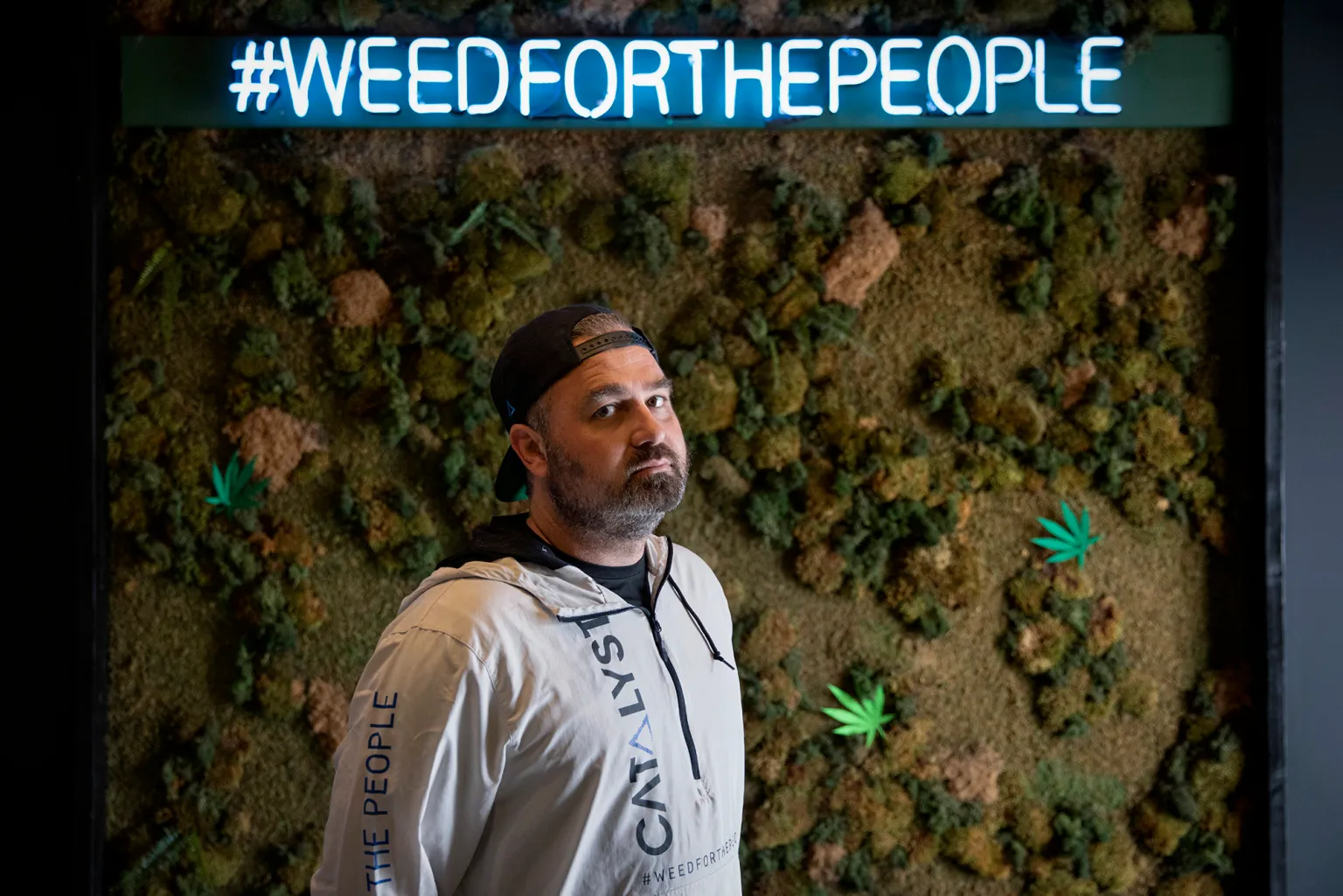
Elliot Lewis, CEO of Catalyst Cannabis Co., at one of its dispensary locations in Long Beach on May 27, 2022. Lewis is leading the charge for voters to overrule local officials who oppose retail sales of cannabis. Photo by Alisha Jucevic for CalMatters
Working regular overnight shifts has distorted Samantha Kadera’s sleep schedule, so the emergency room doctor smokes cannabis a few times a week to relax before bed.
It’s a common habit among the young parents that Kadera knows in Manhattan Beach, the upscale Los Angeles suburb where she moved last year to raise her two elementary school-aged children in a more family-friendly environment.
But there are no dispensaries in the city; officials banned them five years ago after voters legalized recreational cannabis in California, concerned about attracting criminal activity and advertising aimed at minors. So Kadera stops at a store on her way to and from the Westside L.A. hospital where she works.
Changes loom if Manhattan Beach residents approve an initiative this fall to allow as many as two licensed cannabis businesses. It has triggered an increasingly acrimonious battle between a local entrepreneur eager to gain a foothold in a fresh market and city leaders determined to protect what they see as the character of their community.
“They do like to keep us in a bubble,” Kadera, 40, said one evening as she strolled with her dog along the Strand, a beachside path lined with multimillion-dollar homes. “But the reality is, there’s widespread use, so it would be nice to have it around here.”
Rapidly shifting attitudes — and a nascent legal industry still struggling to stabilize itself — have thrust cannabis back onto ballots across the state, six years after voters approved Proposition 64 to authorize Californians who are at least 21 years old to buy, grow and use it for recreational purposes.
A provision in that 2016 measure gave local governments discretion to ban cannabis businesses — and the vast majority of them did. More than 60% of cities and counties do not allow retail sales, according to the state, and while most of California’s most populous places do permit dispensaries, there are strict limits in many of them.
Desperate to expand where they can operate and to compete with a still-dominant illicit market, many in the cannabis industry have pushed state leaders to override Prop. 64 and open the entirety of California to retail sales.
But it’s a nonstarter at the state Capitol, where local control generally rules the day. A bill this session that would have only required local governments to permit medical cannabis businesses was quickly scaled back to a guarantee for patient access to delivery options.
So frustrated cannabis users and companies are turning their attention to the local level, launching municipal campaigns to pry open the holdouts, one at a time.
‘Voters have lost their patience’
Hirsh Jain, founder of the cannabis consulting firm Ananda Strategy, has tracked about two dozen cities over the past year — from Red Bluff to Sausalito to Santee — where citizen initiative drives are qualifying for the ballot or pressuring local officials to develop their own ordinances to regulate and tax cannabis sales.
“The ballot initiative is a way to get the elected officials to stare reality in the face that their citizens want this,” Jain said, pointing to a fall 2019 poll from the UC Berkeley Institute of Governmental Studies that found public support for legal cannabis had only increased since Prop. 64. Nearly two-thirds of respondents favored allowing commercial dispensaries in their communities.
“Voters have lost their patience,” he said. “They might be willing to cut their elected officials some slack, but after a while, they’re going to take matters into their own hands.”
Enter Elliot Lewis, a self-described “motherf — ing hustler to the core” and the founder of Catalyst Cannabis Co., which operates 11 dispensaries, mainly in Southern California. He and fellow executives at the company are aggressively pursuing a strategy to force their way into cities that continue to ban retail cannabis sales.
They have funded initiatives to require dispensary licenses in Manhattan Beach and three of its neighbors in the South Bay — Redondo Beach, Hermosa Beach and El Segundo — which each represent a crown jewel of the untapped legal cannabis market: wealthy and touristy, with a voter base that firmly backed Prop. 64. Voters in all four cities will get a chance to weigh in on permitting cannabis sales in either November or next March.
In his profane and zealous style — alternately hilarious and intimidating — Lewis defends his approach as more than a business venture. It is a political statement, a frontal assault on the principle of local control that he believes the “Karens and Chadwick Moneybags” who run city governments worship with Biblical reverence, often flouting the will of their own constituents.
“You’re talking about cocktail-party-donor people. I don’t think they understand where the zeitgeist of the younger generation is,” Lewis said. “You’ve metaphorically got to take a gun to their head, because that’s just how they operate.”
‘It doesn’t fit with our community’
The rising tension over the future of cannabis access in California is perhaps best captured by Manhattan Beach, a surfing hotspot of 35,000 residents, most famous for its iconic concrete pier.
Though 62% of the city’s voters supported Prop. 64, officials remain skeptical about cannabis dispensaries. City council members say there has been no groundswell of demand for retail sales among their constituents, including some who complain about being duped and coerced into signing the initiative petitions.
“It’s about money. There’s a lot of money in the South Bay and the dispensary owners know this,” Mayor Steve Napolitano told CalMatters in an email. “So why have pot shops that residents don’t need or want, just to enrich a few owners?”
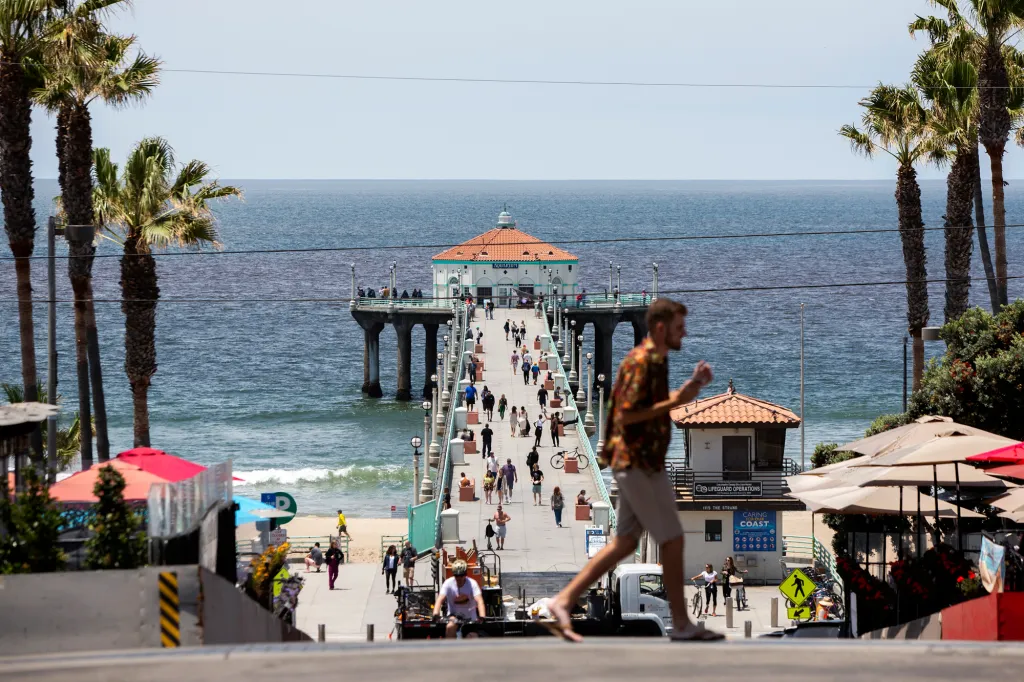
People make their way along the Manhattan Beach Pier in Manhattan Beach on May 27, 2022. Photo by Alisha Jucevic for CalMatters.
To fight the initiative, the council directed city staff last month to develop competing measures for the November ballot that would uphold the ban on dispensaries and establish regulations, including a 25% sales tax, to make opening a dispensary prohibitively expensive.
“It doesn’t fit with our community. It certainly doesn’t fit with the development of our community,” said Hildy Stern, a Manhattan Beach councilmember who served as mayor this spring while the city debated how to respond to the initiative.
Stern, a mother of four who said she could not remember how she voted on Prop. 64, called it “distressing” that retail cannabis sales might be imposed by outsiders whose values do not fit with Manhattan Beach’s “small-town, family-oriented nature.” The city banned public smoking and tobacco sales in recent years — rare steps even for liberal California — to reduce beach pollution and vaping by students.
“I do not feel that the retail sale of cannabis in Manhattan Beach is appropriate,” Stern said. “I really am concerned about how access increases normalization to our youth.”
‘It cheapens a high-end beach town’
That sentiment has framed the public debate in Manhattan Beach, which prides itself on its top-performing schools.
Loading up her car with groceries outside the Vons downtown, Amy McAvin, 51, a bookkeeper who has lived in the city her whole life, said she worries about cannabis becoming even easier for kids to get.
A mother of two teenagers, McAvin assumed her children would use cannabis, so she encouraged them to develop safe habits, such as only smoking in social situations and not driving afterwards. She said she smoked herself when she was younger and voted for Prop. 64, but “I just don’t really condone it.”
“I’m not going to be out there picketing” if the initiative passes, she said. “We could just put other things in place of a dispensary.”
The litany of objections around town is long: The community is too residential. Dispensaries would attract undesirable visitors. It would be hypocritical to allow cannabis sales after banning tobacco. Those who want cannabis can already easily get it by delivery or driving to a nearby city.
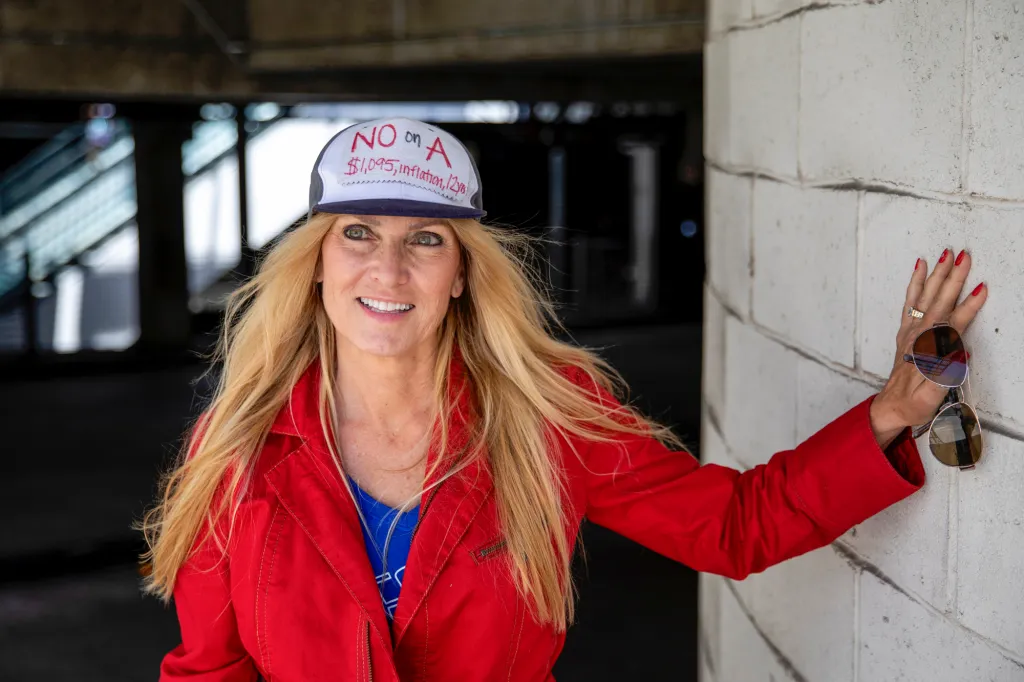
Manhattan Beach resident Charlene Harding, who said she opposes cannabis shops because they don’t fit the vibe of Manhattan Beach, is pictured on May 27, 2022. Photo by Alisha Jucevic for CalMatters
“It cheapens a high-end beach town,” said Charlene Harding, 59, a retired government worker who moved to Manhattan Beach two decades ago. Though she has “never even puffed,” she said she did not care if others smoked — within reason: “I hate when I go to the beach and it smells like skunk.”
The opposition is far from universal, however, despite what city officials say they have heard.
David Sulaski, 54, a retired investment banker who has lived in Manhattan Beach for six years, said the city was full of “fun-loving people” who would embrace dispensaries.
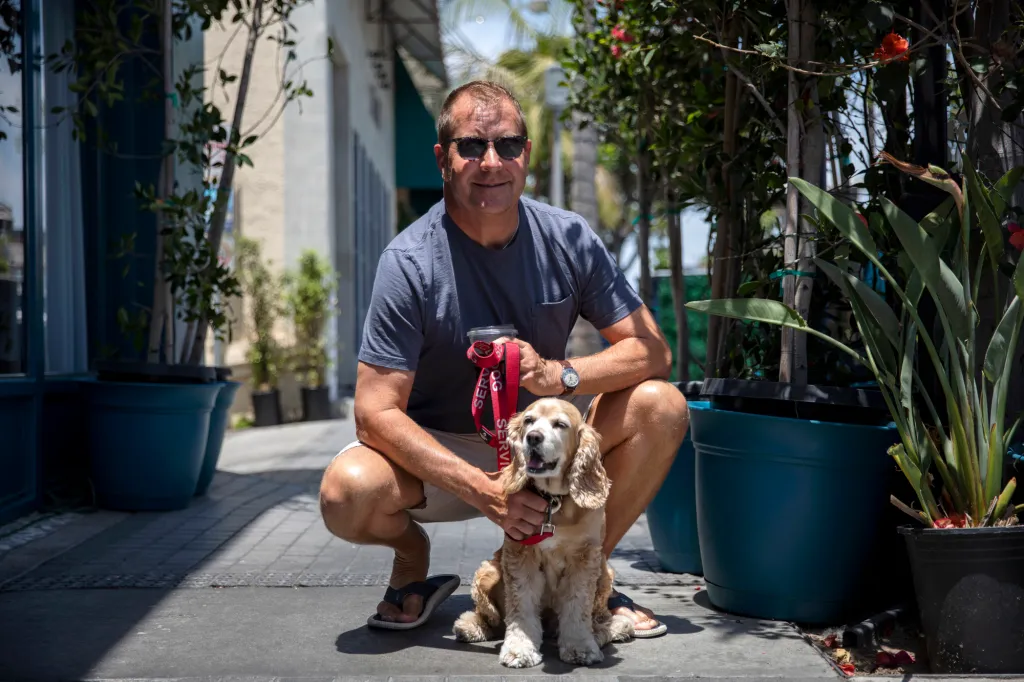
Manhattan Beach resident David Sulaski, who supports cannabis shops opening, is pictured with his dog Stella in Manhattan Beach on May 27, 2022. Photo by Alisha Jucevic for CalMatters
“This is a community that likes to have a good time,” he said as he walked his dog down Manhattan Avenue in the city’s commercial center. “I don’t know why we make decisions that fly in the face of those things.”
Sulaski, who uses cannabis “every day that I can” and gets it delivered, said it was silly to make people go elsewhere to buy cannabis when Manhattan Beach could benefit from the tax revenue.
“We don’t expect our freedoms to be restricted in California. We could live in a red state for that,” he said. “Just give people what they want.”
‘Weed doesn’t change that’
Tax revenue may be the most compelling reason for cities to finally allow retail sales. Officials in Redondo Beach estimate that each license could generate as much as $1 million per year for the city.
State regulations also require testing cannabis products to ensure they are free of contaminants before they can be sold in licensed dispensaries, a safeguard that does not exist on the illicit market.
Derek Glunts, who grew up in Manhattan Beach, began smoking in high school and bought cannabis that he said was cut with chemicals at an illegal dispensary that presented itself as a church.
“Every single product they sold there was fake. They would turn black within a week and genuinely our lungs would hurt afterwards.” Glunts said. “I had a friend who was coughing up brown stuff from his lungs repeatedly for weeks and weeks after smoking some of the stuff he bought.”
The 21-year-old student was recruited last year to serve as the proponent for the Manhattan Beach initiative by a childhood friend, who had already signed on as a proponent for the petition in Redondo Beach. Both were longtime customers at Catalyst Cannabis.

Derek Glunts, a petitioner on the initiative to allow legal cannabis sales in Manhattan Beach, is pictured on May 27, 2022. Photo by Alisha Jucevic for CalMatters.
Glunts, who has a medical cannabis prescription to treat anxiety and depression, said he enjoys smoking because “it takes the edge off things” and connects him to a community, though he has been taking a break in recent months to focus on his mental health.
Not even old enough to vote when Prop. 64 was on the ballot, Glunts said he was proud to be starting a conversation around cannabis use in a community that has long acted as though it wasn’t happening there. His family is in full support, he said, and the response has been overwhelmingly positive, aside from elitist and traditional residents who worry about riffraff coming to Manhattan Beach just to buy cannabis.
“The biggest battle is just getting over that stigma, that image,” he said. “Weed doesn’t change that. It’s not like weed’s going to come in to Manhattan Beach and all of a sudden, the schools are going to start performing poorly, people are going to move away, we’re going to have a bunch of bachelors move in. That’s not the reality.”
‘They’ve had six years to figure this out’
The Catalyst Cannabis team’s strategy was to target places where support for Prop. 64 was high and “city councils were just dithering and failing to act,” Lewis said.
Splitting the approximately $300,000 cost with another cannabis brand, Tradecraft Farms, they circulated petitions last year to overturn the bans on retail sales in the four beach cities. Once they collected signatures from at least 10% of registered voters, officials could either adopt the ordinances as written or put them to the ballot.
Their model was El Monte, a city in the San Gabriel Valley where the team first tested this blueprint three years ago. After presenting the city with enough signatures, the council ratified the ordinance, rather than hold an election, because the voters had already affirmed their support for legal cannabis with Prop. 64. The first dispensary, operated by Catalyst, opened last October.
None of the cities in the South Bay followed suit, however. The firm resistance caught Lewis by surprise, and he said he regrets not engaging with local officials to try to get them on board before launching the initiatives. He acknowledges that the sneak attack may have undercut any opportunity to reach a compromise and avert an election fight, though he also believes “incompetent” council members are using his approach as an excuse for their underlying opposition to cannabis.
“It just hits them in a way that they’re not used to. But I am who I am,” he said. “They’ve had six years to figure this out.”
While Manhattan Beach plots to uphold its ban on retail cannabis sales, its neighbors have not gone quite as far in their opposition. Hermosa Beach and El Segundo, which are set to vote in November on allowing two storefronts each, are considering adding competing measures to the ballot that would allow dispensaries under more restrictive rules.
Redondo Beach, the biggest of the beach cities and the most valuable potential prize among them, has signaled the most openness to the commercial cannabis market.
Before banning retail sales in 2017, the city council deliberated allowing dispensaries, and it established a steering committee to continue exploring that option. The local mall, the South Bay Galleria, has been particularly enthusiastic about serving as a potential site as it struggles to recover from losing its anchor department store.

Different varieties of cannabis flower are on display at one of the Catalyst Cannabis Co. dispensary locations in Long Beach on May 27, 2022. Photo by Alisha Jucevic for CalMatters.
Those discussions, however, languished for years, which the Catalyst team cited as an impetus for taking the issue to voters. Redondo Beach Mayor Bill Brand, who has used cannabis to treat the nausea from chemotherapy for lung cancer, said the city always planned to repeal the sales ban, but it was not a priority, especially during the coronavirus pandemic.
“I haven’t had people in the community beating down on our door to do anything,” he said. “We tend to focus on things the community’s concerned about.”
‘Slash-and-burn strategy’
The qualification of Catalyst’s initiative, which would allow as many as three dispensaries in Redondo Beach, has made it unavoidable.
City council members punted the measure to the March 2023 ballot, giving them more time to finish developing their own ordinance based on recommendations from the steering committee. That more restrictive framework — which would only allow two retailers, impose a 5% sales tax and establish a 1,500-foot buffer zone around schools — is on track for approval as soon as August.
Councilmember Zein Obagi Jr. said the city wanted to strike a “reasonable” balance that would better accommodate feedback from residents, many of whom he said do not oppose cannabis but are wary of a dispensary opening near where they live or their children walk to school. Like other local officials in the South Bay, he vehemently opposes the proposal from the Catalyst team, which he calls a “slash-and-burn strategy” to create a commercial cannabis monopoly.
“They framed this initiative to virtually give themselves a license,” Obagi said. “This didn’t sit right with any of us.”
These accusations set Lewis off. He repeatedly denies that he is trying to establish a monopoly — yet he admits there are criteria written into the initiatives that would benefit Catalyst when applying for a dispensary license. The system cities would use to evaluate applicants, for example, awards points for being a union operator, which Catalyst is. The company already leases properties in Manhattan Beach and El Segundo that fall within the eligible areas for cannabis businesses.
“We’d be stupid if we didn’t try to take a little bit of an advantage,” Lewis said. “But those self-serving things are very, very mildly self-serving.”
Now, tensions between Catalyst and the beach cities are only deepening — Lewis is circulating a petition to recall Obagi, whom he calls “fake” and a “douchebag” — and it seems increasingly likely that they are headed to a campaign showdown. That means spending more money on a political fight that Catalyst and its allies cannot use to build out their businesses.
Still, it may be worthwhile for Lewis, who said he could probably pay off what he’s invested in the initiatives with just one new store in the South Bay, though he worries that the city officials will scheme to block his applications for a license.
“They’ll make sure I lose,” he predicted. “On a good day, if I get one or two, I’ll be f — ing happy.”
And despite the bad blood his approach has generated, Lewis is ready to try again, perhaps with some slight modifications. He said he’s considering targeting as many as 10 more cities across California over the next year.
“If the initiative is bad, step the f — out of the way,” he warned. “It’s called democracy. Let the voters decide.”
###
CalMatters.org is a nonprofit, nonpartisan media venture explaining California policies and politics.
OBITUARY: Leslie Susan Alto, 1949-2022
LoCO Staff / Tuesday, June 21, 2022 @ 6:56 a.m. / Obits
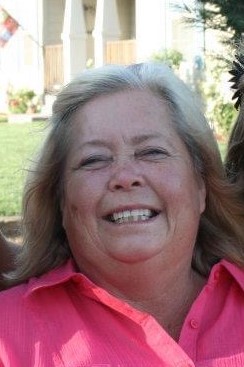
Leslie Susan Alto — better known as Susan, Sue, Mom or Grandma Sue — was born May 3, 1949 and passed away on June 10, 2022 at the age of 73. She was born to Marlyn and Art Moxon and resided in the Arcata Bottoms for most of her life. Growing up she was involved in 4-H and dance, was the star of the Arcata High School Flower Drum Song musical, and enjoyed competing in gymkhana events.
She met her husband, Larry Alto of Eureka during school and were married in June 1966. They soon welcomed their four children into the world, and while Larry drove truck for Alto Bros Trucking, Sue spent the next years of her life raising children and running the barn. Whether it was filled with horses, Hereford cattle, or 4-H and FFA projects (both her children and grandchildren’s), she was a county fair fixture, known affectionately by all as Grandma Sue. As lifelong Hereford breeders, Larry and Susan devoted much of their lives to Alto Herefords; showing and selling cattle at the local, state, and national levels while earning many accolades along the way including the CNHA Hereford Breeder award in 2009. Her passion for Hereford cattle is instilled in her family and will be for generations to come; however, her greatest joy in life came from spending time with her grandchildren and great-grandchildren.
Sue Alto was the bravest and strongest woman to ever grace her family. She put others first and never hesitated to volunteer or offer a helping hand.
Sue is preceded in death by her parents Art and Marlyn Moxon of Arcata. She is survived by her husband Larry of 56 years; her four children, daughter Lisa Dias of Eureka; son Kevin (Sara) Alto of McKinleyville; daughter Carrie (Barry) Morrell of Willows; and son Rusty Alto of Klamath Falls; her siblings, Diane (Marc) Lafleur of Dow’s Prairie; June (Ken) Moxon of Arcata; and Jack (Donna) Moxon of Arcata; her brother-in-law’s, Gary Alto and Jerry (Lola) Alto; her grandchildren Amber (Rafael) Lopez, Sadie Mullins, Chelsea (Kolby) Jackson, Rachel Dias, Bailey Morrell, Hannah Alto, Logan Alto, and Connor Alto; great-grandchildren, Hayden, Cinch, Parker, Bentley, and Leslie Mae; and numerous nieces and nephews. She leaves behind a blonde-haired, blue-eyed legacy for years to come.
A Celebration of Life and luncheon will be held at Azalea Hall, 1620 Pickett Road, McKinleyville from 1 p.m. to 4 p.m., Saturday, July 2, 2022. Family and friends are asked to please bring a dessert to share.
###
The obituary above was submitted by Leslie Alto’s loved ones. The Lost Coast Outpost runs obituaries of Humboldt County residents at no charge. See guidelines here. Email news@lostcoastoutpost.com.
OBITUARY: Linda Griswold Pavlich, 1940-2022
LoCO Staff / Tuesday, June 21, 2022 @ 6:56 a.m. / Obits

Linda
Griswold Pavlich passed away on June 14, 2022, with her son at her
side. Linda was born on December 17, 1940, in Corvallis, Oregon to
William and Helen Griswold. The family moved to Drain, Oregon in
1941, and then in 1956 moved to Bend, Oregon, where Linda graduated
from Bend Sr. High. After attending Oregon State College (now
University) she went to work for US Bank head office in Portland,
Oregon. She worked at several branches throughout Oregon, retiring
after 35 years from the 29th & Willamette branch in
Eugene. She was blessed with a son, Shawn Johnson (Eugene, Oregon)
and in 1990, she met and later married Roman Pavlich, whom she called
her Prince, of Eureka.
Her son and husband survive her. She is also survived by stepdaughters Megan Magness, Julie Townsend (Bob), step-granddaughter, Ashley Townsend Powell (Noah), step-great-grandson, Atticus (Springfield, Miss.), and her sister, Mary Scott (Eureka). She was predeceased by her stepson Michael Pavlich and her precious labs, Molly, Raven and tabby cat, Sam.
She enjoyed sewing, making quilts for family and friends, making preemie quilts for St. Joseph’s Hospital, gardening and tagging along with her husband for outdoor adventures.
At Linda’s request there will be no service. Please be an organ donor and hug your husband, children, pets, and friends.
###
The obituary above was submitted by Linda Pavlich’s loved ones. The Lost Coast Outpost runs obituaries of Humboldt County residents at no charge. See guidelines here. Email news@lostcoastoutpost.com.


