Law enforcement is still seeking the DTO’s alleged leader, Alejandro Luna
Since the summer of 2021 the Humboldt County Drug Task Force (HCDTF) has been investigating a large drug trafficking organization (DTO) led by Alejandro Ramirez Luna (52 years old from Eureka). During the investigation agents were able to identify multiple houses in Eureka that Luna was using to hide large quantities of methamphetamine.
On December 12th, 2021 agents conducted surveillance on an associate of Luna’s as he drove Luna’s truck to the Central Valley to pick up more methamphetamine. Agents authored a search warrant for the vehicle and all residences and co-conspirators involved in the Luna DTO. The warrant was signed by a Humboldt County Superior Court Judge.
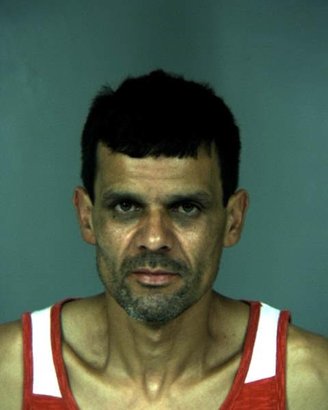
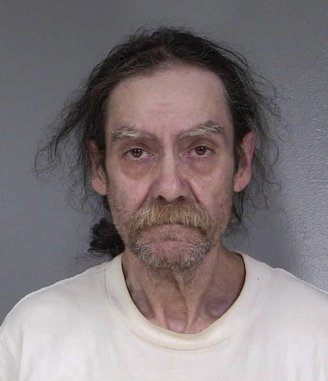
Marte Espitia
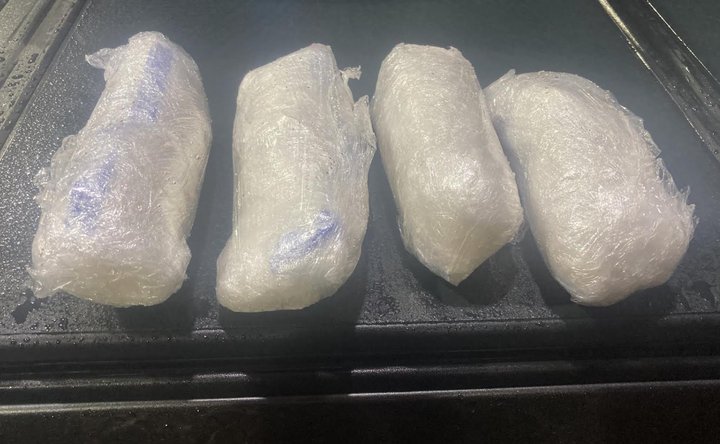
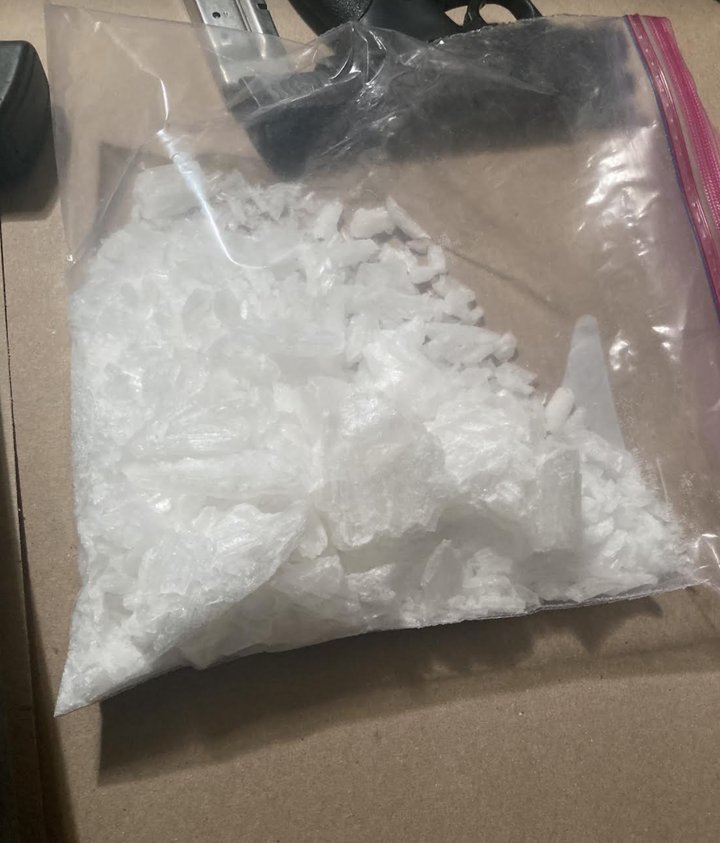
On December 13, 2021, at approx. 1:15am agents followed the truck back into Humboldt County. A Humboldt County Sheriff’s Deputy made a traffic stop on the vehicle on Highway 101 in Cook’s Valley. Agents detained the driver, Marte Omar Espitia (58 years old from Eureka). K-9 Bodhi from the HCDTF conducted a search of the truck and alerted to a Shop-Vac machine. Agents found a hidden compartment in the bottom of the Shop-Vac that contained 4 pounds of methamphetamine.
Espitia was transported to the Humboldt County Jail where he was booked for the following charges:
11379(b) H&S Transportation of controlled substances across non-contiguous counties
11378 H&S Possession of methamphetamine for sale
182 PC Conspiracy to distribute methamphetamine
Four pounds of alleged meth
HCDTF agents assisted by the Eureka Police Department (EPD) and Humboldt County Sheriff’s Office (HCSO) followed up the arrest by serving three search warrants. Agents served the first search warrant at Luna’s residence in the 1300 block of 9th St. in Eureka. Luna was not home at the time of the search warrant. Agents located small quantities of methamphetamine inside of Luna’s residence.
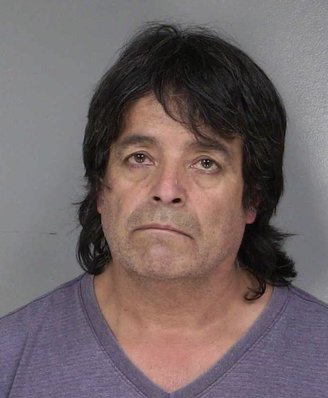
Stephen Egan
The next search warrant was served in the 200 block of 14th St. in Eureka. At this residence agents located approx. 3 ounces of methamphetamine along with two loaded handguns. Agents arrested Stephan Paul Egan (63 years old) for the following charges. Egan was booked at the Humboldt County Jail:
11370.1 H&S Possession of controlled substances while armed
11378 H&S Possession of methamphetamine for sale
11366 H&S Operating or maintaining a drug house
182 PC Conspiracy to distribute methamphetamine
William Tindle
The third search warrant was served at a residence in the 2200 block of G St. in Eureka. At this location agents detained William Joseph Tindle (58 years old). Agents conducted a search of Tindle’s residence where they located approx. two pounds of methamphetamine and 7 firearms.
Tindle was transported to the Humboldt County Jail where he was booked for the following charges:
11366 H&S Operating or maintaining a drug house
11378 H&S Possession of methamphetamine for sale
182 PC Conspiracy to distribute methamphetamine
11370.1 H&S Possession of controlled substances while armed
In total agents seized approx. 6 pounds of methamphetamine and 9 firearms from this DTO.
Agents are looking for Alejandro Ramirez Luna and ask that if anybody has information as to his location that they contact the HCDTF.
Anyone with information related to this investigation or other narcotics related crimes are encouraged to call the Humboldt County Drug Task Force at 707-267-9976.
Do you know the meaning of “gingerbread,” as it relates to Ferndale? Have that term defined for you and absorb more li’l tidbits about the Cream City in this adorable edition of “Bartell’s Backroads,” a regular segment produced by ABC10-TV out of Sacramento which features its star, John Bartell, seeking out rural California weirdness. Enjoy.
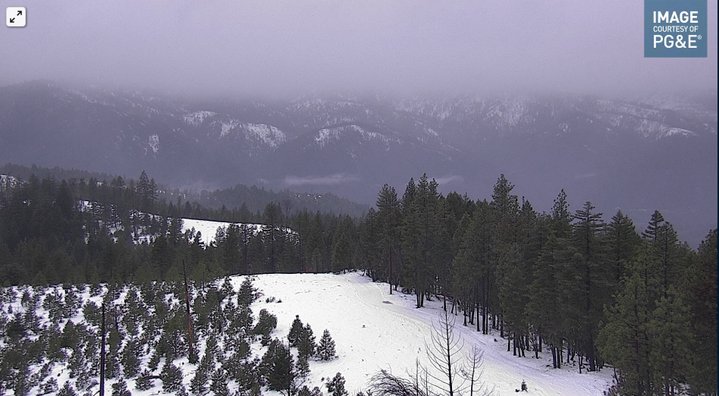
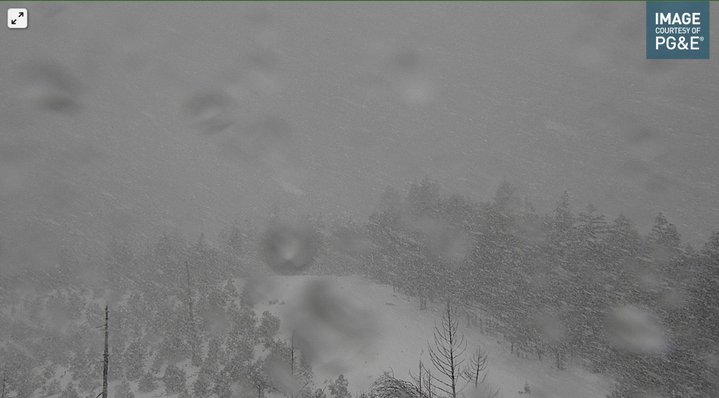
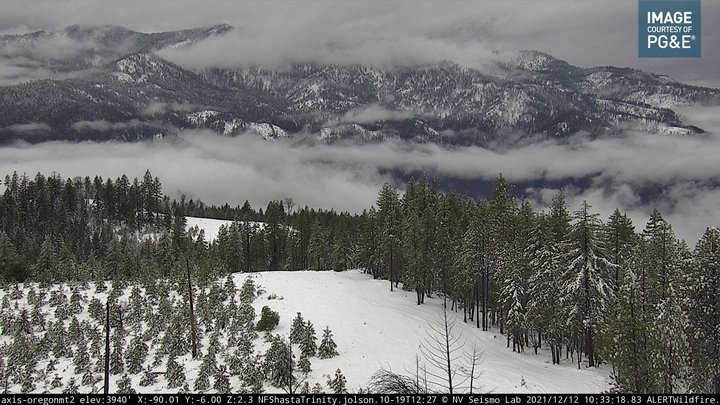
Oregon Mountain in Trinity County this morning. | AlertWildfire
A Winter Storm Warning is in effect for the North Coast today until 10 p.m.
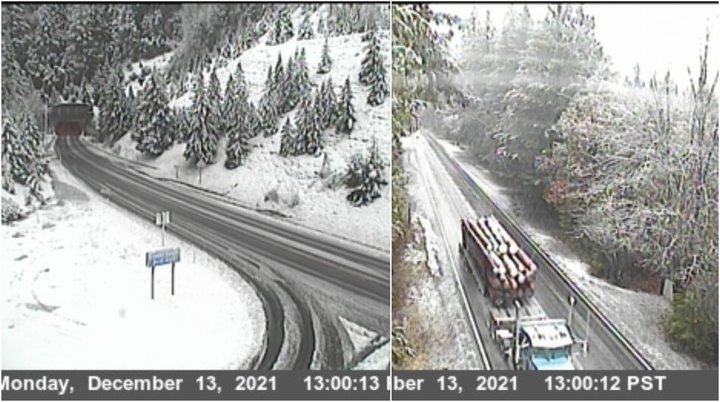
Eureka’s National Weather Service office forecasts heavy snow for areas above 1,500 feet in elevation, making for hazardous driving conditions along stretches of Highway 299 and 199. Six to 12 inches of snowfall will be possible at Berry Summit and the Collier Tunnel Rest Area.
Latest images of the Collier Tunnel (left) and Highway 199 at the Oregon border (right).| Caltrans
“Travel could be very difficult along Highway 299 near Berry Summit and on Highway 199 at the Collier Tunnel, with slippery, snow-covered road conditions and poor visibility,” the NWS stated. “Some high elevation rural roadways may become impassable.”
As of this afternoon, the Humboldt County Roads Department has issued chain controls for Horse Mountain.
All schools within the Klamath-Trinity Joint Unified School District have been dismissed early today due to the weather. School athletics have been canceled.
Current conditions at Oregon Mountain. | AlertWildfire
Heavy mountain snow will also be possible along the highest elevations of Highway 36 and Highway 3 in Trinity County. Snow levels are forecast to drop below 2,000 feet in Humboldt and Del Norte Counties this afternoon. Minor amounts of snow will be possible at elevations as low as 1,000 feet by tomorrow morning.
Accumulated snow totals are expected to see a substantial increase by Wednesday, especially in high-elevation areas of Trinity County. Snowpack in the Trinity Alps could be 4 feet deep by Wednesday night.
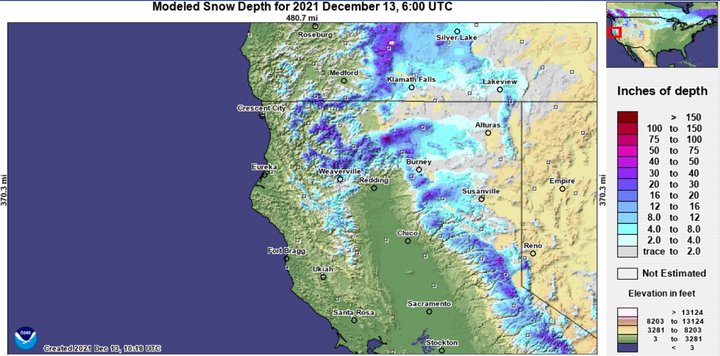
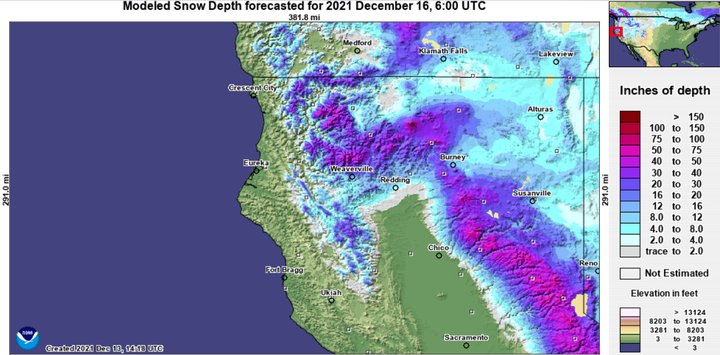
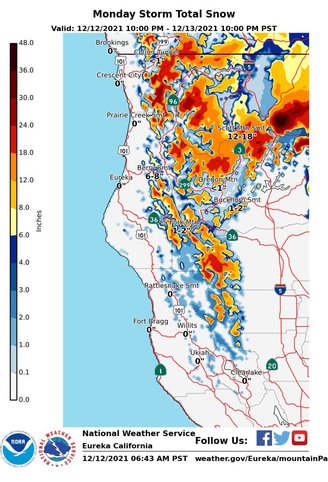
Modeled snow depth for today and Thursday. | Graphics provided by the NWS.
In addition to the snow, 18 to 21-foot waves will be possible along the North Coast today.
“Large, unexpected waves can sweep across the beach without warning, sweeping people into the sea from rocks, jetties, and beaches,” the NWS stated. “These waves can also move large objects such as logs, crushing anyone caught underneath.”
The NWS is urging beachgoers to keep a safe distance from the ocean today.
“Don’t be fooled by an ocean that looks calm,” the NWS said. “There can be 30 minutes of small waves before a sneaker wave strikes. Avoid rocks and jetties. Avoid steep beaches. Stay much farther back from the water and never turn your back on the ocean.”
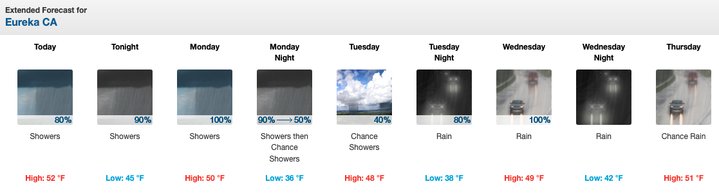
Rain and thunderstorms will continue to be possible throughout the day for greater the Humboldt Bay Area. These storms may also produce small hail. The chance of thunderstorms will diminish by 10 p.m.
Rain is in the forecast until Friday, which is expected to be mostly sunny with a high of 51 degrees.
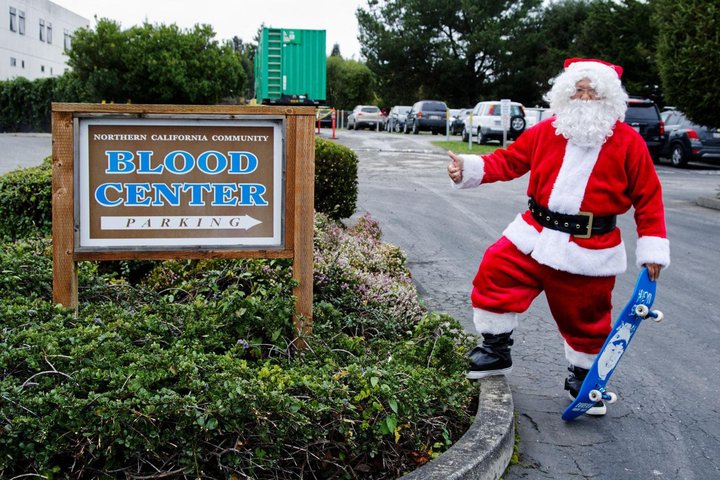
Could you spare a pint, Humboldt? The Eureka Police Department and the North Coast Community Blood Bank are again teaming up for their annual Holiday Blood Drive which is taking place between 8 a.m. and 7 p.m. this Wednesday, Dec. 15 at the blood bank at 2524 Harrison Ave. in Eureka. Michaele will be really, really proud of you if you make the scene! Ciao Bella!
A current look at Oregon Mountain in Trinity County. | AlertWildfire
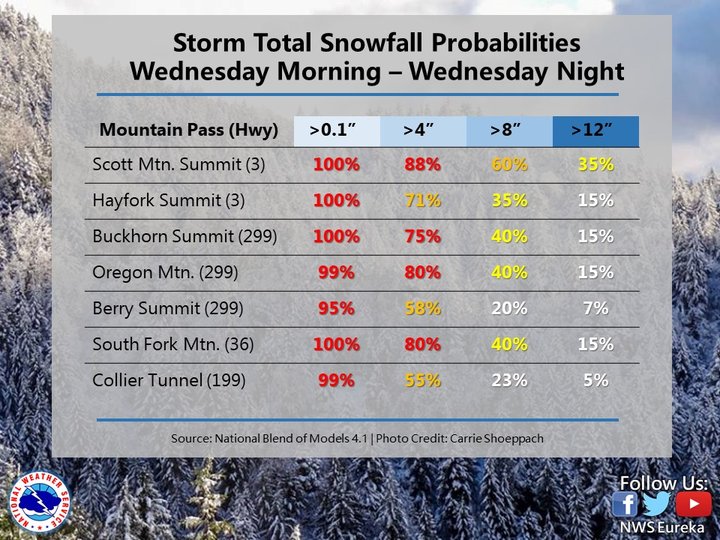
Another round of heavy mountain snow could dump 6 to 8 inches of powder on Berry Summit by tomorrow night.
Anticipated snow totals through tomorrow night. Map does not include light, lower elevation snow. | Graphics by theNWS
“Snow levels will [drop] Monday midday through the evening,” the NWS stated. “Significant accumulations [will be] possible at Berry Summit.”
Higher-elevation areas like Scott Mountain Summit in Trinity County could see between 12 to 18 inches of snow. Areas at elevations as low as 1,000 feet could also see snowfall.
“We are still assessing the chance for a coating to locally an inch or two along some of the Highway 101 passes or even parts of Highway 20 into Lake County as snow levels fall to 1,000 feet, possibly even lower, by Tuesday morning.”
Rain, thunderstorms and small hail will be possible tomorrow across the greater Humboldt Bay Area.
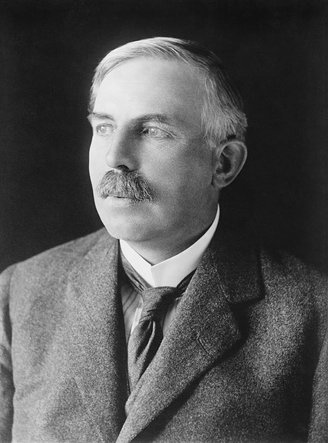
“Not exist? Not exist? Why, I can see the little buggers as plain as I can see that spoon in front of me!” New Zealander Ernest Rutherford was responding to fellow physicist Arthur Eddington’s remark that if electrons were so unimaginably small, perhaps they didn’t actually exist. That was back in 1920, and honestly, if you ask a physicist today, “How large is an electron,” you probably won’t get a clear answer. It’s not like asking, “How big is a baseball?” You’d probably have to sit through a lengthy explanation involving zero-radius particles (whose energy density would be infinite) versus finite-radius particles (which are incompatible with general relativity).
Fact is, we humans are best at getting a handle on things that approximate to our size, or—for really small stuff—things we can see. A grain of salt, a hair, that’s about a small as our senses can do anything with. All we can do from there on down is use analogies.
Regarding the electron, the best that can be said is that its radius can be no larger than 10 to the minus 18 meters, that is, it’s less than one millionth of a trillionth of a meter—yeah, pretty useless. Try this analogy, based on the story about the elderly senator who had been listening intently to a scientific presentation at a formal Congressional hearing. He asked, “Is an electron that much smaller than a speck of dust?” The answer was, “Senator, an electron bears about the same relation to a speck of dust as a speck of dust does to the size of the earth.”
For the sake of argument, let’s suppose the electron does have a size, and that size, as above, is 10^-18 meters. What about a speck of dust? That can be very small, too, by our normal standards of size: about 4 millionths of a meter, or 4 microns, for the smallest specks. Based on these numbers (1) a dust speck is about 4 billion times the size of an electron, and (2) Earth is about 3 billion times the size of the dust speck. Close enough! We could write the ratios like this, with one more thrown in for good measure:
(The radius of an electron to the radius of a speck of dust) = (The radius of a speck of dust to Earth’s radius) = (Earth’s radius to the distance of the nearest star). Roughly speaking.
Forget electrons, let’s look at something much more topical: the size of coronavirus that’s causing Covid-19 havoc here and around the world. How small is it? Really small.
Imagine that you have a single grain of salt on your palm. There’s you and there’s the grain of salt. You’re big, the grain is small: it’s about 100,000 times smaller than you. Now go one step beyond, imagine something that bears the same relation to a grain of salt as the grain of salt has to you. Got it? That’s a coronavirus. Yup, tiny—50 times smaller than that speck of dust we were talking about (about 100 nanometers in diameter, if you’re up on your units). One more for good, ahem, measure: You could fit about 10,000 typical viruses across the width of the period at the end of this sentence.
A damn sight smaller than that spoon Rutherford was eyeballing.
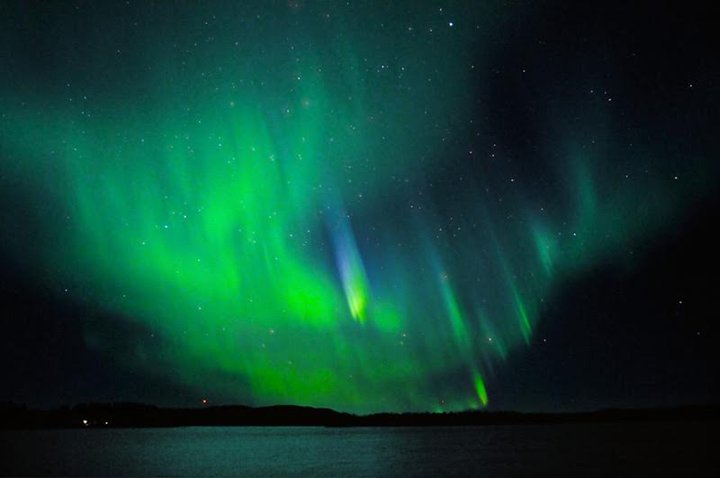
You can thank “surfing electrons” from the sun colliding with atmospheric nitrogen and oxygen molecules for the Northern Lights | Varjisakka, Creative Commons)
Here
in Istanbul, we have the privilege of coexisting with history. Each
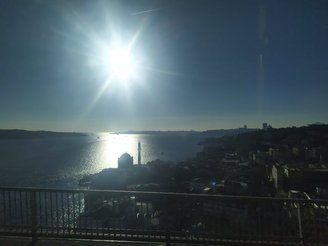
morning on the ferryboat, I can look out over the darkened waters of
the Bosphorus and see the Hagia Sophia and the Blue Mosque. As we
approach the European shore, the orange-lit facade of Dolmabahçe
Palace shines on the surface of the waves, themselves burnished and
shining almost like liquid armor.
Often
I remind myself what gifts these morning visions are. After all, the
tourists come in great flocks from all around the world each year to
behold these places, to snap photos, to commune with some inner
longings, perhaps even to learn about something that is greater than
themselves, before returning home to their regular routines. And for
me, I get to see them every day; they are my regular routine.
And
so what do they mean to me?
Not
much, to be honest, except scenery. When I lived in Prague, it was
very much the same thing. Each day, I used to pass Prague Castle,
high on the hill over the city, and the Charles Bridge, always
crowded with tourists, the spires of Tyn Church and the other places.
After the initial thrill wears off, they dissolve somewhat into the
background, the peripheral, and become merely places you see on your
way to work. I suppose the same could be said of California, only in
California it was the Pacific, the ethereal redwoods, that were the
monuments, natural wonders. Seeing them every day, you begin to take
them for granted.
Still,
all of these places hold certain meanings – why else do people long
to see these places so much? Is it merely their beauty? No, it is
because these places hold some personal meaning, confirm some
sentiment, or else validate the aims of something broader, like the
state or nation.
When
in Rome, I visited the Colosseum, what remains of the Forum, as well
as the Vatican, and viewed the many masterpieces to be found in the
Villa Borghese, and other places as well. It occurred to me later
that I was beholding the vestiges of ancient visions, dreamed of by
people who are long gone. And I recall in Florence climbing those
narrow, winding steps up to see Brunelleschi’s Duomo, which I’d
always dreamed of doing, alongside so many others. In fact, I confess
I got a bit claustrophobic and acrophobic at the same time as we
reached the top of the steps, so many people crammed high up in this
narrow place, that I got vertigo and had to go back down. No doubt
the old architect would have been disappointed in me, but then he
might have chuckled at the irony:
for don’t
we always fall short of reaching the ideal?
###
All
these centuries after they were envisioned, crafted and built, these
structures stand as – what? Impersonally beautiful works of art?
Cash cows for the municipalities and local merchants? Or imprints of
past ideals? Check marks on bucket lists? All of the above, I
suppose.
And
what of the artists? What were they looking for? Did they not have
many, often conflicting reasons?
When
Michelangelo was commissioned by the Pope or the Medici family or
whoever to sculpt David or paint the Sistine Chapel ceiling, was he
not fulfilling and expressing some internal vision along with those
of his patrons? Had he insisted on pursuing his own agenda, it is
doubtful the great man would have been employed for very long. On the
other hand, Warhol, with his soup cans, Marilyns and Coke bottles,
was able to please both the gods of Art and commerce, as well as his
own personal fancies.
Nowadays,
artists are free to express whatever they like—indeed, we usually
insist that their works be personal, honest, real. From the films of
someone like Bergman or Scorsese, to the works of a Duchamp or an
album by Wilco, we demand that artists let their hair down, to tell
us how we really feel. Shows like “Mad Men” and, more recently,
“Succession,” thrillingly remind us of our many frailties, our
betrayals, our failure. No doubt these works do reflect the spirit of
our culture, and they are entertaining, relevant.
But
do (should) they point to something more? Those great cathedrals in
Europe, or the mosques here in Istanbul, for example, were intended
to reflect the importance and permanence of God, of the immortal
soul, of Heaven, and that we poor souls were meant to value and
strive for these things as we regarded those vast structures. One
could say that the towering skyscrapers of our world, from New York
to Shanghai, are meant to remind us of the importance and permanence
of Money, or the everlasting forces of commerce and ambition, of
aspiration. These things are value judgements of course, and as
mutable as the individual reading this.
I
suppose there are some of you now saying that I’ve missed the mark:
that it is the ideas that matter, not the works themselves. Because
it is what they represent that lives on. Yes, but are you telling me
that all these tourists standing on the ferry beside me, snapping
silhouetted selfies with the Hagia Sophia prominently in the
background, are really that interested in ideas?
After
of these long-winded observations, I guess what it comes down to is,
what are people looking for? What am I looking for?
Often
you hear people say, when they visit these old cities, things like,
“Why can’t we build things like this anymore?” And you don’t
have to guess that they are thinking about our present day landscapes
of endless shopping malls, fast food restaurants, billboards and
faceless apartment blocks. Even here in a great old city like
Istanbul, the further away from the Bosphorus, the more the city
looks just like any other big city, just a lot more of it, a
ceaseless jumble of random buildings, streets and shops, a jigsaw
puzzle where no pieces fit, except in relation to your ordinary life.
There is the bakery where you by your bread, the bakkal
where
you pick up a few groceries on the way home, your local pub, etc. The
rest is just a vast, impersonal maze where “other
people” live.
Sometimes
I like to imagine I were a great visual artist, and that the city
would commission me to produce some immense work – a statue, a
painting, some tower or mechanical symbol – and that this work
would become a defining visual icon of that city, like the Eiffel
Tower or Statue of Liberty.
That
will never happen, but I like to ponder it. Do we still have such
artists? Are they really necessary, especially since the Internet has
created this inner visual landscape that has so much more relevance
to our everyday lives. A meme nowadays can have as much impact as a
great statue, maybe even more.
Have
we lost the artists who could show us the goals and aims of the
state, or have we simply lost the leaders who are able to tell us
what these goals and aims are? If our goals and aims have changed,
what are they? Funnily enough, I am not even sure which “we” I am
speaking of, perhaps it is the global community, or maybe just the
online community that happens to revolve in and around this
particular website. Nowadays, “we the people” is an elusive,
floating mass, the number of “likes” on your thread, the migrants
drowning at sea. Perhaps hash tags and emoji are the icons of our
age,
and some artist will be commissioned to erect an enormous @ in a park
some day.
Anyway,
just some random thoughts on the way home from work. As I say, I am
not sure what motivated me to write this missive. Perhaps in all of
these places, I am ever in search of myself, and that for better or
worse, the sight of those great mosques on the hills above the
Bosphorus, whatever they may mean to you or anyone, are a reason to
get out of bed in the morning, of nothing else.
To
get up, and keep searching. For what? That’s up to you.
###
James
Tressler, a former Lost Coast resident, is a writer and teacher
living in Istanbul.