

Convicted Sex Offender Michael Flowers Sentenced to 160 Years to Life for Rape of Local Woman
LoCO Staff / Thursday, Oct. 7, 2021 @ 3:45 p.m. / Courts
PREVIOUSLY: 64-Year-Old Man Convicted of Rape Charges, Faces 25-Years-to-Life
###
Press release from the District Attorney’s Office:
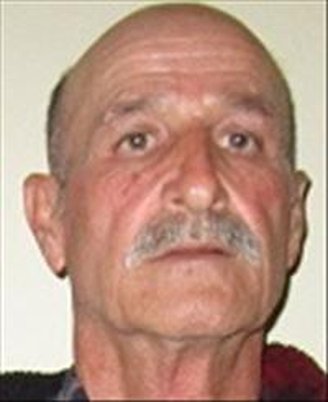
Flowers. | Image via CA Dept. of Justice.
Earlier today, Judge Christopher G. Wilson sentenced convicted sex offender Michael Dennis Flowers to serve 160 years to life in prison for his February 2020 rape of Jane Doe, a local woman in her early twenties.
The sentencing follows a trial earlier this year in which a Humboldt County jury convicted Flowers of all charges brought against him by the District Attorney, including rape, sexual penetration with a foreign object and acquiring a person for purposes of prostitution.
Prior to his rape of Doe in Humboldt County, Flowers received multiple felony convictions in Tuolumne County, including a 1977 assault with intent to commit rape and 1994 convictions for attempted murder and three separate charges of continuous sexual abuse of a child.
Flowers was released on parole to Humboldt County after serving time in prison for his Tuolumne County crimes. During the Humboldt County trial the jury heard testimony from Doe and each of the women who, as children in Tuolumne County, survived sexual abuse by Flowers.
At the conclusion of this morning’s sentencing, Judge Wilson commented that the women should never have to testify about the abuse again. Assistant District Attorney Stacey Eads, who prosecuted Flowers, stated: “I have tremendous respect and appreciation for the women who testified and I wish them continued strength and healing as they move forward.”
BOOKED
Today: 3 felonies, 8 misdemeanors, 0 infractions
JUDGED
Humboldt County Superior Court Calendar: Today
CHP REPORTS
Dyerville Loop Rd / Barnum Rd (HM office): Trfc Collision-1141 Enrt
Elk Valley Rd / Huston St (HM office): Traffic Hazard
ELSEWHERE
KINS’s Talk Shop: Talkshop September 7th, 2026 – Eureka Police
Governor’s Office: Happy Labor Day! California is the #1 for state for workers, #1 economy in the nation
Governor’s Office: Governor Newsom proclaims Labor Day
RHBB: Barn Destroyed as Fire Spreads to Second Structure Near Ferndale
Deputies Tase Combative Wanted Felon Twice Before Arresting Him in Garberville, HCSO Says
LoCO Staff / Thursday, Oct. 7, 2021 @ 3:13 p.m. / Crime
Press release from the Humboldt County Sheriff’s Office:
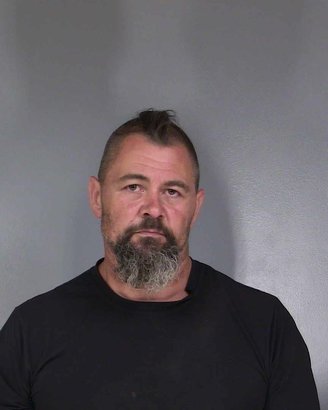
Dakota Blue Reinius. | Photo via HCSO
On 10/7/2021, at about 00:09 hours, Humboldt County Sheriff’s deputies were dispatched to the Garberville Town Square in the 700 Block of Locust St for the report of suspicious activity by 5-6 individuals including possible drug use and disturbing the peace.
Deputies arrived on scene and identified one of the subjects as 47-year-old Dakota Blue Reinius, known to the responding deputies to be a felony warrant suspect.
Upon advising Reinius of his warrant and providing instruction to remain seated, Reinius ignored deputies’ commands by standing up and beginning to walk away. Deputies advised Reinius that he was under arrest and commanded him to get on the ground while they had their Tasers pointed at Reinius. Another subject on scene then ran in front of Reinius forcing deputies to lower their Tasers.
At this time Reinius began running away from deputies and a short foot pursuit ensued and ended when Reinius stopped, turned towards deputies, raised his fists, and took a defensive stance for fighting.
Due to Reinius refusing commands and his aggressive behavior, the deputy pointed and discharged their department issued Taser into Reinius. Reinius then began to reach towards his pocket, deputies commanded Reinius to place his hands up, however Reinius ignored the command and the deputy again deployed their Taser into Reinius after which Reinius complied with deputy commands and was placed into handcuffs and under arrest. During their search of Reinius’s property subsequent to arrest, deputies located a loaded firearm inside Reinius’s backpack.
Reinius was booked into the Humboldt County Correctional Facility on charges of Carrying a loaded firearm in person/vehicle in public (PC 25850(a)), Obstructing a Public Officer (148(a)(1)), in addition to warrant charges for inflicting corporal injury on spouse/cohabitant (PC 273.5(a)), false imprisonment with violence (PC 236), kidnapping (PC 207(A)), and battery with serious injury (PC 243(d)).
This case is still under investigation.
Anyone with information about this case or related criminal activity is encouraged to call the Humboldt County Sheriff’s Office at (707) 445-7251 or the Sheriff’s Office Crime Tip line at (707) 268-2539.
ARCATA OKs SHROOMS! City Council Unanimously Passes Resolution Decriminalizing the Use of Psychedelic Plants and Fungi
Stephanie McGeary / Thursday, Oct. 7, 2021 @ 11:54 a.m. / Local Government
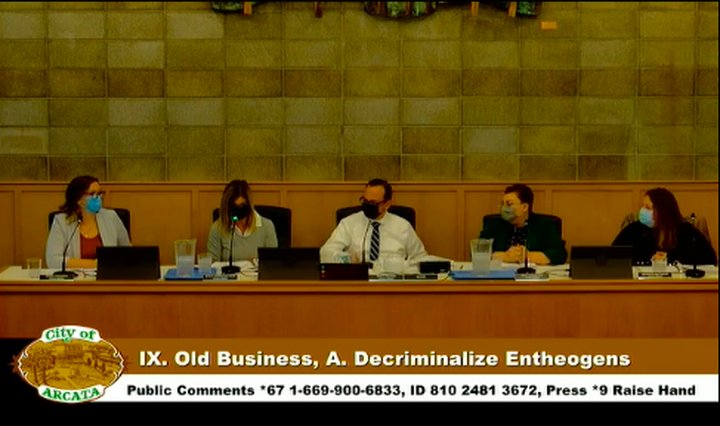
Arcata City Council members (from left) Sarah Schaefer, Stacy Atkins-Salazar, Brett Watson, Emily Goldstein, Meredith Mathews all gave the thumbs up to psychedelics on Wednesday. | Screenshot from meeting video.
###
Arcata residents 21 and older can now use magic mushrooms, ayahuasca, mescaline and other psychedelic plants or mushrooms without fears of legal repercussions. During its Wednesday night meeting, the Arcata City Council unanimously and enthusiastically passed a resolution that decriminalizes the use of entheogenic plants and fungi in the city.
The resolution, drafted by city staff and members of local working group Decriminalize Nature Humboldt, states:
The City Council of the City of Arcata hereby declares that the investigation and arrest of persons for planting, cultivating, purchasing, transporting, distributing, engaging in practices with, or possessing Entheogenic Plants and Fungi or plant compounds which are on the Federal Schedule 1 list shall not be a public safety priority for the City of Arcata; and that only limited City funds and resources be used to investigate, detain, arrest or pursue prosecution for an alleged violation of State and federal law regarding the use of Entheogenic plants by a person twenty-one (21) years of age and older when other code violations are present such as a public disturbance, driving while under the influence, use in the presence of minors, or jeopardizing public safety.
Arcata City Manager Karen Diemer began with a little bit of background on the subject, explaining that in recent years some scientists and individuals have been attesting to the therapeutic benefits of the use of entheogens.
“Psychedelics were broadly banned under the 1970 Controlled Substance Act,” Diemer said to the council. “More recently, scientists in places such as John Hopkins University, New York University, UCLA Medical Center have conducted smaller studies that suggest the use of several of these plants and fungi — guided by trained professionals — really do have the potential to relieve many mental health illnesses and struggles for individuals.”
Several other cities, including Oakland and Santa Cruz, have recently decriminalized psychedelics and moves have been made for decriminalization at a state level with SB 519, which was pulled prior to the recall election, Diemer explained. Diemer added that she did believe the bill will eventually return to the assembly and will likely be passed in the future.
The council’s unanimous decision comes as a little bit of a surprise after the resolution failed to pass during the council’s July 21 meeting — with council members Sarah Schaefer and Emily Goldstein in support and Brett Watson and Stay Atkins-Salazar voting against. Both the councilmembers who opposed said that they were not necessarily against decriminalization but had some concerns about community safety.
But during Wednesday’s meeting, Watson and Atkin-Salazar made it clear that their reservations had largely been put to rest.
“I was one of the people that was hesitant the first time around,” Atkins-Salazar said. “I felt like it was just coming at us fast and perhaps the public wasn’t fully aware of what we were doing. I just wanted to be sure that the public had a chance to digest the information and that this was a good fit for our community.”
Atkins-Salazar added that the changes in language made to the resolution since the last meeting, the recommendation made by the city’s Public Safety Committee and Decriminalize Nature Humboldt’s public education efforts had helped ease her fears.
Mayor Watson, however, still had some concerns over the potential repercussions of people using psychedelics without proper guidance or dosage. At his request, the council agreed to add language to the resolution stating that entheogens should be consumed “in a therapeutic setting and with proper guidance.”
Close to a dozen people joined the Zoom meeting to comment on the item, all of them in support of the resolution. Danielle Daniel, lead organizer of Decriminalize Nature Humboldt, thanked the council and community for its support and tried to alleviate some of the council’s safety concerns.

Psilocybe cyanescens, at a type of psychedelic now decriminalized in Arcata | Photo: Caleb Brown via Wikimedia Commons. Creative Commons License.
“I understand the concerns of people taking too much and maybe getting overwhelmed by the experience of a strong psychedelic,” Daniel said to the council on Wednesday night. “But what we have been trying to do is teach people how to take these in a good way and in a safe way. And with decriminalization we will have more abilities to teach people how to take these in a good way and provide safe spaces for people to take these in a therapeutic way.”
In the end, the council passed the resolution, 5-0. It was the first time the item had come before newer councilmember Meredith Matthews, who wanted to say how much her views on this subject have changed over the years.
“As a mother and someone who was raised at the height of the ‘just say no to drugs’ campaign… I just really want to appreciate how far the science has come and I really appreciate the science-backed research that has been done,” Matthews said. “It’s been a lot for me to unpack personally, just from my age and where I am. But folks have done a great job.”
###
PREVIOUSLY:
Eureka’s Needle Exchange Was One of Several Targeted by Eco-Rooted Lawsuits. A New State Law Will Stop That.
Rachel Bluth / Thursday, Oct. 7, 2021 @ 11:05 a.m. / Environment , Health Care , Sacramento
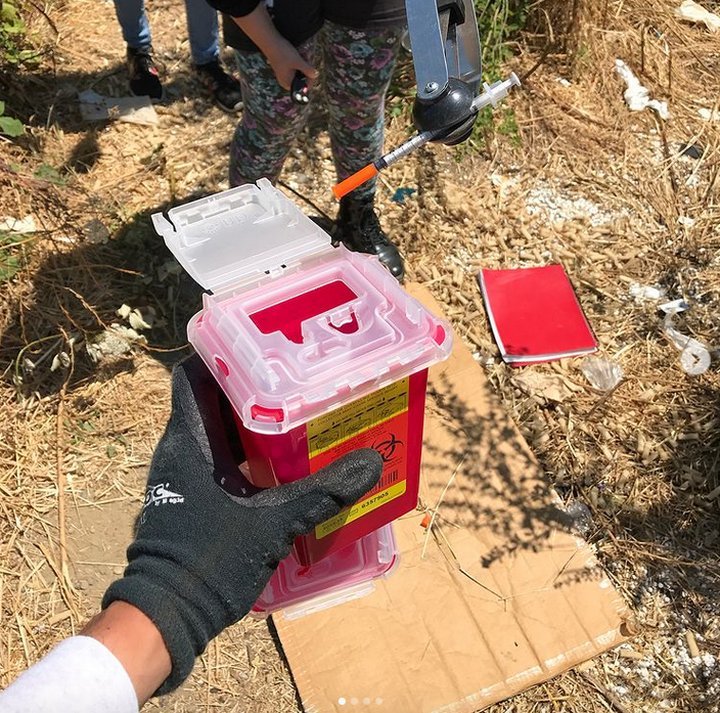
Employees of the Humboldt Area Center for Harm Reduction (HACHR) picking up needles in 2017. | File photo via HACHR.
###
For more than 30 years, public health officials and nonprofits in California have provided clean hypodermic needles to people who use them to inject drugs.
For nearly that entire time, opponents have accused the free needle programs of promoting drug use and homelessness.
But recently, opponents have deployed a novel strategy to shut them down: using environmental regulations to sue over needle waste. They argue that contaminated needles pollute parks and waterways — and their lawsuits have succeeded across the state.
A bill signed Monday by Democratic Gov. Gavin Newsom will thwart that tactic.
Environmental challenges have already forced free needle programs in Orange County, Chico and Eureka to close or modify their operations.
The new law comes at a critical moment for a program in Santa Cruz. A final court ruling that could determine the fate of the program is expected within days, and it’s not clear how the law will affect the judge’s decision.
“We’re in the midst of an opioid crisis,” said Assembly member Joaquin Arambula (D-Fresno), a physician who wrote the bill Newsom signed, AB 1344. “We need all the tools that we have available for us to address this crisis head-on.”
Despite the legislative victory, lawsuits to challenge needle programs on other grounds are still possible, and local ordinances banning needle exchanges have flourished across California.
Under the new law, which takes effect Jan. 1, opponents of free needle programs will no longer be able to sue over violations of the California Environmental Quality Act, known as CEQA.
CEQA requires projects that need approval from a public agency or receive public funding to be assessed for their potential environmental impacts. This requirement applies to major construction projects, like reservoirs and freeway overpasses, and localized ones such as affordable housing. CEQA is enforced by lawsuits and has been invoked over the years to stop or slow unpopular proposals, like homeless shelters.
California allows licensed physicians to give clean needles to patients without authorization. Free needle programs run by local governments or community groups must be approved by the state, a county or city.
These programs, which allow people to dispose of used “rigs” and get new ones, attempt to reduce the spread of HIV and hepatitis C, which can spread among drug users who share needles, and decrease infections among users. Some are true “exchanges” that require people to turn in a used needle to get a new one. Others allow people to take what they need without returning them.
In the past few years, opponents have started focusing on the programs’ environmental impacts because some needles end up on the ground or in creeks and rivers.
Walt McNeill, a lawyer in Nevada City, California, challenged nonprofit-run needle programs in Chico, Eureka and Santa Cruz on behalf of local officials, former law enforcement officers and community groups.
McNeill said his clients aren’t opposed to needle programs in general, just ones they believe are run irresponsibly. “You have no idea where the needles are going, and no way of recovering needles effectively,” he said.
The trend in environmental challenges began a few years ago when the only needle program in Orange County shut down following a CEQA lawsuit. In 2020, a program created to address needle pollution in Chico closed after it settled a CEQA lawsuit, then later reopened on a smaller scale under a physician’s authority. Also in 2020, Eureka officials wouldn’t reauthorize a needle program after McNeill challenged it on environmental grounds.
Last year, McNeill sued one of two free needle programs in Santa Cruz County. Run by the Harm Reduction Coalition of Santa Cruz County, it operates out of a van and serves up to 75 people each Sunday on the same street corner in an industrial part of town. The complaint alleged the program “spread tens of thousands of used and unused hypodermic needle ‘litter’” throughout the community and has led to “environmental degradation of the creeks, streams, rivers and beaches.”
A superior court judge in Sacramento is expected to hand down her ruling soon. McNeill said he’s confident the judge will side with his clients despite the new law because of other flaws in the program. If she disagrees, he said, he may file another suit on other grounds.
“No matter how you slice it, the program will be deauthorized,” he said.
But Denise Elerick, founder of the coalition, said she believes her program will survive. She said arguments about needle litter mask anti-homeless sentiment.
“They say it’s about the environment but it’s not. They want people to die and disappear,” she said.
Decades of research shows that needle giveaways aren’t a major source of pollution, and that people who get needles from an exchange are more likely to dispose of them properly than those who don’t.
A 2019 study by Santa Cruz County’s Health Services Agency found that for every 10 needles that ended up on the ground or in a river, 1,000 made it into a sharps container, used to collect used needles, or an official disposal point. The report concluded that reducing needle litter would require more syringe programs and disposal sites, not fewer.
The Santa Cruz program, which began in 2018, gives out as many syringes as people request.
In addition to offering nine sizes of syringes, the program gives out sharps containers, ranging in capacity from a quarter gallon to 8 gallons, which can be returned, picked up or left at disposal kiosks around town.
On one Sunday in August, 56 people stopped by the van and 51 sharps containers were distributed. The coalition would not disclose how many needles it typically gives away.
The clients also gathered supplies to protect them from staph infections, covid and other dangers: condoms, hand sanitizer, masks, alcohol pads, drug-testing strips to ferret out fentanyl, and medication to reverse overdoses. The program even offered clean pipes to encourage that drugs be smoked — rather than injected — and reduce the spread of covid from sharing pipes.
Many who line up each week live in nearby parks and alongside creeks that are the focus of opponents’ environmental concerns. They said they have a vested interest in keeping the environment clean.
“Just because we’re drug addicts doesn’t mean we don’t take care of ourselves,” said one woman, 35. (In order to observe how the program works, KHN agreed not to name the people procuring supplies.) “Yeah, I live in a tent, but my tent is clean. I try to take care of other people and I take care of myself.”
The new law comes too late for programs like Chico’s, because the city has since passed an ordinance banning syringe exchanges. Similar bans have been adopted in Anaheim, Oroville, Butte County, Yuba City and elsewhere in the past few years.
Ryan Coonerty, a Santa Cruz County supervisor, said the county likely won’t adopt a ban, though he’s disappointed by Newsom’s decision. He believes the nonprofit needle program in Santa Cruz contributes to needle pollution more than the county-run program, which requires people to turn in used needles to get fresh ones.
“We will continue to struggle with needle litter and, unfortunately, not get any help from the state to stop needles from going into the ocean, parks and beaches,” he said.
But the Centers for Disease Control and Prevention and other public health agencies say one-for-one programs limit the ways people can safely dispose of sharps, forcing them to hang onto their needles until the next needle exchange. That’s not realistic, according to the people who lined up to get needles from the Santa Cruz program.
“A lot of us are homeless,” said one 40-year-old woman, “and we can only stay someplace for so long.”
###
This story was produced by KHN, which publishes California Healthline, an editorially independent service of the California Health Care Foundation.
How About a Humboldt Crossword?
Andrew Goff / Thursday, Oct. 7, 2021 @ 7 a.m. / Humboldt Crossword
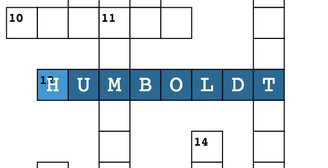
It’s Thursday morning. You’ve got stuff to do. But not so fast! You have not yet attempted LoCO’s super new “Humboldt Places” crossword puzzle, the result of someone at LoCOHQ saying, “What if we had a crossword?” and then someone else googling a way to quickly make that a thing. We were successful in making an OK looking crossword and now your day is delayed. Tough!
DO LoCO’s HUMBOLDT CROSSWORD NOW.
Fair warning: Only the most grizzled of Humboldt insiders and/or old timers will be able to complete this crossword, so don’t feel bad when you decide you’d much rather go count banana slugs in the yard. If you get stumped, call your grandma or your county supervisor. Go!
-LoCO’s HUMBOLDT PLACE NAMES CROSSWORD-
# # #
Wow! That was so fun. So much so that now you’re thinking, “When is LoCO going to ruin my morning with another one of these?” Hey, maybe. Why don’t you give us a topic!?
Eureka City Council Approves Vaccination Mandate for City Employees
Stephanie McGeary / Wednesday, Oct. 6, 2021 @ 6:26 p.m. / Local Government
PREVIOUSLY:
###
During a lengthy virtual meeting on Tuesday night, the Eureka City Council unanimously approved a COVID-19 vaccine mandate for all city employees, requiring that all employees be at least partially vaccinated by Oct.19 and fully vaccinated by Nov. 23.
The mandate states that employees who fail to comply with the policy “will not be permitted to perform work at City worksites and are subject to release from City employment.” Employees may request an exemption, however, if they have a verifiable medical condition that makes the vaccine not advisable or have religious beliefs that bar vaccination. If their exemption request is not approved, they must be partially or fully vaccinated within 14 days and fully vaccinated within eight weeks of when they were notified that their request for was not approved.
“This was not a decision that was made lightly and we feel that it’s really necessary and crucial in order to continue these critical public services that we provide,” Will Folger, director of human resources for the City of Eureka said to the council.
Asked by the council about the process of verifying someone’s religious exemption, Folger said that it was difficult to know exactly what that would look like and that it will have to be dealt with on a “case by case basis.”
The decision to approve the mandate seemed to be a relatively easy one for the council, with a pretty short discussion among the councilmembers. The public comment period took up some time, however, with more than a dozen community members sharing their thoughts on the issue — many urging the council to vote against it.
“Nobody should lose their jobs due to your COVID response,” community member Anne Baker said to the council. “People’s livelihoods are in your hands, which is a place I never expected our jobs to be. Your hands. Your hands can take away our paychecks, our hard-earned accomplishments from our work and our ability to provide for our families.”
Other community members voiced their support for the mandate, saying that vaccines are safe, effective and the only realistic way for us to get through this pandemic.
“I understand there are a lot of concerns, there are people who are very afraid,” commenter Mark Pardoe said during the meeting. “But the reality is the vaccine is very safe, it’s critical for our community and we have to remember there are a lot of people out there who really need us to help protect them. So I hope as a community we do as much as we can to help protect those people.”
Several commenters mentioned that some people have suffered serious side effects from the vaccine (The CDC reports that serious side effects from COVID vaccines are extremely rare.) One person questioned what the city’s liability might be if someone were to experience severe side effects after having to get vaccinated.
City Attorney Bob Black explained to the council that a person would have to file a worker’s comp claim and that he thinks “the odds of success in those types of claims will be very, very low.”
Ultimately the council voted to approve the COVID vaccination mandate, which will become effective immediately.
“For me this was a very difficult decision,” Councilmember Kim Bergel said during the meeting. “When looking at both sides of the situation I think it’s important to look at the community as a whole. This isn’t about individual people anymore. This is about a community as a whole working together. I heard a comment that 59-year-olds don’t die, and I just want to say that four people I know have died from COVID, and they were younger than 59. So I feel a level of frustration with that kind of banter and I wish you would look into your statistics a little further.”
###
In other business, the council spent a lot of the meeting discussing ways to transform the City’s Citizen Advisory Board — a group that advises the Chief of Police on police-community relations and police operations — into something with a little more teeth.
Originally city staff had proposed changing the name of the board to the “Citizen Oversight Board,” but the council agreed during the meeting to change the title to the “Community Accountability Board,” because the goal of the group is to improve transparency and accountability within the Eureka Police Department.
During the discussion, the council decided that it would like to see the board provide more oversight of police policy and procedures, have more access to community complaints about the police department and receive more input from historically marginalized groups.
The council also agreed that the City should consider hiring an Independent Police Auditor to work closely with the board and address citizen complaints, suggesting policy changes and addressing officer misconduct.
Councilmember Kati Moulton — who had put the item to the agenda — at first felt that there should not be any members on the board who previously served in law enforcement. But, at the suggestion of Police Chief Steve Watson, the council agreed to limit the board to only one member who has experience in law enforcement.
For the time being, the board will retain its current members at least until their terms expire. Moving forward, board members will be recommended by the mayor and selected by the council.
Though police reform has been a oft-discussed topic in the last year or so, especially since the EPD texting scandal, Councilmember Moulton wanted to say that those were not the reasons behind her desire to address this issue.
“The reason I brought this up when I did is that I feel very strongly that citizen oversight for the police is necessary for transparency and accountability,” Moulton said during the meeting. “This is not my response to any incidents that have happened, whether in this city or another city — any investigation, anything having to do with the EPD specifically or how ithas operated. I think this is a protection that we need to put into law and place for the future health and accountability of our police department and our community.”
New Grant-Funded Program Will Bring Social-Emotional Learning Through the Arts to Classrooms Around Humboldt
Jacquelyn Opalach / Wednesday, Oct. 6, 2021 @ 4:51 p.m. / Education

A kindergarten student’s “Mixed” artwork | Image from artsintegration.net
###
If we could forget that education ever existed, and start over from scratch, what would it look like?
That’s a question — originally posed by Harvard Graduate School of Education’s Project Zero — that Bill Funkhouser, an arts education specialist for the Humboldt County Office of Education, keeps in mind.
“To me, that’s kind of what creative education is about. It’s about saying, ‘Let’s forget about all this baggage that we have in education, and really think about what works. What makes for a collaborative, creative classroom community?’” Funkhouser told the Outpost.
HCOE recently learned it is the recipient of a federal $3.3 million grant that will fund a program aiming to bring social-emotional learning through the arts to three local schools. The scope and goals of the project — which will be called ArtSEL (Art/Social-Emotional Learning) — remind Funkhouser, who is coordinating the program, of that question: What would a clean slate for education look like?
For one, he thinks it would involve a healthy, consistent scoop of social-emotional learning practices, incorporated into every aspect of any student’s day at school. Social-emotional learning involves guiding students toward developing person skills — stuff that isn’t necessarily in the syllabus, like self-awareness, self-management, social awareness, relationship skills and decision-making. Social-emotional learning isn’t a new educational concept, but its application has ballooned in recent years as more and more young people are facing mental health issues.
“We get so focused on the test scores and that sort of thing. And we go, ‘Why aren’t they succeeding?’” Funkhouser said. “And I think often the answer is, well, what are we doing to meet their social-emotional needs?”
Some teachers brush off that responsibility, Funkhouser said, figuring it’s up to parents to teach their children those skills at home.
“I just see that as a real opportunity missed, because at home they don’t have 30 other people from different backgrounds,” he said. “What a great opportunity for being given a chance to communicate, collaborate, work creatively in a classroom community, right? And that’s what we’re after. That’s what we’re trying to establish here.”
ArtSEL will span five years and will benefit three to-be-determined local K-8 schools. Every staff member at participating schools, from teachers to bus drivers to administrators, will undergo training pertaining to social-emotional learning, which, over the first year and with ongoing support over the following four, will accumulate in hundreds of hours of training.
“We want everybody who might be involved with that child’s life to have been trained in what it means to understand social-emotional learning [and] to understand what creativity looks like,” Funkhouser said. “We think that anybody who interacts with children in these schools has the potential to make a difference.”
HCOE Arts Program Manager and ArtSEL Director Stacy Young said that there is rarely the funding to train staff in such a wide scope. “Every adult that’s in a student’s life has the opportunity to grow from this grant,” Young told the Outpost. “It makes it really consistent for the students.”
Still deep in the pandemic, meeting children’s social and emotional needs is important as ever, Young said, pointing out that this year’s third-graders haven’t experienced a normal school year since kindergarten. “You’re looking at these social structures and norms that have been disrupted. I would argue that this grant would be helpful in any school in the United States,” Young said.
On top of that are Humboldt’s high rates of children in foster care and children experiencing homelessness, making the implementation of social-emotional learning even more essential, Funkhouser said.
In many cases, art is the perfect vessel for teaching social-emotional skills.
“We believe that children learn and thrive when their social-emotional needs are met. And we think the arts are a natural way to meet those needs,” Funkhouser said. The staff training will involve how to implement social-emotional learning across the core curriculum, which can often be achieved through the arts.

Third-grade students’ collaborative artwork | Image from artsintegration.net
For instance, a collaborative art project can introduce young kids to a host of social-emotional skills.
“They have to learn how to communicate what they think the artwork should look like, they have to learn how to compromise,” Funkhouser said. “And then [the students] make this artwork and none of [them] own it.”
Funkhouser referenced a specific lesson that he and (out of area) teacher Jonathan Juravich collaborated to develop. Based on the children’s book “Mixed” by Arree Chung — which is about a world where primary colors discover mixing after living separated from one another — the lesson, on the surface, is simply about mixing paint colors.
“It’s easier to talk about it in terms of a book, because there’s that distance of ‘Oh, we’re just talking about red and yellow, we’re not talking about racism, we’re not talking about xenophobia, we’re not talking about the hard topics yet.’ But we’re getting there,” Funkhouser said. “I think it’s an example of how SEL and the arts work really well together.”
Both Funkhouser and Young agree that the arts are not valued enough in today’s classrooms. Too often, the arts are reserved for after other learning — like math, science and language — is done, Funkhouser said, even though art can be integrated into all subjects and strengthen them, and even though the benefits of the arts are wide, like the social-emotional learning that can accompany them.
“This is an academic grant, where higher-order thinking is at the top of our goals, yet it is through the arts,” Funkhouser said.
Funkhouser and Young are excited and confident about the project, which is already off to a promising start. Of 109 applicants to the United States Department of Education, HCOE was one of 27 proposals that was awarded a grant, and the application scored 298 of 300 possible points.
ArtSEL is the second federally-funded program HCOE’s Arts Program has received and the fourth grant-funded program Funkhouser has coordinated. The resources used and developed over the course of those programs are all available on artsintegration.net, which has accumulated hundreds of pages and is visited by tens of thousands of users each year. Funkhouser is launching a new website — artsel.org — where all the resources developed for ArtSEL will be posted.
“[We’re] changing education in our community for the children and future citizens of our area,” Funkhouser said. “I think we’re making a difference.”


