

Bill to Decertify Police for Serious Misconduct Clears Legislature
Robert Lewis / Thursday, Sept. 9, 2021 @ 7:16 a.m. / Sacramento
California built up over decades some of the strongest legal protections for law enforcement officers in the country. It’s why a Danville police officer accused of wrongfully shooting a man in 2018 was able to stay on the streets, only to kill again earlier this year. And it’s why officers who are fired for wrongdoing can sometimes quietly find a new job in another department.
But that appears certain to change.
California is poised to join most of the country when it comes to disciplining the worst of the worst officers. Lawmakers passed a bill Wednesday that would allow the state’s law enforcement accrediting body to decertify officers for serious misconduct — essentially kicking them out of the profession for things like sexual assault, perjury and wrongfully killing civilians.
California is one of only four states without such a power.
The bill is now headed to Gov. Gavin Newsom, whose office helped broker the recent amendments and is expected to sign it into law.
Sen. Steven Bradford, a Gardena Democrat and chair of the public safety committee, introduced the bill with Senate President Pro Tem Toni Atkins. Despite the Democrat controlled government and the national movement for criminal justice reform, the legislation faced considerable hurdles.
A decertification bill failed last year, and this year’s version met with resistance from influential law enforcement associations. But after last minute concessions aimed at mollifying critics, the state Assembly last week passed the bill and the Senate voted again to approve the amended version.
“California and the nation as a whole has experienced tragedy after tragedy where consequences for egregious abuses of power went unpunished and cries for accountability went unanswered — eroding public trust in law enforcement,” Bradford said in a statement after the vote. “This bill is the first of its kind in California and we finally join the 46 other states with processes for the decertification of bad officers.”
The bill would create a new division within the state’s Commission on Peace Officer Standards and Training to investigate alleged misconduct. A new nine-member advisory board would recommend whether to strip an officer of his or her certification — basically a license to work in policing. The commission, which is made up of mostly political appointees from law enforcement, would then decide whether to revoke or suspend an officer’s certification — a decision that an officer could ultimately appeal in court.
Law enforcement associations opposed the bill. In hearing after hearing, police chiefs and law enforcement association representatives said they supported the concept of decertification but feared the definition of serious misconduct was vague and the advisory board would have too much sway.
Brian Marvel, president of the Peace Officers Research Association of California, told CalMatters in July that the bill created a “biased and unclear process for revoking an officer’s license.”
To help allay some of those concerns and secure passage, the bill recently was amended to require a two-thirds vote of the commission as opposed to a simple majority before an officer could be decertified. The amended version also no longer requires that two members of the advisory board be victims of excessive force or relatives of people killed by police. Instead, those positions would be members of the general public with a “strong consideration” given to victims of such abuse. Other changes would clarify the definition of serious misconduct and could limit the commission’s ability to decertify officers whose cases were already heard in local trial courts.
The changes rankled some bill supporters.
Sheila Bates, a member of the Black Lives Matter Los Angeles policy team and a coalition of advocates that co-sponsored the bill, said victims of excessive force deserve to have a voice in the proceedings. She also said she worries the two-thirds supermajority vote necessary for decertifying an officer will make it much harder to hold bad officers accountable
“Police have more rights in the state of California and less accountability in the state of California and they want to keep it that way,” Bates said.
Still, she said, it’s past time for decertification to become law.
“It still is a strong bill,” Bates said.
“Police have more rights… and less accountability in the state of California and they want to keep it that way.”
— Sheila Bates, Member of Black Lives Matter Los Angeles
Ellie Virrueta of the Let Us Live Coalition has been working on getting decertification passed for the last two years. Virrueta’s teenage cousin was killed by police in Southern California in 2012. She said local authorities deemed it a justified shooting but she questioned the findings and said her family would “have had a better opportunity for real justice” if something like the decertification bill had been in place.
“When we fight we really do win,” she said after the Senate vote. “It’s not the end of the road. We still have a lot of work to do.”
The late amendments weren’t enough for some law enforcement groups to drop their formal opposition.
“Unfortunately, the final text of the bill still includes unclear and subjective definitions of what would constitute serious misconduct, the make-up of the board remains biased against the officer and the bill still does not contain any reference to the Peace Officers Bill of Rights,” said Marvel, the Peace Officers Research Association of California president in an email to CalMatters.
He said the organization “looks forward to continuing our work with the Governor’s office and leaders of both houses as they develop the program created by the bill.”
The bill made it out of the Assembly last week with 49 votes. The amended version cleared the Senate with 28 votes. The governor has until Oct. 10 to sign it into law.
###
CALmatters.org is a nonprofit, nonpartisan media venture explaining California policies and politics.
BOOKED
Today: 3 felonies, 8 misdemeanors, 0 infractions
JUDGED
Humboldt County Superior Court Calendar: Today
CHP REPORTS
4060 Mm101 N Hum R40.60 (HM office): Traffic Hazard
Sr197 / Us101 (HM office): Traffic Hazard
Sr96 / Legion Way (HM office): Hit and Run No Injuries
9700 Mm1 N Men 97.00 (HM office): Trfc Collision-Unkn Inj
ELSEWHERE
RHBB: Magnitude 3.7 Earthquake Centered East of Hydesville
RHBB: Motorcyclist Injured in Solo Crash at 14th and California in Eureka
RHBB: Southbound Highway 101 Traffic Backs Up From Richardson Grove to Benbow
RHBB: Woman Suffers Possible Leg Fracture in Dyerville Loop Road Motorcycle Crash
California Recall Candidates Stretch the Truth on COVID, Climate Change and More
Sameea Kamal / Thursday, Sept. 9, 2021 @ 7:09 a.m. / Sacramento
Everyone’s entitled to their own opinions, but not to their own facts.
That holds true for politicians, including the candidates in California’s Sept. 14 recall election and Gov. Gavin Newsom. Campaigning during a resurgent COVID-19 pandemic and deadly, unprecedented wildfires, their approaches to the state’s problems can vary.
But the facts behind some of those issues don’t change. We look at some of the claims being made on the campaign trail and how they match up with reality:
COVID-19 masks
What the candidates said:
Larry Elder: In press conferences and interviews, he has said that young people are less likely to contract COVID-19, and that even if they do, their symptoms are likely to be mild: “The idea that we’re requiring children to wear masks, to me, is against science.”
Kevin Kiley: In an Aug. 25 debate, said that the harms of masks to a child’s development “far outweigh any benefits, and those benefits aren’t even very clearly established.”
The facts:
Earlier in the pandemic, the U.S. Centers for Disease Control and Prevention said there was a lower incidence of COVID among children, but that was likely due to less exposure with schools closed and to less testing. But more recent studies once schools reopened show that infection rates can be comparable, and in some settings higher, than in adults. According to the CDC, about 1 in 3 children hospitalized with COVID-19 in the U.S. were admitted to the intensive care unit — similar to the rate among adults.
Studies cited by the CDC show that masks and physical distancing have helped limit the spread of COVID-19 in schools.
COVID-19 vaccines
What the candidates said:
John Cox: In the Aug. 25 debate and in an interview with CalMatters, he said that COVID is 99.9% survivable and that vaccines work, so “if I’m vaccinated — which I am — do I really care if someone is unvaccinated?”
Cox also told CalMatters that natural immunity from having COVID-19 might be better than being vaccinated: “There’s a whole number of studies…that say that natural immunity is possibly superior to the vaccines.”
The facts:
The death rate from COVID-19 depends on a number of factors, including underlying health conditions and exposure levels based on where one lives or works. The World Health Organization cautions that estimating survival rates can be complex, given differences in how governments report coronavirus cases, plus asymptomatic cases that are never reported.
What we do know: There have been 4.5 million reported deaths worldwide out of nearly 220 million known cases, or about 2% of cases, according to Johns Hopkins University.
And according to a CDC study in Kentucky, unvaccinated people were more than twice as likely to contract COVID-19 a second time, compared to those who had gotten COVID-19 one time and were fully vaccinated.
 Medical assistant Letrice Smith fills syringes during a community COVID-19 vaccination clinic run by Ravenswood Family Health Network at Facebook headquarters in Menlo Park on April 10, 2021. Photo by Anne Wernikoff, CalMatters
Kiley: In the Aug. 25 debate, said California was the only state with a vaccine mandate.
Kiley also said that Gov. Gavin Newsom cast doubt on the COVID vaccines last October to score political points by saying he would not “take the FDA’s word for whether the vaccine is safe.” Kiley cited the U.S. Senate Health Committee chairperson as criticizing Newsom for “discouraging Americans from taking the vaccine” and “costing lives.”
The facts:
At least a dozen other states had announced vaccine mandates at the time of the debate, though not all were in effect.
Newsom’s comments last October came before FDA emergency use approval; the governor said California would do its own review. Sen. Lamar Alexander did call on Newsom to stop second-guessing the FDA, but he said that “could delay approval, discourage Americans from taking the vaccine and cost lives.”
Gavin Newsom: An ad from the anti-recall committee says that voting yes means electing an “anti-vaccine Trump Republican.”
The facts:
The highest polling replacement candidates — Republicans Cox, Elder, Kiley, Kevin Faulconer and Caitlyn Jenner, plus Democrat Kevin Paffrath — all say they oppose state-imposed vaccine mandates.
But they have also said they are all vaccinated, and encourage Californians to get the shot.
Climate change
What the candidate said:
Cox: In an interview with CalMatters, Cox said: “China and India have produced more pollution than the rest of the world combined.”
He proposed reducing their use of fossil fuels by shipping those nations liquefied natural gas produced in California. He also said: “The burning of natural gas does not significantly produce greenhouse gas.”
The facts:
According to the Global Carbon Project, China’s 2019 emissions were 11.2 billion tons a year, followed by the U.S. at 5.8 billion tons, the European Union at 3.2 billion tons and India at 2.9 billion tons. That means China and India together would total 14.1 billion tons per year, compared to 49.1 billion for the rest of the world.
On the impact of natural gas, the U.S. Energy Information Association says that while it is a relatively clean-burning fossil fuel, methane leaks from natural gas wells, storage tanks, pipelines and processing plants are a strong greenhouse gas.
Crime and justice
What the candidates said:
Faulconer: In an Aug. 4 debate, said that Newsom has “enabled the ‘defund the police’ movement.”
The facts:
Newsom has said that he wants to see police reform, but hasn’t said he supports defunding the police. In June 2020, he said he “supports legislation to track excessive use of force by police, and to require more training on implicit bias.”
In a July 2021 interview, he reiterated his position: “Don’t ever confuse me with the defund police movement.”
Elder: In an interview with The Sacramento Bee editorial board and in a Sept. 2 press conference, said that he doesn’t believe the police disproportionately use deadly force against Black people: “This business about the police engaging in systemic racism is false, it’s a lie. There have been many studies showing, if anything, that the police are more hesitant, more reluctant, to pull the trigger on a Black suspect than a white suspect.”
The facts:
A 2019 study found that Black men were 2.5 times more likely to be killed by police than white men, according to data from 2013 to 2018. For black women, the rate was 1.4 times more likely. And a study of data between 2015 and early 2020 showed that police shootings of unarmed Black people in the U.S. were three times higher than that of white people
Elder: in the CalMatters interview: “During this coronavirus pandemic, 20,000 convicted felons have been released under early release, presumably for compassionate reasons. I think it’s one of the reasons why crime has gone up.”
Cox: at a May 4 press conference, said Newsom “let 76,000 inmates out of jail with almost no warning.”
The facts:
While the state is giving 76,000 inmates — including 20,000 inmates who are serving life sentences and violent and repeat felons — the opportunity to reduce their sentences, they aren’t all being released.
“These changes do not result in the automatic release of any incarcerated individual,” Dana Simas, a state corrections spokesperson, told PolitiFact. “This is not an early release program.”
Instead, it’s an expansion of an existing program that allows inmates to reduce their time served by one-third instead of one-fifth, which has been the law since 2017, for good behavior and for participating in rehabilitation programs.
Other claims
What the candidate said:
Kiley: In an interview with CalMatters, he said a lot of Californians live in “energy poverty,” which he defined as when 10% or more of one’s income is spent on energy.
The facts:
“Energy poverty” is more broadly defined as “insufficient access to affordable energy.” What Kiley is referring to — the percentage of income a household spends on energy costs — is known as the energy burden. According to 2019 data from the Department of Energy, that number in California is closer to 4% to 6%.
What the candidate said:
Paffrath: In an interview with CalMatters said, “It’s unfortunate that we have a governor that is more interested in himself or consolidating power in his office. Look at SB 7 as a perfect example, it was supposed to accelerate housing efficiency and it just consolidates $15 million developer projects into his office.”
The facts:SB 7, signed into law in May, was proposed by state Senate leader Toni Atkins so it wasn’t quite a consolidation of power by Newsom. While the legislation does allow the governor to expedite certain projects, it’s not a new concept. It builds on a 2011 law that relaxed strict California Environmental Quality Act regulations for eligible housing, clean energy and manufacturing projects by lowering the threshold to include projects of more than $15 million.
What the candidate said:
Elder: In an interview with CalMatters said: “The reason we’re having a net migration out of California for the first time in our state’s history — and we’re 170 years old — is that middle-class people, people making between $50 and $100K, are leaving.
The facts:
This isn’t the first time California has seen negative net migration, or out-migration. There has been out-migration between 1992 and 1996, and between 2004 and 2010, according to the Public Polling Institute of California. In 2020, the state recorded its first population decline in at least 120 years, according to Census data.
What the candidate said: Elder: In a campaign ad, said Newsom “closed tiny stores, but kept big chains open.”
The facts:
Newsom ordered strict lockdown measures early in the pandemic in March 2020, but, by July of last year, allowed some to reopen with safety measures in place. The businesses were reopened based on industry and COVID-19 transmission rates, not size. But as a result, many smaller businesses were shut down longer.
What the candidate said:
Elder told the Sacramento Bee that he agreed President Joe Biden was elected “fairly and squarely.” One week later, he tweeted that he believed there were “shenanigans in the 2020 presidential election.”
The facts:
The 2020 elections were found to be “the most secure in American history,” according to a statement from a coalition of government and election industry officials.
###
CALmatters.org is a nonprofit, nonpartisan media venture explaining California policies and politics.
OBITUARY: Marylee Patricia Rohde, 1930-2021
LoCO Staff / Thursday, Sept. 9, 2021 @ 6:56 a.m. / Obits
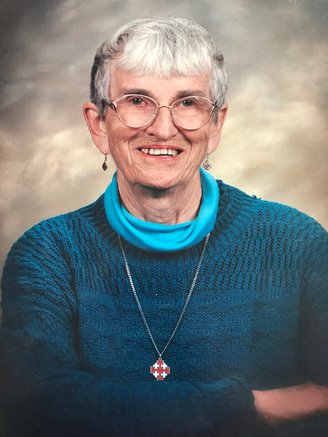
Marylee Patricia Rohde
October 9, 1930 – April 6, 2020
Marylee Rohde died quietly and at peace in Albuquerque, New Mexico on April 6, 2020. She was born in Eureka on October 9, 1930, the youngest child of Walter and Ida Connick. She grew up in Eureka and attended Lafayette Elementary School, Eureka Junior High and Eureka Senior High, graduating from Eureka High School in 1947. She was baptized at Christ Church Episcopal in Eureka and grew up in the church. She spent many happy times with her family and friends on picnics in the redwoods and at Big Lagoon. She attended Humboldt State College after graduating from high school. She met Harold, better known as Hal Rohde at a Job’s Daughter’s - DeMolay event. They fell in love and were married at Christ Church Episcopal on July 10, 1949. They settled in Eureka. Hal reenlisted in the Navy during the Korean War and they lived for a short time on Bainbridge Island in Washington, shortly after the birth of their daughter Katherine (Kay). When Hal was deployed overseas, Marylee and Kay moved back to Eureka. Upon Hal’s return, they purchased the house on Williams Street in Eureka where Marylee continued to live after Hal’s death in 1989. They raised four children there – Katherine, William (Bill), Meredith and John.
Marylee was active at Christ Church Episcopal where she taught Sunday School, served on the Altar Guild, was a member of the Guild of the Good Shepherd and was the adult leader of the Girls Friendly Society (GFS). She became involved with GFS in the Diocese of Northern California, and she coordinated and directed the GFS Creative arts camp for several summers. She sang in the Redwoods Choral and traveled with the group several times on their European tours. She was an Associate of the Community of the Transfiguration, an Episcopal Religious Order, and participated in the Associates Retreats, and the weekly gathering of Associates in the local area.
Marylee worked as secretary for St. Bernard Catholic Church, the Redwoods Halfway House and in the St. Bernard High School office. She enjoyed working with the students and faculty members.
Marylee was very interested in the history of the area as her family had settled in the area back in the 1850’s. She loved to share stories of her relatives’ experiences living in Humboldt County and Eureka. She was a member of the Humboldt County Historical Society and served as president for several terms. Marylee also loved books, and to read. She became involved with the Friends of the Eureka Library and served a term as President of the organization.
Marylee loved the natural world and wanted to learn all she could about the natural and cultural history of the places that she visited. She shared that love with her family and most family outings and vacations were spent hiking, camping, and picnicking in state and national parks. She and Hal continued to enjoy the outdoors as they visited their children who all lived in other states. When the grandchildren came along, Marylee and Hal enjoyed spending time with them.
In 2013, Marylee moved to Truth or Consequences, New Mexico where daughter Meredith lived. When Meredith and her husband Gary retired and moved to Albuquerque, Marylee moved to Brookdale Assisted Living in Albuquerque where she lived until her death. She attended St. Chad’s Episcopal Church in Albuquerque. She enjoyed meeting new people and she participated in the social activities at Brookdale. Marylee is survived by children Katherine Rohde of Albuquerque, New Mexico; William Rohde (Nancy) of Forks, Washington, Meredith (Gary) Michaliszyn of Albuquerque, New Mexico, John (Culleen) Rohde of Centennial, Colorado: 12 Grandchildren: Alex Earring, Elizabeth Bleacher, David Rohde, Christopher Rohde, Michael Rohde, Willie Rohde, Matthew Michaliszyn, Nicholas Michaliszyn, Bridget Wooten, Sean Rohde, Brian Rohde, Kevin Rohde; and, 7 Great-grandchildren – Carson Earring, John and Anne Bleacher, Campbell and Gillian Rohde, Liam Michaliszyn, Sheridan Coyne and Connor Wooten. Marylee is also survived by her sister-in-law Elena Connick; nieces, Patricia Person, Beth Connick, May Ulibarri, Mary Thompson, Darlena Rivera; and nephews, Walt and Stephen Connick and Walter Connick.
She was preceded in death by her husband, Harold, her parents, Walter and Ida Connick, her sister, Helen Person and her brothers, Darrel and Bryce.
A celebration of life is planned for September 11, 2021, at 2 p.m., at Christ Church Episcopal in Eureka. The family welcomes friends of Marylee to join them in celebrating Marylee. Masks are required in the church. Due to the current Covid conditions, the reception has been cancelled. We are looking for options for to gather and tell the stories. Information will be shared during the service on September 11. You may also contact Kay Rohde, 307-277-3421, kayrangerrev@gmail.com or Meredith Michaliszyn, 575-740-0840 for more information.
Her remains will be scattered in Humboldt County.
###
The obituary above was submitted on behalf of Marylee Rohde’s loved ones. The Lost Coast Outpost runs obituaries of Humboldt County residents at no charge. See guidelines here.
Kamala Harris Comes to Newsom’s Rescue, Whether He Needs It or Not
Ben Christopher / Wednesday, Sept. 8, 2021 @ 4:37 p.m. / Sacramento
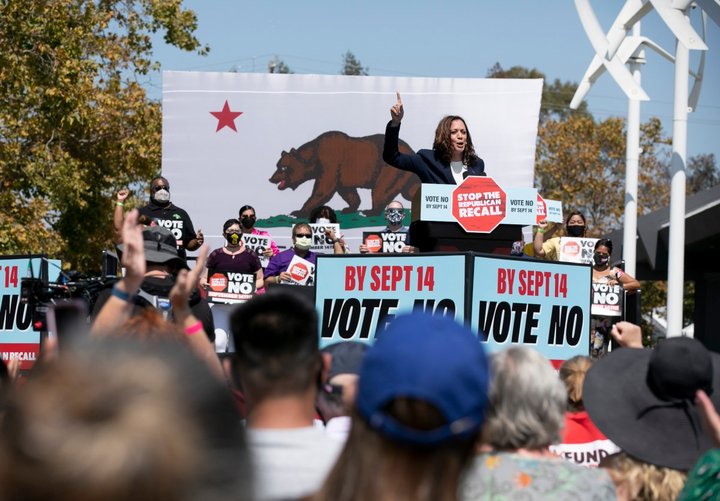
Vice President Kamala Harris speaks in support of Gov. Gavin Newsom at a campaign rally at the IBEW-NECA training center in San Leandro on Sept. 8, 2021. Newsom faces the recall election next week. Photo by Anne Wernikoff, CalMatters
###
There was something almost poetic about this latest rendezvous.
Here was Gov. Gavin Newsom, San Francisco’s former mayor, who ascended to the apex of California government.
Next to him stood Vice President Kamala Harris, another alum of San Francisco politics who climbed those same ranks at the same time, only to ascend further still, landing just short of the peak of American government.
And now, with Newsom facing what could be the most harrowing challenge of his political career, he was back in the Bay Area, though not in San Francisco, but in the East Bay — Harris’ turf. And he’s asking his oldest political frenemy to put in a good word just six days before the Sept. 14 recall.
“It was really important to me to come home today to stand and speak in support of my dear friend, my long-standing friend, a great California leader, a great American leader, Governor Gavin Newsom,” Harris said today before the gathered union members and party activists.
Newsom used the opportunity to lambast the top polling Republican replacement candidate, Larry Elder, as he has at virtually every public event for weeks.
“He doesn’t believe there’s a glass ceiling,” Newsom said. “Tell that to Kamala Harris, who shattered the glass ceiling as vice president of the United States.”
The outdoor rally, held in the parking lot of a union training center lot in San Leandro, drew a bevy of California Democrats: Lt. Gov. Eleni Kounalakis, state Controller Betty Yee, Insurance Commissioner Ricardo Lara, Treasurer Fiona Ma, Democratic Party chairperson Rusty Hicks, Congressmember Barbara Lee and both Bontas — Rob, the attorney general and his wife Mia, who was sworn into her husband’s former Assembly seat on Tuesday.
“Even as our vice president has been working side by side with President Biden to beat back the COVID-19 pandemic and protect American interests around the world,” Lee said, “she’s always stayed rooted right here in her community.”
In one respect, Harris is only the latest big name party player to make the trek out west on Newsom’s behalf. Saturday, Massachusetts Sen. Elizabeth Warren was the main attraction at an anti-recall rally in Culver City, where she hyped Newsom and bad-mouthed Larry Elder, the leading Republican replacement candidate. Minnesota Sen. Amy Klobuchar hit the campaign trail in Orange County the next day.
Former President Barack Obama put out a vote no video today. And Californians can’t turn to YouTube these days without getting a plea from a pre-recorded Sen. Bernie Sanders. Don’t let “some right wing Republican governor” boot Newsom from office, he pleads in the widely distributed ad.
But a campaign stop by Harris means something else, said Corey Cook, a political science professor at St. Mary’s College in Moraga and a close watcher of San Francisco politics.
Other nationally renowned Democrats have done their best to raise the specter of a GOP victory, making a case that “has been less about Newsom and more about what might happen if Newsom loses,” said Cook.
But given her long, overlapping — if sometimes strained — relationship with the governor, Harris “can really mobilize the base with a message other than, ‘just vote against the guys you don’t like,’” Cook said.
“She can actually speak on behalf of Newsom in a way that is credible and more meaningful, maybe, than anybody else.”
There’s another obvious way Harris’ visit stands out. Sean Clegg, a Democratic political strategist who is advising Newsom in the recall and who has worked for Harris, spoke to a gaggle of reporters before the vice president arrived.
“Y’all are here,” he said. “I don’t think there were as many of you for Amy Klobuchar the other day.”
As someone who watched both Harris and Newsom ascend the ranks of San Francisco politics two decades ago, Zirl Wilson, sporting a purple Service Employees International Union T-shirt, said Harris has “great credibility” for him as a voter. “But then again, we’re not here for her, we’re here for Newsom.”
“We know this is just a call for the Republicans to come over and take over California,” he added.
Harris isn’t as popular as she used to be. Nationwide, only 43% of voters hold a favorable view of the vice president, compared to 50% who don’t, according to a Los Angeles Times poll aggregator.
But, importantly for Newsom, Harris remains well above water with voters in her home state. And she remains as popular as ever with Democrats, the voters Newsom is now most eager to turn out. According to a UC Berkeley survey from late July, the most recent statewide survey to ask the question, 77% of Democrats said they approve of the vice president’s handling of her job. Only 12% said they disapprove, with another 11% saying they were unsure.

Gov. Gavin Newsom and Vice President Kamala Harris embrace on stage during a campaign rally encouraging Californians to vote “no” on the recall election next week, at the IBEW-NECA training center in San Leandro on Sept. 8, 2021. Photo by Anne Wernikoff.
Harris’ visit also hammers home the national import of the recall. As both Newsom — and paradoxically Elder, his prime Republican opponent — have stressed, whoever is governor would have the power to fill a vacancy in the U.S. Senate should one open up between now and 2023. If Sen. Dianne Feinstein, who is 88, leaves office early, Elder has vowed to replace her with a Republican. That would tip control of the Senate to the GOP; it is now 50-50, with Harris able to break ties.
This isn’t the first time Harris has flown home to sing Newsom’s praises. When he was running for governor in 2018, Harris, the recently elected and quite popular junior senator hit the campaign trail with him.
And in April of this year, the vice president came to California to tout the Biden administration’s infrastructure plan and threw in a generous helping of praise for Newsom. “We are unambiguous in our support for Gov. Newsom,” she told reporters in Oakland.
Fraternal twins or frenemies?
The support between the two hasn’t always been so unambiguous.
Both ascended parallel career tracks of the San Francisco Democratic power at roughly the same time. They traveled in the same connected, well-heeled circles and each got early leg ups from Willie Brown, the former mayor and Democratic power broker. Both were elected to top executive spots in city government by running as moderates (by San Francisco standards) in 2003. Newsom became mayor, Harris became district attorney; both took their oaths of office on the same day.
And seven years later, both made the jump from San Francisco to Sacramento at the same time with Newsom becoming lieutenant governor and Harris becoming attorney general.
“There’s always been lots of tension and animosity there, but they suppress it pretty well,” said Garry South, a Democratic political strategist who ran Newsom’s unsuccessful gubernatorial campaign in 2010.
Political “fraternal twins” is how Clegg put it to the San Francisco Chronicle in 2014. “And if they ever run in the same race, it would be ‘a murder-suicide.’”
The two could-be rivals avoided that grisly outcome in 2015.
Sen. Barbara Boxer, first elected in 1992, was throwing in the towel and Gov. Jerry Brown was halfway through his fourth and final term. As longtime California political reporter Dan Morain wrote in his biography of the vice president, Harris and Newsom reached a solomonic kind of pact to divvy up the soon-to-be-vacant seats and go their separate ways. Harris would run for Boxer’s seat in D.C. and Newsom would make his claim on the governor’s mansion.
Six years later, their paths are crossing again.
“I’m out here to support her in any way we can,” said Brenda Okoli-Ugbiyobo, another SEIU worker from Oakland. “Because she’s here to support someone else. And that’s the way it is when you get up there — you reach back and pull other people up.”
Not that Newsom would likely appreciate that framing.
In 2008, the two rising stars met on equal footing at the Democratic National Convention in Denver. Both were highlighted as “hotshots to watch” on a Time magazine panel, alongside Cory Booker, then the mayor of Newark and now U.S. senator from New Jersey. Asked what united everyone on stage, Newsom said it was their self-determination: “We are not waiting for Air Force One to rescue us.”
This week, it’s just Air Force Two flying to Newsom’s rescue. The president is scheduled to follow suit early next week.
###
CALmatters.org is a nonprofit, nonpartisan media venture explaining California policies and politics.
Looking to Streamline Development of the Waterfront and Old Town, City of Eureka Seeks Help From Outside Consultants
Stephanie McGeary / Wednesday, Sept. 8, 2021 @ 3:12 p.m. / Local Government
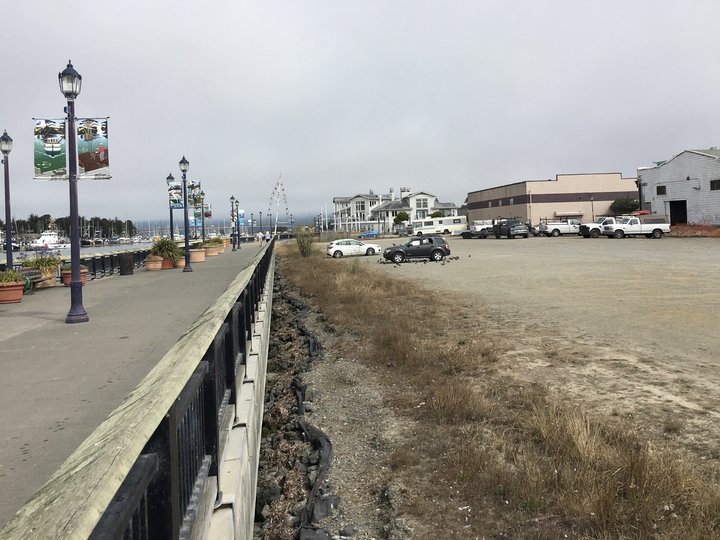
Our sparsely building’ed waterfront. Photo: Stephanie McGeary.
###
For years the City of Eureka has been looking for ways to improve the waterfront and develop the gravel lots and vacant buildings in the area, a process that has proven laborious, largely due to the extra steps involved with developing in the Coastal Zone. Now, the City has decided to outsource some of that work by hiring a firm to develop the Waterfront Specific Plan, which will guide zoning changes and future development for about 130 acres of the city.
During Tuesday’s meeting, the Eureka City Council unanimously approved the release of a request for proposals (RFP) for the Waterfront Specific Plan, the deadline for which will be Oct. 29. A panel will then review the proposals, conduct interviews (if necessary) and the Council will vote to award a proposal in December.
The goal of the plan, Caitlin Castellano — senior planner for Eureka — explained to the council during the meeting, is to provide a roadmap for development of the vacant and underutilized sites and buildings along and near Eureka’s central waterfront. The hired consultant would be in charge of creating the document and facilitating the necessary environmental analysis required by California Environmental Quality Act (CEQA).
“Eureka’s Local Coastal Program — known as the LCP — and the 2040 General Plan call for mixed use development along Eureka’s waterfront on Humboldt Bay,” Castellano read from the RFP during Tuesday’s meeting. “However, regulatory and environmental barriers often hinder these efforts.”
This idea is that approval of this plan will allow for CEQA streamlining, meaning that future developments within the project area wouldn’t necessarily be subject to the full CEQA process, making it much easier for the projects to move forward.

Map of the project area for the Waterfront Specific Plan | from the City’s RFP
The project area covers about 130 acres and includes Eureka’s Old Town neighborhood, the Commercial Bayfront and the Library District. Castellano said that if the budget allows, the project area could be expanded to include portions of Eureka’s downtown neighborhood as well. The project will be funded by a $215,000 California Department of Housing and Community Development Grant.
Eureka’s vision for the Waterfront Plan, outlined in the RFP, includes the development of housing, retail spaces, restaurants, waterfront hotels, vacation rentals, neighborhood markets, and public spaces — including plazas, squares, parks, parklets and community gardens. The City would especially like to see plans for mixed-use developments, which would include businesses on the ground floor, with housing units above.
Of course, with the City currently desperate to meet state housing requirements, there is a lot of emphasis on the inclusion of housing plans. Castellano said that one of the major goals of this project is the creation of at least 115 housing units by the year 2027.
The RFP also states that the proposal should address historic preservation, improvements to pedestrian, bicycle and transit connectivity, improvements to street lighting, branding and promotional strategies and should “solicit the active participation of property owners, investors, local business owners, and residents.”
Parking will also need to be a part of the plan and will need to be coordinated with the City’s downtown parking study, which is currently underway. Councilmember Natalie Arroyo, clearly alluding to some of the community backlash around plans to build housing on city-owned parking lots, mentioned that conducting a parking study will be an important and possibly lengthy part of this process.
“As we’ve seen in the last years, people’s feelings about parking can be in direct conflict with housing development,” Arroyo said during the meeting. “If we don’t address it, we’re going to regret it.”
View the full Waterfront Specific Plan RFP here.
HSU Saw the Highest Number of Reported Rapes In More Than a Decade During the COVID Lockdown, Report Shows
John Ross Ferrara / Wednesday, Sept. 8, 2021 @ 2 p.m. / HSU
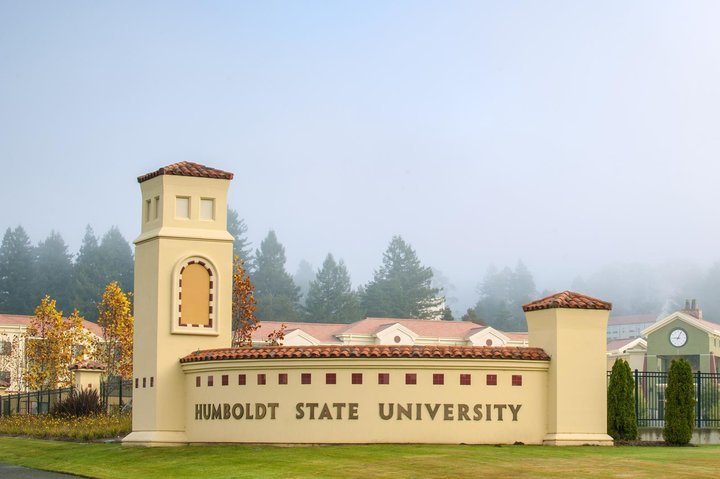
HSU | Photo courtesy of the CSU system.
In a year where in-class learning was suspended and the amount of students living on campus was cut by more than half due to the COVID-19 pandemic, Humboldt State University saw its highest number of reported rapes since 2006, according to its annual crime statistics released yesterday.
The Clery Act report — a federally mandated disclosure of university crime statistics — shows that six on-campus rapes and five “fondling” incidents were reported at HSU in 2020.
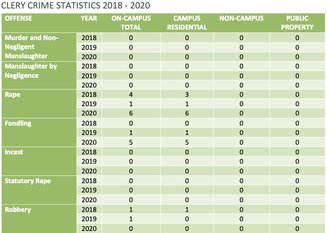
A segment of HSU’s 2020 Clery report. | HSU
HSU Police Department Chief Anthony Morgan, who replaced Chief Donn Peterson in February, discussed last year’s rise in reported sexual assaults with the Outpost.
“I’ve really been focusing on statistics [for crimes that have occurred] since I’ve been here,” Morgan said. “I understand these numbers are concerning and will take a deeper dive into each report to deter these types of incidents moving forward.”
Although the university saw the highest number of reported rapes in nearly 15 years, experts such as Maxwell Schnurer, HSU’s chair of the Sexual assault Prevention Committee, say that a rise in reports can also reflect a supportive campus environment.
“If harm happens, the university tries to get support for those folks,” Schnurer said. “It’s a good thing that people know they can get help on campus.”
And while the university’s Sexual Assault Prevention Committee prioritizes prevention, as the name suggests, it’s also focused on creating a culture where victims of sexual assault — a historically underreported crime — feel comfortable coming forward.
“Our primary goal is prevention,” he said. “We use Check It bystander intervention training and cultural norms to [encourage students to] have each other’s backs and intervene before harm happens. The Secondary thing is: responding if harm happens and making pathways to getting help clear.”
While the university uses Clery report data in its planning to prevent sexual assault, the numbers themselves aren’t an exact tool for measuring how many students are sexually assaulted each year. For example: If a student reports a rape that occurred off university property, or if the location is unknown, the incident would not be reflected in the annual Clery report.
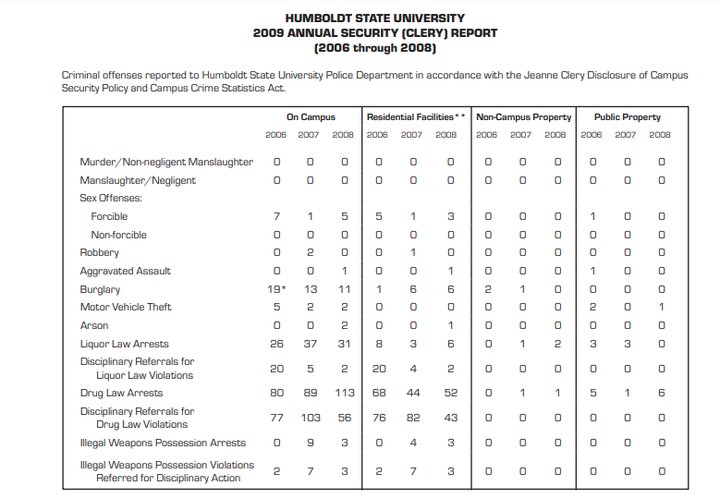
A segment of HSU’s Clery report in 2009. | HSU
A single incident of sexual assault can also be unintentionally represented in a Clery report multiple times. If a student were to report one sexual assault to multiple university employees, that single incident could be reflected in the report by more than one figure.
HSU Program Analyst for Title IX and Discrimination, Harassment and Retaliation Prevention Nicki Viso told the Outpost that the Clery data is more of a reflection of school policy than an exact calculation of students who are sexually assaulted each year.
“[The report] filters out certain things,” Viso said. “It’s like a piece of campus security. It tells the full picture of our policies, but what goes in those columns is very specific.”
While it’s unclear if the pandemic had any effect on the number of rapes reported on campus last year, Schnurer said that HSU’s Sexual Assault Prevention Committee will have its monthly meeting this Friday, where the university’s top decision makers will discuss the Clery report and ways to improve campus safety.
Schnurer encourages all victims of harm within the campus community to contact the Campus Advocate Team hotline at (707) 445-2881.
Newsom’s Call Now: California Legislature Passes These Top 2021 Bills
CalMatters staff / Wednesday, Sept. 8, 2021 @ 7 a.m. / Sacramento

The State Capitol in Sacramento. Photo: Max Whittaker, CalMatters.
###
The second year of the coronavirus pandemic in California was shaped by two political undercurrents at the state Capitol: a budget awash with cash, thanks to a booming stock market and federal aid, and a looming recall election asking voters to throw Gov. Gavin Newsom out of office.
A massive budget surplus allowed Newsom and legislative Democrats to go big on a progressive agenda they believe will help the state recover from COVID hardships. They passed a $262.6 billion budget that includes:
- free preschool for all 4-year-olds
- lunch for all public school students
- state-funded health insurance for low-income undocumented immigrants age 50 and older
- grants for small business owners
- rent and utility relief for people who fell behind on their bills
- $600 stimulus payments for most Californians — landing in bank accounts just weeks before the Sept. 14 recall election.
Newsom found himself with so many dollars to spend that he gave away $115 million to encourage Californians to get the COVID-19 vaccine with a series of game-show style lotteries. That led to the surreal image of the governor on stage with life-size action figures and googly-eyed minions as he celebrated the reopening of amusement parks and handed out vaccine lottery checks under a shower of confetti.
But gobs of money and Democrats’ supermajority didn’t make everything possible. Tensions between moderate and liberal Democrats stymied many proposals. The recall threat also may have doomed some legislation that might have reflected unfavorably upon California and its governor. Bills that stalled included proposals to create single-payer health care, ban corporate donations to political candidates, legalize psychedelic drugs, sanction clinics where addicts can use illegal drugs under medical supervision, and allow people to turn their bodies into garden compost after death.
Still, lawmakers managed to send Newsom hundreds of bills, which he has until Oct. 10 to sign or veto. Even if voters oust him on Sept. 14, the transition period of as long as 38 days means the fate of these bills is in Newsom’s hands. Here are the most interesting or consequential decisions the governor faces.
— Laurel Rosenhall
Changing single-family zoning
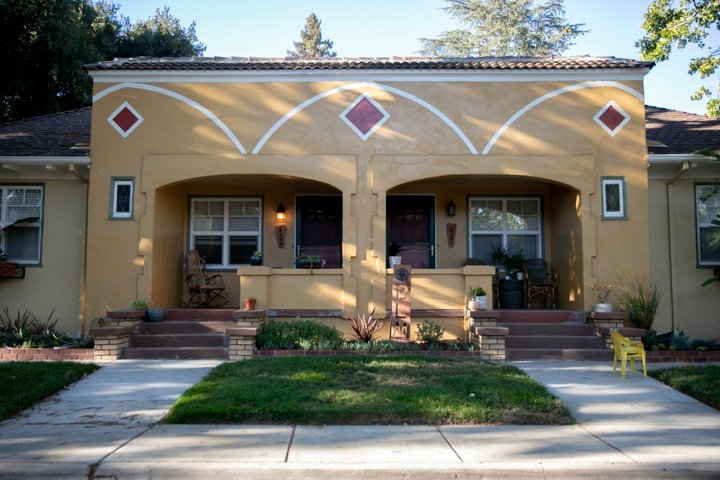
A duplex in Sacramento on Aug. 4, 2021. Photo by Anne Wernikoff, CalMatters
WHAT THE BILLS WOULD DO
SB 9 would allow most homeowners across the state to build two houses or a duplex where now only one house is allowed. The bill, carried by a team of Democrats led by Senate leader Toni Atkins of San Diego, would also permit eligible homeowners to split their lot and add two more units on the second parcel — as long as it’s at least 1,200 square feet and outside fire hazard zones or historic districts. Owners would have to stay in their homes for at least three years after splitting their lots.
SB 10 by San Francisco Democratic Sen. Scott Wiener would let a local government rezone single-family parcels to allow as many as 10 units near public transit hubs and within urban areas.
Both bills would allow homeowners and developers to skip lengthy review processes, but projects would still ultimately be subject to final approval by the city.
WHO SUPPORTS THEM?
The growing Yes in My Backyard movement has been trying to increase density for years, with mostly failed attempts. Realtors, landlords, builders, developers and Facebook all back the bills, which were central to the affordable housing package put forward by state Senate leader Toni Atkins, a San Diego Democrat.
WHO’S OPPOSED?
Dozens of California cities, mayors and council members, including the Los Angeles City Council, say the zoning changes take away local flexibility, decision-making and community input. Neighborhood groups such as Livable California also argue the bill doesn’t create affordable housing, and could spur gentrification. Opponents are already organizing a ballot measure in November 2022 to reassert local control over zoning.
WHY IT MATTERS
About two-thirds of California is zoned for single-family homes, and California is short between 1.8 million and 3.5 million homes, which Newsom campaigned on building by 2025. While a zoning change won’t magically create the missing units, allowing building where it’s now illegal would add to the overall housing stock over time. Together, these bills are the most significant in years approved by the Legislature to address California’s housing crisis; a sweeping bill to reduce local control over zoning and create more affordable housing failed in 2018, 2019 and 2020.
GOVERNOR’S CALL: ?
Ending secret settlements
By Grace Gedye
WHAT THE BILL WOULD DO
SB 331 would ban employers from using secret settlements to prevent workers from speaking out about all kinds of illegal harassment or discrimination, with some limited exceptions. Carried by Democratic Sen. Connie Leyva of Chino, it builds on a law passed in 2018, which limited the use of non-disclosure agreements to settle cases of sexual discrimination, harassment or assault.
WHO SUPPORTS IT
A bevy of legal groups, labor groups, and women’s advocacy groups support the bill. It is co-sponsored by California Employment Lawyers Association, Equal Rights Advocates and Ifeoma Ozoma, a former public policy official at Pinterest who broke her non-disclosure agreement to speak out about discrimination she says she faced at the company. They say secret settlements perpetuate workplace discrimmination and harassment because they prevent survivors from speaking out.
WHO’S OPPOSED
Initially, objectors included a group of businesses and trade associations, helmed by the California Chamber of Commerce, arguing that the bill would effectively end the use of severance agreements. Businesses that choose to use severance agreements often do so in part to safeguard against potential reputational harm. In response to several amendments, such as one that allowed employers to keep the size of severance payments confidential, the Chamber and other groups withdrew their formal opposition.
WHY IT MATTERS
Non-disclosure agreements are used widely among the world’s most powerful tech companies, many of which are based in California. Other industries use them too. By allowing workers to come forward with their allegations, this bill could prevent repeat offenders from harassing others. It would also allow workers to discuss their experiences with family and friends even if they decide not to go public — something many of these agreements prohibit. The flip side: Businesses concerned about protecting themselves against reputational harm would have one less tool in their toolkit if this bill becomes law.
GOVERNOR’S CALL: ?
Legal protection for prescribed burns
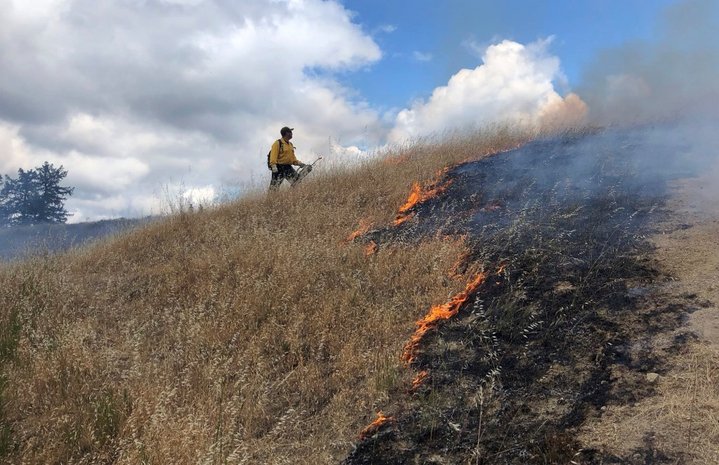
A prescribed burn in 2019. Photo courtesy of Lenya Quinn-Davidson, University of California Cooperative Extension/Humboldt County Prescribed Burn Association
By Julie Cart
WHAT THE BILL WOULD DO
The state is more frequently handing off some responsibility for off-season prescribed burns to local fire-safe community groups and tribes. SB 332 by Democratic Sen. Bill Dodd of Napa would provide legal and liability cover to those entities should the fires they set get away from them.
WHO SUPPORTS IT
The bill is supported by a broad base of groups, including farming and ranching advocates, local fire-safe organizations and firefighting professionals. Supporters say the bill would remove a financial disincentive and create more fuel breaks to save lives and structures.
WHO’S OPPOSED
Insurer and attorney groups opposed the bill, saying that lowering the legal accountability for those who set prescribed burns will bring an “unintended affect (that) will be catastrophic for California’s property and people.”
WHY IT MATTERS
Wildfire experts agree that a powerful prescriptive against fires is to safely set them under precise conditions to reduce the fuels — trees and brush — available to burn, especially around communities. The state has agreed to an ambitious prescribed-burn program and is training local officials and volunteers to carry out the fires. But fear of liability should the fire accidentally escape has prevented broader adoption of the program.
GOVERNOR’S CALL: ?
Greater access to police records

Police officers in Balwin Park on Aug. 6, 2019. Photo by Anne Wernikoff for CalMatters
WHAT THE BILL WOULD DO
SB 16 by Berkeley Democratic Sen. Nancy Skinner would expand the public’s access to police records — allowing them to view sustained findings in which an officer used unreasonable force, failed to intervene when another officer used excessive force, engaged in racist or biased behavior, or conducted unlawful arrests and searches. It also would allow release of records after an officer resigns, put a 45-day limit on when agencies must respond to records requests, and remove the time limit on when judges can consider police misconduct complaints to be admissible in criminal cases.
WHO SUPPORTS IT
The American Civil Liberties Union, the California News Publishers Association, the California Public Defenders, the California Police Chiefs Association and a long list of civil rights organizations. Supporters see this bill as a way to hold more police accountable.
WHO’S OPPOSED?
Originally opponents included the League of California Cities, which argued that the bill would place a substantial burden on city budgets, and the California State Sheriffs’ Association, which contended the bill was too broad. Both dropped their opposition after the bill was amended to limit mandatory release of information only in sustained cases, not every incident.
WHY IT MATTERS
California is one of the most restrictive states in the nation when it comes to releasing police misconduct records. In 2018, the Legislature passed a law giving the public access to police records if officers lied during an investigation, sexually assaulted someone, or used their guns or other force in a case in which someone was seriously injured or died. This bill would further expand that access.
GOVERNOR’S CALL: ?
Teaching mental health
WHAT THE BILL WOULD DO
SB 224 would mandate mental health instruction in middle schools and high schools that have an existing health education course. Supporters hope that such instruction would eventually be required in all schools statewide. Content would cover a range of topics, including habits that promote mental wellness, signs and symptoms of common mental health conditions and ways to seek help.The bill is carried by Democratic Sens. Anthony Portantino of La Cañada Flintridge and Susan Rubio of Baldwin Park.
WHO SUPPORTS IT
A coalition of nearly 50 organizations that advocate for mental health, children’s rights, disability rights and civil rights, along with the California Hospital Association and the American Academy of Pediatrics, support the bill. They say it’s crucial to reduce stigma and normalize conversations about mental health in schools, since that’s where children and adolescents spend the majority of their time.
WHO’S OPPOSED
No current opposition. To address concerns raised by teachers unions, the bill’s scope was reduced to include only schools with current health education programs, as opposed to all schools in the state.
WHY IT MATTERS
Over the past decade, rates of hospitalization for mental health emergencies have been skyrocketing among children and adolescents. Between 2012 and 2019, California emergency rooms reported a 42% increase in the number of children they were treating for mental illness. The pandemic has further exacerbated the trend.
GOVERNOR’S CALL: ?
Vote-by-mail for farmworker union elections
By Grace Gedye
WHAT THE BILL WOULD DO
Currently, farmworker union elections are held in-person, often on the grower’s property. AB 616 by Democratic Assemblymember Mark Stone of Santa Cruz would give farmworkers the option to vote at home — or anywhere else they like — in union elections. Then they could deliver or send their ballot, sealed in a signed envelope, to the state board that oversees farmworker union elections, or they could give it to an organizer to deliver on their behalf.
WHO SUPPORTS IT
Labor groups and unions, including United Farm Workers, which sponsored the bill. They say it would make union elections more accessible to farmworkers.
WHO’S OPPOSED
Business groups, like California Chamber of Commerce, and groups that represent the interests of farm owners, like the Western Growers Association, oppose the bill. They say they’re concerned about workers being pressured into voting a certain way if this bill is enacted. Workers are allowed to have a witness present when they vote at home under this bill.
WHY IT MATTERS
The rate of unionization among farm workers is incredibly low — approximately 0% according to analysis from UC Merced. Unions are linked to higher wages and better benefits for workers. This bill would give farm workers another way to participate in union elections and could speed up the election process.
GOVERNOR’S CALL: ?
Adding dependent parents to your health plan
A nurse practitioner examines an elderly patient at a clinic in Guerneville in February 2020. Photo by Anne Wernikoff for CalMatters
WHAT THE BILL WOULD DO
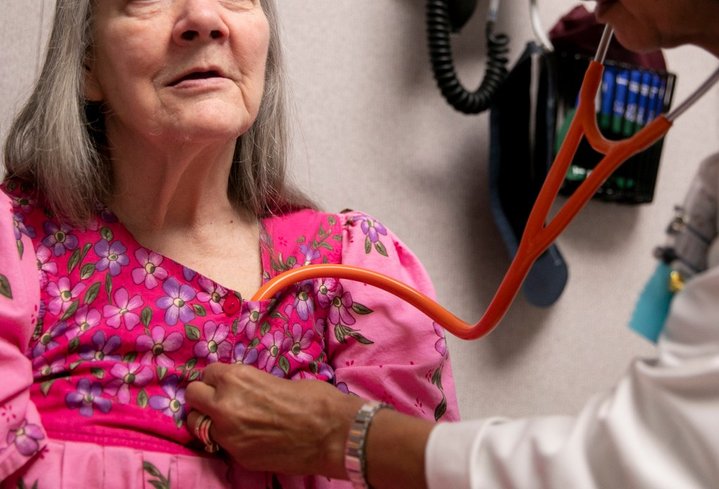
AB 570 would require health insurance plans to make coverage available to their members’ dependent parents. Under federal law, people already can add their children up to age 26 to their health plans. Through this bill, authored by Assemblymember Miguel Santiago, a Los Angeles Democrat, California would be the first state to expand this benefit to include parents. This bill applies only to private state-regulated health plans.
WHO SUPPORTS IT
The bill was sponsored by state Insurance Commissioner Ricardo Lara and health care advocacy and immigrant rights organizations as a way to expand coverage and help a family reduce health care costs by having all family members covered by the same plan.
WHO’S OPPOSED
The California Association of Health Plans and the California Chamber of Commerce initially argued that the bill would raise premiums, but dropped their opposition after the bill was amended to exclude employer-sponsored and group plans.
WHY IT MATTERS
The bill, which the state estimates would benefit up to 15,000 people, could be most helpful to middle-class families with undocumented parents who don’t qualify for Medicare or subsidized coverage through the state’s marketplace. This year’s state budget opened the state’s Medi-Cal program to low-income undocumented people 50 and older and removed some barriers for older Californians.
GOVERNOR’S CALL: ?
Gender-neutral toy sections
By Grace Gedye
WHAT THE BILL WOULD DO
AB 1084 would require large department stores that sell kids’ products to maintain a gender-neutral section of toys and child care items. Stores that do not comply would face a light penalty: a fine of up to $250 for first offenses, and a fine of up to $500 for second offenses. It’s carried by Democratic Assemblymembers Evan Low of San Jose and Cristina Garcia of Bell Gardens.
WHO SUPPORTS IT
The Phluid Project, which partners with brands to distribute gender-free clothing and accessories, argues that the bill will increase freedom of expression for children and parents. It’s also backed by Equality California and the Consumer Federation of California, which says that products marketed to girls often have higher price tags.
WHO’S OPPOSED
Socially conservative groups including the Capitol Resource Institute and California Family Council say it’s not the state’s role to mandate how stores market their products. Retailers objected to an earlier version of the bill that included children’s clothing, a provision since removed from the bill.
WHY IT MATTERS
This bill might not radically alter Californians’ shopping experiences: Some large stores already organize their toys by type of product rather than by gender. But it’s a foot in the door for advocates who could push for bigger change in the future.
GOVERNOR’S CALL: ?
###
CALmatters.org is a nonprofit, nonpartisan media venture explaining California policies and politics.


