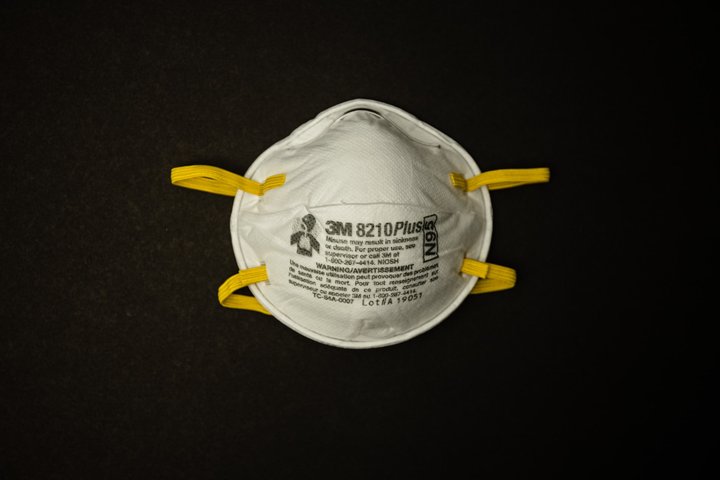
The N95s are the ones you want. You might not get this model, but you’ll get one just as good. Photo by Jonathan J. Castellon on Unsplash.
###
From the Arcata Economic Development Corporation:
In the face of rising COVID numbers in Humboldt County, Arcata Economic Development Corporation (AEDC) is organizing the distribution of Personal Protection Equipment (PPE), 200,000 N-95 regulation face masks for small businesses and nonprofits to use in response to the revived mask regulation. The masks will be distributed free of charge thanks to a contribution from the Governor’s Office of Emergency Services, the Office of the Small Business Advocate and PPE Unite.
There will be distribution events held throughout the county next Tuesday Aug. 24 with the remaining masks available to schedule for pick up around the community after the events. Masks will be distributed until the supplies run out.
“We did this a year ago. This is not where we hoped to be right now,” said Susan Seaman, program director for AEDC. “Still, I’m grateful that we can again provide materials to keep our businesses safe and open. I also continue to be so amazed at the collaborative nature of our community who pulled together all of these events in less than a week. Besides our distribution partners, the City of Eureka received and is storing several pallets of masks and the Pierson Company immediately allowed the use of their parking lot for drive through distribution site. These things could be big hurdles. They aren’t when we all work together.”
Here is a list of where businesses can pick up their PPE on Tuesday, Aug. 24. Businesses are not required to be part of any organization to receive masks.
Arcata: The City of Arcata will host an event for people to pick up materials at the City Hall parking lot from 10 a.m. to 4 p.m. Arcata Chamber of Commerce and Arcata Main Street are partnering with the City for distribution.
Greater Eureka Area: Arcata Economic Development Corporation will host a drive-through distribution event at the Eureka Mall on from 9 a.m. to 1 p.m. The event will be held on the Henderson Street side of the mall. The City of Eureka, Eureka Main Street and Eureka Chamber of Commerce are partnering to help distribute masks in Eureka.
Fortuna/Eel River Valley: Fortuna Chamber will have a distribution event for materials on Tuesday, from 9 a.m. to 1 p.m. at the Fortuna Chamber, 735 14th St, Fortuna. Fortuna Business Improvement District is working with the Fortuna Chamber to distribute masks.
McKinleyville: McKinleyville Chamber of Commerce will be hosting their distribution event at the McKinleyville Chamber at 1640 Central Avenue, from 9 a.m. to 1 p.m.
Southern Humboldt: Materials will be distributed at the Garberville Chamber of Commerce at 782 Redwood Drive, from 9 a.m. to noon. The Southern Humboldt Visitor Center Bureau is partnering with the Chamber to distribute masks.
After the distribution date, businesses can schedule a time to pick up additional masks at one of the many partner locations in the County by going to ppeunite.org.
Additional communities will be distributing masks to their businesses. Contact the City of Blue Lake, the City of Rio Dell, the City of Trinidad for more information. Willow Creek Chamber of Commerce will be distributing their masks through Coast Central Credit Union in Willow Creek.
This distribution is done with the help from the COVID Economic Resiliency Consortium (CERC), a group of business and economic development advocates who have been providing updates, sharing resources, and ensuring consistent communication to our community’s businesses and public-at-large about COVID 19 since March 2020.
For questions about masks or mask distribution, please call Susan Seaman at (707) 798-6132 ext. 212 or email susans@aedc1.org.
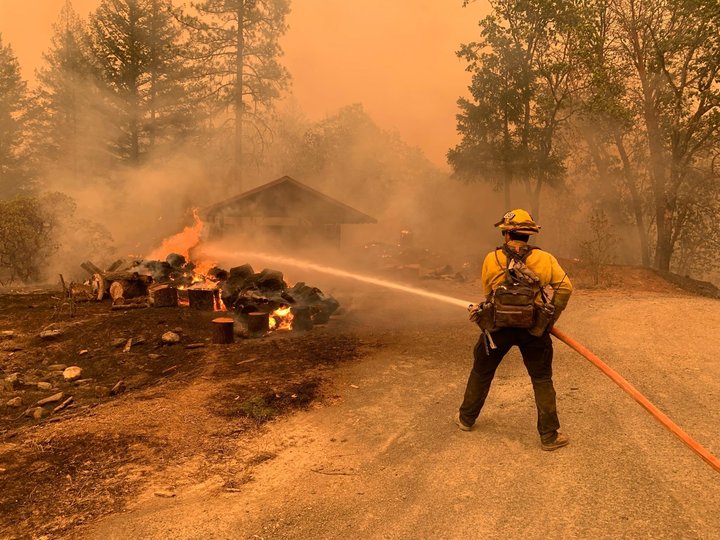
A Calfire engine crew protecting a structure in Junction City on Monday. | InciWeb
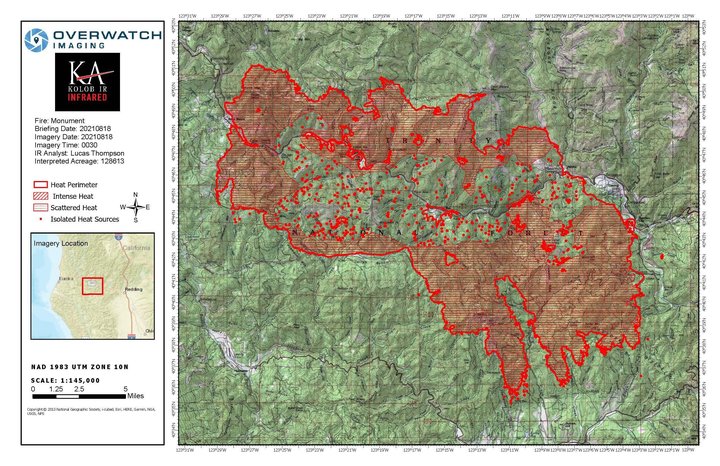
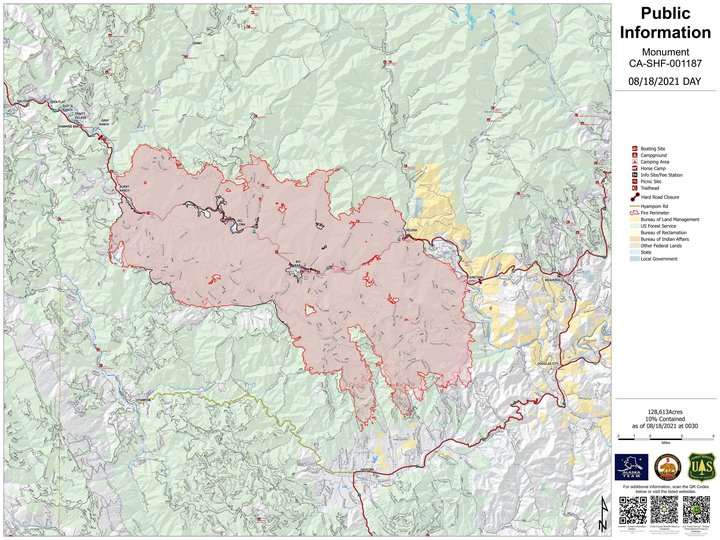
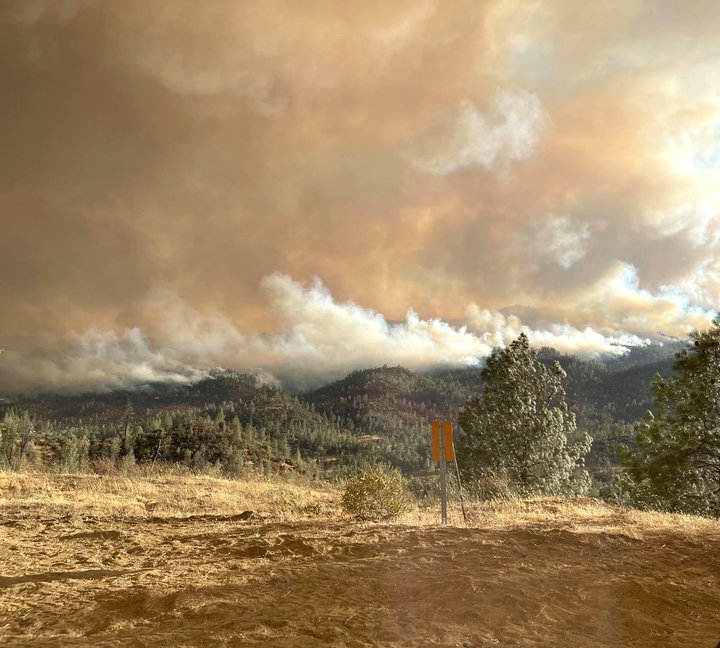
The Monument Fire burning along Highway 299 between Burnt Ranch and Weaverville has grown to 128,613 acres and remains 10 percent contained.
The number of firefighters battling the fire has increased to 920 as the fire continues to threaten communities in Trinity County.
“The Monument Fire continued to advance to the south, east and north, threatening the communities of Junction City and Hayfork,” the fire’s incident management team stated today.
The Trinity County Office of Emergency Services is urging people to sign up with the CodeRed emergency alert system for the latest evacuation information.
Evacuation Orders: In effect for Sky Ranch Road, Junction City, Red Hill, Canyon Creek, Coopers Bar, Big Bar, Del Loma, Big Flat, Helena, Cedar Flat, Burnt Ranch, Sky Ranch Road in Junction City, Barker Mountain and the areas northwest of Hayfork Summit and Sunshine Meadows, Harrison Road, Farmer Ranch Road and for residences from Ewing Road, up through all residences off Brady Road in Hayfork.
Evacuation Warnings: In effect for Weaverville, Douglas City, areas south from Barker Mountain to Haystack proper and the north side of Hyampom Road from Hayfork proper to nine-mile bridge.
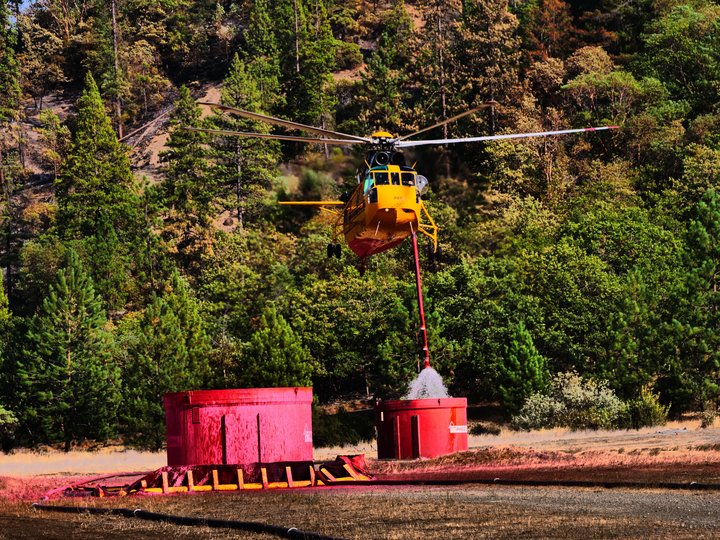
A heavy lift helicopter taking off after filling its tank with water yesterday. | U.S. Forest Service
American Red Cross evacuation shelters are available at Shasta College at 1555 Old Oregon Trail, Building 1900 in Redding and at Trinity Valley Elementary School at 730 Highway 96 in Willow Creek.
A domestic animal shelter is set up at the Trinity County Animal Shelter at 563 Mountain View St. in Weaverville (530- 623-1370). Domestic and large animals can be taken to the emergency shelter at the Hoopa Rodeo Grounds on Pine Creek Road in Willow Creek.
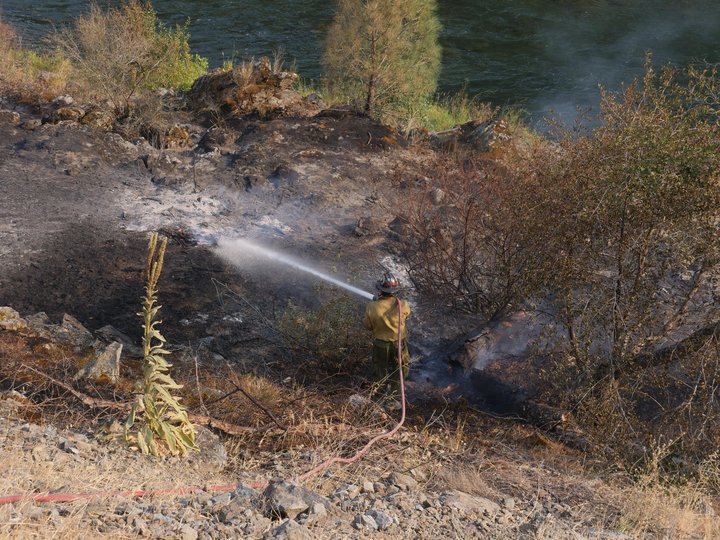
Engine Captain Diego Alvarez dousing a hot spot along the Trinity River yesterday. | USFS
Highway 299 remains closed from Hawkins Bar to Oregon Springs Road.
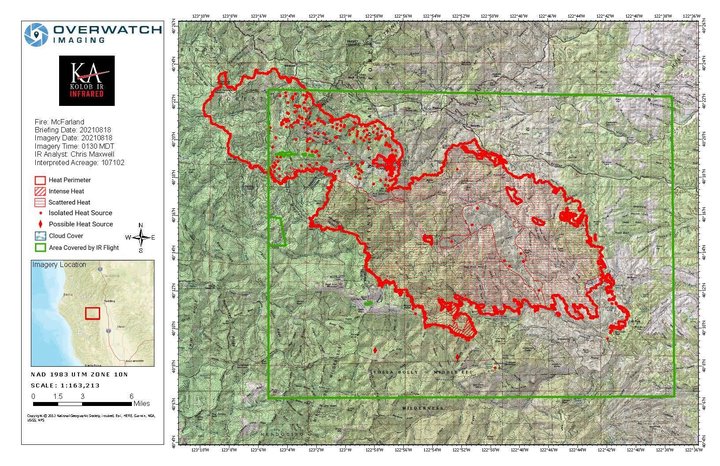
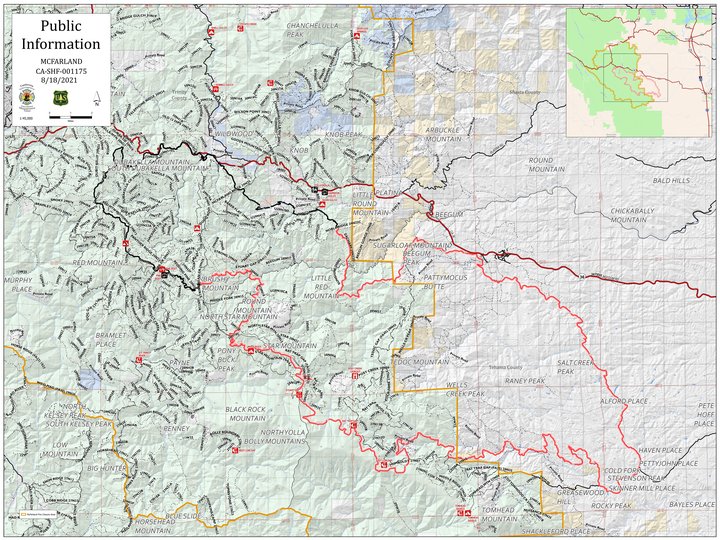
The McFarland Fire burning along Highway 36 in trinity County has grown to 107,102 acres.
While firefighters say they once had the fire 68 percent contained a few days ago, the fire’s containment is now listed at 51 percent.
“Yesterday, gusty and dry west to northwest winds surfaced over the fire area and increased fire activity,” the fire’s incident management team stated today. “Extreme fire behavior pushed the fire to the east into Beegum Peak and over Tedoc Mountain. Fire continued to push and spot to the east and southeast. Crews were able to get a dozer line in Pattymocus Butte last night to keep fire off the Highway 36 corridor.”
A Red Flag Warning is still in effect across the North Coast’s interior until 8 p.m. today. Northwesterly winds with 30 to 40 mph gusts are forecast throughout the evening, making for critical fire conditions.
While containment lines continue to shrink, the amount of firefighters dispatched to fire is also on the decline. As of this morning there are 631 firefighters actively working on the fire — 31 fewer firefighters than on Monday.
Evacuation Orders:
One mile north of Highway 36 from Platina to Vestal Road, all homes south of Highway 36 including all of Tedoc Road, east to and including all of Vestal Road, north of Pettyjohn Road; North of Pettyjohn Road to Highway 36W and west of the intersection of Highway 36W and Canon Road to to Tehama-Trinity County line.
Evacuation Warning:
All homes on the south side and all homes to one mile north of Highway 36 from the Shasta-Trinity County line to Platina; North of Bowman Road and Highway 36 west of Luce Griswold to the Tehama-Trinity County line.
Highway 36 remains completely closed between Highway 3 and Bowman Road. Due to the closure, Caltrans District 2 is currently operating one-way traffic control with short delays at the August Complex Emergency Slide location on Highway 36 approximately 6 miles west of the Highway 3 junction.
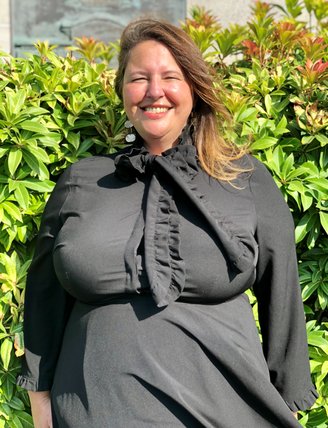
Arcata City Council’s newly-appointed Councilmember Meredith
Matthews was sworn-in to public office in a formal ceremony outside of Arcata City Hall on Tuesday,
August 17.
On Wednesday, July 28 the Arcata City Council appointed Matthews to serve out the remainder of Sofia
Pereira’s term of office after she stepped down to take on a new position as Humboldt County’s Director of
Public Health. The Arcata City Council made the decision to appoint a new Council Member to serve the
remainder of Pereira’s term, which will end in November of 2022.
Of her swearing in, Matthews said, “Being sworn-in to serve on the Arcata City council is an honor that I
do not take lightly. I am so proud to be able to represent the people of Arcata, the town that I love. I just
want everyone to know that they have a voice, and I am so happy to be a voice for Arcata.”
Matthews’ first public meeting as an official member of the Arcata City Council will take place [today],
Wednesday, August 18 at 6 p.m.
Due to the rise in COVID-19 cases locally, Arcata City Council meetings are currently being held on
Zoom.
The agenda for the meeting can be found here with more information on how to view the meeting or
make public comment. For more information, please visit cityofarcata.org or call (707) 822-5953.
Press release from the Humboldt County Sheriff’s Office:
On Aug. 16, 2021, at about 6:27 p.m., Humboldt County Sheriff’s deputies were dispatched to a parking lot on the 7300 block of Tompkins Hill Road for the report of a vandalism and brandishing that had just occurred.
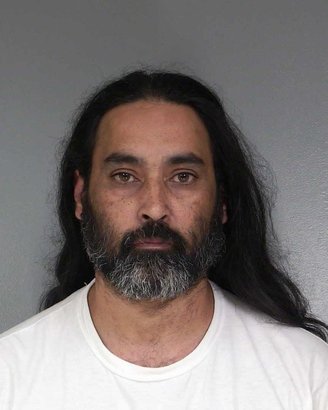
Deputies contacted a 41-year-old male victim who was uninjured. The victim told deputies that he had driven to the Fields Landing Boat Ramp to meet with a female acquaintance, 42-year-old Melissa Marie Ryan. Upon his arrival, the victim was confronted by Ryan and 50-year-old Gabino Antonio Rivera. According to the victim, Rivera brandished a knife at the victim, began threatening him, then stabbed a tire and the victim’s vehicle.
The victim fled in his vehicle to the Tompkins Hill location. The suspects followed the victim to the location. Rivera then reportedly exited his vehicle and brandished a crossbow at the victim before fleeing the area.
Gabino Rivera
Deputies contacted Rivera and Ryan outside a residence on the 1800 block of Buhne Drive in King Salmon. Following further investigation, Rivera was taken into custody and booked into the Humboldt County Correctional Facility on charges of attempted assault with a deadly weapon likely to cause great bodily injury (PC 664/245(a)(1)), exhibiting a deadly weapon other than a firearm (PC 417(a)(1)), criminal threats (PC 422), vandalism (PC 594(b)(1)), conspiracy to commit a crime (PC 182(a)(1)) and violation of probation (PC 1203.2(a)(1)).
Ryan was cited and released on charges of conspiracy to commit a crime (PC 182(a)(1)).
Anyone with information about this case or related criminal activity is encouraged to call the Humboldt County Sheriff’s Office at (707) 445-7251 or the Sheriff’s Office Crime Tip line at (707) 268-2539.
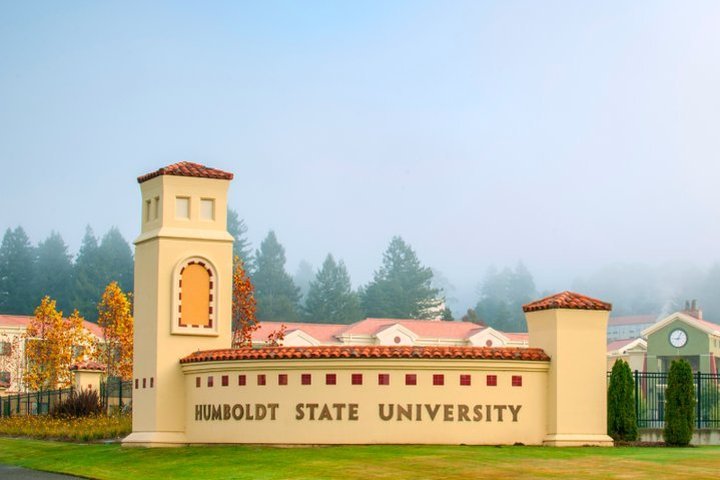
As the Dixie Fire continues to grow, Lassen Community College in Susanville evacuated 106 students and staff to Humboldt State University.
They arrived by bus early Wednesday morning and are staying in residence halls, separate from HSU students, until conditions improve in Susanville.
HSU is providing them with supplies and, in coordination with the local Red Cross, health and wellbeing services and other support during their stay.
The LCC students include those who arrived last week and had left HSU on Saturday. Most evacuees are vaccinated, though out of an abundance of caution they were tested for COVID-19 immediately upon arrival. Those who are unvaccinated must be tested weekly.
Everyone will be expected to follow all campus health and safety protocols, including wearing masks on campus and doing daily wellness self-checks. HSU has isolation beds set aside to handle any positive cases.
This is a difficult time for the LCC community and we ask HSU students, staff, and faculty to please keep them, their loved ones, and all the communities that have been affected by wildfires throughout the region in your thoughts.
If you are traveling in an affected area, please be cautious and stay updated on current conditions. In particular, be aware of official announcements such as road closures and changing traffic conditions.
Humboldt State University is hosting 28 student athletes and coaches from Lassen Community College (LCC), in Susanville, who needed to be evacuated from the area due to unhealthy air quality from the Dixie Fire.
They arrived by bus last night and will be housed in a residence hall on campus until conditions improve in Susanville. HSU is providing them with supplies and, in coordination with the local Red Cross, health and wellbeing services during their stay.
HSU is proud to welcome the students and coaches to campus. Please keep their loved ones and all the communities that have been affected by wildfires throughout the region in your thoughts.
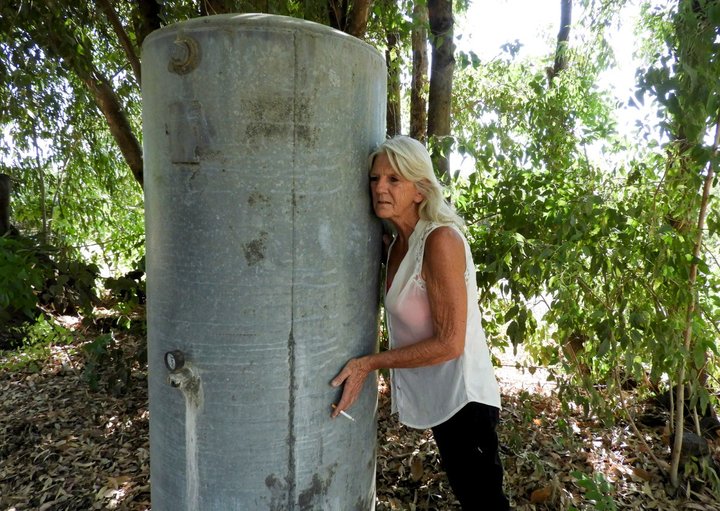
Kelly O’Brien listens to her well hum as it fills with cool water after more than a month of living without water at her home on July 2, 2021. Photo by Rachel Becker, CalMatters
###
Kelly O’Brien’s drinking water well had been in its death throes for days before its pump finally gave out over Memorial Day weekend.
It wasn’t a quiet death at O’Brien’s home in Glenn County, about 100 miles north of Sacramento.
Spigots rattled. Faucets sputtered. The drinking water turned rusty with sediment. In the end, two houses, three adults, three children, two horses, four dogs and a couple of cats on her five acres of land were all left with no water for their sinks, showers, laundry, troughs and water bowls.
As extreme drought spread across the state, O’Brien feared that the water underneath her property had sunk so low that it was out of the reach of her well.
“The whole time you’re going, ‘Oh please, let it be something else. Let it be a switch. Let it be the pump — let it be anything but being out of water,’” O’Brien said. She worried that she might have to take out a second mortgage to afford the thousands of dollars if her well had to be drilled deeper.
Soon O’Brien learned that other wells were failing around her. She heard about one neighbor to the north, another to the east. The list kept growing: She started a Facebook group for owners of dry wells to share their woes and resources, and it grew to more than 665 members.
“In a way, you’re kind of relieved it’s not just you,” O’Brien said. “However, it’s really terrifying at the same time to think that it’s not just us — it is everybody around us.”
During the height of the state’s last drought, thousands of Californians in the Central Valley ran out of water as their wells went dry. So much water was pumped from underground, mostly by growers, that the earth collapsed, sinking up to two feet per year in parts of the San Joaquin Valley.
Alarmed, the California Legislature in 2014 enacted a package of new laws that aimed to stop the over-pumping.
But seven years later, little has changed for Californians relying on drinking water wells: Depletion of their groundwater continues. Pumping is largely unrestricted, and there are few, if any, protections in place.
Now, after two dry years, reports of dry wells are worsening and spreading in many new areas, leaving more families like O’Brien’s with no drinking water. Despite the law, about 2,700 wells across the state are projected to go dry this year, and if the drought continues, 1,000 more next year.
“It feels like we’re in a very similar place to where we were in the last drought.” — Darcy Bostic, Pacific Institute
Called the Sustainable Management Groundwater Act or SGMA, the laws gave local groundwater agencies in critically overdrafted basins 26 years — until 2040 — to achieve sustainability and stop impacts of overdraft from worsening.
Those managing less-depleted water supplies, like the ones underlying Glenn County, have until 2042.
But, somewhat predictably, this drought arrived much sooner than the laws’ safeguards: As a result, echoes of the last drought are now sputtering from people’s faucets and knocking through their empty pipes.
“It feels like we’re in a very similar place to where we were in the last drought,” said Darcy Bostic, who analyzed groundwater sustainability plans at the Pacific Institute, a global water think tank. “Everyone talks about how it’s different, and how it will take time, but people are still going to lose access to drinking water. And we don’t really have a new plan for addressing that.”
During the last drought, dry wells were largely in the San Joaquin Valley, but Northern California is being hit hard this time. Well outages are creeping north through the Sacramento Valley, where Glenn, Tehama and Colusa residents reported more than 250 well outages to county officials by mid August, more than were reported during the last drought. Almost half of measurements showed groundwater levels dropped last year compared to the previous three years.
“The scope is much larger than I think anything we heard about before,” said Joe Karkoski, the State Water Resources Control Board’s deputy director of the division of financial assistance. “We’re hearing from counties that we didn’t hear from during the last drought.”
Now former state Sen. Fran Pavley, a Democrat and an author of the bills that became the act, says it may be time for the California Legislature and state agencies to accelerate its implementation.
“We don’t know when the next drought will come. So when this passed in 2014, I think most of us thought it would probably be plenty of time,” Pavley said. And was it? “Apparently not.”
###
Interstate 5 through the Sacramento Valley offers a fast-forward view of a changing landscape. Jade green rice fields give way to the stop-motion blur of orchards. “Let the good times grow!” declares a peeling sign along the highway to Glenn County.
Sprinklers hiss in the hot summer sun in orchards near O’Brien’s home, but she still has no water. It’s been longer than a month since her pump gave out.
She’s had only two real showers, one that cost $15 at a health club, and bucket-washes with water from a neighbor’s well heated on the stove most days. She tries to avoid outdoor work that would soil her clothes and make her sweat.
“Every day was consumed with the next step on how to live your life without water,” O’Brien says.
Her dishes simmer in a slow cooker all day before O’Brien washes them at night with boiled bottledwater. With no water to rinse rags, the dust that kicks up from dirt roads and is dragged inside by her two dogs builds up on her furniture. “It just keeps getting thicker, and thicker — and pretty soon you can write your name in it,” O’Brien says.
The price tag of waterless life is adding up. She’s had to purchase drinking water and a hastily acquired storage tank, and her weekly laundromat visits cost $30 each.
“All the little extras that you really can’t afford to be without,” O’Brien says. “Honestly, this is the last set of clothes I have before I have to do laundry.”
For six million people, it’s their only source. In a good year, groundwater makes up about 40% of California’s water supply. In a bad one, like this year, it’s close to 60%.
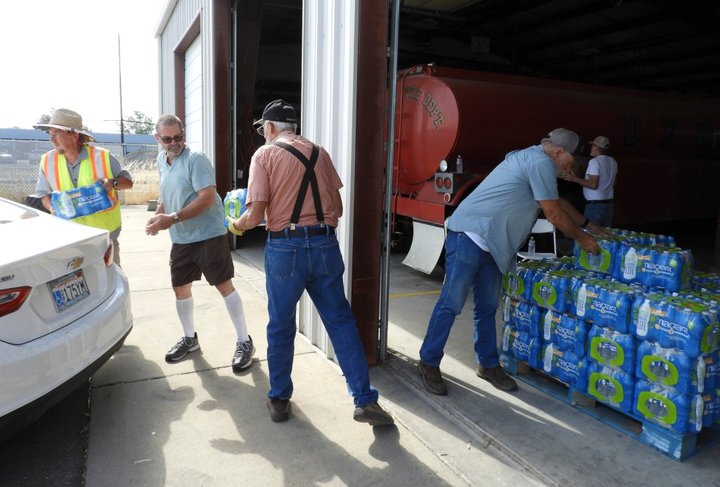
Volunteers at the Orland Fire Department in Glenn County distribute bottled water to people with dry wells on July 28, 2021. Photo by Rachel Becker, CalMatters
Fed by rain, snow and streams, groundwater is one of California’s most precious resources.
In dry years, when the flows from surface waterways dwindle, growers — who account for about 80% of all groundwater used in the state — tap into more of the underground supply to irrigate their parched crops. In 2015, growers pumped more than twice what they did in 2005.
Farmers were among those who struggled, fallowing an estimated half-a-million acres of land. Matt Angell, a Madera County almond and grape grower who also drills and repairs wells, still remembers the trauma of the last drought. He couldn’t sleep, and developed diabetes that he blames in part on the stress.
For three years, desperate farmers and well owners kept calling Angell for help. “The stress of knowing people were going to lose their farm was overwhelming. The stress of people calling me and going, ‘I don’t have any water in my house’ was overwhelming.”
In O’Brien’s Glenn County, the board of supervisors enacted a drilling moratorium for new agricultural wells through the end of next June.
The region’s farmers are feeling the pain of the overdrafted groundwater. But they urged a more targeted approach to a ban, only in the areas suffering severe depletion.
“This county would not really exist if it wasn’t for ag,” said Matt Lohse, who told the Board of Supervisors he’s proud to be a Glenn County farmer. “My dad is actually going to have to drill a new house well, currently he’s fighting to be able to irrigate … I get it. I understand the impact in Glenn County.”
Mike Vereschagin, who grows almonds and prunes around Orland and Artois, told CalMatters that he doesn’t have enough surface water and his wells are producing less during the drought, so he had to start buying water from other growers and irrigation districts. Without it, “I wouldn’t have enough to irrigate all my orchards after harvest, do some of the post-harvest irrigation which is critical for setting next year’s crop,” he said.
Ritta Martin, a sixth-generation rancher and president of the Glenn County Farm Bureau, worries about California’s endless cycles of drought.
“It just seems like there’s been more dry years than not, in recent memory,” she said. In dry years, “the groundwater can’t sustain all of the orchards and other irrigated crops that we have in the area.
“It’s scary to think about.”
###
Driving down county roads in her Ford F-150, O’Brien can tell which of her neighbors are out of water by the plastic storage tanks erupting from their yards. She points out rows of trees where there had once been a dairy or a hayfield.
O’Brien lives on the same lot on the outskirts of Orland that her parents bought in the late 1960s, when she was a child. She’s worked as a hair stylist and bartender and raised four children, and she now lives in a mobile home on her land while her son, daughter-in-law and three grandchildren occupy the main house.
Her parents moved to the Sacramento Valley from Chicago, drawn by the slower pace of a community created by irrigated agriculture.In the early 1900s, enticed by advertisements promising “Water available and in abundance at all seasons of the year,” farmers transformed Glenn County, contributing more than $1 billion a year to the economy and providing one in three jobs.
The promise of abundant water, though, has now become more precarious.
Increasingly unreliable surface water supplies have led to more reliance on groundwater and less water seeping into the subterranean stores. Many dry wells, like O’Brien’s, cluster near Stony Creek. The creek, which soaks into the soil and replenishes groundwater in wet years, has slowed to a trickle, edged by green scum.
O’Brien had to lower her well’s pump once already to reach water during the last drought.But she is relieved to learn that the diagnosis this time isn’t as bad as she originally feared. The groundwater has again sunk below the reach of her pump, but not below the depth of her well. So she needs to lower a new pump, not a new well.
O’Brien noticed that her well’s problems began when nut orchards began replacing hayfields. She’s reluctant to point fingers in her small community, but the facts illustrate the problem. Orchards in the area create a double whammy: They are often irrigated by groundwater but don’t feed underground stores like other crops do when flooded.
Agriculture is Glenn County’s biggest water user, according to the county, and orchards bearing fruit and nuts have almost doubled in acreage from 2009 to 2019. More than 650 permits for agricultural wells were issued over the last ten years, compared to 380 for households. (Not all of them may have been drilled.)
“If we had the rains and the snowfall and everything else that we needed in order to fill our reservoirs … we wouldn’t be talking today,” O’Brien says.
Still, she asks, “How many acres of almonds are we going to actually put in this county before people say uncle?”
As O’Brien drives past an orchard, the mechanical whine of an agricultural well hums through the truck’s window.
“You can hear them screaming,” she says, “and it goes on, and on and on.”
###
California was the last in the nation to regulate groundwater statewide.
But as the last drought gained steam, so did the legislation — and to Brown, it must have sounded familiar. The act tasked local groundwater agencies with developing plans to avoid worsening the major aftershocks of groundwater depletion, including “significant and unreasonable“ seawater intrusion, land subsidence, and degradation of water quality.
The state’s mandate, though, is still two decades away.
The law is “not geared for today’s drought. It’s geared for future droughts, which are going to be much worse,” said Felicia Marcus, who chaired the State Water Resources Control Board under Brown during the last drought. “They were meant as a climate change hedge and a way to assure that folks can farm off into the future. They weren’t an instant Band-Aid.”
Marcus and lawmakers involved at the time said the 20-year deadline was set because of the time needed to create new local agencies and let streams and other sources gradually recharge groundwater depleted over decades.
“It was something of a marriage between what could be done both practically and politically, along with what had to be done from an environmental standpoint,” said former Assemblymember Roger Dickinson, a Democrat from Sacramento and lead author of one of the act’s bills.
Still, given the pace of climate change, the timeline gives “them maybe longer than — now looking back — (it) should have been,” Pavley said.
“For a state like California that prides itself on being environmentally oriented and sensitive, we have a long way to go when it comes to managing our groundwater and protecting access to clean drinking water for all Californians,” Pavley said.
The California Farm Bureau opposed the legislation, saying it was too far-reaching. By some estimates, between 500,000 and a million acres of farmland would have to be fallowed to end the San Joaquin Valley’s overdraft.
Now the focus is on helping growers participate in the local planning process, said Chris Scheuring, the California Farm Bureau’s water lawyer.
“Sooner or later, we were going to have to reckon with declining groundwater levels in some of the places,” he said. “Farmers didn’t necessarily embrace (the law) at the outset but they are surely trying to figure out how to deal with it now.”
Stephanie Anagnoson, director of water and natural resources for Madera County, where groundwater is critically overdrafted, said she feels deeply conflicted about the timeline.
“We are working so hard, and I often feel like half of the world is like ‘Why aren’t you doing this at twice the speed?’ And the other half is like ‘Why are you going so fast? You have 20 years!’” she said.
“People can’t wait the 20 years” so the state must ensure that the local plans “are based on real stuff, not wishful thinking.” — Felicia Marcus, former chair of the State Water Resources Control Board
“That’s a problem, if we now have only reviewed four plans,” said groundwater act architect Pavley, who said there might be a need for more funding or staff to accelerate the review. “That’s a red flag right there.”
Paul Gosselin, California’s deputy director of statewide groundwater management, said the agency is tasked with reviewing plans that are thousands of pages apiece and coming up with “specific and actionable” input on each one. But he said the local agencies can start implementing them now, even while they’re still being assessed.
But some residents with dry wells blame local and state officials for not controlling pumping. “Who’s supposedly watching our groundwater?” said Mario Bringetto, a Madera County homeowner whose pump now sucks dirt into his pipes as the water table falls. “The people who are in charge are doing a terrible job, in my opinion.”
The former water board chair, Marcus, said “people can’t wait the 20 years” so the Department of Water Resources must take strong steps to ensure that the plans “are based on real stuff, not wishful thinking.”
In O’Brien’s Glenn County, the local agencies responsible for monitoring the groundwater underneath her home haven’t submitted their plans yet. The water there is not considered “critically overdrafted” so the plans aren’t due until January 2022.
“I’ve heard recently from quite a few folks that (the act) is about 10 years too late,” said Lisa Hunter, who is leading the county’s effort to draft the plan. “The ones that are having issues right now, there’s nothing in place currently to help ease their fears.”
Some researchers predict that the new plans will fail to protect shallow drinking water wells that serve households, many of them in disadvantaged communities. Thousands of domestic and hundreds of community drinking water wells could fail under the current sustainability goals.
The San Joaquin Valley’s plans, for instance, could allow up to 12,000 drinking water wells to go partially or completely dry by 2040, according to the Water Foundation. From 46,000 to 127,000 people could lose access to at least some drinking water supplies.
Back in 2015, Jay Famiglietti, then a senior water scientist at the NASA Jet Propulsion Laboratory and CalTech, warned that the new law would allow “nearly 30 years before we even know what is working.
“By then, there may be no groundwater left to sustain,” he wrote.
Since then, the rate of depletion has accelerated: It’s about 1.5 times higher now than measured during previous droughts, according to preliminary satellite data, Famiglietti said.
“Things have only gotten worse,” he said.
###
On a hot July day, O’Brien is leaving the dry lakebed of Stony Gorge reservoir when her daughter-in-law texts her: The water is finally back, after five long weeks.
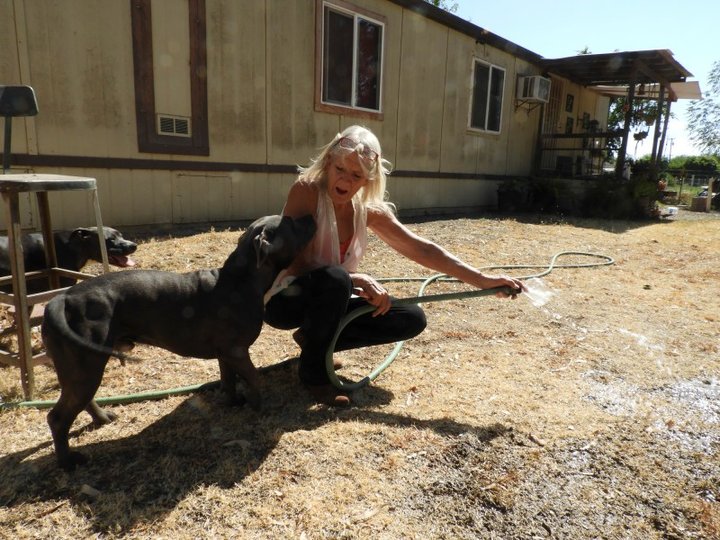
The first thing O’Brien does when she gets home is turn on the hose. “I’ll be damned,” O’Brien says, running her fingers through the stream. Her two pit bulls, delighted by the spray, snap at water belching from the spigot.
Kelly O’Brien and her dog Louie enjoy water flowing through a hose for the first time in more than a month, after a new pump was installed in her well to reach the sinking groundwater, July 2, 2021. Photo by Rachel Becker, CalMatters
Inside, O’Brien holds her hands under the tap and wipes the water across her face. “You don’t know how good that feels,” she says. “To be able to put it on your face, I mean — ” she grabs a packet of baby wipes off the counter, “they just don’t cut it.”
Many of her neighbors, though, are still waiting without water. Some report wait times to drill their new wells or lower their pumps are stretching out for months, leaving entire households, their pets and their livestock living on tanker truck deliveries, bottled water supplies and hoses connected to neighbors’ spigots.
But O’Brien still doesn’t feel safe even now that her water is flowing again. As endless cycles of drought grip California, the groundwater underneath her home is dropping lower and lower.
“I don’t know how long this is going to last,” she says, standing in her parched yard across the street from lush, green, irrigated orchards. “We just hope it lasts for a while. And we get some rain.”
###
CALmatters.org is a nonprofit, nonpartisan media venture explaining California policies and politics.