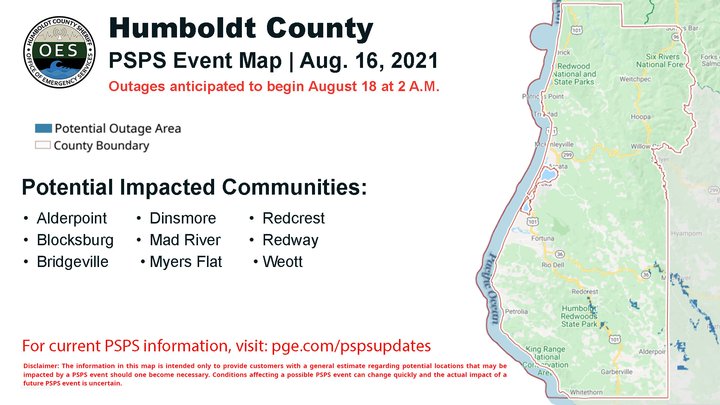
Thanks to efforts to reconfigure the Humboldt Bay Generating Station so that it can operate in “island mode,” the overwhelming majority of Humboldt power users no longer have to worry about PG&E’s wildfire-related Public Safety Power Shutoff (PSPS) events. But the Humboldt County Office of Emergency Services announced today that a handful of the county’s far-flung communities may be subject to planned outages starting early Wednesday.
Read the OES statement below:
Due to forecasted weather conditions causing a potential for wildfire, PG&E has informed us that Southeast Humboldt County is in the scope for a possible Public Safety Power Shutoff (PSPS) beginning Wednesday, August 18 at 2 a.m.
The following communities may be impacted by this outage:
Alderpoint, Blocksburg, Bridgeville, Dinsmore, Mad River, Myers Flat, Redcrest, Redway (approx. 2 impacted customers), Weott.
Estimated time of restoration is currently August 19 at 10 a.m.
The scope of this event is rapidly changing/evolving. Impacted areas may change in the coming hours/days depending on weather conditions and potential for fire ignition.
PG&E will be opening an outdoor Community Resource Center at the Bridgeville Community Center, located at 38717 Kneeland Road, providing impacted residents with an ADA-accessible restroom and hand-washing station, medical equipment charging, device charging, Wi-Fi, bottled water and snacks.
For more information about the upcoming PSPS or to see if your residence will be impacted, visit: pge.com/pspsupdates.
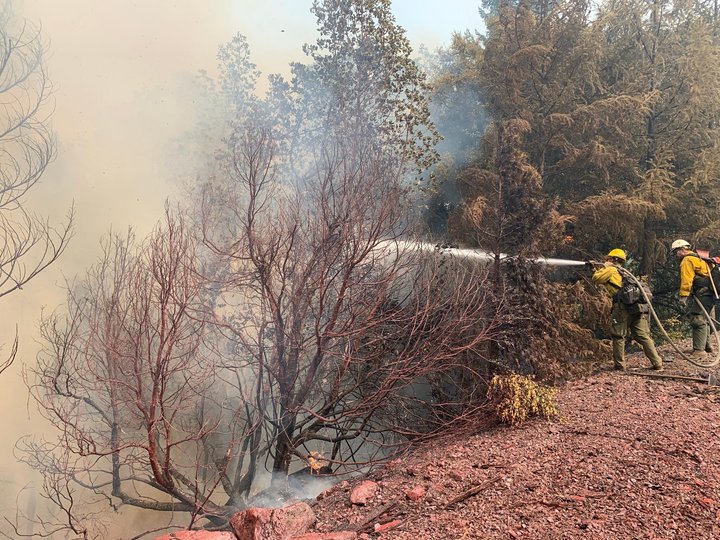
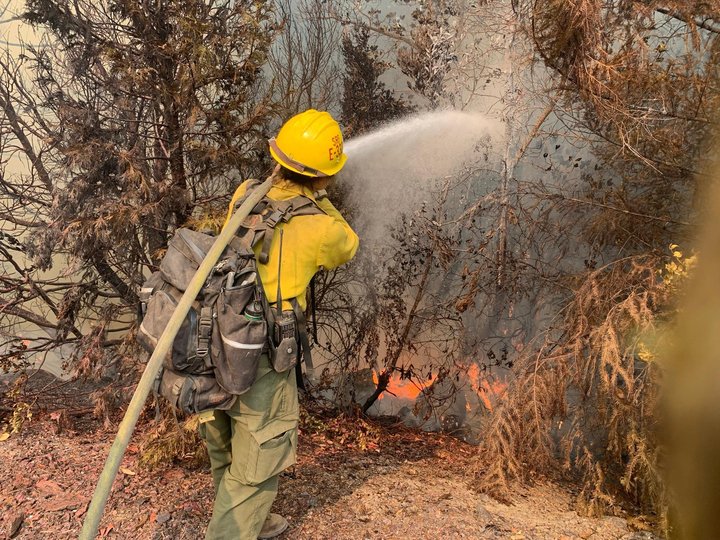
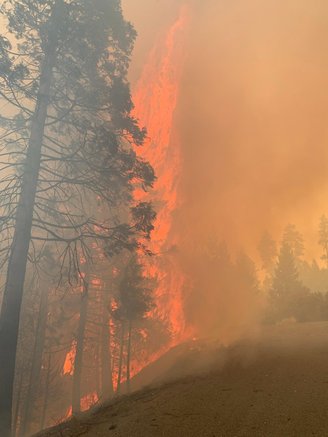
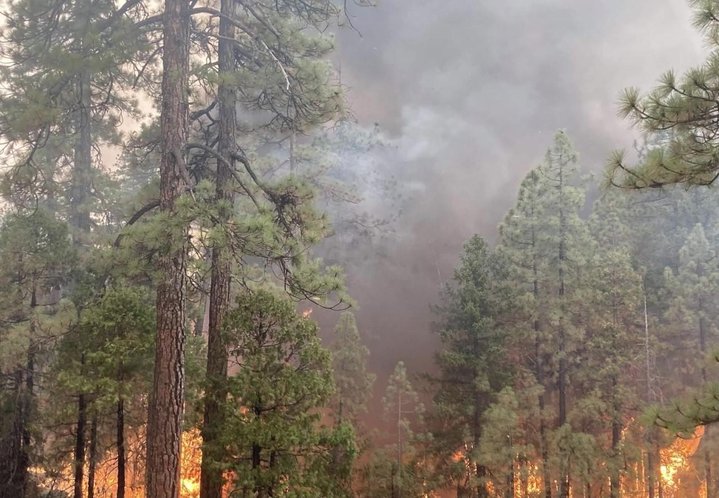
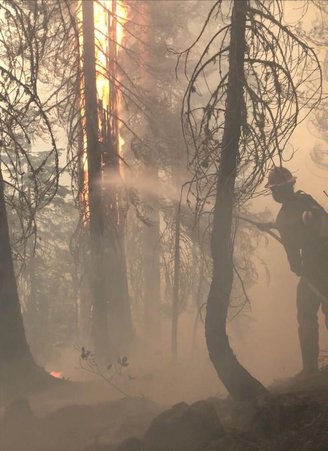
Firefighters battle the Monument Fire. | All photos form InciWeb
Monument Fire
The Monument Fire burning along Highway 299 in Trinity County between Burnt Ranch and Junction City has grown to 97,287 acres and is now 10 percent contained.
A team of 863 firefighters is actively working to contain the fire.
“Last night, the Monument fire was extremely active on all flanks, predominately to the southeast,” the fire’s incident management team stated today. “The fire exhibited long, uphill runs and group torching as it advanced towards Sky Ranch Road in Junction City, prompting the evacuation order issued by the Trinity County Sheriff’s Office.”
Evacuation orders remain in effect for residents of Sky Ranch Road, Junction City, Red Hill, Canyon Creek, Coopers Bar, Big Bar, Del Loma, Big Flat, Helena, Cedar Flat, Burnt Ranch, Sky Ranch Road in Junction City, Barker Mountain and the areas northwest of Hayfork Summit.
An evacuation warning has been issued for residents north of Highway 3 from the Wildwood Road to Hayfork Summit.
“As the fire intensified, firefighters and heavy equipment resources were reallocated to the area,” the incident management team stated today. “Crews made an aggressive attack to keep the fire within the containment lines, preventing further spread. Crews concentrated their efforts on point protection, defending structures and the values at risk in and around the surrounding area of Junction City.”
American Red Cross evacuation shelters are set up at Shasta College at 1555 Old Oregon Trail, Building 1900 in Redding and at Trinity Valley Elementary School at 730 Highway 96 in Willow Creek.
A domestic animal shelter is in place at the Trinity County Animal Shelter at 563 Mountain View St. in Weaverville (530- 623-1370). Domestic and large animals can be taken to the emergency shelter at the Hoopa Rodeo Grounds on Pine Creek Road in Willow Creek.
Highway 299 remains completely shut down by the fire between Hawkins Bar and Junction City.
Firefighters estimate that the Monument Fire will be fully contained by September 1.
###
The McFarland Fire.
McFarland Fire
The McFarland Fire burning along Highway 36 in trinity County is now 51,909 acres in size and remains 68 percent contained.
A team of 662 firefighters is actively working to contain the fire and is still determining how far the fire pushed to the east and south last night.
“Yesterday, gusty and dry west to northwest winds surfaced over the fire area and increased fire activity,” the fire’s incident management team stated today. “Extreme fire behavior pushed the fire to the east into Beegum Peak and over Tedoc Mtn. Fire continued to push and spot to the east and southeast. Crews were able to get a dozer line in Pattymocus Butte last night to keep fire off the Highway 36 corridor. The northwest section of the fire area remained relatively calm after mop-up efforts.”
An evacuation order has been issued for residents 1 mile north of Highway 36 from Platina to Vestal Road, and all homes south of Highway 36 including all of Tedoc Road and all of Vestal Road north of Pettyjohn Road.
An evacuation warning has been issued for all residents on the south side of Highway 36 and 1 mile north of Highway 36 from the Shasta-Trinity County line to Platina.
Highway 36 is completely closed between Highway 3 and Bowman Road.
Firefighters estimate that the McFarland fire will be fully contained by August 21.
A joint message from the North Coast Unified Air Quality Management District:
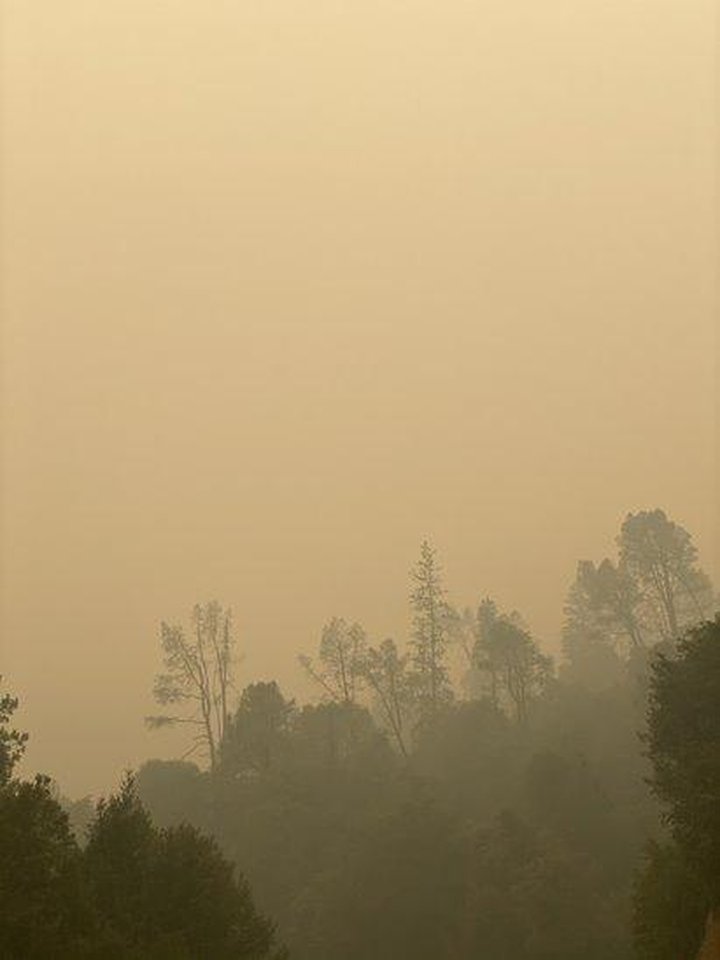
The Monument Fire, McFarland Fire, River Complex, and Antelope Fire continue to produce heavy smoke impacts. The
USFS Air Resource Advisor on the Monument and McFarland fires indicate that gradual west to east improvement of
smoke impacts will continue today as west to northwest winds increase and the inversion lifts. The improvement will
continue until Wednesday when shifting winds are forecast to occur. This smoke clearing may also increase fire
behavior.
Air quality monitors and the current Air Quality Index (AQI) for communities should be viewed athttps://fire.airnow.gov. USFS Air Resource Advisors (ARA) assigned to the Monument/McFarland and River
Complex fires provides daily ARA Smoke Outlook Forecasts at https://wildlandfiresmoke.net/outlooks.
Eureka (including Scotia to Trinidad) – Good conditions today
Orleans – Good to Moderate with USG to Unhealthy returning on Tuesday
Weitchpec – Good conditions
Hoopa – Good overall, with possible USG on Tues/Wed
Willow Creek – Good overall, with a possible return to USG to Unhealthy on Tues/Wed
Garberville, Redway – Good conditions, with possible Moderate to USG on Tues/Wed
Del Norte County:
Crescent City – Good conditions
Gasquet – Good to Moderate conditions
Klamath – Good conditions
Trinity County: (see above Advisory and Alerts)
Burnt Ranch – Good to Moderate overall, with possible return to worsened conditions Tues/Wed
Smoke Impact Summary
The Monument Fire, McFarland Fire, River Complex, and Antelope Fire will be active again today. In areas near the
fires, the USFS Air Resource Advisors indicate that we should expect more smoke impacts to influence air quality in
communities near the fire and towards the east. We are starting out today with less smoke over the fires, which may
help reduce the severity of the smoke impacts compared to what was experienced yesterday evening. This smoke
clearing may also increase fire behavior. The arrival of offshore winds is expected Tuesday and Wednesday. Smoke
is expected to impact areas west and south of the fires beginning on Wednesday/Thursday.
If you are in areas that continue to be Unhealthy to Hazardous air quality, it is really important to take health and safety
precautions. Take actions to limit outdoor activity and smoke exposure. Learn how to protect yourself from wildfire
smoke. Visit the Wildfire Smoke Resources section of our webpage at www.ncuaqmd.org.
In Trinity County, High-Efficiency Particulate Air (HEPA) Filters have been placed at the following locations:
Trinity County Library, 351 Main St., Weaverville
Hours: Monday/Wednesday/Friday 1:00pm - 6:00pm; Tuesday/Thursday 10:00am - 6:00 pm
Trinity County Health and Human Services Murray Building (Next to Sheriff Substation),6641 Hwy 3, Hayfork
Hours: Tuesday/Friday 9:00am-4:00pm
Particulate Matter (PM2.5) monitors are located in Crescent City, Weitchpec, Hoopa, Willow Creek, Weaverville,
Hayfork, Eureka, and Garberville. Air quality monitors and the current Air Quality Index (AQI) for communities
should be viewed at https://fire.airnow.gov
Fire information can be found at http://inciweb.nwcg.gov/ or https://fire.airnow.gov/. Current weather information can
be found at www.wrh.noaa.gov. As with all wildfires, ash fallout is possible depending on fire activity and proximity to
the fires. Ash fallout information can be found in the Wildfire Smoke Resources section of our webpage at
www.ncuaqmd.org.
Health Information & Actions To Protect Yourself From Smoke Impacts
Concentrations of smoke may vary depending upon location, weather, and distance from the fire. Smoke from wildfires
and structure fires contain harmful chemicals that can affect your health. Smoke can cause eye and throat irritation,
coughing, and difficulty breathing. People who are at greatest risk of experiencing symptoms due to smoke include:
those with respiratory disease (such as asthma), those with heart disease, young children, and older adults.
These sensitive populations should stay indoors and avoid prolonged activity. All others should limit prolonged or heavy
activity and time spent outdoors. Even healthy adults can be affected by smoke. Seek medical help if you have
symptoms that worsen or become severe.
Follow these general precautions to protect your health during a smoke event:
Minimize or stop outdoor activities, especially exercise.
Stay indoors with windows and doors closed as much as possible.
Do not run fans that bring smoky outdoor air inside – examples include swamp coolers, whole-house fans, and fresh
air ventilation systems.
Run your air-conditioner only if it does not bring smoke in from the outdoors. Change the standard air conditioner
filter to a medium or high efficiency filter. If available, use the “re-circulate” or “recycle” setting on the unit.
Do not smoke, fry food, or do other things that will create indoor air pollution.
Consider leaving the area until smoke conditions improve if you have repeated coughing, shortness of breath, difficulty
breathing, wheezing, chest tightness or pain, palpitations, nausea, unusual fatigue, lightheadedness.
For further information, visit the District’s website at www.ncuaqmd.org or call the District’s Wildfire Response
Coordinator at (707) 443-3093 x122.
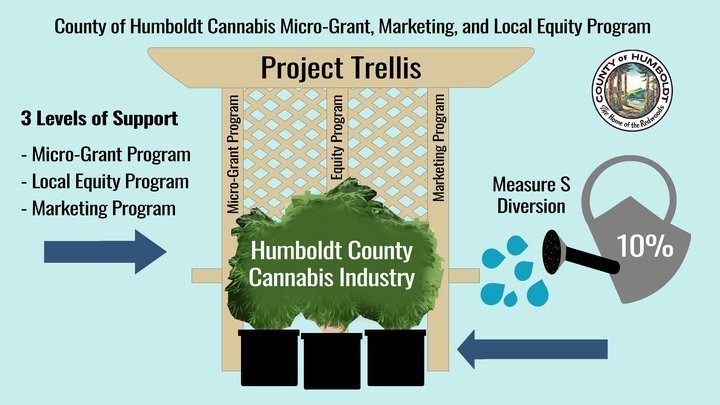
The money waters the weed, which grows tall and strong on the “trellis.” Graphic: County of Humboldt.
###
Press release from the County of Humboldt:
More than $2 million in funding is available through the County of Humboldt’s Project Trellis Local Equity Program V2.0, to help individuals in the local cannabis community enter and succeed in the commercial cannabis marketplace. Eligible equity applicants can apply for up to $10,000 per service, unless otherwise indicated. Eligibility requirements and available services can be found in the County of Humboldt Local Equity Program Manual.
The County Administrative Office - Economic Development Team is administering the Local Equity Program V2.0 which is funded by grants from the Cannabis Equity Grants Program for Local Jurisdictions and supplemented by local Measure S tax revenue. The Local Equity Program V2.0 is governed by guidelines of the Cannabis Equity Grants Program for Local Jurisdictions administered by the Governor’s Office of Business and Economic Development, and the California Cannabis Equity Act as amended by AB 97 (Stats. 2019, Ch. 40).
The goal of the program to implement the recommendations set forth in the Humboldt County Cannabis Equity Assessment. The Program supports the State of California’s and County of Humboldt’s goals to further equity among those impacted by the criminalization of cannabis, by providing services to individuals in Humboldt County’s cannabis community, particularly small growers who were adversely affected by the criminalization of cannabis, and to assist them as they work to overcome the financial and logistical challenges of coming into compliance with county and state regulations.
All applications and supporting documents will be reviewed by Economic Development staff to ensure the applicant meets eligibility criteria. Some projects may receive a lower amount than what was requested, based on the availability of funds or needs of service. A typical approval process can take 60 or more days from when the application is received. Upon approval, the applicant will receive a notice of award, contract, fund request form and a W9 form.
Applications should be submitted electronically by using the application form. If an applicant is unable to use the online application, a PDF download of the application is available and can be emailed to ProjectTrellis@co.humboldt.ca.us. A hard copy can be requested by contacting Project Trellis at 707-445-7745. Hard copies can be mailed or delivered to the County of Humboldt CAO’s Office of Economic Development, Attn: Project Trellis, 825 5th Street #112, Eureka, CA 95501. Applications must be received or postmarked no later than 5 p.m. on September 17.
Applications may be subject to public disclosure pursuant to the California Public Records Act.
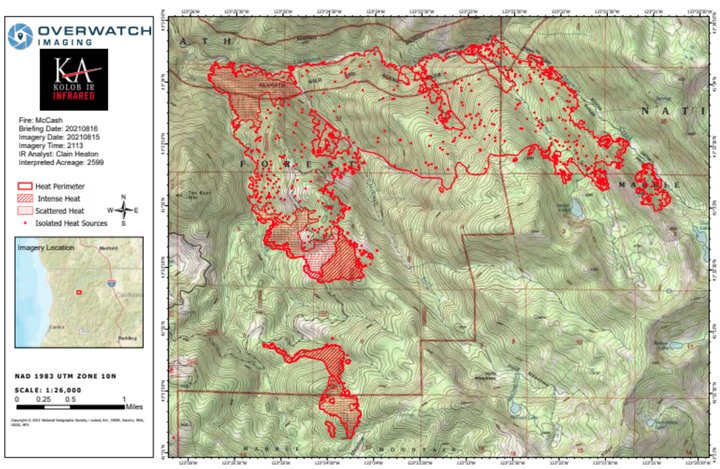
The McCash Fire burning east of Highway 96 in the Klamath National Forest has grown to 2,599 Acres and remains 1 percent contained.
A firefighter working the McCash Fire. | InciWeb
The fire’s incident management team stated this morning that firefighters are focused on protecting communities along the fire’s southern border.
“Burning and holding the southern line is critical to protect the identified values and communities along highway 96, including the community of Orleans,” the incident management team stated. “Firefighters continue working to complete the northern indirect line, improve and prepare roads, create safety zones, and create an alternate route around the Independence Creek Bridge, which is closed due to damage and impeding access for fire resources.”
While Highway 96 is open, firefighters are asking drivers to slow down in the area for the safety of firefighters and the public.
“Watch for increased fire related traffic on area roads and highways,” the fire’s incident management team stated. “Please drive defensively.”
Cooler temperatures and breezy conditions are forecast for today, which firefighters say could clear smoke and improve visibility. Lower humidity and northeasterly wind gusts up to 20 mph may make for more hazardous fire conditions on Tuesday and Wednesday.
A team of 366 firefighters are actively working on the fire, including three hotshot crews, five type 2 hand crews, eight engines, two helicopters, five dozers, three water tenders, and five masticators.
Sure, your President of Positivity is all about Mondays, but you might be surprised to know that she also exists on the six other days of the week. Take Tuesday, for example. That’s when you might find her down at the Old Town Farmers’ Market picking up some ghee from her buds at Ghee Well.
In this week’s episode, after zooming by both a new Old Town mural and her friend at Gallup Farmstead, Michaele ends her morning jog with a visit with gheemaker Holly Hall to learn more about her favorite butter-like product.
Have you tried saying “ghee” out loud yet? Try it out! It’s fun! Ghee!
El Centro, with a population of 44,000, is the Imperial Valley’s largest city. Photo by Shae Hammond for CalMatters
###
Imperial County, tucked into the southeast corner of California, learned early on what it meant to be a COVID-19 hotspot. The virus bulldozed through the agricultural county last spring, then again in the winter. About one in six residents has been infected, and 745 people have died.
But Imperial County has one statistic that is giving local health officials hope: 86% of its eligible population has been vaccinated with at least one dose. It’s one of the best vaccination rates in California, eclipsed only by Marin and Santa Clara counties and tied with San Francisco. Statewide the rate is 74%.
In addition, Imperial was one of only 11 counties in mid-July where more than half of its residents on Medi-Cal, the state health insurance program for low-income people, were vaccinated. That’s a sign that it is faring better than most counties in protecting its disadvantaged residents from COVID-19.
In many ways, Imperial is defying the odds: Despite its remoteness and high poverty, which is often associated with worse health outcomes, most of its 186,000 residents appear steadfast in keeping the virus at bay.
“In general, there is a correlation with income and vaccination rates, but I think what Imperial County data tells us is that it can be overcome, it just takes effort,” said Fabian Rivera-Chavez, assistant professor of pediatrics and biological sciences at the University of California, San Diego.
The reasons for Imperial’s high percentage of vaccinated residents are not well understood. But local experts and health officials say one key factor is its strong network of nonprofits, clinics, hospitals and agricultural employers that have reached out to people personally to provide vaccinations.
Located far from California’s more populous areas, Imperial’s residents over the years have come to rely on their local network to overcome health challenges.
“In our world, we do learn from others. I think small communities, we are used to working closely together and that has translated in our efforts and our response,” said Rosyo Ramirez, a deputy director at Imperial County’s Public Health Department.
The county has administered 227,700 doses of COVID-19 vaccines. “There is no way we would have been able to do that on our own,” Ramirez said.
Imperial has the largest proportion of vaccinated residents in the entire southern half of the state. About 73% of Los Angeles County residents and 50% of Kern County residents, for instance, have received at least one shot, compared to Imperial’s 86%.
Imperial County has a lot working against it when it comes to controlling a pandemic.
It’s also sparsely populated — 43 people live per square mile, compared to its next door neighbor, San Diego County, which has 793 people per square mile, and Los Angeles, with 2,744.
That means not having access to a car in Imperial can pose significant challenges and limitations for people seeking vaccinations.
Being a border county, Imperial also has a large bi-national population, meaning people may work on one side of the border and live on the other. That comes with its own unique logistical challenges in controlling and tracing the spread of the virus.
The Imperial Valley was an uninhabited desert wasteland, bordered by barren mountains, until it was transformed at the turn of the 20th century when a canal diverted Colorado River water to irrigate crops. Since then, it has become a top producer of vegetables and livestock, valued at more than $2 billion a year, led by cattle, alfalfa, lettuce and broccoli. Its biggest city is El Centro, home to 44,000 people.
The Imperial Valley was a wasteland before a canal delivered Colorado River water for irrigation. Now desert land like this is surrounded by lush, irrigated fields. Photo by Shae Hammond for CalMatters
A personalized approach to vaccinations
Reaching out to people in remote towns that are many miles apart is difficult, but seems to be paying off in Imperial County.
Rosa Diaz, CEO of the Imperial Valley LGBT Resource Center, said her organization has focused on some of the most rural communities, like Ocotillo, Bombay Beach, Niland and Seely, where populations range from 200 to 1,000 people. When the weather allows, her team sets up canopies in these towns to provide vaccine education and information on how to sign up, and to survey people on whether they have bedridden family members that need transportation, Diaz said.
For four months this year, a medical team from El Centro Regional Medical Center, one of two area hospitals, set up shop at the Imperial Valley Mall every Friday. They’d administer anywhere from 600 to 1,000 doses a day — on their busiest day they had almost 2,000 people, said CEO Adolphe Edward.
When vaccines became more available to farmworkers in the spring, Shelby Trimm, executive director of the Imperial Valley Vegetable Growers Association, spent days on the phone coordinating with farm labor contractors so that they’d send field workers to vaccination clinics.
Many farmworkers have to report to different worksites, so going through the contractors was a good way to capture more people, Trimm said.
“You had these buses full of workers from the fields show up to vaccination clinics,” Trimm said. “The goal was really to make it as easy as possible.”
The Imperial Valley is one of the most production agricultural areas in California, known for livestock, alfalfa and vegetables. Rows of crops grow near Brawley in this photo shot on Feb. 5, 2021. Photo by Shae Hammond for CalMatters
Trimm said that local providers also set up clinics at the border to offer doses to farmworkers and others who come into Imperial for work.
The county offers vaccinations to people who work in Imperial and live on the Mexico side. But its vaccination data only reflects doses given to people with U.S. addresses and ZIP codes, county public health officials said.
“If they’re working here, they’re affecting our community,” Ramirez said. “From the beginning we understood that it was important to get them vaccinated.”
While there is no county data to show vaccination uptake by sector, Trimm said that anecdotally there wasn’t much vaccine resistance or hesitance among farmworkers.
“At this point you’ve had COVID or have a loved one who did,” Trimm said. “So many people saw family members dying or sick. It can’t get any worse than that. So if there was a way to save themselves, people did it.”
The medical center’s Edward agrees that many of the county’s residents may have felt compelled to get vaccinated because the virus hit close to home. “People got serious about it,” he said.
Imperial County may have more natural immunity because of its high infection rate.
“A county that was hit hard like Imperial is also likely to have a higher rate of natural immunity,” Rivera-Chavez at UCSD said. And when people who have natural immunity get vaccinated, they gain what’s known as “hybrid immunity,” which can provide even stronger protection, he explained.
Hospitalizations are rising
Still, as long as some residents continue to be unvaccinated, there is risk, Edward said. In the last two weeks, Imperial’s COVID hospitalizations jumped from eight to 16 on average between July 29 and Aug. 11. Hospital admissions in California have shot up at roughly the same rate.
This shows that there is still work to be done. More than half of Imperial County residents are on Medi-Cal. And while Imperial is ahead of most other counties with 50% of its Medi-Cal members vaccinated, that means there is another half that has fallen into the gap.
Earlier this month, the state announced it would be rolling out $350 million in incentive payments for health insurance plans to increase vaccination among their Medi-Cal members across the state. Funding for health plans is contingent on them meeting specific vaccination goals, and some money could provide direct incentives to people, like grocery store gift cards.
“I’m glad people are getting vaccinated, but we can’t stop here,” Edward said. “I think a lot of people are running out of energy…but we know that the people left are the hardest to reach.”
###
CALmatters.org is a nonprofit, nonpartisan media venture explaining California policies and politics.