(GRAPH) Humboldt’s Unvaccinated Are Contracting COVID at Two and a Half Times the Rate of the Vaccinated
Ryan Burns / Monday, Aug. 9, 2021 @ 11:29 a.m. / COVID-19 and Humboldt
Graph via County of Humboldt. | Click here to see it bigger.
###
The highly transmissible Delta variant of COVID-19 has sent communities across the United States, including Humboldt County, back to the darkest days of the pandemic, with case rates, hospitalizations and deaths skyrocketing over the past few weeks.
Most alarmingly, Delta has proved more capable than previous variants of causing “breakthrough” cases — that is, infecting people who’ve been fully vaccinated.
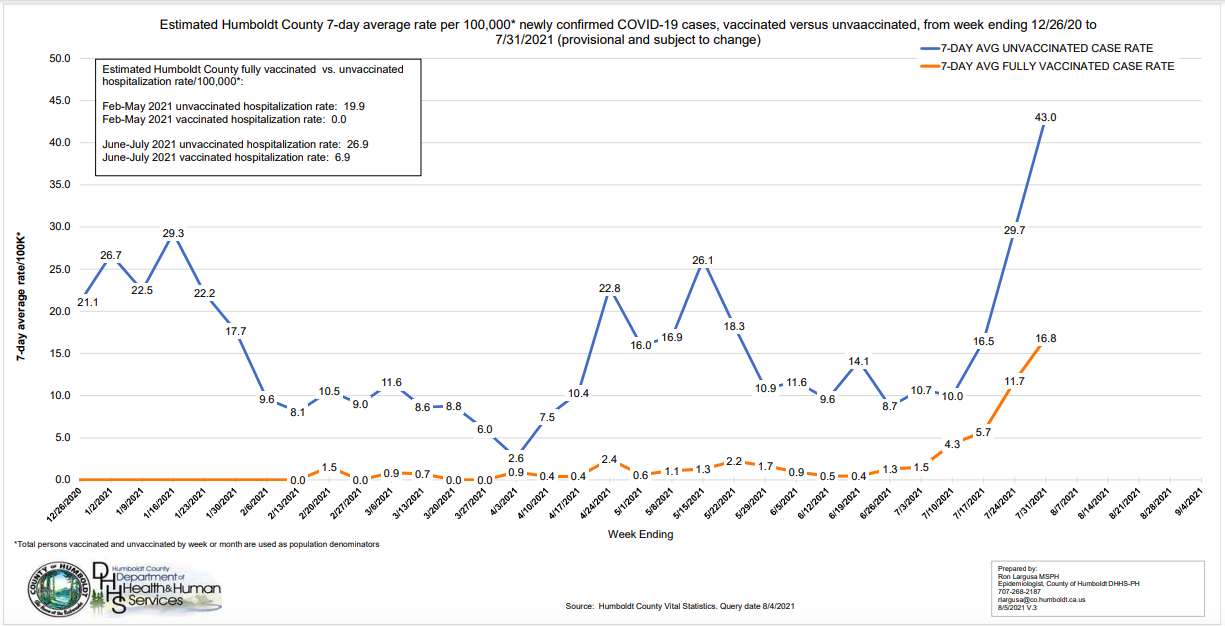
Still, provisional data released Friday by the Humboldt County Department of Health and Human Services (DHHS) show that during the most recent spike in cases, unvaccinated residents have accounted for two and a half times more cases than those who’ve been vaccinated. (The county’s population was split roughly 50-50 between vaxxed and unvaxxed during that time.)
The data also show that during June and July, unvaccinated county residents who contracted COVID-19 were nearly four times more likely to require hospitalization than those who’d gotten their jab(s). Vaccinated residents had a hospitalization rate of 6.9 per 100,000 while the rate among unvaccinated residents was 26.9.
These data are presented in the agenda for Tuesday’s scheduled meeting of the Humboldt County Board of Supervisors, along with an update from Health Officer Dr. Ian Hoffman.
That update, which you can read in full below, was written this past Thursday, one day before the county announced its highest-ever daily total of confirmed new cases — 100 of them — along with the death of a resident in their 40s, marking the county’s 56th COVID death. To date, no one who’s been fully vaccinated has died from COVID-19 in Humboldt County.
Here’s Hoffman’s update:
If there is one thing that the past few weeks have shown us, it is that we should always be prepared for rapid changes with COVID-19. The arrival of the Delta variant has dramatically changed the situation in our county. The rise in cases seen in many counties has now hit here, with 400% increases in cases in a matter of a few weeks. Along with this was a dramatic rise in hospitalizations, peaking at 25 hospitalizations for COVID-19 as of a few days ago.
We suspect this may go higher, and we are watching the situation in the hospitals closely. In previous surges the hospitalizations remained well under 20 beds. The hospital staff, clinic staff, public health staff, really everyone in health care, who have all been working tirelessly for 18 months to treat and prevent COVID-19 were dealt a devastating blow with this news. Many in the community are noticing more illness, voluntarily cancelling events due to concern, returning to safety measures that were taken during the last COVID-19 surges.
It was with this urgent necessity that Public Health decided, in consultation with many community leaders across our county, to reinstate the mask mandate effective 12:01 a.m. Saturday August 7th. We take this step to preserve the balance in our rural healthcare system that is already under a tremendous amount of strain, to ensure that we can keep businesses open, keep events ongoing safely, and to keep schools on track towards full reopening in just a few weeks.
We would like to share publicly data on the current surge from our Humboldt County Epidemiology Program. Please find attached a graph that shows the case rate for both unvaccinated and fully vaccinated populations in our county. You can see the steep rise of cases with this latest Delta surge, much larger than the two previous surges (winter surge with Epsilon, spring surge with Alpha). And you can see the stark difference in both cases and hospitalizations among the fully vaccinated in Humboldt County. Our local data is consistent with what is seen nationally with Delta variant. While we are seeing some breakthrough cases, we are also seeing a very large reduction in hospitalizations and death among the fully vaccinated, which reinforces the importance of getting vaccinated.
There have been many ups and downs in this pandemic. This is another one of those big pendulum swings, and given the course so far, it is unlikely to be the last one. The hospitals are preparing for potentially even more surge of cases in the coming weeks, as they have prepared in the past. Public Health is scaling up testing and investigations again, as we have several times throughout the pandemic to deal with surges. In the end, vaccination will remain the key tool to getting us out of the pandemic by preventing severe disease and death from COVID-19.
We urge everyone who is eligible to seek out vaccination. If you are unsure, please seek out a trusted source on vaccine information from your community.
BOOKED
Yesterday: 3 felonies, 8 misdemeanors, 0 infractions
JUDGED
Humboldt County Superior Court Calendar: Today
CHP REPORTS
No current incidents
ELSEWHERE
RHBB: Planning for Sea Level Rise Splits Humboldt Commission
RHBB: Burning Starting Today on Vegetation Management Project West of Redding
Man in Critical Condition After Being Struck by a Vehicle Following Some Sort of Confrontation Near Lady Bird Johnson Grove, Sheriff’s Office Says
LoCO Staff / Monday, Aug. 9, 2021 @ 11:25 a.m. / Crime
Press release from the Humboldt County Sheriff’s Office:
On August 7, 2021, at about 11:45 a.m., Humboldt County Sheriff’s deputies were dispatched to the area of Bald Hills Road near Lady Bird Johnson State Park for the report of a firearm brandishing and traffic collision.
Deputies arrived on scene and located an injured adult male victim lying in the middle of the road. The male was transported to an out of area hospital where he remains in critical condition. Deputies also contacted an additional adult male on scene who told deputies he struck the victim with his vehicle out of self-defense after the victim threatened him with a firearm. The firearm was located at the scene.
This case is under investigation by the Humboldt County Sheriff’s Criminal Investigations Division. No arrests have been made at this time.
Anyone with information about this case or related criminal activity is encouraged to call the Humboldt County Sheriff’s Office at (707) 445-7251 or the Sheriff’s Office Crime Tip line at (707) 268-2539.

BE FOREWARNED: All Simulated Hell Will Break Loose in the Humboldt State Dorms Thursday Evening
LoCO Staff / Monday, Aug. 9, 2021 @ 10:37 a.m. / Non-Emergencies
Pictured: Humboldt State’s Cypress Hall (photo: HSU) adumbrated with flames by Ricardo Gomez Angel’s flames (via Unsplash).
###
Press release from Humboldt State:
Humboldt State University Housing & Residence Life will hold an emergency simulation on Thursday, August 12, 2021, to test campus and community response teams. The simulation will begin around 6 p.m. The simulation will be loud and include participation from Housing & Residence Life, the University Police Department, the Arcata Fire Department, and Arcata Mad River Ambulance.
Passersby may see smoke coming out of buildings and actors crying for help. First responders will be using emergency radios, and traffic flow may be affected on campus.
The purpose of the exercise is to train Housing staff and local first responders on how to respond to a campus housing emergency. The emergency simulation is intended to provide a real-time, realistic experience of an emergency as well as provide the opportunity to test and evaluate a practical plan and practice communication among agencies.
How Did John Cox Go From GOP Standard-Bearer to Bears and Trash Balls?
Ben Christopher / Monday, Aug. 9, 2021 @ 7:58 a.m. / Sacramento

Republican recall candidate John Cox holds a press conference at the state Capitol on Aug. 5, 2021. Cox brought a giant Monopoly board dubbed “Gavinopoly” to outline points in his proposed tax cut plan. Photo by Anne Wernikoff, CalMatters
###
It’s two days before the California Republican Party is supposed to pick its torchbearer, so the other leading candidates in the campaign to recall Gov. Gavin Newsom are busy making phone calls and schmoozing party delegates.
But John Cox has other plans this Thursday morning: He’s in front of the state Capitol showing off a life-sized board game. “Gavinopoly” — which the candidate explains is meant to illustrate his new tax plan — is only the latest prop in what has become the recall’s most prop-happy campaign.
Many voters will remember the 1,000-pound bear that Cox, an investment manager and accountant from north San Diego County, chauffeured around on his first statewide bus tour of the recall race. Fewer probably recall the follow-up gimmick: A 8-foot ball of trash.
This one — a 12-by-12 foot game board made up of sofa cushion-sized jigsaw puzzle pieces — is a bit easier to manage, his campaign aides all agree. No trailer nor finicky tarp nor wildlife wrangler toting rotisserie chickens required. “This is definitely the most interesting campaign I’ve worked on,” said campaign manager Bryan Reed.
And not just because of all the visual aids.
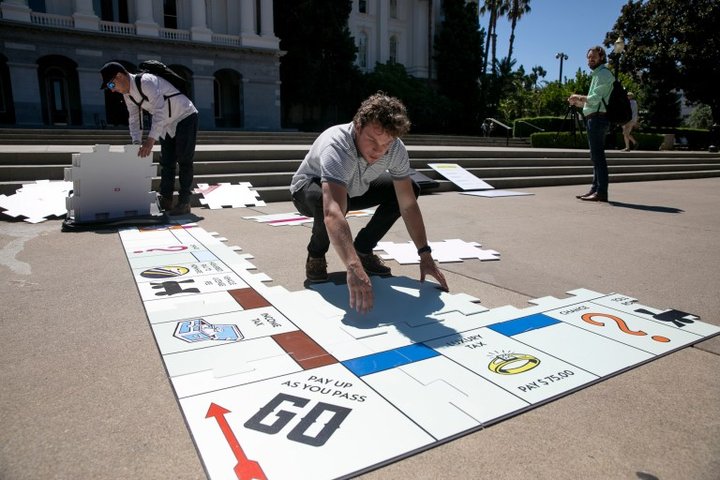
Cox campaign staff set up a giant Monopoly board dubbed “Gavinopoly” in front of the state capitol on Aug. 5, 2021. Photo by Anne Wernikoff, CalMatters
Cox — the GOP’s standard bearer in the 2018 governor’s race and listed as a Republican on the Sept. 14 recall ballot — is now accusing the party of insider dealing and corruption.
The millionaire, who is funding his own campaign, said he’s happy to go it alone this time.
“I think a lot of Republicans already know who I am. I mean, I ran in 2018, and I got almost 5 million votes — I think that was a lot of Republicans,” he said, standing in front of the board game and a handful of reporters. “We’re gonna get that message out. I think we’ll be fine.”
‘A name recognition thing’
For Cox it’s a return to form.
Throughout his many years on the campaign trail — running unsuccessfully for Congress, for U.S. Senate, for president of the United States, for county recorder of deeds back in his native Illinois — Cox has always portrayed himself as an outsider. As he’s said for years, including six times at the televised recall debate last week, he’s a “businessman” — not a “career politician,” a “celebrity” or an “insider” — and therefore he’s uniquely resistant to the sleaze and corruption that he says defines policymaking.
That line seemed a little discordant in 2018 when Cox was running as the GOP’s preferred candidate for governor, backed by the entire party’s state congressional delegation and then-President Donald Trump.
But three years later, Cox is back in his comfort zone — on the outside looking in.
Cox’s math is about right. Facing off against Newsom in the last governor’s race, he won 4.7 million votes.
But that number skips over another one that his critics in the party often point to: He lost by 24 percentage points, a larger defeat than any GOP gubernatorial candidate in California since 1950.
In a ruling last week Sacramento County Superior Court Judge Laurie Earl rubbed in that fact. The campaign defending Newsom will be allowed to argue in the official state voter guide that the effort is an abuse of the state’s recall laws, she wrote, precisely because Cox’s defeat was so lopsided.
“The recall is being held less than three years after a sizeable majority of California voters elected Newsom Governor,” Earl wrote. “Out of over 12.4 million votes cast in the 2018 gubematorial election…approximately 4.7 million (or just 38 percent) voted for Republican challenger John Cox.”
And yet under the odd — and critics say anti-democratic — rules that govern California’s recall elections, if Cox won 38% of the vote this time, he could easily glide into the governor’s office. That’s because if a majority of voters opt to fire Newsom on the first question on the ballot, whichever replacement candidate gets the most votes on the second question will win — no matter how small a sliver of the vote they get.
Hence the bear, said Fred Davis, a communications consultant to Cox with a long history of gonzo campaign tactics.
“Let’s just say it took some time for John to warm up to it,” Davis said, who said he sold the candidate on the hairy mascot, but takes no credit for the trash ball or “Gavinopoly.”
“It’s a long shot that Gavin will get booted, but if he gets the boot, this will be the best chance of winning you’ve ever had in your life,” he said, recounting his conversation with Cox in the early months of the campaign. “You could win with a small percentage of the vote. And that’s going to be a name recognition thing” — recognition that a recent statewide race and a road trip with a Kodiak can buy, no matter what GOP leaders think about your campaign.
“I gotta tell you, the bear and the ball and the game are getting to the average person, and that’s a good thing.”
— Republican recall candidate John Cox
The candidate seems to have come around to that idea, even if he bristles at the notion that he’s dealing in gimmicks. For Cox, standing in front of the giant faux-Monopoly board to promote his tax cut plan, this is not a game.
“My plan on homelessness was very lengthy. I’ve authored countless op-eds on water, electricity, housing, education,” he said outside the Capitol last week. “But I gotta tell you, the bear and the ball and the game are getting to the average person, and that’s a good thing.”
At first, the campaign’s internal polling numbers did look promising, Davis said. “Then somebody got in the race that was bigger than a 1,000-pound grizzly bear.”
That would be Larry Elder.
Elder is a longtime conservative radio host and commentator who boasts a ready-made fan base among recall-backers and who only got on the ballot at the last minute after winning a legal battle over a requirement that candidates submit their tax returns.
While early polling showed Cox neck-and-neck with former San Diego Mayor Kevin Faulconer, both are now between 3 and 10 percentage points behind the GOP base’s new favorite.
“Then somebody got in the race that was bigger than a 1,000-pound grizzly bear.”
— Fred Davis, a consultant to the John Cox campaign
Elder’s candidacy has upended the calculus behind Cox’s campaign, said Jack Pitney, a Claremont McKenna College political science professor.
“Republican voters don’t like career politicians so there’s a certain logic to (Cox’s) position” of campaigning as an outsider, he said. “But now there’s somebody in the race who is even more prominently an outsider than he is.”
Behind the break-up
In the meantime, Cox has burned many of the bridges he constructed just three years ago.
On Saturday, the state party’s delegates voted against endorsing any candidate. That was widely expected. More remarkable is that Cox, the former GOP gubernatorial candidate, wasn’t even in the running.
Under the party rules, any of the 1,500 delegates were allowed to nominate as many candidates as they wished for a possible endorsement. Candidates who received at least 200 votes were up for consideration. Four made the cut: Elder, Faulconer, Assemblyman Kevin Kiley of Rocklin and former Sacramento-area member of Congress Doug Ose.
Cox came in fifth with 131 votes. Only two voted for Cox alone. Both were paid consultants of the campaign.
Cox insisted that he “didn’t lobby” any of the delegates or ask any of his supporters to back him.
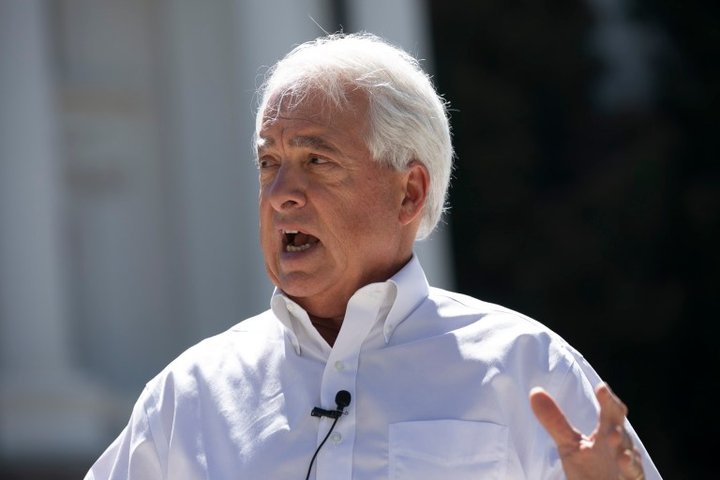
Cox campaign staff set up a giant Monopoly board dubbed “Gavinopoly” in front of the state capitol on Aug. 5, 2021. Photo by Anne Wernikoff, CalMatters
“The Republican Party should not endorse anybody, and we should be united. We shouldn’t enter a divisive fight over endorsements,” he said before the vote. “I felt the whole process was stilted by a few people that were trying to get a particular candidate in there.”
And yes, he meant Faulconer. “The establishment candidate, the politician,” he said when asked to clarify.
Cox has been going after his fellow San Diego Republican since day one.
Cox’s first ad, in February, was called “Gavin Faulconer,” a joint attack that equated the former mayor’s alleged lack of integrity and corruption with Newsom’s. It dropped when Faulconer was being heralded by some within the party and the state’s business community as the GOP’s best hope for toppling Newsom. Since then, Faulconer has won the endorsement of most GOP state legislators and has raised the most from big donors.
Cox, meanwhile, has outraised the rest of the replacement field so far, but only because he’s donated more than $9 million to his own campaign.
Sacramento County GOP Chairperson Betsy Mahan said she saw something personal in Cox’s broadside against Faulconer.
Cox “certainly had high hopes that he was going to come back and reassume the role to be the Republican candidate to challenge Newsom and I think he was surprised that others stepped up,” she said.
In 2018, Cox “worked very hard, he was a good candidate,” she added. “But it’s pretty obvious that it’s time to consider someone else.”
Other party leaders have been less sympathetic.
“John Cox led the California Republican Party to its most disastrous statewide election result in California history,” U.S. Rep. Darrell Issa of San Diego County wrote to supporters last month. Issa went on to list a dozen political failures and call Cox “incompetent” and “erratic.”
The missive was nominally an endorsement of Faulconer, but it doubled as an usually public torching of the party’s former gubernatorial candidate.
“It’s pretty obvious that it’s time to consider someone else.”
— Sacramento County GOP Chairperson Betsy Mahan
Tensions flared again late last month. When news broke that party insiders were toying with the idea of lowering the threshold needed to endorse a candidate from 60% of the delegates to a mere 50%, Cox blasted them on Twitter. “The insiders at California Republican Party are now no better than the Democrats,” he said, accusing the party of trying to grease the skids for Faulconer.
The next day, he parked himself in front of the party’s Sacramento headquarters to hold a protest press conference.
Harmeet Dhillon, who represents California at the Republican National Committee and is one of the state’s most prolific conservative litigants, was one of the party heavyweights who pushed for the new endorsement process.
She dismissed Cox’s complaints. “My mother taught me about sour grapes when I was a child, and I think that’s what this is,” she said. “Not qualifying to even compete for the party’s nomination should be a sign to somebody.”
Former California GOP Chairperson Ron Nehring, another Faulconer supporter, was more direct. Cox’s protest “is code for @Kevin_Faulconer is kicking my ass and I can’t win the support of @cagop delegates so I’m going to crap on the entire party,” he tweeted.
But Faulconer didn’t win the endorsement, either. No one did. Of all the nominating votes cast by delegates, the clear winner was neither insider Faulconer nor self-described outsider Cox. It was the biggest wild card in the recall — Elder.
###
CALmatters.org is a nonprofit, nonpartisan media venture explaining California policies and politics.
Dust to Dust: Will California Lawmakers Legalize Human Composting — Transforming Bodies Into Soil?
Marissa Garcia / Monday, Aug. 9, 2021 @ 7:39 a.m. / Sacramento
Two wheelbarrows full — that’s how much soil a composted human body creates. In California, it could soon be legal for people to be transformed into soil after death.
Only three after-death options are available now in California: burial and cremation — by fire or water. But a bill moving through the Legislature would legalize “natural organic reduction,” or the composting of human remains, adding a greener funerary option to the mix.
“The idea of returning to Earth is somewhat metaphorical, whereas natural organic production offers a literal return to the earth,” said Anna Swenson, spokesperson for Recompose, the company that developed the process.
While California considers sanctioning human composting, other states have already begun. In 2019, Washington became the first state to legalize the process. And this year, the dominoes kept falling: Colorado legalized it in May, and Oregon followed suit in June. Next year, New York could do the same.
Since the pandemic’s onset, conversation has started about the need for alternatives to cremation. Amid the peak of deaths from COVID-19 in January, Los Angeles County was cremating so many bodies that local air quality regulators temporarily lifted cremation limits meant to minimize air pollution.
Natural organic reduction comes at a time when demand for green death care options is growing. In 2017, lawmakers legalized alkaline hydrolysis, or cremation by water. This uses only one-eighth of the energy needed by a standard cremation, which guzzles fossil fuels and emits carbon dioxide. But despite legalization, the practice has not caught on widely, and only a few funerary homes provide the service in California.
Burial isn’t so green either — it leaches chemicals into the ground and takes up scarce land.
If each Californian opted to be composted after death, supporters of the innovation argue, the carbon saved would be enough to power 225,000 homes for a year — or more than half the homes in San Francisco.
The bill has so far advanced through the Legislature with significant bipartisan support. Left-leaning politicians support this environmentally-friendly technology. And both the left and right appreciate expanding consumer choice.
Religious concerns with composting technology
The only formal opposition so far comes from the Catholic church.
The California Catholic Conference did not respond to CalMatters’ interview requests, but told Religion News Service last year that it opposed an earlier version of the bill.
“We believe that the ‘transformation’ of the remains would create an emotional distance rather than a reverence for them,” spokesperson Steve Pehanich said at the time.
But the lawmaker pushing the bill, Assemblymember Cristina Garcia, was raised Catholic and represents a heavily Catholic district in southeast Los Angeles County. She said she understands that turning into soil after death isn’t everyone’s preference.
“But it’s my duty not to impose my religion on other folks. My duty is to allow individuals to have choices to do what’s best for them,” she said.
— Assemblymember Cristina Garcia
“I actually had a lively discussion with my parents over this bill this weekend,” the Democrat from Bell Gardens said at a Senate committee hearing in June. “My mom was excited about the idea, and my dad just couldn’t deal with it.”
Garcia said she will always advocate for her constituents’ rights to practice their religions freely and safely.
“But it’s my duty not to impose my religion on other folks. My duty is to allow individuals to have choices to do what’s best for them,” she said.
Swenson says that Recompose has done the science on the soil, and the science has been key in earning support from lawmakers.
“We did (natural organic reduction) six times in the study, and now we’ve done it over 50 times since we’ve been open, so we do have good proof that this works,” Swenson said.
Lynne Carpenter-Boggs, who serves as an advisory scientist for Recompose, has studied soil for 30 years.
In testimony to the Senate Health Committee in July, the scientist said that “the finished material is soil-like and unrecognizable visually, chemically or microbiologically as human remains…. and (the soil) can safely and selectively nourish the land and plants and forests.”
Composting human remains would be a new procedure for the state to regulate. The first concern lawmakers are grappling with: how human-sourced soil should be legally treated.
“Is it the same as what we do with cremated ashes, or are we looking at some different set of criteria and guidance?” Democratic Sen. Richard Pan of Sacramento said in the hearing.
It’s likely ashes and soil will be treated similarly under law, Garcia said. Under her Assembly Bill 501, soil resulting from human remains could only be left in places with no local prohibition, and the landowner would also need to provide written permission.
“Is it the same as what we do with cremated ashes, or are we looking at some different set of criteria and guidance?”
— Democratic Sen. Richard Pan
While California still has not finalized regulations yet, it’s possible it could also follow suit with some of Colorado’s rules: It made it illegal to use human-sourced soil to grow food that people eat. In other words: You could use it to grow a flower garden, but not your veggies.
Garcia’s bill gives the state Cemetery and Funeral Bureau an additional year to develop guidelines for the soil before services could start in July 2023.
Not everything decomposes
Another concern: do all parts of the human body actually turn into soil?
“There are parts of our bodies that don’t naturally decompose — teeth, fillings… bones — so how does that all work mechanically?” Democratic Sen. Josh Newman of Orange County asked in the Senate hearing.
Bodies are placed into “vessels” to initiate the composting process. And the vessels look nothing close to caskets — drawing from nature’s inspiration, the wall of all 10 vessels resembles a broken-off piece of honeycomb. High heat during the composting process helps microbes break down all organic materials — including bones and teeth. The cured soil is then searched for any non-organic materials — such as titanium hips, pacemakers or dental work. Any retrieved items will typically get recycled.
“There are companies out there that work with crematories today that recycle metals from bodies after cremation, so it’s very similar,” Katrina Spade, founder and CEO of Recompose, said in the hearing.
The privately-held company, based near Seattle, started human composting in January 2021. So far, Recompose has returned more than 50 bodies back to the earth. And it is scaling up fast, hoping to open a larger Seattle location in spring 2022. And if the bill passes, Recompose hopes to be open in Southern California by July 2023.
In Washington, the soil of a loved one can be sent to a conservation forest, given back to the family, or a combination of both options. Swenson, the Recompose spokesperson, said: “We’re hopeful we can replicate something like that in California.”
###
CALmatters.org is a nonprofit, nonpartisan media venture explaining California policies and politics.
California Lawmakers and Teachers Unions Stop Short of a Vaccine Mandate
Joe Hong / Monday, Aug. 9, 2021 @ 7:33 a.m. / Sacramento
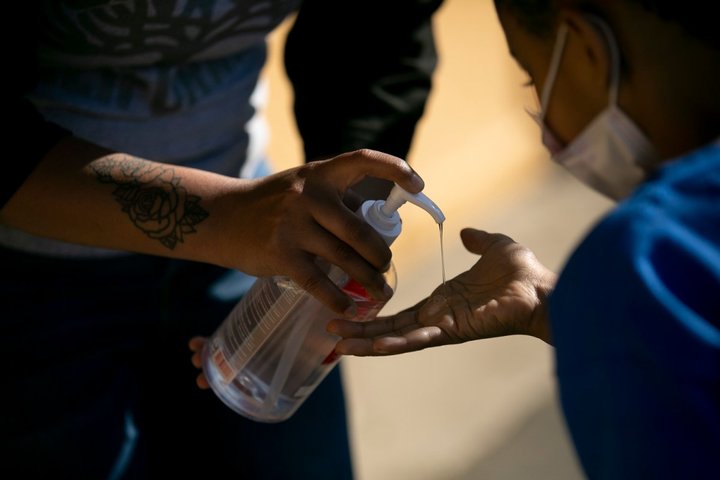
RRising first graders sanitize their hands before entering the classroom during summer session at Laurel Elementary in Oakland on June 11, 2021. Laurel is a hub program for five district schools hosting 120 kids for the summer with a focus on resocialization in addition to academics. Photo by Anne Wernikoff, CalMatters
###
Maribel Ahumada says she lost her sister and nephew to COVID-19 last December.
So when the vaccine became available this spring she took her 16-year-old triplet sons to the grand opening of a vaccination center at San Pedro High School in Los Angeles so they could all get their shots.
Today, as California confronts another wave of the pandemic, she’s frustrated that school districts aren’t acting with the same urgency. She said vaccinations should “100 percent” be required for teachers.
“The way things are going with COVID and now the delta (variant), it should not be an option,” Ahumada said. “I lost two members of my family. I know COVID is real.”
State lawmakers, however, have yet to issue a vaccine mandate for public school teachers, arguing that a mask mandate, increased ventilation and other existing safety measures are enough.
Legislators have put the decision in the hands of local officials, but most school districts haven’t made vaccination a requirement for teachers either because they’re still exploring the legality of a mandate or there isn’t enough support from local teacher unions. The California Teachers Association is strongly supporting vaccines, but has so far stopped short of endorsing a vaccination mandate for all public school teachers.
Some school districts have settled for the softer alternative of a weekly COVID-19 test, as some are facing advocacy groups that are actively fighting against a vaccination requirement for teachers until the FDA fully authorizes the vaccines.
Fifty-four percent of eligible Californians have been fully vaccinated. Coronavirus positivity rates are skewing towards younger, healthier people resulting in lower rates of hospitalization and death.
At the same time, however, the delta variant is breathing new life into what has become a pandemic of the unvaccinated.
Children under 12 are not yet eligible for the vaccine. Public health experts say students, especially younger children, should be safe from getting COVID-19 at school even if their teachers aren’t vaccinated, as long as everyone on campus wears masks and follows hygiene protocols. In rare instances, young children were diagnosed with multisystem inflammatory syndrome after contracting COVID-19. So far, California has had more than 300 cases of the syndrome and 37 have died nationwide.
But spread among unvaccinated adults at schools could threaten a return to distance learning, which devastated students’ mental health and worsened the academic achievement gap along the lines of race, income and disability.
“The need for children to be back in in-person learning has been well demonstrated,” said Monica Gandhi, a professor of medicine at UC San Francisco. “We should do everything we can to keep students in classrooms, including mandating teacher vaccinations.”
The best defense
Megan Bacigalupi, the executive director of Open Schools California, says school districts should take all precautions to ensure in-classroom instruction all year.
“Vaccination is the way out of this,” she said. “Getting everyone vaccinated protects everyone, including kids.”
Bacigalupi has two kids, a third grader and kindergartener, in the Oakland Unified School District. She said she’s not too worried about her kids’ safety because younger children are less likely to catch or fall seriously ill from COVID-19. But she is worried that high case numbers among teachers would force the district to revert to distance learning.
“If we end up with a bunch of sick teachers, we might end up back on Zoom.”
— Andrew Noymer, public health professor at UC Irvine
Most public health experts share Bacigalupi’s concern.
“Those who are vaccinated are much less infectious even with the delta variant,” said Gandhi. “It seems paramount for teachers to be vaccinated.”
In vaccinated individuals who do get infected with COVID-19, Gandhi said, their immune systems are able to greatly reduce the amount of virus in their throats, making it far less likely to spread to others. Considering children are less likely to get seriously ill from COVID-19, unvaccinated adults will be most at risk at schools.
“If we end up with a bunch of sick teachers, we might end up back on Zoom,” said Andrew Noymer, a public health professor at UC Irvine.
Despite these experts urging universal teacher vaccinations, there has been little momentum among state lawmakers. State Sen. Josh Becker, a Democrat who represents sections of San Mateo and Santa Clara counties, has been one of the few calling on districts to require teachers to be fully vaccinated before returning to campuses.
“We’re at a tipping point,” he said. “The delta variant in many ways puts our mindsets back to March 2020. But back then, we did not have the defense.”
Gov. Gavin Newsom on July 26 said that state employees and health care workers must be fully vaccinated or be tested for COVID-19 at least once a week. On Thursday, the California Department of Public Health went a step further and ordered all indoor health care workers to be vaccinated.
When it comes to school employees, however, the governor is also leaving the decision up to local districts. At a Friday press conference at Juanita B. Jones Elementary School in San Bernardino, Newsom said he’s confident that the masking mandate, increased ventilation and other existing safety measures will be enough to keep schools open all year long. But he urged all school employees to get vaccinated.
“We can take these masks off once and for all,” he said. “That way we can keep our kids back in-person without any stress or anxiety for the rest of the year.”
The California Teachers Association is strongly supporting vaccines but has so far stopped short of endorsing a vaccination mandate for all public school teachers. Randi Weingarten, the president of the American Federation of Teachers, the second largest teachers union in the country, said she she would support a vaccination requirement for teachers.
“The circumstances have changed,” she told NBC News. “It weighs really heavily on me that kids under 12 can’t get vaccinated.”
Local approaches
Los Angeles Unified, San Diego Unified and San Jose Unified School Districts are requiring teachers to either show proof of vaccination or be tested at least once a week. San Francisco Unified will not require teachers to be vaccinated, but is asking its employees to provide their vaccination status.
Sweetwater Union High School District in southern San Diego County, which is not requiring teachers to be vaccinated, has had 75 positive cases since its school year started on July 21, mostly among its 37,000 students. Students and staff who came into contact with anyone who tested positive can remain on campus as long as they’re vaccinated and asymptomatic. Unvaccinated students or staff who come into contact can remain on campus as long as they agree to a series of COVID-19 tests over a 10-day period.
Local teachers union president Julie Walker said no serious illness or hospitalizations have been reported to her or the district. She said a vaccine mandate would require negotiations with the district administration. Considering that some teachers do not want to be vaccinated, Walker said it’s unlikely the union would support a mandate.
“I have some very adamant members who don’t want it,” Walker said. “I encourage, but I don’t mandate.”
She said she doesn’t think a requirement is necessary considering the district’s masking rules, contact tracing and testing sites.
Public health experts, however, say there’s no substitute for full vaccination.
“Testing is simply not as good as being vaccinated,” Gandhi said. “Your exposure could have been in between the two times of testing.”
“Testing is simply not as good as being vaccinated. Your exposure could have been in between the two times of testing.”
— Monica Gandhi, a professor of medicine at UC San Francisco
Legal obstacles to requiring teacher vaccination
While many lawmakers, school district officials and teachers unions are all strongly urging school employees to get vaccinated, making it a requirement could open up legal challenges against the state and local districts because none of the COVID-19 vaccines have been fully approved by the U.S. Food and Drug Administration.
Under the vaccines’ current status of “emergency use authorization,” a mandate could be susceptible to legal challenges from employees who refuse, according to Dorit Reiss, a law professor at UC San Francisco.
“We don’t have a lot of cases on this because we’re in a new situation,” said Reiss. “There’s never been a vaccine for the whole population under emergency use authorization.”
But so far, lawsuits related to vaccine mandates at schools and universities have been unsuccessful.
On Aug. 2, a panel of federal judges threw out a lawsuit filed by a group of students against Indiana University’s vaccine mandate. On July 27, a court dismissed a lawsuit against Los Angeles Unified and its requirement that teachers either be vaccinated or undergo weekly testing.
In fact, there’s already precedent for a COVID-19 vaccine mandate in California public higher education. Both the University of California and the California State University systems are requiring faculty, staff and students to be fully vaccinated before they return to campus.
“I am one of thousands of UC and Cal State teaching faculty who are under a vaccine requirement as terms of our employment,” said Noymer, the UC Irvine public health professor. “So it doesn’t seem particularly oppressive to me to require K-12 teachers to vaccinate.”
But local district officials are reluctant to take that step before the vaccines receive full FDA approval. At the very least, district administrators and teachers unions alike want to negotiate what a vaccine mandate might entail.
“We’re certainly in conversation with our unions on how to encourage vaccinations,” said Richard Barrera, president of the San Diego Unified school board. “It’s an evolving conversation.”
Upon FDA approval, Reiss says, the state could mandate vaccines and teachers and their unions would have to comply without bargaining because the order isn’t coming from their employers.
Bacigalupi, the Oakland Unified parent and director of Open Schools California, said districts should absolutely mandate the vaccine once it gets full approval.
“It strikes people as contradictory that there are individuals who would oppose a vaccine mandate, but are completely fine with a mask mandate,” she said.
A return to distance learning unlikely
Public health experts and school district officials do agree that even without a vaccine mandate for school staff, the current spread of COVID-19 and the delta variant will probably not threaten school reopenings in the fall.
Gandhi said as long as schools enforce masking and routine testing, students should be safe on campus.
“Even despite not having any vaccines around, we’ve been able to keep schools open,” she said. “I think the data has shown us that we can reopen safely even during high community spread.”
Scott Borba, superintendent of Le Grand Union Elementary School District in Merced County, said close to 70% of his staff were vaccinated as of the spring. He said he won’t be requiring his staff to submit proof of vaccination. Besides the masking rule, he expects classrooms will feel relatively normal when students return on Aug. 11.
“I’m praying and hoping that we can start the year off normal,” Borba said. “It feels good to be doing education again after a year and a half of being a public health coordinator for my school.”
Ahumada, however, said she’ll pull her sons out of school and into distance learning if she sees too many positive cases among students or staff.
“My sons are desperate to go back,” she said. “But people are still dying. COVID is not gone yet.”
###
CALmatters.org is a nonprofit, nonpartisan media venture explaining California policies and politics.
OBITUARY: William ‘Smidge’ Frank Colegrove, 1962-2021
LoCO Staff / Monday, Aug. 9, 2021 @ 7:20 a.m. / Obits
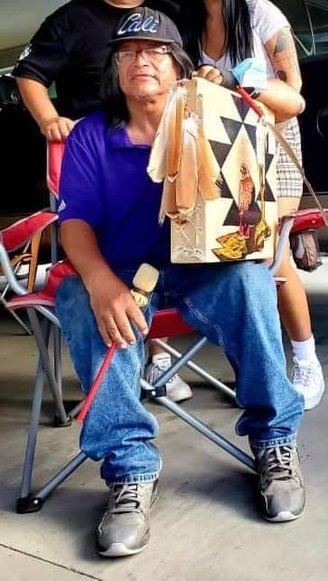
William “Smidge” Frank Colegrove, 57, started his journey home at UCSF in San Francisco on August 3, 2021. Smidge was a native of the Hoopa and Yurok tribes and a resident of Hoopa. He was born August 14, 1963 to Agnes (Jeeps) Colegrove and William (Squeaky) Frank Jr.
Smidge was a pillar of the community — he was an amazing father, a thoughtful and caring brother and a loving uncle, cousin or friend to all. Smidge’s family will miss everything about him, from his big belly laugh to the unique way he spread happiness and laughter everywhere he went.
Smidge attended Hoopa Valley Elementary and Hoopa high school. From ceremonial dances to sporting events to gambling, Smidge loved to be surrounded by his people. His children look back at times with their dad surrounded by ceremony and love as some of their fondest memories. Smidge left a little piece of himself with every person who crossed his path and still had so much to give. He was truly a unique soul and his extraordinary presence will forever remain unforgettable.
Smidge was a dedicated advocate for native rights and water preservation. He “fought the good fight” as he would’ve said by attending the majority of the dam removal protests and Trinity River demonstrations for the past 20 years. He had the time of his life while at Standing Rock in North Dakota fighting against the Dakota Access Pipeline and still talked about it to his girls up until his last days. Smidge loved his native ceremonies most of all, he was a very spiritual man with a very strong singing voice and a very loud and proud Injun holler. If there was an Injun card game going on that’s where you would find Smidge. He was happiest when singing and laughing with his brothers, uncles, cousins, and lifelong friends. Hoopa will forever feel the loss of our great seal, but the memory of him will live on forever — in our dances, in our hearts, and in his children.
Above all else Smidge was a proud dad, he loved all four of his children with every part of his heart and was so thankful to have been their father. Smidge is survived by his daughters Sharissa Sergeys, and Danielle Frank, sons Jess Mclaughlin, and William Frank IV, grandson Darvin Davis, Father William (squeaky) Frank Jr., brothers Eugene (EFC) Colegrove, and Robert Blake, sisters Maggie Sylvies, Cecilia Sylvies-Frank, Alexis Carlene Pratt and Charlotte Frank, aunts Darlene Titus (Cyd Colegrove), Mary Anne Colegrove, Carol Anne McCullough, Cherlette Colegrove, Suzie Mclaughlin, Itsy Frank, and Jewel Frank, uncles Carl (Si-mooch) Colegrove, Alex Pratt, Ricky Frank, and Jack Vadgley and countless nieces, nephews, cousins, and friends whom he loved each in their very own way.
Smidge is preceded in death by his brother Jay Lee Frank, his mother Agnes (Jeeps) Colegrove, grandma Charlotte Colegrove, grandma Ada Florence Jones, grandpa William Barney Frank Sr., aunt Carolyn Frank, great aunts Louise Vadgley, Minnie Mcwilliams, Muriel (Diddy) Jackson, and Louise Kiesner, and uncles Eugene Fredrick (Fada) Colegrove, Johnson Colegrove, and Dennis Jackson, great uncles James Jackson and Peter Jackson. Pallbearers are Jess Mclaughlin, William Frank IV, Eugene Colegrove (EFC), Tony Risling, Darvin Davis, James Gensaw, Manuel Frank, David Maloney, Boyd Ferris, Robert Wolf Colegrove, Salish Jackson, Sherman Norton, Lincoln (Loggie) Jackson, Robert Colegrove, and Christian Colegrove. Honorary Pallbearers are William (squeaky) Frank Jr., Shaun (Snacks) O’neill, Carl (Si-mooch) Colegrove, Ticmil Ashley, Blaze Carpenter, Donte Natt, Ricky (Dimpy) Frank, Dean Powell, Panther Colegrove, Henry Frank, Rodney (rowds) Robbins, Marcus Williamson, Quentin Mosier, Henry McCullough, Arlen Doolittle, Glenn Moore, Deacon Ferris, Sylvester (Flabs) and Freddy Brown, Tom Vanbergen, Lance Lammon, David (Hootie) Lewis, Burr Rogers, Eli Erickson, Caw-tep Thompson and all his dance brothers.
The funeral arrangements are being made at Paul’s Chapel in Arcata. There will be a wake held for Smidge at the pink Baptist Church located at 0 loop road on highway 96 starting at 8 p.m. Monday, August 9. The funeral will be at the same location the following day Tuesday, August 10, starting at 10 am from which we will go to the Brown Family Cemetery on Pine Creek to lay Smidge at his final resting place.
There will be food available after the burial at his niece Angela Saxon’s located at Hostler Field Housing, there will be a sign posted. Covid precautions will be in place and masks will be mandatory with absolutely no exceptions. The family would like to give thanks for the enormous amount of prayers and strength being sent their way and to everyone who provided Smidge with medical attention .
###
The obituary above was submitted on behalf of William Colegrove’s loved ones. The Lost Coast Outpost runs obituaries of Humboldt County residents at no charge. See guidelines here.