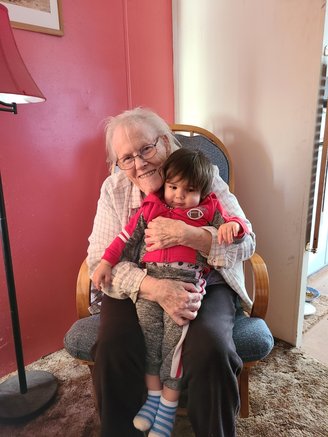
We are saddened to announce that Rosalie Marie Gartzke passed away on March 25, 2021 at the age of 82. She was born on January 9, 1939 in Eureka, where she lived her entire life. Rose (as she liked to be known) was active and healthy until she suddenly passed away due to COVID-19, despite receiving excellent care and comfort in her last days at St. Joseph Hospital.
Rose will be mourned by her husband of 55 years, Curtis Gartzke; her daughters, Kris Ananda and Teresa Stringer, her husband Steve and her grandchildren Michael Sanders, Cory Sanders, Joseph Stringer and Cariana Escareno, her husband Braulio, her great-grandson Damien Escareno and her sister Shield Daggs. She was predeceased by her sister Ramona Downey.
Rose grew up with simply means and developed a strong sense of resourcefulness and tenacity. She enjoyed rose gardening, knitting and traveling with her husband. Rose was friendly and always had an entertaining story to tell with her playful sense of humor. Rose was very giving and was always there for people to offer her support with kind words and generous actions. She was a regular donor at her local blood bank.
Rose is greatly loved and will be missed by all who knew her: family, extended family, friends and all who had the pleasure of knowing her.
You don’t need to believe in Heaven to envision her escorted by the kindest of angels to a lush haven where she may rest in peace.
She will always live in our hearts.
###
The obituary above was submitted on behalf of Rosalie Gartzke’s loved ones. The Lost Coast Outpost runs obituaries of Humboldt County residents at no charge. See guidelines here.
For
the last twelve months, the City of Eureka has produced weekly messages
from the Mayor. These videos have helped the community weather the
storm, but as the weather warms,
and vaccines get distributed more widely into the community, it is time
to start looking forward.
We will mark this transition with a new kind
of video, starting today, the city will begin distributing Community
Conversations, a series of interviews with local
artists, volunteers, public servants, and business leaders.Each weekly
video will highlight what makes Eureka great and the many ways our
diverse citizens partner, get involved, and give back.
My
name is Monica Topping, and I am the administrative director at the Ink
People Center for the Arts, which is the city of Eureka’s official arts
organization. I also am the coordinator
for North Coast Open Studios, which is a DreamMaker project of the Ink
People. It is a county-wide community art event that typically happens
in the first two weekends of June when there’s not a pandemic happening.
The
Ink People is the City’s official arts organization. We support art and
culture, projects and artists and creators throughout the County. We
have a gallery here in our building when
our gallery is not completely virtual. We have a drop-in after school
program, Mars Project, which is a fantastic, amazing program for kids
aged 12 to 26.
We’ve got the DreamMaker program, which is what Open
Studios is a part of. There’s also like more than
a hundred active DreamMakers in this area that are basically art and
culture projects that are sort of independently run as part of the Ink
People. If people have a creative idea or a community project that they
want to do, trying to find funding for that,
if you’re not a nonprofit, can be really extra difficult whether it’s
sponsorships or grant funding or anything else, we can take them under
our wing, make them part of the Ink People as a DreamMaker. And they can
apply for grant funding, or they can get sponsors
from businesses who can use it as a tax, write off as a donation to
their project which is really nice. So it’s really neat that we’ve got
this kind of constant conversation going on with all these incredibly
creative people in our community who are doing
incredible work.
They
say that, there’s the whole Humboldt County census numbers about more
artists per capita in Humboldt County than any other county in
California. What I think is really incredible about
that is that a lot of artists have other jobs, but on the census, they
identified themselves as artists first and foremost. And I think that’s
really, really special. You walk around the streets of Eureka and almost
everywhere you look, you like spin one direction,
you’re going to see a mural or a public art bench or some kind of
sculpture. There’s so much art going on around here. You walk through
Henderson Center and there’s poetry on the sidewalks. It’s incredible.
I
think that the creative community in Humboldt, in Eureka, is definitely
a beacon of light to other creatives. I think it doesn’t hurt that
we’ve got these gorgeous giant trees and this
ocean, and sometimes you can find a single spot to stand in where
you’ve got one on each side of you. That is a really good inspiration
for being creative, but certainly, knowing that there is such a big
support system for creative people in this area definitely
brings people here to be part of it, or if they accidentally show up
and then find out that this exists, it just kind of makes them feel like
it’s home.
We
have this commission within the city, an actual city commission, that’s
an official thing that supports the local art and culture community.
The Art and Culture Commission has helped
to create the city’s Strategic Arts Plan in the last few years. The
city did that, but we supported it. All the benches along the waterfront
and the utility boxes that you see when you’re walking around town, and
a lot of the murals that are around here, we
have supported that happening.
I
think that over the last year, people have really seen the importance
of art. In the time that we, a lot of people have been maybe less
consumed by the hustle and bustle and the, to and
from, and only getting to really pay attention to the life that they
live and not much else outside of that, they’ve been given a little more
breathing room with masks on to experience it. And I think hopefully
the community will see that how important it
is to have neighborhood art, the random utility boxes in the middle of
residential neighborhoods getting painted nice colors, the parks are
being painted, nice colors. It’s just making everything a little more
enjoyable in the world around us and seeing that
art doesn’t just have to be limited to the inside of a gallery. You
don’t have to make a point of leaving the house to go into a place
during their business hours to see visual arts. I think on the far side
of this, we’re going to hopefully see much more of
it and much more of it done in a very public way.
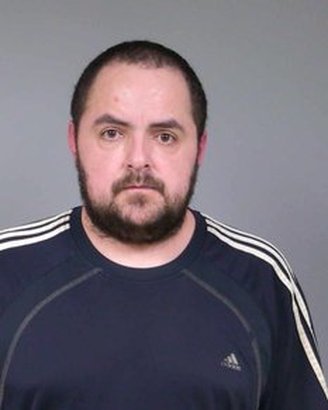
A Rio Dell man pleaded not guilty today to the sexual abuse of two children, with one of the alleged victims 10 years old or younger when they were molested.
Judge Larry Killoran advised Jorge Alcazar Vasquez, 41, that he has been charged with the felonies of oral copulation or sexual penetration of a child 10 or younger and sexual intercourse or sodomy of a child 10 or younger. The alleged abuse took place between August 2017 and June 2018.
Additionally, Vasquez is accused of continuous sexual abuse of a child from July 2018 to October 2019.
Eureka police arrested Vasquez after an extensive investigation, and he remains in Humboldt County Correctional Facility with bail set at $1,705,000. Today he appeared via video from the jail, speaking through Spanish interpreter Carlos Benemann.
Asked whether he wanted to hire an attorney or have one appointed, Vasquez said “I don’t have money for this.”
Killoran appointed the Conflict Counsel’s Office to represent Vasquez, with Deputy Conflict Counsel R.J. Loehner entering not guilty pleas on his behalf. Loehner warned Vasquez sharply not to speak to anyone about his case.
“Do not discuss the allegations with anybody,” the attorney said. “Phone calls are recorded; letters are copied and will be used against you.”
At Loehner’s request, a bail hearing was scheduled for Tuesday. A probation officer will interview Vasquez and then make a recommendation on whether he is a good candidate for supervised release. His bail amount will also be discussed then.
The judge told Vasquez he is to have no contact whatsoever with the victims.
“I have a protective order that’s going to be served on you by the end of the day,” Killoran said.
In the EPD news release issued after Vasquez’s arrest, just one victim was mentioned. Loehner said today that he understood “a statement was taken yesterday,” and he asked for a copy of the statement.
As of now, the preliminary hearing is scheduled for April 14.
From the Humboldt County Joint Information Center:
The number of residents testing for COVID-19 has dropped considerably in recent months as vaccination rates increase, leading health officials to push for continued testing.
“Testing is critical to reducing disease spread in the community,” said Hava Phillips, Public Health Clinic and Communicable Disease Program supervisor. “It’s a lot easier to spread a disease when you don’t know you have it.”
Testing in Humboldt County is offered at no charge seven days a week (7 a.m. to 7 p.m.) at Redwood Acres in Eureka and is also available at various locations throughout the county each weekday. Walk-ins are welcome at all sites, and turnaround time for results averages 48 to 72 hours. See the full schedule below:
Eureka – Seven days a week, 7 a.m. to 7 p.m. (Redwood Acres, 3750 Harris St.)
Arcata – Mondays, 8 a.m. to 5:30 p.m. (Arcata Community Center, 321 M.L.K. Jr. Pkwy.)
Garberville – Tuesdays, 9 a.m. to 4:30 p.m. (SoHum Health Sprowl Creek Campus, 286 Sprowl Creek Road)
Fortuna – Wednesdays, 8 a.m. to 5:30 p.m. (River Lodge Conference Center, 1800 Riverwalk Drive)
According to the Centers for Disease Control and Prevention (CDC), early data show the vaccines may work against some variants but could be less effective against others. Currently, there are five variants of concern in California, which are thought to be more contagious or likely to cause greater illness or severe disease, according to the California Department of Public Health.
Also, while COVID-19 vaccines are effective at keeping people from getting COVID-19, the CDC is still learning how well vaccines prevent them from spreading the virus that causes COVID-19 to others, even if they do not have symptoms.
Additionally, a big concern among Public Health officials is that a vaccine-resistant variant will develop “before we are able to get it under control,” Phillips said.
“Viruses mutate easily, and if the mutations are significant enough, they can create a new variant,” she said, explaining that each person with COVID-19 may have viruses with a few different mutations. “But if people know they are sick and stay isolated, then none of those mutations have the chance to spread to anyone else, and the chance for a new variant decreases.”
New variants are found by looking at the virus found among positive tests. “When people don’t get tested it takes longer to identify that new variants are spreading, which slows down research and response,” Phillips said.
Fully vaccinated people should still watch for symptoms of COVID-19, especially following an exposure to someone with suspected or confirmed COVID-19, CDC states. If symptoms develop, all people — regardless of vaccination status — should isolate and be clinically evaluated for COVID-19, including getting tested, if indicated.
Some Safeway and CVS Pharmacy locations are offering COVID-19 vaccination appointments. See if there are appointments available for your age group or sector at one of these locations by clicking on the links below.
A program aiming to more than double the number of Native American
folks working in local school districts may well be coming to
Humboldt and Del Norte counties. Called the Northern California
Native Teacher project, the multi-year program would be funded
through a $400,000 federal grant and would credential and place 60
Native Americans into local school districts, working as primary and
secondary education teachers, counselors and school psychologists.
Although the project’s leaders won’t know if the grant is
approved until July, they hope to start the program in August and are
looking for folks interested in participating.
“There’s
a real need to make culturally congruent classrooms where Native
students can feel comfortable and see role models of themselves in
the school staff,” Jim McQuillen, director of education for the
Yurok Tribe, told the Outpost during a phone interview.
“Schools right now fall very short of that here in the Humboldt/Del
Norte areas.”
In
Humboldt and Del Norte, about three percent of K-12 educators are
Native American — 38 of Humboldt’s 1,280 teachers and nine of Del
Norte’s 268 teachers were of Native descent in 2019, according to
the most current data from the California Department of Education.
Meanwhile, about 10 percent of students are Native American between
the two counties, according to Colby Smart, assistant superintendent
of educational services at the Humboldt County Office of Education.
The average American Indian student population percentage in
California is about half of one percent.
“There
is an ugly achievement gap for American Indian students throughout
the region — and in California — [American Indian students] are
still lagging behind with our graduation rates and our test scores.
That’s what we’re trying to close, that gap,” McQuillen said.
The
ACLU of Northern Californiareleased
a “failing grade” report in October last year,
which exposed the vast disparities Humboldt’s Native American
students face, including larger achievement gaps and higher rates of
exclusionary discipline than their non-Native peers. The report cites
data backing up these claims, including that in 2019, “Native
American high school graduates in Humboldt County are meeting the
requirements needed to enroll in a UC or CSU at less than half the
rate of all high school graduates in the county,” and that
“Indigenous students in Humboldt County experience suspension rates
nearly five times the state average for white students.”
Providing
students with consistent access to mentors who understand and share
their culture and experiences is one of many suggestions outlined in
the report.
“The
failure of formal education for Native American students in Humboldt
County robs entire generations of the ability to access institutions
that make decisions that fundamentally impact their lives and
communities,” the report reads. “This harms future generations,
as hundreds of Native American youth do not see themselves as valued
or valuable, nor do they have many role models to follow and be
inspired by.”
If
approved, this grant, which is being submitted by the Yurok Tribe, as
well as another grant aiming to place Native American teachers in
business administration positions supported by the Blue Lake
Rancheria, would be big steps toward fostering an educational
environment where Native students are better supported. Other
partners of these efforts include the Hoopa Education Association,
Tolowa Dee-ni’ Nation, Wiyot Tribe, and the Northern California
Indian Development Council.
“Our
goal is to get people that first credential and a pathway to working
here locally, and then get them into the classrooms,” Jack
Bareilles, the grant writer, told the Outpost.
The
program would be available to Native Americans, including Alaska
Native and members
of federally recognized or State recognized Tribes, Native Hawaiians
and Native American
Pacific Islanders. Participants will need a bachelor’s degree in
any subject to participate, however, rising college juniors and
seniors are welcome to apply, too. Over the first year organizers are
hoping to support 20 people in getting their credential, which would
include a monetary stipend of $7,000 to $15,000.
The
grant is due in May, and the program’s visionaries are still
ironing out logistics. It’s likely that many participants would
earn their credentials from Humboldt State, a prospect the university
is excited about.
“This
is a really big opportunity for us,” Libbi Miller, chair of HSU’s
School of Education, told the Outpost. “We are continually
looking for opportunities to better serve our tribal communities. But
we also know that we continually are looking at our representation in
the School of Education, [and] we know that we’re falling short
there.”
Of
the 200 students enrolled in HSU’s education department, about 25
to 30 are people of color, Miller said. The department offers five
credential programs — educational leadership, special education,
elementary education, secondary education and liberal studies
elementary education. Students in the school of education who come
from local communities often stay local after earning their
credentials, Miller said.
“The
more teachers we can educate who are coming from their communities
and working in their communities, the better that those teachers can
support students and children in the community,” Miller said. The
intention is to attract folks who intend to stay local, and if they
don’t, they’ll likely have to return the stipend, Bareilles said.
Miller
expressed excitement about the grant, especially because it will
financially support students going through the program. Earning a
teaching credential requires a year of student teaching, and students
sometimes can’t work at the same time. Stipends from the $400,000
grant would help mitigate that obstacle.
“Not
only is our university is located on Wiyot land, but we’re surrounded
by a huge number of different communities, and we need to do a better
job,” Miller said.
Participants
in the program also would have the option to earn a Yurok language
teaching credential through the Yurok Tribe, which is the largest
tribe in California. For this credential pathway, the Yurok Tribe
administers a written and oral test, which requires fluency to pass.
The state of California issues a Yurok language teaching credential
to people who pass.
“We’re
asking people to challenge themselves to, if they already have a
degree or they’re interested in becoming a teacher, to get on board
and become a teacher, help our students,” McQuillen said. “Our
interest is to get our kids to succeed, and have more culturally
relevant classrooms, and make schools a better place for all kids.”
The
Blue Lake Rancheria is submitting a different federal grant proposal,
which aims to increase the number of Native Americans serving in
administrative roles on school campuses. If approved, the program
would support up to 15 Native American folks through earning a
master’s degree in building administration, and then would help
place them in administrative roles over the next few years. The
five-year program would support the education of five people per year
over the first three years, and then the last two years would be
dedicated to job placement.
For
this grant, interested participants must already be teachers,
limiting the pool of potential applicants quite dramatically, said
Alison Robbins, executive director of the Blue Lake Rancheria Tribal
Education Agency. “Trying to find that many people that are
interested in becoming building administrators in Humboldt County is
going to be difficult,” Robbins said.
For
this reason, Blue Lake Rancheria is looking at ways to expand access
for this grant to tribes across 21 Northern California counties.
“That’s how few Native American classroom teachers there are, which
is why the Yurok Tribe’s grant is so important,” Robbins said.
Because
the participants will likely be quite spread apart, they’ll
probably earn the master’s building administration degree from an
online program, Robbins said, but nothing is set in stone yet.
There
is no record of how many Native Americans work in building
administrative roles in California schools. “In Humboldt County, as
far as we have surveyed so far, there are no building administrators
[or] district superintendents that are Native American and belong to
any of our local tribes,” Robbins said.
“Leadership
really sets the tone for a school environment. And so, we feel that
by having Native American persons, or other persons of color, even,
in positions of authority, that they can help lead the education
system, towards a more inclusive, diverse curriculum and education
for students,” Robbins said, who expressed appreciation toward the
US Department of Education and Office of Indian Education for
recognizing the need for more Native role models in schools.
More
information about programs offered through the Blue Lake Rancheria
Tribal Education Angency can be found here.
The
Humboldt County Office of Education is thrilled about these
initiatives. “Our Native American population is really extremely
high. We have a really rich, vibrant tribal community up here,”
Colby Smart at HCOE told the Outpost. “So anything we can do to
build up the workforce, to help develop inclusive and representative
classrooms, I see that as a real positive.”
Between
local tribes, school districts, HSU, and HCOE, these programs would
be extremely collaborative efforts.
“When
our community embarks on projects such as these, they are most
successful when they are comprised of multiple agencies and multiple
partners, and this is a great example of that,” Smart said. “You’ve
got the involvement of the university, local school districts, tribal
organizations, and so, to me, those are the kinds of projects that
really end up making big, big impacts in our community.”
HCOE
will help, too, by providing professional development support and by
assisting with recruitment efforts.
“Creating
a classroom environment that’s reflective of the communities is
extremely important, not just for that targeted population but for
all populations of kids,” Smart said. In addition to that, Smart
values the program because it will likely produce teachers who are
guaranteed to stay in the area. The county anticipates hiring about
50 new teachers per year over the next few years, Smart said.
“Because
many of the students are being recruited from within the counties,
it’s highly likely that they’re not going to leave the county, right,
so they already have a vested interest in the community,” Smart
said. “And so I see that as a big, big benefit.”
People
interested in participating in the Northern California Native Teacher
project are invited to fill out thisinterest
form. If the grant is approved, filling out this form
does not guarantee you a slot in the program or lock you into
participating; it is simply meant to identify interested folks.
“We
talk equity all the time, which we should,” Bareilles said. “But
the real impact is when we have diversified our workforce so that our
workforce looks like our kids.”
###
DISCLOSURE: The Blue Lake Rancheria is a minority owner of Outpost parent company Lost Coast Communications, Inc.
Press release from the Humboldt County Sheriff’s Office:
On March 31, 2021, at about 4:45 p.m., a Humboldt County Sheriff’s deputy assigned to the Trinity River Division was contacted regarding multiple swimmers in distress at the Big Rock river access in Willow Creek.
The deputy arrived on scene and observed three people stuck on a rock in the river. The deputy retrieved his department-issued water rescue gear, and with the help of additional community members on scene, the deputy deployed the rescue equipment and brought all three of the subjects safely to shore.
The deputy later learned the subjects were from the Arcata area and had decided to go for a swim in the river due to the nice weather.
The Sheriff’s Office would like to thank the community members who assisted our deputy in bringing the subjects to safety.
While the weather is getting warmer throughout Humboldt County, the Sheriff’s Office would like to remind the public that it is still too early to swim in some of our local rivers, including the Trinity River, due to high water levels and swift currents. If you do decide to swim in the local rivers this summer, the Sheriff’s Office offers some safety tips:
Be sure to check river levels and flow information with the National Weather Service, in addition to water release information for the Trinity River.
Never swim alone.
Avoid swimming into a fast-moving current. If the current seems too strong, get out of the water.
Don’t consume alcohol while swimming.
Inflatable water toys should not be used in place of a life jacket. Young children should wear a life jacket when swimming in the river. Watch children at all times.
If you are not a strong swimmer, do not swim in the river. Instead, enjoy from the shore.
Press release from the Humboldt County Sheriff’s Office:
On April 1, 2021, at about 5:15 p.m., Humboldt County Sheriff’s deputies were dispatched to a residence in the area of Myrtle Avenue and Indianola Cutoff Road for the report of shots fired.
Sand.
Deputies responded to the residence and located a 51-year-old male victim uninjured. Deputies learned that the victim had observed an unknown male suspect on his property and confronted him, after which the suspect left. According to the victim, the suspect later returned, discharged a firearm at the victim, then fled into a nearby mobile home park.
Through further investigation, deputies learned that the suspect had fled into a residence within the mobile home park. Deputies surrounded the residence and negotiated with the suspect for a peaceful surrender. The suspect, later identified as 18-year-old Gage James Sand, was taken into custody without further incident.
Sand was booked into the Humboldt County Correctional Facility on charges of attempted murder (PC 664/187(a)).
This case is still under investigation.
Anyone with information about this case or related criminal activity is encouraged to call the Humboldt County Sheriff’s Office at (707) 445-7251 or the Sheriff’s Office Crime Tip line at (707) 268-2539.