King Darius says: I am a Persian; setting out from
Persia I conquered Egypt. I ordered to dig this canal from the river
that is called Nile and flows in Egypt, to the sea that begins in
Persia. Therefore, when this canal had been dug as I had ordered,
ships went from Egypt through this canal to Persia, as I had
intended.
— Darius
the Great, 522-486 BC, Chalouf stele, Kabret, Egypt, written in Old
Persian
###
1887 copy of the Chalouf stele by Joachim Menant. The original is now in the Louvre. (Public domain. Via Wikimedia.)
Suez canal problems?
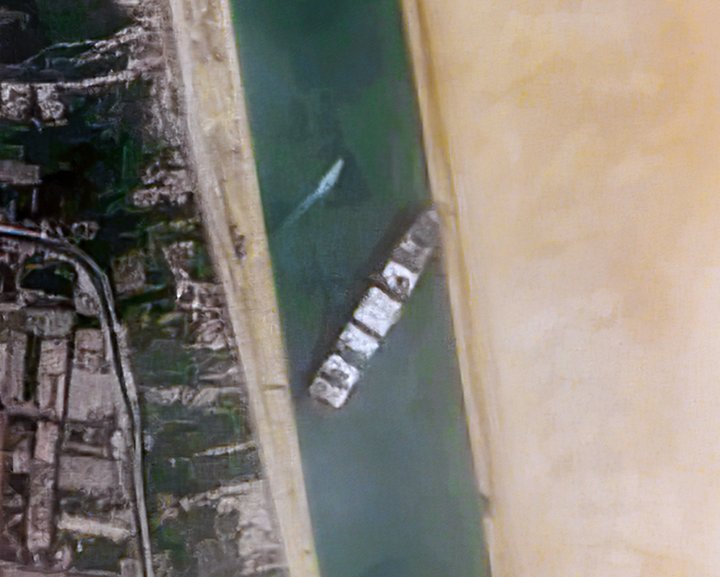
They started much more than two weeks ago, when the quarter-mile-long
Japanese/Taiwanese container ship Ever Given managed to wedge
itself across the southern (single channel) reach of the canal,
blocking it for a week. Try 3,500 years, a thousand years before King
Darius finally achieved success, when one pharaoh after another tried
to dig a sea passage between the Red Sea and the Mediterranean. We
know of at least four failed attempts, even though back then the Red
Sea encroached into the desert farther north than it does now, making
for a shorter project. And even Darius’ canal soon silted up once
Persian control of the area ended.
ESA satellite image, March 24. (Processed satellite data by Pierre Markuse, via Wikimedia. Creative Commons)
More recently, the Ever
Given incident wasn’t the first time Suez had been blocked,
although it was the first unintentional blockage. Following the 1967
Six-Day War, when Israel rapidly overwhelmed Egyptian forces from the
air, Egypt blockaded the canal at both ends, trapping fifteen cargo
ships from all over for eight years. Dubbed “the Yellow
Fleet” after being coated with desert sand, they were finally
released when the canal re-opened in 1975.
The canal was
originally opened in 1869, following ten years of construction under
the guidance of French diplomat Ferdinand de Lesseps. This wasn’t
the first French attempt at linking the Mediterranean to the Red Sea.
Napoleon, during his brief campaign in Egypt (1798-1801) and before
being thwarted by Britain, had his engineers locate Darius’
original canal, which extended north from the Red Sea to the Bitter
Lakes (see satellite photo), thence westward to a branch of
the Nile. Napoleon planned to restore and rebuild the 500 BC canal,
except he wanted to route it north from the Bitter Lakes directly to
the Mediterranean. However, surveys from his Egyptian expedition
incorrectly showed the elevation of the Red Sea as 30 feet higher
than that of the Mediterranean, which would have required a
complicated system of locks, so the plan was abandoned as too costly.
(In fact, the two seas are roughly at the same level: south of the
lakes the canal is tidal, while between the lakes and the Med, the
flow is north in winter, south in summer.)
This NASA image shows the Bitter Lakes between Suez City on the Red Sea and Port Said Mediterranean. The Ever Given was stuck about halfway between the lakes and the Red Sea. The 120-mile long canal cuts over 5,000 miles off a voyage from the Indian Ocean to Europe. About 50 ships pass through it every day. (Public domain, via Wikimedia.)
On a personal note, I
thought I’d be admiring the canal when I traveled by bus from Cairo
to Jerusalem some years ago. Sadly, I only glimpsed it from afar,
since the main road from Cairo to the Sinai Peninsula ducks down
under a long tunnel on either side of the canal. (On seeing a
particularly regal-looking dog there, I thought of the classic
palindrome “A man, a plan, a canal: Panama!” So I asked my
Italian seat-mate, “Is god Zeus a Suez dog?” “Si!”)
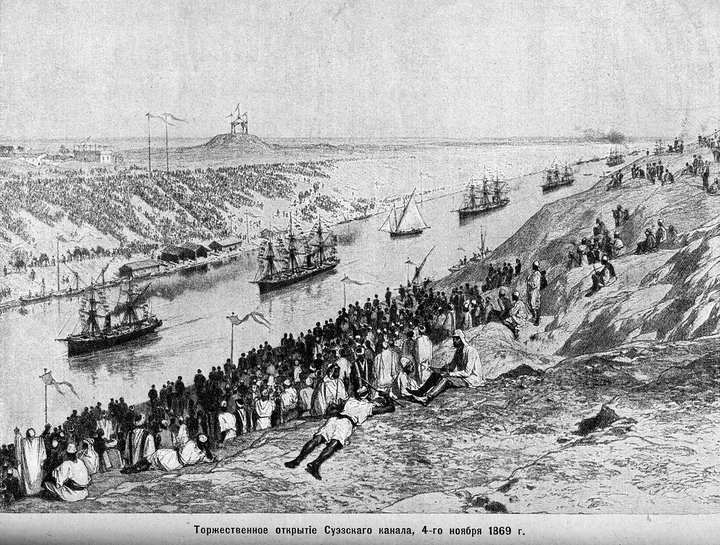
Here’s my favorite
image of Suez, an etching showing the first convoy to travel through
the canal November 17, 1869.
In a Zoom meeting this past week, one of my colleagues brought up a point that had thus far not been raised. We’re all Zoom-fatigued enough as it is that we try to keep the sessions short. Ever since the pandemic took hold last winter, we have been flying by the seat of our pants, adapting to online teaching. Our students, for the most part, have adapted as well.
“At a certain point,” the colleague said, “Shouldn’t we develop a core template for the online curriculum? I mean, because this is where we’re heading, to some form of hybrid learning.”
She had a point, the rest of us grimly conceded. Sooner or later, this pandemic will wind down, allowing us to return to the university campus which has for the most part been shut down for the past year. But no doubt, that will not mean an end to online classes. Most likely, we will eventually have a mixture: perhaps three days at the campus, two days at home, or some such formula yet to be determined. After all, the online courses have had their benefits. It’s nice, for example, not having to navigate the city’s often soul-crushing rush hour traffic in the mornings and evenings. And not having to brave the cold, miserably wet mornings we in Istanbul have experienced of late,
Of course we all miss the face to face interaction with the students. We miss the pleasant, positive vibe of the campus (the café, the chats over coffee with colleagues during break time, the gossip). Likewise, the students miss having the chance to make new friends, the social atmosphere that school provides along with academics. No doubt we will return to the campus, hopefully later this year.
But equally certain is the fact that an online component will remain. After all, we cannot be too sure that another wave, even another virus, won’t come along. But also, our colleague’s suggestion notwithstanding, we have managed to develop a viable working online model, through lots of trial and error. We use Blackboard, a well-known education platform, and Zoom for the virtual classroom, Why just throw these tools out when the coast seems to be clear? Why ignore the benefits and potential of online learning, which has a lot of room for further growth and development?
Also, the students have gotten used to it. It would appear to be more prudent, and forward-thinking, to continue to develop and refine the platform, as our colleague suggested at the meeting last week. Technology also fails though: You can’t ‘always count on your Internet connection, as we all know.
Which means that, yes: sooner or later, we need to get back to the campus, for a lot of good reasons. But also for good reasons, we need to keep and improve the online model. The old and new ways should work together, and this pandemic, for better or worse, has forced us into finally doing things in practice that previously only been talked about in theory.
###
All of this got me thinking of the world in general. The world we have always known, the one we have grown to miss terribly the past year, has receded not so gently further into the past. My wife and I, like most people, find ourselves pining for the days when we would routinely plan our summer holidays. When we could travel abroad (America this year? Or Europe again?). Now we’re not even sure that, even when we get vaccinated, if the vaccines we get will be accepted abroad (“Sorry, your China-produced vaccines are not good enough for us to grant you entry. Next!”)
Years ago, I worked at a steakhouse in Eureka. A lot of the regulars were in their late fifties, early sixties. They remembered the glory days of the North Coast, when logging and fishing were king and queen, and the steakhouse was the best place in town. Some of these old-timers could be grumpy, quarrelsome, fussy whenever they came into the restaurant.
“Their problem,” observed my manager at the time, “Is that the world is changing. And there’s not a damn thing they can do about it.”
It’s never been good to fear change – something I learned from those days. And nowadays, our world has changed very dramatically, continues to change every day. None of us really know when this pandemic, and its effects will finally end, or at least peter down to a level that enables us to stop wearing masks and banish the concept of social distancing from our vocabulary and daily habits.
It could well be, as some have posited, these measures will be in place for years, if not the remainder of the decade. Rather than the Roaring Twenties, this could be The Worrying Twenties. Well, at least we can all have a drink of something better than bathtub gin.
Perhaps this pandemic will be, for our generation, the world-changing, cataclysmic event that the first World War was for the flappers and sad young men of that era. Speaking of them for a moment, the end of the Great War saw the emergence of the New Woman, with bobbed hair, short skirts, and a newfound independence. The so-called woke movement, propelled by the ever-growing power of social media, will continue to transform and challenge longheld attitudes toward race, gender and sexual orientation. The Jazz Age produced the first movie stars; our age produces Instagram stars and influencers (“influencer,” a term that scarcely existed a decade ago).
In politics, China is making increasingly bold moves to become the world’s preeminent power, just as America was at this time a century ago. China’s economy is set to surpass the U.S. by 2030, according to recent news reports, and the situation in Hong Kong, not to mention China’s Vaccine Diplomacy effort, the recent successes of its space program, the ongoing construction of the New Silk Road (which by the way, also includes Istanbul), not to mention the unveiling of new aircraft carriers – all of these things, along with the West’s general preoccupation with wars – from the Middle East to its own present culture wars – the past twenty years or so, suggest that China’s ambitions not only will be realized, but that profound change in the world order may already be under way. If so, in ten years’ time, the students at my university will probably be learning Chinese instead of English (or Chinese along with the existing English courses).
I’ve drifted far afield from that opening, from our Zoom meeting. These are just thoughts (God, do we have too much time to think nowadays? Too much time at home), I have had for some time that I just wanted to get down. Maybe in a few years’ time, I’ll look back on these grandiose theories and wince, but that would hardly be the first time that’s happened.
###
To employ the cliché, only one thing is certain: change. Just as my English colleague pointed out at the meeting. No matter what happens regarding this pandemic, online learning is here to stay, in one form or another, something we teachers and our students will have to accept, and we have. I suppose the same is true for a lot of other things.
I wonder what F. Scott Fitzgerald, the chronicler of the Jazz Age, would have said about this latest version of the Twenties. He might have called it the Streaming Age, or the Spotify Age, if he wished to assign a soundtrack. But that too is another sign of our times, that we don’t have a predominant, era-defining style of music (would you count KPop? I say, meh); we all listen to our own playlists rather than the radio (I probably haven’t listened to a radio station proper in – how long? Probably about the last time I actually bought a newspaper, and who can remember the last time they did that?)
Then again, the always prescient Fitzgerald might have found the concept of “generations” itself to be a rather outmoded idea, given that we seem to have dissolved or transmogrified into an online mass, a sea of comments, shares, likes and memes – young and old alike breathing the same contaminated air, equally (equally? That’s a loaded word: “comparably” then) connected and disconnected, affected and disaffected.
Maybe the Hybrid Age is a more fitting term, since moving forward a lot of things will be mixed together, the old absorbed into the new, if not replaced or discarded, where ambiguation is the norm; those seeking clarity will be singing with the nightingales.
Most likely we will continue, for example, wearing masks for quite a while, and the modifications that restaurants and cafes, and other public places, have had to make to allow for social distancing will also probably remain. Who knows? Have dark, corner booths gone the way of the smoking section? Romantic couples can only lament, and rendezvous in the park for a picnic instead.
Well, enough philosophizing and prognosticating for one day. I’ve got an online class to teach, and before that, my wife needs me to take our son Leo for a tractor ride in the living room. That, along with at least one more perusal of “The Book of Things To Spot,” are among Leo’s morning requirements. Being a parent is one of the big changes I for one have certainly had to get used to the past year. But some changes, big or small, are worth it.
I’ll close on an encouraging thought, the old dirge from Shelley:
The world’s great age begins anew The golden years return …
Shelley is right, of course. But the golden years, upon returning, never look quite the same as they once did. Often we don’t even notice they were here until they are gone. Maybe the best thing is to just try to live now and enjoy this age for what it is, and for whatever it turns out to be.
###
James Tressler, a former Lost Coast resident, is a writer and teacher in Istanbul.
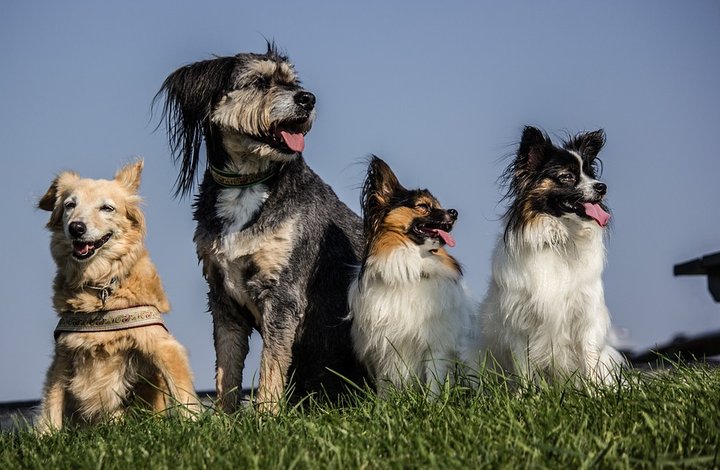
To own this many dogs, you would need a “Dog Fancier” license under Eureka’s updated animal ordinance | Image by Pixabay user JenniGut. Pixabay license
During its Tuesday night meeting the Eureka City Council will discuss the city’s updated animal ordinance, which would alter the city’s rules surrounding pet ownership for the first time in over half a century.
The Eureka Police Animal Control Department has been working to update the existing ordinance for about five years, holding several public meetings, conducting research and rewriting the ordinance several times. After holding a public workshop on Mar. 9, city staff has made some additional changes that it hopes will address the community’s concerns.
For one thing, the ordinance has some less restrictive language surrounding the numbers of specific types of pets residents can keep and focuses more on updating the rules of appropriate animal care.
“Essentially what we found was that putting hard limits on the numbers is not realistic,” Animal Control Officer Celeste Villarreal told the Outpost in a recent phone interview.“Really our goal is to implement an ordinance that ensures public safety, ensures the quality of life of our residents.”
The current draft ordinance, for example, no longer limits the number of small rodents — such as mice, rats and guinea pigs — someone can keep (in its previous version owners were limited to 10.) This is with the exception of rabbits, of which 20 or less would be allowed on properties under 5,000 square feet and up to 40 would be allowed on larger properties.
As for miniature goats and miniature pigs, the current ordinance still limits ownership to two (with an exception for baby mini goats or pigs under the age of four weeks.) However, the latest draft also allows for up to two full-size goats or pigs within city limits, as long as your property is at least 11,000 square feet. Horses, ponies or cows would only be allowed on properties at least 21,000 square feet in size.
In addition to requiring dog and cat owners to obtain a “Dog Fancier” or “Cat Fancier” license if they own more than three of each type of furry friend, the ordinance now also requires an “Exotic Animal Fancier” license for anyone wanting to keep more than 10 exotic animals — including reptiles, amphibians and parrots. Many other exotic animals — such as bats, crocodiles, venomous snakes, porcupines and anteaters — are strictly prohibited. But keep in mind that those animals are already illegal to keep unless you are a licensed zoo.
The council will decide on the cost for the “fancier” licenses, which would require an annual renewal. But Villarreal says that these licenses are not going to be expensive or require a complicated process. Since dogs are already required to be licensed, there would be no additional fee for obtaining a “Dog Fancier” license, Villarreal said. When you go in to license your fourth dog, you would just apply for a fancier license instead of a regular one.
Additionally, the latest draft of the ordinance includes more language around proper animal care, such as stricter requirements for what is considered an acceptable shelter. Under this ordinance shelters with wire or grid flooring that doesn’t protect the animals feet would not be acceptable and using metal drums, abandoned vehicles, uncovered porches or lean-tos as shelters would also be prohibited.
Officer Villarreal and Eureka Police Captain Chief Brian Stephens wanted to remind the public that the primary purpose of this ordinance is to create a framework for legal, safe and ethical animal ownership. Penalties would be complaint-based and the department plans to put its energy into dealing with dangerous or unsanitary animal situations, not penalizing people who haven’t gotten around to obtaining a “fancier” license.
“We put a lot of work into this [ordinance] and we really think this is the roadmap for responsible pet ownership,” Capt. Stephens told the Outpost. “We really appreciate everyone’s input.”
If the council decides to move forward, the ordinance would be brought back for adoption at a later meeting. You can view the full draft ordinance here.
###
In other business, the council will consider drafting an ordinance that would require higher pay for grocery store employees during the COVID-19 emergency.
The issue was brought forward by UFCW Local 5 — the local chapter of the United Food and Commercial Workers, which has been working to obtain higher compensation for grocery store workers who have continuously worked throughout the pandemic. Many cities, including San Francisco, Oakland, Long Beach and Los Angeles have recently adopted “hazard” or “hero” pay ordinances, most requiring grocery stores to pay employees somewhere between an additional $3 to $5 an hour.
Eureka Co-op | File photo
The purpose of the additional pay, Local 5 North Coast Director John Frahm told the Outpost, is to acknowledge the health and safety risks of essential grocery store workers, many who have been working with the public throughout the last year. Additionally, Frahm says that grocery stores have largely seen huge profit increases during the pandemic. Brookings Institution reported that the 13 largest retail and grocery store companies in the United States earned $17.7 billion more in the first three quarters of 2020 than they did in 2019.
However, there have been some doubts about whether local grocery stores have seen these same profit increases. When the Arcata City Council discussed a hazard pay ordinance, several council members said that they were concerned about the burden this would place on some of our local businesses and one grocery store owner said that they had actually seen a decrease in profits since 2019.
But Frahm says that local grocery store employees have been saying this is the busiest they’ve ever been. “The grocers in the store will tell you it’s like Christmas every week,” he said.
Local 5 suggests that the ordinance last until the county is in the yellow tier or a minimum of 90 days and apply to any large store that “devotes 15% or more of its interior space to the sale of household foodstuffs for offsite consumption.” Grocery stores that have 500 or more employees nationally and more than 15 employees in Eureka would be asked to pay an additional $4 an hour and stores that have more than 25 but less 500 employees in Eureka would pay an additional $3.
Of course, if the Eureka City Council decides to move forward with a hazard pay ordinance, it would decide the parameters, such as the amount of the pay raise, the size and type of stores that would have to pay and the duration of the ordinance.
You can read the full draft ordinance suggestions here.
Cape Horn Dam at Van Arsdale Reservoir. Photo: PG&E.
###
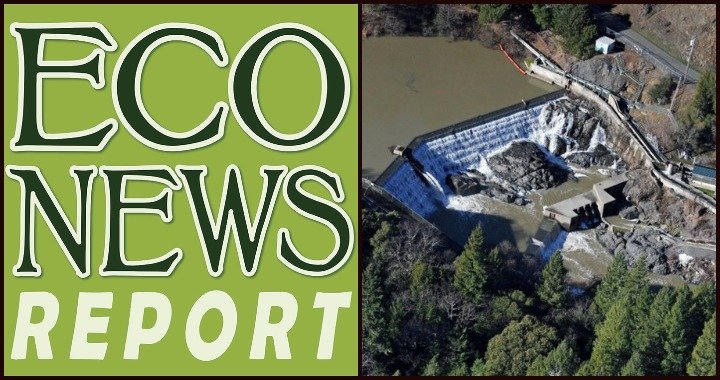
There’s
a proposal to remove the fish-blocking Scott Dam on the Eel River but
looming problems still remain. Cape Horn Dam, just downstream of
Scott Dam, technically allows for fish passage through its
fish ladder — but that’s only when the ladder is properly
functioning and the trouble is that fish often can’t use the ladder
because it gets so choked with rocks and debris. So what good is the
removal of Scott Dam if salmon still struggle to get past Cape Horn
Dam?
Friends
of the Eel River is pressing the Federal Energy Regulatory Commission
(FERC) to address persistent issues with the fish ladder and –
shockingly — FERC admitted that Friends of the Eel River is right!
In an important win for salmon, FERC has agreed to consult with the
National Marine Fisheries Service as required by the Endangered
Species Act.
Find
out what this victory means for salmon and dam removal across the
West Coast on this week’s EcoNews Report.
Friends of the Eel River (FOER) has claimed an obscure but important win in our fight to
reverse the harms Pacific Gas & Electric’s two Potter Valley Project dams continue to cause
critically imperiled Eel River salmon and steelhead. Though it took the threat of a lawsuit, the
Federal Energy Regulatory Commission (FERC) has conceded it improperly approved an
operations plan for new doors on the fish ladder at Cape Horn dam. The Commission failed to take
the basic steps required by the Endangered Species Act to ensure listed species won’t be pushed
closer to extinction by federal actions.
On March 25, FERC issued a new Order withdrawing the January 28 Order FOER had challeged.
Having apparently received a revelation, FERC wrote that “(c)ommission staff has determined that
we are required to consult with the National Marine Fisheries Service (NMFS) under section 7(a)(2)
of the Endangered Species Act (ESA) to ensure that implementation of the Plan is not likely to
‘jeopardize the continued existence of any endangered species or threatened species or result in the
destruction or adverse modification of such species…’”
“FERC’s about-face is a victory for us and a result of our diligent efforts to protect the Eel River’s
native fish,” said Alicia Hamann, FOER’s Executive Director. “FERC is notorious for refusing to
consult over the impacts on fish and wildlife of the dams it regulates. We’re very happy to see the
Commission acknowledge, even in this small instance, that the Endangered Species Act does
impose a legal duty on FERC itself to ask the expert agencies how its projects affect listed species.”
“This should help move all parties involved toward a realistic solution to the Eel River dams,” said
FOER Conservation Director Scott Greacen. “FERC’s concession means NMFS will take a long
overdue look at Cape Horn dam’s fish ladder, the longest and highest in California, through the
prism of the Endangered Species Act. If a truly adequate fish ladder is even possible at Cape Horn
dam, we have to know what would it cost compared to just removing the dam. The Two Basin
Partnership now seeking to relicense the Potter Valley Project has proposed removing Scott dam,
but so far refused to even consider removing Cape Horn dam. That will have to change.”
To submit a locally-filmed (or produced) video, upload it to YouTube and email the link to News@LostCoastOutpost.com with your name, a brief description of your work and “TRL” in the subject line. Please do not submit videos containing any form of violence, racism, illegal activity, pornographic material, bullying or harassment. Also, no advertisements or duplicated submissions please.
Humboldt County Travel Video - Hunter Rayl
Local photographer and super Instagram friend of LoCO Hunter Rayl sends in this cinematic travel film put together in 2019.
“Humboldt County is my home county and I wanted to make a cinematic travel film for it to give this place some exposure,” Rayl said. “I used a Canon 80D and a 17-40mm & 50mm lens to film this. Also use a DJI Mavic Air. Edited on Premiere Pro. Hope you enjoy the beauty of it! Much Love.”
Ambient #1 - Michael Thompson
Local X-ray technician Michael Thompson plays ambient music on a 10-stringed instrument known as a Chapman stick.
“This is an ambient looping piece using an EBow and delays to create an evolving soundscape with video shot on the North Coast,” he said. “Beware, it’s just over 11 minutes long. Sort of a meditative piece.”
“Stranded in the Moment” - The Trouble
“One year ago today, the reality of COVID-19 personally came into focus for us,” the band shares. “Like many other bands, we had plans made, rehearsals scheduled, shows booked. At the time we had no idea what was to come and looking back it still doesn’t seem real. We recorded “Stranded in the Moment” in November 2019, before the world turned upside down, but it feels oddly relevant to the past year. This song is a gift to our friends and fans, and a reminder that we are still here, and we look forward to making more music for you in the future.”
On Friday April 2, 2021, at approximately 9:30 p.m., the Arcata Police Department responded to a shooting in the parking lot of a motel in the 4700 block of Valley West Blvd.
Officers located a 27-year old male with gunshot wounds and rendered medical aid until he was transported to Mad River Community Hospital in serious but stable condition.
Investigators learned the victim was involved in an altercation with two males in the parking lot that resulted in gunfire. The suspects were last seen fleeing on foot.
The suspects were identified as follows and are considered armed and dangerous:
LUKE ALLEN OLSENSMITH DOB: 10-09-1993
TONKA JODY GRITTS DOB: 08-31-1992
This is an ongoing investigation and anyone with information as to the suspects’ whereabouts is encouraged to contact the Arcata Police Department’s Investigations Division.
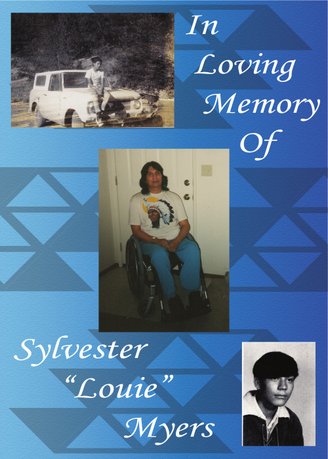
Sylvester Lewis Myers was born April 22, 1952 in Humboldt County to
Charles Everett Myers and Ida Mae Lewis. He passed away on March 15,
2021 in Arcata. Similar to his late brother Dewey, he also didn’t
go by his first name but rather an adaptation of his middle name,
Louie. Although, he did have many nicknames given to him throughout
his life such as Sad Sack, Screwy Louie, Kung-Fu Louie, Uncle Ear,
Sylvester the Cat and Horsefeathers. He was a son, brother, husband,
father, grandpa, uncle, mechanic, Elvis fan, artist, vehicle
enthusiast and a member of the Yurok Tribe.
As
a young boy, he had an aptitude for fixing cars. One would find him
as a young boy learning and helping his father fix cars. This skill
would later lead him to attend a school in Los Angeles to train to
become a mechanic. After finishing school he started working as a
mechanic in Los Angeles but would later move back and forth between
LA and Humboldt County. He was a mechanic most of his life and always
loved to be around cars.
Being
a vehicle enthusiast, he always wanted to own cars and he did own
many different vehicles throughout his lifetime. He also owned a
motorcycle in which he shared many memories with family and friends.
Most likely his favorite vehicle he owned was a white Corvette as he
would always talk about it even after he crashed it. Even towards the
end of his life he always talked about getting a car and fixing it up
for him to drive around town in.
He
loved to play and dance to Elvis Presley as well as his “Oldie but
Goodies” music. On one occasion, his ex wife mentioned he would
dance on a table to Elvis shaking his hips as Elvis would. In another
occasion, he had his two nieces sing along with him to Angel Baby at
the very least three times while parked in his sister’s old red
Pinto on Martin’s Ferry bridge.
In
his later years, he would draw his favorite cartoon characters and
Jesus drawings for his family and friends. When he was in the
hospital he would then make drawings for his nurses and doctors. He
especially loved to draw pictures for his pretty nurses.
With
that said he loved the ladies and had three wives in his life. Two of
which gave him his sons. His second wife gave him Andrew and
Sylvester Myers. His third wife gave him Laurance Myers. He loved all
his sons in his own way.
He
really just wanted to live as long as he could in this life. There
were many times when he did almost lose his life but as he would say,
“the good lord didn’t want him in heaven yet.” As such he was
given the nickname Sylvester the Cat with the many lives he seemed to
have. With his passing, his family can only imagine him saying as he
would when he left a place, “Elvis has left the building.”
He
is preceded in death by his Grandparents Melissa & Charles Myers,
Rose & Andrew Lewis; his parents, Charles Everett Myers & Ida
Mae Lewis; his siblings Sharon Myers, Sam Young, Eugene Young,
Frankie Erickson, Joseph Henderson, Everett Dewey Myers & Andrea
Lavato; his Aunts & Uncles Georgiana & John Troll, Queen
James, Arvada Lewis, Andrew Lewis, Jr., Rose Wilder and Marilyn
Latham; and his wife Pamela Whitlatch.
He
is survived by his sons, Andrew Myers, Sylvester Myers Jr. and
Laurance Myers; his grandchildren, Ryan Myers, Sylvester Myers III,
Pamela Myers; his brothers & sisters, Everetta Myers, Gilbert
Myers, Larry Silloway and Barbara Rakestraw; his first cousin who was
like a brother, Richard “Dickie” Myers and his many nieces and
nephews.
Honorary
pallbearers are Gilbert Myers, Larry Silloway, Wesley Latham, Richard
“Dickie” Myers, Anthony Lavato, James Snow, Nin Myers, Gilly
Myers, Frankie Jo Myers, Richard Myers, Charlie Myers, Dustin Latham,
Dewey and Louie Myers.
The
graveside service and burial was held at 1 p.m. on Friday, April 2,
2021 at Greenwood Cemetery in Arcata.
###
The obituary above was submitted on behalf of Sylvester Myers’s loved ones. The Lost Coast Outpost runs obituaries of Humboldt County residents at no charge. See guidelines here.









.jpg)

