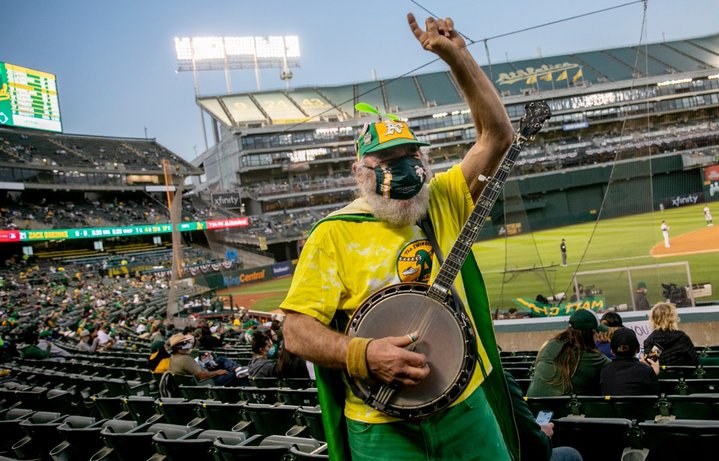
San Francisco resident Stacy Samuels, also known as Super A or Banjo Man, plays the banjo while cheering in the stands. Samuels, who has been bringing his banjo to Athletics games for more than 30 years, said “It’s great. It feels like a regular game,” of the season opener. Photo by Anne Wernikoff, CalMatters
###
Long before he watched the windup to the first pitch, even before he entered the Oakland Coliseum, Sergio Santillan of Hayward was already feeling emotional.
“I kinda wanna cry. I’m just loving it,” he said, beer in hand, perched on a cement divider in the parking lot.
Last year would have been Santillan’s third year as an A’s season pass holder — but then it all came to a screeching halt. The emergence of the coronavirus pandemic triggered a California shutdown, and the season was postponed and then closed to live fans, who were replaced by cardboard cutouts.
“I was,” he said, “bitter.”
But last night, Major League Baseball welcomed spectators back to stadiums for regular season games for the first time since October 2019. The significance of Californians returning to a large public gathering — albeit masked and socially distanced, and stadiums at about a quarter of capacity — wasn’t lost on anyone. And it was underscored by an inescapable reminder: In the parking lot just behind the stadium, occupants in dozens of cars were lined up to receive their Johnson & Johnson COVID vaccine.
For baseball fans who turned out at California stadiums to watch openers by the Los Angeles Angels, San Diego Padres and Oakland A’s, the experience wasn’t exactly the same as before the pandemic. But the general consensus was that it felt good to be back.
“I was here before I was born. In this stadium and every year since,” said Kurt Samuels, a perennial season ticket holder for Oakland’s baseball team, the A’s, and football team, the Raiders. “The A’s winning or losing is such a tradition and to not have that last year made what was happening in 2020 that much more real,” he continued. “This last year has been torture.”
The pandemic disrupted the 2020 baseball season, as it did so many other things. Season openers were initially postponed from April to July, and the regular season was ultimately cut short to only 60 games rather than the usual 162. Fans were excluded from attending, to reduce the risk of COVID-19 transmission.
But as spring of 2021 loomed, the prospect of attending a baseball game enticed Californians. It was no coincidence that Gov. Gavin Newsom — facing a potential recall election fueled in part by dissatisfaction over pandemic restrictions — staged his annual State of the State speech last month at a virtually vacant Dodgers Stadium, where he promised a return to at least semi-normal life.
Oakland, in Alameda County, falls in the orange tier on the state’s hierarchy and thus could have filled a venue to a third of capacity. But the smaller size of the Coliseum meant that A’s fans were limited to quarter capacity, or just over 12,000 attendees, to ensure six feet of social distancing between pods of two to four people. The Coliseum also required that all fans remain masked when not eating or drinking, and use cashless payments and ordering for concessions.
The only hiccup? The cashless payment system, which caused some friction for fans who had a hard time accessing the app.
“We’ve been having trouble with mobile ordering,” said Darby Nastasia, her sparkly green eyeshadow and A’s mask matching the sea of green around her. But she and her fiance, David Baker, agreed it wasn’t enough to take away from the experience, saying they were “just happy to be in this environment.” The Coliseum eventually opened beverage purchases to credit card holders.
As for the outcome, the A’s lost, to the bad boys of baseball, the Houston Astros, giving A’s fans the chance to boo the trash can bangers who cheated their way to a World Series title in 2017.
But for the most part, fans were happy to comply if it meant they could enjoy a game in person. “It’s a little different,” said Tracy resident Michael Saenz. “It’s definitely fine, but different.”
Darby Nastasia, left, and fiancé David Baker, cheer from the stands. “ I cried a little bit,” said Nastasia of being back at Coliseum after more than a year. Photo by Anne Wernikoff, CalMatters
Fans sit in pods of two to four during the game in order to maintain sufficient space between groups. Photo by Anne Wernikoff, CalMatters
A Coliseum service employee carries a sign through the stands reminding fans to wear as mask. The Coliseum implemented a number of safety protocols for the season opener including masking, distancing and touch free payments for concessions. Photo by Anne Wernikoff, CalMatters
Players and spectators stand for the national anthem at the start of the game between the Oakland A’s and the Houston Astros. The Oakland Coliseum operated at 26% capacity in order to allow ample spacing between groups. Photo by Anne Wernikoff, CalMatters
Ernie Robles, center, enjoys chicken wings in the parking lot with his sons Benicio, left, and Antonio, right, before entering the stadium for the start of the game. “Once I get in I’ll put my mask on. It’s the new, new, you know?” He said of the safety protocols. Photo by Anne Wernikoff, CalMatters
Fans distance as they wait to enter Oakland Coliseum before the season opener. The ballpark opened to fans for the first time since October 2019. Photo by Anne Wernikoff, CalMatters
Talat Mirmalek of San Francisco speaks with a concessions employee while struggling to use the online ordering and payment app. “We’re missing the whole first half of the game right now,” her friend Sierra Coats said in frustration. Photo by Anne Wernikoff, CalMatters
Fans socially distance as they wait in line to pick up orders at a concessions stand. Many struggled to use the online ordering and payment app, leading to lines and delays. Photo by Anne Wernikoff, CalMatters
Tents housing the Coliseum COVID vaccination site can be seen in the background behind the A’s stadium on opening day. The vaccination site, which is run as a partnership between FEMA and California Office of Emergency Services, has administered more than 292,000 doses since opening six weeks ago. Photo by Anne Wernikoff, CalMatters
Perry Farahani throws a baseball with his son Jacob, 12, in the Coliseum parking lot. “It’s different than normal but I’ll take it,” he said of not being able to tailgate. Photo by Anne Wernikoff, CalMatters
Andrew Rodriguez of Union City organizes his A’s apparel as her gets in line to enter the stadium before the start of the game. Photo by Anne Wernikoff, CalMatters
###
CALmatters.org is a nonprofit, nonpartisan media venture explaining California policies and politics.
The Lasen helicopter conducting gas surveys in the North Coast is N16770. | Image via PG&E.
Press release from PG&E:
Just in time for National Safe Digging Month,Pacific Gas and Electric Company (PG&E) started conducting aerial patrols of gas transmission pipelines in Humboldt County April 1. Residents may notice the low-flying helicopter in Southern and Southeastern Humboldt County at a height of 300 to 500 feet.
The helicopter will fly to and from Eureka’s Murray Field, intermittently Monday through Sunday, between the hours of 8 a.m. and 4 p.m. through the week of April 4.
PG&E conducts semi-annual aerial patrols of all its gas transmission pipelines in the interest of public safety and system integrity. PG&E crews are combining the use of LIDAR-based equipment and state-of-the-art leak detection technology with a streamlined repair process to find and fix leaks, if any are detected, faster than ever before.
Each patrol consists of a pilot and an observer. The observer in the helicopter uses a GPS-enabled tablet with mapping data to navigate the pipelines and document excavation and construction activity, or other observations that warrant follow-up.
Where appropriate, PG&E ground personnel are sent to construction areas to verify that safe digging practices are being followed. This includes confirming the use of a valid 811 ticket for proper marking of underground utility lines that help prevent the gas line from being hit.
April is National Safe Digging Month and PG&E would like to remind its customers to call 811 or visit www.usanorth811.org before starting outdoor projects where dirt is moved. 811 signals utilities to come to the location to mark all underground lines for free. Contractors with projects of all sizes are required by California Government Code 4216 to call 811, including contractors hired by a homeowner. This prevents strikes on underground lines. Strikes to underground lines is a public safety risk, causing damage and possibly injury.
From North Coast Journal: What specific policies or procedures have the vaccine task force or Humboldt County Public
Health put in place to overcome vaccination barriers within the Latinx community?
Hi Humboldt. Again this is Lindsey Mendez and to respond to North Coast Journal,
I would like to start with saying that in an emergency response, which we are
right now performing during the pandemic and doing vaccinations, we are always trying to do a check
and balance system in the public health department to ensure that we are vaccinating with equity
and that we are using the right methods and the right partnerships to accomplish this goal.
We are currently using meetings and quality improvement tools
and looking internally and allowing our partners externally to discuss with us
how we are performing and how we can do better right now and in the future.
From North Coast Journal: What groups or organizations have Public Health and the vaccine task force consulted with
to plan vaccination outreach and education efforts with the Latinx community specifically?
The Public Health Department has been utilizing many relationships that we
have in the community and we’ve been doing listening sessions along with planning sessions
with groups such as Paso a Paso, the Promotores, True North, we’ve been working with the St.
Joseph’s community outreach groups and many other partners like Open Door and Mad River.
With that said, the efforts that we’ve been taking have also gone into the EOC
side where we’ve been hiring and using personnel and volunteers who can assist us in our clinics
so that we can achieve both biological speaking and cultural competency.
From North Coast Journal: There have been reports in
other areas of the state where immigrants and undocumented residents needed to provide proof
of eligibility in the form of a state-issued ID or social security card for a vaccine,
have there been any situations like these in our county? Can you clarify
what people need to bring for their vaccination appointment if anything?
I am not aware of any issues in Humboldt County in which somebody was unable to get a vaccine
due to documentation. Citizenship status is not requested and we encourage anyone who
is eligible to get a vaccine to do so right now. We are asking for any kind of photo ID,
such as a Costco card, to show that the person who made the appointment is the person who is
coming for the vaccination. With that said, as we move into using MyTurn in Humboldt County,
there will be a website that will guide you through how to make the appointment,
what makes you eligible and also what you will need to bring to your appointment.
From Redheaded Blackbelt: Many local businesses
are now making decisions about re-opening and, in the process,
taking inventory of staff vaccination levels. Is it appropriate for a business owner to require
staff who work directly with the public to be vaccinated as a condition for reemployment?
In the state of California and in this county, there is no requirement to have a vaccination
for employment. We would encourage anybody who is eligible to get the vaccine because we know
that this is a life-saving vaccine and that as we move through our lives of opening up and
having more commerce, we would like to protect as many people in the population as possible.
From North Coast News: Are there ever leftover vaccines at
any vaccine sites in Humboldt? Some counties allow for people to line up and wait for the overflow
and try and get a vaccine on a first-come first-serve basis. Does Humboldt do that?
Right now Humboldt is not having people wait for extra doses outside of clinics
because logistically that can become very difficult.
What we are doing though is utilizing a policy that we have in place through our
Joint Information Center to ensure that we are calling persons who are eligible for the vaccine
so that they can receive the extra doses. We do not waste doses in Humboldt County.
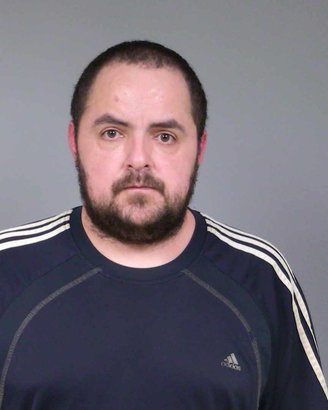
On March 31, 2021, the Eureka Police Department’s Problem Oriented Policing Team
(POP), with assistance from the Humboldt County Drug Task Force (DTF), arrested 41-
year-old Jorge Alcazar Vasquez of Rio Dell following a months-long investigation into
ongoing sexual assault of a child under 10.
The Eureka Police Department’s Criminal Investigation Section (CIS) headed the
investigation into the ongoing assaults that occurred in Eureka. The report was
submitted to the Humboldt County District Attorney’s Office and an arrest warrant for
Alcazar Vasquez was issued.
Alcazar Vasquez was transported and booked into the Humboldt County Correctional
Facility for oral copulation or penetration with a child under 10, sexual intercourse or
sodomy with a child under 10, and recurring sexual conduct with a child. Bail is set at
$1,705,000.
This is an ongoing investigation. Anyone with information regarding this case is asked to
contact Detective Corrie Watson at (707) 441-4032.
A widely popular botanist known for his series of funny, informative and profoundly interesting social media videos on plant ecology will host an online, four-part lecture series billed as “Blue-Collar Botany” next month in partnership with the Kneeland-based field guide publisher Backcountry Press.
Backcountry Press co-owner Allison Poklemba told the Outpost that she and her husband Michael Kauffmann have known the featured host — Joey Santore — for more than a decade.
“He first got his start with botany by being interested in conifers,” Poklemba said. “My husband wrote books about conifers and they really hit it off connecting as colleagues about 15 years ago. We’ve kept in touch with him throughout the years and when he comes up here to visit, we help him with plant exploration tips.”
Santore in Humboldt County.
Santore is a self-taught botanist who recently quit his day job driving diesel trains along the West Coast to travel the world and pursue his passion for studying plant life. He began documenting his travels on social media in 2017, sharing what he’s learned through his accentuated Chicago dialect and crass sense of humor.
Partly thanks to a video that went viral on Reddit in 2019, his videos have become wildly popular and now receive hundreds of thousands of views from people all over the world. Poklemba said this global audience has followed him to the Backcountry Press.
“It’s exciting to offer this virtual experience,” she said. “People have signed up for this class from Singapore, Hong Kong, Australia, Austria, the UK, every random state you can think of. It’s pretty cool that people can come together in this temporary online community to be part of a class like this.”
Despite his international appeal, the Backcountry Press is warning those unfamiliar with Santore’s educational style that these classes will not be “G-rated.” Santore describes his content as an attempt “to inject an awareness of the botanical world and the ecological and evolutionary context in which it occurs into the mind of every single human being on Planet Earth, via art, educational videos and podcasts, with a mild mix of smart-assed humor, as channeled through the ugly mug of a loud and obnoxious Chicago Italian.”
An example of Santore’s comedic and informative teaching style.
Tickets for all four two-hour lectures, which will be spread out over the course of two weeks in May, are available through the Backcountry press website.
“The first class will cover flower morphology for identification purposes,” Santore wrote on social media. “The second will cover taxonomy, naming, and what you can learn about a plant’s evolution from a scientific name. The last two classes will cover plant ecology and evolution, and how things like plate tectonics and a change in ocean currents can cause new species of plants to evolve and why certain plants grow where they do.”
The price of all four lectures is $49. More than 100 people have already signed up for the class and Poklemba said that they will likely cap the event at 1,000 tickets sold. Those who sign up today will receive a $10 discount.
“There will be crass jokes and lots of shouting (to make sure you’re paying attention),” Santore said. “Each class will end with a question and answer session that will go on as long people have time for.”
Santore’s most recent video recorded in the Barahona Province of the Dominican Republic.
UPDATE: At the request of the applicant, the continued hearing on Arcata Land Company’s proposed 23-acre cannabis project was continued. The Planning Commission scheduled a special meeting for April 22 at 6 p.m.
###
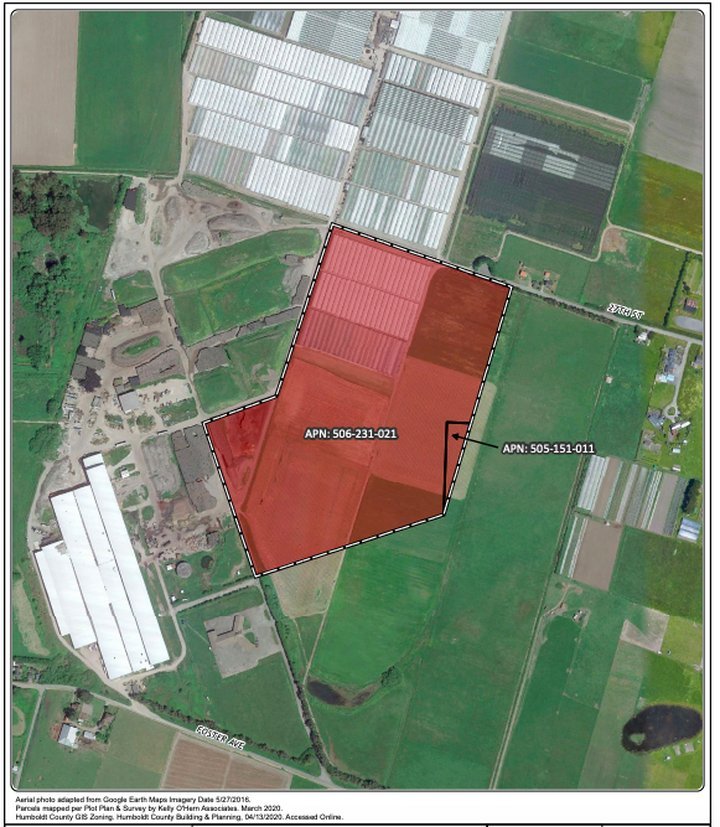
Parcels for a proposed 23-acre cannabis cultivation project (in red). The buildings in the lower left are a permitted processing, manufacturing and distribution facility. Sun Valley Floral Farm’s existing greenhouses are to the north. | Image via County of Humboldt.
In a letter sent to the commission Wednesday, Natalynne DeLapp and Ross Gordon of the Humboldt County Growers Alliance, a cannabis industry organization, say representatives of the project applicant, Arcata Land Company, reached out the previous day to suggest a compromise.
“On March 30,” the letter states, “Arcata Land Company sent HCGA a proposal in writing that suggested a
willingness to reduce the scale of the project to eight acres of mature plant cultivation, and four
acres of nursery space.” The Arcata Land Company is led by Lane DeVries, CEO and president of Sun Valley Floral Farms, which owns the property on which this project is proposed.
Humboldt County Planning and Building Director John Ford confirmed the offer via email, telling the Outpost that the company suggested slashing the size of the industrial grow down to eight acres of cultivation — including 5.7 acres of mixed-light and 2.3 acres light deprivation in hoop house-style greenhouses — and four acres of nursery.
“I do not have more than that right now,” Ford wrote.
DeVries did not respond directly to voicemails, but he let it be known through an intermediary that no one from his organization will be commenting to any reporters until they are ready.
This project has generated a lot of interest, which isn’t surprising considering it would be the largest cannabis cultivation site in Humboldt County by a wide margin and one of the largest in the state. The March 18 Planning Commission hearing was continued due to the volume of public comment, which lasted for several hours. Deliberations are scheduled to continue Thursday evening.
If the Arcata Land Company’s offer was meant to placate some of the fiercest project opponents, it did not succeed — at least, not with HCGA.
A bit of background: DeLapp and Gordon submitted a five-page letter to the commission back on March 15, outlining a range of objections to the project on behalf of the organization’s membership, which is comprised of more than 250 local cannabis businesses.
Size was the major issue for the HCGA, along with many other public commenters. The HCGA’s March 15 letter argued that county officials never intended to allow for such a massive cultivation operation when they were crafting the Commercial Medical Marijuana Land Use Ordinance (aka Ordinance 1.0) or its successor, the Commercial Cannabis Land Use Ordinance (Ordinance 2.0).
“At best, it can
be argued that the [Arcata Land Company] project takes advantage of legal loopholes and oversights in the drafting of
these ordinances,” the letter states, “but we do not see how it can be argued that the project is consistent with the
intent and purpose of these ordinances.”
The letter quotes from Ordinance 2.0, which says, “no more than eight acres
of Commercial Cannabis cultivation permits may be issued to a single Person.”
In the follow-up letter sent Thursday, DeLapp and Gordon say the project proponents believed that their offer to reduce the project down to eight acres of cultivation and four of nursery would satisfy HCGA’s requests. Not so.
“After reviewing the language in Humboldt’s cannabis ordinances, and discussing with our
membership, we do not agree,” the letter says. (Underline in the original.) The letter reiterates the argument that drafters of the county’s weed regulations meant to limit the total cultivation area held by any one person or company to eight acres — nursery space included.
County planning staff has argued otherwise. In fact, Ford addressed this argument head-on during the March 18 meeting.
“I think the size shocks people,” he said. However, he continued, both the CMMLUO (Ordinance 1.0) and the CCLUO (Ordinance 2.0) identified industrial sites like this one as desirable redevelopment opportunities for new cannabis projects. “And so it has been a priority, frankly, of the county to process cannabis cultivation on industrial sites.”
While the 38.2-acre Sun Valley property sits in the midst of lush agricultural fields, it is zoned heavy industrial with a qualified combining zone, aka a “Q zone,” dating back to its previous incarnation as a log deck for the Simpson Lumber Mill.
Thursday’s Planning Commission meeting is scheduled to begin at 6 p.m. You can virtually attend via Zoom through this link. The password is 200525.
Last time, though, so many people tried to log in via Zoom that the county reached the maximum allowed to participate, so if Zoom doesn’t work, try calling in: (346) 248-7799. Enter meeting ID 976-3777-7152 and the password: 200525.
And if you’d just like to watch, the meeting will be live-streamed at humboldt.legistar.com and broadcast on cable through Access Humboldt.
On March 31, 2021, at about 8:20 a.m., Detectives with the Eureka Police Department’s
Problem Oriented Policing Team (POP) conducted a probation search of a room at a
motel on the 100 block of 4 th Street in Eureka. The room was registered to Charles
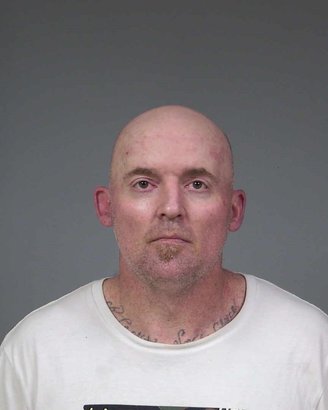
Lloyd Gay, 46 years old from Eureka. Gay is on formal probation in Humboldt County
for possession of heroin for sales.
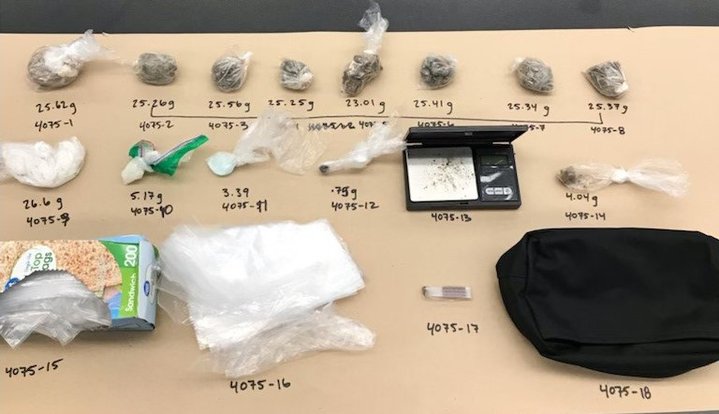
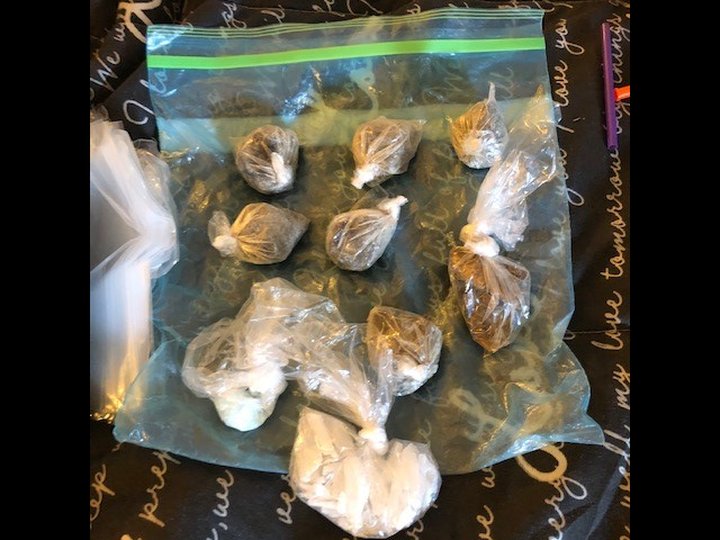
During the search of the room detectives located 205 grams of heroin, 35 grams of
methamphetamine, packaging material and a digital scale. Also located was $5,200 in
cash that was seized as suspected proceeds of narcotics sales.
This is the second time in the month of March that Gay was found to be in possession
of large quantities of narcotics. On March 4th, Gay was arrested for possession of
heroin, methamphetamine and Fentanyl for sales.
Gay was arrested and booked into the Humboldt County Correctional Facility for
possession of methamphetamine for sales, possession of heroin for sales and violation of
probation. A bail enhancement and proof of source of income was approved by a
Humboldt County Superior Judge due to Gay’s continuous arrests for sales of
narcotics.