From the Humboldt County Joint Information Center:
More than 3,600 Humboldt County Phase IA health care providers have received their first COVID-19 vaccine since the first shipment arrived in the county in mid-December. Administration of the remaining 2,000 first-round doses will continue tomorrow.
Public Health is working closely with the county’s Emergency Operations Center to set up clinics to continue to administer first doses to the remaining people in the Phase 1A category, which continues to include health care-related entities. The invitation-only clinics are scheduled to run three days a week for the next six weeks and will include vaccinations of health care staff from offices that are not part of a larger health care entity such as a hospital or clinic network.
Second doses of the Pfizer and Moderna vaccines, which include a primer dose followed by a booster shot 21 days and 28 days later respectively, are arriving in the county and will be administered starting this week.
While Public Health anticipates receiving between 1,000 and 2,000 vaccines weekly, Humboldt County Health Officer Dr. Ian Hoffman said, “As the second doses arrive, the arrival of first doses may slow down, which is what we saw happen this week.”
He said planning for distribution is ongoing. St. Joseph Hospital, Mad River Community Hospital, Jerold Phelps Community Hospital, Southern Humboldt Community Healthcare District, United Indian Health Services, Open Door Community Health Center, Southern Trinity Health Services and the Public Health Branch are licensed through the state to administer the vaccine.
“The first step was for each agency to get through its own qualifying staff. Now they are branching out to administer vaccine to other qualifying providers, and there are thousands of them,” Dr. Hoffman said, adding that this week vaccinators at Mad River and St. Joseph hospitals will shift focus to administer second doses to staff.
While Public Health’s primary role is to coordinate the distribution of the vaccines and manage the contact tracing of positive COVID-19 cases, Public Health nurses have stepped in to vaccinate when needed, administering dozens of vaccines to employees at local skilled nursing facilities over the weekend and will also be running the vaccination clinics.
Dr. Hoffman said he is hopeful vaccination of the next phase will start sometime toward the end of winter but stressed that this depends on many factors. “We are reliant on how many doses we are given, and we continue to plan with many contingencies in mind,” he said. “Each agency licensed to administer vaccine has ample other responsibilities to our community. It’s important that we do not overwhelm the system that is also taking care of our society.”
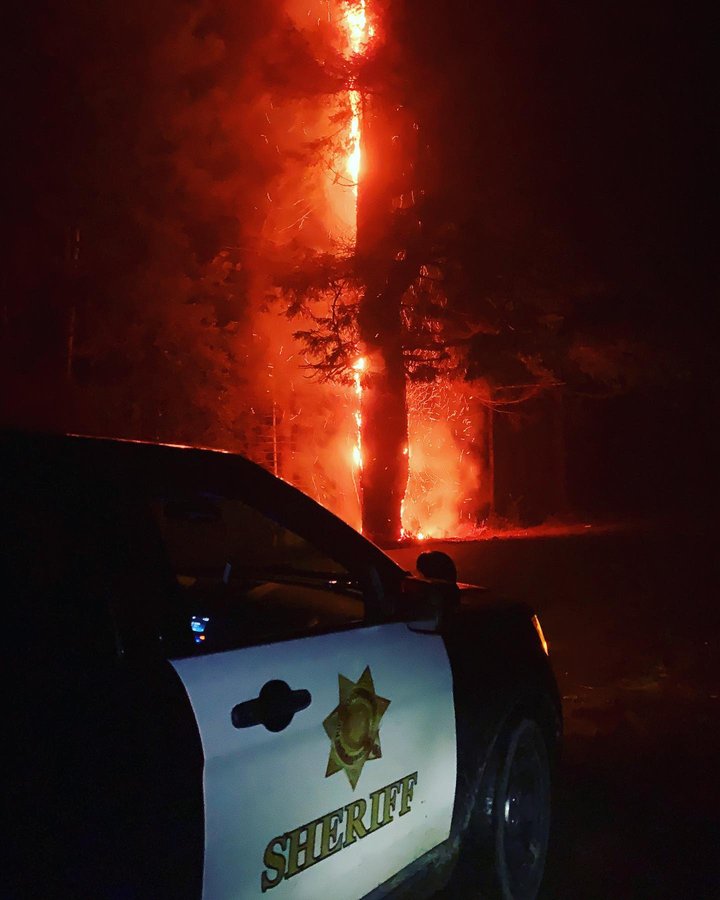
Hot sight in SoHum last night. The Humboldt County Sheriff’s Office explains:
Last night HCSO Southern Humboldt deputies came across an unusual sight while returning from a call: a 100+ foot tall tree on fire on Wilder Ridge Road. CAL FIRE was requested and responded to the scene to ensure the fire did not spread.
It is unknown what caused the fire at this time, however per CAL FIRE, at least three similar incidents occurred roughly this time last year.
Well then! It would appear that someone else watched Netflix’s Murder Mountain and found themselves enchanted by its depiction of Humboldt as a lawless hellscape that we all somehow manage to exist in. So odd and exciting is the stylized version of our remote corner of California to this most-recent streaming tourist — a musician, in this instance — that it inspired its own soon-to-be-released album of songs, imaginatively titled Murder Mountain. A lyrical sampling:
“No one really gives a damn what we do on Murder Mountain No cops, no Feds to cannibalize this war Isolated in our national troubles Like the kills notched on my M1 Garand”
So sings Phoenix-based singer/songwriter Johnny Ironsights on the album’s twangy title track — you can watch the video for the song, filmed mostly in an Airstream trailer in the safety of Bisbee, Arizona, above. In an interview with the publication American Songwriter, Ironsights describes the denizens of the Humboldt in his song as “like hippies, but with AK-47s,” a people who’ve “created their own space that is outside of the law,” which, sure, all sounds like fun songwriting fodder. But then, of course, there is also the violence Ironsights has heard about.
“People believe it’s linked to either the cartels, or somehow a serial killer or something to do with illegal marijuana cultivation, so that’s where that idea came from,” Ironsights says. This constant tension, presumably, leads Humboldtians to seek out simple comforts like those described in the chorus of “Murder Mountain.”
“I’ll just sit and think about the restless times we had, extinguish this misplaced rage with an eight ball and a homely girl.”
Or, you know, you could get a latte from Jitter Bean. Murder Mountain, the album, will be released in full on March 5, 2021.
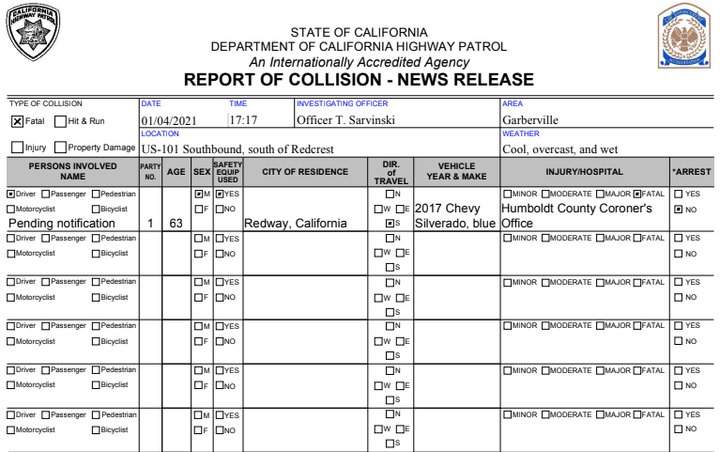
On Jan. 4, 2021, at 5:17 p.m., a 63-year-old male out of Redway, California was driving a blue 2017 Chevy Silverado pickup truck on
US-101 Southbound, south of Redcrest when he drove off the west roadway edge.
The Chevy traversed a steep embankment and collided
head-on into a tree before coming to rest on its wheels at the bottom of the embankment. The male driver and only occupant of the vehicle
sustained fatal injuries and was pronounced deceased at the scene.
At the time of the collision, the roadway surface was wet due to recent
rainfall. The driver was wearing his seatbelt, and DUI as a factor will be determined upon the completion of the collision investigation.
The California Highway Patrol Garberville Area office is investigating this traffic collision.
Press release from the Humboldt County Sheriff’s Office:
On Jan. 4, 2020 2021, at about 9 p.m., Humboldt County Sheriff’s deputies were dispatched to the 1300 block of Murray Road in McKinleyville for the report of an armed robbery and carjacking that had just occurred.
Deputies arrived on scene and contacted two victims, a juvenile female and an adult male. The victims told deputies that they had driven to the location to meet with two juvenile male acquaintances. When the two males entered the vehicle, one of the juveniles reportedly exhibited a firearm and demanded cash. All three occupants fled from the vehicle and the juvenile suspect reportedly drove away, stealing the vehicle. Deputies later located the stolen vehicle parked in the area of Murray Road and Kelly Avenue.
The victims were able to identify the suspect and upon further investigation, deputies located the juvenile at a residence on Pedroni Road. The juvenile was taken into custody without further incident and booked into Humboldt County Juvenile Hall on charges of carjacking (PC 215(A)) and robbery (PC 211).
Anyone with information about this case or related criminal activity is encouraged to call the Humboldt County Sheriff’s Office at (707) 445-7251 or the Sheriff’s Office Crime Tip line at (707) 268-2539.
Tonight, at a special meeting, the Northern Humboldt Union High School District will begin to consider a proposal to charter a new high school in Samoa —
called the Samoa Beach Academy — that would have a strong career
and technical education (CTE) focus.
Citing
Samoa’s additions of new residences,
businesses
and growing development
in general, the petitioners say there is “a strong
community need” for workforce-ready high school graduates. They
express a desire to expand immediate employment opportunities for
high school graduates in an area that has high poverty rates, adding
that their curriculum would also help college-bound graduates quickly
secure a high-paying job to better afford college tuition.
The
actual location of the desired facility is unclear. The charter
proposal submitted to NoHum includes a letter of intent to rent a
specific facility owned by Danco Builders, but an address was not
included. That letter describes that the space includes a few
classrooms, laboratories and common rooms, as well as office spaces
and restrooms. Elsewhere, the proposal indicates that the space
requires further construction, noting that “the facility, at
completion, will be a state-of-the-art, modern, innovative career
technical institution with classrooms, learning laboratories, and
hands-on workshops.” The lease of five years was set to begin on
January 1, 2021.
The
Samoa Beach Academy was registered
as an incorporated nonprofit in May of 2020. The
address registered to the institution is 5251 Ericson Way, Arcata,
which is the address of Danco Builders headquarters. One Samoa Beach
Academy board member, Julianne Eagle, works as a communications
director for Danco. The Outpost reached out to Eagle and other
members of the Samoa Beach Academy to inquire about the location of
the facility and how its construction will be funded, but did not
hear back by publication.
Lead
petitioner Catherine Scott, who was formerly superintendent of the
Southern Humboldt Unified School District and now owns a consulting
business, submitted the required and nearly 300-page charter proposal
to NoHum in November. The proposal can be viewed in the agenda for a Tuesday, January 5 special board meeting, where the petitioners will
present their application to the community and address questions from
the board.
Here’s
their mission:
Samoa
Beach Academy provides students a safe, innovative, hands-on and
student-driven trade and college preparatory high school with robust
extracurricular and athletic programs. Our collaborative
team takes a holistic approach to education to instill our students
with integrity, respect,
and compassion. Located at our unique, state-of-the-art campus
between the Pacific Ocean and Humboldt Bay, we graduate young adults
who are both academically prepared and career-ready for their
future.
Specifically,
the petitioners hope to begin by offering three CTE programs —
building and construction trades, health and science medical
technology, and business and finance — but noted in the proposal
that more pathways might be added as the school grows. All students
would take a CTE survey class as freshmen to learn about the three
pathways before choosing one area of study to pursue during their
remaining three years of high school. The curriculum will also
include an internship in whatever area of CTE each student chooses,
and the Samoa Beach Academy hopes to partner with College of the
Redwoods and Humboldt State University for dual enrollment options as
well.
Additionally,
the school would aim to teach all subjects with CTE in mind,
including those not traditionally related to CTE, such as social
science.
Students
could instead opt for their college-bound program and complete A-G
requirements for a state university while dabbling in a chosen CTE trade.
The school promises to offer advanced placement courses for
interested students, noting that if enrollment in those classes is
low there will be an opportunity to take them online.
The location seems to have heavily
influenced plans for the charter. The proposal references Samoa’s demographics — in terms of poverty rate and top vocations — to explain the choice of a CTE curriculum, which the petitioners selected
by reviewing the occupations by median earnings of Samoa residents.
With beach and bay access, the school also plans to utilize the
unique location for educational purposes, by completing biology labs
in the bay or practicing construction in sandy areas near the beach.
The
Samoa Beach Academy’s mission mentions a holistic approach to
learning, which they’ll integrate as a “sound social emotional
learning program.” That would include the opportunity to
participate in thrice-daily mindfulness practices, which are 10- to
15-minute breathing and focusing sessions, and the use of “mindful
language and vocabulary” — like “anchor breathing” (breathing
technique) or “heartfulness” (meditation strategy) by teachers.
The program would also include the option to participate in monthly
restorative practices circles, during which students would be invited
to express appreciations of each other and then voice and resolve
conflicts with one another. The school promises to train faculty in
these areas and offer mindfulness workshops to parents, too.
The charter’s team and independent board hope to open their school for the fall 2021 semester, and though the charter’s first year of enrollment would cap at 150 students, the size of the school would grow over its first five years until reaching a maximum capacity of 400 students.
The
proposal defined the charter’s budget for its first five years of
operation, which total an estimated $1,625,714 for the 2021-2022
school year and grow to $4,404,095 by 2025-2026.
NoHum
currently includes two charter schools for high-school-age kids,
Laurel Tree and Six Rivers Charter High School. Six Rivers is a
dependent charter school, and has a more involved relationship with
the district than more common, independent charter schools do. Arcata
High School shares its campus with Six Rivers, so students there can
enroll in AHS classes, and Six Rivers administration and student
representatives participate in NoHum board meetings.
NoHum
Superintendent Roger Macdonald briefly introduced the charter
proposal at a board meeting last month. Macdonald said he expressed
interest to the petitioners in partnering with the new charter school
in a similar way to Six Rivers, but that they’d prefer to create
and operate the school independently.
Though
most large high schools in Humboldt County do offer some CTE-related
classes and programs, Samoa Beach Academy would be the first to offer
CTE as its primary curriculum.
The
NoHum board has until March 6 to make a decision to approve or not
approve the charter. The board meets via Zoom — link here — tonight at 5:30 p.m.
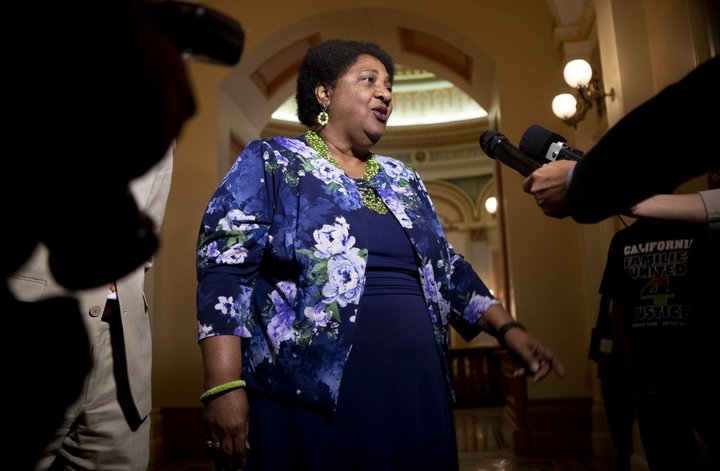
Assemblymember Shirley Weber gives a press conference in the capitol following the passage of her bill AB 392 which would limit the use of deadly force by police in California on July 8, 2019. Photo by Anne Wernikoff for CalMatters
###
Seventy years ago, sharecroppers David and Mildred Nash refused to back down in a dispute with a white farmer, and fled from a lynch mob in Hope, Arkansas. With their 2-year-old daughter in tow, they found a new home out west in a place so different her grandfather, who would die without ever being able to vote, called it a “foreign land.”
This year that toddler, Shirley Weber, is slated to become the first Black Californian to become the state’s top election official.
It’s easy to imagine that poignant bit of historical symmetry was on Gov. Gavin Newsom’s mind when he announced Weber’s nomination late last month.
With Joe Biden and California Sen. Kamala Harris on their way to different wings of the White House, Newsom was given the opportunity — or the headache — of picking Harris’ replacement. Three days before Christmas, the governor finally brought the California-wide guessing game to a close: Secretary of State Alex Padilla would sit out the remainder of Harris’ term and become California’s first Latino U.S. Senator.
Padilla’s appointment opened up its own vacancy. A few hours later, Newsom made another announcement: Weber, a Democratic assemblywoman from San Diego.
The rollout of the one-two appointment was almost certainly meant to appease different constituencies of the state electorate. Latino activists had spent weeks reminding the governor that the state’s largest ethnic group had never been demographically represented the state in the U.S. Senate. Many Black Democrats and other progressives — Weber among them — urged the governor not to allow Harris’ departure from the Senate to leave the nation’s most esteemed legislative body without a single Black woman.
Weber’s appointment was not widely anticipated like Padilla’s. But her biography indicates life experience relevant to the job of California’s top election administrator. Voting, denied to the Webers in the South, became a precious, fiercely guarded and unfailingly exercised right for the whole family.
A university professor and a school board member before joining the Legislature in 2012, Weber’s most notable legislative achievements have focused on education policy — where she’s often ticked off the state’s teachers unions — new regulations on when police can use lethal force and racial justice. Last year, she carried bills to place a repeal of California’s ban on affirmative action on the ballot (it failed) and to create a committee to study possible reparations for California’s descendants of slaves.
Here’s a conversation with her, condensed and edited for clarity:
Q: We all saw the video of the call in which the governor offered Secretary Padilla the job. I’m curious, did you receive a phone call? Was it an email? What was that ask like for you?
A: I didn’t have the same experience that Padilla had with the tears and so forth and so on. I had gotten a phone call I think the night before when the governor made his decision as to what he was going to do.
Q: Was this something that you were pushing for? Were you seeking out the position?
A: No, no. It was not even on my radar, initially. It was not something I was pushing for, not something that I had asked for. I know others had….I knew there were others who had been called in to discuss the position…I was approached in a very general way — a “what do you want to do with your life?” sort of conversation. But I didn’t connect the dots that it was about the secretary of state position until it became more apparent.
Q: You’ve accomplished a lot in the Legislature. When you were offered the position was there a voice in the back of your mind saying, “I don’t necessarily want to leave this behind”? Or were you ready to jump on it?
A: You know, whether you’re in the Assembly or at a university or any of the various other things I’ve done, you kind of come to the realization of your own mortality, that this won’t last forever. And I only have another term (in the Legislature) to go…then I’m termed down.
But I always recognized the fact that you have to do what you can while you’re there, and you have to make it count. But equally important, at least in my world, is that you have to empower other people to do the work. Because most folks are afraid to take on the challenges that I took on, OK? What I have always tried to teach, to demonstrate to others, is that you can be a change agent, you can be the voice, you can be that strongback, you can be that person and still have the respect of everybody in the room…So if I can spark that in the (legislative) members that are there now, and they’re doing some of it and if I can even support them in some of their efforts — you know, because I’ll be just across the street — that would be worth it.
…
You know, I had one member come to me and say, “I want to be a badass like you.” I said, “I didn’t know I was! I’m just a little old lady.”
Q: Do you remember who that was?
A: (Thinking) Who wanted to be a badass…? Oh, it was (Assemblymember Kevin) McCarty (a Democrat from Sacramento). That was early on in the game. He’s a badass now.
A: So how do you plan to be a badass at the secretary of state’s office then? What are your priorities?
I’m hoping that we will continue this change to make sure that voting is accessible to everyone and that there are various ways that people can vote.
…
I also want to focus on civic education. I look at what kids know and even what adults know about the elected positions and voting and the balance of power. All of those things have really become civic lessons in the last four years!…So I’m looking at ways in which we can, in addition to all the stuff we normally do, help people have a good, strong civic lesson about voting, about democracy, about the relationship between the states and federal government.
You know, I had one member come to me and say, “I want to be a badass like you.” I said, “I didn’t know I was! I’m just a little old lady.” — Assemblymember Shirley Weber
I’m not sure if our folks truly understand it. Because if you did, you would be vigilant about voting, you would understand how fragile the democracy is, and you would understand what tyranny is.
…
I had a worker on my campaign in 2012. He was probably in his 40s or 50s. He worked really hard on my campaign. He was on corners every morning waving signs. And one day, after working on the campaign so long, he said to me, “this is the first time in my life I really wish I could vote.” I said, “Why can’t you vote?” He whispered and said, “I’m an ex-felon.”
And I said, “You can vote!” He was shocked. So we registered him to vote and he voted. And I realized that there were just an awful lot of people in our district who didn’t know that once you have done your time, you have the right to vote. Not like some of the southern states.
So I said when I get to Sacramento, I’m going to deal with that. And that was one of the first bills I did (legislation requiring state and county officials to inform those released from jail or prison of their voting rights). And as I was walking around Sacramento, I would mention it to people and very, very important lobbyists would say, “People who are ex-felons can vote?”
Q: Maybe it’s not surprising given your background, but you seem to view this job as another opportunity to be a teacher — this time for 40 million people.
A: Education is in my soul. I’ve been a teacher since I was 5 years old on my mother’s back porch in the projects. I did everybody’s homework because I was stupid (laughing) and I love doing homework!
Q: When you were growing up, when your family came to California from Arkansas, was voting a big part of your family tradition?
A: Oh, definitely. My dad came in ‘51. That was before the Voting Rights Act. People knew very clearly in the South that you didn’t try to register to vote because you could be killed. So my father was not a registered voter. Neither was my grandfather. And after my father had to flee the South, when he came to California, among some of the first things he did was to register to vote. He and my mom voted in every election there ever was.
My mother volunteered at the polls when we were in elementary school. She became one of the poll workers and eventually she became a supervisor at the polls. When my elementary school could no longer allow folks to vote in the auditorium because of the free and reduced lunch programs (which required the school to make) space for the kids to eat, my mother said, ‘Well, you guys can vote at our house.’ So our house became the polling place at 351 West 45th Street…We all knew as kids that on those days when voting took place, you leave through the backdoor and you come in through the backdoor because the people in the living room were doing important business — like voting.
Q: You were pretty vocal in pushing the governor to select a Black woman for Senator Harris’ soon-to-be-vacant seat. You told Erika Smith at the L.A. Times that you would be “very, very, very upset” if Newsom did not —
A: And I am. I’m still upset and I’m still concerned…I met with the (Legislative) Black Caucus and one of the things I insisted that we do was send another letter to the governor saying that we still want a seat. If a seat becomes available, we want a Black woman’s voice in it because there are none in the Senate.
California may have another opportunity, depending on (Democratic Sen. Dianne) Feinstein. If she runs again or if she resigns or whatever she does — if there’s a change, we still want a Black woman. But in addition to that, it’s also the responsibility of the 48 other states. Only one other state here in America, Illinois, has also had a female African American (U.S. senator).
…
But the governor knows I’m still very, very, very upset. Alex Padilla has done amazing work. But I still want to emphasize the fact that representation does matter. You know, having been on God, I can’t tell you how many boards and commissions where I was the only (Black woman) in the room, I think I made a difference. Because when issues came up, I had an experience that none of the others had and that is being a Black woman who has been the victim of the system being supported.
Q: Among those playing the guessing game about the open Senate seat, I think there was a view that if the governor was to pick Padilla — which he did — he had to then offer the secretary of state position to a Black woman. As if one were a kind of compensation for the other.
A: Yeah, it’s not at all. These are totally different realities…(I’ve had people say) ‘Congratulations, Shirley, you’re gonna do a great, great job, blah blah blah. But we still want a Senate seat.” And I say, “Amen. We do.”…(Because U.S. Senators are not subjected to term limits unlike state constitutional offices) the long term effect of having a Senate seat is extremely important and it’s a voice in that arena. They’re not interchangeable.
Q: Your daughter (Akila Weber, who sits on the La Mesa city council) announced that she’ll be running for your Assembly seat once you leave it. Did you encourage her to get into politics?
A: I would never try to get anybody to go into politics because that’s something you have to want to do…I never stopped going to meetings because I had children. So my kids learned to take their coloring books and sit in the corner while we had board meetings.
…
(Akila ran for student body president of her elementary school). Her principal, who I knew, called me and says, “Girl, I am shocked…I have never had a sixth grade president come into my office and say, ‘Here is the agenda. Could you make copies for the meeting?’” … She’s always been a leader type.
Q: Have you given her any campaign advice?
A: The only advice that I’d ever give my daughter is: Don’t lose your sense of integrity; never become so angry that you become ineffective. There’s always a way to get things done.
###
CALmatters.org is a nonprofit, nonpartisan media venture explaining California policies and politics.