

Why Have the Contact-Tracing Statistics on the County Dashboard Been Frozen for the Last Few Weeks? Health Officer Answers Media Questions
LoCO Staff / Tuesday, Dec. 22, 2020 @ 3:50 p.m. / COVID-19 and Humboldt
Earlier today, Dr. Ian Hoffman, Humboldt County’s health officer took questions from the media on the county’s management of the pandemic: Why have the public contact-tracing statistics not budged in the last few weeks? How is his department handling the workload associated with a surge of new cases? Do mortuary workers get the vaccine? Have there been other workplace outbreaks at Brius assisted-living facilities? Will his office released the names of the deceased?
(To that last question, Hoffman answers with a quick “no,” though that may inadvertently have been due to a technicality. In the past, the Coroner’s Office — not Public Health — has released the information in question.)
Video above, rough transcript below.
###
The Lost Coast Outpost asks, “Can you tell us what is going on with the ‘transmission type’ statistics on the county dashboard? In the past 30 days, there have been 770 new cases of COVID confirmed in the county. Over the same period of time, only 60 cases have been officially put down as due to contact or travel. Meanwhile, the number of cases listed as “under investigation” has ballooned up to 768 — well over the number of known, active cases in the county. How can the dashboard categorize only 14 more infections as being through ‘contact to a known case’ between Dec. 1 and now, when there have been some 70 cases related to the Granada outbreak over the same period?”
It’s a great question. Really happy everyone’s looking at the dashboard and using it.
We can clarify on this. So December 1st we went to a state-based system called CalConnect, which is a way to really do the contact tracing and investigation in a much more organized manner. Of course that training and transition period took away from some of the other work that we were doing, which included how we can track all this and put it on the dashboard.
So my understanding is there’s a backlog of those 600 some cases that we are working to get that information on. We know the information, we just have to collate it and put it in the right place so that we can put it on the dashboard, and that’s being done over the course of the next week.
What I’ll say is that you know, yes, we know what the majority of our cases are, they’re still the vast majority are contact to a known case. There’s still a smattering of travel-related cases and certainly gatherings is another area we know that a big majority of our cases are coming from. So, look for that update soon it’s something we’ve been working on over the past week and going into the next week.
The Lost Coast Outpost asks, “What work does Public Health do to track the progression of disease in people actively battling the virus? What resources must you bring to bear in monitoring active cases? With the number of known, active cases over 500, do you find that Public Health is unable to do this work to the degree that it should be done, or to the degree that it did previously?”
Yeah, really great question, encompasses a lot of what we do here at Public Health and what our role is in people with COVID-19. So our first role is really identifying the cases of COVID-19 and we we get that directly from the the state and the systems that track the laboratory results and and our teams contact the people who are positive for COVID-19, they interview them and they find out about what sort of risks they have for spread of the disease. They also give them a lot of information about how they can isolate at home, who their contacts are, and also help define the period that they were contagious and that they might have had contact with other people. And they give information about how they can get medical care, but I’ll be clear that we do not provide any medical care to the cases. We do encourage people to seek out care from their doctor or if they need to to seek emergency services. The next part of it is really identifying the contacts and getting those people on quarantine. We used to do a lot more of that when the case number in the caseload was smaller. We have had to let go of that and that’s what a little over a month ago we started talking to people about this message that we’re going to ask low-risk cases to contact their own contacts and give them information about quarantine. So that’s where we’re at right now. We continue to contact every case who has COVID-19 and we continue to give them information about COVID-19, about isolation and about how to put their contacts on quarantine and we look for contacts to high-risk settings.
The Times-Standard asks, “What guidance has the state provided for vaccinating mortuary employees who have contact with COVID positive bodies?”
Yeah, I haven’t seen specific guidance on people who work with COVID positive bodies, but you know we do have guidance for the three tiers in Phase 1a and those three tiers do include in Tier 3 laboratory workers, so I assume we will put them with that Tier 3. We’ll look into it and see, but I would put that in the same category as someone who works in a laboratory. So keep looking for that guidance and we’ll let people know if we get any more specific on it.
The Times-Standard asks, “How long is the deceased capable of passing along the virus after death?”
I’ll have to say I don’t know the answer to that. I don’t know that there’s any studies or solid evidence about that. We do have recommendations for use of PPE with a body that’s COVID positive and all of those folks should be versed in that and should be using full PPE.
The Times-Standard asks, “Are any other Brius facilities in Humboldt County affected by the outbreak at Granada?”
So, we don’t know of any other outbreaks at any other facility by that company in Humboldt County. Many of our skilled nursing facilities and assisted living facilities have had a case in a worker, but have not resulted in outbreaks. So there are no other outbreaks in Humboldt County.
The Times-Standard asks, “Have any Granada residents or staff received vaccinations?”
No, they have not. We are working on a plan right now to begin the vaccinations there once their quarantine has passed, we’ll get working on them and all the skilled nursing facilities in the next round.
The Times-Standard asks, “Previously names of COVID-19 related deaths were released. Will further names be released at any point. If not, why not?”
Public Health does not release the names of those deceased from COVID-19 and we have no plans to do so in the future.
BOOKED
Today: 4 felonies, 7 misdemeanors, 0 infractions
JUDGED
Humboldt County Superior Court Calendar: Today
CHP REPORTS
1004 Redway Dr (HM office): Trfc Collision-Unkn Inj
500 MM96 E SIS R5.00 (YK office): Traffic Hazard
ELSEWHERE
RHBB: New Fire Near French Gulch Grows Rapidly in First 45 Minutes
KINS’s Talk Shop: Talkshop October 5th, 2026 – Brian Stephens
RHBB: Redcrest’s Hayle Gibson-Stillwell Rides into the NFR as the One to Beat
Governor’s Office: California’s economy continues to dominate — topping $4.5 T in economic output, and remains the world’s fourth largest economy
Humboldt’s First Allotment of COVID Vaccine Doses Nearly All Administered; More Being Distributed
LoCO Staff / Tuesday, Dec. 22, 2020 @ 2:43 p.m. / COVID-19 and Humboldt
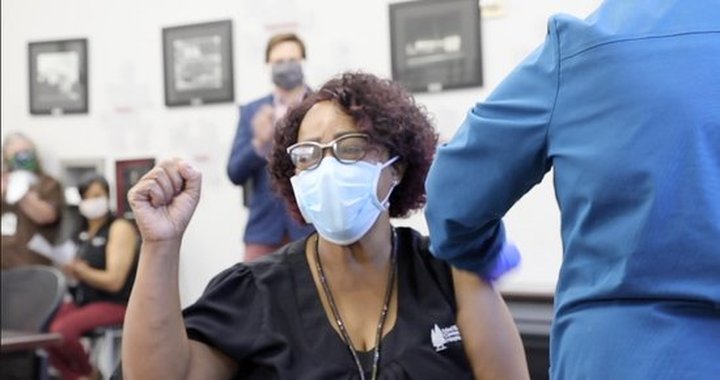
Video still of Yolanda Stevens, Occupational Health Supervisor at Mad River Community Hospital, becoming Humboldt’s first vaccine recipient.
###
Press release from the Humboldt County Joint Information Center:
All 975 of the first allotment of Pfizer COVID-19 vaccines will be administered to Phase 1A-tier 1 priority and high-risk populations in Humboldt County by the end of today, with vaccines from the second allotment going out as well.
Phase 1A-tier 1 prioritizes high-risk populations, including people at risk of exposure to COVID-19 through their work in any role in direct hospital care or long-term care settings, and people at direct risk of exposure in their non-clinical roles, including but not limited to environmental services, patient transport or interpretation. Additionally, this Phase 1A-tier 1 includes emergency medical services and dialysis staff.
St. Joseph Hospital Communications Manager Christian Hill said as of Monday evening, the hospital had administered nearly 400 vaccines to staff, with 400 more expected to be administered by end of business today.
Additionally, Pamela Floyd, Mad River Community Hospital’s Chief Compliance Officer and Director of Risk, Quality and Plant Operations, said just over 300 of its employees had received their first dose. Kent Scown, Chief Operating Officer for the Southern Humboldt Community Healthcare District that operates Jerold Phelps Community Hospital, said they were on track to administer nearly 70 vaccines by the end of the day.
There have also been vaccines administered to Phase 1A-tier 1 staff from other local health care facilities, including staff who will be tasked with administering vaccines to other health care workers.
Humboldt County Health Officer Dr. Ian Hoffman said, “We have been coordinating with local hospitals and other top tier health facilities for months. As we receive our allotments of the vaccines, we are allocating them as fast as they are coming in.”
Both the Pfizer and Moderna vaccines require two doses—a primer dose followed by a booster shot 21 days and 28 days later respectively.
New information from the California Department of Public Health (CDPH) yesterday indicates that Humboldt County could continue to receive allocations of approximately 1,600 vaccine doses per week for the next few weeks, but changes to this may still occur at the federal level. Guidelines on Phase 1B of vaccine distribution are expected to be released by CDPH shortly.
For updates on vaccination distribution in California, go to cdph.ca.gov/Programs/CID/DCDC/Pages/COVID-19/COVID-19Vaccine.aspx.
Toni’s 24-Hour Restaurant is Latest Arcata Eatery to Shutter Due to COVID-19 Exposure
John Ross Ferrara / Tuesday, Dec. 22, 2020 @ 2:20 p.m. / COVID-19 and Humboldt , Food
Baked goods at Toni’s.
Arcata’s popular 24-hour eatery Toni’s has temporarily closed and canceled all Christmas pies and bakery orders after one of its employees tested positive for COVID-19.
Owner Toni Collenberg told the Outpost that this is the first time the restaurant has closed on a regular business day since it shut down for five weeks in 2018 for a remodel.
“To our valued customers, we are sorry to say that we have an employee that has tested positive [for COVID -19],” Toni’s wrote on its social media page. “We have made the decision for the safety of our staff and customers to close and thoroughly clean our facility.”
Toni’s is the latest in a growing list of Arcata restaurants that have temporarily closed due to COVID outbreaks among employees. Multiple employees also tested positive for the virus at Wildberries Marketplace earlier this month, causing the store to reduce its hours.
Toni’s has announced that it will reopen on Sunday at 7 a.m.
Fortuna Man, 40, Killed While Walking Across Hwy. 101 Near Loleta Drive, CHP Says
LoCO Staff / Tuesday, Dec. 22, 2020 @ 1:32 p.m. / News
UPDATE, Dec. 23:
The Humboldt County Coroner’s Office has identified the victim as 40 year old Derek Radcliffe of Fortuna, according to the CHP.
###
Press release from the California Highway Patrol:
On 12/18/2020, at approximately 1957 hours [7:57 p.m.], the CHP Humboldt Communication Center (HCC) received a call of a vehicle versus pedestrian traffic collision on United States Route 101 (US-101) northbound, south of Loleta Drive.
CHP, Humboldt County Sheriff’s Office, California Department of Forestry and Fire Prevention, Fortuna Fire Department, and City Ambulance personnel responded to the scene.
Based on CHP’s preliminary investigation, it appears this collision occurred when John Doe, a pedestrian dressed in dark clothing, walked in an easterly direction across US-101 northbound into the path of a 2010 Toyota driven by Ms. [Scarlett] Pettyjohn [age 50, of Los Angeles].
John Doe was knocked to the roadway and a 2006 Chevrolet, driven by Mr. [Thomas] Akin [age 57, of Visalia], subsequently collided with Doe’s body.
Unfortunately, John Doe succumbed to his injuries on scene and was pronounced deceased at approximately 2007 hours [8:07 p.m.]. John Doe’s drug and/or alcohol impairment, and identification, are pending determination by the Humboldt County Coroner’s Office.
No other parties were found to be under the influence of drugs and/or alcohol at the time of this collision. The CHP is continuing to investigate this collision and asks anyone with information to contact the Humboldt Area CHP office at (707)822-5981. Please reference CHP Case Number 9125-2020-00933.
###
DOCUMENT: Report of Collision
County Warns of Ice and Snow Atop Horse Mountain; More Expected Along 299 Friday: ‘Everyone Carry Chains’
Ryan Burns / Tuesday, Dec. 22, 2020 @ 11:39 a.m. / Transportation

###
Here on the second day of winter, Humboldt County has issued its first snow report of the season. There’s not a lot to it, but hey, snow!
An inch and a half has accumulated near the communication towers atop Horse Mountain, according to the report. “It is extremely icy; everyone carry chains,” the county warns.
Dare we start dreaming of a white Christmas? Well, that’s probably not in the cards — unless you live atop Horse Mountain. But the local office of the National Weather Service did issue an advisory Wednesday morning, warning of wintery road conditions for anyone who, for some reason, must drive through northeastern Trinity County Friday afternoon through Saturday morning.
Travel on highways 299 and 3 may be impacted by snow, particularly at Oregon Mountain Summit, Buckhorn Summit and Scott Mountain Pass. The exact snow level and snow amounts are still not certain. The period of highest probabilities for snow appears to be Friday afternoon through Saturday morning. Be ready for winter weather driving conditions and check the forecast for the latest updates.
Stay safe out there, folks.
Five Things to Know About California’s New US Senator, Alex Padilla
Ben Christopher / Tuesday, Dec. 22, 2020 @ 10:59 a.m. / Sacramento
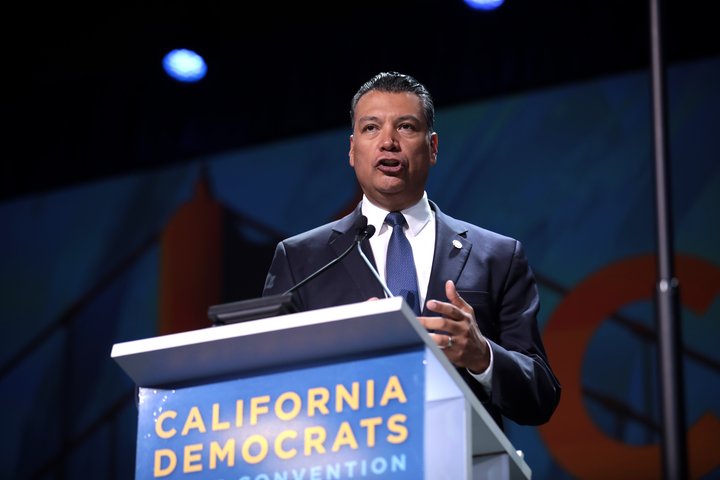
Secretary of State Alex Padilla speaking with attendees at the 2019 California Democratic Party State Convention at the George R. Moscone Convention Center in San Francisco, California. Photo: Gage Skidmore, Creative Commons license.
###
Political junkies and capitol insiders, pat yourselves on the back.
Ever since Joe Biden picked Sen. Kamala Harris as his vice presidential running mate in August, the parlor game of choice for California’s most politically plugged-in has been: Who will Gov. Gavin Newsom pick to fill her vacant Senate seat?
Alex Padilla — California’s Secretary of State, a loyal Newsom ally and a Latino in a state that has never had a member of that largest ethnic group serve as senator — was a top pick. Sure enough, as Newsom announced Tuesday, the Democrat from Pacoima is on his way to Washington.
But for many Californians — perhaps the majority — Padilla’s nomination is likely to elicit more curiosity than self-congratulation, less “I knew it” and more “who knew?”
If you’re acquainting yourself with Padilla for the first time, here are a few takeaways from his California CV.
1. California’s #1 turnout booster
Like surfing, Silicon Valley and unaffordable housing, California has made easy access to the ballot box its calling card. While many GOP-run states have embraced voter ID requirements and have balked at the prospect of sending ballots by mail, we’ve gone in the opposite direction.
Padilla can take credit for a lot of that.
Consider these recent changes to the state’s voting rules:
- Eligible adults are automatically registered to vote when they apply for a driver’s license — though California’s new motor voter program hit a few speed bumps along the way
- 16- and 17-year-olds can pre-register to vote, ensuring that they are automatically added to the voter rolls when they turn 18
- If a registered voter’s official signature doesn’t match the one they put on their mail-in ballot envelope, counties are now required to give them the opportunity to try again
- Before the pandemic made it a statewide practice, over a dozen counties sent ballots to every active, registered voter — whether they signed up to vote by mail or not
- California’s 2020 primary was bumped up from June to March, giving the state’s voters an earlier say in this year’s presidential contest
All of that is thanks to legislation sponsored by Padilla. And as head of the national coalition of Democratic state election administrators, he has also been one of the most prominent evangelists for California’s election model on the national stage.
2. Leaving behind an ethically dicey $35 million bill
With mammoth turnout expected in an election like no other, staff inside the Secretary of State’s office spent the summer of 2020 scrambling to inform voters about the what, when, where and how of voting.
That’s why they inked a contract in September with the political consulting firm, SKDKnickerbocker, to run a statewide PR campaign called Vote Safe California. The total tab: $35 million.
That contract got Padilla into hot water with Republicans. SKDKnickerbocker has longstanding ties to the Democratic Party and was a client of president-elect Joe Biden, then a candidate in the election the firm had been hired to promote. GOP members of Congress launched an investigation and the conservative Howard Jarvis Taxpayers Association took Padilla to court.
As CalMatters reported, the contract also didn’t go over well with the state’s Democratic controller, Betty Yee, who is responsible for approving all state government payments. According to Yee’s staff, Padilla’s office planned to draw the necessary $35 million from a pot of cash that was supposed to fund county government voter outreach operations. In a letter Padlla wrote to Yee, he argued that the SKDKnickerbocker campaign was being conducted “on behalf of counties.”
But so far Yee has refused to budge. And it’s unclear who will ultimately be left holding the bag.
3. Patron saint of tote bags
Padilla hasn’t just changed the way Californians vote. As a state Senator, he’s changed the way we shop too.
In 2014, Gov. Jerry Brown signed what was arguably the most controversial bill of Padilla’s eight-year legislative tenure, outlawing single-use plastic bags at grocery stores.
The statewide ban wasn’t enacted without a fight. Padilla drew flack from fellow Los Angeles Democrats who worried the bill would harm a major plastic bag manufacturer south of downtown.
Conservative critics piled on, both in California and nationally, highlighting Padilla’s effort as a measure par excellence of California nanny statism. The Pacoima senator made an easy target for the libertarian critique. Prior legislative efforts of his included a successful bill to force chain restaurants to list calorie counts on their menus and an unsuccessful one to ban the sale of tobacco products near schools.
Padilla brushed off the concerns about the bag ban during a speech on the Senate floor in 2014.
When local governments have introduced plastic bag bans, he said, “the sky does not fall and consumers adapt and life goes on.”
Even after the bill was signed — two years after it was first introduced — it didn’t become law immediately. In 2016, plastic bag manufacturers took to the ballot to override Padilla’s ban. But that campaign failed. The cloth bags you might store in your closet or in the trunk of your car are testament to that and to Padilla’s work.
4. The first senator of Generation 187
Like an entire generation of young Latinos, including former Senate leader Kevin De León, Padilla insists he had no intention of getting involved in politics until 1994.
That year, Proposition 187 was on the ballot, a measure to exclude undocumented immigrants from all non-emergency public services, including public education.
Padilla said it was the naked nativism of that campaign — and of Gov. Pete Wilson’s, who was running for re-election as a supporter of 187 — that drew him to Demoratic party activism. The son of Mexican immigrants who grew up in the San Fernando Valley, Padilla told CalMatters in 2018 that he felt that he “had to get involved so that families like mine, communities like mine, would not continue to be scapegoated or targeted.”
Padilla was in early 20’s at the time. Fresh out of college with a big ticket bachelor’s degree, his parents were not immediately on board with his turn to politics. As he recalled it: “Wait a minute, four years of MIT engineering school…for what?”
He started behind the scenes. He worked the campaigns and made friends with up-and-coming members of the Legislature, including Tony Cárdenas, now a congressman. He served as an aide to Sen. Dianne Feinstein. In 1998, he finally ran for a seat of his own and a year later, at 26, he was elected to the Los Angeles City Council. At 28, he became the council’s youngest president — a feat not just for Padilla, but for the growing coalition of Latino Democrats in the valley’s northeast.
On the Los Angeles City Council, Padilla had a knack for bringing “consensus and calm and peace,” said Harvey Englander, a longtime lobbyist and public affairs consultant in Los Angeles. “It’s not that he didn’t make waves but he didn’t make enemies.”
With Tuesday’s appointment, a quarter century after California voters passed Prop. 187, Padilla will become the state’s first Latino U.S. Senator.
5. A friend of Newsom
Padilla’s alliance with Newsom began as a marriage of convenience.
When Newsom announced his bid to run for governor in 2010, challenging the elder statesman and front runner Jerry Brown, the San Francisco mayor knew he needed to make inroads in southern California — particularly with Latino voters.
And so the gubernatorial hopeful picked Padilla, a newly elected state senator and a rising star in the party, to help him do just that.
Newsom’s bid was a long shot that predictably failed. He dropped his campaign before Brown even officially announced his own run, opting instead to campaign for lieutenant governor. But Newsom was a rising star in his own right and Padilla’s early support gave the young senator a prominent role in a statewide campaign. It also earned him an ally on the rise.
In 2017, when Newsom decided to run for governor again, Padilla once again offered his endorsement, supporting the lieutenant governor over Antonio Villaraigosa, who had served as Los Angeles mayor when Padilla was on the council.
That loyalty seems to have paid off.
###
CALmatters.org is a nonprofit, nonpartisan media venture explaining California policies and politics.
CR Police Academy to Implement Bias Testing, Examine Institutional Racism, Among Other Changes
LoCO Staff / Tuesday, Dec. 22, 2020 @ 10:13 a.m. / Education , Government
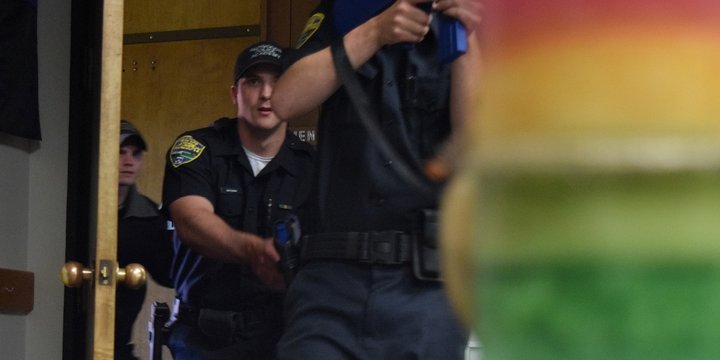
Photo via College of the Redwoods.
Press release from College of the Redwoods:
The College of the Redwoods Basic Law Enforcement Academy Advisory Committee has released its findings. The committee, comprised of local law enforcement leadership as well as representatives from Native Tribes and Black, LGBTQ, and Latinx interest groups, was convened in November to take a comprehensive look at the Law Enforcement Academy’s curriculum in order to address potential racial bias.
Some of the recommendations from the advisory committee have already been implemented for the next Academy class, starting January 11, 2021. They include a grappling component in the defensive tactics curriculum in an effort to reduce lethal force, more de-escalation training, the inclusion of Crisis Intervention Training, and an emphasis on critical thinking. Additionally, Explicit and Implicit Bias tests will be used as a source for discussion on how these biases influence the role of the officer and their effect on interactions with the public.
In future cohorts, discussions on power dynamics in the field will explore the ethics of power and authority, and examine structural and institutional racism and how it contributes to a power imbalance. Trauma Informed Policing will be incorporated in an effort to aid in understanding intergenerational trauma and on-going oppression of communities typically labeled as “dysfunctional.” This will address stigma by educating students on the prevalence of substance use disorders and mental illness, and encourage discussions about connections between historical trauma and addiction, mental illness, and co-occurring disorders among communities that have been historically disempowered and oppressed.
The Academy will seek to create a culture where it is ok to ask for help, and will help officers work with members of the LGBTQIA+ community, especially transgender identities.
“I am extremely thankful for everything our police officers do and am proud that CR’s police academy produces officers who are honest, intelligent, kind, and determined,” said CR President Keith Flamer. “The recommendations the Committee sent to me will only make an excellent police academy even better. I want to thank all of the community members who participated in the curriculum review process. Their input was invaluable. I look forward to the ongoing conversations.”
CR’s new Administration of Justice Director Michael Perkins also embraces the findings, saying “I see the recommendations put forth by the advisory committee as a great road map to further develop our program. We are very proud that many of the concepts for development are already in place and we have great ideas on where we can further build on these successes.”
“The Basic Law Enforcement Academy of College of the Redwoods has been a vital training program for our communities,” said incoming CR Board president Danny Kelley. “The Board of Trustees stand behind President Dr. Flamer and Director Perkins as they seek to enhance officer training with the excellent and timely recommendations of the Advisory Committee. Law enforcement is a difficult and thankless job. CR is committed to supporting the Academy and to providing future officers with the best training possible for the protection and benefit of all members of our community.”
The Committee will meet again early next year with Mr. Perkins and coordinator Greg Allen and further recommendations will be forthcoming.


.jpg)