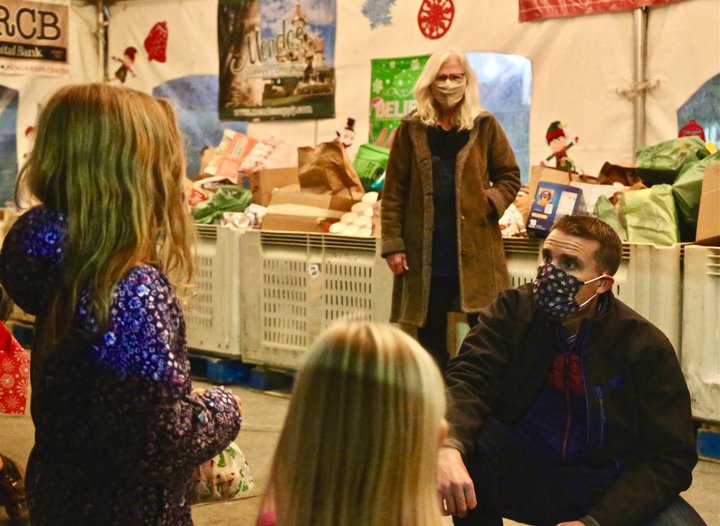
“Santa Rex,” Senator Mike McGuire and Food For People’s Anne Holcomb celebrate this year’s haul | Photos: Andrew Goff
From the office of California State Senator Mike McGuire:
Senator McGuire’s 5th annual Humboldt Holiday Food Drive with KHUM Radio and Food For People capped off its most successful event yet last night with final fundraising amounts blowing away all expectations.
“Our initial stretch goal was to raise $10,000, all to benefit Food for People. We never expected the incredible outpouring of support that we continue to see. High school students rallied, business owners showed up and neighbors donated in droves. Humboldt County has delivered a truly special holiday gift — the gift of food for thousands who are hungry,” Senator Mike McGuire said.
Senator McGuire convenes with some future voters.
More than $45,000 and over 10,000 pounds of food has been donated, thus far, to Food For People during the 5th annual Humboldt Holiday Food Drive. Monetary donations continue to flow in at FoodForPeople.org.
Because of the pandemic, the need for food and funds is greater than ever. Six high schools partnered on the Food Drive (Eureka, McKinleyville, Arcata, Fortuna, Ferndale and St. Bernard’s) and they all held various kick off events, food drop-offs, produced videos, made commercials and rallied their classmates to participate in any way they could. The effort of the students was truly inspiring.
“Food for People would like to extend our warmest thanks to all of the local high school students and community members whose support for the 5th annual Humboldt Holiday Food Drive surpassed our wildest dreams!” said Anne Holcomb, Executive Director, Food For People. “We had no idea how it would go this year in light of the pandemic and its impact on our communities, but the students rose to the challenge and did so quite impressively. They decided to forego the competition between schools and united on behalf of their community to raise as much food and funds as possible, and they knocked it out of the park! We are so grateful to Senator McGuire for investing so much time and energy into engaging these future leaders in the fight against hunger, and their parents, teachers and advisors should be incredibly proud of what they were able to accomplish. Their efforts will make a huge difference for those who are struggling during this incredibly challenging time.”
On December 10, 2020, at approximately 1729 hours, a California Highway Patrol Officer assigned to the Garberville Area attempted to stop a blue Nissan Sentra for a speed violation on northbound US-101 south of Leggett, CA.
The vehicle failed to yield and a pursuit ensued northbound on US-101. Additional Garberville Area units responded to the pursuit and deployed a successful spike strip in the Richardson Grove area. Two tires deflated and the Nissan came to a stop on US-101 south of Garberville. The driver (CHAVEZ) and right front passenger (male, unidentified) fled from the Nissan and down a steep embankment, west of US-101. Officers detained one female party (HERRERA) in the vehicle before pursuing the two other occupants. Officers pursued the male suspects on foot and apprehended CHAVEZ. The male passenger was not located. Approximately one pound of suspected methamphetamine was located in the Nissan.
CHAVEZ was booked in the Humboldt County Jail for the following: reckless fleeing/evading, felon in possession of a firearm and ammunition, possession of narcotics for sales, possession of narcotics while armed, transportation of narcotics for sale, possession of a collapsible baton, possession of a fake ID, resist/obstruct/delay a peace officer, probation violation. HERRERA was booked in the Humboldt County Jail for the following: possession of narcotics for sale, possession of narcotics while armed, transportation of narcotics for sale, and possession of a collapsible baton.
A search for the male passenger was conducted with the assistance of the Humboldt County Sheriff’s office and a California Department of Fish and Wildlife warden and K9, with negative results. He is described as a HMA, 6’, 230lbs, GRY sweatshirt, BLK pants.
Press release from the Humboldt Area Coalition for Harm Reduction:
Last
night’s special meeting held by the Eureka City Council was called
to hold a vote to suspend the Syringe Exchange Program (SEP) at HACHR
within the city of Eureka. HACHR would first like to thank all
individuals who spoke out about this issue in support of HACHR.
Although the weight of testimony was 40-15 in HACHR’s favor, and
though science was — as always — on the side of harm reduction,
Eureka City Council members Bergel, Allison and Messner voted to
restrict all SEP operations in the City of Eureka at the special
meeting on Dec 10, 2020.
Public
comment in favor of keeping HACHR’s SEP operational included
individuals with esteemed titles such as Raymond Courtemanche with
Bright Hearth Telehealth, Matt Curtis of California Department of
Public Health, Office of AIDS, local OB/GYN, DO Carrie Griffin, and
former County Health Officer Doctor Ann Lindsay. Not to mention the
numerous community members, several with lived experience, who
expressed deep concern about the consequences of the proposed
resolution. Despite this, council members Bergel, Messner, and
Allison already had their minds made up about the decision they would
make during this meeting.
The
actions taken by these three council members are reckless, dangerous,
and rooted purely in emotion. These Councilmembers openly discussed
their personal feelings of giving up on the relationship with HACHR
throughout this and previous meetings. Their personal frustrations,
based on PAST experiences with the organization, were prioritized
over the CURRENT reality of HACHR’s best attempts to open
communication and resolve conflict. They are not only putting the
health and well-being of HACHR’s participants in jeopardy, but the
lives of our entire community.
This,
amidst a pandemic, as winter approaches, and after California
Department of Public Health (CDPH) released a vulnerability
assessment indicating Humboldt County is at an increased risk for
HIV, Hep C, and fatal overdose. CDPH has also reported seeing
increases in wound botulism related to injection drug use, and
according to the CDC, HIV and HCV clusters are on the rise since
COVID-19 began.
When
City Council member Castellano suggested an amendment to the
resolution to give HACHR until December 24th to continue services to
better inform program participants about the resolution and give them
a chance to prepare for the cessation of syringe services, City
Council members Bergel, Allison and Messner voted against it. This
decision leaves some of our participants with limited or no access to
internet blindsighted — especially those who visit HACHR for
supplies on a bi-weekly basis or more sporadically.
While
this holiday season is going to be a challenge for most people during
the pandemic, imagine how hard it would be for you if you were on the
streets, and now had one less resource available to keep you healthy
and safe. As many community members understand, our population of
program participants must run all over town in order to access needed
resources in our community. HACHR has worked hard to get all
necessary harm reduction services under one roof, and has been able
to offer our community members a vast array of harm reduction
supplies and education, as well as referrals to other valuable
resources. While syringe services get folks through the door, our
staff of trained and qualified harm reductionists offer program
participants the non-judgemental care that they are seeking. For
some, this means safer smoking kits in order to stop injecting, while
for others it means Medication Assisted Treatment- when they are
ready.
HACHR
has done every reasonable thing we could do to come into full
compliance with the requirements of the City of Eureka. The city has
perpetuated the narrative that HACHR has been uncooperative and
non-compliant for the last 4 years. But the ordinance has only been
in place since 2018, with the absence of quarterly reports only being
an issue for 1 year, during a time in which the city — as they now
admit — didn’t actually have the authority to control the program in
this way. Nevertheless, Executive Director Allen gathered data from
the past two years and created data reports to bring HACHR into full
compliance with the city’s ordinance. The ED has built a relationship
with Miles Slattery, who is now the official city manager. Executive
Director Allen, along with HACHR board members, have attended
mediation and worked to find common ground with the city. In this
mediation, HACHR agreed to the following: put up a security fence at
the 3rd Street location; allow an external evaluator to witness
operations on site; hire an on-site monitor trained in de-escalation
to ensure all participants adhere to their agreements with HACHR and
that no illegal drug sales or use happen on property; HACHR would
begin mobile only SEP services in June of 2021. The city agreed to
help find funding for the vehicle through a grant application and
Open Door offered to pay for the fence, pending council’s approval of
the now defunct agreement.
Limiting
options for SEP access by requiring mobile only does not align with
harm reduction best practices; multiple programs providing increased
access to sterile syringes through a needs-based distribution model
and additional hours was suggested by Matt Curtis, a Harm Reduction
Specialist with CDPH, as the best route to decrease the county’s
vulnerability to rises in HIV, HCV and fatal overdose. However, in
order to make a good faith effort and strengthen the relationship
with the city council, HACHR was willing to move to mobile only
distribution, and has practiced one-to-one distribution for years.
Now, the city has decided that HACHRs SEP services must stop
completely within the city limits and that the county program can
immediately start covering an additional 15 hours of services,
despite only currently operating two days a week for six hours total.
Beyond
adding another barrier to the already dismal resources in Humboldt
County, this resolution also fails at addressing the neighbor’s
concerns about HACHR’s participants in the 3rd St. neighborhood.
HACHR will still provide all other services despite the restrictions
on exchange, and although we may see an initial drop in participation
overall, it is likely that the participants that come in for other
services are the same people who would have been coming in for
exchange. Furthermore, many of these individuals live in the
neighborhood, even if they don’t have a roof over their head, and
won’t leave if HACHR stops offering exchange services. So, we are
left with nothing but a short-sighted, discriminatory resolution that
will leave many people, including the broader community, at greater
risk for health disparities.
Building
trust is a two way street, and it appears that city council members
Bergel, Messner and Allison never intended to invest in the process
of healing the relationship with HACHR; they caused us and the city
to waste time, money, and resources in an exercise of futility. The
time for compromises is over. We are going to do everything we can to
get syringes to those who need them. We will take every action
available to us in order to make sure the needs of our population are
met, and to protect the community as a whole.
We
will continue offering all the services we are able to offer, and
staffing our 3rd Street location as usual. We are also able to
continue SEP services and outreach in Arcata. We ask you, our
community members and supporters, to continue putting pressure on the
city council. Write letters to the editor. Talk to your neighbors,
friends and family members about harm reduction and how essential it
is for the health of our community. We are grateful for your
continued support and assure you HACHR isn’t going anywhere.
Eureka City Councilmembers Leslie Castellano (left) and Austin Allison | Screenshots from Eureka City Council meeting held vis Zoom
After hours of deliberation and hearing from over 60 public speakers during a special meeting Thursday night, the Eureka City Council voted to temporarily ban syringe exchange programs (SEPs) in the city until it can draft new rules to regulate them.
The vote was 3-2, with Councilmembers Leslie Castellano and Natalie Arroyo dissenting, to repeal a resolution adopted by the council in 2016 that supports the operation of SEPs and replace it with a new resolution that prohibits SEPs until the city can establish a syringe exchange ordinance. The temporary ban becomes effective on Dec. 16.
The decision follows two council meetings held last week, during which the council failed to come to an agreement with the Humboldt Area Center for Harm Reduction (HACHR), which operates the only city-governed SEP in Eureka. Since its inception in 2016, HACHR has been a lightning rod for controversy, with many residents complaining about the nonprofit’s syringe exchange operated out of its Third Street facility.
Under the new resolution, HACHR will still be allowed to provide its other services, including overdose prevention and free HIV and Hepatitis C testing, and the county SEP operated by the Department of Health and Human Services (DHHS) will still be able to operate within the City of Eureka.
Reached by the Outpost this morning, Eureka City Manager Miles Slattery said that city staff is already working on drafting the SEP ordinance, which will then go to a consultant for a California Environmental Quality Act (CEQA) review before it can be adopted by council. Slattery added that DHHS has agreed to temporarily extend its syringe exchange hours, but he does not know yet what the additional hours will be.
Even with the DHHS continuing to offer syringe exchange, HACHR staff says that the council’s decision to temporarily prohibit SEPs will have a devastating effect on the population the program serves.
“Access to syringe services saves lives,” HACHR posted on its Facebook page. “Restricting access to syringe services is a public health emergency in the making. This action will impact our community at unknowable levels for an unforeseeable amounts of time - via an increase in HIV and HCV transmission, an increase in utilization of emergency medical services DURING A PANDEMIC and due to use of non-sterile equipment, including abscesses, blood infections including MRSA and other forms of staph, cellulitis, clotting disorders, and sepsis.”
Seven days a week, San Francisco’s public health laboratory operates until midnight. Workers are exhausted, their director says. And still, the COVID-19 specimens keep coming in their little plastic tubes, with test results expected quickly to help manage California’s alarming surge of infections.
The lab was set up earlier in the pandemic to handle 700 COVID-19 specimens each day; now it’s receiving about 2,000, said the lab’s director, Godfred Masinde.
“We’ve been given more than we can handle,” said Masinde, who also is president of the California Association of Public Health Laboratory Directors.
Problems with COVID testing are resurfacing across California as turnaround times for test results climb once again after a summer of frustrating delays. Many labs have been slammed with record numbers of specimens as public health officials expanded test sites and hours and Californians flocked to get tested before Thanksgiving.
The average turnaround time for test results has risen by 30% from the first week in November to the last week, or from 1.3 days to 1.7 days, according to state public health data.
That may not sound like much, but public health experts say it’s critical for COVID-19 test results to be reported within one to two days, because longer delays mean that infected people may unknowingly spread the disease to others before they can isolate at home.
“In the middle of our surge, our testing capacity is getting stretched again even though we have doubled our capacity.” — Dr. Erica Pan, former acting state health officer
State health officials monitor test turnaround times closely, publicly posting a dashboard that tracks performance of the many commercial, hospital and government labs that collectively process up to 300,000 specimens every day. In the last week of November, 78% of test results were returned within two days on average, compared to 89% in the first week.
“In the middle of our surge, our testing capacity is getting stretched again even though we have doubled our capacity,” said Dr. Erica Pan, former acting state health officer said last week at a UCSF COVID-19 briefing. “Slow testing turnaround is happening again.”
California has spent hundreds of millions of dollars to boost the state’s laboratory capacity, contracting with commercial labs and building a massive new PerkinElmer laboratory in Southern California. That lab, in Valencia, was supposed to help ease the burden on other labs, but it’s still getting up and running. In the last week of November, nearly a third of its tests took three or more days to process and return results, despite the 24- to 48-hour turnaround mandated in its contract.
However, some large commercial labs like Curative, in San Dimas, are managing to keep up with the onslaught of specimens.
Others, including giants LabCorp and Quest, are buckling under the strain. In the first week of November, those two labs returned results for 90% and 72% of their tests, respectively, within two days. But by the end of the month, as their caseloads rose by about one-third, LabCorp was only able to return 37% of its tests within two days; Quest reported only 31% of tests within two days.
Quest declined to discuss its California lab but noted it returns test results nationally within two to three days for all patients and within two days for priority patients. A LabCorp spokesperson said the company is returning COVID-19 test results within the two to four days specified on its website. She said it is seeing a nationwide rise in demand and plans to expand capacity.
Kaiser Permanente’s Southern California laboratory, which processed all of its roughly 50,000 COVID-19 tests within two days in the first week of November, saw its caseload more than triple by the end of that month. Its ability to return results declined sharply as a result.
In contrast, the HMO’s Northern California laboratory was not as hard-pressed. The two laboratories serve only Kaiser patients.
“The level of surge we’re seeing now risks overwhelming the state’s ability to keep up with testing and treatment,” said Lisa Arellanes, a Kaiser Permanente executive who oversees the labs. “That’s why it’s so critical to take action now to slow the spread of the virus, including practicing physical distancing, avoiding travel and gatherings, washing hands and wearing masks.”
Stanford Health Care’s laboratory also has struggled. Although it was able to process virtually all of its samples within two days in early November, the lab could only return just over half of samples by the end of the month, according to state public health data.
Dr. Christina Kong, the lab’s medical director, said in a statement that the lab has experienced equipment failures and nationwide shortages of some of the supplies they need to process COVID-19 specimens. The lab is installing a new PerkinElmer system and other automated equipment to speed up its work, Kong said.
The pressure on labs across the state is only expected to intensify. The long lines to get a COVID-19 test that Californians remember from the summer reappeared just before Thanksgiving as people sought pre-holiday tests, even though the state has worked to expand testing sites and hours.
State health officials say that the sheer number of tests is causing lab turnaround times to climb. They’re pinning their hopes on the new PerkinElmer public health lab, which is expected to handle up to 150,000 tests per day later in 2021, to ameliorate the lags.
But that’s not the only reason.
Labs have had to compete for scarce pipettes and other supplies needed to process tests. Lab machines, not built to withstand round-the-clock operation, are failing, said San Francisco’s . Masinde. And he’s worried about his people – the microbiologists and technicians who’ve worked overtime and without a real break for months on end, much like the overworked nurses and doctors in California’s hospitals. Masinde needs another two microbiologists, but they’re in short supply and government regulations mean a time-consuming hiring process, he said.
Still, Masinde said his lab is remodeling to accommodate new automated equipment provided by the state, including robots, to help process the ever-growing torrent of test samples. He’s frustrated by the scramble, citing years of budget cutbacks and consolidation of California’s public health laboratories.
“You can see people are fatigued,” Masinde said. “But we are trying to cope.”
###
CalMatters health care coverage is supported by grants from the Blue Shield of California Foundation, the California Health Care Foundation and the California Wellness Foundation. CALmatters.org is a nonprofit, nonpartisan media venture explaining California policies and politics.
At the median of his first term, Gov. Gavin Newsom has faced vexing challenges — some of his own making. Photo by Anne Wernikoff for CalMatters
###
Speaking to the camera from his home office during the final days of a family quarantine, Gov. Gavin Newsom seemed at times to be giving himself a pep talk, as much as encouraging 40 million Californians to hunker down amid a coronavirus spike threatening to overwhelm hospitals.
“We will get through this,” the governor said last week, before a bookcase decorated with antique cameras and stylish knick-knacks. “This is the final surge. We have a light at the end of the tunnel with these vaccines, but we need to take seriously this moment.”
The moment is consequential not only for California — with more than 10,500 people hospitalized with COVID and 77% of the state’s population on the strictest state-ordered lockdown since spring — but also for Newsom’s political career. He’s approaching the midpoint of his four-year term just as California confronts a critical phase of the pandemic. How he manages it will shape his political future.
The second half of a governor’s first term is key to re-election prospects, and Newsom heads into it next month following a high-profile gaffe and facing huge challenges. Millions of Californians have lost their jobs and many struggled to get unemployment payments from a state agency plagued by problems, including accusations that it paid at least $1 billion to crime rings involving prison inmates. Most schools remain shuttered, leaving millions of students at home with online lessons that most parents say are ineffective. Two million Californians are at risk of being evicted after falling behind on rent during the pandemic, and more than 150,000 are homeless.
“If Gavin Newsom is able to rise to the occasion and get through the next year, that will say a lot about how voters see him in two years,” said Roger Salazar, a Democratic political consultant who worked for recalled former Gov. Gray Davis.
“How he gets through the pandemic, restarting the economy and putting behind these missteps — whether the personal one like the French Laundry (dinner party), or institutional ones like EDD. He’s got to be able to say ‘I came, I saw, I solved it.’”
Newsom’s solutions so far have not kept up with the scale of the problems. Weeks after his “strike team” recommended fixes for the Employment Development Department, the explosive fraud allegations prompted him to announce a new “task force.” Newsom has kicked the politically charged issue of school reopenings to local school boards, rebuffing pleas from mayors and state legislators to pressure districts to reopen. Though the state’s in the process of acquiring more than 6,100 motel rooms to house homeless people, tent encampments remain visible in many cities, and could grow with looming evictions.
“His legacy is going to be the pandemic. It will always be: He was governor in the largest state during the pandemic. How did he do? What did he do?” — Political Science Professor Fernando Guerra
But at his midpoint he’s also doing some rebooting, naming new leaders for the health and employment departments. He appears poised to bring on a new chief of staff with strong political chops, a sign that Newsom is looking ahead to reelection. Jim Deboo, a lobbyist and campaign consultant who has been a political adviser to Newsom, is joining the governor’s office in January. Current chief of staff Ann O’Leary — a respected policy wonk who lacked relationships in the statehouse — is widely expected to land a job in the administration of President-elect Joe Biden.
The incoming Biden administration could help Newsom, too. Not only will fellow Democrats run the federal government, but Californians will hold key positions, with Kamala Harris as vice president and Xavier Becerra nominated to Biden’s cabinet as health and human services secretary.
Newsom’s relationships in Washington could prove critical as he confronts the most important task of 2021: distributing the COVID vaccine so that Californians can get their lives back to normal. Because eventually, “everything in life will be pre-pandemic and post-pandemic,” said Fernando Guerra, a political science professor at Loyola Marymount University.
“His legacy is going to be the pandemic,” Guerra said. “It will always be: He was governor in the largest state during the pandemic. How did he do? What did he do? How did it work out?”
Waiting in the wings is Republican Kevin Faulconer, the outgoing mayor of San Diego. Faulconer said he is considering a run for governor in 2022 because California needs “a competition of ideas” after a decade of being run entirely by Democrats.
“One-party rule has been failing,” Faulconer said in an interview.
He’s especially critical of Newsom’s pandemic restrictions on businesses — saying, “every two weeks we get another set of rules and regulations” — and hands-off approach to school reopenings.
“Reopening the schools requires state leadership, and we’re not getting it,” Faulconer said.
“What we are seeing now is a de facto two tier system of education in our state, where private schools are open again, and public schools are not.”
It’s an argument that could paint an especially vivid distinction between Newsom and Faulconer. Newsom’s children attend a private school in Sacramento that opened for in-person instruction when infection rates were low this fall. Faulconer’s children attend a public college and a public high school that have moved entirely online.
Of course, it’s highly unlikely that a Republican could win election statewide, with Democrats holding a 22-point registration advantage. President Donald Trump is deeply unpopular in California; Faulconer voted for Trump, saying he thought he was better for the economy.
“He’s got to be able to say ‘I came, I saw, I solved it.’ “ — Democratic consultant Roger Salazar
Californians are pessimistic about the economic outlook over the next year, with 58% of likely voters saying they expect periods of widespread unemployment or depression in a new survey by the Public Policy Institute of California.
Yet the poll suggests — perhaps counterintuitively — that Californians are largely satisfied with Newsom: 59% of likely voters said they approve of how he is handling the economy. The poll was taken before the latest stay-at-home orders took effect. News of Newsom’s dinner party at the French Laundry broke while the survey was being taken in November, but the sample size was too small for pollsters to discern if the incident had an impact on public opinion.
The results are in line with an October poll that found 58% of Californians approve of Newsom’s job performance and 61% approve of his handling of the coronavirus pandemic. That may say less about how Californians feel about Newsom overall than how they feel about him compared with Trump, said Mark Baldasarre, the institute’s president.
“The electorate is so polarized right now that people make their decisions about who they trust, who they like, and they tend to stick with that,” he said.
Californians overwhelmingly vote Democratic and feel the country is going in the wrong direction under Trump, so “they put their hope and support behind their Democratic governor,” Baldasarre said.
When Biden takes over, Californians may judge Newsom differently, he said, because they could expect more progress from a Democratic governor working with a federal administration of the same party.
“I think there will be more holding the governor accountable for what happens,” Baldasarre said, “Rather than: ‘How good a job are we doing at playing defense?’”
###
CALmatters.org is a nonprofit, nonpartisan media venture explaining California policies and politics.
Beloved
sister, wife, mother and grandmother Dona “Marie” Hough, died
peacefully in last half hour of Tuesday, December 8, 2020. She was
born on March 31, 1937 in American Falls, Idaho,
to Dewalt and Bertha Kiehn Hoffer.
After
working her way through and receiving her degree in Elementary
Education from Pacific Union College, Marie taught briefly at the
Seventh-day Adventist Church in Quincy, Calif.
She was working on her master’s degree when she moved to Fortuna in
1963 to teach at Fortuna Junior Academy, where she taught grades 5
and 6 from1963 to
1966.
She met Ken Hough and they were married in June of 1966.
Marie
was an accomplished musician, serving the Fortuna Adventist Church as
pianist, vocalist and choir director. Although she stopped teaching
to help her entrepreneurial husband in real estate, she maintained
her love of children, working as a substitute teacher at the
Adventist School, leading children’s divisions at the church and
helping with many church and school programs. She served as an elder
in the church, with many people benefiting from her gentle wisdom and
perspective.
Marie
is survived by her husband of 54 years, Ken, her sister, Betty
Pramberg (Ken), her daughters, Colleen Hough (Don) and Doris Pires
(Rick), and her stepchildren, Arlene Stafford and Kenny Chapman. She
has two grandsons, Matthew and Andrew Fillman, a step-granddaughter
Sarah and a step-great-grandaughter, Talulah. She has two nieces and
two nephews, Brenda, Bonnie, Ben (Sandi) and Bill Tracey. She leaves
behind many friends.
The
family honors Ken for the oversight of Marie’s care at home and
extends their heartfelt thanks to the ladies who have lovingly given
it over the last four years, most recently Sarah, Misty, Chelsey,
Adelina, Kelli Ann, Terra and Ronette. Special thanks also to Dr Kate
Estlin and Dr Donald Baird for their insightful guidance and support.
Marie
rests, waiting for that Great Day when “…the Lord shall descend
from heaven with a shout…and the dead in Christ shall rise…” 1
Thessalonians 4:16-17
There
will be a private graveside service for family and a public memorial
when COVID restrictions have eased.
###
The obituary above was submitted on behalf of Dona Hough’s loved ones. The Lost Coast Outpost runs obituaries of Humboldt County residents at no charge. See guidelines here.