

OBITUARY: Dona ‘Marie’ Hough, 1937-2020
LoCO Staff / Friday, Dec. 11, 2020 @ 6:56 a.m. / Obits

Beloved
sister, wife, mother and grandmother Dona “Marie” Hough, died
peacefully in last half hour of Tuesday, December 8, 2020. She was
born on March 31, 1937 in American Falls, Idaho,
to Dewalt and Bertha Kiehn Hoffer.
After working her way through and receiving her degree in Elementary Education from Pacific Union College, Marie taught briefly at the Seventh-day Adventist Church in Quincy, Calif. She was working on her master’s degree when she moved to Fortuna in 1963 to teach at Fortuna Junior Academy, where she taught grades 5 and 6 from1963 to 1966. She met Ken Hough and they were married in June of 1966.
Marie was an accomplished musician, serving the Fortuna Adventist Church as pianist, vocalist and choir director. Although she stopped teaching to help her entrepreneurial husband in real estate, she maintained her love of children, working as a substitute teacher at the Adventist School, leading children’s divisions at the church and helping with many church and school programs. She served as an elder in the church, with many people benefiting from her gentle wisdom and perspective.
Marie is survived by her husband of 54 years, Ken, her sister, Betty Pramberg (Ken), her daughters, Colleen Hough (Don) and Doris Pires (Rick), and her stepchildren, Arlene Stafford and Kenny Chapman. She has two grandsons, Matthew and Andrew Fillman, a step-granddaughter Sarah and a step-great-grandaughter, Talulah. She has two nieces and two nephews, Brenda, Bonnie, Ben (Sandi) and Bill Tracey. She leaves behind many friends.
The family honors Ken for the oversight of Marie’s care at home and extends their heartfelt thanks to the ladies who have lovingly given it over the last four years, most recently Sarah, Misty, Chelsey, Adelina, Kelli Ann, Terra and Ronette. Special thanks also to Dr Kate Estlin and Dr Donald Baird for their insightful guidance and support.
Marie rests, waiting for that Great Day when “…the Lord shall descend from heaven with a shout…and the dead in Christ shall rise…” 1 Thessalonians 4:16-17
There will be a private graveside service for family and a public memorial when COVID restrictions have eased.
###
The obituary above was submitted on behalf of Dona Hough’s loved ones. The Lost Coast Outpost runs obituaries of Humboldt County residents at no charge. See guidelines here.
BOOKED
Today: 4 felonies, 7 misdemeanors, 0 infractions
JUDGED
Humboldt County Superior Court Calendar: Today
CHP REPORTS
Us101 / Oceanview Dr (HM office): Trfc Collision-Unkn Inj
Painter St / Wildwood Ave (HM office): Trfc Collision-Unkn Inj
ELSEWHERE
RHBB: Wildfire Burning Near Highway 101 South of Laytonville
Governor’s Office: California reminds voters to check their mailboxes and return their ballot ASAP!
County of Humboldt Meetings: Oct. 8, 2026 - Humboldt Housing and Homelessness Coalition General meeting
RHBB: CHP Pursuit Ends With High-Risk Stop at Highway 299 and 101
OBITUARY: Donna ‘Bomba’ Elaine Willburn, 1947-2020
LoCO Staff / Friday, Dec. 11, 2020 @ 6:56 a.m. / Obits
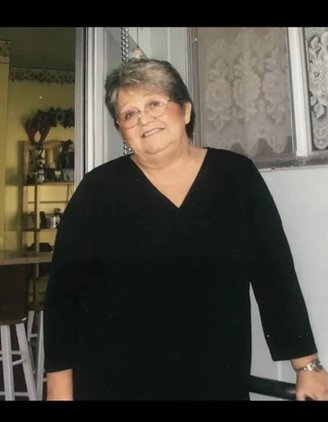
Donna ‘Bomba’ Elaine Willburn
April 24, 1947 - November 26,
2020
Donna came into this world as the first born child of Calvin and Barbara Willburn on April 24, 1947. She made her mark on this earth through her love, compassion, and heart. When she became a grandmother in 1985 she would then forever be known as “Bomba” - a title she wore with pride and she wore it well! You could find Bomba at any of the local sporting events, whether she had a child or grandchild playing or not. She would be there cheering, supporting, and selling baked goods to raise money for the teams. Donna was a Bomba to all who needed her.
Her door was always open. Her cookies were magic. And no one did Christmas quite like Bomba. Her cakes, quilts, afghans, and dresses were sought after all throughout Humboldt and beyond. Her shoulders carried the weight of our woes, her smile brightened our hearts and her laugh lifted our souls when we thought all was lost. She was the mastermind behind many family reunions and celebrations, creating magic for many generations and training up the next.
Bomba embarked on her Flower Walk on November 26, 2020, joining her parents Calvin & Barbara, Brothers Calvin, Jr & Richard, Daughters Michelle, Karen, and Tawnja “Tunes,” and Grandson Justin. Her legacy lives on through her son Churchman, daughter Gwen, Sister Vicki, grandchildren Elmer, Stephanie, Kelsey, Brittini, Scott, Kyle, Erica, Katelynn, Makenzie, Churchman, Chandler, Taylor, & Catrina, and her great-grandchildren Aaliyah, Ryder, Brooklyn, Braylynn, Aubrey, & Sage.
###
The obituary above was submitted on behalf of Donna Wilburn’s loved ones. The Lost Coast Outpost runs obituaries of Humboldt County residents at no charge. See guidelines here.
(VIDEO) ’Twas a Day for Old Town Euphonium Carols
Andrew Goff / Thursday, Dec. 10, 2020 @ 5:15 p.m. / :) , Music
There’s been less street music in Eureka as of late. But if you happened to be doing some masked Christmas shopping in Old Town Thursday, you may have noticed some horn-blown Christmas carols wafting into your ears. Usually this time of year, Joyce Carter is playing numerous gigs around the county as a member of TubaChristmas, but obviously this is a bad year to be gathering near groups of people emptying spit valves. So it goes. Instead, Carter decided to bring her euphonium down to the Old Town Gazebo and blow out some holiday favorites solo for passersby. Clarinet is her main instrument, but for this setting she likes the way the euphonium sound carries through the streets better.
“The sound bounces off the buildings. And everybody needs some Christmas cheer right now,” Carter told us on her motivations for today’s performance. “The music scene has been sheltered, so unless it’s just your family you can’t play with people. You have to be safe.”
Her family and a couple other properly socially distanced friends have been playing some music recently, though. Weather permitting, they’ve been playing Dixieland jazz tunes most Sundays around 1:30 p.m. in front of their home on Santa Clara Street under the moniker “The Myrtletown Driveway Band.”
“It’s really fun because some of the neighbors will come out. They wear their masks, sit and listen. Some of them dance,” Carter explained. “We’re just trying to keep spirits up.”
Deputy Health Officer Answers Questions on the COVID Outbreak at Granada and the Coming Vaccine
LoCO Staff / Thursday, Dec. 10, 2020 @ 4:22 p.m. / COVID-19 and Humboldt
Today, Dr. Josh Ennis, a county deputy health officer for the county, took a number of questions from the media on the state of the pandemic — including, particularly, the outbreak at the Granada assisted living facility and the coming vaccines.
Video above, rough transcript below.
###
Good afternoon and thank you for being with us. Would you like to start by addressing the community?
Yeah, I appreciate this opportunity to do so. I
think it’s important to talk a little bit about the situation at Granada. Yesterday we announced some numbers, and we wanted to give you a little more context for what may be ongoing there. So as we started testing the entire facility, as you have noticed, the numbers have increased quite rapidly, and in analyzing the numbers and doing our investigations, I think a fair conclusion at this point is we are somewhat late in detecting cases within that facility. The strategy around testing is not foolproof, and that is demonstrated clearly here.
So I want you to know that we have done a lot in that first week in response. We had our county infection preventionist involved with reviewing their policies and procedures around this response, we’ve had CDPH have a surveyor on site the past two weeks to go over some of those processes, and I want you to know that Granada has been working with us hand in hand, and they’ve been doing everything really that we’ve asked for. They have a really challenging job right now and these people are doing everything they can, they’re knowingly stepping into a facility with a lot of COVID-19.
I want you to know that despite these numbers looking as big as they do, they are not driving the current, cumulative totals over the same time period. Something like 70 percent or so of all these cases are still outside of the facility, and so it’d be really misleading for anyone to conclude that what’s happening at this facility is driving all of our numbers here. So I’d like to remind you that these are people we’re talking about, they have loved ones in the community, and we can really tie our everyday actions of every single person to what’s happening in this nursing facility. So I’d encourage you all to be kind to one another, and be respectful and try to take care of each other.
We’ll get into questions from the media.
The Redwood News asks…”Yesterday in regards to the increase in cases at Granada Rehab and Wellness, you said ‘our community is not insulated from the facility’s outbreak, and that transmission within our community at large can be amplified by it.’ Can you elaborate on that further?”
I touched on this just at the end of my upfront here, but taking the focus off Granada just for a moment, I want to talk about how investigation tracing works in general. As soon as we get a positive, we try to reach out to that individual, we tell them you’re positive, you’re infectious, who have you come in contact with during your infectious period? And so when there are small numbers, we can do that very quickly, we can do it effectively. When we’re looking at the volume that we have had recently, on the order of a couple hundred cases in about a week’s time, that process slows down.
And so when we’re looking at very large volumes in a short period of time, the time with which we’re able to reach out, do that investigation, do that tracing, it lengthens. And so there’s potentially more people being exposed on account of that process generally slowing down. And so when we talk about a facility outbreak, it’s not a contained, closed system. There are people, by nature of caring for those people, who have to come in and out of the facility. And so this can, really it’s a marker for disease that has come into this facility, but when numbers get large, it can ripple back outward into the community, and that’s the point I would like to make with saying this in our release yesterday.
The Redwood News asks…”Public Health says there are 54 positive cases in residents, and 16 staff members at Granada. Their own website (last updated 12/9) says they only have 5 cases in residents. With the thought in mind that Granada and Public Health are working together through this outbreak, don’t you think the 2 very different numbers are misleading? Can you give an explanation as to why the numbers don’t reflect each other?”
So I’ll assure that we have been working very closely from the very beginning with Granada, as well as their regional leadership. In fact, I was on the phone at 8 p.m. a couple nights ago, speaking with some folks at Granada. So we are in constant communication with them, as well as CDPH, and we’ve really been moving hand in hand with this.
Any time we have numbers, for numbers of residents, numbers of staff, we’re vetting those numbers with Granada at least daily to make sure our numbers line up. Now when it comes to what they’re presenting on a public-facing page, I don’t know what their process looks like for reporting of that, of their internal number, but I assure you, their internal number on a daily basis is a match to ours.
The Redwood News asks…”We know that local health care workers are going to be the first to receive a Covid-19 vaccine once approved and it arrives in Humboldt. Are health care workers required to get the vaccine? Are people able to opt out?”
At this time, there is no requirement, there is no mandate, and I think that’s all I have to say about that.
The Redwood News asks…”When vaccines eventually begin being rolled out for older individuals with underlying conditions, are you able to talk about how those individuals will be identified locally? Will they be notified by Public Health or their doctor that they are eligible to receive that next phase of the vaccine?”
So I think many people in this particular group are anxiously awaiting vaccine, I completely understand that. This fits in more with phase 1B, and right now we’re in the very beginning here, phase 1A as it’s called by the CDC, is really going to focus on health care workers.
To give you an idea of timeline here, health care workers number somewhere around north of 10,000 for our county. We’re looking at allotments that fall well short of that very early on. And so when we talk about people who might be in this next group of phase 1B, which is what this question is asking about, that may be a month away yet. So the planning around phase 1A has changed on an almost daily basis, but as we get closer and closer, it has come in with more clarity.
So for phase 1B we have an idea of how we might roll this out, there may be parallel channels here including Public Health alerts, including working through out health care coalition and making sure there’s direct outreach from the providers themselves, but as far as specifics go, we don’t have a specific plan because there are a lot of specifics go, we don’t have a specific plan because there are a lot of logistical issues surrounding receiving the vaccine and special requirements around storage and movement and shelf life. And so, it’s been very difficult to have real firm details as we roll out this planning, but this question is asking about phase 1B and there would probably be several different ways we would reach out to that population.
The North Coast News asks… “How many vaccines is the county expecting to receive in the first rollout? Also, any update on when they will roll out?”
I think that I’m unable to give an exact number at this time. The FDA is currently reviewing the EUA submission. In anticipation of an emergency use authorization occurring, it could be as early as shipments shipping out next week. Again, supply will be very limited very early on, but it could be as early as next week that they actually start shipping allotments.
The North Coast News asks… “What happens after a person receives a COVID-19 vaccine? Are they followed up with by a doctor? Do they still have to wear a mask? What percentage of people need to be vaccinated in order for some of the safety modifications to be lifted?”
Yeah, these are all great questions and I think it goes to the fact that this could be the beginning of the end of COVID-19. Now, is it going to happen any time soon? No, I think it’s going to take many, many months to get people vaccinated. But the end point here, the last question here, is asking about what percentage of people need to be vaccinated for us to go back to normal, resume normal life.
I think that the general idea here is that we can potentially obtain herd immunity whether that’s through natural infection, or whether through the vaccination. And so we need to reach about 65 or 70% of people being immune to the disease all around the same time. And so, we still don’t have an idea of how long natural immunity lasts when it comes to actual infection. We don’t know how long immunity lasts for the vaccine. But the idea is if we can move quickly enough and have the immunity stay, whether that’s through infection or vaccination, we can try and hit that 65% or 70% number. And best case scenario, lots of things have to line up, I think I’ve heard some experts say as early as June. I think that’s optimistic.
I think that more realistic, the earliest we can probably see that occur might be in the fall. Again, there’s a lot of unknown here. Production issues, distribution issues. When I’m talking about this, we’re talking about developed first world nations. There will be more difficulty doing this in developing nations, which are going to serve as repositories for disease. So there are a lot of things that go into answering this question, but developed nations, if everything goes as planned, I think we might be looking at summer or fall at the absolute earliest.
The North Coast News asks… Do you expect to need the Redwood Acres alternate care facility in the coming month?
We hope to not need Redwood Acres. We have been planning around how to use it, should we need it at some point. I really don’t know the answer to this question and it depends to some degree on how bad flu season is. I do know and I firmly believe that if COVID-19 spreads very quickly, if we have more than one potentially one skilled nursing facility outbreak ongoing at the same time, and then we have a bad flu season, it is very possible that we would need Redwood Acres. There’s a lot in there that I can’t predict. I do know that if you project our current rate of COVID-19 as well as hospitalizations, it could seriously tax our health care system. But we are going to do everything we can to keep the care happening within the four walls of the hospitals and we’ve been working with them all along to develop robust plans to do that. But we do have a so called “pop-off valve” where we can allow very low acuity people at the end of COVID-19 care who maybe just need another day or two to get things sorted out, to allow that to occur at Redwood Acres.
The Redheaded Blackbelt asks… Are any residents of Granada being transferred to local acute care hospital settings for care, and if so how is this impacting Humboldt County‘s ICU availability percentage?
Granada patients, depending upon their already-stated end of life care decisions, may do any one number of things. Many people if they still wish to have aggressive care, they’re going to get transferred to the hospital. They’re going to be offered the same standard treatments that many non-nursing facility residents would be offered. Many patients have had the end of life discussion surrounding this pre-pandemic. So they know that they’re constantly battling chronic medical conditions. They may have made known what their ideas are around quality of life, as well as dependency upon health care or medical resources. And so some of them have chosen not to have aggressive care at the end of life, whether that’s a COVID-19 thing or not.
So, with nursing facilities in particular, many of them are in that latter category. And so if they’ve made that known and they wish at the end of their life to be made comfortable, we have been trying to support that occurring wherever it is they wish for that to occur. Sometimes they may wish for it to stay within the nursing facility, some people sometimes wish to potentially go home. But with COVID-19 that brings in a lot of transmission and exposure concerns. Others may wish for something in the middle that maybe the hospital is more appropriate for end of life. So, when it comes to Granada, our current ICU capacity, it does have potential to impact our ICU capacity significantly. At this time, it is not impacting it in a dramatic way though.
The Redheaded Blackbelt asks… Have there been any new cases of COVID detected among the jail population in the last few weeks? If so, how many?
The short answer is no. Over the past several months, there have only been a couple staff members, and in fact no inmates. We’ve worked very closely with the jail to mitigate any risk of introduction of COVID-19 into the facility and they continue to be a great partner in doing so.
IN WITH THE NEW! Arcata City Councilmembers Sworn in During Special Meeting Today
Stephanie McGeary / Thursday, Dec. 10, 2020 @ 3:57 p.m. / Local Government
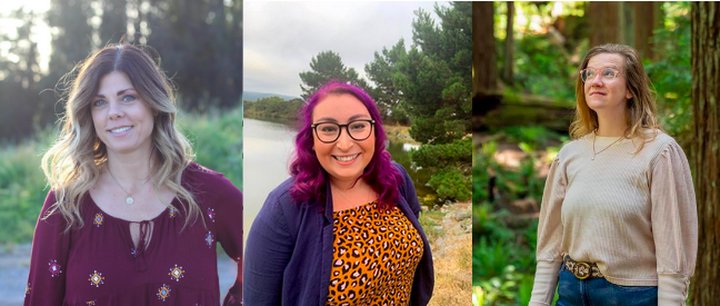
New Arcata City Councilmembers (from left) Stacy Atkins-Salazar, Emily Grace Goldstein and Sarah Schaefer
###
The City of Arcata ushered in a new era at a special city council meeting today, during which newly elected councilmembers Stacy Atkins-Salazar, Emily Grace Goldstein and Sarah Schaefer were sworn into office.
Before welcoming the new faces, the council and city staff said goodbye to outgoing Arcata councilmembers Michael Winkler, who held the position for 12 years, and Paul Pitino, who served on the council for 10 years.
“Both of these councilmembers truly are one of a kind,” Arcata City Manager Karen Diemer said during the meeting, thanking Winkler and Pitino for their service. “They have served with a passion and a love for Arcata that will be felt for generations.”
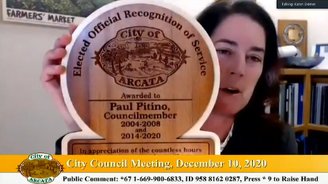
City Manager Karen Diemer shows the plaque that will be sent to outgoing councilmembers Winkler and Pitino
Pitino and Winkler’s time on council is marked by many high-profile issues, including the unsolved murder of HSU Student David Josiah Lawson and subsequent protests, the removal of the McKinley statue from the Plaza, and drastic budget cuts due to the COVID-19 pandemic, to name a few.
“Things in the city council, especially in the last four years, have been very heated and it might not always have been clear, but I recognize the passion, especially in the areas where I and other members of the council have differed,” Winkler said in his parting statement during today’s meeting. “Those have been very difficult. I’ve tried to look at my conscience and my ethics of how I’ve treated other people fairly. Maybe I haven’t always done that, but it’s something I’ve always strived for.”
After the farewells, the meeting was moved outside to the lawn in front of Arcata City Hall, where Atkins-Salazar, Goldstein and Schaefer — each wearing masks and standing six feet apart — took their oaths and were sworn into their positions on city council.
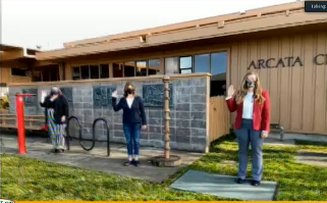
Goldstein, Atkins-Salazar and Schaefer take the council oath at City Hall | Screenshot from Zoom meeting
Following a recess, the new council reconvened and elected Sofia Pereira to serve as mayor and Brett Watson to serve as vice mayor for the next year.
There was a little bit of hesitation on Pereira’s part, however, for how this process should be carried out. The Arcata City Council rotates these roles, and councilmember Watson was next in line for the vice mayor position, and will move up to mayor next year. For new councilmembers, the roles are assigned in order of highest vote count. So with three new council members, this means that one with the lowest vote count from the election — councilmember Shaefer — will not have a chance to serve as mayor during the next four years.
Because of this conundrum, Pareira suggested that the council change the order and nominated Atkins-Salazar — the new councilmember with the highest vote count — to serve as vice mayor. Pereira then opened up the issue for discussion.
Councilmember Watson said that he felt strongly that the council should stick to its usual protocol, allowing him to serve as vice mayor for this year. Watson’s stance was echoed by Councilmember Shaefer, who said that she was willing to forgo the mayor position during her four-year term in the interest of sticking to a system that has worked for the council.
“If Brett is passionate about serving as vice mayor, I support that,” Shaefer said, adding that theoretically she will have a chance to serve as mayor if she is elected for another term. “It’s not the number one passion in my heart to serve as mayor. I’m happy serving as a member of the council. That is what I’m here for and I’m excited to do that.”
Trinidad May Reinstate a Moratorium on Short-Term Rentals at a Special Meeting Thursday Evening
Ryan Burns / Thursday, Dec. 10, 2020 @ 3:45 p.m. / COVID-19 and Humboldt
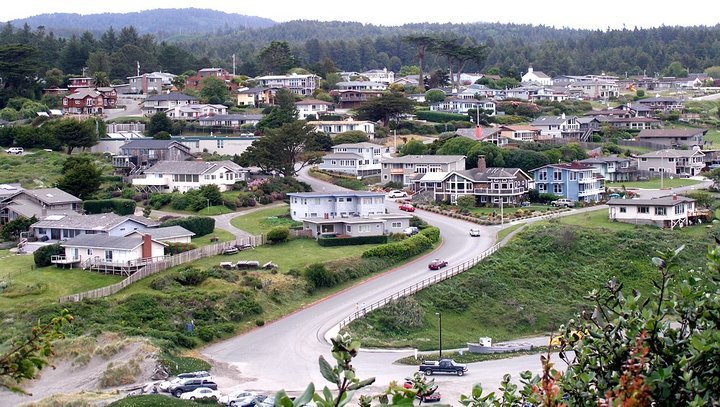
Trinidad. | Image via Wikipedia.
###
In another indicator of the worsening COVID-19 pandemic here in Humboldt County, the tourist-adored City of Trinidad might be closing its doors to outsiders this evening.
At a special meeting starting at 5:30, the Trinidad City Council will consider passing an urgency ordinance, which would reinstate a moratorium on short-term vacation rentals within city limits. As with the moratorium the city passed back March (and rescinded in June), visiting health care workers and other essential folks would be excluded from the ban.
The urgency ordinance, which cites “a current and immediate threat to the public health, safety or welfare” of the public, must be approved by four of the five council members to pass.
It’s not clear exactly when the ordinance would take effect. One paragraph in the document says the measure “shall take effect immediately upon adoption” while, two paragraphs later, it specifies a 90-day period lasting from December 14 to March 14, unless extended by another four-fifths vote.
City Clerk Gabriel Adams said City Attorney Russ Gans drafted the moratorium in response to input from council members at the Nov. 24 council meeting. Members of the community have been voicing concerns about vacation rentals as the pandemic worsens, Adams said. He noted that the council can tweak and add content to the ordinance before voting on it tonight.
Meanwhile, short-term rentals, including hotel stays, remain permitted in the county’s unincorporated areas, though they must adhere to the purple tier guidelines under the state’s Oct. 20 health order.
If the Northern California region’s ICU capacity dips below 15 percent (it was at 30.3 percent as of this morning), then Humboldt and neighboring counties would get hit with the state’s Regional Stay-at-Home Order, which states:
[N]o hotel or lodging entity in California can accept or honor out of state reservations for non-essential travel, unless the reservation is for at least the minimum time period required for quarantine and the persons identified in the reservation will quarantine in the hotel or lodging entity until after that time period has expired.
Additionally, hotels and lodging entities in a county under a Regional Stay Home Order cannot accept or honor in-state reservations for non-essential travel.
Hotels or other commercial and residential buildings may offer lodging for essential functions and travel including COVID-19 mitigation and containment measures, treatment measures, accommodation for essential workers, or housing solutions, including measures to protect homeless populations.
Until then, lodging facilities remain open, though there is a statewide travel ban in effect.
For anyone looking to participate in tonight’s meeting, the city will publish a link and participant code on the calendar page of its website.
(AUDIO) Local Experts Record Chorus of Humpback Whales Singing Same Song Off the Humboldt Coast
John Ross Ferrara / Thursday, Dec. 10, 2020 @ 2:50 p.m. / Nature , Ocean , Wildlife
A pair of local biologists picked up a chorus of holiday humpbacks on their underwater microphone earlier this month.
Local marine biologists and whale expert Jeff Jacobsen said that he and local biologist Jessie Bunkley recorded more than 10 minutes of the whales singing the same song 12 nautical miles off the coast of Eureka on Dec. 2.
“A winter song from another species, another realm,” Jacobsen said. “You’ll hear a chorus of two, probably three humpback whales singing the same song, but not in synch.”
Jacobsen, the same expert who recorded the calls of rare transient orcas near the Samoa Peninsula in June, said that the humpback song is complex.
“It gets rather wild!” he said. “The song has several themes, each consisting of a phrase that is repeated. Each phrase has its own units that mostly stay the same throughout the phrase.”
Jacobsen said the recorded whales are males transitioning from the feeding season to the breeding season.
“Only males sing,” he said. “They all sing the same song and the song slowly changes during the singing season all across the Pacific Ocean: Mexico to Hawaii to Japan. This same pattern repeats in all ocean basins, and in some places one population switches to another population’s song within a season.”
Jacobsen said that the whales have been observed off the Humboldt coast for more than a month, and that by January, they will be in their southern breeding area between Cobo San Lucas and Costa Rica.
“When they return in the spring, some still will be singing,” he said. “Then all songs go quiet during the summer feeding season when they all make other non-song sounds.”
Jacobsen is encouraging Outpost readers to analyze the recording for themselves and suggested that some even play the music for pets and document their reactions.


