

Fatal Crash on Highway 36
John Ross Ferrara / Tuesday, Nov. 24, 2020 @ 1:20 p.m. / Traffic
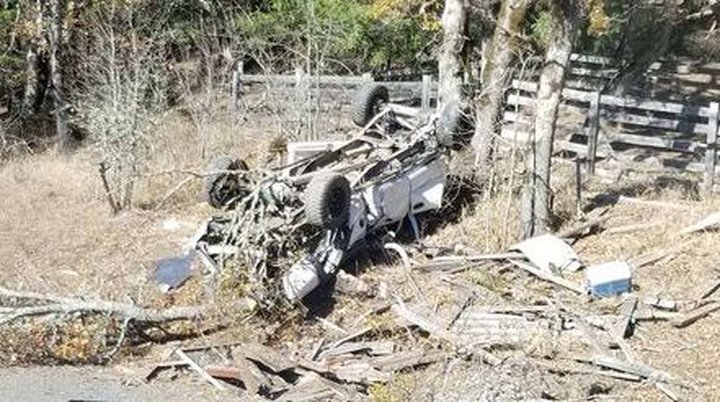
Photos of the crash provided by a reader.
One person was reportedly killed in a single-vehicle crash on Highway 36 in Humboldt County this morning.
California Highway Patrol spokesperson Paul Craft told the Outpost that no other information is available at this time due to a computer system error.
Photos of the scene sent to the Outpost by a reader show a white pickup or SUV overturned near the Dinsmore Airport.
Craft said that more information will be released on the crash when it becomes available.

BOOKED
Today: 14 felonies, 6 misdemeanors, 0 infractions
JUDGED
Humboldt County Superior Court Calendar: Today
CHP REPORTS
Indian Creek Rd / Jacobs Way (YK office): Trfc Collision-1141 Enrt
Summer Ln / Scenic Creek Dr (HM office): Missing/Abducted Child
40�43‘32.8”N / 123�50‘51.73”W (HM office): Trfc Collision-1141 Enrt
ELSEWHERE
RHBB: Medical Helicopter Called After ATV Rolls Over Near Maple Creek Road South of Korbel
RHBB: Structure Fire Spreads to Vegetation Near Shelter Cove
Governor’s Office: Governor Newsom builds nation’s largest state service corps — 50,000 members sworn in since 2019
County of Humboldt Meetings: Behavioral Health Board - SUD/Dual Recovery Committee - Oct. 8, 2026
Humboldt County is Now in the Purple, Most-Restrictive COVID Tier. Here’s What That Means.
Ryan Burns / Tuesday, Nov. 24, 2020 @ 1:06 p.m. / COVID-19 and Humboldt
UPDATE:
# # #
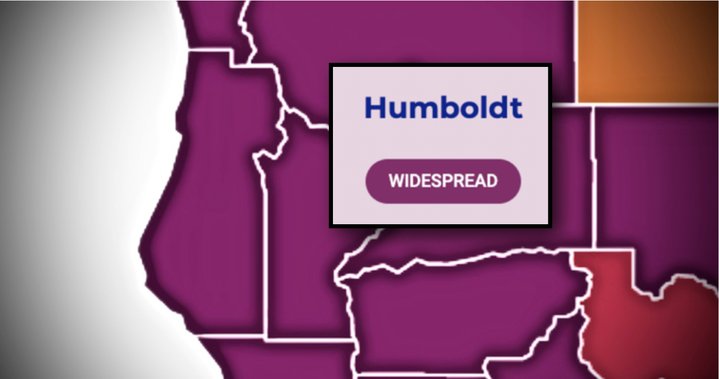
As predicted, Humboldt County’s dramatic rise in confirmed COVID-19 cases prompted state public health officials on Tuesday to move us into the most restrictive, purple tier indicating “widespread” risk under California’s “Blueprint for a Safer Economy.”
The move comes just eight days after Humboldt County was moved from the least-restrictive, or yellow, tier directly to the red or “substantial” tier as state public health officials pulled the “emergency brake” in an effort to slow the spread.
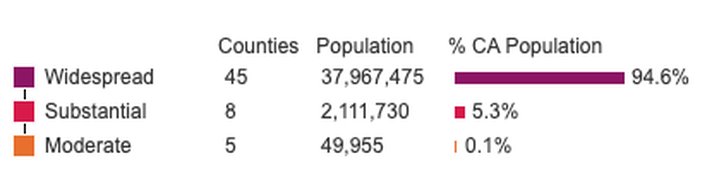
Forty-five of the state’s 58 counties, including all of Humboldt’s neighbors, are now in the purple tier while another eight in the red. That means 99.9 percent of California residents live in counties with “substantial” or “widespread” risk.
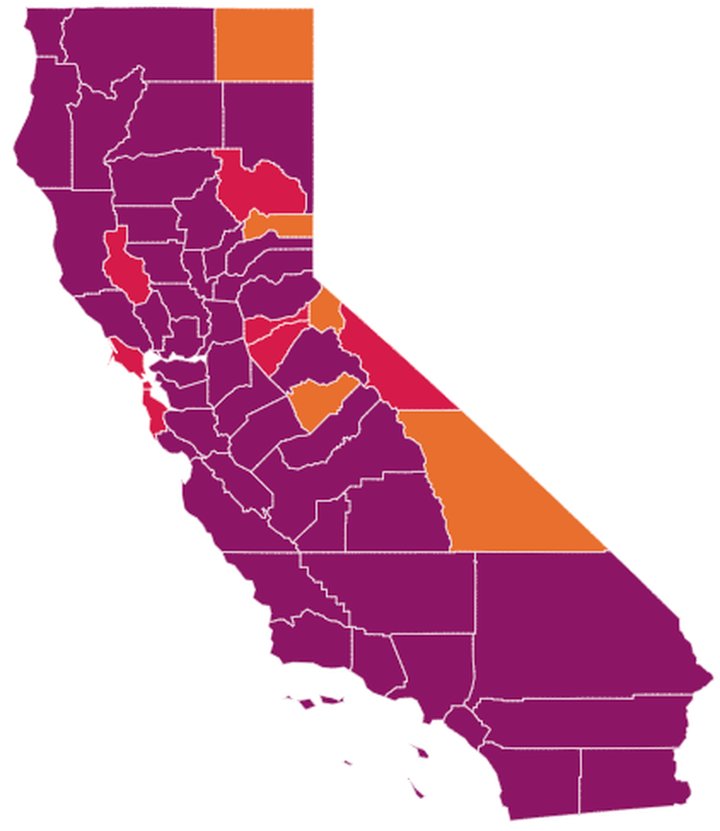
In a live press conference streamed online at noon Tuesday, California Health and Human Services Secretary Dr. Mark Ghaly said cases in California are growing at a faster rate than ever before. “We are in the midst of a surge,” he said.
The latest statewide daily case count of 15,329 is close to a record, Ghaly said. Over the past two weeks there has been a 51 percent increase in test positivity rate and an 81.3 percent increase in COVID-19 hospitalizations. There are currently 5,844 California residents hospitalized due to COVID-19, and Ghaly said we can expect deaths to rise as well.
So what does going purple mean for Humboldt County? In short, more restrictions. With Thanksgiving just two days away, gatherings are limited to three households and must now take place outdoors only. Restaurants, gyms, movie theaters and places of worship are also limited to outdoor-only operations under the purple tier. Retail is limited to 25 percent capacity, down from 50 percent in the red tier.
A full list of the restrictions in each tier can be found on the California Department of Public Health website, at this link.
On Facebook, the Humboldt County Sheriff’s Office said it will continue to prioritize “education and voluntary compliance, rather than criminal enforcement of health orders,” saying it has seen “overwhelming success with this approach.”
###
ADDENDUM: One thing we neglected to mention is this (as articulated by the county in a press release):
Now that Humboldt County is in the purple tier, the state’s Limited Stay at Home Order will take effect locally onWednesdayThursday. This order requires residents to refrain from gathering with non-household members and stop any non-essential activities between 10 p.m. and 5 a.m. Members of the same household may leave their home during this time as long as they do not interact with other households, and activities related to “the operation, maintenance, or usage of critical infrastructure” are exempt, according to the state’s order.
How California Reached Historic Voter Turnout Despite Pandemic, Distrust
Lewis Griswold / Tuesday, Nov. 24, 2020 @ 7 a.m. / Sacramento
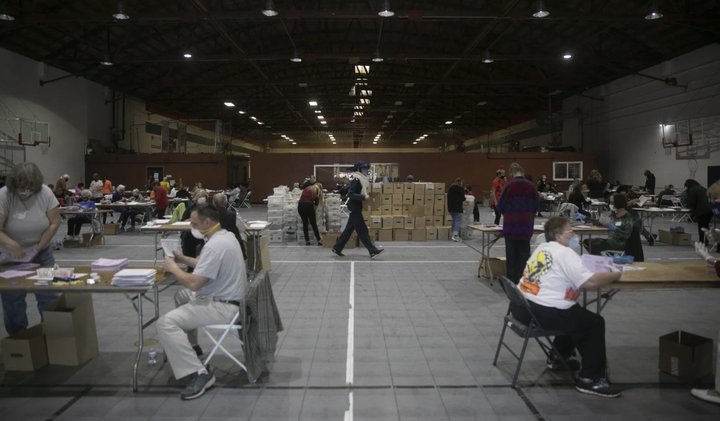
Dozens of volunteers extract ballots at the sports complex in Martinez on Oct. 31, 2020. By Halloween, Contra Costa County had already received more ballots than the total number in the March primary. Photo by Anne Wernikoff for CalMatters
Californians faced the naysayers and voted by mail in record numbers this election, potentially avoiding a pandemic super spreader event and showing the nation it could be done.
CalMatters interviewed voting officials in most of the state’s 58 counties and their verdict is in: The experiment with voting by mail saw few glitches, little drama and, instead, might well provide a blueprint for future elections across the country.
Indeed, state officials are already talking about plans to make voting by mail permanent for the biggest state in the union and its 22 million registered voters.
Besides the unprecedented challenge of conducting the election in a pandemic, voting officials also had to deal with a deep, partisan divide that helped to fuel widespread misinformation about election security.
Yet by the time polls closed at 8 p.m. Nov. 3, voter registrars say they had little need for law enforcement help and reported insignificant incidents affecting ballot safety. They reported historic numbers of ballots cast, about 17.6 million at last count, and almost 208,000 more still to process as of 5 p.m. Monday.
Upping the ante on mailed ballots
Vote by mail got a jump-start four years ago when the Legislature passed the Voter’s Choice Act, launching a pilot project of select counties in 2018 and allowing any county, starting in 2020, to send a ballot to every voter. Voters could choose to mail in their ballots, place them in a drop box, or vote in person. County-wide vote centers — one for every 10% of registered voters in larger counties — replaced neighborhood polling places.
At the time, few were talking about how to survive a pandemic. The bill instead was intended to increase voter turnout by making voting more convenient.
“In a strange way we were extra prepared,” said the voting law’s author, Sen. Ben Allen (D-Santa Monica). “It was fortuitous that we passed this and got it off the ground when COVID struck.”
In 2018, five counties went with the new model — Madera, Napa, Nevada, Sacramento, and San Mateo. This year, ten more counties joined them — Amador, Butte, Calaveras, El Dorado, Fresno, Los Angeles, Mariposa, Orange, Santa Clara, and Tuolumne.
When the pandemic disrupted everyday life, Gov. Gavin Newsom upped the ante. He issued an executive order for every voter in the state to be sent a mail ballot. The Legislature made it law, and gave the other counties the option to consolidate polling places on the theory that fewer polling places would help stop the spread of the virus.
Mail ballots and vote centers in 2020 proved popular with voters, registrars said.
“We heard positive feedback from a lot of voters about being able to vote early, and then also be able to vote at any location,” said Deva Proto, Sonoma County registrar of voters.
Voter registrars say the Voter’s Choice Act model — mailed ballots to every registered voter, backed up by vote centers for same-day registration, language assistance, accessible voting machine use, replacement ballots and in-person voting — is probably the future of voting in California.
“These county-wide vote centers, they were the greatest thing,” said Brandi Orth, registrar of voters in Fresno County and president of the California Association of Clerks and Election Officials.
It was especially helpful that technology used in the centers allowed officials to verify a voter’s eligibility on the spot and reduce the number of provisional ballots, which speeds up vote counting, she said.
California already had plenty of experience with mail voting, with more than half of voters using it since 2012. In recent years, usage increased: 65% of voters cast ballots through the mail in the 2018 general election and 72% in this year’s primary as more counties adopted the Voter’s Choice Act model. Some rural counties already mailed each registered voter a ballot.
In California, registrars can start processing mail ballots when they arrive, but not tally the votes. In Pennsylvania, by contrast, mail ballots can’t be processed until election day. Most California counties issued substantial vote totals soon after polls closed because many ballots had already been prepared for counting.
“Making voting easier”
Momentum is building to make statewide vote by mail permanent in California.
Assemblyman Marc Berman, D-Menlo Park and chair of the Assembly Committee on Elections and Redistricting, said Nov. 9 he would introduce legislation next year to require all active registered voters be mailed a ballot for future elections.
The success of early voting — more than half of the mail ballots were returned by election day — prompted Gov. Gavin Newsom to say he’d support making it permanent.
“We’ll discuss that with the Legislature, but I think making voting easier, providing more choice and more opportunity is fabulous,” he said on election day.
Speaker of the Assembly Anthony Rendon and Secretary of State Alex Padilla, both Democrats, also said they liked the idea.
If Berman’s proposal gains traction, the Legislature should come up with the money to help counties pay for mail balloting and vote centers, said Kim Alexander, president of the California Voter Foundation advocacy group.
“The idea has merit but you have to talk about funding,” she said. “I didn’t see that in the announcement.”
Federal CARES Act money, provided to help cover the costs of the pandemic, helped pay the costs of mailing ballots to every voter. “That’s not going to be there next time,” she said.
And the Voter’s Choice Act model needs “refinements,” she said. She pointed to the requirement that some centers be open for 11 days so voters can cast their ballot at their convenience. Registrars surveyed by CalMatters also said the requirement should be scaled back, because they didn’t get enough traffic to justify the cost.
California joins states with high turnout
The final numbers are not in, but voter turnout in California reached 80% as of Monday. Voter turnout last topped 80% in 1972 and 1976, according to California Secretary of State data.
More recent high turnout years show 75% in 2016 and 79% in 2008.
Did mailing each registered voter a ballot increase voter turnout? Probably, said Lisa Bryant, a political science professor at California State University, Fresno, who specializes in election administration.
“If we look at the data nationally, states that conduct all-mail (Oregon) or nearly all-mail (Colorado and Washington) elections have among the highest turnout rates in the country,” she said.
For clues in California, she looked at Voter’s Choice Act counties where all voters were mailed ballots in earlier elections.
In the 2018 primary and general elections, Voter’s Choice Act counties saw a larger increase in turnout than other counties, she said.
“I haven’t dug into the 2020 numbers yet since they haven’t been finalized, but I expect we will see a high number of mail ballots was a contributing factor to higher turnout in the general as well,” she said.
Turnout increases because it is easier for people to vote, she said.
“They don’t have to set aside time, try to estimate how long lines will be, or worry about transportation when they vote by mail,” she said. “Voters also report in surveys that they like being able to research information on the ballot while completing their ballot, which is hard to do in the voting booth.”
Voter registrars agree that vote by mail seems to increase turnout.
“If the Legislature is interested in continuing with this increased voter turnout, they need to continue with vote by mail,” said Joe Holland, Santa Barbara County registrar of voters.
Technology for peace of mind
Opting for peace of mind, millions of Californians signed up to receive text messages, email, or phone calls informing them their ballot had been received and would be counted. The BallotTrax system, called WheresMyBallot, also informed voters if they should contact their county election office to resolve ballot problems such as a missing signature on the envelope. More than 20,000 messages were sent to voters alerting them they needed to cure their ballots.
BallotTrax is a 21st century option that the Secretary of State’s office likes.
“Delivering the same type of ‘customer service’ experience that Californians are used to when ordering retail items online is a major step in modernizing our elections,” said Sam Mahood, press secretary for the Secretary of State’s office, in a written statement.
Some counties reported problems with the system. As mail ballots were returned in droves, it would take short-staffed small counties a few days to verify signatures. But if the voter checked WheresMyBallot, it appeared their ballot had not been received so voters would call the office, said Julie Bustamante, Lassen County clerk-recorder.
“We’re on the phone all the time,” she said. “I think we should have the option that the county doesn’t have to participate.”
BallotTrax costs $41,667 a month for statewide service and is paid by the state, the Secretary of State’s Office said. There’s no cost to counties.
Advocate says too many ballots rejected
The rejection rate of mail-in ballots for the election won’t be known until results are final, but California Voter Foundation research shows a 1.7% rejection rate over a 10-year period.
That’s too high, said Alexander of the voter foundation.
“Young voters were three times more likely to get their ballot rejected,” Alexander said. “I do worry that the system that uses signatures and mail will be foreign to young voters.”
Another problem is that too many ballots are disqualified because they were postmarked after election day, the study found.
That’s true this year too, it appears. In Sacramento County, 783 ballot envelopes arrived two days after the election and 455 were postmarked Nov. 4, one day too late to be counted, the foundation said.
In Sacramento County’s past three elections, most ballots rejected for lateness were due to being postmarked too late, not for arriving too late to count, the foundation said. In the state’s March primary, about 70,000 of 102,000 rejected mail ballots were rejected for lateness.
To attack the problem, voters should be allowed to bring their mail ballot to a vote center and put them into the scanner, Alexander said. Shasta County allowed that option in the election and “it worked incredibly well,” she said.
“The voter can watch the counter turn over and know it was accepted,” she said.
Voters who fail to sign the ballot envelope or whose signature did not match are mailed a notice to come in and “cure” the problem so their ballot gets counted.
Few ballots are still arriving by mail, according to elections officials. The last day to receive a mail ballot was Friday.
Battling rumors with facts
Many voter registrars said they spent inordinate amounts of time combating misinformation and rumors spread on social media.
“Every day for several hours,” said Orth, the Fresno County registrar. “Every time you turned around there was wrong information getting out there.
“The whole Sharpie thing was ridiculous,” she said, referring to a sudden controversy that ballots marked with Sharpie pens would not be counted. But other rumors included dire warnings not to vote at early vote centers because the vote would not be counted, that mail ballots would not be counted, and that vote fraud was occurring, she said.
Social media misinformation was the most problematic to deal with, registrars said.
“I just tell people don’t look at Twitter, don’t look at Facebook, look at the election material we send out, educate yourself and vote,” said Candace Grubbs, Butte County registrar of voters.
Napa County registrar John Tuteur said he once spent two hours online responding to social media misinformation.
San Luis Obispo County elections hired two people specifically to take phone calls, many of them about misinformation. The county also had a large presence on Facebook to get out the correct information.
Other registrars had similar experiences.
“We spent more time just posting informative videos and infographics on our own social media to try to be the official source of information,” said Rebecca Spencer, Riverside County registrar of voters.
Throughout the state, people brought their ballots into the main office to be sure they were received after news stories about potential postal service delays.
Mail ballots in California worked as planned, but voter skepticism was widespread.
“How do I know my vote counted?” was a common question, said Michelle Baldwin, registrar of voters of Tulare County. “A lot of them didn’t feel comfortable putting them in the ballot drop box or the mail.”
How to vote in a pandemic
As if misinformation wasn’t a big enough hurdle, elections officials also needed plans to protect people from the coronavirus. Poll workers wore masks in all counties surveyed by CalMatters.
With few exceptions, in-person voters were conscientious about wearing masks and following safety rules, registrars said.
“It was less of an issue than I thought it would be,” Orth said.
In San Bernardino County, poll workers had their temperature checked daily and wore face shields and masks. Poll workers in San Joaquin County also wore face shields and masks.
To reduce the chances of spreading the virus, counties found large spaces for in-person voting and offered drive-through voting. Santa Barbara County, for instance, used a high school gym. Santa Clara County had poll workers bring ballots out to voters waiting in their car.
Napa, Tulare, Imperial and Santa Cruz counties checked temperatures before allowing people to vote in person.
Few election officials reported staff infected with the coronavirus. But San Joaquin County said a poll worker tested positive for COVID–19 at a voter service center in Escalon, forcing 16 staff members to quarantine. And in Tulare County, a poll worker reportedly tested positive using a rapid test. But poll workers wore masks and practiced physical distancing so exposure to the public was minimal, the health department said.
In Kings County, a staff member was exposed to the coronavirus two days after the election, causing the registrar of voters to shut the office for two weeks while staff stayed home.
“This is the most difficult, complex election I’ve done in 25 years,” said Scott Konopasek, Contra Costa County assistant registrar of voters. Nevertheless, he said, “This is the one that’s rolled out smoother and better than any previous election.”
Running a smooth election in the midst of a pandemic and political and cultural cross currents is an achievement, he said.
“We felt that this was really, really important for us to be doing,” he said. “We were actually serving our country in a very important way that no one else can do.”
Votebeat reporter Michael Lozano and University of California Berkeley Graduate School of Journalism reporters Katie Licari-Kozak, Aaron Leathley and Freddy Brewster contributed to this story.
This coverage is made possible through Votebeat, a nonpartisan reporting project covering local election integrity and voting access. In California, CalMatters is hosting the collaboration with the Fresno Bee, the Long Beach Post and the UC Berkeley Graduate School of Journalism.
###
CALmatters.org is a nonprofit, nonpartisan media venture explaining California policies and politics.
OBITUARY: William Martin, 1937-2020
LoCO Staff / Tuesday, Nov. 24, 2020 @ 6:56 a.m. / Obits

William Martin, 83, passed away on March 12, 2020. William was born to Gladys and Raymond Martin on Feb. 14, 1937 in Loma Linda, California. He moved with his family to Humboldt County as a young boy. He met his wife Virginia Martin in Eureka and they married on Feb. 22, 1985. They had four children that they raised happily in Humboldt County.
William went into the Army in 1953 at the young age of 16 and ended up serving abroad in the Korean War. After leaving the military he worked as a mechanic for many local shops and he bought himself a fishing boat and became a captain fishing up and down the Oregon and Northern Californian coasts. Years later when he met his wife Virginia they started the family florist business called Virginia’s Flowers on Broadway in Eureka. Working the family business together for the next two decades they raised their children in the beautiful nature of Humboldt that William was so fond of. He spent most of his days with his children, whether it was another trip to the beach for agate hunting or simply to just sit and watch the waves crash and the birds fly by, nature was a huge part of William’s everyday life.

In Williams later years he was very close to his grandchildren spending time with them everyday teaching them about life. If he wasn’t driving around or hanging out watching the waves you might have been able to find him at your local poker room. He quite enjoyed the occasional poker game and he had every reason for he was a very skilled player. He earned himself the nickname “Wild Bill” for his known presence in the poker room.
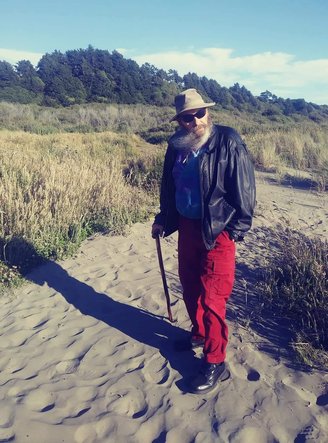
Anyone who ever met William couldn’t help but leave with a smile. He was quite the jokester and his humor was extremely contagious. He was a friend to all he met. Someone who would even sacrifice his own life for a stranger. William was an even more amazing father and grandfather. He was a caretaker and hard worker and provided for his family his whole life.
William is survived by his sister Nancy Tucker, and daughter’s, Helen Martin and Gina Golla, his sons, Vincent and William Martin, grandchildren, Heaven, Eden, Luciano, Cora, Lynn, Magi, Bretton, & Roin. He was preceded in death by his parents Gladys and Raymond Martin, his wife, Virginia Martin, his son, Chaim Martin, and his son-in-law Ben Calhoun.
Due to Covid, a service has not been scheduled. The family does hope to do a service in March of 2021 to celebrate William’s life.
###
The obituary above was submitted on behalf of William’s loved ones. The Lost Coast Outpost runs obituaries of Humboldt County residents at no charge. See guidelines here.
OBITUARY: Janet Cavallin, 1943-2020
LoCO Staff / Tuesday, Nov. 24, 2020 @ 6:56 a.m. / Obits
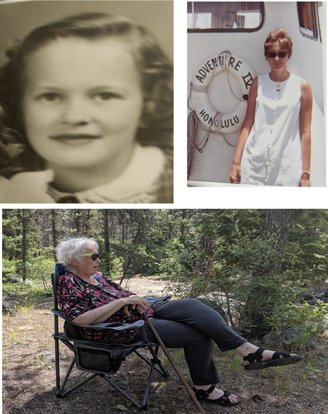
Janet Severson Cavallin was born on October 6, 1943 in Fergus Falls, Minnesota to Alfred A. Severson and Doris Gronner Severson. She passed away after a brief but fierce fight with cancer. Her son Matt and sister Kathleen were with her at the time of death.
Janet was a longtime resident of Eureka and Fortuna. She was a teacher at Toddy Thomas Middle School and Norman G Ambrosini Elementary in Fortuna.
She was preceded in death by her parents.
Survived by her son Matt, her sister Kathleen Severson Wedll, numerous cousins throughout the United States, and her much loved friends in Humboldt County.
Janet was a down to earth person. She requested that there be no memorial service, but any who wish to honor her life should donate to Miranda’s Rescue in Fortuna.
###
The obituary above was submitted on behalf of Janet’s loved ones. The Lost Coast Outpost runs obituaries of Humboldt County residents at no charge. See guidelines here.
OBITUARY: Ken Lockhart, 1938-2020
LoCO Staff / Tuesday, Nov. 24, 2020 @ 6:45 a.m. / Obits

Ken Lockhart went to be with the Lord on November 10, 2020, at the age of 82, peacefully at home with his son, Kevin, by his side. He was born on September 26, 1938, to Chester and Lois Lockhart in New Mexico.
Ken grew up near Cave Junction, Oregon, where he married his high school sweetheart, Loretta Mayfield. They had two sons Kevin and Larry, shortly after marriage. Ken and his young family made several moves in the early years, working and living in Lebanon, Oregon and Denver, Colorado. It was in Denver that Ken worked as a mechanic and ran a service station, while only in his early 20s.
Ken and his family moved to Eureka, so he could work a night job at Vika Trucking as a mechanic. They were living in Eureka when they found a place for rent in McKinleyville, not knowing at the time the little rental would become their home of 55 years.
In 1968 Ken went to work for Redwood Construction as a diesel mechanic for ten years. He was the shop foreman, mostly working nights. He was known as a stern but fair boss, and he made many friends there.
After a short stint working at Sierra Pacific, Ken knew he wanted to open up his own business. About the time his daughter, Kara, was born, he had the opportunity to purchase Clayton Knowles’ old shop on West End Road, Arcata. This was the beginning of Ken’s Truck Repair, where he had developed many lifelong friendships. His truck shop was his home away from home. He worked on diesel trucks, heavy equipment, machinery, and rebuilt motors from all over Humboldt County. He bought and operated several log and water trucks and formed KTR trucking. Many times over, his family has been told that Ken earned the reputation as the best diesel mechanic and fabricator in our area. He was known to build his trucks to go fast, and you could always tell a “Lockhart motor.” Ken’s strong work ethic and mechanical talents were a big influence on many people. He loved what he did, and he continued working until he lost most of his eyesight and finally recognized it was time to retire. He sold his shop to Hank Combs III, who continues the tradition of working on and owning log trucks in the KTR shop.
It was in the late 1960s that Ken and Loretta obtained a place at Ruth Lake where they spent every summer. He was an excellent water skier, even barefoot! Being at the lake made his heart happy. Once he retired in the early 2000s, his son Larry often took him to the lake in the summers. Although no longer able to water ski, he thoroughly enjoyed what was his little piece of heaven on earth.
Being the only daughter and the youngest child, Kara was blessed with many years of living next door to her parents, making it possible for her and husband Ryan’s boys to create many special memories. Kara was the main caretaker for her dad until the day he went to be with the Lord.
Ken is preceded in death by his mother and father Lois and Chester, sisters Ruth Anne and Mary, and brother David Lockhart. He is survived by his wife of 63 years, Loretta; sons Kevin Lockhart, Larry Lockhart, and daughter Kara Lockhart Thomson (Ryan Thomson); grandchildren Ken Lockhart, Kory Lockhart (Celeste Lockhart), Larry Lockhart Jr., Kayla Dennis (Michael Dennis), Reba Coburn (Charlie Coburn), Nic Lockhart, Sara Lockhart, Tyler Thomson, Jace Thomson, Colby Thomson; and ten great grandchildren. The family would like to send special thanks to Jimmy Fike who was a faithful friend to Ken until his last days. We would like to extend our gratitude to our in-home care providers and Hospice of Humboldt, for the help to care for both Ken and Loretta the past few years. Donations in the memory of Ken may be made to Hospice of Humboldt.
###
The obituary above was submitted on behalf of Ken’s loved ones. The Lost Coast Outpost runs obituaries of Humboldt County residents at no charge. See guidelines here.
County Department Heads and Local Agency Leaders Voice Frustration, Concern With Auditor-Controller
Ryan Burns / Monday, Nov. 23, 2020 @ 6:34 p.m. / Local Government
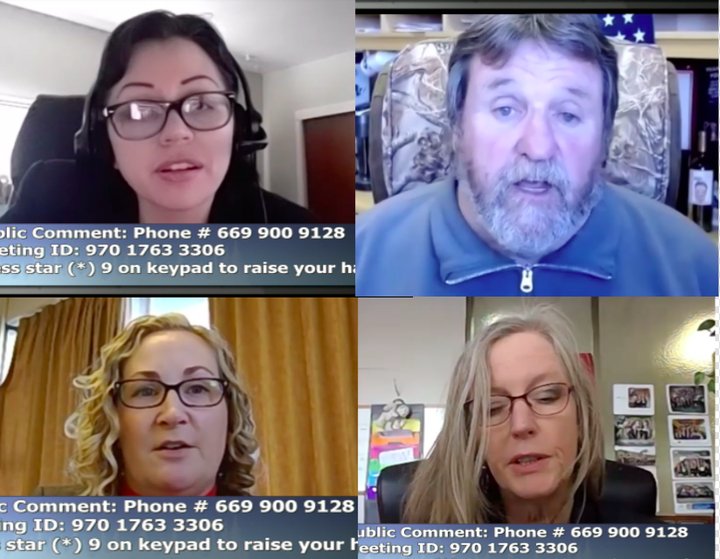
Screenshots from Monday’s meeting (clockwise from top left): Auditor-Controller Karen Paz Dominguez, Supervisors Rex Bohn and Virginia Bass and Chief Administrative Officer Amy Nilsen.
###
In a contentious, messy, jargon- and emotion-filled marathon of a special meeting on Monday, the Humboldt County Board of Supervisors conducted an emergency intervention, of sorts, into the money management practices of Auditor-Controller Karen Paz Dominguez.
Supervisors Rex Bohn and Virginia Bass, who make up the board’s ad hoc budget committee, called the meeting to address operational gaps in the county’s financial reporting — gaps they say could result in the loss of millions of dollars in reimbursement from the state and federal governments.
Delayed payments, late fiscal reports and looming deadlines could have “massive implications, including service reductions, staff furloughs and/or lay-offs,” according to a staff report.
Paz Dominguez, who learned of today’s meeting when the agenda got posted late Friday afternoon, found herself the target of scrutiny and desperate pleas, not only from the supervisors but also from multiple department heads and leaders of community agencies.
In response, Paz Dominguez quoted extensively from state government codes while arguing that her office’s numerous delays in fiscal reporting are the result of serious understaffing and her diligent adherence to the letter of the law.
At the top of the meeting, Bass and Bohn said they’ve been fielding desperate calls from local vendors and special districts regarding late reports and lack of communication from the Auditor-Controller’s Office. Bass highlighted internal reporting issues that are causing problems and potential loss of revenue, such as earned interest apportionments.
“To have a real frank and honest discussion is hard in public, but it’s what we have to do here,” Bass said. “I am hoping we can find a way to move forward with this that keeps us out of financial harm.”
County Administrative Officer Amy Nilsen read into the record a lengthy report that laid out a host of unmet Auditor-Controller responsibilities, including posting of financial records, reconciling cash and investment accounts, closing the books on the 2019-20 fiscal year, distributing cash and interest payments and more.
A major point of contention was the question of whether it’s okay for the Auditor-Controller to post certain charges based on estimates and forecasts or whether they need to be based on substantiated records of expenses. Nilsen said the former is standard practice in the industry, and a partner is a prominent accounting firm was on hand to second that assertion.
But Paz Dominguez insisted that she could not post charges to the State Controller’s Office unless they were verified as actual expenditures eligible for reimbursement from the state and federal governments.
Over the course of the morning, a series of representatives from local agencies called in to the Zoom meeting to voice frustration over delays from the Auditor-Controller’s Office.
“[Y]ou simply don’t hold back the money to special districts while specific in-house issues are addressed,” said Dennis Mayo, who serves on the McKinleyville Community Services District. “This is a problem that’s ongoing.”
Mary Ann Hansen, executive director of First Five Humboldt, said that until last year, the Auditor-Controller’s Office was timely in providing the documents necessary for the agency to perform its own audits, but both this year and last those documents have been late.
“We understand that workload and staffing shortages are hard on everyone … but we have to keep the work going,” Hansen said. She also offered to help. “I want to very sincerely offer any assistance to Auditor-Controller’s Office so that we can meet our deadlines.”
Marcella May, executive director of the Humboldt County Association of Governments, said there have been significant delays in payments to local transportation agencies, adult day health care operators, city governments and other agencies.
Nicole Johnson from the Arcata Fire District said delays have prevented her organization from closing monthly, quarterly and annual records on time.
Glen Senestraro, superintendent of the Fortuna Union High School District, had a tone of desperation in his voice. “The Auditor-Controller’s Office is over a month behind in posting cash receipts, which messes up our books,” he said. Likewise, property taxes haven’t been posted on time, which causes funds to go into the red. ‘The state is looking at deferring our payments, and we may have to do some borrowing.” He said he’s just hoping the negative receipts don’t hurt the district’s credit rating, impacting their ability to borrow the money necessary to keep the doors open.
County department heads also weighed in. Sheriff Billy Honsal said his department’s plans are in limbo because the board hasn’t been able to allocate funds for the first fiscal quarter.
Connie Beck, director of the Humboldt County Department of Health and Human Services, said late claims are affecting her department’s ability to run programs effectively.
And Tom Mattson, director of Public Works, said his department desperately needs to have the books closed for last fiscal year. ”We need it to be done this week,” he said. “Otherwise we will be in big financial hurt. We are willing to do whatever it takes.”
Given a chance to respond, Paz Dominguez delivered a lengthy PowerPoint presentation in which she took issue with many of the statements from the meeting’s staff report. In a series of slides, she identified statements she considered “erroneous,” then offered what she said were the “true and correct” facts along with “evidence,” which was frequently in the form of quotes from government code or county documents.
She also said blame should be spread in many directions, including the COVID-19 pandemic and adversaries on county staff.
“We need departments to stop submitting non-urgent requests marked as ‘urgent,’” she said. “We need your board to stop interfering with our independently elected operations. … We need the CAO [Nilsen] to stop undermining our authority. … We need the County Counsel’s Office to stop interfering … and forcing us to participate in unwarranted investigations. … And we need for all requesters to honor our deadlines and schedules.”
The day’s most emotional testimony came from the county’s generally mild-mannered treasurer-tax collector, John Bartholomew.
“It really pains me to be in front of the board today talking about this stuff,” he began. He then proceeded to challenge a number of the assertions and allegations Paz Dominguez made in her presentation, particularly the implications that county staff wants to take shortcuts or “rubber stamp” operations at the expense of fiduciary responsibility.
“I find it offensive that you take this approach, and that you use social media to make these claims against county operations,” Bartholomew said, referring to Paz Dominguez’s frequent posts on Facebook. “You wrap yourself in the veil of trying to watch out for the taxpayers. For one thing, we are all taxpayers,” he said. “Everyone I know tries their best to provide services to taxpayers … . It just boggles my mind, frankly, that you take this type of approach.”
He said that he and his staff have sent numerous emails to her and gotten no response. He commended Paz Dominguez as very smart and articulate, saying she’s done an excellent job in many areas. “But some of the decisions you’ve made that pertain to interdepartmental procedures, you change [them] without understanding the ramifications in other departments,” he said.
At the end of his comments, Bartholomew apologized for what he called his “emotional outburst.”
Board Chair Estelle Fennell said that this “airing of issues” was needed, and it continued for close to seven hours. There was a great deal of back-and-forth from various department heads, board members and Paz Dominguez herself.
During the public comment period, a number of employees from the Auditor-Controller’s Office spoke in defense of Paz Dominguez and reiterated the need for more staffing, as did union rep Drew Redden. “I think there’s been a lot of growing pains with an Auditor-Controller who wants to do things by the book, to be accountable and transparent,” he said.
Leila Roberts, director of the North Coast Small Business Development Center, called in to speak as a voter and friend of Paz Dominguez, saying she’s turned to her for advice on management and accounting issues. She said Paz Dominguez had made significant improvements while “under a constant barrage of resistance and criticisms.” Roberts described the meeting as “railroading,” which Bass, for one, took exception to.
“It’s not like we haven’t been communicating that we needed certain things done,” Bass said, and she added that public criticism comes with the territory of being an elected official.
Third District Supervisor Mike Wilson spoke up for everyone on county staff and working in special districts, saying they’re all trying to deliver services to the community. But he emphasized that certain financial postings must be made almost immediately because they’re critical “critical to getting funds released so we don’t run into pretty significant cash flow issues.”
Fifth District Supervisor Steve Madrone argued that the staff report was crafted in such a way that it laid too much blame on the Auditor-Controller rather than on the county’s financial accounting systems generally. “We all have some responsibility in this conflict,” he said.
Madrone argued against a suggestion to conduct a staffing study, saying the county should instead provide Paz Dominguez with the extra staffing she has requested.
Bass weighed in on the Facebook issue, saying the social media platform tends to have an inflammatory effect. “I would ask all of us to not play this out on social media, because it is winding this up to where people are really hateful,” she said.
Bass and Human Resources Director Linda Le suggested conducting a staffing study and bringing in the independent firm MGO to help in the Auditor-Controller’s Office, but Paz Dominguez said the public funds would be better used to simply hire the extra employees she’s requested.
Bohn was repeatedly critical of this notion, saying there have already been three employees added to her department since she started. Is the county just supposed to keep throwing people at the problem? he asked.
Gradually it emerged that the most urgent need is to close the books for fiscal year 2019-20 so that the Public Works Department can meet a looming deadline for reimbursement of state funds. “I’m looking at having to lay off the entire department if can’t get the cost plan done,” Mattson said. “What else can I do to get this done?” he added. “Anything!”
In the end, Wilson wound up making a lengthy five-part motion in which the Board of Supervisors agreed to assume shared responsibility for the accuracy of financial reports submitted to the State Controller’s Office. Paz Dominguez, meanwhile, agreed to close last year’s books for the Public Works Department by Friday. And department heads were asked to provide the Auditor-Controller’s Office, by year’s end, with federal rewards letters that document which charges are eligible for reimbursement. And lastly, staff will potentially conduct a staffing study and look at reclassifying some positions in order to alleviate the staffing shortage in the Auditor-Controller’s Office.
Though Bohn was hesitant, the motion passed unanimously.


