
Screenshot of Tuesday’s Humboldt County Board of Supervisors meeting. (Fifth District Supervisor Steve Madrone appeared via Zoom.)
###
At today’s meeting, the Humboldt County Board of Supervisors unanimously voted to assemble a working group to explore the ins and outs of creating a “universal representation fund” that would provide legal counsel for local residents facing deportation. The fund would be financed through private donations and grants.
The proposal, brought forth by Fifth District Supervisor Steve Madrone on behalf of a group of McKinleyville residents, asks the county to create a fund that would provide county-allocated grants to local nonprofits (Centro del Pueblo, the Humboldt Immigrant Rights Network and North Coast Legal Aid) to “ensure that any Humboldt resident facing deportation has access to a qualified attorney.”

Dugan | Screenshot
“This was really a heart-centered action from our neighborhood,” said McKinleyville resident Lisa Dugan. “Seven or eight other counties in California have set up these universal representation funds, and the funds have been set up differently in each county. Some are doing solely county-based … some are using the funds generically to support immigrant families or families who have had a family member detained, and some are actually being used for the representation of people detained by ICE who are potentially facing deportation.”
Second District Supervisor Michelle Bushnell quickly indicated that she would not feel comfortable moving forward without hearing from certain staff members first.
She said she had spoken with County Administrative Officer (CAO) Elishia Hayes ahead of the meeting to see if Public Defender Luke Brownfield would be available to share his two cents on the proposal, given that his office works with immigration attorneys on criminal cases that relate to deportation. However, Brownfield wasn’t able to make it to the meeting.
“I would love to have a full, very robust conversation, but I do want all the players to be in the room,” Bushnell said.
Fourth District Supervisor Natalie Arroyo agreed. “This isn’t defined enough for us to, from my perspective, really take action today, even though I appreciate the intent of it very much.”
First District Supervisor Rex Bohn didn’t like the idea of the county getting involved because it would add an unnecessary bureaucratic element to the fund, and instead urged Centro del Pueblo to set up its own fund.
“[Central del Pueblo has] done so much with so little already,” Bohn said, “If we touch your money, donors or anything like that, you’re not going to get the best bang for the buck. … We’ve got great staff, we’ve got great people, but we have a bureaucracy that we have to follow that is beyond repair. … If you get us involved, it’s going to not help the issue.”
Hayes echoed Bohn’s point and suggested that the McKinleyville group, Centro del Pueblo and any other interested parties reach out to a philanthropic organization, such as the Humboldt Area Foundation.
“I would venture to guess that this is a fund that would have a high level of scrutiny and a high level of transparency required around it … so we would need to develop a program, and what that would look like?” Hayes asked. “Who qualifies? How do we track those funds? Who do we contract with to be the fiscal agent or the receiver of those funds? … There are lots of unknowns there.”
The proposal received near-unanimous support from the half-dozen people who spoke during public comment. Brenda Perez, executive director of Centro del Pueblo, urged the board to “keep the conversation going.”
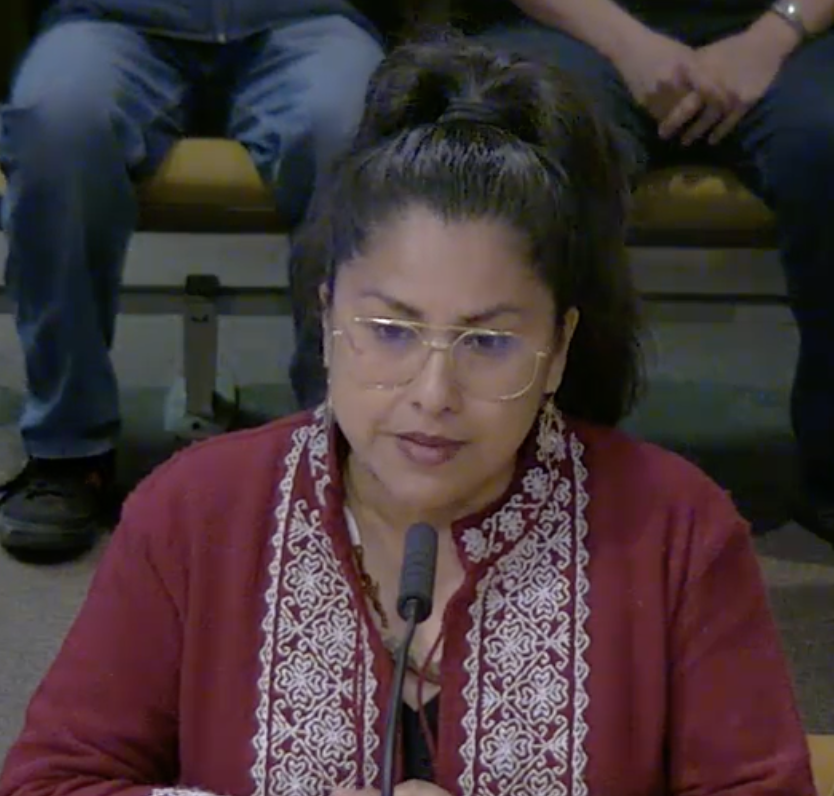
Perez | Screenshot
“I think [the universal representation fund] is a positive policy in the frame of a sanctuary county,” Perez said. “[It is] also a positive message from our local government for the entire community. … Many counties are doing it. Many counties are strengthening this collaboration with non-profits, and this is an example of what we can do to have a positive impact. … The protection that we need urgently.”
Following public comment, Bushnell made a motion to form a working group to investigate the formation of the fund. She nominated Arroyo and Madrone to serve on the group, along with a representative of the public defender’s office, Humboldt Sheriff William Honsal, Department of Health and Human Services Director Connie Beck, a CAO staffer, as well as members of Centro del Pueblo and the McKinleyville group who initiated the proposal. Arroyo seconded the motion.
After a bit of additional conversation, the motion passed in a 4-0 vote, with Third District Supervisor Mike Wilson absent. (Wilson was present for the first part of the meeting, but left shortly after 1 p.m. to catch a flight.)
Humboldt Schools Face Declining Enrollment
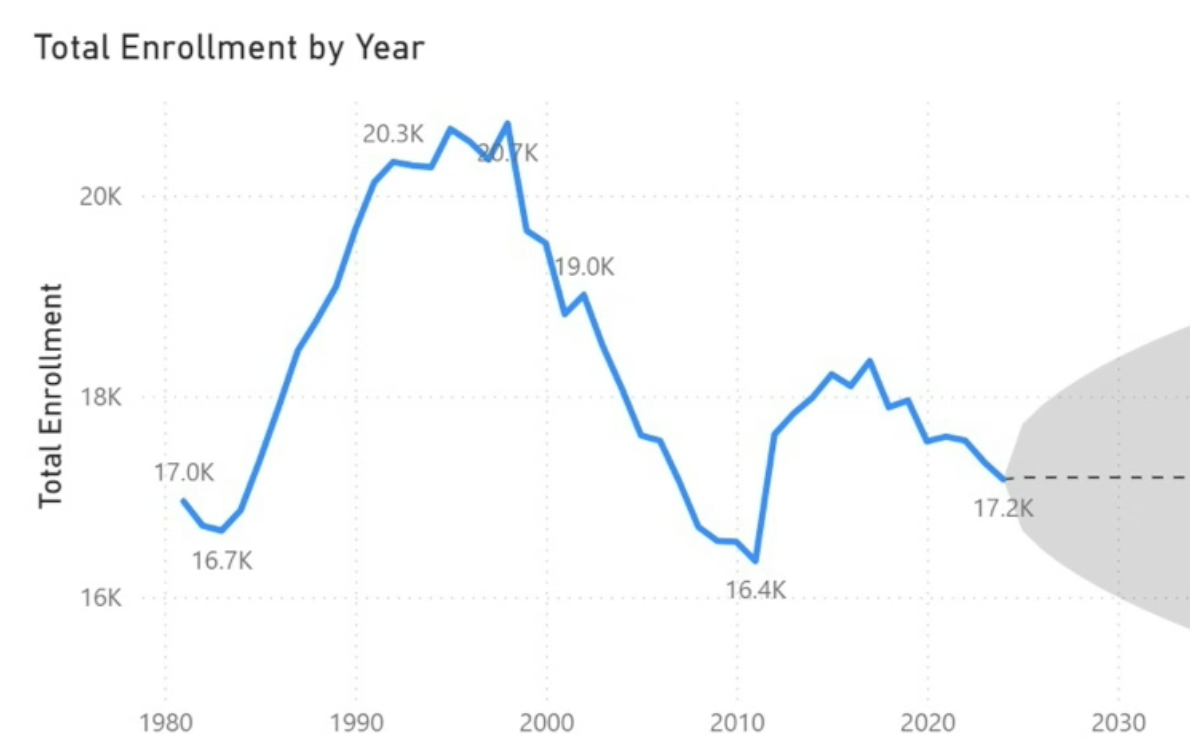
Student enrollment at Humboldt County schools from 1980 to present. | Screenshot
A little earlier in the meeting, the board received a report on the state of local education from Humboldt County Superintendent of Schools Michael Davies-Hughes. While the county’s 30 school districts have made strides in recent years — increasing the graduation rate to 91.9%, topping the state average of 87.5%, and expanding learning opportunities through regional partnerships with Cal Poly Humboldt and College of the Redwoods — student enrollment continues to drop.
“Our schools are primarily funded [by] average daily attendance (ADA), or in layman’s terms, butts in seats,” Davies- Hughes explained. “In Humboldt County, our enrollment has been declining since the late 1990s. Interestingly, our student enrollment in 2026 is about the same as it was 45 years ago in 1981. If we have less students attending, then we have less funds to support our schools, which has implications for staffing stability, program offerings and long-term stability.”
Declining enrollment has closed two local schools in the last year. Green Point School, which served rural Redwood Valley students for more than 100 years, shuttered in July 2025. In February, Agnes J. Johnson Charter School in Weott closed amid a financial crisis spurred by a 35% drop in enrollment that began in 2020.
But where are the students going?
“Our charter school enrollment is increasing, but there’s still an overall net decrease in the number of students that we have attending schools in our county,” Davies-Hughes said, adding that many students have also shifted to homeschooling. “And as these patterns change, we need to focus on equitable access and consistent quality across our schools. So beyond enrollments, we’re navigating some other challenges that directly affect learning conditions.”
One of the main challenges is chronic absenteeism, or students who miss 10 or more days of school each year. Humboldt County’s chronic absenteeism rate is 25.5%, several points higher than the state average of 19.4%.
“Over a quarter of our students are chronically absent,” Davies-Hughes said. “That’s lost instructional time and a signal that students and families need stronger support.”
The county also has a high percentage of students with disabilities (17.5% versus 13% statewide), which requires additional staffing and expertise that can be hard to come by in a rural community. And, much like Humboldt County’s health care sector, the office of education has had a difficult time recruiting and retaining qualified people.

Davies-Hughes | Screenshot
“Teachers and administrators are hard to hire and even harder to keep without the right conditions and supports,” Davies-Hughes said. “The bottom line here is that students’ needs are increasing, while the capacity is under strain. Our strategy has to address both at the same time.”
One such strategy is to integrate AI into schools to “help educators work smarter,” enhance personalized learning and improve operations, Davies-Hughes continued, underscoring the importance of implementing AI tools “responsibly and with training.” The office of education is also looking to strengthen early education, increase access to Career Technical Education (CTE) and expand dual-enrollment opportunities to allow students to get both high school and college credit.
Following the presentation, Bohn acknowledged that the pandemic had a huge impact on student learning. “We all went to computer learning, which opened the door for charter schools, which opened the door for people not to come to brick and mortar,” he said. Bohn added that the “homeschooling numbers have skyrocketed” and asked Davies-Hughes if he knew how many students had made the shift.
“We don’t,” he said. “Homeschool numbers are difficult to track, but those numbers are increasing.”
Arroyo, who requested the state of education report, asked how the office of education works with struggling school districts to avoid closure. Using Green Point School as an example, Davies-Hughes said his office worked with the district to apply for waiver to keep the school open, which had three students enrolled at the time of its closure.
“Ultimately, there needs to be some prospect of increasing enrollment, and Greenpoint … tried all that they could to enroll more students, but there simply aren’t a lot of students down there in Redwood Valley,” Davies-Hughes said. “It was almost inevitable at that point.”
It’s a months-long process that involves the district’s board of directors as well as the county’s committee on school district organization, which helps districts go through the process of consolidating operations.
Bushnell lamented the closure of Agnes J. Johnson School, noting it had been “ a really painful process” for the community. “It’s a process to close a school, and the support that your organization gives is so important in navigating that and to try to relocate those children and their families to a different school district in that same area,” she said.
Wilson closed out the discussion by asking if the office of education had any plans to prohibit cellphones in classrooms.
“There’s actually a state law that’s in place right now that limits or restricts the use of cell phones in the classroom,” Davies-Hughes said, likely referring to Assembly Bill 3216, which requires every school district, charter school and office of education in the state to adopt a policy limiting or prohibiting cellphone use by July 2026. “There’s a phase-in time for that law to be implemented in schools, but we see across Humboldt County that districts are implementing restrictions on cell phone use.”
“Anecdotal information that I have [from] conversations with superintendents and principals is that it’s an overwhelmingly positive move,” he added. “We’re seeing more conversation occurring in the classroom, less disruption and students just being able to focus.”
The board agreed to receive and file the report.
Bayshore Mall Property Negotiations

The former Sears location at Eureka’s Bayshore Mall. | Photos by Ryan Burns.
The board also approved staff’s proposal to move forward with property negotiations for the sale of the old Sears department store at the Bayshore Mall, even though Home Depot has also expressed interest in buying the property.
As previously reported by Ryan Burns, the Bayshore Mall, saddled with nearly $39 million in debts, is set to be auctioned off at the county courthouse Friday morning. However, it’s unclear if the Sears section of the mall is a part of the auction.
Reached for additional comment on the matter, county spokesperson Catarina Gallardo confirmed that the Public Works Department is hoping to acquire the old Sears for a one-stop permitting center, but she could not say whether the property would be a part of the upcoming auction.
“Beyond what is included in the agenda item, the County of Humboldt must maintain the integrity of the negotiating process regarding real estate transactions,” she wrote in an emailed response. “For that reason, we are unable to provide further comment at this time.”
I guess we’ll just have to see what shakes out at the Humboldt County Courthouse this Friday!
CLICK TO MANAGE