
Screenshot of Tuesday’s Humboldt County Board of Supervisors meeting.
###
At today’s meeting, the Humboldt County Board of Supervisors finalized next year’s spending priorities for projects and positions funded by Measure Z, the county’s half-percent sales tax dedicated to maintaining public safety and essential services.
After more than an hour of at-times tense deliberations, the board unanimously voted to use $1.65 million in Measure Z funds, plus $20,000 from the county’s reserves, to fund six projects selected by the Citizens’ Advisory Committee on Measure Z Expenditures. The committee’s rankings for Fiscal Year 2026-27 are listed below in order of priority:
- $57,900 North Coast Rape Crisis Team: Child Abuse Services Team Advocacy and Support Services
- $229,962 City of Fortuna: School Resource Officer for Eel River Valley campuses
- $80,872 Humboldt County Drug Task Force: Operational Support
- $1,034,018 Humboldt County Fire Chiefs’ Association: Fire and Emergency Support Services
- $245,914 K’ima:w Medical Center: Emergency Ambulatory Services for Eastern Humboldt County
- $20,000 Boys & Girls Club: Teen Court Diversion Program
In total, the county received 14 applications for funding, though three applications “did not meet the intent of Measure Z” and were removed from the list, said committee chair Tammy Trent.
Eligible applications that were not approved for funding include a $84,500 request from the Hoopa Valley Tribe for its highway safety initiative, $23,300 from the Department of Aviation for turnout gear replacement, $29,000 from the Southern Humboldt Community Healthcare District for a helistop for medical evacuations, $198,900 from the Arcata Police Department for its juvenile diversion program and $68,800 local match from the Department of Aviation for a new aircraft rescue and firefighting truck.
“When we went through our ranking, we really tried to focus on the intent of the measure,” said Dylan Feierabend, the advisory committee’s vice chair. “We can always find a reason to want to fund all applications. It’s not necessarily the easiest choice when you look at it from a heartstrings perspective.”
During the board’s discussion, First District Supervisor Rex Bohn acknowledged that K’ima:w Medical Center’s ambulatory services are essential for residents of Hoopa, Willow Creek and other communities along Highway 299, but felt the funds should be generated through a parcel tax rather than a countywide tax initiative.
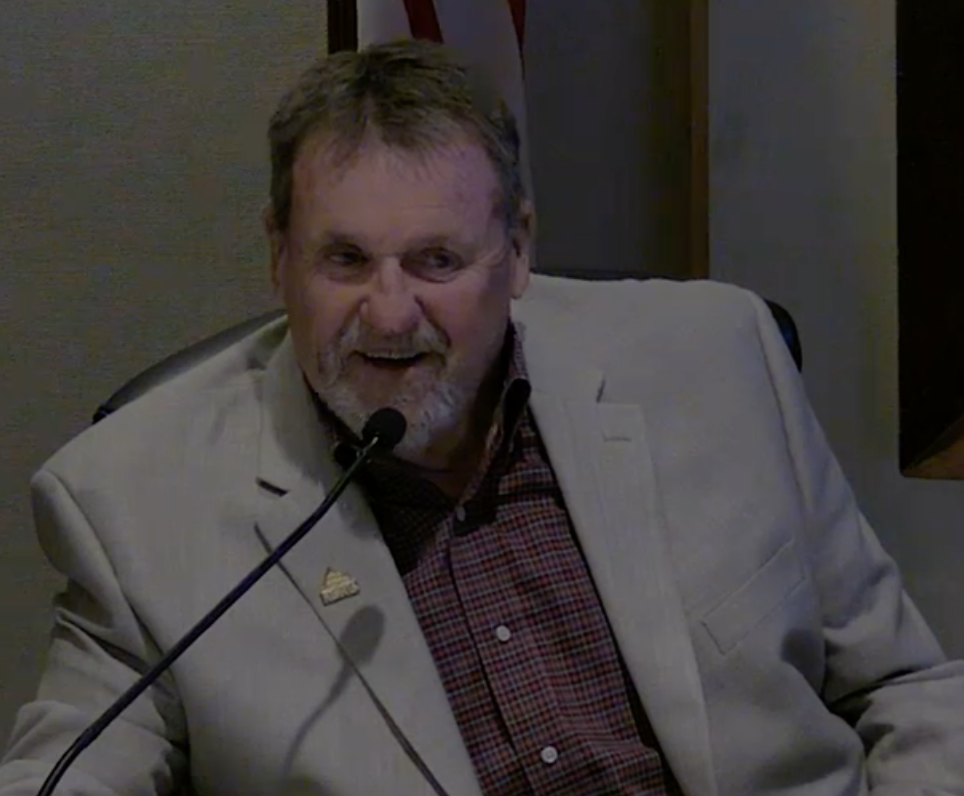
Bohn | Screenshot
“[The ambulance] serves about 2,000 people, plus the traveling public,” Bohn said. “That means we’ve actually subsidized the ambulance service almost to the point of $1,000 a resident up there. It’s a lot of money. … If a lot of the responses are to the highway, then we need to talk to the state because we can’t accept all this burden, especially when we’re increasing what we give them, but our funds are decreasing, and we’re finding ourselves not being able to fund other things that would probably be advantageous to the county as a whole.”
Fifth District Supervisor Steve Madrone also spoke in favor of a ballot measure to fund the ambulance service.
Quincey noted that the Hoopa Valley Tribe doesn’t have the taxing authority to place a measure on the ballot, but said county staff would be willing to work with the tribe to draw up a ballot measure, assuming the Tribe would be interested.
Second District Supervisor Michelle Bushnell echoed Bohn’s funding concerns, adding that STAR Ambulance, which serves Highway 36 communities, holds regular spaghetti feeds to raise money and asked if K’ima:w has looked for other sources of revenue.
K’ima:w Medical Center CEO Ryan Zumalt said the medical center receives additional funding for ambulance service through several long-term grants. The organization also gets a small reimbursement from insurance companies, but it doesn’t cover transport time.
“Anytime that we’re out, we’re paying for another ambulance service to come watch that area while we’re down in Eureka, dropping off patients,” he said. “If I were a private company, I probably wouldn’t operate one up there because it would be a loss. … When they’re close to a city, you actually have that turn time, and you can make volume here. It’s that transport that really gets us.”
Zumalt added that the medical center plans to apply for a state grant that could bring in up to $100,000 for ambulance service.

Wilson | Screenshot
Turning to the subject of law enforcement and local schools, Board Chair Mike Wilson asked why the committee decided to fund a school resource officer for Eel River Valley schools but did not approve the Arcata Police Department’s funding request for a juvenile diversion program that would include Blue Lake and other nearby schools.
“The school resource officer for the City of Fortuna has been funded, I think, for nine out of the last 10 years through Measure Z,” Quincey said. “The juvenile diversion program through the City of Arcata has been funded on and off throughout the life of Measure Z. … And if I recall correctly, there is an existing juvenile diversion counselor through the City of Arcata serving Arcata city limits.”
Wilson reiterated that Arcata’s proposal would expand the city’s juvenile diversion services to other communities and said the application has received several letters of support. He added that he was concerned that the composition of the Measure Z committee tipped in favor of Eel River Valley communities.
“There’s several [committee members] from Fortuna, a couple from Ferndale, and then there’s, like, one from Arcata, one from Eureka, and one from McKinleyville,” Wilson said. “I think we need to do a better job of diversifying our representation on [the committee]. I do want to say the people who we have appointed to this are all very qualified people … but I’m just getting some heartburn and some feedback from my constituents that this seems a little unfair.”
Trent pushed back on Wilson’s assertion that the Measure Z committee was biased in any way, emphasizing that the group puts “a lot of work and hours” into its decision-making process.

Trent | Screenshot
“This committee puts hours into listening to all of these applications, and that’s what makes a big part of our decisions,” she said. “You’re here only hearing part of what we hear. … I just want to let you know that, yes, we do have people from all the different areas, but there’s no bias on this committee. We treat everything equally.”
Fourth District Supervisor Natalie Arroyo commended the committee for striving to be “as neutral as possible” when weighing difficult decisions. She agreed that a school resource officer “plays an incredibly important role in making sure that youth get back on the right path,” but emphasized that diversion programs embody a “restorative justice angle” and strive to keep people out of the system.
“We’re not comparing apples and apples, when we talk about Arcata’s or the Boys & Girls Club [teen court] application and the Fortuna Police Department’s application,” she continued. “One is an officer position, and [the other two are] a more specifically diversion-focused approach. … If we could find a way to get that teen court program in there somehow, it would be phenomenal.”
After some additional discussions and a couple of revisions, Bushnell made a motion to approve staff’s recommendation to fund the committee’s top six choices, including the Boys & Girls Club’s $20,000 application for teen court. Bushnell emphasized that she was not comfortable dipping into the county’s reserves and asked that “any reserves or extras that come in” be put back into Measure Z.
The motion passed 5-0.
###
At the beginning of today’s meeting, County Administrative Officer Elishia Hayes said the agenda item concerning protections for old-growth trees in Lower Redway’s Qualified (Q) Zone would be continued to a date uncertain, though she did not say why. (You can read more about the agenda item at this link.)
Still, several members of the Old Growth Neighborhood Association spoke during non-agenda public comment to emphasize the need for additional protections to prevent the loss of more old-growth redwoods.

Sutton | Screenshot
“Redwood trees are the most dominant species in this neighborhood, and we want to see them protected,” said Redway resident Linda Sutton. “And they can only be protected by proceeding carefully on what we do in the future. I think that logging for obscene profits in a residential zone — that has been residential for many, many, many, many years — is unacceptable and disheartening. The only way out of this is to strengthen the Q Zone.”
Redway resident Sue Maloney said she was “initially outraged” to hear that the item was continued, given that she had driven up from Southern Humboldt to come to the meeting in person.
“But I realized that it’s ultimately probably a good thing, because we want to get this right,” she said. “If there’s one takeaway from this … Lower Redway is not timberland, it’s residential. I can’t be clear enough about that. … These are small residential parcels; they’re less than an acre each. … If it’s less than three acres, it’s not timberland.”
While she did not say when exactly the agenda item would return to the board, Hayes did indicate that it would return “in the very near future.”
CLICK TO MANAGE