
Oysters at Humboldt Bay Provisions in 2021. Photo: by Sarah Stierch, Wikimedia Commons, Creative Commons Attribution 4.0
The oyster producing giant of Humboldt Bay comes to a grinding halt for weeks each year due to sewage overflows. And while emergency aquaculture closures keep the shellfish-dining public safe, oyster farmers say the situation is putting the industry on ice.
“When we are notified, everything stops,” said Todd Van Herpe, owner of Humboldt Bay Oyster Company, which farms on three acres in the north bay.
Affected farms are ordered closed by the California Department of Public Health’s Preharvest Shellfish Unit, and planned harvests come to a standstill. Sometimes, shipments have to be recalled.
For oyster companies, this means cancelled deliveries and triggers what Van Herpe calls a “cascading effect” that disrupts the careful timing of oyster seeds planted years in advance.
A closure from one overflow can last up to 21 days. And combined with mandatory harvest shutdowns during rain events, oyster farmers can go months in a year without harvest income.
Sometimes, Van Herpe said, the closures can be frustrating, especially when there’s a string of them in a row.
“I’m doing everything I can to play by the rules and do a good job, and do this in an ecologically friendly way and try and be an honest purveyor of oysters. And despite all that, something out of my control can shut me down and impact my business,” he said.
When asked to estimate business losses each year from the closures, he laughed. “I think it’d be pretty easy to quantify. And maybe I don’t want to know,” he said.
Arcata Settles With Pacific Seafood
After a 2024 sewage spill and 19-day closure, Pacific Seafood sued the City of Arcata for business losses. Arcata settled with Pacific Seafood and its subsidiaries for $71,500 in March.
1,275 gallons of sewage were released into Humboldt Bay from Arcata’s wastewater system on Jan 13, 2024. This prompted California’s Department of Environmental Health to close shellfish production in the bay from Jan. 13, to Feb. 3, 2024.
“Pacific Shellfish [a subsidiary of Pacific Seafood] was required to cancel harvests and shipments, and experienced lost sales, lost product, employee time, and other expenses and costs as a result,” a claim submitted to the city of Arcata states.
3,800 acres of tidelands, submerged areas and water bottoms in Humboldt Bay are leased by Pacific Seafood and subsidiaries, according to legal documents. The companies point to the vertically integrated nature of the business, with everything from shellfish production to packing being disrupted when the bay was closed.
The complaint alleges Arcata was negligent and has failed to properly design, operate and maintain the wastewater and stormwater systems. It points to four spills in 2024 that similarly shut down operations.
In a statement shared with the Outpost by spokesperson Lacy Ogan, Pacific Seafood pointed to the ongoing nature of the problem.
“Humboldt Bay shellfish farmers and our employees and their families are particularly harmed by bay closures every year, but aging water treatment infrastructure in Arcata and Eureka is a problem for everyone. This is a community problem that needs a community solution, with everyone working together to protect Humboldt Bay and all those who depend on it to have clean water,” the statement said.
The company did not want to comment on possible future litigation related to spills.
Meanwhile, Arcata’s city manager pointed to ongoing efforts to repair parts of the wastewater infrastructure — including the most recent phase of an ongoing Inflow and Infiltration Reduction Program for the city’s collection system, which aims to address a systemic problem that causes sewage spills.
“It’s frustrating, because we put a lot of work into maintaining our sewer collection systems to avoid things like this. And if you look at the type of rainfall events that result in these overflows, it’s a very hard thing to manage such a large amount of water in such a short period of time,” said Arcata City Manager Merrit Perry.
He said it’s common for cities to see overflows during large storms. “But the city’s committed to continuing to work to improve our collection system and avoid these types of situations from happening in the future,” said Perry.
The sewage overflow in question was on a wet day, when water inundated the sewage system. A manhole on West End Road overflowed into Janes Creek, ultimately reaching Humboldt Bay.
Arcata has since bolted down the manhole lid where the spill originated and added a high alarm sensor. But infiltration of old pipes in the area with groundwater and rainwater during winter remains an issue.
Heavy storms and “flushable” wipes causing overflows
Humboldt Bay is the largest producer of oysters in California. It’s also surrounded by multiple wastewater systems. More recently, spills in December 2025 and February 2026 resulted in closures, according to Pacific Seafood.
A California Department of Public Health spokesperson said it’s typical for Humboldt Bay to experience one to three sanitary sewer overflows per calendar year that cause a partial or full bay closure for oyster farming.
But why do the spills happen?
Daniel Vit, field superintendent for Eureka’s department of Public Works, said sanitary sewer overflows in Eureka are most commonly caused by a blockage in the sewer main — typically a combination of grease and debris like so-called “flushable” wipes, which really shouldn’t be flushed.
Overflows often happen during rainy weather, when sewage collection systems get inundated with water. Rain runoff and groundwater can get into aging pipes, compromised private laterals and illicit connections like rain gutters that feed into the sewage system.
“If that water has nowhere to go, it will follow the path of least resistance, which unfortunately is usually a manhole or clean-out, resulting in an SSO [sanitary sewer overflow],” said Vit in an email.
Kelly Allen, Eureka’s public works director, said the city is investing in maintenance, upgrades and monitoring of the system to reduce the likelihood of spills.
“Our ongoing goal is to make spills a non-issue, and the work being done is focused on improving reliability and preventing incidents before they occur,” she said in an email.
But fixing this problem is an expensive and time-consuming process.
Netra Khatri, Arcata city engineer, said it’s very difficult to estimate how much money it would take to fully prevent sanitary sewer overflows. “For a city with aging infrastructure, multiple creeks, and high groundwater levels during the winter season, a rough estimate would likely be in the millions of dollars to significantly reduce or prevent sewer overflows,” he said in an email.
For example, replacing the city’s entire collection system — something that would significantly reduce the inflow and infiltration problem — would cost $100 million or more, estimated Khatri.
Jen Kalt, executive director of environmental organization Humboldt Waterkeeper, said sewage systems locally and across North America aren’t ready for abnormal weather events, which are expected to become more frequent.
“The infrastructure is not built to accommodate the type of rain events that we’re seeing increasingly because of climate change,” she said.
Humboldt County’s Public Health Lab is working on adding a key shellfish test
The problem isn’t unique to Humboldt Bay. A massive sewage spill in the Potomac River earlier this year hit the oyster industry hard, with buyers hesitating to source seafood from the area. It’s also an ongoing problem for Massachusetts aquaculture.
For California, Humboldt Bay sees more sewage-related closures than other oyster farming areas, such as Tomales Bay.
“Humboldt Bay is surrounded by two large municipalities, several sanitary sewer collection systems and several wastewater treatment plants,” pointed out Grant Boyken, spokesperson for California Department of Public Health in an email.
And because overflows are often associated with heavy rainfall, the North Coast’s high precipitation is another factor.
Rainfall by itself triggers closures due to bacteria-related concerns, ranging from three to nine, days depending on rain. During the 2024-2025 season, Humboldt Bay had 155 full or partial closure days due to rainfall, according to the CDPH.
Closures are important to protect public health, said Boyken, because shellfish are filter feeders that can concentrate bacteria and pathogens in their tissues.
“Human sewage discharged into the water from sanitary sewage overflows can contain pathogens and poses a risk of illness to shellfish consumers. CDPH closes shellfish harvesting to protect public health and allow time for the shellfish to cleanse,” he said.
The industry is highly regulated by the National Shellfish Sanitation Program and state public health agencies.
Overall, Van Herpe, owner of Humboldt Bay Oyster Co, said he doesn’t necessarily feel like the regulations go too far.
“It’s a common feeling throughout the industry, that the public’s health is a primary concern. Nobody wants to get anybody sick,” he said.
He does believe the system can be improved, in particular by making it easier for local farmers to test their shellfish for a key indicator.
The 21-day sewage spill-related closures can be lifted earlier if shellfish samples are tested for an indicator for fecal contamination (viral indicator male-specific coliphage).
But the West Coast doesn’t currently have a lab that can test shellfish for this.
Local oyster farmers will commonly opt to wait the full three weeks rather than take on the logistics and cost of shipping samples to the East Coast, said Van Herpe.
Both the Humboldt County Public Health Laboratory and Oregon Department of Agriculture’s Laboratory are working towards offering the test in the future, according to a CDPH spokesperson.
“We are actively in the development of this assay and hope to have it online by the end of the calendar year. It might take a bit longer as this timeline is dependent on how long it takes the FDA’s National Shellfish Sanitation Program (NSSP) to approve our validation,” said Humboldt County’s Public Health Lab Director Pepper Stockton, in an email from a spokesperson.
Stockton said CDPH’s Preharvest Shellfish Program purchased a centrifuge and water bath for the lab for the test.
“Our challenges around staffing levels have prevented us from devoting the needed staff time to this project,” he added.
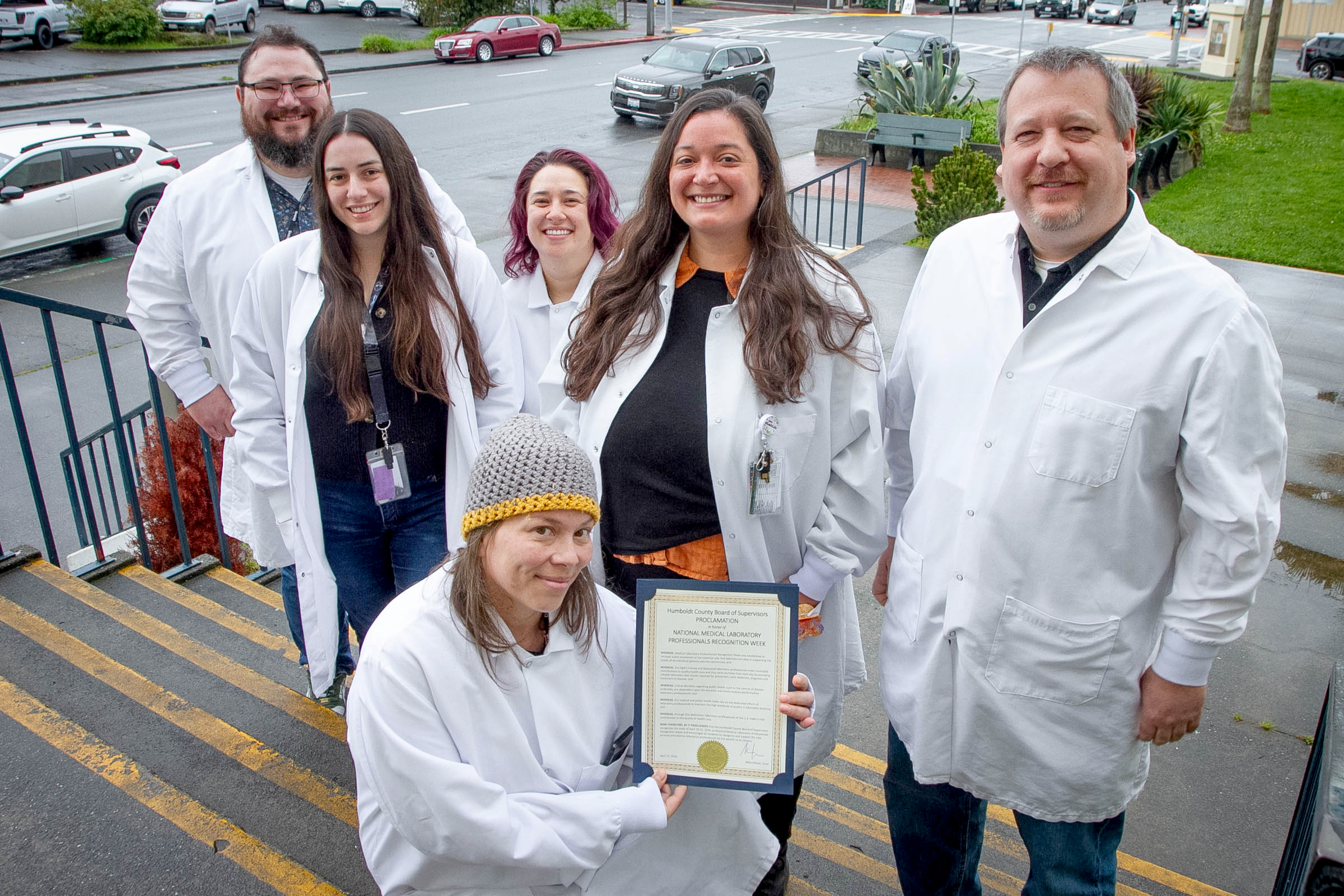
Humboldt County Public Health staff pose with a county proclamation last week, from left: supervising microbiologist Ray Fuller, lab tech Marilyn Sandoval, lab tech Cecilia Kennelly, microbiologist Vannia Pena, lab director Pepper Stockton and, up front, microbiologist Heather Maddox. Contributed DHHS
Oyster farmers are the bay’s “canary in the coal mine,” a stand-in for the health of the ecosystem. They rely on clean water to farm their product.
“If something happens on the water or to Humboldt Bay, we’re oftentimes the first ones to see it, because we’re out there every day,” said Van Herpe.
He’s hopeful the sewage spill problem can one day be fixed.
“We’re a pretty smart species if we apply ourselves. And I think that we can solve that, given the proper motivation and funding to do so,” he said.
CLICK TO MANAGE