
A woman rails against the project. Photos by Dezmond Remington.
PREVIOUSLY:
###
A volatile meeting held last night to discuss the proposed Amazon distribution warehouse in McKinleyville drew a large crowd, almost everyone in it fiercely against the project.
Roughly 200 people flocked to the four-hour meeting, filling up Azalea Hall; attendees lined the walls and sat in almost every seat. Hosted by the Humboldt County Planning and Building Department, it was put on to discuss the department’s permitting process and share information about the project, as well as to give people a chance to share their opinions on the idea.
Two representatives from Amazon attended the meeting: Sonya Kinz, a developer for a sub-contractor, and Stephen Maduli-Williams, an Amazon senior economic development manager. When John Ford, the county’s planning director, announced them, they were booed. Hostility towards Amazon was a common theme throughout the meeting. Heckling was constant.
“There’s no decision, on the part of the county, in terms of what happens [with the project],” Ford said early in the meeting. “We’re here to hear you. We’re here to understand. I think Amazon has the same objective.” A few dozen people laughed.
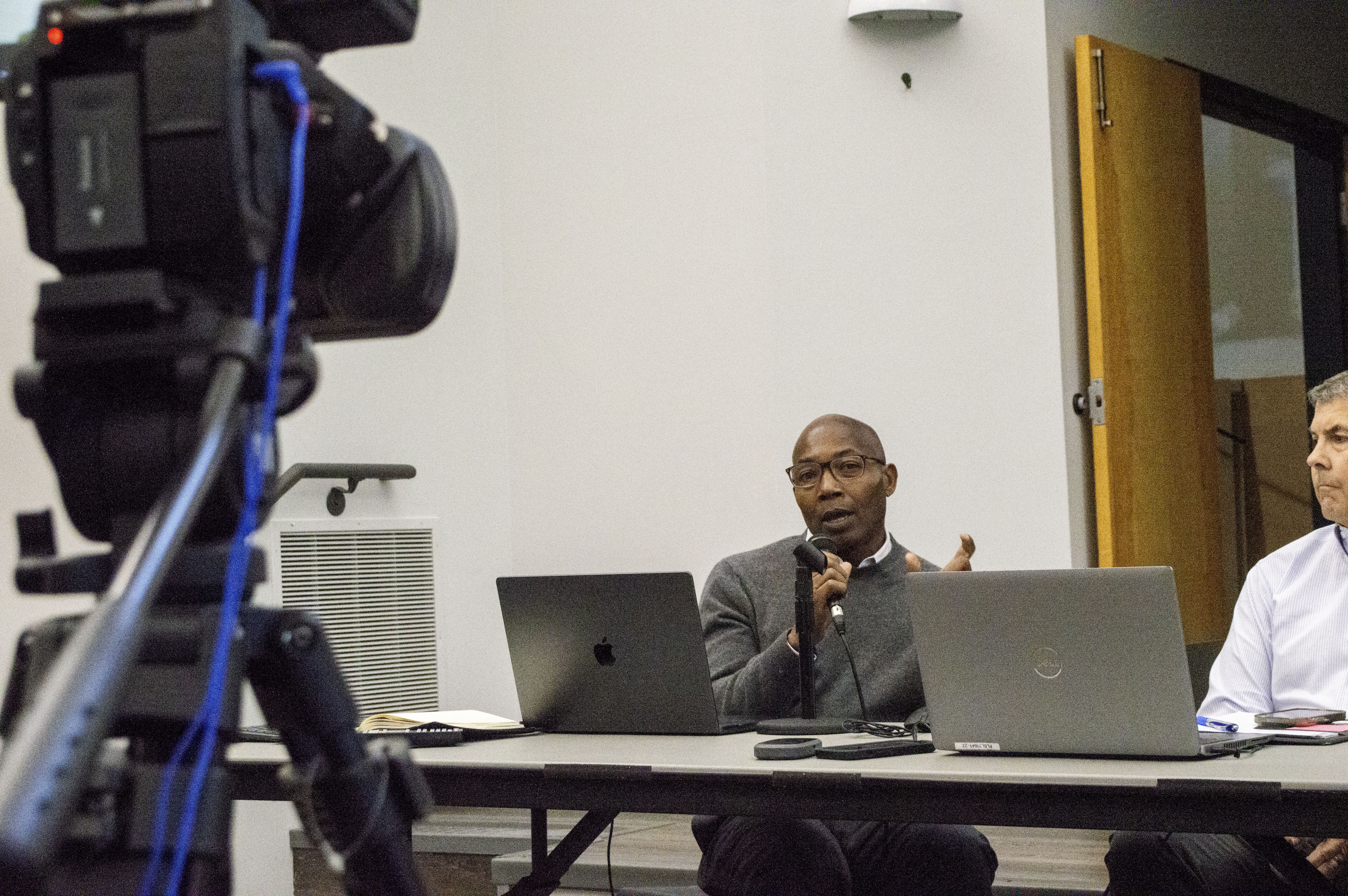
Stephen Maduli-Williams.
The land the facility would be built on is zoned for industrial use, which allows warehouses. But because the property is in the coastal zone, Amazon needs a Coastal Development Permit to construct anything. The county’s planning commission is the entity tasked with deciding if they’ll grant it. Although California’s Coastal Commission can appeal their decision, they’d be appealing it to themselves, and the outcome would be a summary judgement based on the existence of a “substantial coastal issue,” Ford said. The planning commission will decide in February next year if they’ll grant the permit, though the decision can be appealed to the Humboldt County Board of Supervisors and the Coastal Commission.
The complicated process prompted many questions about the county’s relationship with Amazon. Some commenters questioned the county’s motives, theorizing that the government gave Amazon some kind of tax incentive that incentivized it to build a warehouse here. Ford and Maduli-Williams, the Amazon representative, explained that wasn’t the case.
Maduli-Williams also presented a slideshow. He emphasized that the warehouse was much smaller than other last-mile Amazon warehouses — about 40,000 square feet vs. more than 150,000 in other communities — and that though the facility was open at all hours, it wasn’t necessarily going to be active around the clock. Vans wouldn’t run day-and-night either. He claimed that the warehouse would create 227 jobs, about 115 of them full-time. Annual payroll would be roughly $8 million; about $30 million would be invested in McKinleyville. Maduli-Williams said the average wage would be $22 an hour, and workers would receive benefits as well.
The meeting almost ended 45 minutes in when rowdy attendees, champing at the bit to speak and share their opinions, interrupted Maduli-Williams’ presentation, yelling and shouting. Ford wasn’t pleased.
“What we’ve done tonight is come out for your benefit,” he said. “And I know some of you know everything —” he was shouted down for a moment “— Would — would you — You know, I get letters with all kinds of expletives, and I’ve been flipped off before, and I expected more from McKinleyville, frankly.” The crowd jeered.

The crowd lines up to speak.
An older woman, who said she was Yurok, got up on the mic and appealed to the common order and the traditions of local tribes, who she said, wouldn’t act like this. The rabble-rousers quieted, and Maduli-Williams finished his presentation. But the back-and-forth between the crowd and the presenters (both from the government and from Amazon), continued through the rest of the meeting.
“If you’d like to talk to a sheriff’s deputy, that can be arranged,” Ford later said to one woman in the crowd. “This is really not a good representation — can you stop yelling, please?”
Another woman insinuated that they should burn down the warehouse.
“I’m concerned that there’s an epidemic of warehouse fires sweeping this country,” she said. “My concern is that building this warehouse presents a 100% increase in risk of warehouse fires in this community. Did y’all know,” she said to the audience, “that anyone can buy a drip torch at our local hardware store? It’s a great way to support local businesses.” People cheered.


The line of people who wanted to comment on the project stretched back to the rear wall and wrapped around the inside of the building. Many of them brought up the infamously poor working conditions prevalent at many Amazon facilities, the beautiful, sensitive surrounding scenery, the damaging and unsustainable effects shipping millions of packages worldwide every day has on the environment, Amazon’s relationships with Immigrations and Customs Enforcement and labor unions, and the money small business owners lose out on when competing with Amazon. Maduli-Williams said the site in McKinleyville was selected because it was zoned for industrial use, and because the company sees demand for their services here in Humboldt.
Several commenters talked about a recent death of an Amazon worker at a facility in Troutdale; employees were reportedly instructed to keep working while a man died on the warehouse floor. Maduli-Williams called the Troutdale incident “misinformation,” and said that the man who died was being given space so trained “CPR professionals” could work on him.
Besides one woman who said she wanted the facility built to bring jobs to the county, everyone that shared their thoughts was firmly against it.
“Humboldt County needs jobs, and I completely understand the impulse to allow a new employer to move into the area,” a woman named Isabelle said. “I ask everybody to consider what kind of employers we’re allowing into our community. Humboldt needs jobs, jobs with living wages, good health benefits for all employees, and safe working conditions. What we don’t need is people like Jeff Bezos, a man with a vested interest in continuing to make our country a worse place for the working class, while getting rich off of our labor [with] unrealistic work quotas, dangerous warehouse conditions, union busting and driving out local business in the name of shareholder profit. Where do we, as a community, draw the line? I think what we are learning is that we draw the line here…I care about my neighbors. I care about other working class people. And I care about Humboldt County, and I urge you all to do the same.”

The crowd about three hours into the meeting.
CLICK TO MANAGE