
A pedestrian crosses Highway 101 at B Street, a historically dangerous intersection in Eureka. | Photos/graphics by Isabella Vanderheiden unless otherwise stated.
###
Crossing the street in Eureka — especially along Highway 101 where traffic moves fast and protected crosswalks are few and far between — can be a nerve-racking experience for pedestrians and cyclists.
Just the other day, watching traffic pass through downtown from the corner of Fifth and F streets while waiting for my turn to cross the street, I saw two vehicles zoom through red lights and another come to a hard stop midway through the crosswalk. A few weeks ago at the intersection of Broadway and Wabash, I saw a vehicle come dangerously close to hitting a pedestrian traversing the same crosswalk where a man was killed earlier this year. I’ve seen countless other close calls — as well as full-on collisions — while driving and walking in Eureka, seemingly more than anywhere else in the county. Why is that?
Data compiled by the Eureka Police Department confirms that, along with Fourth and Fifth streets, Broadway is one of the most dangerous thoroughfares in the county. More traffic collisions happen on Broadway than any other street in the city. In fact, Eureka ranks among the worst in the state for serious traffic collisions across the board, according to data from the California Office of Traffic Safety (OTS).
In 2017, Eureka recorded 275 injury and fatal traffic collisions, enough to rank first among 94 similarly sized cities with an average population of 26,100 residents. That same year, the city ranked second for injury collisions involving pedestrians and third for incidents involving cyclists. Between 2017 and 2023, Eureka averaged 240 injury traffic collisions per year, as shown in the table below. (The OTS did not have data available for 2024 and 2025.)

Injury/fatal traffic collisions in Eureka between 2017 and 2023.
How does Eureka compare to the rest of the county?
Looking at that same time period, 2017 to 2023, roughly one-third of all injury traffic collisions in Humboldt happened in Eureka, though the numbers fluctuate quite a bit from year to year. Data from the EPD shows a notable uptick in collisions during the work week between noon and 8 p.m.
As show in the table below, Eureka’s collision rate is five to eight times higher than that of Arcata and Fortuna, though it isn’t exactly an apples-to-apples comparison, given the differences in population.

Countywide injury/fatal traffic collisions between 2017 and 2023.
Eureka’s high collision rate is largely attributable to Highway 101. Unlike the county’s six other incorporated cities, the 101 cuts right through downtown Eureka, carrying thousands of vehicles across multiple lanes each day and increasing the likelihood of traffic collisions.
What can be done to reduce Eureka’s collision rate? It depends who you ask.
Increasing Traffic Enforcement
The EPD has employed numerous tactics over the years to reduce collisions on the city’s main thoroughfares, with some success.
In 2025, Police Chief Brian Stephens launched a department-wide effort to boost officer-initiated enforcement, increasing traffic stops by 300%. Earlier this year, the EPD launched “Operation Gateway 101,” a collaborative initiative with the city’s public works and code enforcement departments aimed at improving traffic safety and “quality-of-life concerns” along the Highway 101 corridor. The department launched its “Slow Down Eureka!” social media campaign a few months ago to discourage speeding.
Despite this effort, injury traffic collisions are on the rise. After reporting an 18% increase in injury traffic collisions since the start of 2026, the EPD issued a press release and survey last month seeking public input on improving traffic safety in Eureka.
In a recent interview, EPD Commander Leonard La France acknowledged the uptick in incidents, but told me that traffic collisions are “technically on a downward five-year trend.” Yes, traffic collision reports are up by about 18%, he said, but “criminal” collision reports have actually gone down by 9%.
“Even though we’re on a downward trend, it’s still not good,” La France said, adding that the department’s latest push to reduce collisions is part of its effort to increase proactive policing. “I think we’ve been more vocal about collisions and why we want to stop them [because] we’re getting exhausted by going to injury collisions that are really avoidable. It’s not been happening more; it’s just now we really want to talk about it, and [figure out] how to solve this problem together.”
The vast majority of the city’s traffic collisions occur on the city’s North-South and East-West arterials: Fourth/Fifth, Sixth/Seventh, H/I and Harris/Henderson. As shown in the chart below, Broadway ranked highest for traffic collisions, with approximately 39 incidents recorded since the beginning of the year.
The nightmarish five-way stop at Broadway and West Wabash, where a pedestrian was hit and killed earlier this year, ranks among the most hazardous intersections in the city, along with Buhne and J, Seventh and I, and Harris and H.
But what’s driving these numbers? And why are collisions so bad in these areas in particular?
“I think a lot of it is distracted driving,” La France said. “That’s one common factor we’re seeing [in our data], and it’s not just people on the phone. … They’re driving a vehicle that weighs thousands of pounds without really paying attention because they’re just getting from point A to point B, and it feels to me that people aren’t taking it as seriously as they should. It’s more like a secondary thing that we do to get from here to there … and I think that’s a lack of insight that we’re seeing.”
“Even speeders,” he continued. “We find people doing 50 in a 30, and we ask why and [we often hear], ‘I just wasn’t paying attention,’ which for some people is probably true because it’s a straightaway on H or I street and they hit the gas, and they just don’t realize that all of a sudden, they’re doing 20 over.”
Intentional or not, if you’re going 20 to 30 miles over the posted speed limit, there’s a good chance you’ll end up in jail, La France said.
“That to me is beyond reasonable,” he continued. “We had a collision where some guy blew a red light or a stop sign at Fairfield and Henderson going probably at least 50 miles an hour. [He] crashed into a couple cars, injured someone really bad, [and] we charged them with felony [reckless driving]. [He’s] lucky it wasn’t manslaughter.”
EPD’s push to increase proactive policing has led to an uptick in arrests for both driving and non-driving offenses, but has it made a meaningful impact on people’s driving habits?
As La France puts it, “perception is reality,” so if drivers see an increase in police presence, most of them will alter their behavior accordingly. “Some people won’t because it doesn’t matter to them, but I think a majority of people, when they see a cop, they are reminded that driving is a major responsibility.”

EPD conducts a traffic stop in the Starbucks drive-thru. | Photo: EPD
To reach a wider audience, La France and his colleagues have taken to posting pictures from the scene of traffic collisions to social media — often accompanied by sarcastic quips and hashtags like #YouCantParkThere, #FelonyArrest, #TogetherWeDriveChange and “LowerTheCollisionRate — to show residents what EPD deals with on a daily basis.
“Like, this is why we’re telling you not to drive like this,” he said. “We’ve got to expand who we’re reaching, but how do we do that? … We have some traffic safety videos coming out, and we’ve talked about doing TikTok videos, but I don’t think we’re there yet, although I do love TikTok. … Can we do some videos that are kind of funny but also serious? And again, how do we do that?”
I asked La France about traffic-calming measures implemented in the city in recent years (bulbouts, roundabouts, speed bumps, etc.) and whether he had noticed any changes in driving habits. He acknowledged that certain tactics can have an immediate effect on behavior — “If your car bottoms out [going over a speed bump] you’ll quickly learn not to do that” — but said it’s hard to determine what will have a long-term, meaningful impact.
“I remember years ago — and I mean years — when the Bayshore Mall had some major issues with people speeding in the parking lot, one [general manager], who isn’t there anymore, just went rogue and put up some speed bumps,” he said. “It definitely changed behavior. … The question is, do you want that severe of consequences for that kind of driving behavior? … There are some good ideas, but is it truly effective? I don’t know.”

A pedestrian and her dog cross Highway 101 at G Street in Eureka.
Can Traffic-Calming Measures Solve Eureka’s ‘Traffic Safety Crisis’?
For years, the Coalition for Responsible Transportation Priorities (CRTP) has sounded the alarm over the “traffic safety crisis” plaguing Highway 101 in Eureka. The local nonprofit — which “envisions a North Coast region with vibrant local communities where walking, biking, public transit and other socially and environmentally positive modes of transportation are the norm” — believes that traffic-calming measures are the key to reducing collisions.
“We really try to advocate for the types of improvements that have evidence to support their effectiveness, and the most effective interventions in our research are these street design and traffic-calming interventions that provide protected infrastructure for people walking and biking,” CRPT Executive Director Colin Fiske said in a recent interview. “There’s just an abundance of evidence showing that they do improve safety.”
Take bulbouts, for example. These widely hated curb extensions might be inconvenient to some, especially drivers of large vehicles, but research from the Federal Highway Administration and numerous other entities shows that bulbouts improve pedestrian safety by enhancing visibility.
“I think that’s probably why a lot of people find them annoying, because you do have to slow down quite a bit to make a sharper turn,” Fiske said. “But there’s a safety reason for that, which is that there might be a pedestrian, bicyclist or even another vehicle there that, if you’re making the turn too fast, you won’t be able to see in time.”
CRTP’s 2025 report, “Dangerous Downtown Streets,” examined traffic hazards on Fourth and Fifth streets through locally-sourced data and walking audits. The report concluded that high traffic speeds, failure to yield and poor visibility are among the leading causes of collisions involving both motorized and non-motorized traffic. These factors are amplified at intersections without traffic signals or protected crosswalks.
“Participants in the October 2024 walk audits in the corridor generally found the pedestrian experience in the corridor to be unsafe, unpleasant, and stressful, with many concerns about accessibility for pedestrians with disabilities,” the report states. “Particular concerns about safety and accessibility included crossing Fourth and Fifth Streets at unsignalized intersections, crossing side streets and driveways at unsignalized intersections, various sidewalk and curb ramp accessibility hazards, high noise levels, and lack of adequate lighting.”
The report offers a laundry list of traffic-calming measures to reduce hazards along Highway 101, but few — if any — have been implemented. The city recently installed rapid-flashing beacons at several crosswalks, but it’s not clear if those were already planned or constructed in direct response to the report.
Fiske acknowledged that it takes time to source the funding and do the studies needed to address some of these issues, but in the meantime “people are still dying and getting hurt.”
“The frustrating part of doing this work, having done it for about 11 years now, is that things just tend to take so long,” Fiske said. “After we’ve identified that there’s a problem and everyone agrees that something needs to be done, it still takes a decade for there to be anything done.”

A newly installed rapid-flashing beacon at Seventh and C streets.
The City of Eureka has adopted numerous traffic-calming strategies in recent years. Back in 2018, the city council approved the “Eureka North-South Multimodal Corridor Plan,” which eventually reduced traffic on H and I streets from three to two lanes with a buffered bike lane. A few years later, in 2023, the council adopted a resolution “declaring the importance of complete streets” as part of the city’s commitment to traffic safety and reducing collisions. This led to the construction of 170 new sidewalk bulb-outs throughout the city, as well as flashing beacons at crosswalks and signal reconfigurations at several intersections.
Brittany Powell, a project manager with the city’s engineering department, reported a 20% decrease in traffic collisions on H and I streets since the project wrapped up. Similarly, Powell told the Outpost that signal reconfigurations at Myrtle/West, Harris/S and Buhne/S have “reduce[d] the number of potential conflicts at intersections.”
“The addition of bulb-outs (curb extensions) are proven to slow speeds of turning vehicles and creates shorter crossings for pedestrians,” she added.
Similarly, Caltrans has constructed numerous traffic-calming features along Highway 101 over the past decade through its South Broadway Complete Streets Project, including a pedestrian-activated crossing near Broadway Cinema, separated bike lanes, new transit stops, enhanced pedestrian and cyclist striping, lighting, sidewalk upgrades and a new traffic signal at Hilfiker.
Caltrans, too, has drawn the ire of drivers who feel the projects are unnecessary or even dangerous. Asked to respond to these concerns, Caltrans spokesman Myles Cochrane acknowledged that it can take time to adjust, but said the traffic-calming measures implemented so far have had a significant impact on collisions.
“Caltrans data shows total collisions along U.S. 101 through Eureka have gone down about 70% since 2015. Collisions involving pedestrians or cyclists have gone down about 50% during that same period,” Cochrane wrote via email. The Outpost asked where that figure was sourced, but we’ve yet to hear back. “Since 2015, the state has invested around $50 million in safety and complete streets improvements along U.S. 101 through the city. [Highway] 101 in Eureka belongs to Caltrans; it’s Humboldt’s busiest stretch of roadway, and we’re pleased with the progress.”
Still, traffic-calming measures do have limits.
“Regarding people entering traffic outside of designated crossings, including situations involving impairment or behavioral health, there’s no single easy answer,” Cochrane said. “Highway features cannot prevent every unpredictable action, and sometimes there’s more at play than how we design things. Caltrans follows the Safe System principle that people will sometimes make mistakes, and the transportation system should have multiple layers of protection, so the consequences of those mistakes can hopefully be minimized.”
“The ultimate goal is zero collisions,” he added, “and we need to keep our eyes on the prize.”
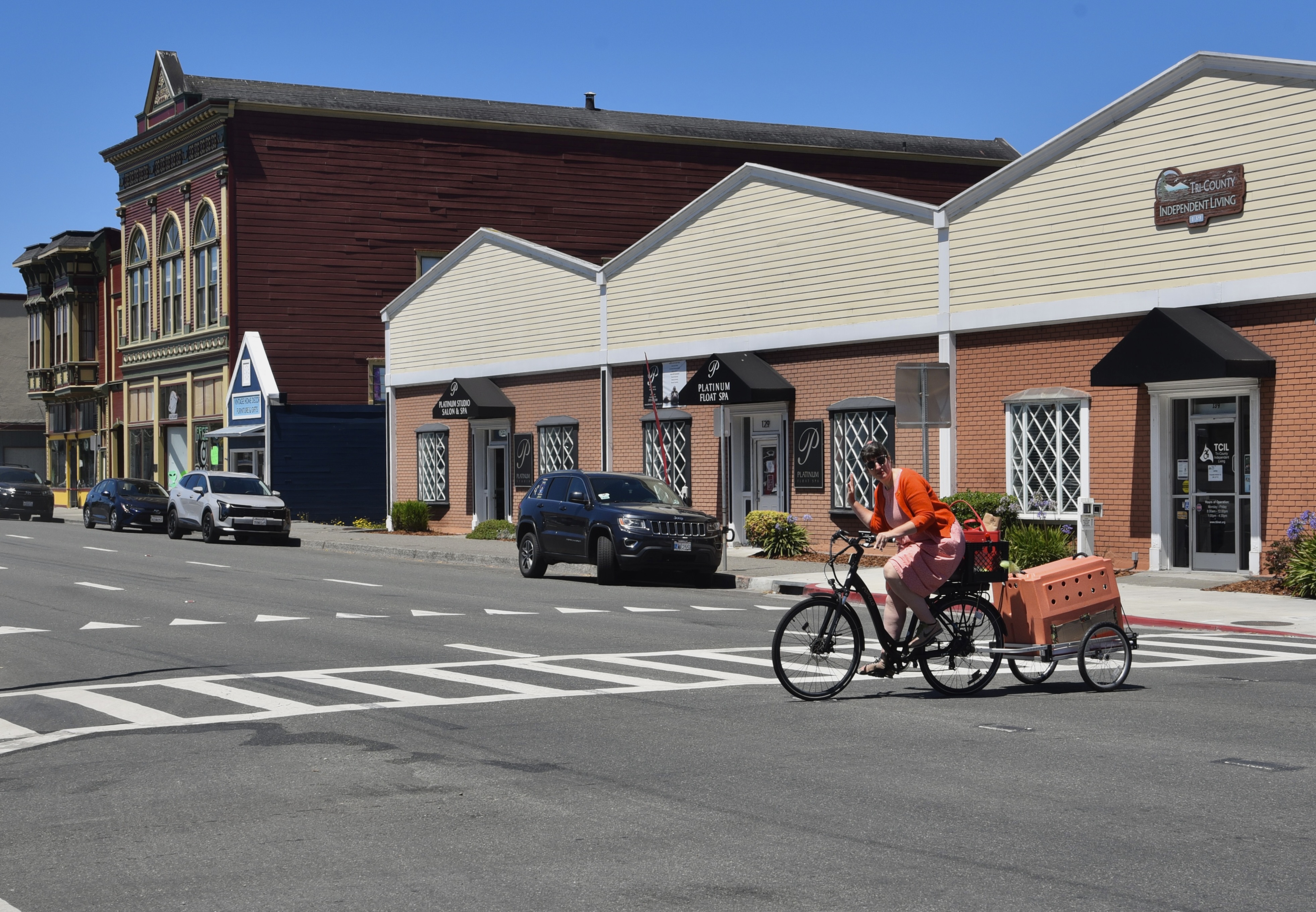
A cyclist crosses Highway 101 at C Street.
Implementing a ‘Vision Zero’ Strategy in Humboldt
While the prospect of “zero collisions” may seem like a pipe dream, the Vision Zero Network believes it’s entirely possible.
[CORRECTION: The Vision Zero Network’s goal is not zero collisions, it is zero traffic fatalities and serious injuries, as explained in more detail below. The Outpost apologizes for the error.]
The Sonoma County-based nonprofit has helped implement advance the Vision Zero Strategy, which originated in Sweden in the 1990s, in dozens of cities across the country. The strategy strives to “eliminate all traffic fatalities and severe injuries, while increasing safe, healthy, equitable mobility for all.”
The Vision Zero strategy is a departure from the “traditional” approach to traffic safety, commonly referred to as the “Three E’s” — Enforcement, Education and Engineering. Vision Zero advocates argue that the Three E’s are too focused on the individual and perfecting driving behavior. Vision Zero, on the other hand, acknowledges that people make mistakes, and to avoid collisions resulting in serious injuries or fatalities, road systems should be designed to reduce the severity of crashes.
“This isn’t a situation where you can say, ‘oh, let’s just put more dollars into traffic enforcement, and we’ll have safer roads’ because no community is going to have a police officer at every corner,” Leah Shahum, founder and executive director of the Vision Zero Network, told the Outpost. “That’s just not feasible. … And yet, there’s an overdependence or overemphasis on traffic stops being able to solve the problem. … There’s also growing recognition around the country that the idea of overemphasizing traffic stops is not only impractical and inefficient, but it can be really harmful in terms of worsening and exacerbating racial disparities.”
To make a meaningful impact on collisions, policymakers need to employ a multi-disciplinary approach that goes beyond the transportation and public safety sectors, Shahum said.
“Transportation planners, engineers, police — they should absolutely be at the table, along with public health partners and folks who work in trauma centers and the hospitals, [because] they have the bird’s-eye view of what’s happening,” she said. “[We need] folks from all these different fields … really coming together [to discuss] what works and what doesn’t in their communities. What do we need now most? What do we need more of? What do we need less of? How do we … modernize our road safety efforts to be most effective, most cost-efficient and most equitable?”
Last month, the Humboldt County Association of Governments (HCAOG) rolled out a series of temporary traffic safety demonstration projects as part of the county’s Vision Zero Action Plan, which is currently underway. Feedback from these traffic-calming projects — located in Arcata, Eureka, Ferndale and Fortuna — will be incorporated into the county’s action plan.
The plan will take some time to develop, but once it’s adopted, it will reshape the county’s approach to traffic safety and inform permanent design decisions to reduce collisions.
“Road design is a critical element for slowing speeds and saving lives, so we work to identify and fund projects across the region in line with best practices for reducing speed and conflicts between vehicles and vulnerable road users like pedestrians and bicyclists,” HCAOG senior planner Stevie Luther told the Outpost via email. “Our consultants are designing a public education campaign that when implemented will encourage safer behavior from all road users, targeted to address specific problems like distracted driving and speeding.”
The public draft is slated for release in October, and a public meeting will follow. The final plan will be reviewed by the HCAOG board in December.
Want to share your thoughts? Take the survey here.

Traffic-calming projects like this mini roundabout at Humboldt and G streets in Eureka have been installed across the county. | Photo: HCAOG
In Closing, A Plea From a Pedestrian
Getting hit by a car is a jarring and terrifying experience. If you live through it, it will change the way you interact with other vehicles, pedestrians and cyclists for the rest of your life. I would know; I was hit by a car while crossing Highway 101 at E Street on a January night in 2023.
I had met with a friend earlier in the evening, and I was standing at the corner waiting for the green light. When the signal turned in my favor, I looked both ways and stepped off the curb into the crosswalk. I had made it maybe two steps when I was suddenly pushed to the ground, hitting my head and scraping my face on the asphalt.
Before I could comprehend what had happened, a gray-haired man with thick-rimmed glasses in a silver SUV pulled up to the curb. He rolled down his window and asked if I wanted him to pull over. My immediate response, which may come as a surprise to those of you who haven’t gone through a shocking and disorienting experience, was to say, “I’m fine!” The man didn’t think twice and continued north on the 101.
As I scraped myself up from the sidewalk, I saw the countdown signal was still going and I dashed through the intersection, rubbing my throbbing cheek. I heard someone near the Starbucks shout, “Hey, are you OK?”
“I’m fine!”
I didn’t go to the ER that night because I felt fine, which was probably influenced by the concussion. My jaw hurt a little, and so did my hip, which bore most of the impact, but it was probably no more damage than an ordinary fall would do, right? And as strange as it may sound, I was actually embarrassed about what had happened to me.
I went to the ER the next day and was told that, yes, I had a concussion and deep bruising on my hip, and that I had a hairline fracture in my orbital cavity, just below my left eye. Noting too serious, but the attending physician still admonished me for waiting a full 12 hours to go to the ER, warning that I could have had a collapsed lung or internal bleeding.
Over the days and weeks that followed, I replayed the scene over and over in my head, imagining what could have happened if I had been just two or three steps further into the crosswalk. It took a couple of weeks before I worked up the courage to walk to work again, and when I finally did, I watched the cars around me with a degree of caution and paranoia I had never experienced before. Even still, if a vehicle approaches the crosswalk too quickly, I hesitate before crossing the street.
While working on this story, I spoke with a lot of people who know a lot more about the topic of traffic safety than I do, but I kept coming back to my own experience and how it has changed my walking and driving habits. Sure, EPD can increase enforcement and the city can build a new roundabout at a problematic intersection, but above all, the onus is on each and every one of us to be responsible and help keep each other safe.
CLICK TO MANAGE