The year was 1893. A young man of twenty joined a group of friends on a fishing excursion at the Mattole River. Early one morning, he opted for a hike in order to explore the surrounding area. The young man climbed a bluff to observe the view and found himself overlooking the land that he knew would one day be his home. In 1894, when he reached the age of 21, Albert Etter made the journey to Eureka and filed claim to the parcel of land that he and his family would settle — the land now known as the Ettersburg Ranch.
The Ettersburg Ranch in southern Humboldt County provided more than simply a home for the Etter family. Thanks to the Etter brothers, the ranch became a place of enterprise and self-sufficiency, where the industries of timber, agriculture, and livestock played important roles. It was the unique site of an agricultural experimental station, where many varieties of plants were grafted, developed, raised and distributed throughout the world.

Benjamin.
The rich history of the Ettersburg homestead may be said to have begun with the story of one man. Born in Switzerland in 1822, Benjamin Etter came to the United States as a young man and first settled in Missouri. He served in the United States armed forces for the duration of the Mexican War. After the war, Etter received a homestead of forty acres from the government in the area that is now downtown Chicago. He sold the land, however, when, like so many others, he heard the cry of “GOLD!” from faraway California.
According to Leo Etter, grandson of Benjamin, the elder Etter traveled to California by sea, crossing the isthmus of Panama, not an easy journey in those days. From there he found passage on anothership heading for San Francisco.
Etter then went overland to El Dorado County, where he lived and mined gold for some years. In 1854, he traveled to St. Joseph, Missouri to visit family, and there he met and married Wilhelmina Kern, a native of Germany. The newly married couple made their way back to El Dorado County, where they settled in Placerville to raise their family and to continue Etter’s mining operations.
There, Benjamin Etter mined for gold from approximately 1849 to 1870. During this time, Wilhelmina bore seven of their thirteen children (ten of whom survived). The couple’s only daughter, Louise, was born in 1858. The remaining boys were Emil, born in 1861; Jules, in 1863; George, in 1866; William, in 1867; Fred, in 1869; Albert, in 1872; August, in 1875; Francis and Louis, twins, in 1879 and the youngest, Walter, in 1882.

Wilhelmina.
After twenty-one years of mining, Benjamin Etter decided to move his family farther west, to the newly-developing region surrounding Humboldt Bay. Perhaps he had tired of a miner’s life, or perhaps he had, by then, accumulated enough gold to begin a new business enterprise of his own. No doubt the Etters had heard talk of the rich pasture lands and enormous stands of timber alongside an idyllic bay to the west. Whatever the reason might have been, the year of 1870 saw the family settle on some acreage at Coffee Creek, near Ferndale.
During their years in Ferndale, the rest of the Etter children were born and • raised. Benjamin Etter devoted himself to a prospering dairy business, at which all of the children were obliged to work until they reached the age of 21. After that, they were free to strike out on their own.
Wilhelmina Etter and her husband were said to have possessed a great love for plants, for gardening, and for experimentation in growing things. It was their mother, however, who was most influential in instructing her children in gardening techniques. Although all of her children enjoyed the benefit of such instruction, one in particular developed a fascination for the horticultural arts.
For him, it became a lifelong study. Albert Etter has often been referred to as Humboldt’s counterpart to the famed horticulturalist, Luther Burbank. Indeed, Etter and Burbank were not only friends, but fellow scientists as well, exploring similar avenues of plant breeding and hybridizing. Albert Etter eventually pursued the course of his childhood fascination in his extensive experimental work at the Ettersburg Ranch.
Albert was the first of his family to settle the property, a beautiful little valley surrounded by rolling hills. This land was later to be known as Ettersburg. The area was named for the Etter brothers, pioneer sons of Benjamin Etter, who came to the place to homestead, to raise families, and to work the land. Albert was soon joined at the property by his brother August, and shortly thereafter by his brothers Fred and George. The four formed a partnership called the Etter Brothers and thus began the work of developing various business enterprises connected with their land. George Etter purchased a ranch of his own on bordering property (now owned by Lee French). The three remaining brothers then combined their holdings into one large ranch. August and Albert built the first ranch house, a small cabin, in 1905.
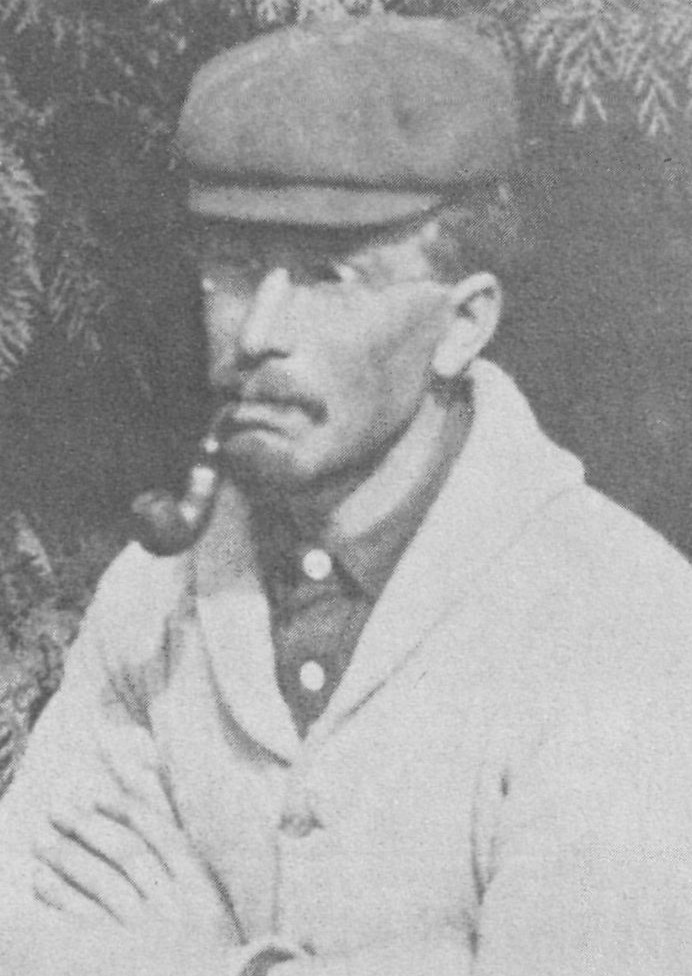
Albert.
Albert erected a small platform in the branches of a madrone which he dubbed his “sleeping tree,” and there might have spent many hours planning the future projects that he and his brothers would undertake. The brothers each excelled in a variety of skills, and their combined efforts would help to further their goals of self-sufficiency for themselves and for their families. Soon after homesteading a section of the ranch known as “Grasshopper Ridge,” Fred Etter purchased a sawmill and moved to the Petrolia area in the year 1900, where he operated the mill for the next twelve years.
Leo Etter’s wife, June, recalled a visit by the elder Etter to her family’s ranch in nearby Honeydew immediately following the great earthquake in 1906. Neighbors were few and far between, and a democratic spirit prevailed during times of crisis. The North Coast was not immune to damage by the earthquake, and June recalled that a large rockslide occurred nearby.
Etter’s visit was an expression of concern for the safety of his friends. Leo’s father, Fred Etter, and June’s father, Elihu Lindley, were great friends throughout their lives.
Fred Etter brought his sawmill from Petrolia to the Ettersburg Ranch in 1912. The brothers used the steam-powered mill to develop an extensive lumber business at the ranch. Fred had charge of the woods and mill operations. Timber on the property provided the necessary lumber for many county bridges, for neighboring homesteads, and for all of the buildings that would eventually be constructed at the ranch itself.
In the years that followed, Fred employed between eight and ten millworkers for the ranch’s logging operations. All the hired hands lived at the ranch along with other members of the Etter family. In 1911, Fred Etter traveled to St. Louis, Missouri, to attend the World’s Fair and visit relatives there. It might have been at this fair that he met his future wife, Margaret, and the two were married later that year. Margaret joined her new husband at the ranch, and the following year bore their first son, Leo Etter.

Fred and Margaret Etter with their children. Leo is standing at left, Cyril, center and Bernard, seated.
Fred Etter was noted for his skills as a carpenter, and took charge of most of the construction on the ranch. The first of several barns was constructed in 1910. The main ranch house was built in 1914. The two-story structure contained many rooms for family and ranchhands. Decks surrounded the entire house both upstairs and downstairs. The huge downstairs kitchen provided meals for ranch-hands and family. A large pantry and root cellar stocked whatever goods were necessary to feed the many mouths. The house was built entirely of lumber milled on the property.
With the ranch house completed, construction then commenced on the barns, shops, and various other out-buildings. One of these included an apple-evaporating plant, built in 1918. The apple business proved an integral part of ranch life. Close to forty acres were planted with many varieties of apples, most of which were developed through Albert’s experimental work.
The entire family would help with the yearly apple harvest. Leo Etter recalled his uncles, their wives and children, arriving at the ranch for apple harvest. They came from all over the surrounding area: Jules Etter, who lived across the nearby Mattole River; Louis Etter, who resided on property bordering the ranch that is now owned by Lee French; Walter Etter, who homesteaded land on nearby Wilder Ridge; Frank Etter, who lived across Bear Creek in Honeydew; and Emil Etter, also a resident of Honeydew. With the large family working together, many fresh and dried apples were shipped to Eureka through the G.M. Connick and Company, and to the surrounding communities as well. Harvest work at the ranch was not limited to apples, however, and the family worked together during harvests of chestnuts, strawberries and other produce.
A cheese factory was constructed on nearby property and Ed Mixer, a cheesemaker from Switzerland, was hired to oversee the cheesemaking. There were 75 goats on the Ettersburg Ranch at the time, and goats were popular stock for many of the neighboring homesteads. Families from the surrounding areas brought goats’ milk to the factory on a regular basis to be made into cheese. One of Leo Etter’s earliest recollections is that of milking the goats, and then delivering the milk to the nearby factory.
Other livestock on the ranch included sheep, cattle and horses. August Etter had charge of the stock, and much of the farm work and transportation of goods.
Transportation in the early days of Humboldt homesteading was no simple matter. The Mattole Road, once merely a walking trail, underwent expansion and improvement during the early 1870s. This road was an important connection between the southern and northern parts of the county. Although a daily stage began operation between Petrolia and Eureka in 1871, the road south of Petrolia toward Ettersburg was not as frequently used, and therefore not as well maintained. The journey from the Ettersburg Ranch to Eureka was made approximately twice a year in what Leo referred to as the “express grocery wagon.” This wagon was pulled by four horses, and the trip required five days in each direction. These biannual wagon runs were essential to ranch life. Many tools were repaired and replaced, and supplies were purchased.
The eldest Etter, Benjamin, never learned to drive an auto. His grandson, however, recalled some of the early ranch vehicles, the first being his father’s purchase of a 1912 “locomobile” in 1920, which was remodeled to serve as a truck for ranch work. Leo taught himself to drive in that truck at age fourteen. The family purchased a Model “T” in the early 20s, a Model “A” in 1929, and a Chevrolet coupe in 1937.
Some years later, another mode of transportation became a familiar part of the Ettersburg Ranch — that of the airplane. Leo Etter’s love of flying began with an airplane ride he took with his father in 1927. After that ride, he hoped to one day pilot a plane of his own.
Etter recalled his early flight training at Long Beach Airport and his first solo flight at Oakland Airport in “an old open bi-plane.” He received a pilot’s license in 1938 at the Los Angeles International Airport. After serving in the army from 1942 until 1946, Etter returned to the ranch, where he built a hangar and an airstrip for his first plane, an Aeronica Champion. In 1947, he attended school at Cal Aero Tech in Glendale, where he received an aircraft mechanics and engine rating. During 1948 and 1949, Etter managed the airport at Ukiah and received his commercial license and flight instructor’s rating. From 1950 until his recent retirement, Etter managed the airport and flight operations in Garberville, where he provided flight instruction and charter service for the local area.
Much of Etter’s charter work included delivery of equipment and supplies to local logging operations during the fifties. These equipment runs often involved making low passes over a designated logging area to drop supplies. The charter service also served as an air ambulance for logging accidents, a common occurence. Leo recalled flying his uncle, August, to Eureka on frequent trips. August Etter would always marvel at this modern mode of transportation — a trip that once took five days now took only thirty minutes. And once he had flown, the elder Etter never desired any other way to travel.
Perhaps some ofthe more historically important and most noted aspects ofthe Ettersburg Ranch were its agricultural achievements under the guidance of Albert Etter. Many varieties of plants from around the world were cultivated. The produce included peaches, plums, pears, grapes, chestnuts and walnuts, as well as the many acres of apples and strawberries. Albert, together with his brothers, developed, grafted, hybridized and sold many new and experimental varieties of apples, strawberries and other plants.
In 1924, he married Katherine, a young “mail-order” bride from New Jersey. When she arrived, the brothers built a house for the couple adjoining the original first cabin, and adjacent to Albert’s experimental gardens. Katherine Etter eventually took over the job of postmistress for Ettersburg, a position she held for many years, and she resided in that same house all of her life.
In addition to his horticultural talent, Albert Etter had an aptitude for writing. In reference to his own writings about Ettersburg, Albert once commented, “…I will assume all responsibility and take all blame…” On a letterhead from the ranch was printed: “…Ettersburg Experimental Place, Ettersburg, California. Founded in 1894 by Albert Etter. Location: 40 miles from nowhere, in the mountains of Southern Humboldt. My specialty - taking up the study of Nature where the Creator left off…”
One of Etter’s major preoccupations was what he referred to as “…solving the age-old apple riddle: From where did our apples come, and how to breed apples…” Although cultivated for many centuries, Etter felt that the apple had undergone little improvement from the original species.
Over the years, Etter continued to experiment and to develop new, hardier, and climatized varieties of apples. He used the basic premise that hybrid varieties could be used successfully when crossed with pure species or other unrelated hybrids. Varieties such as the “Manx Coddling” from England, and the “Reniette Ananus” from Holland, both small hybrid crab apples, were used to successfully breed other new varieties at Ettersburg. The reason for this success appeared to be that the foreign hybrids were not closely related to any local apple varieties. For example, Etter crossed these very small crab apples with the native Humboldt wild crab apple. The new variety that was eventually produced, was said to be “…464 times as heavy as the mother species fruit…”
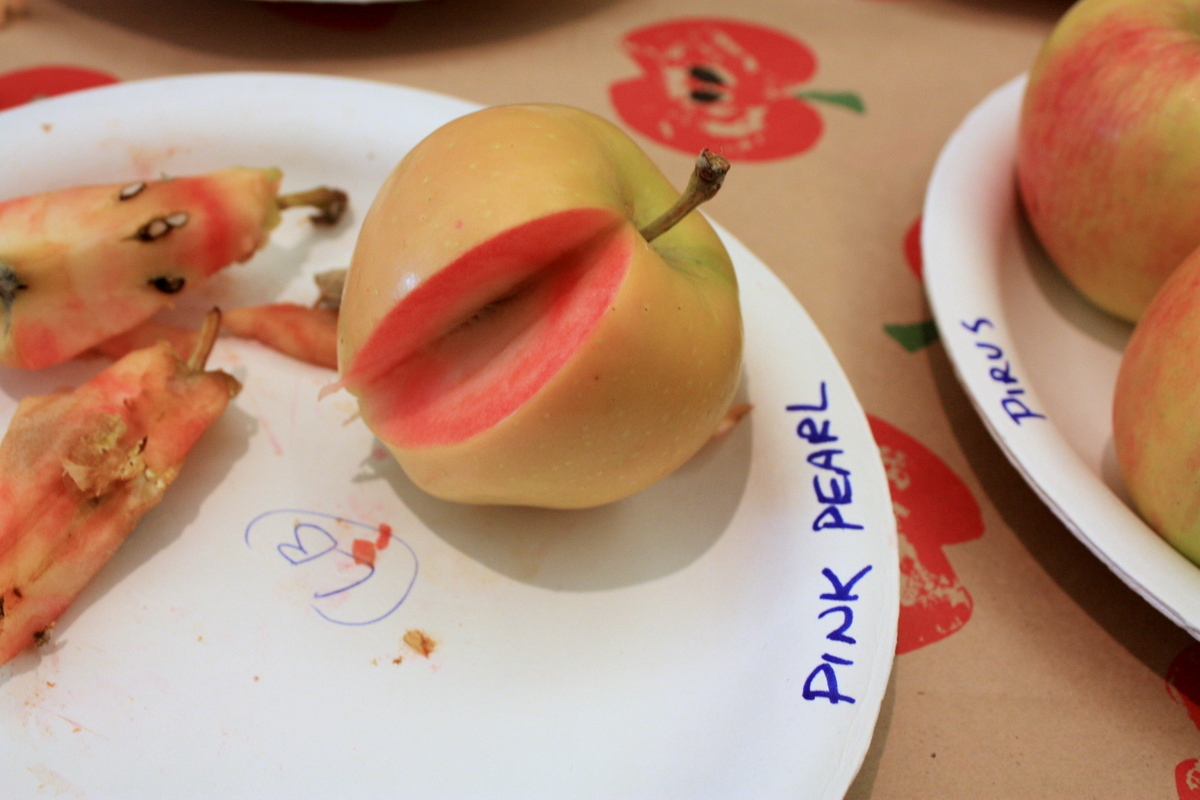
Albert’s “Pink Pearl,” an apple he invented in 1944. Photo: Leslie Seaton from Seattle, WA, USA - Pink Pearl, CC BY 2.0, Link
Etter introduced angle-worms to the soil for building bacterial content, and providing soil aeration. He also introduced Monantha Vetch, a European variety, to the local area. At first, local ranchers were skeptical, but they soon came to realize the benefits of the vetch as an excellent forage and cover crop for livestock feed and soil improvement.
The cultivation of Monantha Vetch as a cash crop was an important part of the agricultural tasks at Ettersburg. Leo Etter recalled the early thrashing operations at the ranch. The Etters owned and operated their own thrashing machine for use at the ranch as well as for many neighboring ranches. When thrashing time arrived, this work involved many friends and neighbors.
Albert and August were not the only Etter brothers to experiment with plant breeding. Their youngest brother, Walter, became quite interested in apple experimentation and developed a variety he named the “Waltanna”, after himself and his wife, Anna. The Waltanna variety was sold worldwide, and was reported to have been shipped as far away as Australia. Over the years, Albert Etter, and his brother, August, continued their extensive work in crossing and developing many varieties of deciduous fruits. The basic principle of crossing wild species with previously cultivated varieties proved to be successful for much of their experimentation.
As the horticultural experimentation continued, people from around the world grew interested. Fruit growers, plant breeders, agricultural scientists, and those simply interested in the experimental work, wrote letters of inquiry and made frequent visits to the Ettersburg Ranch.
At one time, trees and shrubs from all parts of the world surrounded the ranch house, with many varieties of flowers growing at their bases. Even today, nearly a century later, thousands of daffodils surround the house each spring. A tropical palm and a monkey-puzzle tree grow outside the house, as well. And there is an incredible flowering wisteria plant intertwined and growing up the tree some seventy-five feet above.
The early days of Ettersburg saw the arrival of many new families to the area. The education of local children, both informally at home, and more formally, at a school, was an important concern for these pioneer families. According to Leo Etter, the first Ettersburg School was located near the largest madrone tree for miles around, referred to by local homesteaders as the “Indian Council Tree.” The great tree was alleged to have been the site of council meetings for the regional Indian tribes. Perhaps it was under the branches of this tree that local Indians educated their own children.
The area nearby the tree was chosen as the site for the first Ettersburg School. By 1918, there were approximately twenty children living in the Ettersburg area, and a larger school building was deemed necessary. Fred Etter built the Ettersburg schoolhouse that year on property at the ranch. Fred and Margaret Etter had had two more sons by that time: Cyril, born in 1914 and Bernard, born in 1917. Leo was six years old when his father built the schoolhouse, and he began to attend the school that same year.
The three brothers lived many years at the family ranch. Leo mentioned that logging operations at the upper ranch during the 1950s were managed by his two younger brothers. Cyril Etter resided at the ranch for many years with his wife, Vale, and their son, Mike. Mike Etter continues a family tradition today, residing in a home he built on a section of the lower ranch, with his wife, Betty, and their three children.
The Etter women played a major role in the ranch history. Besides the continual responsibilities of child-rearing and home maintenance, the women cooked for the ranch hands, as well as their own families. Leo recalled that his mother, Margaret, was often joined by his aunts Louise, Katherine and Josephine, in order to have help with the constant chores of cooking, canning, gardening and keeping house for so many. Margaret Etter maintained records of all household and ranch business for some years.
Today, Leo Etter and his wife, June, reside at the family ranch house. Portraits of the first Etters, Benjamin and Wilhelmina, hang in the living room. Besides maintaining the ranch and remodeling the house, Leo gardens, runs sheep, and annually harvests the chestnut trees that his father helped to plant. June Etter has commented, “…it’s not everyone that has the opportunity to come home again…”
###
The piece above was printed in the September-October 1985 issue of the Humboldt Historian, a journal of the Humboldt County Historical Society. It is reprinted here with permission. The Humboldt County Historical Society is a nonprofit organization devoted to archiving, preserving and sharing Humboldt County’s rich history. You can become a member and receive a year’s worth of new issues of The Humboldt Historian at this link.
CLICK TO MANAGE