
Arcata. Photo courtesy of Cal Poly Humboldt
The Arcata City Council decided last night to attempt to gradually increase the water rates over the next five years instead of attempting to fill up their water fund immediately.
The council had to decide if they were going to continue the process, which is governed by Proposition 218. Part of that entailed deciding which of the two consultant-recommended strategies they were going to implement: increase the rates by 44% the first year, not at all the second year, and then small, annual increases of 8-10% for the next three years, ending at $13.50 per hundred cubic feet (HCF) of water used monthly; or, increase the rate by 23% the first year, 18% the second year, and then 10-12% bumps the last three years, ending at $14.12 per HCF.
Although most of the focus was on the water rates, the adjustment also includes altering how much the city charges for wastewater, which accounts for about ⅔ of the average customer’s bill. Arcata is planning on switching to a flat fee for single- and multi-family homes, which will be cheaper for many customers, blunting the impact of the water rate increase for many.
Right now the average single-family household in Arcata pays $136.93 monthly for their water and wastewater usage. In 2030, they’ll pay an average of $145.81 if the rate increase goes into effect. The proposed rates are comparable with the area average.

Screenshot from Bartle Wells Associates water rate study.
City staff had previously recommended the more aggressive option, which would allow them to make more revenue immediately, but affordability concerns led them to instead recommend the more gradual choice. (Although the aggressive option costs more upfront, by 2030 it’s slightly cheaper.) The monthly difference between the two, for the average single-family home in Arcata, is $10.13.
“It’s more palatable and easier to do,” said Finance Director Tabatha Miller. “Clearly the city is better off with the upfront revenue boost of the larger water increase, but we need to be cognizant of what works for our customers.”
All of the council agreed with the city’s recommendation to increase the rates gradually, except for councilmember Stacy Atkins-Salazar, who voted “no” on the resolution.
“We keep saying it’s okay if the city doesn’t make as much money, but let’s also be clear that the ratepayers are paying more unless we come up with something else,” Atkins-Salazar said. “I just want to be clear about that… I just want to be transparent about what we’re choosing.”
The fiscal tradeoff for the city is huge. By 2030, the gradual increases will raise $1.6 million less for the water fund to pay for the infrastructure upgrades Arcata needs than the more aggressive option would. The city will also need to issue some $30 million in bonds to finance all $36 million of repairs, but more money in the water fund would allow Arcata to pay the loans off faster and with less interest.
Miller said there was also a chance they might earn some grant funding that could pay for much of the infrastructure replacements, and the council could perhaps revisit the rate increases in a few years.
There’s still a few months before the rates go up, and if more than half of the 6,600 affected customers send in a physical, hard-copy complaint or do it in-person, they can’t raise the rates. All of the councilmembers said they wanted to hear what Arcata’s citizens thought about the rate increases, and encouraged them to come to the public hearing that will be held April 15 at city hall. There will also be an informational meeting on Feb. 25 at 5:30 in the D Street Neighborhood Center.
“I unequivocally want scenario two,” Mayor Kimberley White said. “I understand about pulling off the band-aid, pay now, pay later. However, we have people on fixed incomes and that difference could make the difference of whether they can eat that month or not. And I don’t want that water bill to be the defining factor of families — low-income, older adult, fixed-income people — not being able to eat.”
Arcata Police Department and Fire Update
The Arcata Fire District’s chief Chris Emmons and APD’s chief Chris Ortega both shared some statistics with the council that detailed their department’s efficacy last year. It’s a lot of information to condense into words, so here are two GIFs made from their presentations. You may need to click on them work.
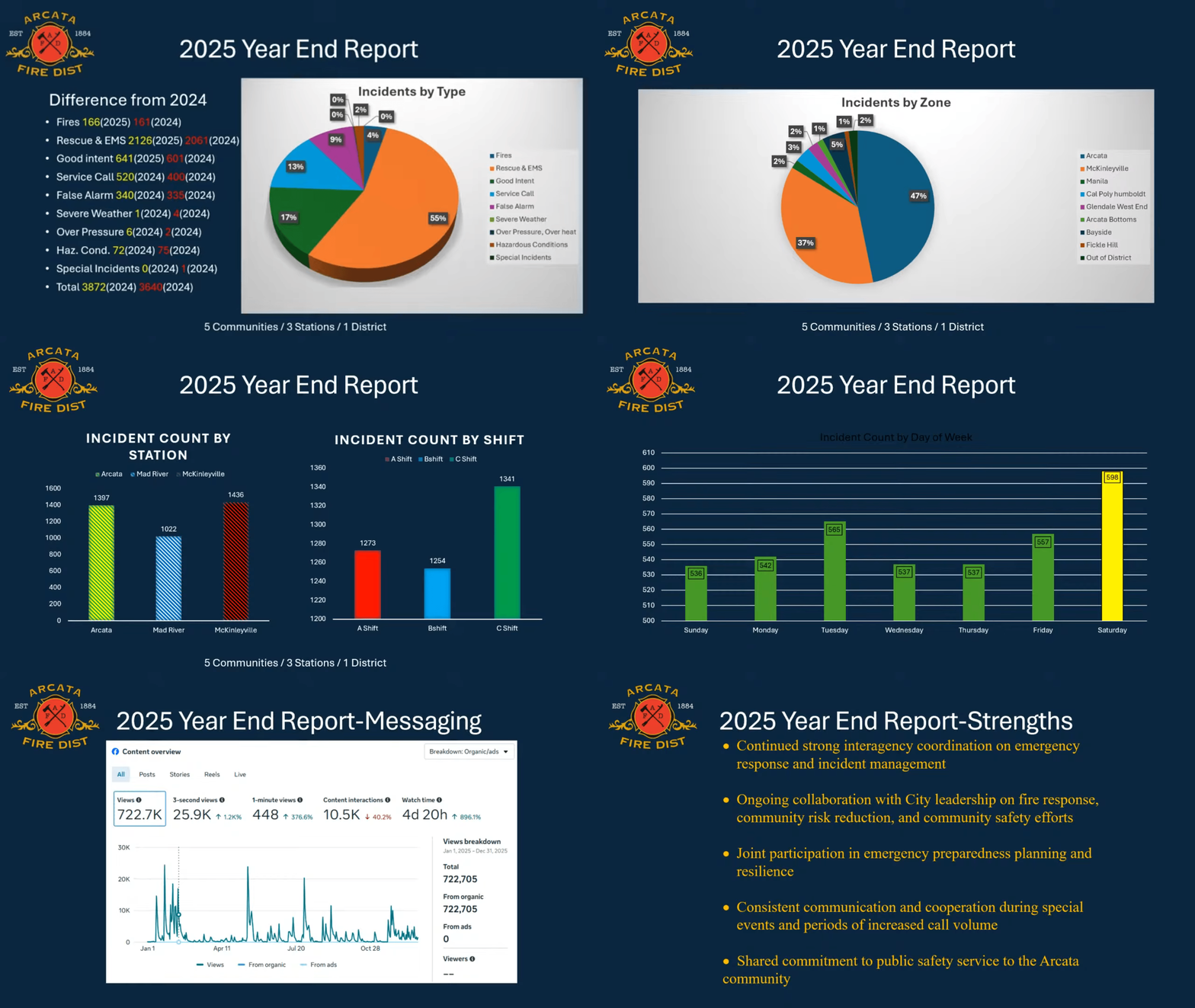

The council thanked them for their service.
CLICK TO MANAGE