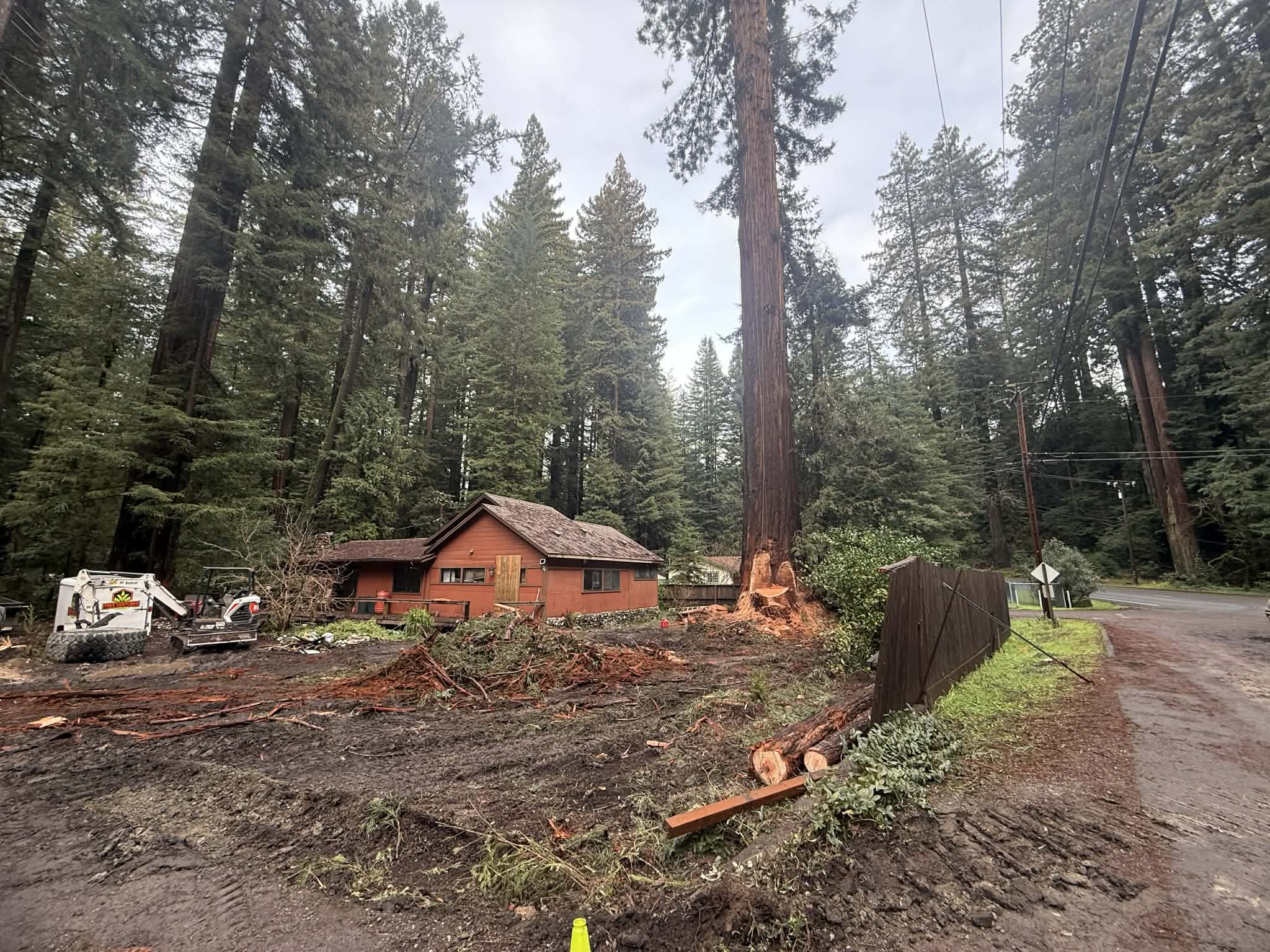
Five “hazardous” old-growth redwood trees were removed from a Lower Redway property earlier this month. | Photo submitted by the Environmental Protection Information Center.
###
AFTERNOON UPDATE: CalFire has launched an investigation into the tree removal in response to concerns raised by the Environmental Protection Information Center (EPIC).
###
The cutting of several “hazardous” old-growth redwoods in a Lower Redway neighborhood has sparked outrage among residents and environmental advocates, raising questions about whether decades-old policies designed to protect old-growth trees are being properly applied.
Several residents spoke out about the controversial tree removal at this week’s Humboldt Board of Supervisors meeting, with several speakers expressing concern that the case sets a dangerous precedent for old-growth trees throughout Lower Redway.
While many people were shocked to see the redwoods cut down, the action complies with state law.
As originally reported by the Redheaded Blackbelt, last year, property owner Robert Scarlett secured a hazard tree exemption from CalFire to remove “approximately five” old-growth redwoods, estimated to be between 200 and 300 years old, from a residential parcel on the corner of Oakridge Drive and Briceland Road in Lower Redway. Scarlett, who is also employed by CalFire, said that he had purchased the single-story house — located on a 0.43-acre parcel directly across the street from his own home — for his mother to live in, but feared that the redwoods surrounding the property posed an immediate safety risk.
He told the news outlet that the trees he considered hazardous were “so close to the structure that we keep getting branches through the roof.” Removing the trees would ensure “nobody gets hurt” and eliminate potential threats “to the structure or any life,” he said.
Reached for comment, Scarlett told the Outpost in no uncertain terms that he did not want to participate in this story.
‘A False Sense of Security’
The removal of the trees has reignited long-held concerns among some residents who thought the days of logging old-growth redwoods were a thing of the past.
“I think some environmentalists were lulled into a false sense of security that, because there are so few [old-growth] trees left and that there’s protections in place, they’re good, and that doesn’t appear to be true,” said Andrew Morris, owner of Briceland Vineyards. “It’s possible that maybe one of those trees was genuinely unsafe, and maybe there was a legitimate case for taking one tree down. … If that’s the case, then several foresters should look at it from the point of view of ‘How can we preserve these trees and the safety of the house?’ Not, ‘Can I construct a narrative to take these trees down that is legal?’”
Several people interviewed for this story expressed similar concerns, many of whom voiced doubt that tree removal was necessary.
Tom Wheeler, executive director of EPIC, acknowledged that falling tree limbs — especially those of gigantic old-growth redwoods — can present safety hazards to structures around them, but felt additional steps could have been taken to prevent the trees from being removed entirely.
“Old-growth can’t just be wantonly removed under the guise of some sort of hazard tree protection,” Wheeler told the Outpost. “Could we limb dangerous branches instead? Is there an alternative? Are all of the trees hazards? … When we’re talking about old-growth redwood, I think that we, collectively as a society, want to be more cautious about removal like these.”
EPIC launched a mass emails campaign urging county officials to take immediate “enforcement action and issue a stop work order to allow for a more considered approach to dealing with any potential hazard” presented by the trees. The letter warns that if logging is allowed to occur, “nearly all of the trees in the community could be declared ‘hazards’ and removed.”
As of this writing, 594 people have sent such an email.

The Lower Redway property captured via Google Street View in June 2025.
Was Tree Removal Justified?
As the Department of Forestry and Fire Protection, CalFire has permitting and enforcement jurisdiction over timber operations on timberland pursuant to the Forest Practice Act of 1973. The County of Humboldt also has a hand in the permitting process, but it’s taken a step back in recent years due to a provision in the Forest Practices Act that precludes the county from requiring permits that would supersede an exemption from the law. (We’ll dive deeper into that process below.)
A Service Record Report obtained by the Outpost includes site notes from CalFire Supervising Forester Lucas Titus, who inspected the Lower Redway property on Oct. 21. In his report, Titus says he visited the property “several times in the past year under the previous owners, who harvested several trees around the property and wanted to harvest several more after their house was damaged” by broken limbs.
“During the inspection approximately five trees/clumps were identified all within 30 feet of structures as having the defect and site conditions indicative of tree failure,” Titus wrote, citing a section of the Powerline Fire Prevention Field Guide relating to hazard tree removal. “These identified trees have already damaged the roof and deck of the main habitable structure and caused damage to the adjacent shed and adjacent property and continue to pose a safety threat.”
But how do foresters determine whether or not a tree poses an immediate threat?
It depends on a few factors, including the size and condition of the tree, as well as its proximity to nearby structures and utilities. A tree can be rendered “defective” due to root rot, deformities, cracks, splits, crown dieback or “any other reason that could result in the tree or a main lateral of the tree falling,” according to Titus’ report.
Yet another factor is the zoning of the site. Because the Lower Redway property is situated within a county-designated “Q Zone,” trees exceeding 12 inches in diameter can only be cut “in an emergency situation” when trees are “threatening people or property.” Under such circumstances, the county requires a special permit.
In his report, Titus notes that he contacted the county about the special permit, and was told by Code Compliance Officer Warren Black that he “didn’t think the County was requiring a permit within the Redway Zone to harvest select safety hazard trees but was going to investigate zoning further.” Still, Titus noted at the end of his report that the property owner might want to get some form of written verification or documentation from the county, just in case.
“Based on the safety issues surrounding the proposed trees this RPF [registered professional forester] agrees that the selected trees pose a safety hazard to the habitual structures and may be harvested,” the report concluded.
Reached for additional comment, Planning and Building Director John Ford confirmed that the county “signed off on [CalFire’s] permit for Hazard Tree Removal” at the Lower Redway site, but did not issue its own permit. Why?
Ford explained via email that the county used to require a special permit in addition to the permit required by CalFire. That changed in 2022 after the county tried to take enforcement action against a local property owner who cut down a small grove of redwoods without a special permit.
“We [were] working towards enforcement of this action when the county was called into a meeting with area foresters and CalFire, and it was presented to the county that the Forest Practices Act precludes the County from requiring permits that would supersede a Timber Harvest Plan or exemption from the Forest Practices Act,” Ford said. “Since that time the county has stayed away from tree removal done under the authority of the Forest Practices Act.”
However, in response to the onslaught of letters opposing tree removal in Lower Redway, Ford revisited the California Code of Regulations and discovered a provision that requires timber operations to “conform to the applicable … city or county zoning ordinances within which the notice of exemption is located.” In simpler terms, because the tree removal occurred within the Lower Redway “Q Zone,” it should have been subject to a higher level of scrutiny.
“There seems to be an inconsistency between the premise that the county has been operating under and the California Code of Regulations and possibly how the Forest Practices Act was interpreted to the county,” Ford explained. “As of now, the Planning and Building Department staff has been instructed to require permits for all activities where a permit would normally be required, associated with tree removal.”
“I know this does not help in the Redway case,” he added.

Another view of the Lower Redway site. | Photo: Mary Giardino
‘The Worst-Case Scenario is Bad’
While Wheeler was relieved to hear that the county is reevaluating its approach to hazard tree exemptions, he lamented the fact that several old-growth trees were lost in the process.
“If we don’t change the way that we deal with these sorts of things … all the old growth of Lower Redway could come out under pretty flimsy justification,” he said. “The worst-case scenario is bad, but I don’t think the worst-case scenario is likely. … I want folks to know that, yes, something was messed up, but people responded, and now change has happened. Otherwise, I think it’s a pretty despondent, sad tale.”
A Redway resident interviewed by the Outpost, who asked to remain anonymous, felt the county and state should expand oversight over hazard tree exemptions to ensure all ecological and environmental factors are properly evaluated. They also questioned whether there could have been a conflict of interest in CalFire approving the exemption for another CalFire employee.
“I’m still flabbergasted … because everyone thought that certainly you cannot cut old-growth down under an exemption,” the anonymous source said. “That limited analysis [from CalFire] could not have been seen as sufficient to make such a huge alteration to the growth here. No consultation, no mention about endangered species take? There’s no marbled murrelet consultation, no identification of spotted owl habitat. I believe a CDFW [California Department of Fish & Wildlife] person should have at least been consulted.”
Reached for additional comment, Titus, the CalFire forester who inspected the site in question, emphasized that the property owner went through the appropriate channels for hazardous tree removal. He added that the county “acted appropriately” in not interfering with the “property owner removing trees that were deemed a safety hazard.
“Rarely do I see trees proposed for harvest that meet these requirements,” Titus wrote via email. “When I have received a harvest document proposing to harvest a tree with these characteristics it has been [for] safety issues. I don’t believe anyone is encouraging landowners to harvest these types of trees and it rarely happens unless it is a safety issue. … During the onsite inspection I conducted on October 21st, 2025, there were several redwood limbs stuck in the roof of the house that are the sleeping quarters for occupants of the house.”
Asked to respond to the allegation that the property owner was given special consideration from CalFire because of his employment with the agency, Titus said Scarlett contacted CalFire’s resource management office and requested a site visit “like any other landowner would.”
“The landowner than [sic] hired a Licensed Timber Operator (LTO) and submitted the harvest document to the CAL FIRE Region office in Santa Rosa which is standard practice for all timberland owners seeking approval to harvest trees,” Titus said. “To date the LTO that was hired and signed onto the harvest document has operated in a professional manner and has not violated any Forest Practice Rules to date on this harvest document.”
“I think it’s extremely important that readers understand that the State of California is not going to prohibit a timberland owner from removing a tree that is a danger to life and property,” he continued. “As a licensed professional with over 25 years of experience working in the forest I can’t with good faith not allow someone to harvest a tree that is a danger to them.”
Reigniting a Culture War
Despite CalFire’s assurances, some residents are still concerned about the precedent set by the lower Redway case. Morris, the Briceland winemaker you heard from earlier in this story, said he’s heard rumors that some locals are now seeking hazard tree exemptions to have old-growth redwoods removed from their properties. For now, that’s just hearsay.
On a more philosophical note, Morris worried that the outrage surrounding the recent tree removal would rekindle a decades-old culture war.
“Another concern is that this is a rekindling of the hippies versus the rednecks war,” he said. “We have enough division in the country, in the state, in the county and our local community that we don’t need an active war.”
CLICK TO MANAGE