
The Humboldt County Board of Supervisors! From left to right: CAO Elishia Hayes, Michelle Bushnell, Natalie Arroyo, Mike Wilson, Steve Madrone and Rex Bohn. | Photo: Ryan Burns
###
After months of negotiations between the Humboldt County Superior Court and county administrators over rising security screening costs, the Humboldt County Board of Supervisors unanimously voted Tuesday to end the county’s agreement with the court and pull its share of funding for weapons screening services at public entrances of the Eureka courthouse “as soon as administratively feasible.”
Over the next few months, staff with the County Administrative Office (CAO) and Humboldt County Sheriff’s Office (HCSO) will work with the court to develop new protocols for trial court security on the second floor of the courthouse, which is required by state law. The updated security procedure will be presented to the board before the end of the fiscal year, which ends June 30, 2026.
Since 2012, the county and the court have shared the cost of hiring private security (currently provided by American Guard Services) to screen people entering the courthouse from Fourth and Fifth streets, with the court paying 83 percent of the bill (about $17,790 per month) and the county covering the rest.
The arrangement seemed to work well for all parties until July 2025, when the court informed the county that it could no longer afford to pay for security screening services due to increased hourly wages for staff, which jumped from $23.64 per hour to $28.43 per hour on Jan. 1.
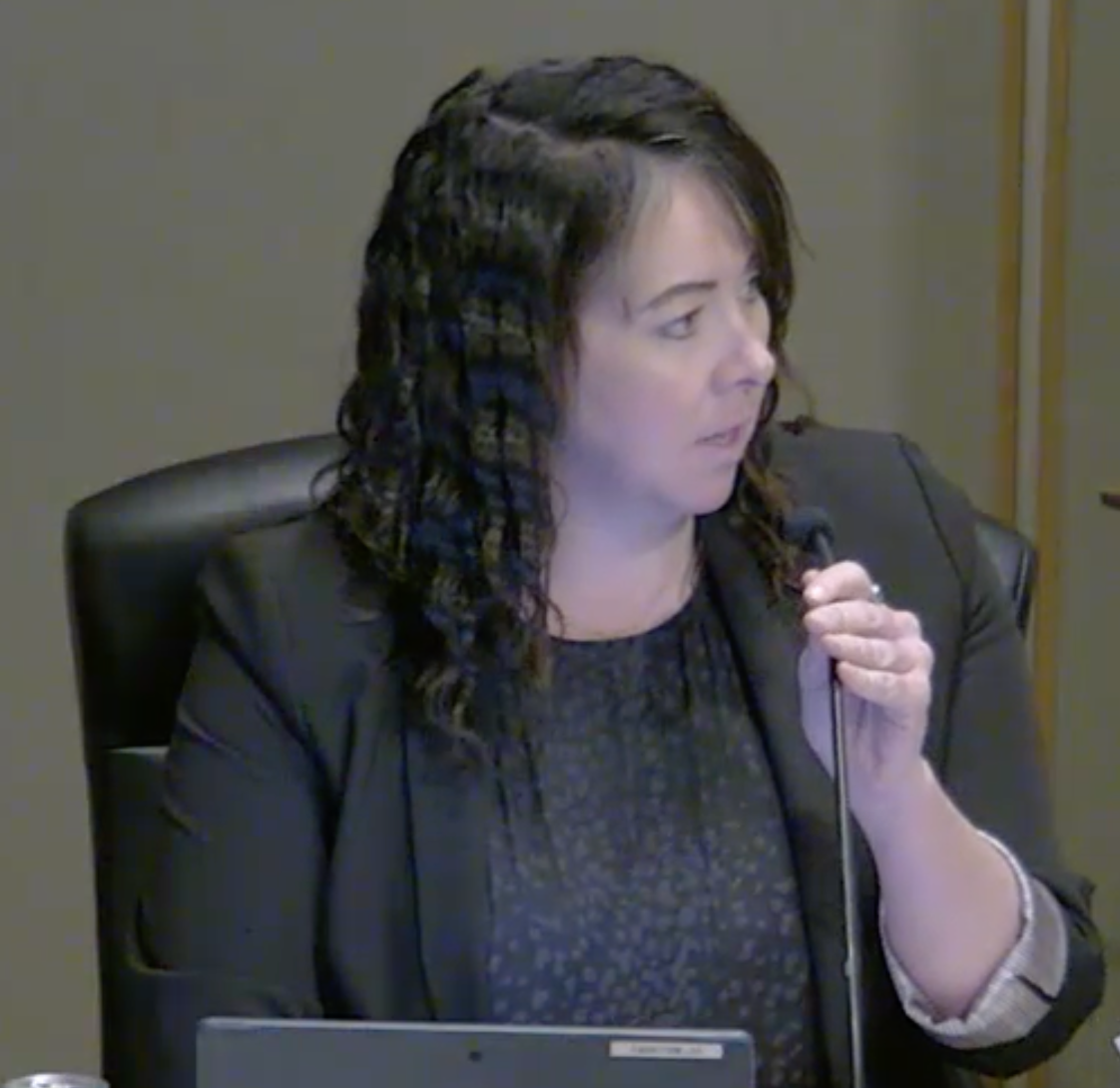
Hayes | Screenshot
Speaking at Tuesday’s meeting, CAO Elishia Hayes said the county tried “to come to some mutually agreeable path forward” with the court. Both parties considered reducing security screening to just one entrance, but doing so wouldn’t necessarily cut the cost of services in half, Hayes said. “[We] have found ourselves at a bit of a stalemate.”
“So the sheriff and I have collectively agreed that our recommendation to your board moving forward, given the court’s intent to completely cease funding at the end of this fiscal year, is to cease all entrance security screening services once the sheriff and I can work with the courts to mitigate any operational impacts, particularly around trial court security services,” Hayes continued.
Sheriff William Honsal said he plans to work with the CAO and the court to maintain security on the second floor of the courthouse. However, Honsal said his department can’t afford to pay for weapons screening, which includes metal detectors and X-ray machines, though he did offer up a deputy to provide security at Board of Supervisors meetings.
Humboldt County Superior Court Judge Kelly Neel urged the board to seek additional funding through the state to maintain screening services, which she believed to be an “essential element of courthouse security.”

Neel | Screenshot
“I cannot imagine how anyone could take seriously the notion that it would be appropriate in this multi-use building, where we have victims of crime, we have children, we have people who are so vulnerable, access this building, not just for the courts, but for everyone,” Neel said. “And [to] say we’re just going to get rid of weapon screening, but, oh, by the way, we’ll provide a deputy for the board of supervisors meetings.”
“I can’t even fathom the amount of time it would take someone to walk through those front doors with a firearm,” she added. “The deputy in here doesn’t have time to react before the damage is done.”
Neel added that it was “misleading” to say there is no funding available. During the five-month negotiation process, she said she contacted the court’s financial advisors to find out how much money was in the security screening fund and discovered that no such fund existed.
“We have zero funds from an entrance screening fund because it does not exist,” she said. “All of that money, starting in 2012, went to the county in a trial court security fund, which encompasses entrance screening, bailiffs, [and] trial judge protection. … It’s not an unfunded mandate. What you should be asking is, how much exactly does the county have? [What] do you get from the trial court security fund? Have efforts been made to seek additional funding through those avenues?”
Honsal said he could understand Neel’s position on the matter, but said he did “not want to contribute to something that [HCSO] wasn’t being reimbursed for.” He blamed the state’s realignment policy — an initiative passed in 2011 that shifted the responsibility for low-level, non-violent felony offenders from the state to local jurisdictions — for putting the county in its current position.

Honsal | Screenshot
“The reason why we are here is because of realignment,” he said. “At that time, I think the court recognize[d] that there [was] going to be a need for screening services, and that’s why they agreed to compensate and be the lead on screening for the courthouse, because we do not get reimbursed at the current rate from the state for just our managing our bailiffs in our courthouse. We cannot, under the funds that we currently receive, take on the additional $300,000 it takes to run the security screening for the courthouse.”
During the board’s discussion, First District Supervisor Rex Bohn suggested that security screening move up to the second floor of the courthouse. “Then it would be on the courts,” he said. “You would get what you wanted, because you would control it. … You would pay for it, though, because it would be all benefiting you.”
Neel disputed his claim, reiterating that the sheriff provides bailiffs to the courts.
After a bit of tense back-and-forth between the two, Hayes interrupted and reminded the board of the topic at hand: entrance screening at the courthouse.
“That is the component that is up for discussion today,” she said, adding that trial court security will remain in place, though it may look different if the county forgoes entrance screening. “Ceasing to pay the 83 percent as is, is just over $200,000 a year. … This $200,000 that we’re talking about right now, potentially being shifted over to the county, has the potential in the future to reach up towards $400,000. I just want to be clear as we talk about the financial impact around this to the county; it’s not an insignificant amount.”
After another half-hour of discussion about potential changes to courthouse security, Second District Supervisor Michelle Bushnell made a motion to end the county’s agreement with the court and direct staff to draft a new security protocol for trial courts. The motion was seconded by Bohn. The board also asked staff to contact the state and North Coast lawmakers to seek additional funding.
Before voting, Bushnell asked if Honsal planned cease entrance screening immediately.
“Yes, I am,” Honsal replied. “Unless we get fully reimbursed [or] we have some other funding source, because I do not have the funds. … We have to negotiate a new contract [with the court], and we can make that out 30 days, 40 days, 45 days … to do a transition, but I just need a timeline.”
Hayes said staff would return with a draft security procedure sometime in May, before the end of the fiscal year on June 30.
The motion passed 5-0.
Polluters Pay Climate Superfund Act
At the start of Tuesday’s meeting, the board considered a letter of support for SB 684 - Polluters Pay Climate Superfund Act of 2025. The bill, which was introduced in the California legislature in April 2025, would require fossil fuel polluters to pay their fair share of the damage caused by greenhouse gases released into the atmosphere between 1990 and 2024.
Fourth District Supervisor Natalie Arroyo requested the letter of support on behalf of a group of her constituents. Arroyo noted that North Coast assemblymembers Chris Rogers and Damon Connolly are both supporters of the bill.

Arroyo | Screenshot
“I did just learn that [SB 684] is also not moving forward in its current form,” Arroyo explained to fellow board members. “It’s sort of that time of year when bills get reconstituted and brought forward again in a slightly modified form, so the request is still to consider passing this [letter] because the support for it will help shape the next iteration. Emphasizing the matters brought up in the bill is still of value.”
Bohn and Bushnell both felt it would be inappropriate to approve a letter of support for a bill, knowing that it could be subject to substantial change. “I’m not really wanting to vote on something that I don’t know what we’re voting on,” Bushnell said.
Arroyo acknowledged that she had only just found out that the bill would be “unlikely to move forward in its current form,” but underscored her support for its current framework. She reiterated that sending a letter of support could influence lawmakers to keep certain aspects of the bill intact.
“I think our legislative platform has spoken to the concerns around climate change in the past, and likely will for [the] 2026 legislative platform that we’ll be working on very soon,” she said. “I don’t think funding to address the impacts of climate change is a big departure from our [current] legislative agenda. Perhaps the language of this is just written a way that is different, but I think we can incorporate it there.”
Arroyo made a motion to approve the letter of support, which was seconded by Third District Supervisor and Board Chair Mike Wilson, who expressed his support for the bill on the principle of holding fossil fuel companies accountable for pollution.
“Taxpayers currently bear the cost of climate adaptation and disaster response, and so this type of legislation is seeking to shift the financial responsibility to the companies that created the problem, rather than working families,” Wilson said. “Revenue from this type of legislation strengthens flood defenses and extreme weather preparation without raising taxes, and creates thousands of jobs [and] infrastructure investments.”
Fifth District Supervisor Steve Madrone said he understood the intent of the bill, but expressed concern that additional costs would be passed on to taxpayers down the line.

Madrone | Screenshot
“I have no doubt that the cost of this will not be borne by these large corporations — it will be borne by the consumers,” he said. “It gets passed on; that’s how it works. I would much rather see a bill that would be focused on incentives for people to use less gas. … I guess my concern is that we figure out how to not just pass on the cost to consumers, but in fact, reward consumers for behavioral changes, where they reduce their use of gasoline and things like that.”
Eventually, the board voted 2-3, with Bohn, Bushnell and Madrone casting dissenting votes.
County Counsel Scott Miles suggested the board make a motion to accept the staff report but not send the letter. Wilson made a motion to that effect, which was seconded by Arroyo. The motion passed 5-0.
###
Other notable bits from Tuesday’s meeting:
- The board reviewed and approved proposed changes to the county’s Commercial Cannabis Land Use Ordinance to permit the use of monofilament netting and allow indoor cultivation in buildings constructed after 2016. The board also considered a request from the Humboldt County Growers Alliance to allow a hemp pilot program at existing permitted sites, but the board agreed that the county should wait to see what happens at the federal level with the Trump administration’s recent decision to reschedule cannabis.
- The board also finalized its appointments to other boards and commissions. Most notably, Madrone, who serves on the Great Redwood Trail Authority’s board of directors, will bifurcate his two-year term and vacate his seat later this year. The seat will be taken over by Bushnell.
- The board also updated the county resolution establishing standard operating hours. For the foreseeable future, county offices will remain closed to the public on Fridays to give staff time to focus on certain projects without distraction.
CLICK TO MANAGE