
A digital rendering of the Eureka Regional Transit & Housing Center, one of the city’s ongoing mixed-use affordable housing projects. | Image: City of Eureka.
###
The City of Eureka must plan for as many as 1,740 new homes over the next decade, including 967 units for low-income residents, to meet state housing mandates.
Eureka’s allocation makes up more than a third of the total number of units assigned to Humboldt County under the state’s Regional Housing Needs Allocation (RHNA) for 2027-2035, which requires the county to plan for 5,962 new housing units to accommodate population growth across all income levels.
Where could the city put all of those units, you ask? The Eureka City Council is wondering the exact same thing.

Bauer | Screenshot
“I don’t know how we got to this point where Eureka is where we put all the housing,” Councilmember Scott Bauer said at Tuesday’s city council meeting. “I don’t understand where we’re going to put 1,740 units in town — we’re pretty well built out. Is that not a consideration?”
“No, it’s not,” said Development Services Director Cristin Kenyon.
Every eight years, the California Department of Housing and Community Development (HCD) reviews the current number of units in a given jurisdiction and compares it to population estimates and other economic growth factors to determine how many new homes a community should plan for. That figure is then passed off to a regional governing body — in our case, that’s the Humboldt County Association of Governments (HCAOG) — which decides how the number units will be split among cities and unincorporated communities.
“There are two steps to this allocation process,” Kenyon explained. “[One], how big is each jurisdiction’s overall allocation? — think of this as the size of each city’s ‘housing pie’ — and then two, how is the pie split by income category?”
The methodology is complicated. Along with the two data points Kenyon mentioned, HCAOG must also consider a city’s “opportunity score,” which is based on various economic, educational and environmental factors, as well as work-based vehicle miles traveled (VMT), which is how far, on average, a community’s residents travel to and from work each day. How each of those scores is adjusted and weighted will affect a city’s RHNA.

Table via City of Eureka.
“Eureka has really low vehicle miles traveled scores, and because that is weighted at 70 percent, it becomes the dominant factor for us, and results in Eureka being assigned more [low-income] units,” Kenyon explained. “We’re worried that this methodology and practice reinforce existing concentrations of lower-income housing in Eureka.”
In simpler terms, city staff is worried that the methodology HCAOG used concentrates too many low-income housing units in Eureka, which could prevent the city from creating other types of housing.
Staff sent a letter to HCAOG outlining the city’s concerns, but Kenyon said the city council could “elevate” the issue and submit a formal appeal.
Councilmember Leslie Castellano asked if the appeal process would delay the RHNA process for other Humboldt County cities. Kenyon said it would prolong the adoption process by another 45 days, kicking final adoption from March to May 2026.
Castellano acknowledged that she is a “pro-housing person” living in a “pro-housing city,” but felt the proposed RHNA would set a “concerning precedent” for Eureka.
“All of the research around healthy communities is saying that we want a robust mix of income levels in neighborhoods, and I definitely agree with that,” she continued. “I know that some folks wanted to push this forward because the City of Eureka is sort of the most likely to actually enact these housing things … but that’s kind of furthering some of the systemic challenges that are also at play.”
Councilmember Renee Contreras-DeLoach asked Kenyon to elaborate on the purpose of the VMT figure. “Is there a baseline assumption that because they’re traveling further, they would want to live closer?” she asked.
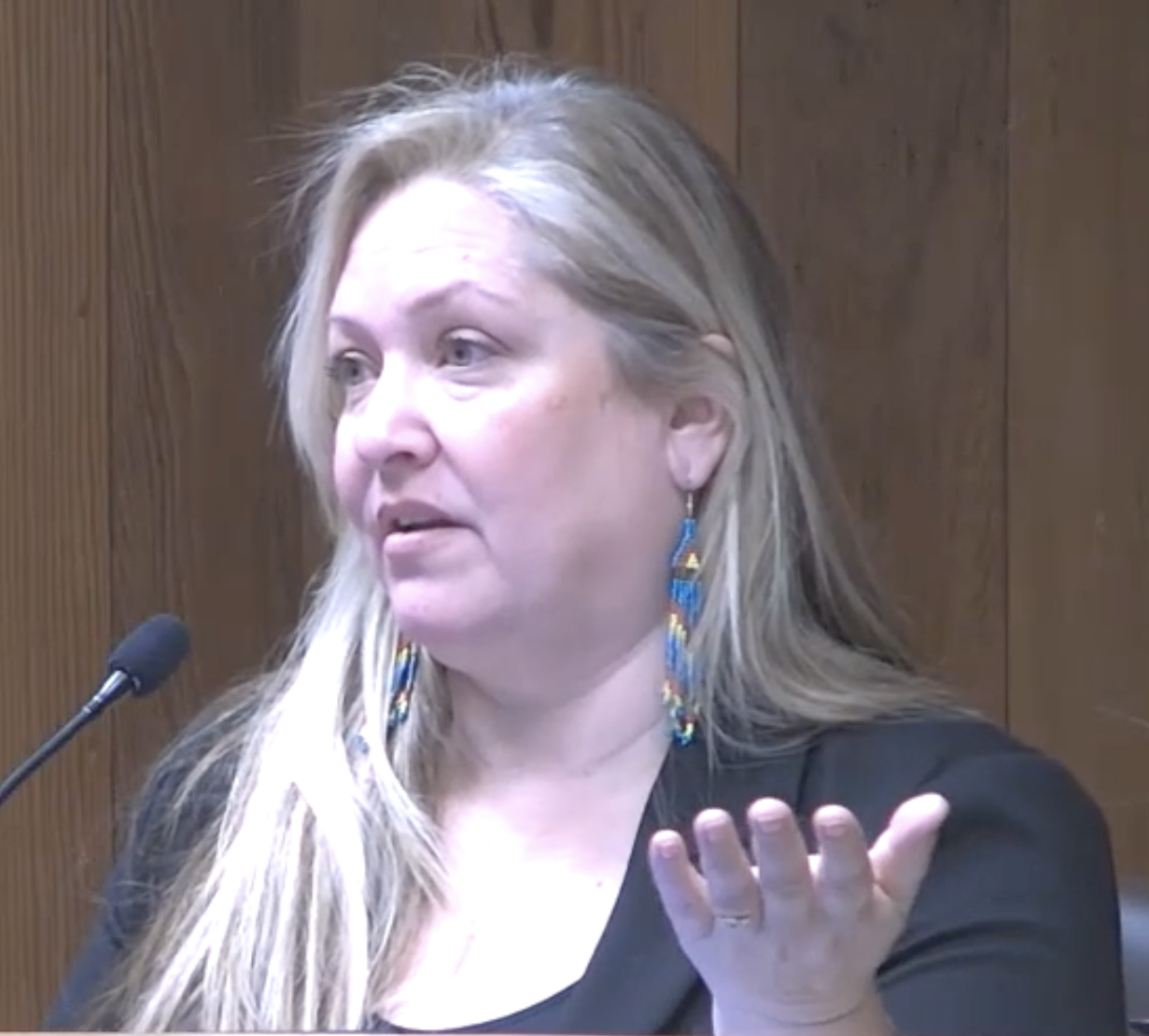
Contreras-DeLoach | Screenshot
“Correct,” Kenyon said. “Transit is included in that composite score because … living in a place where you can access your job without a car is helpful if you’re living in poverty. It’s part of having access to opportunity. I mean, if you’re going to concentrate poverty anywhere, you would want to do it in an urban area with transit, but I would rather us not concentrate poverty period.”
Contreras-DeLoach agreed, adding that “it feels weird” to “shove people into one spot,” even if it’s under the guise of improving access to opportunities.
“I just think that when you’re poor, you still have a right to live in Rio Dell or Fortuna or Trinidad — you have a right to be in other places,” she said. “I don’t think people should assume that that means that people want to live in Eureka, nor does it mean that they should have to.”
The council asked Kenyon if she felt an appeal would be appropriate. “I’m so on the fence about it,” she said. “That’s why we brought it to you.”
After some additional discussion, the council unanimously agreed that staff should submit a formal appeal to HCAOG, with Mayor Kim Bergel expressing her support as well.
CLICK TO MANAGE